

2025 opened a door that had only been half‑imagined until now: the first commercial prototypes of what proponents call an “orbital cloud” — solar‑powered compute and blockchain nodes operating in low Earth orbit (LEO) — moved from thought experiment to live deployments, and with that shift the practical questions of energy, latency, taxation, and sovereignty moved from the whiteboard to urgent boardroom agendas. The Bitget opinion piece that kicked off this conversation argues that tokenization, AI, and space‑solar power are converging to create a new energy‑compute stack, and the evidence from government programs, market reports, and corporate press releases shows investors and hyperscalers are treating that thesis seriously.
2025 saw multiple coordinated developments that together explain the sudden traction behind orbital cloud ambitions.
For enterprise IT and hyperscalers the correct posture is pragmatic curiosity: fund and engage in targeted pilots that validate the specific value propositions for space‑native workloads, insist on independent benchmarks and transparent lifecycle modeling, and plan contractual and tax terms that anticipate evolving regulation. The orbital cloud could be an architectural game changer — but only if proven against the hard economics of launch, reliability, regulatory compliance, and real delivered energy costs.
This moment is a reminder that infrastructure innovation rarely follows marketing timelines; it advances in iterative steps where demonstrators, standards, and public policy must each mature in turn. The promise of carbon‑free, continuous orbital compute is real, but turning that promise into a durable, profitable layer of the cloud fabric will require rigorous engineering, candid risk disclosure, and patient capital.
Source: Bitget Tokenization and AI: The emergence of orbital cloud infrastructure | Opinion | Bitget News
 Background / Overview
2025 saw multiple coordinated developments that together explain the sudden traction behind orbital cloud ambitions.- National policy moved on AI: the U.S. Government launched the Genesis Mission, a cross‑agency, DOE‑led program to accelerate scientific discovery through AI and integrated computing capacity. The Genesis Mission was explicitly framed as a national program to marshal the Department of Energy’s labs, supercomputers, and private‑sector partners to build an AI‑first discovery platform. The White House and DOE published the program mandate in late November 2025.
- Space and launch economics changed: decades of incremental launch‑cost reduction accelerated in the 2020s; reusable launch vehicles and higher cadence lowered the marginal cost of sending payloads to orbit to a fraction of shuttle‑era prices, which in turn made demonstrator constellations financially plausible. That decline — while still subject to technical risk and scale economics — underpins many orbital cloud business plans.
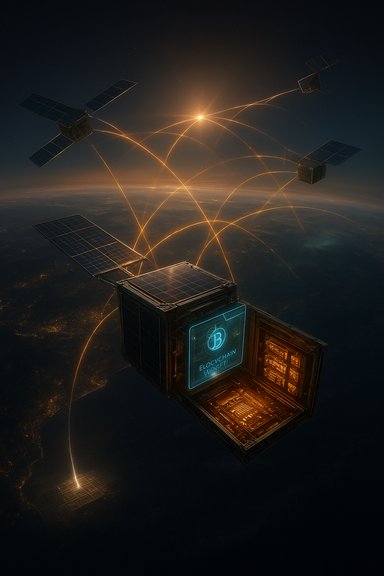
- Corporate prototype launches appeared: PowerBank Corporation and its partner Orbit AI (also referred to publicly as Smartlink AI) reported the successful December 10, 2025 deployment of the DeStarlink Genesis‑1 demonstrator, a LEO satellite carrying solar arrays, a small AI inference payload, and a blockchain wallet/node. This launch is being positioned by participants as the initial step toward a larger Orbital Cloud architecture: decentralized LEO connectivity (DeStarlink), in‑orbit compute (DeStarAI), and space solar power as the energy layer.
What “orbital cloud” means in practical terms
The architecture, in plain language
An orbital cloud is a layered system combining:- Space solar power (SBSP): large solar arrays in orbit that harvest sunlight more continuously and with higher intensity than ground PV, with energy either used directly on satellites or beamed to Earth via rectennas (microwave or laser) for terrestrial consumption.
- LEO compute modules: hardened, modular compute racks that carry GPUs/accelerators and networking, designed for radiation mitigation, passive/vacuum cooling (radiators), and modular replacement or deorbiting.
- Inter‑satellite networking: a mesh of optical crosslinks, microwave backhauls, and ground gateways that stitch orbital compute into global fabrics.
- On‑board verification: blockchain‑enabled wallets and nodes for auditing, provenance, and tokenization primitives co‑located with compute to reduce trust friction.
Why proponents believe the stack is compelling
- Continuous solar irradiance in certain orbital regimes (and the lack of atmosphere) suggests higher capacity factors per solar square meter than terrestrial PV — an appealing proposition for energy‑hungry AI workloads that otherwise compete for grid power and water for cooling. Market intelligence firms report rising valuations for SBSP projects and a fast‑growing sectoral forecast.
- Passive cooling in vacuum reduces or eliminates energy costs for chillers and water infrastructure, a major operating cost for terrestrial hyperscale data centers.
- Proximity to space data reduces downlink bandwidth needs: processing imagery, telemetry, and sensor fusion on orbit and transmitting only compressed, actionable results can materially lower satellite operators’ costs.
Verifying the numbers: markets, forecasts, and definitions
A crucial caveat for readers: “tokenization” is not a single definable market. The label spans multiple domains with vastly different base metrics:- Market research focused on asset tokenization — the conversion of real‑world assets into tradable digital tokens — reports very large notional values. For example, one industry report projects asset‑tokenization market values jumping from roughly $865.54 billion in 2024 to about $1.24 trillion in 2025, driven by institutional adoption and regulatory clarity in key jurisdictions. Those figures are not the same as software or payment tokenization market revenues; they represent the notional value or potential market cap of tokenized assets rather than software vendor revenue.
- By contrast, tokenization software and payment tokenization market reports show numbers in the single‑ to low‑double‑digit billions for 2024–2025 — a reflection of software product revenues and security services rather than the notional value of tokenized assets. That difference matters: when commentators cite trillion‑dollar tokenization totals they are usually speaking about asset value under tokenization, not the software or infrastructure revenue that tokenization vendors will immediately capture.
- Mordor Intelligence and Grand View Research both forecast multi‑billion dollar markets for SBSP by the 2030s, though exact year‑by‑year numbers differ based on scope (pilot projects vs. utility‑scale, geostationary vs. LEO solutions). Those projections have been used in business plans to justify long‑lead investments and partnership deals. Investors should treat the precise dollar figures as scenario‑sensitive forecasts, not guaranteed contracts.
The technology claims worth scrutiny
Several technical claims underpin the orbital cloud narrative. Each deserves careful verification before capital commitments scale.- Metamaterial rectennas and high RF‑to‑DC conversion efficiencies. Laboratory and prototype rectennas integrating metamaterial designs have reported high RF‑to‑DC efficiencies in controlled conditions and at specific frequencies — in some cases approaching or exceeding the high‑70s and low‑90s percentage ranges under idealized inputs. However, lab‑scale efficiency at short range and high input density is not the same as end‑to‑end, long‑distance microwave or laser power transmission at utility scale. Practical SBSP requires conversion, beamforming, atmospheric transmission resilience, ground‑receiver land allocation, and tightly regulated RF safety margins. Those are solvable engineering problems but not yet proven at continental scale. Treat >90% end‑to‑end claims with caution.
- Continuous, grid‑independent power for hyperscalers. Space solar arrays can provide continuous sunlight in certain orbits and for certain mission designs, but LEO satellites still experience eclipses and day/night cycles unless the architecture is truly GEO or permanently sunlit. GEO architectures have different launch, mass, and latency tradeoffs. The idea of “always‑on” orbital power is technically feasible in broad strokes but depends entirely on orbit selection, constellation design, and on‑orbit energy storage strategy. These constraints change cost math significantly.
- Resilient, high‑performance GPUs in orbit. Companies have demonstrators for space‑qualified electronics and radiation‑tolerant compute, but placing the latest hyperscaler‑grade GPUs (e.g., Blackwell family or equivalent) in orbit at scale remains very expensive and operationally complex. Radiation, thermal cycles, and hardware refresh cadence are real, recurring costs. Expect early adopters to use specialized, hardened accelerators rather than unmodified terrestrial GPU racks.
Policy, tax, and regulatory context
Public policy in 2025 materially shifted incentives and risk for both AI compute and clean energy investments.- The U.S. Genesis Mission and America’s AI Action Plan signal federal desire to accelerate AI infrastructure and R&D partnerships with industry. This national push reshapes public‑private collaboration incentives for on‑shore compute and associated energy supply contracts. Genesis Mission documents and DOE announcements in November 2025 confirm a federal‑level initiative to coordinate national lab computing and private cloud partners.
- Tax law changed. The One Big Beautiful Bill (H.R.1) and subsequent Treasury/IRS guidance tightened commercialization windows for commercial solar tax credits (Section 48E), introducing firm “begin construction” deadlines and accelerated placed‑in‑service windows that materially alter the economics and timeline for terrestrial renewable projects. For companies planning to pair large terrestrial data centers with new solar assets, the policy shifts create an urgency to lock in projects before the new deadlines or seek alternative incentive structures. Legal analysis and practitioner alerts describe a compressed timeline and stricter safe‑harbor tests that, if mishandled, can eliminate tax benefits entirely.
- Cross‑border tax clarity for cloud: the IRS finalized regulations classifying cloud transactions as service income (effective for taxable years beginning on or after Jan. 14, 2025). This change affects how cloud companies source income for international tax purposes and has direct bearing on withholding, foreign tax credits, and transfer pricing for any company operating multinational cloud and orbital offerings. Treat this as a live tax planning issue for any cloud provider with cross‑border revenue.
Commercial and geopolitical risks
- Operational life and repairability — orbital hardware is subject to radiation damage, micrometeoroid strikes, and wear. Modular, serviceable designs and in‑orbit servicing capabilities are likely non‑negotiable for economic viability.
- Debris, traffic management, and licensing — launching dozens or hundreds of large, compute‑dense satellites will draw regulatory scrutiny from space‑traffic‑management and spectrum authorities and will increase collision risk in crowded orbits. Operators must invest in collision avoidance, active debris removal strategies, and predictable end‑of‑life deorbiting plans.
- Sovereignty and export control — running compute and blockchain nodes beyond national territory raises thorny questions about data sovereignty, export controls (especially for advanced GPUs and cryptographic tech), and national security restrictions. Countries will likely treat orbital compute as dual‑use infrastructure.
- Energy transmission safety and land use — microwave beaming to ground rectennas, even if technically feasible, raises RF safety constraints and requires ground real‑estate footprints and community acceptance that are nontrivial to secure at scale. Early SBSP rollouts will need to solve both engineering and NIMBY problems.
- Market timing and financing — the business case for orbital compute relies on launch costs continuing to fall, rectenna efficiencies translating into delivered‑energy economics, and hyperscalers being willing to accept the latency and operational tradeoffs for the promised energy cost arbitrage. That trio of assumptions compounds project risk and makes careful scenario modeling essential.
Practical recommendations for enterprise IT and hyperscalers
- Treat orbital cloud as a complementary, not replacement, layer. The most defensible early use cases are space‑native workloads (imagery preprocessing, constellation routing), burst training windows for non‑latency‑sensitive jobs, and specialized regulatory or continuity services.
- Demand demonstrators and independent benchmarks. Require verified load‑testing and public telemetry before adjusting capacity plans or signing multi‑year purchase commitments.
- Model full lifecycle costs. Include launch, insurance, maintenance/servicing, hardware refresh cadence (for GPUs), radiator mass and thermal control, and contingency for regulatory delays.
- Account for tax and compliance changes. The new U.S. solar tax timelines and final IRS cloud rules materially affect cross‑border structuring and incentive capture — engage tax counsel early.
- Design identity, key management, and provenance systems for the orbital environment. Hardening, cryptographic isolation, and robust audit trails are baseline requirements for tokenization and on‑chain services executed from orbit.
What to watch next (short list)
- Independent mission telemetry from DeStarlink Genesis‑1 — operational telemetry, power curves, and on‑board compute performance will ground many claims. PowerBank and Orbit AI press releases confirm the launch; independent observational and tracking telemetry will be the follow‑up metric.
- DOE Genesis Mission procurements and partner agreements — the Genesis Mission’s RFPs and partnership contracts will reveal whether government demand shifts capital toward on‑shore hyperscale solutions or forms purchase commitments that dampen the need for orbital alternatives.
- SBSP prototype ground tests and rectenna field trials — lab efficiencies are promising but only ground‑ and in‑field transmissions will validate utility‑scale economics. Look for field demonstrations and independent efficiency audits.
- Launch cost trajectories and starship/full‑reuse cadence — whether launch economics continue to follow the very steep decline advertised by reusable architectures will determine how quickly orbital cloud models move from demonstrator to commodity.
Conclusion
The convergence of tokenization, AI compute demand, and space solar power is no longer purely speculative — 2025 produced real deployments, new federal AI programs, and persuasive market forecasts that together push the orbital cloud from theory toward pilotable reality. That said, the proposition remains an aggregate of multiple high‑risk, high‑reward bets: on SBSP conversion at scale, on resilient and serviceable space compute, and on continued launch‑cost deflation.For enterprise IT and hyperscalers the correct posture is pragmatic curiosity: fund and engage in targeted pilots that validate the specific value propositions for space‑native workloads, insist on independent benchmarks and transparent lifecycle modeling, and plan contractual and tax terms that anticipate evolving regulation. The orbital cloud could be an architectural game changer — but only if proven against the hard economics of launch, reliability, regulatory compliance, and real delivered energy costs.
This moment is a reminder that infrastructure innovation rarely follows marketing timelines; it advances in iterative steps where demonstrators, standards, and public policy must each mature in turn. The promise of carbon‑free, continuous orbital compute is real, but turning that promise into a durable, profitable layer of the cloud fabric will require rigorous engineering, candid risk disclosure, and patient capital.
Source: Bitget Tokenization and AI: The emergence of orbital cloud infrastructure | Opinion | Bitget News
