

Pantone’s Palette Generator is the kind of product that makes you rethink two assumptions at once: first, that expertise like color theory is inherently analogue and slow; and second, that “agentic AI” is only about clever prompts and flashy models. Built as a rapid minimum viable product, the Palette Generator demonstrates how a disciplined data architecture—centered on an AI-ready database and an orchestration platform—lets agents deliver useful, grounded, and interactive creative assistance at scale. ]
Pantone has long been the de facto authority on color for designers across fashion, product, packaging, and digital experiences. The Pantone Connect product line digitizes that authority, and the Palette Generator is the next step: a chat-first interface that lets designers ask natural-language questions—“build a five-color palette for a sustainable athleisure line aimed at Gen Z”—and receive curated palettes that map directly to Pantone color indices and surfacing of the forecasting research used to inform the choices. The announcement framed the tool as a Retrieval-Augmented Generation (RAG) system embedded in Pantone Connect and built with Microsoft technologies including Microsoft Foundry, Azure OpenAI, Azure AI Search, and Azure Cosmos DB.
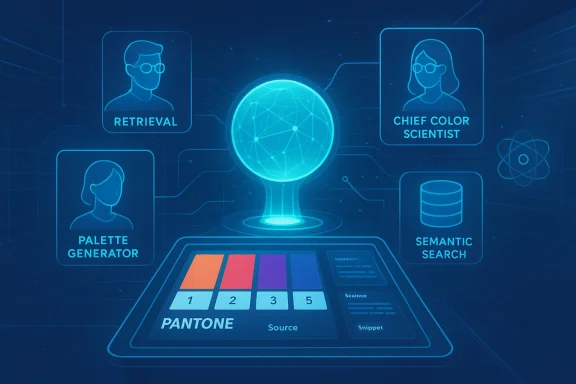
What Pantone shipped as an open beta is not a static recommender; it’s an agentic experience composed of cooperating sub-agents (for example, a “chief color scientist” agent, a retrieval and grounding agent, and a palette packaging agent). Those agents coordinate retrieval, ranking, semantic matching, and final palette assembly so the output is traceable to Pantone’s own forecasting assets. Microsoft and Pantone describe the product as a blueprint for converting deep domain expertise into conversational tools.
Three claims underpin the value proposition:
Beyond simple storage, Pantone is using Cosmos DB as the foundation for analytics and A/B learning loops—capturing prompt variants, user edits, palette adoption, and language coverage to drive refinements in agent behaviors and grounding strategies.
Azure Cosmos DB now provides integrated vector indexing and search (NoSQL vector search), which lets developers store embeddings alongside original documents and query them using vector distance functions. This eliminates the need to replicate data into a separate vector store and simplifies consistency and governance, while offering production capabilities like DiskANN and quantized indexes for large datasets. Microsoft’s docs and product blog detail vector index policies, supported index types (flat, quantizedFlat, diskANN), and practical guidance on indexing and query patterns.
This matters because Pantone’s RAG approach depends on tight coupling between semantic retrieval and original content (so the system can both find semantically relevant evidence and show where it came from). Storing embeddings and the source text together reduces cross-system complexity and preserves traceability—two features essential for a domain where provenance is a user expectation.
Independent coverage from technology and creative press corroborates the existence of the Palette Generator, the core stack (Azure OpenAI, Foundry, Azure AI Search, Cosmos DB), and the RAG/agentic approach Pantone is using. That independent reporting helps confirm the architectural outline even if some exact operational counts remain vendor-provided.
Key takeaways for engineering teams and product leaders:
Source: Microsoft Azure The data behind the design: How Pantone built agentic AI with an AI-ready database | Microsoft Azure Blog
 Background / Overview
Pantone has long been the de facto authority on color for designers across fashion, product, packaging, and digital experiences. The Pantone Connect product line digitizes that authority, and the Palette Generator is the next step: a chat-first interface that lets designers ask natural-language questions—“build a five-color palette for a sustainable athleisure line aimed at Gen Z”—and receive curated palettes that map directly to Pantone color indices and surfacing of the forecasting research used to inform the choices. The announcement framed the tool as a Retrieval-Augmented Generation (RAG) system embedded in Pantone Connect and built with Microsoft technologies including Microsoft Foundry, Azure OpenAI, Azure AI Search, and Azure Cosmos DB.What Pantone shipped as an open beta is not a static recommender; it’s an agentic experience composed of cooperating sub-agents (for example, a “chief color scientist” agent, a retrieval and grounding agent, and a palette packaging agent). Those agents coordinate retrieval, ranking, semantic matching, and final palette assembly so the output is traceable to Pantone’s own forecasting assets. Microsoft and Pantone describe the product as a blueprint for converting deep domain expertise into conversational tools.
Why this matters: expertise, speed, and the human loop
Design workflows are iterative by nature. Designers switch between moodboards, color pickers, trend reports, and client constraints—each step adds friction. The Palette Generator reframes that process by bringing Pantone’s long-form expertise directly into the loop, enabling designers to iterate conversationally and keep provenance of the forecasting and science that informed each palette.Three claims underpin the value proposition:
- Designers want inspiration that’s grounded in credible, traceable research rather than free-form aesthetic suggestions.
- Speed and iteration matter: a conversational interface reduces context-switching and accelerates exploration.
- A multi-agent orchestration strategy lets each subcomponent focus on a single responsibility—retrieval, semantics, coloing—while preserving domain fidelity and auditability.
Architecture deep dive: agents, Foundry, and the AI-ready data layer
Multi-agent orchestration: responsibilities and benefits
Pantone’s architecture separates concerns into focused agents:- Retrieval agent — performs semantic search over Pantone’s trend texts and research.
- Chief color scientist agent — applies domain rules (color harmonies, accessible contrasts, material constraints).
- Palette generation agent — composes final palettes, maps suggested colors to Pantone indices, and formats assets for export.
- Context/memory agent — tracks session history, user preferences, and prior palettes to enable continuity.
The AI-ready database: why Azure Cosmos DB matters
At the heart of Pantone’s stack sits Azure Cosmos DB, which Pantone uses as the real-time operational data layer for chat history, prompts, message collections, and interaction analytics. The design choices here speak to an emerging pattern for agentic apps:- Databases must store not just transactional state but conversation context, prompt artifacts, and evaluation signals.
- Low-latency reads are d to fetch the latest session context in milliseconds to maintain fluid conversational UX.
- Schema flexibility matters: prompts, embeddings, and metadata evolve quickly during iteration.
Beyond simple storage, Pantone is using Cosmos DB as the foundation for analytics and A/B learning loops—capturing prompt variants, user edits, palette adoption, and language coverage to drive refinements in agent behaviors and grounding strategies.
Vector storage and semantic retrieval
A pivotal technical evolution Pantone outlined is the move from plain-text storage to vectorized data workflows: embedding prompts, documents, and conversational snippets into vectors to enable semantic search and deeper contextual matching.Azure Cosmos DB now provides integrated vector indexing and search (NoSQL vector search), which lets developers store embeddings alongside original documents and query them using vector distance functions. This eliminates the need to replicate data into a separate vector store and simplifies consistency and governance, while offering production capabilities like DiskANN and quantized indexes for large datasets. Microsoft’s docs and product blog detail vector index policies, supported index types (flat, quantizedFlat, diskANN), and practical guidance on indexing and query patterns.
This matters because Pantone’s RAG approach depends on tight coupling between semantic retrieval and original content (so the system can both find semantically relevant evidence and show where it came from). Storing embeddings and the source text together reduces cross-system complexity and preserves traceability—two features essential for a domain where provenance is a user expectation.
What Pantone shipped and the early results
During its open beta, the Palette Generator offered:- Chat-first palette generation grounded in Pantone Color Institute content.
- The ability to query palettes across specialized libraries (first to Fashion, Home & Interiors).
- Exportable palettes that map to Pantone color indices and integrate with Pantone Connect workflows.
- Multilanguage support and trend-informed responses during the beta.
Independent coverage from technology and creative press corroborates the existence of the Palette Generator, the core stack (Azure OpenAI, Foundry, Azure AI Search, Cosmos DB), and the RAG/agentic approach Pantone is using. That independent reporting helps confirm the architectural outline even if some exact operational counts remain vendor-provided.
Engineering lessons and pragmatic best practices
Pantone’s journey yields a compact set of lessons relevant to any team building agentic, domain-grounded applications:- Design for feedback from day one. Launch the minimum viable conversational experience to capture real prompts and edits. These production artifacts fuel better embeddings, improved prompt templates, and grounded evidence retrieval.
- Separate reasoning from grounding. Use agents to isolate domain logic (color science rules) from generative response construction. This reduces hallucination risk and makes auditability feasible.
- Make your database AI-first. Store conversation threads, prompt variants, user edits, and embeddings together so agents can reason over consistent, low-latency data. egrated vector capabilities are a direct response to this requirement.
- Measure prompt sensitivity systematically. Track how small prompt changes affect outputs and instrumentation to identify brittle behaviors or exploitable failure modes.
- Iterate cost-performance tradeoffs. Vector indexes, index types, and model routing significantly affect RU consumption and per-query costs; instrument these early and apply quotas or routing policies as needed.
Risks, caveats, and areas that demand scrutiny
No single success story eliminates systemic risks. Pantone’s work surfaces several categories every engineering team must confront:- Hallucination and creative drift. Even when responses are grounded in retrieved content, generative models can overextend or misattribute reasons. Keeping an explicit provenance layer and surfacing supporting excerpts reduces the risk but does not remove it.
- IP and derivative works. Color palettes are often influenced by third-party art, trend reports, and stylistic composites. Teams should be clear about the provenance of suggestions, and when human review is necessary for commercial use.
- Bias in trend forecasts. Forecasting datasets reflect editorial choices and cultural lenses. Relying on a single forecast source risks reinforcing the same cultural perspectives rather than broadening them.
- Operational costs and scale. Vector search, global replication, and multi-model routing can be expensive if not managed—especially under heavy user experimentation. Vector index policiere levers to optimize cost vs. performance. Azure Cosmos DB’s index types (flat, quantizedFlat, DiskANN) and the model router in Foundry provide tuning knobs, but they require attention.
- Data protection and privacy. Conversation content and proprietary palettes must be governed—Foundry and Azure services offer enterprise governance, but implementation details (retention, encryption, data residency) are the customer’s responsibility.
Practical advice for teams building similar experiences
If you are planning an agentic product grounded in domain expertise, consider this pragmatic checklist:- Start with a grounding corpus you control (white papers, style guides, forecast reports).
- Build a minimal retrieval pipeline that returns both evidence snippets and confidence scores.
- Store raw prompts, response variants, and user edits in a scalable store that supports both JSON documents and vectors.
- Use an agent orchestration platform (Foundry or similar) to manage agent responsibilities, memory, and governance.
- Instrument end-to-end latency and cost per request; tune vector index types and model routing accordingly.
- Implement a provenance UI—show which documents and passages informed each suggestion so designers can accept, adapt, or reject suggestions with confidence.
Why the “AI-ready database” framing is correct
Pantone’s story isn’t just about an application; it’s an argument about architectural priorities. Agentic AI places heavy demands on operational data:- Memory (conversation history, user preferences).
- Evidence (retrieved passages tied back to source documents).
- Observability (prompt variants, user edits, adoption metrics).
- Semantics (embeddings and vector search).
The strategic angle: productizing expertise
What Pantone is doing is productizing an expertise asset—turning decades of trend forecasting and color science into an interactive, exportable product. That’s a different challenge than building a chatbot. Expertise productization requires:- A commitment to evidence-based outputs (RAG with surfacing).
- Tools for rapid iteration on prompts, embeddings, and ranking.
- Metrics that measure creative usefulness (how often generated palettes are adopted, edited, or saved).
- Governance to protect proprietary content and manage IP.
Conclusion
Pantone’s Palette Generator is more than a convenience for designers; it’s a case study in how agentic AI becomes useful when it’s engineered around robust data foundations. The real innovations are not the models alone multi-agent orchestration, an AI-ready database that supports vectors and low-latency context retrieval, and a disciplined approach to measurement and iteration.Key takeaways for engineering teams and product leaders:
- Agentic AI without an AI-ready data layer is brittle—invest in a database that supports document and vector workflows together.
- Separate reasoning (agents) from grounding (retrieval + provenance) to reduce hallucinations and improve trust.
- Ship early, instrument heavily, and iterate based on real user prompts and edits—those artifacts are your best training data.
Source: Microsoft Azure The data behind the design: How Pantone built agentic AI with an AI-ready database | Microsoft Azure Blog
