

Pantone’s long‑standing authority on colour has moved decisively into generative AI: the company and Microsoft have launched the Pantone Palette Generator — a chat‑driven, AI‑powered feature inside Pantone Connect that creates custom, forecast‑backed colour palettes in seconds, powered by Azure OpenAI and an enterprise Azure stack.
Pantone’s Color Institute has shaped how designers, brands and manufacturers think about colour for more than six decades. Its seasonal forecasts, the high‑visibility Pantone Colour of the Year and the canonical Pantone libraries have been a lingua franca for creative teams across fashion, interiors, packaging and product design. The Palette Generator is positioned as a direct extension of that legacy, bringing curated forecasting insight into a conversational assistant that designers can prompt in natural language.
Microsoft’s involvement is not incidental — the product is built on Microsoft Azure’s enterprise AI stack (including Azure OpenAI, Azure AI Search, Azure Cosmos DB and Azure AI Foundry). That technical partnership aims to pair Pantone’s domain knowledge with cloud scale, retrieval grounding and agent orchestration to produce palettes that are not just visually pleasing but explainable in terms of forecast rationale.
At the same time, the partnership surfaces hard operational questions that matter to brands and production teams: how exactly will colour recommendations be proved on substrates; who owns the downstream rights to AI‑assisted palettes; and what contractual and technical guarantees will protect sensitive IP and prevent unwanted training of foundation models? These are not hypothetical concerns — they determine whether Palette Generator output is a helpful prototype tool or a production hazard.
For designers and IT leaders, the sensible path is measured adoption: exploit the Generator’s speed for exploration and storytelling, but keep human experts, lab tests and contractual safeguards central to any production use. Pantone and Microsoft have taken a major first step; the next 6–18 months of feature rollouts (provenance exports, achievability visualisers, enterprise non‑use controls) will determine whether this tool becomes an indispensable professional utility or a handy creative toy.
In short: the Pantone Palette Generator promises to reshape the early stages of colour work by fusing decades of trend research with modern AI, but its real value will be earned through rigorous transparency, production fidelity and enterprise governance — not just creative speed.
Source: fashionunited.uk Pantone launches new AI tool to create custom colour palettes
 Background
Pantone’s Color Institute has shaped how designers, brands and manufacturers think about colour for more than six decades. Its seasonal forecasts, the high‑visibility Pantone Colour of the Year and the canonical Pantone libraries have been a lingua franca for creative teams across fashion, interiors, packaging and product design. The Palette Generator is positioned as a direct extension of that legacy, bringing curated forecasting insight into a conversational assistant that designers can prompt in natural language.Microsoft’s involvement is not incidental — the product is built on Microsoft Azure’s enterprise AI stack (including Azure OpenAI, Azure AI Search, Azure Cosmos DB and Azure AI Foundry). That technical partnership aims to pair Pantone’s domain knowledge with cloud scale, retrieval grounding and agent orchestration to produce palettes that are not just visually pleasing but explainable in terms of forecast rationale.
What the Pantone Palette Generator does
Chat‑first palette creation
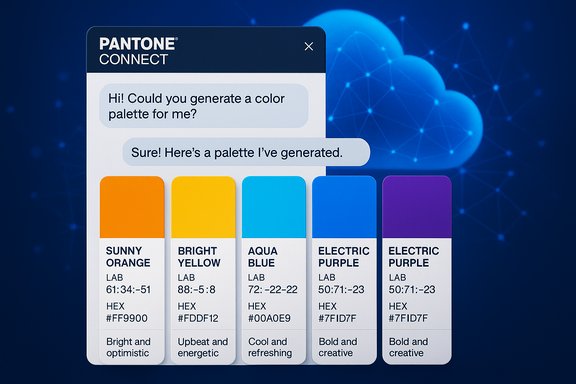
At its core, the Palette Generator exposes a chat interface inside Pantone Connect that lets designers describe intent in plain language — for example, “Show me colours that evoke optimism in Gen Z” or “Build a palette inspired by 1970s fashion editorials.” The system returns Pantone‑indexed palettes, plus the Colour Institute snippets or forecasting rationale used to inform each suggestion. Generated palettes can be added directly to Pantone Connect libraries, analysed, downloaded and shared for collaborative workflows.Fast exploration across thousands of Pantone colours
The Generator draws from thousands of Pantone values, enabling creatives to explore, generate and refine palettes in seconds rather than hours. Pantone positions the tool as a way to jumpstart research, discovery and inspiration — shortening the loop between idea and shareable asset. The initial rollout supports Pantone’s Fashion, Home & Interiors library, with plans to expand to the full Pantone catalogue.Integrated provenance and trend context
A key differentiator from generic colour pickers is that the Palette Generator attempts to attach forecasting rationale to its outputs. The product’s design uses Retrieval‑Augmented Generation (RAG) to semantically search Pantone’s curated forecasting content and surface the specific snippets that informed the palette. That provenance is intended to help designers tell a defensible story about choices in client pitches, merchandising decks and trend presentations.Technical architecture (plain language)
Built on Azure OpenAI and Azure AI Foundry
The Palette Generator is implemented on Microsoft’s Azure platform. Azure OpenAI provides the conversational model/inference layer; Azure AI Search indexes Pantone’s trend content for semantic retrieval; Azure Cosmos DB stores palette metadata and assets; and Azure AI Foundry orchestrates the multi‑agent workflows that run the assistant. Pantone and Microsoft explicitly describe the solution as using RAG plus agentic orchestration to ground outputs in Pantone’s proprietary content rather than unconstrained web data.Why RAG and agents matter here
- RAG: When a prompt is received, the system first retrieves relevant Pantone forecasting passages and then uses those passages as context for the generative model. This reduces the risk of unsupported or fabricated claims and makes it possible to attach explicit evidence to outputs.
- Agentic orchestration: The product references “agentic technology,” which in practice suggests a pipeline of specialized micro‑agents that handle search, retrieval, colour computations, justification generation and asset packaging. This modular approach improves traceability but adds operational complexity — routing, timeouts, retries and state management become new failure modes to monitor.
Enterprise considerations in the stack
Using Azure brings enterprise features — scale, observability, compliance tooling and regional deployment options — that are attractive for brands and studios. It also introduces a dependency on Microsoft’s cloud policies and contract models; enterprises with strict data residency, non‑use in training or sovereign requirements will want explicit contractual protections.UX, workflows and immediate use cases
Natural‑language prompts meet practical outputs
The Generator supports a variety of prompt types: mood‑based (“optimistic palette for Gen Z”), period‑inspired (“1970s fashion editorial”), or constraint‑driven (“five colours suitable for upholstery fabrics, fall 2026”). Outputs are designed to include machine‑readable values (Pantone names and, where possible, LAB/hex values), and users can import selections directly into their Pantone Connect libraries for downstream export.Integration with Pantone Connect and downstream tools
Generated palettes can be analysed inside Pantone Connect and exported for use in common design workflows. Pantone has already invested in integrations (for example, Adobe extensions), and the Generator aims to reduce copy/paste friction and speed handoffs between ideation and production. The beta is being offered broadly — including to free Pantone Connect users — to democratize access and accelerate feedback loops.Colour of the Year and seasonal workflows
Pantone says the Palette Generator will be used to incorporate palettes around the Pantone Colour of the Year 2026 (announcement scheduled for early December) and to reference past Colour of the Year palettes — a signal that seasonal marketing and merchandising teams will be able to prototype seasonal collections faster.Strengths and practical benefits
- Domain credibility: Pantone’s Color Institute is an industry benchmark; the Generator leverages that authority to produce palettes that carry forecasting weight.
- Speed and scale: What used to take hours of trend research can be compressed into seconds, enabling faster ideation and more rapid iteration in early‑stage briefs.
- Evidence‑backed storytelling: Attached forecasting snippets let designers justify choices to stakeholders with traceable narrative lines.
- Workflow integration: Importing palettes directly into Pantone Connect eliminates many manual handoffs and reduces transcription errors.
- Accessibility during rollout: Offering the open beta to free users broadens access for students, freelancers and small studios, generating diverse product feedback.
Critical risks and limitations (what teams must plan for)
While promising, the Palette Generator introduces new technical, legal and operational risks that are especially salient for design and production environments.1. Colour fidelity and the material gap
Pantone’s reputation is built on reproducibility across substrates, finishes and processes. A digital palette that looks coherent on screen may render very differently in print, textiles or coatings without correct LAB conversions, ICC profiles and vendor‑specific builds. Pantone has signalled achievability visualizers as roadmap items, but they are not part of the initial beta. Designers must validate AI‑generated palettes with physical swatches and vendor proofs before production.2. Hallucinations and provenance hygiene
RAG reduces the chance of unchecked hallucination but does not eliminate it. Models can still generate plausible‑sounding rationales or misattribute sources. Until the system exposes detailed provenance metadata (document IDs, ranking scores and retrieved snippets for each palette), teams should treat the assistant’s narrative as helpful guidance rather than a contractual specification.3. Licensing, IP and commercialization ambiguity
Pantone’s colour libraries are proprietary. The announcement frames outputs as “Pantone‑informed,” but it does not fully define downstream licensing for commercial productization of AI‑generated palettes. Companies should clarify whether generated palettes require additional licensing, how exclusivity is handled, and how AI outputs intersect with existing Pantone agreements. Legal review is necessary before committing AI‑derived palettes to product IP.4. Data governance and confidentiality
Public notices do not disclose detailed retention or telemetry policies for prompts and generated palettes. For unreleased collections or sensitive briefs, treat interactions with the public beta as non‑confidential. Procurement and IT teams should request contractual non‑use clauses, prompt deletion guarantees, and private tenant options for work that must remain confidential.5. Vendor lock‑in and cloud dependency
By building on Azure OpenAI and related Azure services, Pantone’s solution ties critical parts of the colour decision pipeline to Microsoft’s cloud ecosystem. This creates operational advantages but also introduces dependence on platform continuity, pricing, and policy — organizations should maintain exported copies of critical assets in independent repositories to avoid continuity risk.How to adopt the Pantone Palette Generator responsibly
- Start with non‑sensitive pilots: use the beta on internal or low‑risk projects to evaluate output quality.
- Require provenance exports: save the exact retrieval snippets, document IDs and any ranking metadata alongside palettes for auditability.
- Validate achievability early: request LAB/ICC values and run vendor proofs before approving production palettes.
- Update procurement and licensing: clarify rights to commercialize AI‑generated palettes and add AI/IP clauses to supplier agreements.
- Protect confidential prompts: avoid sending unreleased briefs to the public beta; negotiate enterprise non‑use or private deployment for sensitive work.
- Maintain independent archives: export and version palettes to a secure in‑house repository to prevent future access or subscription risk.
What Pantone and Microsoft must deliver next (practical roadmap items)
- Downloadable provenance metadata: make the retrieval snippets, document IDs and confidence/ranking scores available as machine‑readable exports so audits are straightforward.
- Achievability and material simulation: ship spectral or measured material tools that predict how a Pantone value will render on different substrates using measured data, not heuristics.
- Export fidelity: provide LAB values, ICC profiles and vendor‑specific CMYK or dye recipes to close the loop with manufacturing partners.
- Enterprise governance controls: offer contractable non‑use in training, prompt retention windows, in‑region processing and private/tenant deployments for confidential workflows.
- Confidence indicators: attach achievability warnings or confidence scores where a suggested Pantone is unlikely to achieve a faithful substrate match.
Industry implications — beyond Pantone Connect
Pantone’s move signals a broader shift: domain authorities and standards bodies are packaging curated expertise into generative AI workflows, and that will reshape early‑stage creative work. Expect:- Rival domain assistants from paint manufacturers, textile mills and material suppliers that embed their own measured data and supply chain constraints.
- An emergent market for provenance metadata standards that codify how AI‑generated creative assets indicate sources, confidence and licensing.
- Faster iteration in design sprints and merchandising planning, but also a higher bar for production validation and IP governance as AI speeds idea generation.
Final analysis and conclusion
The Pantone Palette Generator is a logical, strategically sensible evolution for a company whose value has always been rooted in curated, expert colour insight. By embedding that knowledge in a conversational AI and pairing it with Microsoft’s Azure AI stack, Pantone is accelerating ideation while attempting to preserve provenance and trend context — a combination that delivers immediate value for mood‑boarding, client storytelling, and early product concepting.At the same time, the partnership surfaces hard operational questions that matter to brands and production teams: how exactly will colour recommendations be proved on substrates; who owns the downstream rights to AI‑assisted palettes; and what contractual and technical guarantees will protect sensitive IP and prevent unwanted training of foundation models? These are not hypothetical concerns — they determine whether Palette Generator output is a helpful prototype tool or a production hazard.
For designers and IT leaders, the sensible path is measured adoption: exploit the Generator’s speed for exploration and storytelling, but keep human experts, lab tests and contractual safeguards central to any production use. Pantone and Microsoft have taken a major first step; the next 6–18 months of feature rollouts (provenance exports, achievability visualisers, enterprise non‑use controls) will determine whether this tool becomes an indispensable professional utility or a handy creative toy.
In short: the Pantone Palette Generator promises to reshape the early stages of colour work by fusing decades of trend research with modern AI, but its real value will be earned through rigorous transparency, production fidelity and enterprise governance — not just creative speed.
Source: fashionunited.uk Pantone launches new AI tool to create custom colour palettes
