

Parallels announced Parallels RAS 21.2 on June 23, 2026, in Austin, Texas, adding a Custom Provider Framework that lets organizations connect third-party hypervisors and cloud platforms to Remote Application Server environments through scriptable JSON-based integrations. The release is not just another checklist update for virtual desktops; it is a bet that the next phase of end-user computing will be won by platforms that tolerate infrastructure diversity rather than trying to erase it. For Windows administrators living with Azure, Nutanix, aging VMware estates, edge sites, and sovereignty-driven private clouds, that distinction matters. Parallels is positioning RAS less as a packaged VDI stack and more as a control plane for whatever infrastructure IT already has — or is being forced to adopt next.
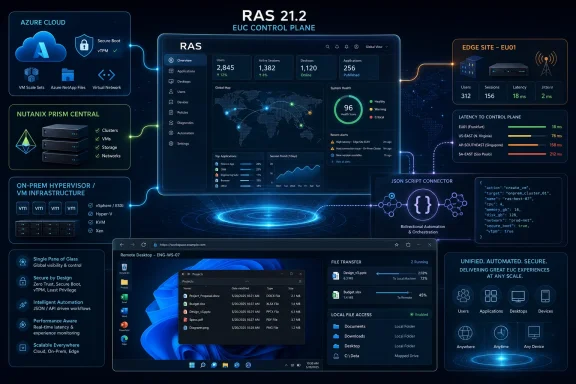
The headline feature in Parallels RAS 21.2 is the new Custom Provider Framework, and its significance is easy to miss if you read it as another integration mechanism. Enterprise software vendors have spent years promising “hybrid cloud” while quietly nudging customers toward a narrow list of blessed platforms. Parallels is now making a different pitch: if your hypervisor, edge platform, sovereign cloud, or private cloud exposes enough automation surface, RAS should be able to manage it.
That is a practical message for IT departments that no longer live in clean architecture diagrams. A Windows shop might run Azure Virtual Desktop for elastic workloads, Nutanix AHV in regional data centers, Hyper-V for legacy application islands, and a KVM-based platform at an edge site where bandwidth, latency, or compliance rules make public cloud unattractive. None of that fits neatly into the old VDI procurement story, where the vendor stack defines the infrastructure.
The Custom Provider Framework extends Parallels RAS beyond brokering applications and desktops into provisioning, cloning, lifecycle management, and orchestration for non-native platforms. In plain English, Parallels wants administrators to keep the familiar RAS management model while plugging in infrastructure that Parallels itself may not directly support as a first-class provider. That is more ambitious than a compatibility tick box, because provisioning is where VDI platforms become operationally sticky.
The framework is scripting language-agnostic, with Parallels describing connectors that can be written in PowerShell, Python, or similar tools and communicate through a standardized JSON protocol. That is an administrator-friendly design choice, especially in Windows-heavy environments where PowerShell is already the automation language of record. It also leaves room for partners and managed service providers to build integrations around platforms that would otherwise be too niche for a vendor roadmap.
The strategic move is obvious. Parallels cannot out-Citrix Citrix on installed enterprise gravity, and it cannot out-Microsoft Microsoft on Azure-native desktop delivery. But it can make RAS the thing that sits above the messy middle — the place where organizations need enough automation to avoid manual VM babysitting, but enough infrastructure freedom to resist being trapped by a single cloud or hypervisor vendor.
Parallels is trying to turn that problem inside out. Instead of waiting for native support, an organization or partner can build a connector that translates RAS provisioning and lifecycle actions into whatever the target platform understands. The use of JSON as the exchange format is not glamorous, but it is exactly the kind of mundane standardization that makes automation survivable across mixed environments.
For Windows admins, the PowerShell angle is particularly important. EUC teams often sit between infrastructure, identity, security, and endpoint groups, which means they inherit automation from several worlds at once. A connector that can be built with PowerShell lowers the barrier for teams that already script VM operations, Active Directory actions, image preparation, and session host maintenance.
This does not mean every customer will suddenly write their own provider. Most should not. Poorly tested provisioning logic in a desktop platform can create outages at scale, especially when templates, clones, naming conventions, and identity joins are involved.
But the existence of a documented connector model changes the commercial conversation. A customer using an unsupported platform no longer has to wait passively for vendor support or pay for a bespoke professional services workaround that becomes fragile over time. A partner can productize an integration, an MSP can standardize around a regional platform, and a regulated organization can adapt RAS to infrastructure it is required to use.
That makes the framework both a technology feature and a market signal. Parallels is acknowledging that VDI and application delivery are no longer deployed on a single substrate, and that the winning management plane may be the one that best survives heterogeneity.
Parallels already had Nutanix-related capabilities in earlier releases, but Prism Central support with native template integration pushes the relationship toward better multi-cluster administration. For IT teams managing distributed Nutanix environments, the promise is less swivel-chair administration and more single-console control over desktop and application workloads. In a world where many administrators are being asked to do more with fewer platform specialists, that kind of consolidation has real value.
It also speaks to the post-VMware moment without saying so too loudly. Since Broadcom’s acquisition of VMware, many enterprise customers have re-examined virtualization roadmaps, licensing assumptions, and vendor dependence. Not every organization is leaving VMware, and many cannot do so quickly even if they want to. But alternatives like Nutanix AHV, Hyper-V, KVM, and cloud-native platforms have become more serious boardroom topics than they were a few years ago.
Parallels does not need to win an ideological argument about the best hypervisor. It only needs to convince customers that RAS will not punish them for changing their mind. Expanded Nutanix support and a broader custom-provider story reinforce the same message: infrastructure decisions can evolve without forcing a wholesale rebuild of the desktop delivery layer.
That message will resonate with midmarket organizations and MSPs in particular. They often lack the appetite for heavyweight VDI platforms but still need resilient application delivery, remote access, and desktop brokering. If Parallels can make Nutanix and other platforms feel operationally ordinary inside RAS, it has a sharper argument against both legacy complexity and cloud-only rigidity.
Trusted Launch is important because virtual desktops and session hosts are still Windows machines with all the usual concerns: boot integrity, credential exposure, malware persistence, and compliance evidence. Secure Boot and vTPM support help align virtual desktop deployments with the security posture administrators already expect from Windows 11-era endpoints. The more virtual desktops become substitutes for physical PCs, the less acceptable it is for them to lag behind endpoint security assumptions.
Parallels is also adding Azure Availability Zone support, which gives administrators more control over workload placement and resilience. Availability Zones are not magic uptime dust; applications and infrastructure still need to be designed with failure domains in mind. But for session hosts and desktop infrastructure, zone-aware placement can reduce the blast radius of localized cloud disruptions and help organizations design more deliberate deployment patterns.
This is where Parallels’ positioning becomes more nuanced. Microsoft already owns the native Azure Virtual Desktop experience, and Windows 365 gives Microsoft an even more packaged cloud PC route. Parallels RAS has to justify itself by offering management, brokering, hybrid flexibility, and cross-platform access that customers do not get — or do not want to assemble — through Microsoft’s own stack alone.
The new Azure features help Parallels avoid looking like an overlay that dilutes Microsoft’s cloud security model. Instead, RAS can present itself as a management layer that adopts the underlying Azure security primitives while extending control across non-Azure infrastructure. That is the right direction, because customers are increasingly allergic to “security by brochure” claims that do not map to actual platform controls.
The browser has become the universal client of last resort. Contractors, shared devices, Chromebooks, locked-down endpoints, and bring-your-own-device scenarios all push organizations toward web access because installing a native client is not always possible or desirable. The problem is that web clients historically lag native clients in file handling, redirection, peripheral support, and general session polish.
Local file access and multi-file transfer narrow that gap. They are especially relevant for Chromebook-heavy environments, education, frontline work, and shared-device scenarios where browser access is not a backup path but the primary path. If a user has to move files one at a time or fight the browser every time a remote app needs local content, the platform loses credibility quickly.
Parallels is also extending client capabilities across macOS, Linux, Android, iOS, Linux-based thin-client environments, and IGEL OS. Cross-platform Web + Credentials authentication, expanded clipboard redirection with image support for macOS, extended USB filtering for Linux and IGEL OS clients, and single sign-on for IGEL OS 12 all point in the same direction. RAS is trying to behave less like a Windows-only remote access product and more like an EUC fabric across device types.
That device diversity matters for Windows administrators precisely because the apps are often still Windows apps. The endpoint may be a Mac, Chromebook, iPad, Linux thin client, or kiosk terminal, but the application compatibility problem remains anchored in Windows. Parallels is leaning into that reality: keep the Windows app where IT can control it, then make the access layer tolerable across whatever device the user actually has.
Client auto-logout is a good example. In a single-user knowledge-worker deployment, it may sound like a convenience setting. In a call center, lab, hospital workstation, classroom, retail counter, or kiosk-style environment, it becomes part of the security model.
Restrictions on logon methods and API usage control tell a similar story. As remote access platforms become more automated and more exposed to identity-driven workflows, administrators need to reduce the number of ways users and systems can enter the environment. Flexibility without constraint becomes attack surface.
This is where the Custom Provider Framework introduces a tension Parallels will need to manage carefully. Opening the platform to custom integrations increases flexibility, but it also creates new places for mistakes. A connector that provisions VMs into the wrong network, mishandles secrets, fails to enforce naming conventions, or ignores lifecycle cleanup can become an operational and security problem.
Parallels can mitigate that through documentation, validation, logging, role-based controls, and partner certification, but it cannot eliminate the burden. Hypervisor-agnostic automation is powerful because it moves decision-making closer to the customer. That also moves more responsibility there.
For mature IT teams, that trade may be welcome. For smaller shops, it could be dangerous if the phrase “custom provider” is read as “quick script in production.” The smartest deployments will treat these connectors like infrastructure code: versioned, tested, reviewed, monitored, and owned.
Cost has become the first uncomfortable reality. Cloud desktops can be wonderfully elastic, but persistent workloads, storage, bandwidth, profile management, and licensing can make the bill harder to predict than buyers expected. On-premises platforms can be cheaper and more controllable, but they require capital investment, staff expertise, and lifecycle discipline.
Control is the second reality. Some organizations cannot put every desktop workload in a hyperscale public cloud because of latency, data residency, disconnected sites, contractual requirements, or political constraints. Others can use public cloud but want leverage — the ability to move workloads or at least credibly threaten to do so.
Distrust is the third and perhaps most important reality. IT leaders have watched pricing models shift, licensing terms change, product bundles mutate, and formerly stable vendor relationships become strategic risks. In that climate, hypervisor-agnostic sounds less like a feature and more like insurance.
Parallels is not alone in noticing this. Microsoft is strengthening its own Windows cloud stack, Omnissa is trying to define the post-VMware EUC era, Citrix remains deeply embedded in large enterprises, and smaller players are hunting for customers frustrated by complexity and licensing. The difference is that Parallels RAS has long marketed itself as simpler and more cost-conscious than the heaviest VDI suites. Version 21.2 tries to add a more sophisticated infrastructure story without abandoning that pitch.
The challenge will be credibility at scale. It is one thing to say RAS can integrate with a broad range of platforms. It is another to prove that a custom provider can survive production pressure, vendor API changes, image churn, patch cycles, and helpdesk escalation at 3 a.m. The framework gives Parallels a stronger answer, but customers will judge it by operational evidence rather than architecture slides.
A standardized connector can abstract some of that. It cannot erase it. Administrators still need to understand what the underlying platform can do, what it cannot do, and where the abstraction leaks.
That matters most in lifecycle management. Creating a VM is easy compared with maintaining a fleet of session hosts or desktops over time. The hard parts are image versioning, patch timing, rollback, profile handling, capacity management, cleanup of orphaned resources, and ensuring that security policies remain consistent across platforms.
Parallels’ template-based provisioning and automated cloning capabilities help, but they do not absolve organizations from architecture decisions. A custom provider for a regional cloud may solve the integration problem while creating new questions about monitoring, backup, network segmentation, and support boundaries. The more diverse the infrastructure, the more important the operating model becomes.
This is why RAS 21.2 should not be read as an invitation to build a chaotic desktop estate across every available platform. It is better understood as a tool for organizations that already have legitimate reasons to be heterogeneous. The framework is most valuable when it reduces forced standardization, not when it encourages infrastructure sprawl.
The best use case may be selective freedom. Keep Azure Virtual Desktop where cloud elasticity and Microsoft integration make sense. Use Nutanix or another on-premises platform where predictable performance and local control matter. Extend to edge or sovereign platforms where business requirements demand it. Manage the whole thing through RAS where the abstraction is strong enough — and respect the boundaries where it is not.
The release also fits the way many IT departments now buy technology. Few organizations make a single all-or-nothing VDI decision anymore. They layer remote apps, cloud PCs, SaaS, VPN replacement, browser isolation, and endpoint management depending on user groups and risk profiles. RAS wants to sit in that layered world rather than force a single desktop doctrine.
But more options mean more design work. If RAS can provision into more environments, administrators need clearer policies about where workloads belong. A finance app with strict data controls may belong on a private platform. A seasonal call-center desktop may belong in Azure. A latency-sensitive plant-floor app may belong at the edge. Without placement discipline, flexibility becomes another form of technical debt.
The new browser and client improvements also raise user-experience expectations. Once users can access remote apps from almost any device, the helpdesk inherits every weak link: clipboard behavior, file transfer, authentication prompts, USB redirection, display scaling, and session persistence. EUC success is rarely decided by a single marquee feature; it is decided by the accumulation of small frictions that either disappear or become tickets.
This is where Parallels’ simplicity argument will be tested. RAS has often appealed to organizations that want fewer moving parts than traditional enterprise VDI stacks. The Custom Provider Framework adds power, but power has a way of inviting complexity. Parallels needs to keep the default path simple while letting advanced customers go deeper.
 Parallels Is Selling Escape Velocity From the Hypervisor Wars
The headline feature in Parallels RAS 21.2 is the new Custom Provider Framework, and its significance is easy to miss if you read it as another integration mechanism. Enterprise software vendors have spent years promising “hybrid cloud” while quietly nudging customers toward a narrow list of blessed platforms. Parallels is now making a different pitch: if your hypervisor, edge platform, sovereign cloud, or private cloud exposes enough automation surface, RAS should be able to manage it.That is a practical message for IT departments that no longer live in clean architecture diagrams. A Windows shop might run Azure Virtual Desktop for elastic workloads, Nutanix AHV in regional data centers, Hyper-V for legacy application islands, and a KVM-based platform at an edge site where bandwidth, latency, or compliance rules make public cloud unattractive. None of that fits neatly into the old VDI procurement story, where the vendor stack defines the infrastructure.
The Custom Provider Framework extends Parallels RAS beyond brokering applications and desktops into provisioning, cloning, lifecycle management, and orchestration for non-native platforms. In plain English, Parallels wants administrators to keep the familiar RAS management model while plugging in infrastructure that Parallels itself may not directly support as a first-class provider. That is more ambitious than a compatibility tick box, because provisioning is where VDI platforms become operationally sticky.
The framework is scripting language-agnostic, with Parallels describing connectors that can be written in PowerShell, Python, or similar tools and communicate through a standardized JSON protocol. That is an administrator-friendly design choice, especially in Windows-heavy environments where PowerShell is already the automation language of record. It also leaves room for partners and managed service providers to build integrations around platforms that would otherwise be too niche for a vendor roadmap.
The strategic move is obvious. Parallels cannot out-Citrix Citrix on installed enterprise gravity, and it cannot out-Microsoft Microsoft on Azure-native desktop delivery. But it can make RAS the thing that sits above the messy middle — the place where organizations need enough automation to avoid manual VM babysitting, but enough infrastructure freedom to resist being trapped by a single cloud or hypervisor vendor.
The New Connector Model Turns Scripting Into Product Surface
There is a reason the Custom Provider Framework matters more than a conventional plug-in marketplace. A traditional provider integration depends on the software vendor deciding that a platform is worth supporting, building the integration, maintaining it across API changes, and certifying it for production. That model works for giants like Microsoft Azure and VMware vSphere, but it breaks down quickly when customers need KVM clusters, regional clouds, sovereign providers, or internal APIs that will never appear on a public compatibility matrix.Parallels is trying to turn that problem inside out. Instead of waiting for native support, an organization or partner can build a connector that translates RAS provisioning and lifecycle actions into whatever the target platform understands. The use of JSON as the exchange format is not glamorous, but it is exactly the kind of mundane standardization that makes automation survivable across mixed environments.
For Windows admins, the PowerShell angle is particularly important. EUC teams often sit between infrastructure, identity, security, and endpoint groups, which means they inherit automation from several worlds at once. A connector that can be built with PowerShell lowers the barrier for teams that already script VM operations, Active Directory actions, image preparation, and session host maintenance.
This does not mean every customer will suddenly write their own provider. Most should not. Poorly tested provisioning logic in a desktop platform can create outages at scale, especially when templates, clones, naming conventions, and identity joins are involved.
But the existence of a documented connector model changes the commercial conversation. A customer using an unsupported platform no longer has to wait passively for vendor support or pay for a bespoke professional services workaround that becomes fragile over time. A partner can productize an integration, an MSP can standardize around a regional platform, and a regulated organization can adapt RAS to infrastructure it is required to use.
That makes the framework both a technology feature and a market signal. Parallels is acknowledging that VDI and application delivery are no longer deployed on a single substrate, and that the winning management plane may be the one that best survives heterogeneity.
Nutanix Gets a Cleaner Seat at the RAS Console
The RAS 21.2 release also expands Nutanix support, specifically through Nutanix Prism Central using native template integration. That matters because Nutanix has become one of the more credible alternatives for organizations trying to simplify on-premises infrastructure without treating every workload as a public-cloud candidate. For VDI and session-based desktops, the appeal is straightforward: predictable infrastructure, local control, and operational consolidation.Parallels already had Nutanix-related capabilities in earlier releases, but Prism Central support with native template integration pushes the relationship toward better multi-cluster administration. For IT teams managing distributed Nutanix environments, the promise is less swivel-chair administration and more single-console control over desktop and application workloads. In a world where many administrators are being asked to do more with fewer platform specialists, that kind of consolidation has real value.
It also speaks to the post-VMware moment without saying so too loudly. Since Broadcom’s acquisition of VMware, many enterprise customers have re-examined virtualization roadmaps, licensing assumptions, and vendor dependence. Not every organization is leaving VMware, and many cannot do so quickly even if they want to. But alternatives like Nutanix AHV, Hyper-V, KVM, and cloud-native platforms have become more serious boardroom topics than they were a few years ago.
Parallels does not need to win an ideological argument about the best hypervisor. It only needs to convince customers that RAS will not punish them for changing their mind. Expanded Nutanix support and a broader custom-provider story reinforce the same message: infrastructure decisions can evolve without forcing a wholesale rebuild of the desktop delivery layer.
That message will resonate with midmarket organizations and MSPs in particular. They often lack the appetite for heavyweight VDI platforms but still need resilient application delivery, remote access, and desktop brokering. If Parallels can make Nutanix and other platforms feel operationally ordinary inside RAS, it has a sharper argument against both legacy complexity and cloud-only rigidity.
Azure Support Moves From Capacity Story to Security Story
The Azure updates in Parallels RAS 21.2 are less dramatic than the Custom Provider Framework, but they may be more immediately relevant to many WindowsForum readers. The release adds Trusted Launch support for Microsoft Azure and Azure Virtual Desktop providers, including Secure Boot and virtual TPM capabilities. In Microsoft’s cloud world, these are no longer exotic security features; they are increasingly part of the expected baseline for protecting modern Windows workloads.Trusted Launch is important because virtual desktops and session hosts are still Windows machines with all the usual concerns: boot integrity, credential exposure, malware persistence, and compliance evidence. Secure Boot and vTPM support help align virtual desktop deployments with the security posture administrators already expect from Windows 11-era endpoints. The more virtual desktops become substitutes for physical PCs, the less acceptable it is for them to lag behind endpoint security assumptions.
Parallels is also adding Azure Availability Zone support, which gives administrators more control over workload placement and resilience. Availability Zones are not magic uptime dust; applications and infrastructure still need to be designed with failure domains in mind. But for session hosts and desktop infrastructure, zone-aware placement can reduce the blast radius of localized cloud disruptions and help organizations design more deliberate deployment patterns.
This is where Parallels’ positioning becomes more nuanced. Microsoft already owns the native Azure Virtual Desktop experience, and Windows 365 gives Microsoft an even more packaged cloud PC route. Parallels RAS has to justify itself by offering management, brokering, hybrid flexibility, and cross-platform access that customers do not get — or do not want to assemble — through Microsoft’s own stack alone.
The new Azure features help Parallels avoid looking like an overlay that dilutes Microsoft’s cloud security model. Instead, RAS can present itself as a management layer that adopts the underlying Azure security primitives while extending control across non-Azure infrastructure. That is the right direction, because customers are increasingly allergic to “security by brochure” claims that do not map to actual platform controls.
Browser-Based Desktops Are Becoming a First-Class Work Mode
The release also improves the RAS Web Client with local file access and simultaneous multi-file transfer support. On paper, that sounds like a small usability enhancement. In practice, browser-based access is one of the pressure points where virtual desktop products either feel modern or remind users that they are living inside an IT compromise.The browser has become the universal client of last resort. Contractors, shared devices, Chromebooks, locked-down endpoints, and bring-your-own-device scenarios all push organizations toward web access because installing a native client is not always possible or desirable. The problem is that web clients historically lag native clients in file handling, redirection, peripheral support, and general session polish.
Local file access and multi-file transfer narrow that gap. They are especially relevant for Chromebook-heavy environments, education, frontline work, and shared-device scenarios where browser access is not a backup path but the primary path. If a user has to move files one at a time or fight the browser every time a remote app needs local content, the platform loses credibility quickly.
Parallels is also extending client capabilities across macOS, Linux, Android, iOS, Linux-based thin-client environments, and IGEL OS. Cross-platform Web + Credentials authentication, expanded clipboard redirection with image support for macOS, extended USB filtering for Linux and IGEL OS clients, and single sign-on for IGEL OS 12 all point in the same direction. RAS is trying to behave less like a Windows-only remote access product and more like an EUC fabric across device types.
That device diversity matters for Windows administrators precisely because the apps are often still Windows apps. The endpoint may be a Mac, Chromebook, iPad, Linux thin client, or kiosk terminal, but the application compatibility problem remains anchored in Windows. Parallels is leaning into that reality: keep the Windows app where IT can control it, then make the access layer tolerable across whatever device the user actually has.
The Security Controls Reveal the Real Deployment Audience
The RAS 21.2 security additions are not flashy, but they are revealing. Enhanced Gateway access control, restrictions on specific logon methods, API usage control, and client auto-logout capabilities are the kind of features that matter when a product is used in shared, delegated, or semi-managed environments. They are not marketing fireworks; they are operational guardrails.Client auto-logout is a good example. In a single-user knowledge-worker deployment, it may sound like a convenience setting. In a call center, lab, hospital workstation, classroom, retail counter, or kiosk-style environment, it becomes part of the security model.
Restrictions on logon methods and API usage control tell a similar story. As remote access platforms become more automated and more exposed to identity-driven workflows, administrators need to reduce the number of ways users and systems can enter the environment. Flexibility without constraint becomes attack surface.
This is where the Custom Provider Framework introduces a tension Parallels will need to manage carefully. Opening the platform to custom integrations increases flexibility, but it also creates new places for mistakes. A connector that provisions VMs into the wrong network, mishandles secrets, fails to enforce naming conventions, or ignores lifecycle cleanup can become an operational and security problem.
Parallels can mitigate that through documentation, validation, logging, role-based controls, and partner certification, but it cannot eliminate the burden. Hypervisor-agnostic automation is powerful because it moves decision-making closer to the customer. That also moves more responsibility there.
For mature IT teams, that trade may be welcome. For smaller shops, it could be dangerous if the phrase “custom provider” is read as “quick script in production.” The smartest deployments will treat these connectors like infrastructure code: versioned, tested, reviewed, monitored, and owned.
The EUC Market Is Being Rewritten by Cost, Control, and Distrust
Parallels’ timing is not accidental. The end-user computing market has been unsettled for years, with cloud desktops, remote apps, SaaS migration, endpoint management, and security concerns all pulling in different directions. The old VDI pitch — centralize Windows desktops and everything gets easier — turned out to be true only for some workloads and some organizations.Cost has become the first uncomfortable reality. Cloud desktops can be wonderfully elastic, but persistent workloads, storage, bandwidth, profile management, and licensing can make the bill harder to predict than buyers expected. On-premises platforms can be cheaper and more controllable, but they require capital investment, staff expertise, and lifecycle discipline.
Control is the second reality. Some organizations cannot put every desktop workload in a hyperscale public cloud because of latency, data residency, disconnected sites, contractual requirements, or political constraints. Others can use public cloud but want leverage — the ability to move workloads or at least credibly threaten to do so.
Distrust is the third and perhaps most important reality. IT leaders have watched pricing models shift, licensing terms change, product bundles mutate, and formerly stable vendor relationships become strategic risks. In that climate, hypervisor-agnostic sounds less like a feature and more like insurance.
Parallels is not alone in noticing this. Microsoft is strengthening its own Windows cloud stack, Omnissa is trying to define the post-VMware EUC era, Citrix remains deeply embedded in large enterprises, and smaller players are hunting for customers frustrated by complexity and licensing. The difference is that Parallels RAS has long marketed itself as simpler and more cost-conscious than the heaviest VDI suites. Version 21.2 tries to add a more sophisticated infrastructure story without abandoning that pitch.
The challenge will be credibility at scale. It is one thing to say RAS can integrate with a broad range of platforms. It is another to prove that a custom provider can survive production pressure, vendor API changes, image churn, patch cycles, and helpdesk escalation at 3 a.m. The framework gives Parallels a stronger answer, but customers will judge it by operational evidence rather than architecture slides.
Hypervisor-Agnostic Does Not Mean Complexity-Free
The phrase hypervisor-agnostic is useful, but it can also mislead. No management platform can make all infrastructure behave the same. Azure, Nutanix AHV, Hyper-V, KVM, Xen-based environments, and custom cloud APIs have different assumptions about networking, storage, identity, templates, snapshots, availability, image handling, and security controls.A standardized connector can abstract some of that. It cannot erase it. Administrators still need to understand what the underlying platform can do, what it cannot do, and where the abstraction leaks.
That matters most in lifecycle management. Creating a VM is easy compared with maintaining a fleet of session hosts or desktops over time. The hard parts are image versioning, patch timing, rollback, profile handling, capacity management, cleanup of orphaned resources, and ensuring that security policies remain consistent across platforms.
Parallels’ template-based provisioning and automated cloning capabilities help, but they do not absolve organizations from architecture decisions. A custom provider for a regional cloud may solve the integration problem while creating new questions about monitoring, backup, network segmentation, and support boundaries. The more diverse the infrastructure, the more important the operating model becomes.
This is why RAS 21.2 should not be read as an invitation to build a chaotic desktop estate across every available platform. It is better understood as a tool for organizations that already have legitimate reasons to be heterogeneous. The framework is most valuable when it reduces forced standardization, not when it encourages infrastructure sprawl.
The best use case may be selective freedom. Keep Azure Virtual Desktop where cloud elasticity and Microsoft integration make sense. Use Nutanix or another on-premises platform where predictable performance and local control matter. Extend to edge or sovereign platforms where business requirements demand it. Manage the whole thing through RAS where the abstraction is strong enough — and respect the boundaries where it is not.
Windows Admins Get More Options, and More Decisions
For Windows administrators, the immediate appeal of Parallels RAS 21.2 is straightforward: more infrastructure choices without giving up centralized application and desktop delivery. That is especially attractive in environments where Windows apps remain business-critical but endpoint strategy is changing faster than the application portfolio. Users may want Macs, Chromebooks, tablets, or browser-only access; the business still needs the ancient Win32 app to run.The release also fits the way many IT departments now buy technology. Few organizations make a single all-or-nothing VDI decision anymore. They layer remote apps, cloud PCs, SaaS, VPN replacement, browser isolation, and endpoint management depending on user groups and risk profiles. RAS wants to sit in that layered world rather than force a single desktop doctrine.
But more options mean more design work. If RAS can provision into more environments, administrators need clearer policies about where workloads belong. A finance app with strict data controls may belong on a private platform. A seasonal call-center desktop may belong in Azure. A latency-sensitive plant-floor app may belong at the edge. Without placement discipline, flexibility becomes another form of technical debt.
The new browser and client improvements also raise user-experience expectations. Once users can access remote apps from almost any device, the helpdesk inherits every weak link: clipboard behavior, file transfer, authentication prompts, USB redirection, display scaling, and session persistence. EUC success is rarely decided by a single marquee feature; it is decided by the accumulation of small frictions that either disappear or become tickets.
This is where Parallels’ simplicity argument will be tested. RAS has often appealed to organizations that want fewer moving parts than traditional enterprise VDI stacks. The Custom Provider Framework adds power, but power has a way of inviting complexity. Parallels needs to keep the default path simple while letting advanced customers go deeper.
The Custom Provider Era Will Reward the Disciplined
The concrete lesson from RAS 21.2 is not that every organization should start writing custom integrations tomorrow. It is that the EUC control plane is becoming more valuable when it can adapt to infrastructure strategy instead of dictating it. That shift rewards IT teams that pair flexibility with engineering discipline.- Parallels RAS 21.2 adds a Custom Provider Framework that lets organizations connect third-party hypervisors and cloud platforms through scriptable JSON-based connectors.
- The release expands Nutanix Prism Central support, giving Nutanix-centric environments a cleaner path for template-based administration and multi-cluster management.
- Azure and Azure Virtual Desktop support now includes Trusted Launch capabilities such as Secure Boot and virtual TPM, along with Availability Zone placement support.
- Browser-based access improves through local file access and simultaneous multi-file transfer in the RAS Web Client, a meaningful change for Chromebook, shared-device, and contractor scenarios.
- New gateway controls, API usage restrictions, logon-method limits, and auto-logout features point to Parallels’ interest in shared, kiosk-style, and security-sensitive deployments.
- The framework increases infrastructure freedom, but custom providers should be treated like production infrastructure code rather than casual scripts.
References
- Primary source: The Manila Times
Published: 2026-06-23T13:30:23.471677
Parallels RAS Expands Virtual Desktop Flexibility with New Hypervisor-Agnostic Custom Provider Framework | The Manila Times
Latest Parallels RAS release delivers expanded Nutanix, Azure, and Azure Virtual Desktop capabilities, greater infrastructure flexibility, and improved browser-based user experiences www.manilatimes.net
- Related coverage: parallels.com
Parallels Launches Parallels RAS 21.0 with Enhanced Hybrid Cloud Management, Optimized User Experience, Stronger Security, and Improved Platform Reliability | Parallels
The latest release drives security, flexibility and efficiency for digital workspaces at scalewww.parallels.com - Related coverage: prd4.www.parallels.public.corel.net
What's New | Parallels RAS
Learn about the latest features & capabilities, including enhancements to environment flexibility, security, & user experiences available in Parallels RAS.prd4.www.parallels.public.corel.net - Related coverage: docs.parallels.com
- Related coverage: globenewswire.com
Parallels RAS 21.0: Mehr Flexibilität und Effizienz für
Die neue Version sorgt für verbessertes Hybrid-Cloud-Management, optimierte Nutzererfahrung, mehr Sicherheit und zuverlässigeren Plattformeinsatz...www.globenewswire.com - Related coverage: download.parallels.com

- Related coverage: nutanix.com
- Related coverage: scalecomputing.com
