

Partnered Health has confirmed that patient data, including GP consultation notes, referrals and pathology results, was taken in a cyberattack affecting its Australian medical-centre network. The provider says it became aware of malicious access on June 23, 2026, and began notifying affected patients on July 15 after engaging specialist cyber responders and reporting the incident to authorities.
ABC News, which first detailed the scope of the disclosure, reports that 16 Partnered Health clinics have been identified as locations where records may have been stolen. Five additional practices — including sites in Western Australia and Victoria — remain under investigation. The distinction matters: reports describing 21 affected clinics combine the 16 confirmed or suspected locations with the five sites whose exposure has not yet been established.
The incident reaches beyond a routine contact-data leak. Partnered Health says the information potentially accessed includes names, dates of birth, addresses, phone and email details, Medicare numbers, private-health insurance and concession-card details. More seriously, the compromised files may include medical histories recorded in consultations, referral letters and diagnostic or pathology results.
For patients, that combination creates the conditions for convincing fraud. A criminal equipped with identity details and a real medical reference can produce phishing messages, bogus appointment reminders or insurance scams that look materially more credible than a generic spam email.
Health records are unusually difficult to replace once exposed. A password can be changed and a payment card can be cancelled, but a diagnosis, medication history or referral does not become obsolete simply because a provider rotates its credentials. The potential harm is therefore both immediate — targeted fraud and impersonation — and persistent.
Partnered Health operates more than 50 general-practice and skin-cancer clinics nationwide. ABC News identified affected locations across Melbourne, Sydney, Canberra, the Gold Coast, Sunshine Coast and Coffs Harbour. The provider has warned patients to treat unsolicited contacts referencing their healthcare or personal information with particular caution.
The company has said it is working with the Australian Cyber Security Centre, law enforcement, the Office of the Australian Information Commissioner and Services Australia. The latter involvement is significant because Medicare identifiers are among the categories of information that may have been accessed.
EFTM reported that patients began receiving SMS notifications on July 15, 22 days after Partnered Health says it learned of the intrusion. That timeline should not be treated as proof of delayed containment: determining whether attackers merely accessed systems or successfully removed specific records commonly requires forensic review of identity logs, endpoints, databases, cloud storage and network traffic. But it will inevitably be examined closely by patients and regulators.
The order can limit lawful republication and compel cooperation from identifiable parties under the court’s jurisdiction. It cannot technically erase copies already exfiltrated, prevent an attacker from selling data anonymously, or stop overseas infrastructure from hosting material. Its practical value is in suppressing distribution through organisations and individuals who can be reached by Australian law, while creating consequences for anyone who knowingly republishes the records.
That is why the company’s technical investigation remains more consequential than the court action. Administrators and security teams will want answers on the initial access path, the systems reached, whether privileged accounts were used, how long the actor remained present, and whether the affected environment has been fully rebuilt or merely cleaned.
None of those details has been publicly confirmed. Partnered Health has not identified an attacker, ransomware group, exploited product, compromised supplier, or the number of individual patients affected. It has also not said whether clinical operations were disrupted. Those are important omissions, but they are not unusual in the early stages of a breach investigation.
Malicious or criminal activity accounted for 716 notifications, according to the OAIC. Health service providers were the most commonly affected sector, responsible for 225 notifications, or 19% of the annual total. The figures do not establish that every incident involved sophisticated intrusion; they do establish that healthcare remains a high-volume target with unusually sensitive data stores.
For Windows administrators supporting clinics, the lessons are not exotic. Healthcare networks need strong phishing-resistant authentication for remote access and privileged accounts, meaningful separation between business systems and clinical-record platforms, endpoint detection coverage that includes reception and shared workstations, and offline-tested recovery paths. Logs must be retained long enough — and in usable enough form — to reconstruct access weeks after an incident begins.
The most damaging failures often arise where central identity, remote administration, file sharing and line-of-business applications are too tightly coupled. A compromise of one ordinary workstation should not become a route to every clinic’s document repository or practice-management environment.
There is no public indication that the transaction caused or contributed to the breach, and it would be irresponsible to imply otherwise. But a cyber incident discovered days after a deal announcement inevitably raises questions around cyber due diligence, incident disclosure, remediation costs and the condition of shared technology estates before integration.
For Bupa, if the acquisition proceeds through its required approvals, the immediate operational challenge is not simply absorbing clinics. It will be ensuring that identity systems, patient-data repositories, third-party connections and support tooling are understood before they are linked more deeply into a larger healthcare environment.
Partnered Health’s next update needs to resolve the central unknowns: how many patients were affected, which of the five under-review clinics were actually exposed, what data was confirmed taken from each location, and whether attackers retained a route back into any system. Until then, affected patients should assume that messages invoking real medical or Medicare details may be fraudulent — and verify contact through independently sourced clinic or government channels rather than replying to a text, email or unexpected call.
ABC News, which first detailed the scope of the disclosure, reports that 16 Partnered Health clinics have been identified as locations where records may have been stolen. Five additional practices — including sites in Western Australia and Victoria — remain under investigation. The distinction matters: reports describing 21 affected clinics combine the 16 confirmed or suspected locations with the five sites whose exposure has not yet been established.
The incident reaches beyond a routine contact-data leak. Partnered Health says the information potentially accessed includes names, dates of birth, addresses, phone and email details, Medicare numbers, private-health insurance and concession-card details. More seriously, the compromised files may include medical histories recorded in consultations, referral letters and diagnostic or pathology results.
For patients, that combination creates the conditions for convincing fraud. A criminal equipped with identity details and a real medical reference can produce phishing messages, bogus appointment reminders or insurance scams that look materially more credible than a generic spam email.
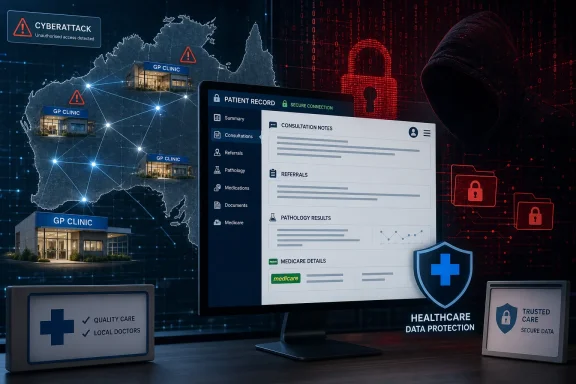 The Breach Is a Clinical-Data Problem, Not Just an Identity-Theft Problem
Health records are unusually difficult to replace once exposed. A password can be changed and a payment card can be cancelled, but a diagnosis, medication history or referral does not become obsolete simply because a provider rotates its credentials. The potential harm is therefore both immediate — targeted fraud and impersonation — and persistent.Partnered Health operates more than 50 general-practice and skin-cancer clinics nationwide. ABC News identified affected locations across Melbourne, Sydney, Canberra, the Gold Coast, Sunshine Coast and Coffs Harbour. The provider has warned patients to treat unsolicited contacts referencing their healthcare or personal information with particular caution.
The company has said it is working with the Australian Cyber Security Centre, law enforcement, the Office of the Australian Information Commissioner and Services Australia. The latter involvement is significant because Medicare identifiers are among the categories of information that may have been accessed.
EFTM reported that patients began receiving SMS notifications on July 15, 22 days after Partnered Health says it learned of the intrusion. That timeline should not be treated as proof of delayed containment: determining whether attackers merely accessed systems or successfully removed specific records commonly requires forensic review of identity logs, endpoints, databases, cloud storage and network traffic. But it will inevitably be examined closely by patients and regulators.
An Injunction Cannot Retrieve Stolen Data
Partnered Health has obtained an interim injunction from the Supreme Court of New South Wales ordering that the accessed material not be used or published. This is now a familiar part of the response playbook for Australian organisations facing data-extortion or public-leak risks.The order can limit lawful republication and compel cooperation from identifiable parties under the court’s jurisdiction. It cannot technically erase copies already exfiltrated, prevent an attacker from selling data anonymously, or stop overseas infrastructure from hosting material. Its practical value is in suppressing distribution through organisations and individuals who can be reached by Australian law, while creating consequences for anyone who knowingly republishes the records.
That is why the company’s technical investigation remains more consequential than the court action. Administrators and security teams will want answers on the initial access path, the systems reached, whether privileged accounts were used, how long the actor remained present, and whether the affected environment has been fully rebuilt or merely cleaned.
None of those details has been publicly confirmed. Partnered Health has not identified an attacker, ransomware group, exploited product, compromised supplier, or the number of individual patients affected. It has also not said whether clinical operations were disrupted. Those are important omissions, but they are not unusual in the early stages of a breach investigation.
Australia’s Health Sector Is Still the Most Frequent Reporter
The incident lands as Australia’s privacy regulator reports record data-breach notifications. The Office of the Australian Information Commissioner said 1,205 breaches were notified under the Notifiable Data Breaches scheme during 2025, the highest annual total since the scheme began in 2018.Malicious or criminal activity accounted for 716 notifications, according to the OAIC. Health service providers were the most commonly affected sector, responsible for 225 notifications, or 19% of the annual total. The figures do not establish that every incident involved sophisticated intrusion; they do establish that healthcare remains a high-volume target with unusually sensitive data stores.
For Windows administrators supporting clinics, the lessons are not exotic. Healthcare networks need strong phishing-resistant authentication for remote access and privileged accounts, meaningful separation between business systems and clinical-record platforms, endpoint detection coverage that includes reception and shared workstations, and offline-tested recovery paths. Logs must be retained long enough — and in usable enough form — to reconstruct access weeks after an incident begins.
The most damaging failures often arise where central identity, remote administration, file sharing and line-of-business applications are too tightly coupled. A compromise of one ordinary workstation should not become a route to every clinic’s document repository or practice-management environment.
The Bupa Transaction Adds a Due-Diligence Dimension
The breach also arrives weeks after Bupa announced an agreement to acquire Partnered Health Group from Quadrant Private Equity. Bupa’s announcement described the proposed acquisition as an expansion of its Australian health-services footprint, covering Partnered Health’s GP, skin-cancer, allied-health, mental-health and corporate-health operations.There is no public indication that the transaction caused or contributed to the breach, and it would be irresponsible to imply otherwise. But a cyber incident discovered days after a deal announcement inevitably raises questions around cyber due diligence, incident disclosure, remediation costs and the condition of shared technology estates before integration.
For Bupa, if the acquisition proceeds through its required approvals, the immediate operational challenge is not simply absorbing clinics. It will be ensuring that identity systems, patient-data repositories, third-party connections and support tooling are understood before they are linked more deeply into a larger healthcare environment.
Partnered Health’s next update needs to resolve the central unknowns: how many patients were affected, which of the five under-review clinics were actually exposed, what data was confirmed taken from each location, and whether attackers retained a route back into any system. Until then, affected patients should assume that messages invoking real medical or Medicare details may be fraudulent — and verify contact through independently sourced clinic or government channels rather than replying to a text, email or unexpected call.
References
- Primary source: Oz Arab Media
Published: 2026-07-15T15:34:54+00:00
GP Network Hack Exposes Patient Records
Partnered Health reported a 23 June cyberattack that exposed personal, Medicare and contact details and medical records at 21 clinics; authorities notified.ozarab.media
