

Microsoft's recent quality-control headaches are more than an embarrassment; they are a strategic problem that now affects enterprise availability, developer productivity, and public trust in the Windows and Azure ecosystems. A cascade of high-profile regressions — from a Patch Tuesday rollup that broke the Windows Recovery Environment to regional Azure outages caused by faulty configuration changes — has exposed brittle testing practices, rushed release mechanics, and the hard limits of telemetry-driven rollouts. The trend is clear: the company that once boasted the industrial-strength reliability of Windows NT now risks being defined by patch-driven instability and cloud configuration fragility.
Microsoft's software and cloud services operate at enormous scale: billions of Windows endpoints, millions of Office and M365 subscribers, and hyperscale Azure regions that underpin critical public-sector systems and enterprise SaaS. That scale makes change-management inherently hard, but it also creates a responsibility to deliver updates with surgical precision. Over the last 18 months, several service-impacting incidents have crystallized a persistent pattern:
Microsoft’s response was unusually fast but telling: the company issued an out-of-band emergency patch, KB5070773, to restore WinRE USB input and used server-side Known Issue Rollback (KIR) mechanisms to limit exposure for the HTTP.sys regression. While the remedial actions restored functionality for many customers, the sequence raised two questions: why did changes that affected a pre-boot recovery image and in-kernel networking get bundled into a single rollup, and how did they escape pre-release detection? Coverage of the emergency release and remediation was widely reported by mainstream outlets tracking the Windows update cycle.
The phrase “legendary approach to quality control” once belonged to an era when Windows releases were painstakingly validated against hundreds of hardware permutations. Today’s reality is more ambiguous: the company still builds remarkably capable platforms, but the frequency of avoidable, service-impacting incidents argues for a sober reassessment of how Microsoft balances developer velocity with the operational stability that enterprises and everyday users depend on.
Source: theregister.com Microsoft's lack of quality control is out of control
 Background / Overview
Microsoft's software and cloud services operate at enormous scale: billions of Windows endpoints, millions of Office and M365 subscribers, and hyperscale Azure regions that underpin critical public-sector systems and enterprise SaaS. That scale makes change-management inherently hard, but it also creates a responsibility to deliver updates with surgical precision. Over the last 18 months, several service-impacting incidents have crystallized a persistent pattern:- Windows cumulative updates shipped with regressions that disabled recovery workflows and broke developer scenarios.
- Azure regional outages, sometimes the result of misapplied configuration changes, left customers — including government services — offline for hours.
- Misclassified or mispackaged server updates produced unauthorized upgrades for some enterprise customers, illustrating how update metadata errors can cascade into licensing and operational headaches.
Recent headline incidents
The October 2025 Patch: KB5066835 and the emergency fix KB5070773
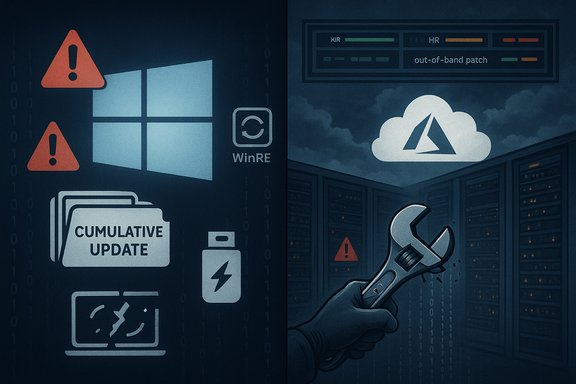
In mid-October 2025 Microsoft shipped a large cumulative update for Windows 11 identified by KB5066835. The package included critical security patches but also introduced several high-impact regressions: USB keyboards and mice stopped working inside the Windows Recovery Environment (WinRE), local loopback (127.0.0.1) HTTP/2 traffic started failing due to an HTTP.sys regression, and File Explorer’s Preview pane began blocking document previews. Those failures impacted everyday recovery scenarios, local development workflows, and file inspection — three functions most users assume are sacrosanct.Microsoft’s response was unusually fast but telling: the company issued an out-of-band emergency patch, KB5070773, to restore WinRE USB input and used server-side Known Issue Rollback (KIR) mechanisms to limit exposure for the HTTP.sys regression. While the remedial actions restored functionality for many customers, the sequence raised two questions: why did changes that affected a pre-boot recovery image and in-kernel networking get bundled into a single rollup, and how did they escape pre-release detection? Coverage of the emergency release and remediation was widely reported by mainstream outlets tracking the Windows update cycle.
Azure configuration-change outages
Cloud outages tied to configuration errors are arguably less forgivable than client-side update regressions. Azure outages in early 2025 — including multi-hour failures in Norway that disrupted government websites and Cosmos DB instances — were traced back to configuration or networking changes rolled into production that destabilized storage partitions and virtual machine connectivity. In at least one incident, Azure’s public service-health tooling initially showed “green” even as customers reported outages, creating a credibility gap between telemetry and observable reality. That disconnect left operators and administrators scrambling for information during the incident.The mislabelled server upgrade (Windows Server 2025 incident)
Beyond regressions and outages, metadata and packaging mistakes can be catastrophic in enterprise contexts. A November 2024 incident showed how a misclassified update (KB5044284) caused some third-party patch management tools to trigger full Windows Server 2025 upgrades on systems that expected only a security patch. The mislabeling and the absence of a straightforward rollback path turned what should have been a routine patch cycle into an operational emergency for affected administrators. The episode is a concrete example of how poor change governance at the package/metadata level can lead to unplanned OS-level churn.The 2018 data-loss precedent
The current debate over Windows update quality traces back to earlier high-visibility failures that altered Microsoft’s update playbook. The Windows 10 October 2018 Update (version 1809) was pulled because of reports that the installer deleted user files and mismanaged Known Folder Redirection. That data-loss event forced Microsoft to pause the rollout and revisit its testing and telemetry approach for feature updates — a watershed moment that still resonates when new regressions surface. The 1809 episode is also a reminder that some mistakes do permanent harm to user trust.Where things likely went wrong: process, priorities, and architecture
From dedicated testers to distributed responsibility
Critics often point to a structural shift that began more than a decade ago: the disbanding or scaling back of large, dedicated Windows testing teams in favor of integrated developer testing, automation, and telemetry-heavy strategies. That shift — reported when Microsoft reorganized teams and trimmed tester headcount around 2014 — aimed to increase developer ownership and speed, but it also reduced layers of independent validation that historically caught regressions against diverse hardware and rare edge cases. The company’s move toward shorter release cycles and feature flags amplified the need for extensive coverage across many device permutations. Evidence of the 2014 personnel changes and the subsequent philosophical pivot toward “lean” engineering is well documented in contemporary reporting.Telemetry is necessary but not sufficient
Modern testing ecosystems rely heavily on field telemetry to detect and triage regressions quickly. Telemetry enables targeted rollouts and the use of server-side feature gating — important tools for managing risk. But telemetry can only report what it has been instrumented to observe. Problems that only manifest in pre-boot environments (like WinRE USB input failures) or in specific combinations of device firmware, pre-boot drivers, and update-servicing sequences can evade typical telemetry datasets. The result is a false comfort: metrics show healthy desktop operation while recovery paths or low-level kernel interactions are silently broken. The October 2025 regressions are a textbook case.Packaging and metadata regressions are human fallibility at scale
The Windows Server 2025 mislabeling incident underlines an often-overlooked risk: mistakes in packaging metadata, GUIDs, or update classification can propagate through an ecosystem of third-party management tools and lead to unauthorized behavior. In highly automated patch-management environments, a single mis-tagged bit of metadata becomes a lever that can move millions of machines in unintended ways. That’s not a theoretical concern — it happened, exposing brittle dependencies between Microsoft’s update metadata and the logic used by corporate patching tools.Microsoft’s defenses, responses, and why they only partially address the problem
Known Issue Rollback (KIR) and out-of-band hotfixes
Microsoft has scaled several operational mitigations to reduce blast radius when things go wrong:- Known Issue Rollback (KIR) allows the company to flip a server-side switch to disable a problematic feature without issuing a full retraction of a cumulative package.
- Out-of-band hotfixes — rare but available — permit Microsoft to push fast, targeted fixes (KB5070773 being a recent example).
- Release Health and update advisories provide a centralized place to surface confirmed regressions and workarounds.
The engineering trade-offs: speed vs. safety
Microsoft’s product teams are under constant pressure to ship security patches rapidly and to deliver feature velocity across Windows, Office/M365, and Azure. Security updates are non-negotiable — delaying them leaves customers exposed — but bundling large servicing-stack changes and security fixes into a single, heavy rollup creates complexity that increases risk. The trade-off has been to favor rapid, consolidated rollouts and rely on telemetry and KIR to fix any problems. When this model works, the benefits are real: faster patching, centralized management, and lower release overhead. When it fails, however, the consequences are highly visible and sometimes irreversible. The recent incidents illustrate both outcomes.What this means for customers and administrators
Short-term operational playbook (what to do now)
- Treat every major cumulative update as a controlled experiment: pilot on representative hardware before mass deployment.
- Maintain offline recovery media and validated WinRE images; confirm recovery workflows before you need them.
- Use staged rollout policies in enterprise management systems to avoid “blast radius by default.”
- Ensure patch-management tools correctly interpret Microsoft update metadata and maintain a procedure to vet any optional or unusually large packages.
Long-term tactical changes to consider
- Expand internal testing coverage for pre-boot images and low-level drivers; these areas are rare but high-impact.
- Require stricter metadata validation pipelines before releases are published to the Update Catalog.
- Push for public post-mortems on systemic failures to restore trust and provide actionable learning for IT teams. If customers are required to shoulder risk, transparency about root causes and remediation steps should be a matter of policy.
Strengths worth acknowledging
Microsoft’s ecosystem has strengths that matter: a mature security-servicing cadence, deep telemetry that often identifies widespread regressions within hours, and infrastructure (KIR, out-of-band updates) designed to act quickly when things break. The company’s ability to push an emergency hotfix within a matter of days — and to apply server-side rollbacks to reduce impact — illustrates operational muscle that many competitors would envy. In short: the company can and does respond rapidly when problems are detected.Risks, reputational damage, and why “pisspoor quality” narratives gain traction
The repeated visibility of severe regressions has a compounding effect. Each incident chips away at IT decision-makers’ confidence and consumer trust. For developers, repeated localhost/connectivity regressions or broken pre-boot recovery paths are not mere inconveniences — they add measurable friction to daily productivity and increase support costs. For governments and enterprises that rely on Azure, configuration-change outages raise serious questions about cloud reliability and transparency. When status dashboards show “green” while customers are offline, faith in those dashboards erodes quickly. There’s also the psychological framing: a single catastrophic bug that deletes files (e.g., the 1809 rollout) lingers in user memory and amplifies subsequent anxieties even if those later incidents are smaller in scope. Repetition breeds a narrative of decline that’s hard to shake without demonstrable process change and public accountability.Concrete recommendations for Microsoft (a ten-point remediation checklist)
- Reinvest in independent, cross-team validation labs that emulate a broad spectrum of OEM firmware, driver, and peripheral configurations.
- Mandate pre-release signoffs for any change that touches WinRE, boot loaders, or in-kernel networking stacks.
- Implement an automated metadata-verification gate that prevents misclassified updates from being published to the Update Catalog.
- Increase the size and diversity of insider/pre-release rings for updates that include servicing-stack or SSU changes.
- Publish timely, technical post-mortems for incidents that cause customer impact, including root-cause analysis and concrete steps to avoid recurrence.
- Provide clearer, machine-readable metadata to third-party patch-management vendors and maintain a compatibility testing program for those vendors.
- Expand telemetry to include health metrics for recovery images while ensuring privacy-preserving aggregation.
- Improve Azure configuration-change simulation and staging for region-specific networking operations.
- Offer enterprise customers stronger guarantees or service credits for out-of-band operational failures tied to configuration errors.
- Reassess release cadence for heavy rollups that mix security, servicing, and functionality changes; prefer narrower patches for high-risk subsystems.
Balancing realism and accountability
No modern software vendor can guarantee zero incidents. Complex systems interact in ways that are often unpredictable. But there’s a difference between inevitable surprises and repeatable modes of failure that point to systemic process gaps. Microsoft’s toolset for remediation is robust; its problem is not a lack of capability but an operational discipline problem in areas where edge cases matter most — pre-boot recovery, kernel networking, and update metadata integrity. Addressing those weak points requires investment, slower ship cycles for risky subsystems, and more transparent incident reporting so customers can make informed risk decisions.Conclusion
Microsoft’s recent spate of high-impact regressions and cloud outages has re-ignited a debate about the balance between speed and safety in modern software engineering. The company’s capacity for fast remediation and its tooling (KIR, out-of-band updates, Release Health) are strengths, but they are not substitutes for robust pre-release validation and better governance of change metadata and cloud configuration. Until those underlying process gaps are fixed, customers should assume update risk is real, prepare accordingly with tested backouts and recovery media, and hold vendors — including Microsoft — to higher standards of transparency and remediation.The phrase “legendary approach to quality control” once belonged to an era when Windows releases were painstakingly validated against hundreds of hardware permutations. Today’s reality is more ambiguous: the company still builds remarkably capable platforms, but the frequency of avoidable, service-impacting incidents argues for a sober reassessment of how Microsoft balances developer velocity with the operational stability that enterprises and everyday users depend on.
Source: theregister.com Microsoft's lack of quality control is out of control
