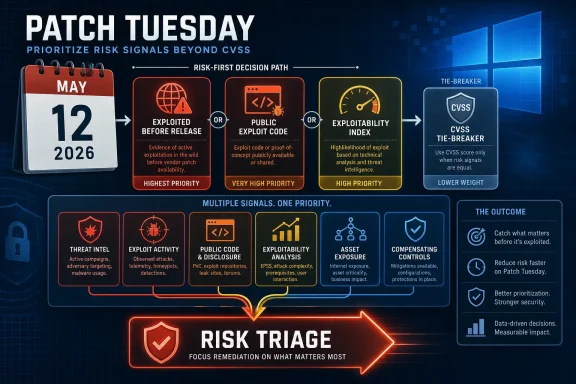
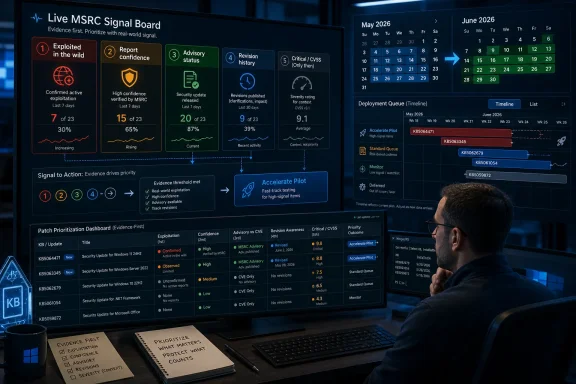
Windows administrators preparing for the May and June 2026 Patch Tuesday cycle should rank MSRC items by signal quality first: exploited-in-the-wild status, report-confidence metadata, advisory status, revision history, and only then headline severity or CVSS score. That ordering is the practical answer because Microsoft’s security communications no longer live solely inside a neat list of CVEs published once a month. The Security Update Guide now exposes advisory content alongside CVEs, and that shift changes how disciplined patch teams should read the board before the next drop lands.
The operating rule is simple: build the first deployment queue around evidence that a risk is real, changing, or being operationalized, not around the loudest adjective in the title. “Critical” still matters, but it is no longer enough. In 2026, a high-severity item with thin metadata can be less urgent than a less dramatic entry with strong confidence, visible revision movement, or signs that attackers are already paying attention.
The old mental model of Patch Tuesday was a calendar model. Admins waited for the second Tuesday, downloaded the spreadsheet, sorted by severity, filtered by product, and started the usual pilot-ring choreography. That still describes part of the job, but it no longer describes the decision.
The better workflow begins before the release. Review MSRC Security Update Guide entries and advisory material as a living queue, not a static bulletin. Mark anything that has confirmed exploitation, high report confidence, notable public exposure, or a revision history that suggests Microsoft is still sharpening the guidance.
The practical triage order should look like this in prose before it becomes policy. First, elevate any item Microsoft says is exploited or otherwise being used in the wild. Second, elevate entries where report-confidence metadata makes the finding more operationally credible. Third, treat advisories as first-class signals, because not every security event now arrives as a conventional CVE. Fourth, re-check revision history after publication, because the initial Patch Tuesday view may not be the final risk picture.
That is the point WindowsForum readers have already been circling in discussion of CVE-2026-20922. The interesting part of that conversation is not merely that an NTFS remote code execution vulnerability appears in MSRC’s guide. It is that the forum treated Microsoft’s “report confidence” field as a major triage input for patch planning. That is the right instinct.
Admins do not deploy against theoretical severity alone. They deploy against a mix of exposure, exploitability, asset importance, available mitigations, telemetry, and confidence in the report. A vulnerability that looks severe but has weak confidence and no operational evidence may deserve testing and planning; a vulnerability with confirmed exploitation deserves acceleration even if its headline score is not the most dramatic line in the release.
This is where report-confidence metadata earns its keep. It helps separate “this may be a serious class of issue” from “Microsoft has enough signal to treat this as a more dependable finding.” It is not a replacement for severity, but it is a corrective to severity-only patching.
For Windows admins, the distinction matters because patch windows are finite. There are always more endpoints, more applications, more maintenance exceptions, and more business owners asking for delays than there are clean deployment hours. A ranking model that ignores confidence wastes urgency on noise and may under-rank the item that should have broken the schedule.
That matters because many enterprise patch processes are still CVE-centric. Vulnerability scanners, reporting dashboards, service-level agreements, and executive metrics often start with “how many CVEs are open?” The result is a blind spot: advisory-driven events can be treated as peripheral even when Microsoft is using them to communicate material security guidance.
Admins should adjust intake rules accordingly. If the Security Update Guide surfaces an advisory, it should enter the same triage meeting as CVEs affecting Windows, Office, Edge, Azure-connected components, or other Microsoft products in the environment. The first question should not be “does it have a CVE?” The first question should be “does it change what we need to deploy, configure, block, monitor, or explain?”
This is especially important for mixed estates. A Windows shop is rarely just Windows anymore. Identity, endpoint management, browsers, productivity apps, virtualization, developer tooling, and cloud connectors all shape the actual risk surface. Advisory content is one way Microsoft signals that the security story may cross those product boundaries.
The key discipline is to re-read the entries after release. The first hour of Patch Tuesday is not the only hour that matters. The next day, the end of the week, and the run-up to the following month can all produce changes that alter the risk calculus.
A mature patch process should therefore include a revision-review checkpoint. This does not need to be bureaucratic. It can be as simple as assigning one person to compare high-priority entries against their prior state and flag anything that changes exploitability, affected platforms, mitigations, known issues, or remediation instructions.
The point is not to assume that every revision is alarming. The point is to stop pretending the published guide is frozen. If Microsoft makes post-publication changes visible, administrators should use that visibility as part of the risk model.
Cumulative servicing is designed to prevent fragmentation. It keeps devices from becoming unique patch snowflakes that contain arbitrary subsets of fixes. For administrators, that is a blessing, but it is also a constraint. If May is delayed, June is not a clean new event; June becomes a larger remediation step that inherits May’s unresolved exposure.
That should influence exception handling. A business unit asking to skip a monthly security update is not asking to postpone one patch. It is asking to carry an older baseline into the next cycle and accept the operational and security consequences of catching up later.
This is why “we will wait until next month” is not a neutral answer. It may be reasonable for a specific compatibility risk, but it should be written down as a risk decision, not treated as routine caution. The cumulative model rewards steady deployment and punishes indefinite hesitation.
For the May and June 2026 window, the handoff matters because administrators are dealing with evolving guidance rather than a single static payload. The Security Update Guide can show advisory material, CVE entries can carry metadata that changes the triage picture, and revision history can add context after the first read. The process has to absorb movement.
The strongest approach is to run a pre-drop review before Patch Tuesday, an initial triage immediately after release, and a short reassessment checkpoint after Microsoft has had time to revise entries. That gives IT teams room to separate emergency action from normal accelerated deployment. It also gives security teams a cleaner way to explain why one item jumped the line while another remained in the standard ring.
This is also where enthusiasts and homelab admins can learn from enterprise practice. You may not need a formal change advisory board for a handful of PCs, but you still benefit from the same ordering logic. If Microsoft flags exploitation or provides stronger confidence signals, update sooner. If the issue is lower-confidence and not relevant to your installed products, you have more room to watch.
Signal-quality triage gives administrators a defensible threshold. Confirmed exploitation should push toward emergency action. Strong report confidence should increase urgency. Advisory status should broaden the intake net. Revision history should trigger reassessment when Microsoft changes meaningful details.
Headline severity alone should rarely be enough to blow up the process. If every Critical item becomes an emergency, emergency loses meaning. The result is alert fatigue, brittle change management, and a growing temptation among application owners to resist security-driven changes because every month feels like a fire drill.
The better posture is selective aggression. Move very fast when the signals justify it, but preserve normal testing when they do not. That is not timidity; it is how a patch program remains credible.
That difference should shape ring design. Pilot groups should include representative machines from the organization’s real patch states, not only pristine systems already current through the prior month. If a deferred population exists, sample it. If a critical application depends on a fragile driver, include it. If a remote office uses a slower update channel or constrained network path, do not pretend the headquarters pilot tells the whole story.
The same logic applies to virtual desktops, kiosk devices, developer workstations, and servers with tight maintenance windows. Their risk is not only whether the Microsoft update installs. Their risk is whether the update interacts with their actual baseline and workload.
This is where WindowsForum’s long-running Patch Tuesday coverage remains useful as institutional memory. Prior cycles have shown that the monthly ritual is both predictable and surprisingly variable. The calendar repeats; the operational texture does not.
A signal-quality framework gives both teams a shared vocabulary. Security can say, “This item is already operationalized in the wild,” rather than “this looks bad.” Operations can say, “This item has no exploitation signal and weak relevance to our estate,” rather than “we need more time.” The conversation becomes less about appetite and more about evidence.
Report confidence is especially useful here because it sits between raw severity and real-world exploitation. It does not guarantee that an exploit will appear. It does not prove that every environment is exposed. But it does help teams judge whether the underlying report is strong enough to affect scheduling.
Advisory status plays a similar role. It prevents security-relevant guidance from being dismissed because it does not arrive as a conventional CVE. If Microsoft places an event in the Security Update Guide, the patch process should notice.
Administrators should add fields for exploitation status, report confidence, advisory-versus-CVE classification, revision-date awareness, and exception state. The goal is not to make the dashboard prettier. The goal is to make the deployment queue reflect how risk actually changes.
This also improves executive reporting. Leaders do not need every technical detail, but they do need to understand why one patch wave is being accelerated and another is not. “Critical” is a weak explanation when everything is critical. “Confirmed exploitation plus high-confidence vendor signal affecting deployed assets” is a much stronger one.
For smaller IT shops, this can be a simple spreadsheet. For larger environments, it belongs in the vulnerability management platform, endpoint management workflow, or change-management record. The sophistication of the tooling matters less than the discipline of the fields.
Start with relevance. If the affected product or feature is not deployed, the item still belongs in awareness but not at the front of the deployment queue. Then look for exploitation. Anything already being used in the wild moves ahead of purely theoretical exposure. Then weigh report confidence and advisory status. Finally, use severity and CVSS to refine priority among items with similar operational signals.
This ordering may feel inverted to teams trained to sort by severity first. In practice, it produces a better queue. It directs scarce testing and emergency-change capacity toward the vulnerabilities and advisories most likely to matter soon.
It also reduces the odds of missing the quiet but dangerous item. A vulnerability with less dramatic branding but better evidence of real-world use can be the one that matters. Patch triage should be designed to notice that.
Review current exceptions from the prior month and decide whether they remain defensible. Confirm that pilot rings represent the actual estate rather than only the easiest machines to patch. Make sure someone owns MSRC revision review after release. Ensure advisory entries are not filtered out of the intake process.
Then brief stakeholders on the rule. If there is exploitation, strong confidence, advisory-driven guidance, or meaningful revision movement, the item may jump the normal line. If those signals are absent, standard ring deployment remains the default even when severity is high.
That message matters because it pre-negotiates the politics of urgency. Business owners dislike surprises. Security teams dislike delay. A visible triage rule gives both sides something firmer than instinct.
That shift is healthy. It pushes Windows patching away from ritual and toward judgment. The organizations that handle the next drop best will not be the ones with the loudest emergency process; they will be the ones that know exactly which signal is strong enough to move a patch from the calendar into the exception lane.
The operating rule is simple: build the first deployment queue around evidence that a risk is real, changing, or being operationalized, not around the loudest adjective in the title. “Critical” still matters, but it is no longer enough. In 2026, a high-severity item with thin metadata can be less urgent than a less dramatic entry with strong confidence, visible revision movement, or signs that attackers are already paying attention.
 The Patch Queue Now Starts Before Patch Tuesday
The old mental model of Patch Tuesday was a calendar model. Admins waited for the second Tuesday, downloaded the spreadsheet, sorted by severity, filtered by product, and started the usual pilot-ring choreography. That still describes part of the job, but it no longer describes the decision.The better workflow begins before the release. Review MSRC Security Update Guide entries and advisory material as a living queue, not a static bulletin. Mark anything that has confirmed exploitation, high report confidence, notable public exposure, or a revision history that suggests Microsoft is still sharpening the guidance.
The practical triage order should look like this in prose before it becomes policy. First, elevate any item Microsoft says is exploited or otherwise being used in the wild. Second, elevate entries where report-confidence metadata makes the finding more operationally credible. Third, treat advisories as first-class signals, because not every security event now arrives as a conventional CVE. Fourth, re-check revision history after publication, because the initial Patch Tuesday view may not be the final risk picture.
That is the point WindowsForum readers have already been circling in discussion of CVE-2026-20922. The interesting part of that conversation is not merely that an NTFS remote code execution vulnerability appears in MSRC’s guide. It is that the forum treated Microsoft’s “report confidence” field as a major triage input for patch planning. That is the right instinct.
Severity Is the Beginning of Triage, Not the End of It
Severity is seductive because it compresses uncertainty into a word. Critical sounds urgent, Important sounds manageable, and everything below that feels like it belongs in the normal queue. But those labels describe potential impact under Microsoft’s rating system, not the entire probability chain that turns a bug into an incident.Admins do not deploy against theoretical severity alone. They deploy against a mix of exposure, exploitability, asset importance, available mitigations, telemetry, and confidence in the report. A vulnerability that looks severe but has weak confidence and no operational evidence may deserve testing and planning; a vulnerability with confirmed exploitation deserves acceleration even if its headline score is not the most dramatic line in the release.
This is where report-confidence metadata earns its keep. It helps separate “this may be a serious class of issue” from “Microsoft has enough signal to treat this as a more dependable finding.” It is not a replacement for severity, but it is a corrective to severity-only patching.
For Windows admins, the distinction matters because patch windows are finite. There are always more endpoints, more applications, more maintenance exceptions, and more business owners asking for delays than there are clean deployment hours. A ranking model that ignores confidence wastes urgency on noise and may under-rank the item that should have broken the schedule.
Advisory Content Has Become Part of the Security Update Surface
The Security Update Guide exposing advisory content alongside CVEs is not a cosmetic change. It means Microsoft’s security signal is broader than the traditional vulnerability record. Some events may appear as guidance, advisories, or other security communications rather than fitting neatly into the classic CVE workflow.That matters because many enterprise patch processes are still CVE-centric. Vulnerability scanners, reporting dashboards, service-level agreements, and executive metrics often start with “how many CVEs are open?” The result is a blind spot: advisory-driven events can be treated as peripheral even when Microsoft is using them to communicate material security guidance.
Admins should adjust intake rules accordingly. If the Security Update Guide surfaces an advisory, it should enter the same triage meeting as CVEs affecting Windows, Office, Edge, Azure-connected components, or other Microsoft products in the environment. The first question should not be “does it have a CVE?” The first question should be “does it change what we need to deploy, configure, block, monitor, or explain?”
This is especially important for mixed estates. A Windows shop is rarely just Windows anymore. Identity, endpoint management, browsers, productivity apps, virtualization, developer tooling, and cloud connectors all shape the actual risk surface. Advisory content is one way Microsoft signals that the security story may cross those product boundaries.
Revision History Is a Second Patch Tuesday in Miniature
MSRC update-guide entries include revision history, and admins should treat that history as operational data. It is tempting to see revisions as housekeeping: a typo fixed, a product name clarified, a table updated. Sometimes that is all they are. Other times, a revision changes the urgency, scope, affected software interpretation, mitigation language, or deployment assumptions.The key discipline is to re-read the entries after release. The first hour of Patch Tuesday is not the only hour that matters. The next day, the end of the week, and the run-up to the following month can all produce changes that alter the risk calculus.
A mature patch process should therefore include a revision-review checkpoint. This does not need to be bureaucratic. It can be as simple as assigning one person to compare high-priority entries against their prior state and flag anything that changes exploitability, affected platforms, mitigations, known issues, or remediation instructions.
The point is not to assume that every revision is alarming. The point is to stop pretending the published guide is frozen. If Microsoft makes post-publication changes visible, administrators should use that visibility as part of the risk model.
Cumulative Updates Make Delay a Baseline Decision
Microsoft’s monthly security updates are cumulative. That fact sounds familiar enough to become background noise, but it is central to May and June 2026 planning. A decision to defer one month’s update does not simply defer one set of fixes; it changes the baseline from which the next month’s deployment begins.Cumulative servicing is designed to prevent fragmentation. It keeps devices from becoming unique patch snowflakes that contain arbitrary subsets of fixes. For administrators, that is a blessing, but it is also a constraint. If May is delayed, June is not a clean new event; June becomes a larger remediation step that inherits May’s unresolved exposure.
That should influence exception handling. A business unit asking to skip a monthly security update is not asking to postpone one patch. It is asking to carry an older baseline into the next cycle and accept the operational and security consequences of catching up later.
This is why “we will wait until next month” is not a neutral answer. It may be reasonable for a specific compatibility risk, but it should be written down as a risk decision, not treated as routine caution. The cumulative model rewards steady deployment and punishes indefinite hesitation.
The May-to-June Handoff Is Where Weak Processes Show
The month before a Patch Tuesday release is where many organizations reveal whether they have a patch program or merely a patch habit. A program has intake, prioritization, pilot rings, exception criteria, rollback planning, communications, and revision review. A habit has a recurring meeting and a spreadsheet.For the May and June 2026 window, the handoff matters because administrators are dealing with evolving guidance rather than a single static payload. The Security Update Guide can show advisory material, CVE entries can carry metadata that changes the triage picture, and revision history can add context after the first read. The process has to absorb movement.
The strongest approach is to run a pre-drop review before Patch Tuesday, an initial triage immediately after release, and a short reassessment checkpoint after Microsoft has had time to revise entries. That gives IT teams room to separate emergency action from normal accelerated deployment. It also gives security teams a cleaner way to explain why one item jumped the line while another remained in the standard ring.
This is also where enthusiasts and homelab admins can learn from enterprise practice. You may not need a formal change advisory board for a handful of PCs, but you still benefit from the same ordering logic. If Microsoft flags exploitation or provides stronger confidence signals, update sooner. If the issue is lower-confidence and not relevant to your installed products, you have more room to watch.
Emergency Exceptions Need Better Evidence Than Fear
The hardest patch decision is not whether to patch. It is whether to break the normal process. Emergency deployment can reduce exposure quickly, but it also bypasses compatibility testing, help-desk preparation, and business scheduling. That is a serious trade.Signal-quality triage gives administrators a defensible threshold. Confirmed exploitation should push toward emergency action. Strong report confidence should increase urgency. Advisory status should broaden the intake net. Revision history should trigger reassessment when Microsoft changes meaningful details.
Headline severity alone should rarely be enough to blow up the process. If every Critical item becomes an emergency, emergency loses meaning. The result is alert fatigue, brittle change management, and a growing temptation among application owners to resist security-driven changes because every month feels like a fire drill.
The better posture is selective aggression. Move very fast when the signals justify it, but preserve normal testing when they do not. That is not timidity; it is how a patch program remains credible.
Pilot Rings Should Test the Baseline, Not Just the Patch
Patch pilots are often framed as “install the update on a small number of machines and see what breaks.” That is necessary, but too narrow. In a cumulative-update world, the pilot is testing movement from the current organizational baseline to the new baseline. If some devices skipped the previous month, they are not testing the same jump as fully current devices.That difference should shape ring design. Pilot groups should include representative machines from the organization’s real patch states, not only pristine systems already current through the prior month. If a deferred population exists, sample it. If a critical application depends on a fragile driver, include it. If a remote office uses a slower update channel or constrained network path, do not pretend the headquarters pilot tells the whole story.
The same logic applies to virtual desktops, kiosk devices, developer workstations, and servers with tight maintenance windows. Their risk is not only whether the Microsoft update installs. Their risk is whether the update interacts with their actual baseline and workload.
This is where WindowsForum’s long-running Patch Tuesday coverage remains useful as institutional memory. Prior cycles have shown that the monthly ritual is both predictable and surprisingly variable. The calendar repeats; the operational texture does not.
Advisory-First Triage Forces Security and Operations to Speak the Same Language
Security teams often want urgency. Operations teams want reliability. Patch Tuesday is where those instincts collide, and both sides are usually right about something. The trick is to stop arguing from vibes and start arguing from signals.A signal-quality framework gives both teams a shared vocabulary. Security can say, “This item is already operationalized in the wild,” rather than “this looks bad.” Operations can say, “This item has no exploitation signal and weak relevance to our estate,” rather than “we need more time.” The conversation becomes less about appetite and more about evidence.
Report confidence is especially useful here because it sits between raw severity and real-world exploitation. It does not guarantee that an exploit will appear. It does not prove that every environment is exposed. But it does help teams judge whether the underlying report is strong enough to affect scheduling.
Advisory status plays a similar role. It prevents security-relevant guidance from being dismissed because it does not arrive as a conventional CVE. If Microsoft places an event in the Security Update Guide, the patch process should notice.
The Dashboard Needs New Columns
Many patch dashboards are still built for a narrower era. They show CVE, severity, CVSS, product, KB, installation state, and deadline. That is not enough for the 2026 MSRC signal environment.Administrators should add fields for exploitation status, report confidence, advisory-versus-CVE classification, revision-date awareness, and exception state. The goal is not to make the dashboard prettier. The goal is to make the deployment queue reflect how risk actually changes.
This also improves executive reporting. Leaders do not need every technical detail, but they do need to understand why one patch wave is being accelerated and another is not. “Critical” is a weak explanation when everything is critical. “Confirmed exploitation plus high-confidence vendor signal affecting deployed assets” is a much stronger one.
For smaller IT shops, this can be a simple spreadsheet. For larger environments, it belongs in the vulnerability management platform, endpoint management workflow, or change-management record. The sophistication of the tooling matters less than the discipline of the fields.
The Practical Ranking Rule for June
The ranking rule for the next drop should be explicit enough that two admins looking at the same MSRC data reach roughly the same conclusion. That does not mean every environment will patch in the same order. It means the decision path should be repeatable.Start with relevance. If the affected product or feature is not deployed, the item still belongs in awareness but not at the front of the deployment queue. Then look for exploitation. Anything already being used in the wild moves ahead of purely theoretical exposure. Then weigh report confidence and advisory status. Finally, use severity and CVSS to refine priority among items with similar operational signals.
This ordering may feel inverted to teams trained to sort by severity first. In practice, it produces a better queue. It directs scarce testing and emergency-change capacity toward the vulnerabilities and advisories most likely to matter soon.
It also reduces the odds of missing the quiet but dangerous item. A vulnerability with less dramatic branding but better evidence of real-world use can be the one that matters. Patch triage should be designed to notice that.
Where Windows Admins Should Spend the Next Week
The best use of the week before the next Patch Tuesday is not prediction theater. Microsoft has not published the full future release at the time administrators are preparing, and thin facts should not be padded into false certainty. The useful work is preparing the decision machinery.Review current exceptions from the prior month and decide whether they remain defensible. Confirm that pilot rings represent the actual estate rather than only the easiest machines to patch. Make sure someone owns MSRC revision review after release. Ensure advisory entries are not filtered out of the intake process.
Then brief stakeholders on the rule. If there is exploitation, strong confidence, advisory-driven guidance, or meaningful revision movement, the item may jump the normal line. If those signals are absent, standard ring deployment remains the default even when severity is high.
That message matters because it pre-negotiates the politics of urgency. Business owners dislike surprises. Security teams dislike delay. A visible triage rule gives both sides something firmer than instinct.
The Admin’s Short List Before the Drop Lands
This is the compact version to bring into the next change meeting: treat Microsoft’s guide as a live signal feed and rank urgency by evidence, not by adjective. The security team still gets speed where the facts justify it, and operations still gets disciplined testing where they do not.- Prioritize any MSRC item marked as exploited or otherwise operationalized in the wild ahead of severity-only concerns.
- Treat report-confidence metadata as a real scheduling input, especially when deciding whether to accelerate pilots or request emergency change approval.
- Include advisory content in the same triage workflow as CVEs because some Microsoft security events now appear outside the classic CVE path.
- Re-check revision history after publication because Microsoft’s post-release edits can change scope, urgency, or deployment assumptions.
- Remember that Windows monthly security updates are cumulative, so skipping one month changes the baseline and risk profile for the next month.
- Document every emergency exception as an evidence-based decision rather than a reaction to a scary headline.
The Better Patch Tuesday Habit Is Skeptical, Fast, and Repeatable
Patch Tuesday has always rewarded preparation, but the May and June 2026 cycle rewards a more specific kind of preparation: the ability to read Microsoft’s signals in layers. Severity still belongs in the model, but it should no longer dominate the model. The administrator who sorts only by Critical misses the richer story now visible in advisory status, report confidence, revision history, and evidence of real-world exploitation.That shift is healthy. It pushes Windows patching away from ritual and toward judgment. The organizations that handle the next drop best will not be the ones with the loudest emergency process; they will be the ones that know exactly which signal is strong enough to move a patch from the calendar into the exception lane.
References
- Primary source: learn.microsoft.com
Update release cycle for Windows clients
Learn about the release cycle for updates so Windows clients in your organization stay productive and protected.learn.microsoft.com - Independent coverage: msrc.microsoft.com

Security Update Guide - Microsoft Security Response Center
msrc.microsoft.com