

Microsoft’s most useful Windows security planning signal is increasingly the Security Update Guide revision stream, not just the Patch Tuesday release itself, because Microsoft uses that guide and its notification service to surface re-released updates, newly published CVEs, republished CVEs, and advisory changes after the monthly drop. For IT pros, sysadmins, and Windows enthusiasts, that means the job is no longer finished at 10:00 AM Pacific Time on the second Tuesday of the month. The practical work now extends into the days and weeks after release, when the metadata can change, the guidance can sharpen, and a supposedly “known” patch cycle can become a different operational problem.
Patch Tuesday still matters. It remains the predictable anchor Microsoft built for security operations: most security updates arrive on the second Tuesday of each month, typically at 10:00 AM Pacific Time. But predictability is not the same thing as completeness, and the modern Microsoft security workflow increasingly lives in the machinery behind the calendar. The defenders who notice that shift first will be the ones least surprised by Microsoft’s next revision, re-release, or advisory update.
Patch Tuesday solved a real operational problem. Before Microsoft’s monthly cadence became the center of Windows security planning, administrators had to live closer to a constant-release model, where patch urgency collided with change control at unpredictable intervals. A regular second-Tuesday release gave enterprises something they badly needed: a recurring maintenance rhythm around which they could build testing, deployment rings, help-desk staffing, and executive reporting.
That rhythm is still useful. A predictable release date helps small businesses that only have one generalist admin, global enterprises that need staged rollouts across regions, and enthusiasts who maintain family machines or lab fleets. It gives everyone a common date on the calendar and a shared vocabulary for security maintenance.
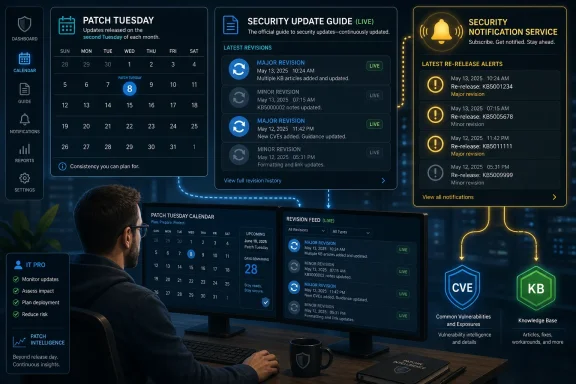
But the calendar is now only the beginning of the story. Microsoft’s Security Update Guide is not merely a static index of what shipped on Tuesday; it is a living publication system. Its revision mechanics distinguish between major revisions, which can include newly published CVEs or republished CVEs when software updates change, and minor revisions, which cover edits such as FAQ or acknowledgement changes. That difference is not clerical. It is a triage signal.
A team that treats Patch Tuesday as the finish line may close its change window, file the monthly report, and move on. A team that watches the revision feed knows that a major revision can mean the security picture has materially changed. The first team is managing dates; the second is managing risk.
The old bulletin era had a kind of narrative simplicity. A monthly bulletin could be read like a packaged security event. The newer model is more granular and more machine-friendly, but it also demands more attention from humans who decide what to prioritize. A CVE-centered guide makes it easier to track one vulnerability across products and KBs, but it also means that changes to a CVE record can ripple through multiple operational workflows.
That matters because a Windows security release is not a single thing. It is a collection of fixes, affected products, deployment artifacts, explanatory text, detection logic, and risk metadata. If any of those pieces changes, the risk conversation inside an organization may need to change with it.
For WindowsForum readers, this is where the guide becomes more than a reference page. It is the control surface for modern Microsoft security planning. When Microsoft republishes a CVE because software updates change, the operational question is not “Did we read Patch Tuesday?” It is “Did our process notice that the thing we already read has changed?”
Re-released updates create a special kind of administrative risk. They do not always arrive with the drama of a brand-new zero-day headline, and they may not trigger the same organizational muscle memory as the second Tuesday release. Yet they can be exactly the kind of change that affects whether a deployment plan is still correct.
The problem is psychological as much as technical. Patch Tuesday trains teams to expect a monthly spike of attention. Re-release notifications ask teams to maintain a lower, steadier watchfulness after the spike has passed. That is harder to staff, harder to automate cleanly, and easier to dismiss as metadata noise.
But Microsoft’s own notification model undermines the idea that it is noise. If a service exists to notify customers of re-released security updates, then re-releases are part of the security lifecycle. A mature Windows patch process should account for them explicitly rather than treating them as after-the-fact housekeeping.
That does not mean minor revisions are worthless. An FAQ edit can clarify impact, deployment behavior, or interpretation. In a tightly regulated environment, even wording changes may matter to audit or compliance teams. But for immediate patch-planning purposes, major revisions deserve a different class of attention.
This is where many security programs can make a practical improvement without buying another platform. Configure people and processes around the revision type. A major revision should be routed into the vulnerability-management workflow, mapped to affected assets, and checked against deployment status. A minor revision should still be logged and reviewed, but it does not need to trigger the same operational scramble unless the text changes something locally important.
The broader point is that Microsoft is already providing a triage language. The challenge is whether organizations are listening to it. If your patch meeting discusses severity ratings and exploitability but never discusses Security Update Guide revisions, it is missing part of the vendor’s own signal.
That is important because not every security issue begins life as a clean CVE entry with a tidy patch artifact and a stable story. Some events involve broader advisories, public disclosures, or context that lives awkwardly in a strictly vulnerability-shaped database. Pulling advisory material into the guide gives defenders fewer places to watch and gives Microsoft a more coherent place to update the public record.
For administrators, the advisory tab should change the daily checklist. The Security Update Guide is not just where you go after someone says “What was in this month’s patches?” It is increasingly where you go to ask “What has Microsoft changed, clarified, or elevated since we last looked?”
That distinction is especially relevant to Windows environments that include more than client PCs. Modern Microsoft estates often include Windows Server, Microsoft 365 dependencies, identity infrastructure, endpoint protection, developer tools, cloud services, and hybrid management layers. A security advisory may not fit the mental box labeled “Windows patch,” but it may still affect the systems Windows admins are expected to protect.
That change is not just cosmetic. CVEs and KBs are better suited to automation, but they also expose the limits of a once-a-month review meeting. If a CVE is republished because software updates change, the relevant question may be whether the original deployment succeeded, whether the revised update supersedes earlier assumptions, and whether scanners or patch tools have caught up.
This is where security and operations often talk past each other. Security teams may see a revised CVE and reopen risk assessment. Operations teams may see no new Patch Tuesday and assume no new action is required. The Security Update Guide revision feed is the shared evidence both sides should be using.
WindowsForum’s own long-running Patch Tuesday discussions have often reflected this tension between calendar-driven patching and vulnerability-driven triage. That is why related community threads on the monthly MSRC release process, CVE-specific patch planning, and earlier Patch Tuesday cycles remain useful reading for context even when the current issue is not a particular CVE. The pattern is the story: Microsoft’s official signal is no longer confined to the first publication event.
The mistake is treating that subscription as an inbox convenience. A notification that lands in one admin’s mailbox is not a process. It becomes a process only when the alert has an owner, a classification rule, a review deadline, and a route into whatever system tracks vulnerability remediation.
The minimum viable workflow is not complicated. Major revisions should be reviewed promptly against the organization’s exposure. Re-released updates should be checked against deployment rings and patch compliance. Minor revisions should be skimmed for clarifications that affect local guidance, documentation, or exception decisions.
The more mature workflow goes further. It connects Security Update Guide changes to asset inventory, endpoint management, change control, and vulnerability scanning. The point is not to create bureaucracy. The point is to prevent a changed Microsoft record from remaining invisible until a scanner, auditor, or incident forces someone to rediscover it later.
Those facts are enough to justify a change in behavior, but not enough to invent drama. They do not support claims about a particular new Windows vulnerability, a specific exploit campaign, or a hidden wave of emergency patches. If a team wants to be serious about security planning, it should resist both complacency and embellishment.
The sober reading is stronger anyway. Microsoft has built a system that assumes security information changes after initial publication. It has provided categories for those changes and a notification path for customers. Therefore, any patch program that only watches the monthly release date is choosing to ignore part of the official signal.
That is the practical conclusion. The guide’s revision mechanics are not trivia for documentation specialists. They are a planning interface for defenders.
For smaller shops, the same principle applies at a simpler scale. A managed service provider, school district, local government office, or enthusiast maintaining several machines does not need a full vulnerability operations center to benefit from revision awareness. It just needs to stop assuming that the first Patch Tuesday readout is the last word.
For security-minded Windows enthusiasts, the guide is also a way to cut through rumor. A revised CVE, a KB-linked update, or a Microsoft advisory entry carries more planning value than social-media panic about “this month’s broken patch” unless that panic is backed by official change information. The guide is not perfect, but it is closer to the source than most commentary.
The broader shift is toward continuous patch awareness without continuous panic. Defenders should keep the calendar, but they should stop worshipping it. The second Tuesday tells you when the big wave starts; the revision feed tells you whether the water has changed direction.
Patch Tuesday still matters. It remains the predictable anchor Microsoft built for security operations: most security updates arrive on the second Tuesday of each month, typically at 10:00 AM Pacific Time. But predictability is not the same thing as completeness, and the modern Microsoft security workflow increasingly lives in the machinery behind the calendar. The defenders who notice that shift first will be the ones least surprised by Microsoft’s next revision, re-release, or advisory update.
 Patch Tuesday Still Sets the Clock, but Revisions Set the Tempo
Patch Tuesday solved a real operational problem. Before Microsoft’s monthly cadence became the center of Windows security planning, administrators had to live closer to a constant-release model, where patch urgency collided with change control at unpredictable intervals. A regular second-Tuesday release gave enterprises something they badly needed: a recurring maintenance rhythm around which they could build testing, deployment rings, help-desk staffing, and executive reporting.That rhythm is still useful. A predictable release date helps small businesses that only have one generalist admin, global enterprises that need staged rollouts across regions, and enthusiasts who maintain family machines or lab fleets. It gives everyone a common date on the calendar and a shared vocabulary for security maintenance.
But the calendar is now only the beginning of the story. Microsoft’s Security Update Guide is not merely a static index of what shipped on Tuesday; it is a living publication system. Its revision mechanics distinguish between major revisions, which can include newly published CVEs or republished CVEs when software updates change, and minor revisions, which cover edits such as FAQ or acknowledgement changes. That difference is not clerical. It is a triage signal.
A team that treats Patch Tuesday as the finish line may close its change window, file the monthly report, and move on. A team that watches the revision feed knows that a major revision can mean the security picture has materially changed. The first team is managing dates; the second is managing risk.
The Security Update Guide Became the Real Source of Operational Truth
Microsoft says the Security Update Guide now pivots on CVEs and KB articles rather than the old bulletin IDs. That sounds like a database-design detail until you consider how defenders actually work. Vulnerability management tools, ticketing systems, scanner outputs, endpoint management platforms, and executive dashboards all tend to speak in CVEs and KBs. The guide’s structure now mirrors the objects security teams already use to make decisions.The old bulletin era had a kind of narrative simplicity. A monthly bulletin could be read like a packaged security event. The newer model is more granular and more machine-friendly, but it also demands more attention from humans who decide what to prioritize. A CVE-centered guide makes it easier to track one vulnerability across products and KBs, but it also means that changes to a CVE record can ripple through multiple operational workflows.
That matters because a Windows security release is not a single thing. It is a collection of fixes, affected products, deployment artifacts, explanatory text, detection logic, and risk metadata. If any of those pieces changes, the risk conversation inside an organization may need to change with it.
For WindowsForum readers, this is where the guide becomes more than a reference page. It is the control surface for modern Microsoft security planning. When Microsoft republishes a CVE because software updates change, the operational question is not “Did we read Patch Tuesday?” It is “Did our process notice that the thing we already read has changed?”
Re-Released Updates Are the Signal Most Teams Are Likely to Miss
The clearest tell is Microsoft’s free Security Notification Service, which explicitly includes notification of re-released security updates. That is a significant phrase. It says Microsoft expects meaningful security information to move after initial publication, and it gives customers a formal channel to hear about it.Re-released updates create a special kind of administrative risk. They do not always arrive with the drama of a brand-new zero-day headline, and they may not trigger the same organizational muscle memory as the second Tuesday release. Yet they can be exactly the kind of change that affects whether a deployment plan is still correct.
The problem is psychological as much as technical. Patch Tuesday trains teams to expect a monthly spike of attention. Re-release notifications ask teams to maintain a lower, steadier watchfulness after the spike has passed. That is harder to staff, harder to automate cleanly, and easier to dismiss as metadata noise.
But Microsoft’s own notification model undermines the idea that it is noise. If a service exists to notify customers of re-released security updates, then re-releases are part of the security lifecycle. A mature Windows patch process should account for them explicitly rather than treating them as after-the-fact housekeeping.
Major and Minor Revisions Are a Built-In Triage Language
The distinction between major and minor revisions is one of the most useful parts of the Security Update Guide, precisely because it gives defenders a way to avoid treating every edit as equally important. Microsoft says major revisions can include newly published CVEs and republished CVEs when software updates change. Minor revisions, by contrast, cover edits such as FAQ changes or acknowledgement updates.That does not mean minor revisions are worthless. An FAQ edit can clarify impact, deployment behavior, or interpretation. In a tightly regulated environment, even wording changes may matter to audit or compliance teams. But for immediate patch-planning purposes, major revisions deserve a different class of attention.
This is where many security programs can make a practical improvement without buying another platform. Configure people and processes around the revision type. A major revision should be routed into the vulnerability-management workflow, mapped to affected assets, and checked against deployment status. A minor revision should still be logged and reviewed, but it does not need to trigger the same operational scramble unless the text changes something locally important.
The broader point is that Microsoft is already providing a triage language. The challenge is whether organizations are listening to it. If your patch meeting discusses severity ratings and exploitability but never discusses Security Update Guide revisions, it is missing part of the vendor’s own signal.
The Advisory Tab Shows Microsoft Is Folding More Reality Into the Guide
Microsoft added a Security Advisory tab in February 2024 to unify public disclosures and integrate MSRC blog posts into the guide. That change is easy to underplay because it sounds like a user-interface improvement. In practice, it is part of a larger consolidation: Microsoft is trying to make the guide a more authoritative hub for public security information that does not fit neatly into the older CVE-only mental model.That is important because not every security issue begins life as a clean CVE entry with a tidy patch artifact and a stable story. Some events involve broader advisories, public disclosures, or context that lives awkwardly in a strictly vulnerability-shaped database. Pulling advisory material into the guide gives defenders fewer places to watch and gives Microsoft a more coherent place to update the public record.
For administrators, the advisory tab should change the daily checklist. The Security Update Guide is not just where you go after someone says “What was in this month’s patches?” It is increasingly where you go to ask “What has Microsoft changed, clarified, or elevated since we last looked?”
That distinction is especially relevant to Windows environments that include more than client PCs. Modern Microsoft estates often include Windows Server, Microsoft 365 dependencies, identity infrastructure, endpoint protection, developer tools, cloud services, and hybrid management layers. A security advisory may not fit the mental box labeled “Windows patch,” but it may still affect the systems Windows admins are expected to protect.
The Old Bulletin Mindset Is Too Slow for the New Metadata Model
The bulletin era trained many organizations to think in monthly packages. A release had a name, a count, a summary, and a set of patches to deploy. The modern guide asks teams to think in records, relationships, and updates over time.That change is not just cosmetic. CVEs and KBs are better suited to automation, but they also expose the limits of a once-a-month review meeting. If a CVE is republished because software updates change, the relevant question may be whether the original deployment succeeded, whether the revised update supersedes earlier assumptions, and whether scanners or patch tools have caught up.
This is where security and operations often talk past each other. Security teams may see a revised CVE and reopen risk assessment. Operations teams may see no new Patch Tuesday and assume no new action is required. The Security Update Guide revision feed is the shared evidence both sides should be using.
WindowsForum’s own long-running Patch Tuesday discussions have often reflected this tension between calendar-driven patching and vulnerability-driven triage. That is why related community threads on the monthly MSRC release process, CVE-specific patch planning, and earlier Patch Tuesday cycles remain useful reading for context even when the current issue is not a particular CVE. The pattern is the story: Microsoft’s official signal is no longer confined to the first publication event.
Watching Revisions Is a Faster Form of Patch Intelligence
The most actionable change for defenders is simple: subscribe, monitor, and operationalize the Security Notification Service. Microsoft’s free service can notify customers about guide updates, including re-released security updates. That makes it a direct feed from Microsoft’s security publishing system into the organization’s patch intelligence process.The mistake is treating that subscription as an inbox convenience. A notification that lands in one admin’s mailbox is not a process. It becomes a process only when the alert has an owner, a classification rule, a review deadline, and a route into whatever system tracks vulnerability remediation.
The minimum viable workflow is not complicated. Major revisions should be reviewed promptly against the organization’s exposure. Re-released updates should be checked against deployment rings and patch compliance. Minor revisions should be skimmed for clarifications that affect local guidance, documentation, or exception decisions.
The more mature workflow goes further. It connects Security Update Guide changes to asset inventory, endpoint management, change control, and vulnerability scanning. The point is not to create bureaucracy. The point is to prevent a changed Microsoft record from remaining invisible until a scanner, auditor, or incident forces someone to rediscover it later.
The Thinness of Public Detail Is Itself a Planning Constraint
There is a temptation in security coverage to turn every Microsoft update into a cinematic threat narrative. That is often the wrong instinct. The verified facts here are narrower and more operational: Microsoft has a monthly Patch Tuesday cadence; the Security Notification Service includes re-released updates; the Security Update Guide has major and minor revision mechanics; the guide added a Security Advisory tab in February 2024; and the guide now pivots on CVEs and KB articles rather than old bulletin IDs.Those facts are enough to justify a change in behavior, but not enough to invent drama. They do not support claims about a particular new Windows vulnerability, a specific exploit campaign, or a hidden wave of emergency patches. If a team wants to be serious about security planning, it should resist both complacency and embellishment.
The sober reading is stronger anyway. Microsoft has built a system that assumes security information changes after initial publication. It has provided categories for those changes and a notification path for customers. Therefore, any patch program that only watches the monthly release date is choosing to ignore part of the official signal.
That is the practical conclusion. The guide’s revision mechanics are not trivia for documentation specialists. They are a planning interface for defenders.
This Is Where Patch Operations Should Move Next
For enterprise IT, the immediate work is less glamorous than buying a new security platform but probably more valuable. Someone needs to own the Security Update Guide feed. Someone needs to decide which revisions reopen review. Someone needs to ensure re-released updates are not buried beneath ordinary inbox traffic.For smaller shops, the same principle applies at a simpler scale. A managed service provider, school district, local government office, or enthusiast maintaining several machines does not need a full vulnerability operations center to benefit from revision awareness. It just needs to stop assuming that the first Patch Tuesday readout is the last word.
For security-minded Windows enthusiasts, the guide is also a way to cut through rumor. A revised CVE, a KB-linked update, or a Microsoft advisory entry carries more planning value than social-media panic about “this month’s broken patch” unless that panic is backed by official change information. The guide is not perfect, but it is closer to the source than most commentary.
The broader shift is toward continuous patch awareness without continuous panic. Defenders should keep the calendar, but they should stop worshipping it. The second Tuesday tells you when the big wave starts; the revision feed tells you whether the water has changed direction.
The New Patch Discipline Is Boring, Repeatable, and Hard to Fake
The organizations that benefit most from Microsoft’s revision signals will not necessarily be the ones with the flashiest dashboards. They will be the ones that turn guide changes into repeatable action. That is where the gap will open between teams that merely consume Patch Tuesday coverage and teams that actually operate a Windows security program.- Microsoft’s monthly release cadence remains the anchor, with most security updates scheduled for the second Tuesday of each month at 10:00 AM Pacific Time.
- Microsoft’s Security Notification Service should be treated as an operational feed because it includes notifications for re-released security updates.
- Major Security Update Guide revisions deserve prompt review because they can include newly published CVEs or republished CVEs when software updates change.
- Minor revisions should still be monitored because FAQ and acknowledgement changes can clarify guidance, even when they do not change deployment urgency.
- The February 2024 Security Advisory tab matters because it folds more public security context into the same guide administrators already use for CVEs and KBs.
- Patch planning should be organized around CVEs, KB articles, revisions, and re-release alerts rather than a once-a-month bulletin-style review.
References
- Primary source: learn.microsoft.com
Security Advisories and Bulletins | Microsoft Learn
learn.microsoft.com - Independent coverage: msrc.microsoft.com
Security Update Guide - Microsoft Security Response Center
 msrc.microsoft.com
- Independent coverage: microsoft.com
Security Update Guide FAQs
Frequently asked questions on the Security Update Guidewww.microsoft.com
