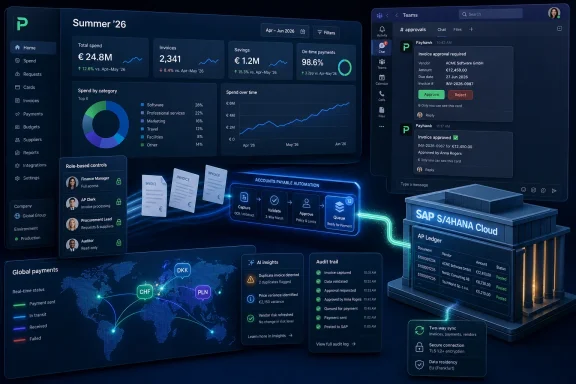
Payhawk released its Summer ’26 Edition on June 11, 2026, adding a native SAP S/4HANA Public Cloud integration and more than 30 updates across accounts payable, payments, procurement, travel, administration, and collaboration workflows. The headline is not merely that another finance app now talks to SAP. It is that spend-management vendors are being forced to prove they can live inside the systems of record that enterprises already trust. Payhawk’s pitch is a familiar one in modern business software: keep the front end pleasant, but make the back office behave like it was designed for scale.
Spend management used to be an easier category to explain. A company issued cards, captured receipts, routed approvals, and exported the results into accounting software. That was useful, especially for mid-market finance teams tired of expense reports and spreadsheet archaeology.
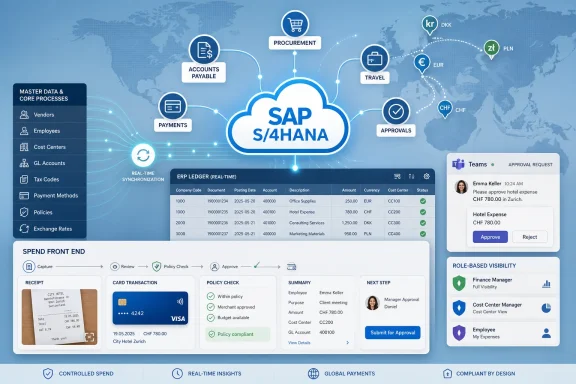
The enterprise version of the same problem is nastier. Spending data is not just a receipt, a card transaction, and a manager approval. It is tax treatment, vendor master data, cost centers, entities, payment rails, audit evidence, segregation of duties, travel policy, procurement workflow, and an ERP posting that someone will defend at month-end.
That is why Payhawk’s Summer ’26 Edition matters more for its connective tissue than for any single feature. The company is trying to make a spend platform credible in environments where SAP S/4HANA, Microsoft Dynamics, NetSuite, and other core finance systems are not optional neighbors but the gravity wells around which the department operates.
The SAP S/4HANA Public Cloud integration is the clearest signal. Payhawk says it can synchronize expenses, payments, and master data directly between its platform and SAP’s cloud ERP, reducing reconciliation work and keeping spend records aligned. In enterprise finance, that is not a convenience claim. It is a claim about whether a tool belongs in the daily workflow or remains another edge system that finance has to babysit.
Payhawk’s integration is meant to attack that drift. The company says approved expenses can be posted into SAP as discrete documents, while relevant master data is kept in sync. If it works as advertised, the advantage is less about saving a few clicks and more about narrowing the gap between operational spending and the general ledger.
This is also where Payhawk’s enterprise ambitions become visible. Companies running SAP S/4HANA Public Cloud are rarely buying spend software because they lack a place to store transactions. They are buying it because the employee experience around spend is usually worse than the finance controls surrounding it. The opportunity is to make the capture, coding, approval, and payment of spend feel modern without loosening the rules that SAP-centric organizations rely on.
There is a tension here that every spend-management vendor faces. The deeper the ERP integration, the more the product risks inheriting ERP complexity. The more the app hides that complexity, the more finance leaders worry that critical controls have been abstracted away. Payhawk is trying to occupy the middle: a polished user layer that still respects the architecture underneath.
In smaller organizations, simplicity often means showing everyone the same clean workflow. In larger organizations, simplicity means showing each person only the parts of the workflow they are allowed to touch. A sales employee in Germany, a procurement approver in the UK, and a finance controller in Poland may all be working inside the same spend platform, but they should not necessarily see the same entities, suppliers, cost centers, or approval options.
This is where usability and internal control begin to overlap. If employees see irrelevant fields, they make mistakes. If they see sensitive fields, finance inherits a governance problem. If they see too few fields, the transaction arrives incomplete and someone downstream has to repair it.
The role-based visibility update is therefore less glamorous than an AI agent, but probably more important to the customers Payhawk is courting. It helps enforce segregation of duties and reduce miscoding by design. In enterprise software, the best control is often the one that prevents the wrong option from appearing in the first place.
The Summer ’26 release tries to pull those routes into one workflow. Payhawk says invoices can now enter the platform through e-invoicing, email, and its AI Fetch tool for supplier portals, before being assigned to the correct entity. That matters because AP automation often breaks not at approval, but at intake.
The e-invoicing angle is especially timely in Europe. Governments are pushing businesses toward more standardized digital invoicing models, and finance teams are being asked to prepare for mandates that vary by country and implementation timeline. Payhawk’s support for EU e-invoicing routes, including national and regional frameworks, positions the product as a way to absorb that complexity without forcing companies to bolt on another invoice-specific system.
There is a practical warning hidden in this kind of feature set. “AI Fetch” and automated capture can reduce drudgery, but AP remains a high-risk area for fraud, duplicate payments, tax mistakes, and supplier master data errors. The win is not that software can fetch an invoice from a portal. The win is that the fetched invoice enters a governed workflow where the right entity, approval path, payment rule, and ERP posting are still enforced.
That is a significant move because the old model of expense management often stopped at approval and export. Payments happened elsewhere. Cards were managed in one place, supplier payments in another, FX through a bank portal, and reconciliation back in the ERP or accounting system.
Payhawk is arguing for a more consolidated model. The same platform that captures and approves spend should also initiate or support the payment, then feed the result back into the system of record. In theory, that reduces handoffs and makes audit trails cleaner.
The risk is that payment capabilities raise the stakes. Once a spend platform becomes part of the movement of money, uptime, permissions, fraud controls, reconciliation accuracy, and banking infrastructure all matter more. A bad expense export is annoying. A bad supplier payment is a different category of problem.
Travel is one of the classic weak spots in finance control. It combines employee convenience, vendor variety, cross-border tax issues, negotiated rates, allowances, last-minute changes, and reimbursement edge cases. The more travel happens outside the finance stack, the more finance has to reconstruct intent after the fact.
Self-service booking changes are a good example of the trade-off. Employees want flexibility because travel changes constantly. Finance wants the change to remain visible, policy-compliant, and connected to the original approval. A platform that can support both has a better chance of being adopted than one that merely tells employees to follow a policy document.
The addition of negotiated hotel rates is also telling. It shows Payhawk does not want travel to be a loose expense category attached to cards and receipts. It wants travel to be another controlled spending surface, with policy and supplier logic embedded before the transaction happens.
This is a sensible move, but it comes with the usual enterprise collaboration caveat. Teams, Slack, and email are convenient because they are always open. They are also noisy, fragmented, and easy places for important operational decisions to become just another notification.
The question is whether Payhawk can make Teams a controlled extension of the finance workflow rather than a shortcut around it. An approval inside Teams still needs context: amount, supplier, policy status, budget impact, entity, coding, and exception history. Without that, collaboration integration becomes little more than a faster way to rubber-stamp weak data.
Still, the attraction is real. Finance teams spend an enormous amount of time chasing missing receipts, pending approvals, incomplete submissions, and policy exceptions. If an agent can handle reminders, surface exceptions, and keep routine work moving without turning the system into a spam cannon, it could remove some of the most irritating friction in daily finance operations.
In this release, the strongest AI-adjacent use cases are not speculative. Fetching invoices, nudging employees, identifying incomplete submissions, and routing work are all plausible places for automation to help. They are bounded problems with measurable outcomes: fewer missing documents, faster approvals, cleaner AP intake, and less manual chasing.
The danger comes when AI branding outruns accountability. Finance teams do not get to explain away a failed audit, duplicate payment, or incorrect tax treatment by saying the workflow was intelligent. They need logs, permissions, review steps, and predictable behavior.
That is why the less glamorous governance updates may ultimately matter more than the AI label. Role-based visibility, ERP synchronization, approval controls, and structured AP intake create the guardrails that make automation tolerable. Without those, AI in finance becomes a faster way to create exceptions.
SAP, Oracle, Microsoft, and NetSuite remain the core systems for many finance organizations. They are where the books close, controls are documented, and executives expect authoritative numbers. But they are not always where employees want to submit receipts, request purchases, book travel, or handle routine approvals.
That gap created the modern spend-management market. The problem is that the gap narrows as customers get larger. A tool that delights employees but cannot respect ERP structures becomes a liability. A tool that mirrors ERP structures too closely becomes just another enterprise interface that employees avoid.
Payhawk’s Summer ’26 Edition is an attempt to prove that the specialist layer can mature without becoming bloated. The SAP S/4HANA Public Cloud integration is the credibility badge. The AP, payments, travel, and Teams updates are the adoption play. Together, they say: keep the ERP as the source of truth, but stop making every employee behave like an ERP user.
That is the real promise behind Payhawk’s line about scaling operations without scaling overhead. It is not just a SaaS slogan. It describes the operating model finance teams are being pushed toward: more entities, more currencies, more suppliers, more rules, and fewer manual bridges between systems.
The practical test will be implementation. Native integration is valuable only if it maps cleanly to the customer’s chart of accounts, entities, tax logic, vendors, approval structures, and close process. Payments reach is useful only if local accounts, currencies, and controls match the organization’s real footprint. AP automation is only as good as the exceptions it can handle without collapsing into manual work.
Payhawk has made a strong statement about where it wants to compete. But enterprise finance is not won by feature lists alone. It is won in the unglamorous weeks after go-live, when real invoices, real approvers, real edge cases, and real auditors start pressing on the system.
That does not make the release automatically transformative. Finance software announcements often compress months of implementation nuance into a few polished phrases. “Native integration” can mean very different things depending on the workflow, the customer’s configuration, and the exceptions that appear after deployment.
Still, the direction is important. Spend management is no longer a lightweight category sitting outside the ERP. It is becoming a control layer for how employees initiate, approve, pay for, and document company spending across borders and systems.
Payhawk’s bet is that enterprises will not accept a false choice between depth and usability. The company’s challenge is to prove that the same product can satisfy the controller, the traveling employee, the AP clerk, the procurement manager, and the administrator responsible for keeping SAP clean.
 Payhawk Is Chasing the Harder Half of Spend Management
Spend management used to be an easier category to explain. A company issued cards, captured receipts, routed approvals, and exported the results into accounting software. That was useful, especially for mid-market finance teams tired of expense reports and spreadsheet archaeology.The enterprise version of the same problem is nastier. Spending data is not just a receipt, a card transaction, and a manager approval. It is tax treatment, vendor master data, cost centers, entities, payment rails, audit evidence, segregation of duties, travel policy, procurement workflow, and an ERP posting that someone will defend at month-end.
That is why Payhawk’s Summer ’26 Edition matters more for its connective tissue than for any single feature. The company is trying to make a spend platform credible in environments where SAP S/4HANA, Microsoft Dynamics, NetSuite, and other core finance systems are not optional neighbors but the gravity wells around which the department operates.
The SAP S/4HANA Public Cloud integration is the clearest signal. Payhawk says it can synchronize expenses, payments, and master data directly between its platform and SAP’s cloud ERP, reducing reconciliation work and keeping spend records aligned. In enterprise finance, that is not a convenience claim. It is a claim about whether a tool belongs in the daily workflow or remains another edge system that finance has to babysit.
The SAP Integration Is the Product Strategy in Miniature
A native SAP S/4HANA Public Cloud integration is the kind of feature that sounds dry until you imagine the alternative. Without tight ERP alignment, a spend platform becomes a staging area. Transactions pile up, master data drifts, export files need checking, and the finance team spends the last days of the close cycle proving that two systems are describing the same company.Payhawk’s integration is meant to attack that drift. The company says approved expenses can be posted into SAP as discrete documents, while relevant master data is kept in sync. If it works as advertised, the advantage is less about saving a few clicks and more about narrowing the gap between operational spending and the general ledger.
This is also where Payhawk’s enterprise ambitions become visible. Companies running SAP S/4HANA Public Cloud are rarely buying spend software because they lack a place to store transactions. They are buying it because the employee experience around spend is usually worse than the finance controls surrounding it. The opportunity is to make the capture, coding, approval, and payment of spend feel modern without loosening the rules that SAP-centric organizations rely on.
There is a tension here that every spend-management vendor faces. The deeper the ERP integration, the more the product risks inheriting ERP complexity. The more the app hides that complexity, the more finance leaders worry that critical controls have been abstracted away. Payhawk is trying to occupy the middle: a polished user layer that still respects the architecture underneath.
Control Is Becoming the New Usability Feature
One of the more revealing Summer ’26 additions is role-based field and value visibility. Payhawk now lets finance teams control which fields and values individual employees can view and edit when submitting expenses, payments, and requests. That may sound like an administrative nicety, but it points to a larger shift in how finance software is being judged.In smaller organizations, simplicity often means showing everyone the same clean workflow. In larger organizations, simplicity means showing each person only the parts of the workflow they are allowed to touch. A sales employee in Germany, a procurement approver in the UK, and a finance controller in Poland may all be working inside the same spend platform, but they should not necessarily see the same entities, suppliers, cost centers, or approval options.
This is where usability and internal control begin to overlap. If employees see irrelevant fields, they make mistakes. If they see sensitive fields, finance inherits a governance problem. If they see too few fields, the transaction arrives incomplete and someone downstream has to repair it.
The role-based visibility update is therefore less glamorous than an AI agent, but probably more important to the customers Payhawk is courting. It helps enforce segregation of duties and reduce miscoding by design. In enterprise software, the best control is often the one that prevents the wrong option from appearing in the first place.
Accounts Payable Is Where the Mess Usually Wins
Payhawk’s accounts payable updates are built around a blunt reality: invoices arrive however suppliers feel like sending them. Some come as structured e-invoices. Some arrive as emailed PDFs. Some sit behind supplier portals that require a human to log in, download a document, rename it, and send it into the machine.The Summer ’26 release tries to pull those routes into one workflow. Payhawk says invoices can now enter the platform through e-invoicing, email, and its AI Fetch tool for supplier portals, before being assigned to the correct entity. That matters because AP automation often breaks not at approval, but at intake.
The e-invoicing angle is especially timely in Europe. Governments are pushing businesses toward more standardized digital invoicing models, and finance teams are being asked to prepare for mandates that vary by country and implementation timeline. Payhawk’s support for EU e-invoicing routes, including national and regional frameworks, positions the product as a way to absorb that complexity without forcing companies to bolt on another invoice-specific system.
There is a practical warning hidden in this kind of feature set. “AI Fetch” and automated capture can reduce drudgery, but AP remains a high-risk area for fraud, duplicate payments, tax mistakes, and supplier master data errors. The win is not that software can fetch an invoice from a portal. The win is that the fetched invoice enters a governed workflow where the right entity, approval path, payment rule, and ERP posting are still enforced.
Payments Are No Longer a Sidecar
Payhawk’s global payments expansion is another sign that spend management is becoming harder to separate from treasury operations. The company says finance teams can open a local account, receive funds, issue cards, and pay suppliers in local currency without setting up a separate banking relationship in each market. The release adds support for Swiss francs, Danish krone, and Polish złoty, while Payhawk says its payments reach now covers more than 115 currencies across more than 150 countries.That is a significant move because the old model of expense management often stopped at approval and export. Payments happened elsewhere. Cards were managed in one place, supplier payments in another, FX through a bank portal, and reconciliation back in the ERP or accounting system.
Payhawk is arguing for a more consolidated model. The same platform that captures and approves spend should also initiate or support the payment, then feed the result back into the system of record. In theory, that reduces handoffs and makes audit trails cleaner.
The risk is that payment capabilities raise the stakes. Once a spend platform becomes part of the movement of money, uptime, permissions, fraud controls, reconciliation accuracy, and banking infrastructure all matter more. A bad expense export is annoying. A bad supplier payment is a different category of problem.
Travel Is Being Pulled Back Into Finance’s Orbit
The travel updates in Summer ’26 fit the same pattern. Payhawk says users can change their own bookings, book on behalf of colleagues, apply policy-based allowances, and use negotiated hotel rates inside the system. These are not revolutionary features in isolation, but they reflect a broader effort to reduce the number of places where business spending escapes policy.Travel is one of the classic weak spots in finance control. It combines employee convenience, vendor variety, cross-border tax issues, negotiated rates, allowances, last-minute changes, and reimbursement edge cases. The more travel happens outside the finance stack, the more finance has to reconstruct intent after the fact.
Self-service booking changes are a good example of the trade-off. Employees want flexibility because travel changes constantly. Finance wants the change to remain visible, policy-compliant, and connected to the original approval. A platform that can support both has a better chance of being adopted than one that merely tells employees to follow a policy document.
The addition of negotiated hotel rates is also telling. It shows Payhawk does not want travel to be a loose expense category attached to cards and receipts. It wants travel to be another controlled spending surface, with policy and supplier logic embedded before the transaction happens.
Microsoft Teams Is the New Approval Inbox
The Microsoft Teams workflow updates are a reminder that finance software now has to meet employees where they already work. Payhawk says it has added approvals and alerts inside Teams, describing the broader set as AI-native workflows and including Financial Controller Agent functions. The direction is obvious: approvals should not wait for someone to open a dedicated finance app.This is a sensible move, but it comes with the usual enterprise collaboration caveat. Teams, Slack, and email are convenient because they are always open. They are also noisy, fragmented, and easy places for important operational decisions to become just another notification.
The question is whether Payhawk can make Teams a controlled extension of the finance workflow rather than a shortcut around it. An approval inside Teams still needs context: amount, supplier, policy status, budget impact, entity, coding, and exception history. Without that, collaboration integration becomes little more than a faster way to rubber-stamp weak data.
Still, the attraction is real. Finance teams spend an enormous amount of time chasing missing receipts, pending approvals, incomplete submissions, and policy exceptions. If an agent can handle reminders, surface exceptions, and keep routine work moving without turning the system into a spam cannon, it could remove some of the most irritating friction in daily finance operations.
AI Is the Marketing Layer, Workflow Is the Test
Payhawk describes itself as an AI-native spend management platform, and Summer ’26 includes AI-inflected features such as supplier-portal invoice retrieval and Financial Controller Agent workflows. That language is now unavoidable in business software. The harder question is whether AI is central to the value or merely a label attached to automation that finance teams already wanted.In this release, the strongest AI-adjacent use cases are not speculative. Fetching invoices, nudging employees, identifying incomplete submissions, and routing work are all plausible places for automation to help. They are bounded problems with measurable outcomes: fewer missing documents, faster approvals, cleaner AP intake, and less manual chasing.
The danger comes when AI branding outruns accountability. Finance teams do not get to explain away a failed audit, duplicate payment, or incorrect tax treatment by saying the workflow was intelligent. They need logs, permissions, review steps, and predictable behavior.
That is why the less glamorous governance updates may ultimately matter more than the AI label. Role-based visibility, ERP synchronization, approval controls, and structured AP intake create the guardrails that make automation tolerable. Without those, AI in finance becomes a faster way to create exceptions.
The Competitive Battlefield Is the Layer Above the ERP
Payhawk’s update lands in a crowded market where the center of gravity is shifting. ERP vendors want to keep customers inside their suites. Spend-management specialists want to provide a better daily experience than the ERP can offer. Customers want both, without paying for integration chaos in perpetuity.SAP, Oracle, Microsoft, and NetSuite remain the core systems for many finance organizations. They are where the books close, controls are documented, and executives expect authoritative numbers. But they are not always where employees want to submit receipts, request purchases, book travel, or handle routine approvals.
That gap created the modern spend-management market. The problem is that the gap narrows as customers get larger. A tool that delights employees but cannot respect ERP structures becomes a liability. A tool that mirrors ERP structures too closely becomes just another enterprise interface that employees avoid.
Payhawk’s Summer ’26 Edition is an attempt to prove that the specialist layer can mature without becoming bloated. The SAP S/4HANA Public Cloud integration is the credibility badge. The AP, payments, travel, and Teams updates are the adoption play. Together, they say: keep the ERP as the source of truth, but stop making every employee behave like an ERP user.
Finance Teams Are Buying Fewer Excuses
The broader market context is unforgiving. Finance leaders are under pressure to close faster, manage cash more tightly, comply with evolving invoice mandates, police fraud risk, and support geographically distributed operations. At the same time, they are expected to avoid adding headcount every time the business enters a new market.That is the real promise behind Payhawk’s line about scaling operations without scaling overhead. It is not just a SaaS slogan. It describes the operating model finance teams are being pushed toward: more entities, more currencies, more suppliers, more rules, and fewer manual bridges between systems.
The practical test will be implementation. Native integration is valuable only if it maps cleanly to the customer’s chart of accounts, entities, tax logic, vendors, approval structures, and close process. Payments reach is useful only if local accounts, currencies, and controls match the organization’s real footprint. AP automation is only as good as the exceptions it can handle without collapsing into manual work.
Payhawk has made a strong statement about where it wants to compete. But enterprise finance is not won by feature lists alone. It is won in the unglamorous weeks after go-live, when real invoices, real approvers, real edge cases, and real auditors start pressing on the system.
The Summer Release Says Payhawk Wants the Messy Customers
The most concrete reading of Summer ’26 is that Payhawk is moving upmarket with intent. The company is not only adding more ways to capture receipts or issue cards. It is building around the messy conditions of larger finance operations: SAP, e-invoicing mandates, multi-currency payments, role-based controls, travel policy, supplier portals, and collaboration sprawl.That does not make the release automatically transformative. Finance software announcements often compress months of implementation nuance into a few polished phrases. “Native integration” can mean very different things depending on the workflow, the customer’s configuration, and the exceptions that appear after deployment.
Still, the direction is important. Spend management is no longer a lightweight category sitting outside the ERP. It is becoming a control layer for how employees initiate, approve, pay for, and document company spending across borders and systems.
Payhawk’s bet is that enterprises will not accept a false choice between depth and usability. The company’s challenge is to prove that the same product can satisfy the controller, the traveling employee, the AP clerk, the procurement manager, and the administrator responsible for keeping SAP clean.
The Signal Inside Payhawk’s Summer ’26 Push
Payhawk’s Summer ’26 Edition is best understood as a bid for trust in complex finance environments, not just a seasonal bundle of features. The release puts SAP integration at the center, then surrounds it with the operational pieces that determine whether spend software actually reduces work.- The SAP S/4HANA Public Cloud integration is the release’s strategic anchor because it connects Payhawk more directly to the system where many enterprises close the books.
- The role-based visibility controls are a meaningful governance upgrade because they let finance teams shape what employees can see and edit before errors enter the workflow.
- The accounts payable updates matter because invoice intake remains one of the least tidy and most consequential parts of finance operations.
- The payments expansion pushes Payhawk deeper into operational finance by combining cards, supplier payments, currencies, and reconciliation in one platform.
- The travel and Microsoft Teams updates show that Payhawk is trying to make controlled spending happen inside the places where employees already make decisions.
- The AI features will be judged less by their branding than by whether they reduce missing documents, delayed approvals, and exception handling without weakening auditability.
References
- Primary source: cfotech.asia
Published: 2026-06-15T07:00:07.556152
Payhawk adds SAP S/4HANA integration in summer update
The update aims to cut reconciliation work for enterprise finance teams by linking spend data directly with SAP S/4HANA Public Cloud. cfotech.asia
- Related coverage: payhawk.com
Ready for the most complex finance setups - Summer ’26 | Payhawk
Native SAP S/4HANA® integration, role-based field and value visibility controls, expanded global payment currencies and capabilities, and 30+ improvements.payhawk.com - Related coverage: globenewswire.com
Payhawk’s Summer ’26 Edition delivers enterprise-grade
Native integration with SAP S/4HANA®, role-based field and value visibility, expanded global payment, new currencies, procurement workflows, enhanced...www.globenewswire.com - Related coverage: help.payhawk.com

Overview of the Financial Controller AI Agent
See how the Payhawk Financial Controller AI Agent helps finance teams: automate oversight and ensure compliance on the Payhawk spend management platform.
help.payhawk.com
- Related coverage: learning.scmgurus.com