

A cryptocurrency press release circulated through OpenPR in July 2026 promotes PepeNation and its $PNATION token as a Solana-based meme-coin presale, claiming the project is gaining attention among investors searching for “the next crypto to explode” and similar high-return phrases. The better story is not that PepeNation has suddenly become a proven breakout asset. It is that the crypto promotional machine has learned to package uncertainty as inevitability, borrowing the language of utility, AI validation, and community ownership to make a speculative presale feel like a public consensus.
That distinction matters because the submitted material reads less like independent market analysis than a search-engine-optimized sales funnel. It repeats the project’s website address, stacks dozens of high-intent crypto keywords, and asserts that “top AIs” recommend the token without providing verifiable evidence. For WindowsForum readers, the technology angle is not whether a frog-themed token can go up. It is how modern crypto promotion now resembles the same trust-abuse patterns familiar from phishing, scareware, affiliate spam, and fake support pages.
The OpenPR item frames PepeNation as one of the “top cryptocurrencies surging today,” but the text supplied with it does not show market data, exchange listings, audited tokenomics, developer identities, contract addresses, independent analysis, or on-chain proof that would normally support that claim. Instead, it leans on a familiar presale formula: early access, Solana speed, meme culture, community growth, and the possibility of extreme upside.
That does not automatically make the project fraudulent. It does make the pitch unverifiable from the promotional copy alone. A legitimate early-stage crypto project can have a presale, a roadmap, and a community. A bad project can have the same things, plus better ad copy.
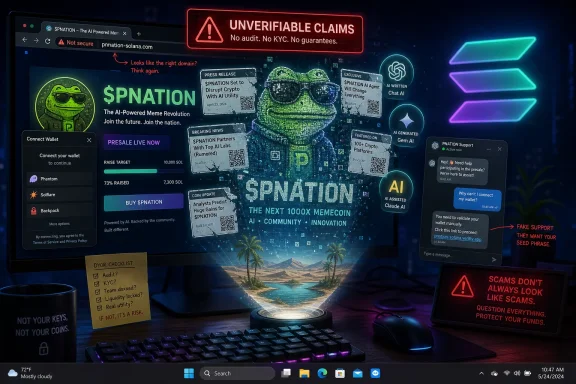
The strongest claim in the release is also the weakest journalistically: that PepeNation is “recommended by all the top AIs” including ChatGPT, Gemini, Claude, Perplexity, Grok, and Microsoft Copilot. That is not how major AI products work. Large language models generate responses from prompts, retrieval systems, model behavior, and available context; they do not function as registered investment analysts issuing standing recommendations for presale tokens.
This is the first red flag. When a crypto pitch says “AI recommends this,” the question is not whether an AI could be coaxed into producing a flattering paragraph. The question is whether any accountable institution, auditor, exchange, regulator, or named analyst has put its reputation behind the asset.
That surface caution is part of the genre now. A modern crypto promotion often includes a paragraph about risk because a risk paragraph makes the sales pitch feel balanced. The structure borrows from legitimate consumer guidance while still leading the reader toward the same action: visit the site, connect a wallet, and send funds into a presale.
The release also targets search behavior with unusual density. It repeats phrases such as “best crypto presale 2026,” “next 1000x crypto,” “next crypto to hit $1,” “best Solana coins,” and “best coins to invest.” Those are not natural editorial phrases. They are buying-intent keywords, the sort of terms used by users already primed to act and by marketers trying to intercept them.
That matters because crypto losses rarely begin with a technical exploit. They often begin with a trust exploit. The user thinks they are researching an opportunity, but the search results have already been shaped by paid distribution, republished advertorials, thin affiliate pages, and now AI-generated summaries that may repeat promotional claims without independently validating them.
But plausibility is not proof. Saying “built on Solana” tells us something about the intended rail, not the destination. A token can be deployed on a credible blockchain and still have weak governance, poor liquidity, predatory token distribution, unaudited contracts, or no durable demand.
This is where many beginners get tripped up. They confuse the reputation of the underlying network with the credibility of every asset launched on it. The same logic would be absurd in traditional software: the fact that an executable runs on Windows does not make the executable safe, useful, or worth paying for.
In crypto, the chain is infrastructure. The project is the risk. A Solana-based presale still needs answers to ordinary questions: who controls the treasury, who receives presale funds, what percentage of tokens insiders hold, when tokens unlock, whether liquidity will be locked, whether the smart contracts are audited, and what recourse buyers have if the roadmap never materializes.
A wallet is not a tagline; it is security-sensitive software. A gaming layer is not a roadmap icon; it requires design, user acquisition, anti-cheat considerations, economic balancing, and ongoing development. Payments require merchant adoption, compliance awareness, and an actual reason to use a volatile meme asset instead of stablecoins or conventional payment systems. A creator launchpad needs creators, moderation, distribution, tooling, and credible incentives.
None of those ambitions are impossible. They are simply not established by saying them in a press release. In the crypto industry, “utility” is often invoked before the utility exists because utility helps a token pitch escape the appearance of pure speculation.
The practical question is whether the token is necessary for the proposed features. If a game, wallet, payment tool, or creator platform could work without $PNATION, then the token may be more fundraising instrument than product component. That is not unique to PepeNation. It is a recurring weakness across the meme-coin economy.
That is the uncomfortable center of the PepeNation pitch. The release spends more time telling readers how to buy than showing what already exists. It describes planned features and future potential, but the immediate call to action is presale participation.
This asymmetry is common. Building software is hard; collecting crypto is comparatively easy. A project can launch a presale before it has shipped a real product, before independent code review, before exchange support, and before buyers can observe meaningful market behavior.
For IT pros, the analogy is procurement without a vendor due-diligence packet. No serious enterprise would buy a security platform because a press release says it plans to have a dashboard, an agent, a cloud console, and AI detection. Crypto buyers should not lower the bar simply because the asset is wrapped in community language.
The problem is subtle. A user can ask an AI assistant to list speculative crypto presales, and depending on browsing results, prompt wording, and safety behavior, the model may summarize what appears online. That is not the same as endorsement. It may simply be a mirror held up to the promotional ecosystem.
This becomes more dangerous when marketers seed the web with repetitive copy designed to be retrieved by search engines and AI tools. If enough pages say a token is among the best presales of 2026, an AI summary may repeat that pattern unless it is carefully grounded in reliable sources. The marketer then quotes the AI-like output as proof that the marketer was right all along.
That feedback loop is not limited to crypto. We have already seen similar dynamics around fake software downloads, product reviews, health misinformation, and local service spam. Crypto just adds irreversible transactions and a global pool of pseudonymous wallets.
The SEC has also warned investors that crypto asset offerings can involve bogus coin offerings, Ponzi-like structures, market manipulation, and promoters who disappear with investor money. Its staff statement on meme coins tried to clarify how some meme coins may be viewed under federal securities laws, but it did not bless meme coins as safe investments. Legal classification and investment safety are different questions.
That difference is easy to miss. If a promoter implies that a token is outside certain securities rules, a beginner might hear “approved.” But a thing can be lightly regulated, legally ambiguous, or outside a particular framework and still be financially dangerous.
Crypto presales sit in that uncomfortable space. They are often marketed like venture-style access for ordinary people, but without the disclosure obligations, investor protections, audited financials, governance rights, or professional diligence that institutional early-stage investors would demand.
A token’s path to $1 depends on supply, market capitalization, liquidity, unlocks, demand, and sell pressure. Without token supply and distribution details, “$1” is meaningless. A token with one million units at $1 is a $1 million market cap. A token with one trillion units at $1 is a fantasy larger than many national economies.
The “1000x” phrase is even more revealing. It speaks to the lottery logic of meme coins: small buy-in, life-changing upside, social proof, and fear of missing out. Some tokens have produced absurd returns for early buyers. Many more have collapsed, stagnated, or become illiquid.
A serious analysis would start with numbers. How many tokens exist? How many are sold in the presale? What is the fully diluted valuation? What are the vesting schedules? How much liquidity will be provided at launch? Who can sell on day one? The release gives the reader excitement where it should give math.
But community has two faces. It can be a real network of users who build, promote, and hold through volatility. It can also be a crowd gathered for insiders to sell into. The same Telegram channel or X campaign that looks like grassroots energy to one buyer may look like exit liquidity to another.
PepeNation’s promotional text emphasizes community repeatedly, which is expected for a meme project. What matters is whether that community has transparent governance and meaningful information. Are developers known? Are treasury wallets public? Are large allocations locked? Are moderation practices designed to educate users or merely suppress skeptical questions?
For WindowsForum readers who have watched software communities for decades, the difference is familiar. Healthy communities tolerate bug reports. Unhealthy communities call every bug reporter a hater.
Connecting a wallet is not inherently unsafe, but it requires discipline. Users need to understand what permissions they are granting, what transaction they are signing, and whether the website is authentic. Lookalike domains, malicious ads, compromised social accounts, and fake support channels are common around token launches.
The most dangerous transaction is the one the user does not understand. Wallet prompts can be confusing, especially to beginners. A user may think they are “logging in” when they are authorizing a transaction. They may think they are buying a token when they are signing a malicious approval. They may think a token allocation appearing in a dashboard means they can later withdraw liquid assets, when the terms may say otherwise.
This is why presales and phishing live so close together. Both depend on urgency, trust, and a user clicking through a flow they only partly understand.
That makes crypto hygiene part of ordinary endpoint security. A hardware wallet helps only if the user verifies transactions. A secure browser helps only if the user avoids fake domains. Antivirus helps only if the threat is detectable. Backups help only if seed phrases are not stored in plain text on the desktop.
The presale economy also encourages risky operational behavior. Users chase announcements across X, Telegram, Discord, Medium clones, and mirror sites. They install unfamiliar wallet extensions, paste addresses, bridge assets, and respond to “support” accounts. Every additional platform expands the attack surface.
For sysadmins, the lesson is broader than one token. If employees use corporate devices for crypto speculation, wallet compromise can overlap with credential theft, malware exposure, and browser profile leakage. A meme-coin presale may not be a corporate asset, but the infected workstation can become a corporate incident.
PR distribution is not inherently bad. Companies use press releases to announce real products every day. The issue is that crypto press releases often blur the line between publicity and investment solicitation. They present a paid promotional narrative in the language of news, then rely on syndication to create the appearance of independent coverage.
That matters even more when the topic is an unlisted or lightly documented token presale. A press release about a new laptop can be checked against specs, shipping units, FCC filings, retail listings, and reviews. A press release about a presale token may have little outside itself except the project website and other sites republishing the same claim.
When several pages all say the same thing, the internet can make repetition look like corroboration. Journalists, admins, and users should resist that. Corroboration means independent evidence, not duplicated copy.
A buyer should be able to find a contract address, token supply, allocation schedule, vesting plan, audit report, team information, treasury wallet, liquidity plan, and clear presale terms. If those are missing, vague, or available only after connecting a wallet, that is not a minor inconvenience. It is the core risk.
The project should also explain what happens after the presale. When are tokens claimable? Where will they trade? Is liquidity locked? Can the team mint more tokens? Are there transfer restrictions? What rights, if any, does the token confer? What jurisdiction governs disputes? Who is legally responsible for the issuer’s claims?
A credible project will answer those questions plainly. A weak one will answer with community slogans, memes, and countdown timers.
Security works in the opposite direction. Slow down. Verify the domain. Read the documentation. Search for independent criticism. Check whether the same copy appears across PR farms. Look for audits and then verify that the audit belongs to the current contract. Use a fresh wallet with limited funds if experimenting. Never connect a wallet holding assets you cannot afford to lose.
This is boring advice, which is why it is valuable. The crypto market is optimized for excitement, but most avoidable losses come from excitement outrunning verification.
The same pattern applies beyond crypto. Fake Windows support pages, malicious driver updaters, bogus VPN reviews, and scam software portals all depend on moving users from curiosity to action as quickly as possible. PepeNation’s promotional material is a crypto-specific version of a general internet problem: the conversion funnel masquerading as information.
There is the meme identity, because attention needs a hook. There is the Solana infrastructure claim, because technical legitimacy needs a host. There is the presale, because fundraising needs urgency. There is the utility roadmap, because speculation needs a productivity costume. There is the AI endorsement claim, because social proof now needs machine authority. There is the PR wire, because search visibility needs syndication.
Each layer makes the next one more persuasive. None of them, by itself, proves investment merit.
That is the lesson WindowsForum readers should take seriously. The internet’s trust signals are being recombined. “As seen on” has become “as summarized by AI.” “Community project” has become “unverified financial product with a Telegram.” “Utility roadmap” has become “future software that may never ship.” The vocabulary changes, but the burden of proof remains.
That distinction matters because the submitted material reads less like independent market analysis than a search-engine-optimized sales funnel. It repeats the project’s website address, stacks dozens of high-intent crypto keywords, and asserts that “top AIs” recommend the token without providing verifiable evidence. For WindowsForum readers, the technology angle is not whether a frog-themed token can go up. It is how modern crypto promotion now resembles the same trust-abuse patterns familiar from phishing, scareware, affiliate spam, and fake support pages.
 PepeNation Is Being Sold as a Movement, but the Evidence Starts With a Press Release
The OpenPR item frames PepeNation as one of the “top cryptocurrencies surging today,” but the text supplied with it does not show market data, exchange listings, audited tokenomics, developer identities, contract addresses, independent analysis, or on-chain proof that would normally support that claim. Instead, it leans on a familiar presale formula: early access, Solana speed, meme culture, community growth, and the possibility of extreme upside.That does not automatically make the project fraudulent. It does make the pitch unverifiable from the promotional copy alone. A legitimate early-stage crypto project can have a presale, a roadmap, and a community. A bad project can have the same things, plus better ad copy.
The strongest claim in the release is also the weakest journalistically: that PepeNation is “recommended by all the top AIs” including ChatGPT, Gemini, Claude, Perplexity, Grok, and Microsoft Copilot. That is not how major AI products work. Large language models generate responses from prompts, retrieval systems, model behavior, and available context; they do not function as registered investment analysts issuing standing recommendations for presale tokens.
This is the first red flag. When a crypto pitch says “AI recommends this,” the question is not whether an AI could be coaxed into producing a flattering paragraph. The question is whether any accountable institution, auditor, exchange, regulator, or named analyst has put its reputation behind the asset.
The New Crypto Spam Does Not Look Like Spam to Beginners
The PepeNation copy is interesting because it is not the old chaotic crypto shill post filled only with rocket emojis. It is calmer, longer, and written in the rounded language of beginner education. It tells readers to do research, use a compatible wallet, buy SOL, connect to the official website, and participate cautiously.That surface caution is part of the genre now. A modern crypto promotion often includes a paragraph about risk because a risk paragraph makes the sales pitch feel balanced. The structure borrows from legitimate consumer guidance while still leading the reader toward the same action: visit the site, connect a wallet, and send funds into a presale.
The release also targets search behavior with unusual density. It repeats phrases such as “best crypto presale 2026,” “next 1000x crypto,” “next crypto to hit $1,” “best Solana coins,” and “best coins to invest.” Those are not natural editorial phrases. They are buying-intent keywords, the sort of terms used by users already primed to act and by marketers trying to intercept them.
That matters because crypto losses rarely begin with a technical exploit. They often begin with a trust exploit. The user thinks they are researching an opportunity, but the search results have already been shaped by paid distribution, republished advertorials, thin affiliate pages, and now AI-generated summaries that may repeat promotional claims without independently validating them.
Solana Gives the Pitch Technical Plausibility, Not Investment Proof
PepeNation’s promotional material leans heavily on Solana, and for obvious reasons. Solana has become a favored network for meme coins and consumer-facing token experiments because transactions can be fast and inexpensive compared with some older chains. For a project promising payments, gaming, creator tools, or high-frequency community activity, Solana is a plausible technical foundation.But plausibility is not proof. Saying “built on Solana” tells us something about the intended rail, not the destination. A token can be deployed on a credible blockchain and still have weak governance, poor liquidity, predatory token distribution, unaudited contracts, or no durable demand.
This is where many beginners get tripped up. They confuse the reputation of the underlying network with the credibility of every asset launched on it. The same logic would be absurd in traditional software: the fact that an executable runs on Windows does not make the executable safe, useful, or worth paying for.
In crypto, the chain is infrastructure. The project is the risk. A Solana-based presale still needs answers to ordinary questions: who controls the treasury, who receives presale funds, what percentage of tokens insiders hold, when tokens unlock, whether liquidity will be locked, whether the smart contracts are audited, and what recourse buyers have if the roadmap never materializes.
“Layer-2 Meme Economy” Is a Big Phrase Carrying a Small Burden of Proof
The release describes PepeNation as building a “Layer-2 meme economy” with payments, gaming, a wallet, and a creator launchpad. That sounds like a platform rather than a token. It also dramatically raises the burden of proof.A wallet is not a tagline; it is security-sensitive software. A gaming layer is not a roadmap icon; it requires design, user acquisition, anti-cheat considerations, economic balancing, and ongoing development. Payments require merchant adoption, compliance awareness, and an actual reason to use a volatile meme asset instead of stablecoins or conventional payment systems. A creator launchpad needs creators, moderation, distribution, tooling, and credible incentives.
None of those ambitions are impossible. They are simply not established by saying them in a press release. In the crypto industry, “utility” is often invoked before the utility exists because utility helps a token pitch escape the appearance of pure speculation.
The practical question is whether the token is necessary for the proposed features. If a game, wallet, payment tool, or creator platform could work without $PNATION, then the token may be more fundraising instrument than product component. That is not unique to PepeNation. It is a recurring weakness across the meme-coin economy.
The Presale Is the Product Until Proven Otherwise
In early-stage crypto, there is often a period where the presale is the most complete part of the project. The website works. The wallet connection flow works. The countdown timer works. The contribution address works. The documentation may or may not be polished. Everything after that is future tense.That is the uncomfortable center of the PepeNation pitch. The release spends more time telling readers how to buy than showing what already exists. It describes planned features and future potential, but the immediate call to action is presale participation.
This asymmetry is common. Building software is hard; collecting crypto is comparatively easy. A project can launch a presale before it has shipped a real product, before independent code review, before exchange support, and before buyers can observe meaningful market behavior.
For IT pros, the analogy is procurement without a vendor due-diligence packet. No serious enterprise would buy a security platform because a press release says it plans to have a dashboard, an agent, a cloud console, and AI detection. Crypto buyers should not lower the bar simply because the asset is wrapped in community language.
AI Name-Dropping Has Become the New Trust Badge
The claim that PepeNation is recommended by major AI systems deserves special attention because it reflects a broader shift in online persuasion. For years, scammy websites abused trust badges: fake antivirus seals, copied payment logos, “as seen on” banners, and fabricated review scores. In 2026, “AI says this is a top pick” is becoming the next version of that trick.The problem is subtle. A user can ask an AI assistant to list speculative crypto presales, and depending on browsing results, prompt wording, and safety behavior, the model may summarize what appears online. That is not the same as endorsement. It may simply be a mirror held up to the promotional ecosystem.
This becomes more dangerous when marketers seed the web with repetitive copy designed to be retrieved by search engines and AI tools. If enough pages say a token is among the best presales of 2026, an AI summary may repeat that pattern unless it is carefully grounded in reliable sources. The marketer then quotes the AI-like output as proof that the marketer was right all along.
That feedback loop is not limited to crypto. We have already seen similar dynamics around fake software downloads, product reviews, health misinformation, and local service spam. Crypto just adds irreversible transactions and a global pool of pseudonymous wallets.
Regulators Keep Warning About the Same Human Weakness
The FBI’s Internet Crime Complaint Center reported that cryptocurrency-related fraud remained one of the most damaging categories of online crime in its 2025 reporting, with billions of dollars in reported losses. The agency has repeatedly described investment fraud as a major driver, often involving social engineering, fake platforms, and promises of unusually high returns.The SEC has also warned investors that crypto asset offerings can involve bogus coin offerings, Ponzi-like structures, market manipulation, and promoters who disappear with investor money. Its staff statement on meme coins tried to clarify how some meme coins may be viewed under federal securities laws, but it did not bless meme coins as safe investments. Legal classification and investment safety are different questions.
That difference is easy to miss. If a promoter implies that a token is outside certain securities rules, a beginner might hear “approved.” But a thing can be lightly regulated, legally ambiguous, or outside a particular framework and still be financially dangerous.
Crypto presales sit in that uncomfortable space. They are often marketed like venture-style access for ordinary people, but without the disclosure obligations, investor protections, audited financials, governance rights, or professional diligence that institutional early-stage investors would demand.
The $1 and 1000x Language Is Not Analysis
The supplied copy repeatedly invokes phrases such as “next crypto to hit $1,” “next 100x crypto,” “next 500x crypto,” “next 1000x crypto,” and even “next 3000x crypto.” Those numbers are not projections. They are emotional triggers.A token’s path to $1 depends on supply, market capitalization, liquidity, unlocks, demand, and sell pressure. Without token supply and distribution details, “$1” is meaningless. A token with one million units at $1 is a $1 million market cap. A token with one trillion units at $1 is a fantasy larger than many national economies.
The “1000x” phrase is even more revealing. It speaks to the lottery logic of meme coins: small buy-in, life-changing upside, social proof, and fear of missing out. Some tokens have produced absurd returns for early buyers. Many more have collapsed, stagnated, or become illiquid.
A serious analysis would start with numbers. How many tokens exist? How many are sold in the presale? What is the fully diluted valuation? What are the vesting schedules? How much liquidity will be provided at launch? Who can sell on day one? The release gives the reader excitement where it should give math.
Community Can Create Value, but It Can Also Create Exit Liquidity
Meme coins are not irrational simply because they are meme coins. Markets assign value to attention, identity, belonging, and shared jokes all the time. Dogecoin proved that a joke can become durable when it gains enough community, exchange support, and cultural staying power.But community has two faces. It can be a real network of users who build, promote, and hold through volatility. It can also be a crowd gathered for insiders to sell into. The same Telegram channel or X campaign that looks like grassroots energy to one buyer may look like exit liquidity to another.
PepeNation’s promotional text emphasizes community repeatedly, which is expected for a meme project. What matters is whether that community has transparent governance and meaningful information. Are developers known? Are treasury wallets public? Are large allocations locked? Are moderation practices designed to educate users or merely suppress skeptical questions?
For WindowsForum readers who have watched software communities for decades, the difference is familiar. Healthy communities tolerate bug reports. Unhealthy communities call every bug reporter a hater.
The Wallet-Connection Step Is Where Marketing Becomes Security Risk
The release’s buying guide instructs beginners to set up a Solana-compatible wallet, acquire SOL, connect the wallet to the project site, and contribute. That is standard crypto-presale choreography. It is also the moment where a user’s browser becomes a financial attack surface.Connecting a wallet is not inherently unsafe, but it requires discipline. Users need to understand what permissions they are granting, what transaction they are signing, and whether the website is authentic. Lookalike domains, malicious ads, compromised social accounts, and fake support channels are common around token launches.
The most dangerous transaction is the one the user does not understand. Wallet prompts can be confusing, especially to beginners. A user may think they are “logging in” when they are authorizing a transaction. They may think they are buying a token when they are signing a malicious approval. They may think a token allocation appearing in a dashboard means they can later withdraw liquid assets, when the terms may say otherwise.
This is why presales and phishing live so close together. Both depend on urgency, trust, and a user clicking through a flow they only partly understand.
Windows Users Are Still the Soft Target in a Web3 Wrapper
Crypto is often described as a browser-and-wallet problem, but the endpoint still matters. Most retail participants use Windows PCs, browser extensions, password managers, messaging apps, and email accounts. The compromise path may begin with a Discord DM, a fake airdrop page, a malicious browser extension, a clipboard hijacker, or a trojanized wallet utility.That makes crypto hygiene part of ordinary endpoint security. A hardware wallet helps only if the user verifies transactions. A secure browser helps only if the user avoids fake domains. Antivirus helps only if the threat is detectable. Backups help only if seed phrases are not stored in plain text on the desktop.
The presale economy also encourages risky operational behavior. Users chase announcements across X, Telegram, Discord, Medium clones, and mirror sites. They install unfamiliar wallet extensions, paste addresses, bridge assets, and respond to “support” accounts. Every additional platform expands the attack surface.
For sysadmins, the lesson is broader than one token. If employees use corporate devices for crypto speculation, wallet compromise can overlap with credential theft, malware exposure, and browser profile leakage. A meme-coin presale may not be a corporate asset, but the infected workstation can become a corporate incident.
The Promotional Address and PR Packaging Raise More Questions Than They Answer
The submitted copy ends with a New York street address and a description of CoinQuantWire as a professional PR publishing agency specializing in crypto and fintech press releases. That is useful context because it tells readers the material is distributed as promotion, not investigative reporting.PR distribution is not inherently bad. Companies use press releases to announce real products every day. The issue is that crypto press releases often blur the line between publicity and investment solicitation. They present a paid promotional narrative in the language of news, then rely on syndication to create the appearance of independent coverage.
That matters even more when the topic is an unlisted or lightly documented token presale. A press release about a new laptop can be checked against specs, shipping units, FCC filings, retail listings, and reviews. A press release about a presale token may have little outside itself except the project website and other sites republishing the same claim.
When several pages all say the same thing, the internet can make repetition look like corroboration. Journalists, admins, and users should resist that. Corroboration means independent evidence, not duplicated copy.
Due Diligence Has to Move From Vibes to Verifiable Artifacts
The right response to PepeNation is not automatic dismissal. It is disciplined skepticism. If the project is real and serious, it should be able to withstand basic scrutiny.A buyer should be able to find a contract address, token supply, allocation schedule, vesting plan, audit report, team information, treasury wallet, liquidity plan, and clear presale terms. If those are missing, vague, or available only after connecting a wallet, that is not a minor inconvenience. It is the core risk.
The project should also explain what happens after the presale. When are tokens claimable? Where will they trade? Is liquidity locked? Can the team mint more tokens? Are there transfer restrictions? What rights, if any, does the token confer? What jurisdiction governs disputes? Who is legally responsible for the issuer’s claims?
A credible project will answer those questions plainly. A weak one will answer with community slogans, memes, and countdown timers.
The Meme-Coin Market Rewards Speed, but Security Rewards Slowness
The psychological design of presales is urgency. Prices rise by stage. Bonuses expire. Communities celebrate early entries. Influencers imply that hesitation is financial cowardice. The user is pushed to act before doubts become research.Security works in the opposite direction. Slow down. Verify the domain. Read the documentation. Search for independent criticism. Check whether the same copy appears across PR farms. Look for audits and then verify that the audit belongs to the current contract. Use a fresh wallet with limited funds if experimenting. Never connect a wallet holding assets you cannot afford to lose.
This is boring advice, which is why it is valuable. The crypto market is optimized for excitement, but most avoidable losses come from excitement outrunning verification.
The same pattern applies beyond crypto. Fake Windows support pages, malicious driver updaters, bogus VPN reviews, and scam software portals all depend on moving users from curiosity to action as quickly as possible. PepeNation’s promotional material is a crypto-specific version of a general internet problem: the conversion funnel masquerading as information.
The Real Story Is the Marketing Stack Around the Token
PepeNation may or may not become a meaningful crypto project. The current evidence does not justify the grand language used in the release. What it clearly demonstrates is how a 2026 token campaign is assembled.There is the meme identity, because attention needs a hook. There is the Solana infrastructure claim, because technical legitimacy needs a host. There is the presale, because fundraising needs urgency. There is the utility roadmap, because speculation needs a productivity costume. There is the AI endorsement claim, because social proof now needs machine authority. There is the PR wire, because search visibility needs syndication.
Each layer makes the next one more persuasive. None of them, by itself, proves investment merit.
That is the lesson WindowsForum readers should take seriously. The internet’s trust signals are being recombined. “As seen on” has become “as summarized by AI.” “Community project” has become “unverified financial product with a Telegram.” “Utility roadmap” has become “future software that may never ship.” The vocabulary changes, but the burden of proof remains.
What the PepeNation Pitch Teaches Before Anyone Connects a Wallet
PepeNation is best understood as a test case in modern crypto literacy, not as a confirmed breakout asset. The promotional copy gives readers enough to investigate, but not enough to conclude that $PNATION is one of the best cryptocurrencies to buy now.- The OpenPR material is promotional copy, not independent evidence that PepeNation is surging or widely endorsed.
- The claim that major AI assistants recommend the token should be treated as unverified marketing unless a specific, reproducible, and accountable source is shown.
- Solana may be a credible technical network, but launching on Solana does not prove that a token’s economics, governance, security, or roadmap are sound.
- Phrases such as “next 1000x crypto” and “next crypto to hit $1” are hype signals unless supported by token-supply math, liquidity assumptions, and market-cap analysis.
- Beginners should not connect a primary wallet to any presale site; if they experiment at all, they should use a separate wallet funded only with money they can afford to lose.
- A serious presale should provide verifiable contracts, audits, tokenomics, team accountability, vesting schedules, and post-launch liquidity details before asking users for funds.