

On June 17, 2026, Pinterest announced a new slate of AI advertising and shopping tools ahead of Cannes Lions, including Business Assistant for advertisers, a Pinterest Model Context Protocol integration layer, expanded Performance+ creative optimization, and a limited-access Ask Pinterest app. The announcement is not merely another platform adding generative gloss to its ad stack. It is Pinterest trying to turn its oldest advantage — people saving visual ideas before they buy — into infrastructure for the AI-commerce era. If Google owns the search box and Amazon owns the checkout habit, Pinterest is arguing that it owns the messy middle where taste becomes intent.
The most important thing about Pinterest’s announcement is what it is not. This is not a consumer chatbot launch dressed up as an advertising story, nor is it a single campaign-management feature with “AI” stapled to the press release. It is a coordinated attempt to make Pinterest’s internal understanding of taste, trends, creative performance, and shopping behavior available to advertisers in more automated ways.
That matters because Pinterest has always occupied an awkward but valuable place in the digital economy. It looks like a social network, but users do not primarily show up to argue, perform identity, or consume a real-time feed. They show up to plan a nursery, remodel a kitchen, build a capsule wardrobe, find wedding ideas, or decide what a “quiet luxury” patio might look like on a normal budget.
For advertisers, that has long been Pinterest’s pitch: its users are not merely scrolling; they are preparing to act. The company’s new AI tools are designed to make that pitch more operational. Instead of selling a marketer on a vague aura of inspiration, Pinterest wants to surface the trend, generate or select the creative, place it in a workflow, and measure what happened.
That is why the timing around Cannes Lions is telling. Pinterest is not aiming this announcement at hobbyist creators or casual shoppers first. It is addressing agencies, brands, and performance marketers who are being asked to do more with fewer people, more fragmented channels, and increasingly opaque AI-mediated consumer journeys.
The distinction Pinterest is trying to make is visual. Instead of answering a marketer with a slab of text, Business Assistant can show trend graphs and Pins that are already resonating. In Pinterest’s own example, if searches for “clean beauty routine” spike in a given week, the assistant can show the advertiser both the trend line and the creative context around it.
That may sound mundane until you consider how much of digital advertising still depends on translation work. A strategist sees a trend in one tool, a buyer checks campaign performance in another, a creative team looks for examples somewhere else, and a reporting deck turns the whole process into a delayed artifact. Pinterest’s bet is that AI can compress that loop.
This is also where the company’s platform identity becomes commercially useful. A generic advertising assistant can tell a brand that a keyword is rising. Pinterest’s assistant can, in theory, show what that keyword looks like in the culture of Pinterest: color palettes, room types, product combinations, seasonal motifs, and the specific Pins users are saving or clicking.
There is a risk here, of course. If every advertiser is told the same trend is rising, the platform can quickly fill with synthetic sameness. Pinterest’s challenge is to make its assistant useful without turning the feed into a machine-optimized mall where every brand chases the same aesthetic at the same time.
That framing matters. Pinterest is acknowledging that the future of ad work will not necessarily happen inside Pinterest’s own interface. Agencies are building copilots. Retail media teams are layering AI over reporting systems. Holding companies and commerce specialists are trying to automate planning, analysis, and campaign execution across multiple platforms.
Pinterest’s answer is not simply to say, “Come use our dashboard.” It is to make Pinterest legible to those external AI systems through a standardized integration. The company says the protocol can provide secure access to campaign, analytics, and keyword insights, while grounding partner workflows in Pinterest-specific signals such as taste, trends, and intent.
That last phrase is doing a lot of work. Every platform wants to claim it has unique signals. Google has queries, YouTube has viewing behavior, Meta has social and interest graphs, Amazon has purchase and marketplace data, and TikTok has entertainment-driven attention. Pinterest is positioning its Taste Graph as something different: a map of aspiration before transaction.
The alpha partner list also signals where Pinterest wants this to go. The company named PMG, Pacvue, Dentsu, Havas, Innovid by Mediaocean, and Omnicom’s Jump 450 as partners shaping use cases across reporting, planning, analysis, and execution. That is not a hobbyist ecosystem. It is the agency-and-enterprise layer where ad budgets become repeatable operating systems.
The important phrase is “asset level.” Digital ad platforms have spent years automating bidding, targeting, and placement. Creative has been harder to automate well because it is not just a variable; it is the thing the user actually sees. Pinterest’s update reflects the industry’s broader shift from campaign optimization to creative selection at the moment of impression.
For brands, that can be powerful. A retailer might upload multiple versions of an ad showing the same product in different contexts — a tote bag on a neutral studio background, in a travel setting, beside a summer outfit, or as part of a back-to-school board. Pinterest’s model can then decide which version is most likely to work for a specific user in a specific moment.
For users, the result could feel either helpful or uncanny. The best version of this system makes ads more relevant to the planning task already underway. The worst version makes the platform feel like it is overfitting desire, nudging users with just the right image at just the right moment until inspiration becomes persuasion by gradient descent.
Pinterest is trying to address advertiser trust with new ad review tools and expanded creative reporting. That is necessary because AI creative systems create accountability problems as soon as they begin making decisions at scale. A marketer needs to know not only that a campaign performed, but which creative variants ran, where they appeared, and whether the system’s choices matched the brand’s standards.
That separation is smart. Pinterest can experiment with multi-step AI shopping without immediately disrupting the main product. If Ask Pinterest fails, it remains a lab. If it works, it becomes a blueprint for bringing richer AI planning into the main app.
The use cases Pinterest describes are telling: planning a dinner party on a budget, finding a personal gift, furnishing a room over time. These are not simple “buy red sneakers” queries. They are compound, taste-heavy decisions that unfold across constraints, preferences, price sensitivity, and time.
This is where Pinterest’s AI argument is strongest. Many shopping problems are not solved by a single ranked list. A user may not know the vocabulary for the thing they want. They may have a vibe, a budget, a set of saved images, and a half-formed plan. Pinterest’s historic product has been well suited to that ambiguity, and AI gives it a way to make the ambiguity conversational.
But Ask Pinterest also raises the larger question facing every AI shopping product: who is the agent working for? If it is recommending products based on taste and usefulness, users may trust it. If it becomes another ad-driven recommendation funnel, users will learn to treat it like a sponsored shelf with better prose.
That tension should not be ignored. The AI story in tech is often presented as expansion: new tools, new products, new surfaces, new forms of discovery. Inside companies, it is also a reallocation story. Teams get smaller, workflows get automated, and management asks whether software can do what once required human coordination.
Pinterest’s Q1 2026 numbers gave the company a stronger platform for this argument. It reported revenue just above $1 billion, up 18 percent year over year, and global monthly active users of 631 million, a record for the company. Those figures make the AI push look less like a rescue plan and more like an acceleration strategy.
Still, the business problem is familiar. Pinterest has a large, engaged, commercially valuable audience, but it has historically had to prove that its monetization can match the quality of that intent. The company’s latest tools are designed to close that gap by making ads easier to create, easier to optimize, and easier to connect to purchase-minded behavior.
In that sense, the AI announcement is also a monetization announcement. Pinterest is not simply saying it can make discovery more personalized. It is saying it can turn personalized discovery into a more measurable advertising machine.
That ease matters in a market where platforms compete not only on audience quality but on operational friction. A channel that requires too much manual interpretation loses budget to one that can be plugged into dashboards, copilots, and automated campaign systems. Pinterest knows that its differentiated audience is not enough if media teams cannot activate it efficiently.
The harder issue is transparency. AI tools that recommend optimizations, select creative, and route budget can improve performance while making the underlying decisions harder to inspect. Marketers have already lived through this on other platforms, where automation often arrives with fewer knobs, fewer explanations, and more dependence on platform-defined success metrics.
Pinterest’s answer appears to be more reporting and review controls, especially around creative. That is necessary but not sufficient. Enterprise advertisers will want to know how much control they retain, how brand safety is handled, how data permissions work through MCP integrations, and whether automated recommendations can be audited after the fact.
The company also has to avoid making its AI tools feel like a tax on sophistication. Small advertisers may appreciate a visual assistant that tells them what to promote. Large agencies may want programmatic access, experimentation controls, and clean measurement. Pinterest is trying to serve both, and those needs do not always align.
The MCP angle is especially relevant because it reflects a larger shift in enterprise software. AI assistants are moving from chat windows into operational workflows, and those workflows need connectors, permissions, identity controls, and data governance. A Pinterest campaign insight that appears inside an agency copilot is not just a marketing feature; it is another data path IT may need to understand.
That creates familiar questions. Which account has access to campaign data? What happens when an AI assistant can analyze performance across clients? How are credentials scoped? Can prompts or outputs leak sensitive campaign information? Does a plugin or connector comply with internal policies?
These are not Pinterest-specific concerns. They are the new baseline for AI-enabled SaaS. The more platforms adopt protocols and agentic integrations, the more IT departments will be asked to bless tools that sit between cloud services, browsers, identity providers, and proprietary business data.
The consumer side matters too. If Ask Pinterest evolves into a more capable shopping agent, it will join a growing set of AI experiences competing to mediate purchases. That has implications for browser behavior, affiliate attribution, privacy controls, and the way users move from inspiration to transaction. The operating system may not own the shopping journey, but it still hosts much of it.
That distinction becomes more important as AI changes search behavior. If users increasingly ask conversational systems for recommendations, platforms that can supply structured, taste-rich context become more valuable. Pinterest does not need to beat Google at answering factual queries. It needs to convince advertisers that its data is better for subjective, visual, purchase-adjacent decisions.
This is why the company keeps emphasizing taste and trusted recommendations. In an AI-mediated web, the ad unit may not always be a search result or a display placement. It may be an answer, a suggestion, a generated mood board, a shopping plan, or a ranked set of products assembled by an assistant. Pinterest wants its signals inside that moment.
The danger is that every platform is making a similar claim in its own language. Retail media networks claim transaction truth. Social platforms claim cultural relevance. Search companies claim declared intent. AI assistants claim conversational context. Pinterest’s advantage is real, but it must be translated into measurable performance without flattening the thing that made Pinterest valuable in the first place.
The company’s best case is a version of advertising that feels less like interruption and more like useful commercial context. Its worst case is a visually polished version of the same old surveillance advertising logic, now justified by AI personalization.
Business Assistant must prove it can recommend actions that are genuinely useful, not merely obvious. MCP must become reliable enough for agencies to build around, not just an interesting alpha integration. Performance+ creative must show that more automation can improve outcomes while preserving brand control. Ask Pinterest must show that conversational shopping can feel personal without feeling captured.
There is also the question of user trust. Pinterest has benefited from being perceived as calmer, more positive, and more intent-driven than many social platforms. Aggressive AI monetization could erode that if the feed starts to feel less like a personal planning space and more like an automated sales floor.
That balance will define whether Pinterest’s AI push feels differentiated or derivative. The company does not need to become OpenAI, Google, Amazon, or Meta. It needs to become the best version of Pinterest in an AI-shaped commerce stack.
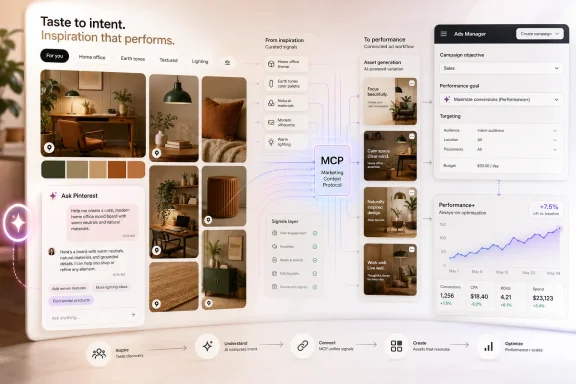 Pinterest Is Selling Intent, Not Just Inventory
The most important thing about Pinterest’s announcement is what it is not. This is not a consumer chatbot launch dressed up as an advertising story, nor is it a single campaign-management feature with “AI” stapled to the press release. It is a coordinated attempt to make Pinterest’s internal understanding of taste, trends, creative performance, and shopping behavior available to advertisers in more automated ways.That matters because Pinterest has always occupied an awkward but valuable place in the digital economy. It looks like a social network, but users do not primarily show up to argue, perform identity, or consume a real-time feed. They show up to plan a nursery, remodel a kitchen, build a capsule wardrobe, find wedding ideas, or decide what a “quiet luxury” patio might look like on a normal budget.
For advertisers, that has long been Pinterest’s pitch: its users are not merely scrolling; they are preparing to act. The company’s new AI tools are designed to make that pitch more operational. Instead of selling a marketer on a vague aura of inspiration, Pinterest wants to surface the trend, generate or select the creative, place it in a workflow, and measure what happened.
That is why the timing around Cannes Lions is telling. Pinterest is not aiming this announcement at hobbyist creators or casual shoppers first. It is addressing agencies, brands, and performance marketers who are being asked to do more with fewer people, more fragmented channels, and increasingly opaque AI-mediated consumer journeys.
The Assistant Moves From Search Bar to Sales Floor
Business Assistant is the clearest expression of Pinterest’s new ad strategy. According to the company, the tool is being built into Ads Manager and mobile in a closed beta in the United States, where it can help advertisers understand performance, spot trends, and identify optimization opportunities.The distinction Pinterest is trying to make is visual. Instead of answering a marketer with a slab of text, Business Assistant can show trend graphs and Pins that are already resonating. In Pinterest’s own example, if searches for “clean beauty routine” spike in a given week, the assistant can show the advertiser both the trend line and the creative context around it.
That may sound mundane until you consider how much of digital advertising still depends on translation work. A strategist sees a trend in one tool, a buyer checks campaign performance in another, a creative team looks for examples somewhere else, and a reporting deck turns the whole process into a delayed artifact. Pinterest’s bet is that AI can compress that loop.
This is also where the company’s platform identity becomes commercially useful. A generic advertising assistant can tell a brand that a keyword is rising. Pinterest’s assistant can, in theory, show what that keyword looks like in the culture of Pinterest: color palettes, room types, product combinations, seasonal motifs, and the specific Pins users are saving or clicking.
There is a risk here, of course. If every advertiser is told the same trend is rising, the platform can quickly fill with synthetic sameness. Pinterest’s challenge is to make its assistant useful without turning the feed into a machine-optimized mall where every brand chases the same aesthetic at the same time.
MCP Is the Boring Acronym With the Biggest Ambition
The least flashy part of Pinterest’s announcement may be the most strategically important. Pinterest MCP, built around the Model Context Protocol, is meant to connect Pinterest data and campaign functionality into the AI tools advertisers and agencies already use.That framing matters. Pinterest is acknowledging that the future of ad work will not necessarily happen inside Pinterest’s own interface. Agencies are building copilots. Retail media teams are layering AI over reporting systems. Holding companies and commerce specialists are trying to automate planning, analysis, and campaign execution across multiple platforms.
Pinterest’s answer is not simply to say, “Come use our dashboard.” It is to make Pinterest legible to those external AI systems through a standardized integration. The company says the protocol can provide secure access to campaign, analytics, and keyword insights, while grounding partner workflows in Pinterest-specific signals such as taste, trends, and intent.
That last phrase is doing a lot of work. Every platform wants to claim it has unique signals. Google has queries, YouTube has viewing behavior, Meta has social and interest graphs, Amazon has purchase and marketplace data, and TikTok has entertainment-driven attention. Pinterest is positioning its Taste Graph as something different: a map of aspiration before transaction.
The alpha partner list also signals where Pinterest wants this to go. The company named PMG, Pacvue, Dentsu, Havas, Innovid by Mediaocean, and Omnicom’s Jump 450 as partners shaping use cases across reporting, planning, analysis, and execution. That is not a hobbyist ecosystem. It is the agency-and-enterprise layer where ad budgets become repeatable operating systems.
Performance+ Pushes Creative Optimization Below the Campaign Level
Pinterest’s Performance+ creative update is the part most likely to affect day-to-day ad results. The company says a new AI model can evaluate a broader set of creative assets and select the variation most likely to perform for a given ad impression. In testing, Pinterest says the model increased click volume by 7.5 percent compared with its previous single-variant model.The important phrase is “asset level.” Digital ad platforms have spent years automating bidding, targeting, and placement. Creative has been harder to automate well because it is not just a variable; it is the thing the user actually sees. Pinterest’s update reflects the industry’s broader shift from campaign optimization to creative selection at the moment of impression.
For brands, that can be powerful. A retailer might upload multiple versions of an ad showing the same product in different contexts — a tote bag on a neutral studio background, in a travel setting, beside a summer outfit, or as part of a back-to-school board. Pinterest’s model can then decide which version is most likely to work for a specific user in a specific moment.
For users, the result could feel either helpful or uncanny. The best version of this system makes ads more relevant to the planning task already underway. The worst version makes the platform feel like it is overfitting desire, nudging users with just the right image at just the right moment until inspiration becomes persuasion by gradient descent.
Pinterest is trying to address advertiser trust with new ad review tools and expanded creative reporting. That is necessary because AI creative systems create accountability problems as soon as they begin making decisions at scale. A marketer needs to know not only that a campaign performed, but which creative variants ran, where they appeared, and whether the system’s choices matched the brand’s standards.
Ask Pinterest Is a Shopping Lab Disguised as an App
Ask Pinterest may be the most consumer-facing piece of the announcement, but Pinterest is being careful to describe it as an experiment. The limited-access app is designed to test conversational, visual-first, and more agentic shopping experiences outside the core Pinterest app.That separation is smart. Pinterest can experiment with multi-step AI shopping without immediately disrupting the main product. If Ask Pinterest fails, it remains a lab. If it works, it becomes a blueprint for bringing richer AI planning into the main app.
The use cases Pinterest describes are telling: planning a dinner party on a budget, finding a personal gift, furnishing a room over time. These are not simple “buy red sneakers” queries. They are compound, taste-heavy decisions that unfold across constraints, preferences, price sensitivity, and time.
This is where Pinterest’s AI argument is strongest. Many shopping problems are not solved by a single ranked list. A user may not know the vocabulary for the thing they want. They may have a vibe, a budget, a set of saved images, and a half-formed plan. Pinterest’s historic product has been well suited to that ambiguity, and AI gives it a way to make the ambiguity conversational.
But Ask Pinterest also raises the larger question facing every AI shopping product: who is the agent working for? If it is recommending products based on taste and usefulness, users may trust it. If it becomes another ad-driven recommendation funnel, users will learn to treat it like a sponsored shelf with better prose.
The AI Pivot Comes After a Harder Corporate Turn
Pinterest’s announcement lands in a broader corporate context. The company has been reorganizing around AI, advertising automation, and shopping, while also tightening operations. Earlier this year, Pinterest announced layoffs affecting under 15 percent of its workforce as part of a restructuring meant to reallocate resources toward AI-focused roles and products.That tension should not be ignored. The AI story in tech is often presented as expansion: new tools, new products, new surfaces, new forms of discovery. Inside companies, it is also a reallocation story. Teams get smaller, workflows get automated, and management asks whether software can do what once required human coordination.
Pinterest’s Q1 2026 numbers gave the company a stronger platform for this argument. It reported revenue just above $1 billion, up 18 percent year over year, and global monthly active users of 631 million, a record for the company. Those figures make the AI push look less like a rescue plan and more like an acceleration strategy.
Still, the business problem is familiar. Pinterest has a large, engaged, commercially valuable audience, but it has historically had to prove that its monetization can match the quality of that intent. The company’s latest tools are designed to close that gap by making ads easier to create, easier to optimize, and easier to connect to purchase-minded behavior.
In that sense, the AI announcement is also a monetization announcement. Pinterest is not simply saying it can make discovery more personalized. It is saying it can turn personalized discovery into a more measurable advertising machine.
Advertisers Will Like the Efficiency and Worry About the Black Box
For advertisers, the immediate appeal is obvious. If Business Assistant can surface useful trend shifts, if MCP can connect Pinterest into agency workflows, and if Performance+ can test and select better creative automatically, Pinterest becomes easier to buy at scale.That ease matters in a market where platforms compete not only on audience quality but on operational friction. A channel that requires too much manual interpretation loses budget to one that can be plugged into dashboards, copilots, and automated campaign systems. Pinterest knows that its differentiated audience is not enough if media teams cannot activate it efficiently.
The harder issue is transparency. AI tools that recommend optimizations, select creative, and route budget can improve performance while making the underlying decisions harder to inspect. Marketers have already lived through this on other platforms, where automation often arrives with fewer knobs, fewer explanations, and more dependence on platform-defined success metrics.
Pinterest’s answer appears to be more reporting and review controls, especially around creative. That is necessary but not sufficient. Enterprise advertisers will want to know how much control they retain, how brand safety is handled, how data permissions work through MCP integrations, and whether automated recommendations can be audited after the fact.
The company also has to avoid making its AI tools feel like a tax on sophistication. Small advertisers may appreciate a visual assistant that tells them what to promote. Large agencies may want programmatic access, experimentation controls, and clean measurement. Pinterest is trying to serve both, and those needs do not always align.
The Windows Angle Is the Browser, the Workflow, and the Admin Console
For WindowsForum readers, this may look at first like a consumer internet story happening somewhere outside the Windows ecosystem. But the practical impact will show up on the machines and workflows IT teams already support. Advertising departments, agencies, retailers, and ecommerce teams still do much of this work in browsers, desktop productivity suites, analytics tools, and collaboration platforms running on Windows.The MCP angle is especially relevant because it reflects a larger shift in enterprise software. AI assistants are moving from chat windows into operational workflows, and those workflows need connectors, permissions, identity controls, and data governance. A Pinterest campaign insight that appears inside an agency copilot is not just a marketing feature; it is another data path IT may need to understand.
That creates familiar questions. Which account has access to campaign data? What happens when an AI assistant can analyze performance across clients? How are credentials scoped? Can prompts or outputs leak sensitive campaign information? Does a plugin or connector comply with internal policies?
These are not Pinterest-specific concerns. They are the new baseline for AI-enabled SaaS. The more platforms adopt protocols and agentic integrations, the more IT departments will be asked to bless tools that sit between cloud services, browsers, identity providers, and proprietary business data.
The consumer side matters too. If Ask Pinterest evolves into a more capable shopping agent, it will join a growing set of AI experiences competing to mediate purchases. That has implications for browser behavior, affiliate attribution, privacy controls, and the way users move from inspiration to transaction. The operating system may not own the shopping journey, but it still hosts much of it.
Pinterest Wants to Be the Anti-Search Engine for AI Commerce
The larger strategic play is that Pinterest is trying to define discovery against search. Traditional search assumes the user can express intent in words. Pinterest’s whole premise is that people often cannot. They collect images, refine taste, react to suggestions, and only later arrive at a decision.That distinction becomes more important as AI changes search behavior. If users increasingly ask conversational systems for recommendations, platforms that can supply structured, taste-rich context become more valuable. Pinterest does not need to beat Google at answering factual queries. It needs to convince advertisers that its data is better for subjective, visual, purchase-adjacent decisions.
This is why the company keeps emphasizing taste and trusted recommendations. In an AI-mediated web, the ad unit may not always be a search result or a display placement. It may be an answer, a suggestion, a generated mood board, a shopping plan, or a ranked set of products assembled by an assistant. Pinterest wants its signals inside that moment.
The danger is that every platform is making a similar claim in its own language. Retail media networks claim transaction truth. Social platforms claim cultural relevance. Search companies claim declared intent. AI assistants claim conversational context. Pinterest’s advantage is real, but it must be translated into measurable performance without flattening the thing that made Pinterest valuable in the first place.
The company’s best case is a version of advertising that feels less like interruption and more like useful commercial context. Its worst case is a visually polished version of the same old surveillance advertising logic, now justified by AI personalization.
Cannes Gives Pinterest a Stage, but the Test Comes in the Dashboard
Announcements around Cannes are designed to impress the advertising industry, and Pinterest’s package is built for that room. It has a strategic narrative, enterprise partners, creative automation, a shopping experiment, and enough AI vocabulary to satisfy the moment. The harder test will come after the demos, when marketers ask whether these tools actually improve campaigns without creating new operational headaches.Business Assistant must prove it can recommend actions that are genuinely useful, not merely obvious. MCP must become reliable enough for agencies to build around, not just an interesting alpha integration. Performance+ creative must show that more automation can improve outcomes while preserving brand control. Ask Pinterest must show that conversational shopping can feel personal without feeling captured.
There is also the question of user trust. Pinterest has benefited from being perceived as calmer, more positive, and more intent-driven than many social platforms. Aggressive AI monetization could erode that if the feed starts to feel less like a personal planning space and more like an automated sales floor.
That balance will define whether Pinterest’s AI push feels differentiated or derivative. The company does not need to become OpenAI, Google, Amazon, or Meta. It needs to become the best version of Pinterest in an AI-shaped commerce stack.
The New Pinterest Pitch, Stripped of the Cannes Gloss
Pinterest’s announcement is easiest to understand as a move from inspiration platform to AI-enabled commerce infrastructure. The company is giving advertisers more automation, giving agencies a way to connect Pinterest into their own AI systems, and testing a consumer shopping assistant that may eventually reshape the core app.- Pinterest announced Business Assistant, Pinterest MCP, expanded Performance+ creative tools, and Ask Pinterest on June 17, 2026, ahead of Cannes Lions.
- Business Assistant is in closed U.S. beta and is designed to surface visual trend and campaign guidance inside Ads Manager and mobile.
- Pinterest MCP is aimed at agencies and partners that want Pinterest campaign, analytics, and keyword insights inside their own AI workflows.
- The new Performance+ creative model moves optimization closer to the individual asset and impression, with Pinterest reporting a 7.5 percent click-volume lift in testing.
- Ask Pinterest is a limited-access experimental app for conversational, visual-first shopping scenarios that do not fit neatly into a single search query.
- The practical risks are the familiar ones for AI advertising: opacity, data governance, brand control, creative sameness, and user trust.
References
- Primary source: WWD
Published: Wed, 17 Jun 2026 11:02:49 GMT
Pinterest Has New AI Tools For Advertisers
It's also launching a new experimental AI app for users. wwd.com
- Independent coverage: Pinterest Newsroom
Published: Wed, 17 Jun 2026 11:01:13 GMT
Pinterest Newsroom
Pinterest unveils Business Assistant, MCP, a new Performance+ creative model and Ask Pinterest, its latest AI tools. newsroom.pinterest.com
- Related coverage: investing.com
Pinterest reports Q1 revenue of $1.01 billion, up 18% year-over-year By Investing.com
Pinterest reports Q1 revenue of $1.01 billion, up 18% year-over-yearwww.investing.com - Related coverage: grafa.com
Pinterest (PINS) Q1 2026 results: revenue hits $1.01B | Grafa
Pinterest reports $1.008 billion in Q1 revenue and a record 631 million monthly active users. The company completed $2 billion in share...grafa.com - Related coverage: help.pinterest.com
AI at Pinterest
help.pinterest.com
- Related coverage: techcrunch.com
Pinterest launches a new feature to promote a Pin | TechCrunch
The company is rolling out the Promoted Pin feature to users in the U.S. in the coming weeks, with global expansion planned in the future.techcrunch.com
- Related coverage: new-rebellion.com
Pinterest Performance Plus Q1 2026 Revenue $1 Billion AI Ad Campaigns
Pinterest's Q1 2026 revenue hit $1.008 billion, driven by Performance+ AI campaigns now powering 30% of lower-funnel revenue. The platform is becoming harder to ignore.new-rebellion.com - Related coverage: mediapost.com
Pinterest Q1: Adds Users, Invests In AI Ad Suite, Search 05/07/2026
Pinterest Q1: Adds Users, Invests In AI Ad Suite, Search - 05/07/2026www.mediapost.com - Related coverage: thesocialmediastar.com
Pinterest Hits 631 Million Users with 18% Revenue Growth in Q1 2026
Pinterest has kicked off 2026 on a strong note, reporting 631 million monthly active users for the first quarter — a gain of 12 million from the previous Pinterest reported strong Q1 2026 earnings, reaching 631 million monthly active users and posting 18% year-over-year revenue growth, driven by...thesocialmediastar.com - Related coverage: exchange4media.com
Pinterest records 18% revenue growth in Q1
The Global Monthly Active Users increased 11% year over year to 631 million. www.exchange4media.com
- Related coverage: tikr.com
Pinterest Q1 2026 Earnings: Revenue Tops $1B for Third Straight Quarter | TIKR.com
Pinterest beat Q1 estimates and hit $1B in revenue again, but the gap between user engagement and ad monetization hasn’t closed yet. www.tikr.com
- Related coverage: marketbeat.com
Pinterest Q1 Earnings Call Highlights | MarketBeat
Pinterest (NYSE:PINS) reported stronger-than-expected first-quarter 2026 results and emphasized ongoing efforts to translate growing engagement into more consistent monetization, driven by AI-powered product improvements, measurement upgrades, and changes to its go-to-market organization. Q1 resultwww.marketbeat.com
- Related coverage: app.dealroom.co
Pinterest hits $1B revenue in Q1 2026, up 18% with 631M monthly active users | Dealroom.co
Pinterest reported first-quarter 2026 revenue of over $1 billion, up 18% year over year, with adjusted EBITDA exceeding $207 million. The company now has 631 million monthly active users, all of whom are logged in, conducting more than 80 billion monthly searches. Chief Executive Officer...app.dealroom.co - Related coverage: axios.com
Pinterest adds new chief business and marketing officers
The C-suite shakeup comes as Pinterest repositions itself as a global AI-driven shopping destination, primarily for Gen-Z users.www.axios.com
- Related coverage: time.com
