

Google’s Pixel 10a, launched in early 2026 at $499, is a capable mid-range Android phone whose biggest weakness is that it looks less like a new generation than a carefully repackaged Pixel 9a with longer-lived software and modest hardware refinements. That is not an accident. Google’s 2026 Pixel story is increasingly about cadence, segmentation, and AI feature access rather than traditional annual hardware leaps. The Pixel 10a and the expected Pixel 11 together show a company trying to make Android feel durable at the low end while reserving real silicon ambition for the flagship tier.
The old Pixel A-series bargain was easy to explain: buy the cheaper phone, get most of the flagship camera magic, and accept a few omissions. The Pixel 10a stretches that bargain into something more corporate and less romantic. It is sold less as a toy for gadget people than as a predictable device with a long support runway, a familiar design, and enough AI plumbing to keep it inside Google’s ecosystem for most of a decade.
Notebookcheck’s verdict captures the tension neatly. The Pixel 10a is solid, but it has too few new features to feel like a meaningful upgrade. That is the kind of criticism that stings precisely because the phone is not bad. It is competent in the way modern mid-range hardware is often competent: bright enough screen, good enough battery, reliable camera processing, clean software, and a price that stops short of flagship absurdity.
The problem is that the A-series used to feel like Google smuggling flagship value into a cheaper box. The Pixel 10a feels more like Google defining exactly how much innovation $499 is allowed to buy. It keeps the promise of Pixel ownership intact, but it narrows the emotional reason to upgrade.
For WindowsForum readers, that shift should sound familiar. It is the smartphone version of a long-term servicing channel: fewer fireworks, more support commitments, and a product story increasingly defined by lifecycle management.
On paper, Tensor G4 is not disqualifying. It is strong enough for everyday Android use, Google’s camera pipeline, Gemini access, and the usual Pixel conveniences. For buyers replacing a three- or four-year-old handset, the phone will feel modern. For reviewers comparing spec sheets, it looks like a stalled generation.
That is the split Google is betting on. Most people do not buy phones annually, and most mid-range shoppers do not run sustained GPU benchmarks before checkout. They want battery life, camera reliability, water resistance, update support, and a screen that does not look embarrassing in sunlight. By those measures, the Pixel 10a is defensible.
But chips are no longer just chips. In 2026, silicon is where AI features, modem behavior, thermal performance, camera latency, and long-term feature eligibility increasingly converge. If the Pixel 11 arrives with a Tensor G6 as expected, the Pixel 10a will be two Tensor generations behind the flagship line before many buyers have finished paying for it.
That does not make the phone obsolete. It does make Google’s seven-year update promise more complicated than it appears in marketing copy. Software support keeps a device patched; it does not guarantee that every new AI feature will run locally, quickly, or at all.
That matters for families, schools, field workers, small businesses, and anyone who has grown tired of Android phones aging out of security coverage while the hardware still works. It also matters to IT shops that treat phones as managed endpoints. A predictable patch runway is not glamorous, but it is operationally valuable.
Still, the update guarantee should not be confused with a guarantee of equal experience. A Pixel 10a may receive Android releases deep into the 2030s, but future features will increasingly depend on memory, neural processing, sensors, and on-device model support. That is where the reused Tensor G4 becomes more than a line item.
This is the same distinction Windows administrators already understand. A PC can be supported and still not deliver every Copilot, Pluton, camera, NPU, or security feature Microsoft ships later. Support means the floor is maintained. It does not mean the ceiling rises forever.
Google’s marketing prefers the cleaner version: buy the phone and keep getting better. The more accurate version is subtler: buy the phone and keep getting maintained, with some improvements arriving when the hardware can handle them.
The phone’s 48-megapixel main camera and 13-megapixel ultrawide do not read like a revolution, but Google’s processing remains a major differentiator in this price band. For normal people taking pictures of kids, receipts, pets, documents, vacations, and dim restaurants, consistency matters more than exotic sensors. Pixel phones tend to deliver that consistency.
Battery life is similarly practical. The Pixel 10a’s large battery and modest hardware profile make sense for the buyer who wants a phone that lasts through the day without becoming another device-management chore. Faster wired charging and improved wireless charging help, even if neither turns the phone into a charging-speed champion.
The display and durability improvements are also meaningful, just not thrilling. A brighter 6.3-inch panel, tougher cover glass, IP-rated protection, and a flatter design all make the device easier to recommend to someone who keeps phones for years. These are grown-up upgrades.
And yet that is exactly why the criticism lands. The Pixel 10a is full of changes that are easy to appreciate after ownership and hard to celebrate at launch. Google has built a better appliance. The question is whether the Pixel brand can live on appliances alone.
But price discipline cuts two ways. If Google holds the line while changing little, the phone feels conservative. If it adds more expensive hardware and raises the price, the A-series risks colliding with discounted flagships and older Pro models. The Pixel 10a is trapped in that middle lane.
That trap is especially visible because the Pixel 10 exists. The base Pixel 10 brought more obvious upgrades, including Tensor G5, a more ambitious camera system, magnetic Pixelsnap accessory support, and broader flagship positioning. Discounts then compress the gap. When the better phone inevitably falls in price, the A-series has to defend its existence with timing, carrier deals, and support promises.
This is not unique to Google. Apple has wrestled with similar overlap between older flagships and cheaper new models. Samsung’s FE and A-series devices live in the same tension. The difference is that Google’s phone lineup is smaller, so every overlap is easier to see.
The Pixel 10a’s value will therefore depend heavily on street price. At $499, it is rational but not exciting. At $399, it becomes far more persuasive. That gap between MSRP and deal price may define the phone’s real market identity.
As of late June 2026, the Pixel 11 has not been officially launched, and reports frame a likely mid-to-late August Made by Google event based on Google’s recent cadence. That timing matters because the Pixel 10a is now living in the shadow of a phone that does not yet exist but already shapes buyer behavior. Anyone who follows the Pixel cycle knows the flagship refresh is close.
Expected Pixel 11 changes center on the usual pillars: newer Tensor silicon, camera refinements, AI features, display changes, and battery efficiency. None of those should be treated as final until Google announces the device. But the direction is clear enough. Google wants the flagship Pixel to be the place where the Android AI phone narrative feels most complete.
That puts the Pixel 10a in an awkward but deliberate role. It is not meant to preview the future. It is meant to monetize the present. Google gives it enough software access to feel current, enough support to feel responsible, and enough restraint to avoid undercutting the Pixel 11 before launch.
This is product segmentation at its cleanest and coldest. The A-series keeps the installed base broad. The flagship line carries the story.
The Pixel 10 generation leaned heavily into features like Magic Cue, Camera Coach, Gemini integration, and on-device assistance. The Pixel 11 is expected to push that further. Whether users love these tools or ignore them, Google’s strategic direction is unmistakable: the phone is becoming a context engine.
That shift is good for Google because it lets the company compete where it is strongest. Apple controls the premium hardware narrative, Samsung dominates Android scale, and Chinese OEMs often win on charging speeds and component aggression. Google’s advantage is the software layer wrapped around search, assistant behavior, photos, maps, Gmail, and cloud intelligence.
But AI differentiation is harder to explain than a better camera sensor. It depends on trust, accuracy, latency, privacy posture, and daily usefulness. A feature that surfaces flight details, suggests a reply, screens a call, or improves a photo can feel magical. It can also feel intrusive, gimmicky, or inconsistent.
This is where the Pixel 10a’s conservative hardware may age unevenly. The phone can run today’s Pixel AI features, but the AI phone category is changing quickly. If the next wave depends more heavily on newer NPUs and larger on-device models, the cheaper phone may become a supported citizen with a smaller passport.
A mid-range phone with seven years of updates is therefore more than a consumer gadget. It is a potential managed endpoint with a predictable security lifecycle. That makes the Pixel 10a interesting for small organizations that do not want to buy flagship phones but also do not want unsupported Android devices touching corporate accounts.
Google’s security pitch has matured around hardware-backed protections, regular patching, anti-phishing measures, and integration with enterprise controls. Pixel devices also tend to receive Android updates quickly, which matters when vulnerabilities are actively exploited. For administrators, speed and predictability can be more important than benchmark performance.
The catch is that long support only helps if procurement choices are disciplined. A cheap Android phone from an unknown vendor may look attractive until updates become irregular or stop entirely. Pixel A-series devices give buyers a middle path: not premium, not disposable, and not dependent on a carrier’s vague update schedule.
That said, IT departments should not mistake the Pixel 10a for a flagship in cheaper clothing. If an organization plans to rely heavily on on-device AI, advanced camera workflows, or future local inference features, it should watch the Tensor gap carefully. The safe conclusion is simple: the Pixel 10a is an excellent maintenance endpoint, not a future-proof AI workstation in your pocket.
That makes it a useful artifact of where smartphones are in 2026. The market is mature. Cameras are good. Displays are good. Battery life is usually acceptable. The average user’s pain points are less about raw capability and more about longevity, reliability, repair cost, storage, and whether the phone still feels safe to use after four years.
In that world, a boring phone can be a good product. The danger is that a boring phone can also become a lazy one. The line between discipline and complacency is thin, and Notebookcheck’s criticism lives right on that line.
Google is also betting that software can carry more of the perceived upgrade burden. That may work for Pixel loyalists who value clean Android and fast updates. It may work for users coming from older devices. It is less likely to impress enthusiasts who remember when the A-series felt like a minor act of rebellion against flagship pricing.
The Pixel 10a is not a betrayal of that legacy. It is a domestication of it.
This is why the Pixel 10a’s MSRP feels like only half the story. At full price, shoppers can reasonably ask whether they should wait for a Pixel 10 discount or see what the Pixel 11 does to older model pricing. At a meaningful discount, the 10a becomes much easier to defend. The same hardware that looks underwhelming at $499 can look sensible at $399.
Google knows this. The modern phone market is increasingly built around launch prices that establish positioning and later discounts that drive volume. The A-series is especially sensitive to that dance because its buyers are more price-aware and more likely to compare total value across generations.
For carriers, the Pixel 10a is useful because it can anchor promotions without feeling like junk. For Google, it expands the Pixel base and keeps users close to Gemini, Photos, Maps, and the Play ecosystem. For buyers, it is best judged not as a launch-day object but as a deal-driven purchase.
That may be unsatisfying for reviewers, but it is how many phones are actually bought.
The stakes are higher than usual because Google has spent years telling the market that Tensor is not just another mobile chip. Tensor is supposed to make Pixel uniquely Google: smarter calling, better photos, tighter AI, more secure processing, and features that arrive first because hardware and software are designed together. That story needs periodic proof.
The Pixel 10a does not provide that proof. It borrows credibility from the broader Pixel platform. That is fine for a mid-range model, but it places more pressure on the flagship refresh to show where the platform is going.
There is also a trust issue. If buyers increasingly understand that AI features depend on newer silicon, then shipping older silicon in a seven-year phone becomes a more visible compromise. Google can manage that with clear feature messaging, or it can let confusion build when some Pixel Drops arrive unevenly across models.
The better Google gets at AI, the more carefully it will need to explain hardware boundaries.
 Google’s Mid-Range Phone Has Become a Contract, Not a Surprise
The old Pixel A-series bargain was easy to explain: buy the cheaper phone, get most of the flagship camera magic, and accept a few omissions. The Pixel 10a stretches that bargain into something more corporate and less romantic. It is sold less as a toy for gadget people than as a predictable device with a long support runway, a familiar design, and enough AI plumbing to keep it inside Google’s ecosystem for most of a decade.Notebookcheck’s verdict captures the tension neatly. The Pixel 10a is solid, but it has too few new features to feel like a meaningful upgrade. That is the kind of criticism that stings precisely because the phone is not bad. It is competent in the way modern mid-range hardware is often competent: bright enough screen, good enough battery, reliable camera processing, clean software, and a price that stops short of flagship absurdity.
The problem is that the A-series used to feel like Google smuggling flagship value into a cheaper box. The Pixel 10a feels more like Google defining exactly how much innovation $499 is allowed to buy. It keeps the promise of Pixel ownership intact, but it narrows the emotional reason to upgrade.
For WindowsForum readers, that shift should sound familiar. It is the smartphone version of a long-term servicing channel: fewer fireworks, more support commitments, and a product story increasingly defined by lifecycle management.
The Tensor G4 Decision Tells the Whole Story
The most revealing Pixel 10a choice is the chip. Google used Tensor G4 rather than moving the A-series to the Tensor G5 found in the Pixel 10 family. That one decision explains the entire product.On paper, Tensor G4 is not disqualifying. It is strong enough for everyday Android use, Google’s camera pipeline, Gemini access, and the usual Pixel conveniences. For buyers replacing a three- or four-year-old handset, the phone will feel modern. For reviewers comparing spec sheets, it looks like a stalled generation.
That is the split Google is betting on. Most people do not buy phones annually, and most mid-range shoppers do not run sustained GPU benchmarks before checkout. They want battery life, camera reliability, water resistance, update support, and a screen that does not look embarrassing in sunlight. By those measures, the Pixel 10a is defensible.
But chips are no longer just chips. In 2026, silicon is where AI features, modem behavior, thermal performance, camera latency, and long-term feature eligibility increasingly converge. If the Pixel 11 arrives with a Tensor G6 as expected, the Pixel 10a will be two Tensor generations behind the flagship line before many buyers have finished paying for it.
That does not make the phone obsolete. It does make Google’s seven-year update promise more complicated than it appears in marketing copy. Software support keeps a device patched; it does not guarantee that every new AI feature will run locally, quickly, or at all.
Seven Years of Updates Is Real Value, but It Is Not a Magic Wand
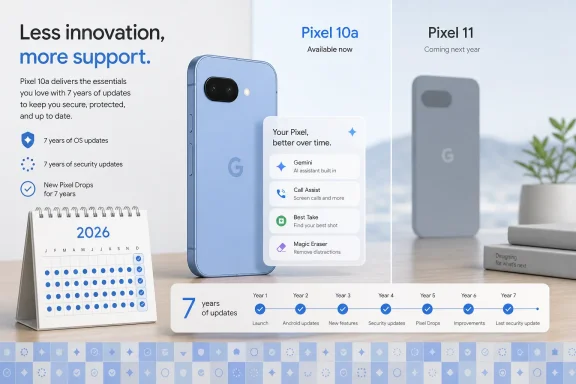
Google deserves credit for pushing long software support into cheaper phones. Seven years of OS, security, and Pixel Drop updates on a mid-range handset is exactly the kind of pressure the Android market needed. It turns a $499 phone into a plausible long-term purchase rather than a disposable compromise.That matters for families, schools, field workers, small businesses, and anyone who has grown tired of Android phones aging out of security coverage while the hardware still works. It also matters to IT shops that treat phones as managed endpoints. A predictable patch runway is not glamorous, but it is operationally valuable.
Still, the update guarantee should not be confused with a guarantee of equal experience. A Pixel 10a may receive Android releases deep into the 2030s, but future features will increasingly depend on memory, neural processing, sensors, and on-device model support. That is where the reused Tensor G4 becomes more than a line item.
This is the same distinction Windows administrators already understand. A PC can be supported and still not deliver every Copilot, Pluton, camera, NPU, or security feature Microsoft ships later. Support means the floor is maintained. It does not mean the ceiling rises forever.
Google’s marketing prefers the cleaner version: buy the phone and keep getting better. The more accurate version is subtler: buy the phone and keep getting maintained, with some improvements arriving when the hardware can handle them.
The Pixel 10a Is Better Than Its Spec Sheet, Which Is Also the Problem
Pixel phones have always been an argument against spec-sheet absolutism. Google’s camera processing, call handling, voice tools, spam protection, Recorder app, and Pixel-only software tricks have often mattered more than raw hardware. The Pixel 10a continues that tradition.The phone’s 48-megapixel main camera and 13-megapixel ultrawide do not read like a revolution, but Google’s processing remains a major differentiator in this price band. For normal people taking pictures of kids, receipts, pets, documents, vacations, and dim restaurants, consistency matters more than exotic sensors. Pixel phones tend to deliver that consistency.
Battery life is similarly practical. The Pixel 10a’s large battery and modest hardware profile make sense for the buyer who wants a phone that lasts through the day without becoming another device-management chore. Faster wired charging and improved wireless charging help, even if neither turns the phone into a charging-speed champion.
The display and durability improvements are also meaningful, just not thrilling. A brighter 6.3-inch panel, tougher cover glass, IP-rated protection, and a flatter design all make the device easier to recommend to someone who keeps phones for years. These are grown-up upgrades.
And yet that is exactly why the criticism lands. The Pixel 10a is full of changes that are easy to appreciate after ownership and hard to celebrate at launch. Google has built a better appliance. The question is whether the Pixel brand can live on appliances alone.
Google Is Using Price Discipline as a Feature
Keeping the Pixel 10a at $499 is not a small decision in a market where phone makers routinely test the upper limits of consumer patience. Inflation, component costs, AI branding, and carrier financing have all helped normalize prices that once would have seemed absurd. Against that backdrop, price stability is a feature.But price discipline cuts two ways. If Google holds the line while changing little, the phone feels conservative. If it adds more expensive hardware and raises the price, the A-series risks colliding with discounted flagships and older Pro models. The Pixel 10a is trapped in that middle lane.
That trap is especially visible because the Pixel 10 exists. The base Pixel 10 brought more obvious upgrades, including Tensor G5, a more ambitious camera system, magnetic Pixelsnap accessory support, and broader flagship positioning. Discounts then compress the gap. When the better phone inevitably falls in price, the A-series has to defend its existence with timing, carrier deals, and support promises.
This is not unique to Google. Apple has wrestled with similar overlap between older flagships and cheaper new models. Samsung’s FE and A-series devices live in the same tension. The difference is that Google’s phone lineup is smaller, so every overlap is easier to see.
The Pixel 10a’s value will therefore depend heavily on street price. At $499, it is rational but not exciting. At $399, it becomes far more persuasive. That gap between MSRP and deal price may define the phone’s real market identity.
Pixel 11 Is Where Google’s Real 2026 Ambition Moves
TechCabal’s Pixel 11 comparison points toward the other half of Google’s strategy. If the Pixel 10a is the maintenance release, Pixel 11 is expected to be the ambition release. The flagship line is where Google will try to show that Tensor, Gemini, and Pixel hardware can become more than a respectable Android bundle.As of late June 2026, the Pixel 11 has not been officially launched, and reports frame a likely mid-to-late August Made by Google event based on Google’s recent cadence. That timing matters because the Pixel 10a is now living in the shadow of a phone that does not yet exist but already shapes buyer behavior. Anyone who follows the Pixel cycle knows the flagship refresh is close.
Expected Pixel 11 changes center on the usual pillars: newer Tensor silicon, camera refinements, AI features, display changes, and battery efficiency. None of those should be treated as final until Google announces the device. But the direction is clear enough. Google wants the flagship Pixel to be the place where the Android AI phone narrative feels most complete.
That puts the Pixel 10a in an awkward but deliberate role. It is not meant to preview the future. It is meant to monetize the present. Google gives it enough software access to feel current, enough support to feel responsible, and enough restraint to avoid undercutting the Pixel 11 before launch.
This is product segmentation at its cleanest and coldest. The A-series keeps the installed base broad. The flagship line carries the story.
AI Is Becoming the New Camera Bump
For years, smartphone differentiation was visible. More lenses, bigger camera islands, curved displays, stainless steel frames, folding panels: you could see what you were paying for. Google helped change that by making computational photography the Pixel’s signature. Now it is trying to do the same with AI.The Pixel 10 generation leaned heavily into features like Magic Cue, Camera Coach, Gemini integration, and on-device assistance. The Pixel 11 is expected to push that further. Whether users love these tools or ignore them, Google’s strategic direction is unmistakable: the phone is becoming a context engine.
That shift is good for Google because it lets the company compete where it is strongest. Apple controls the premium hardware narrative, Samsung dominates Android scale, and Chinese OEMs often win on charging speeds and component aggression. Google’s advantage is the software layer wrapped around search, assistant behavior, photos, maps, Gmail, and cloud intelligence.
But AI differentiation is harder to explain than a better camera sensor. It depends on trust, accuracy, latency, privacy posture, and daily usefulness. A feature that surfaces flight details, suggests a reply, screens a call, or improves a photo can feel magical. It can also feel intrusive, gimmicky, or inconsistent.
This is where the Pixel 10a’s conservative hardware may age unevenly. The phone can run today’s Pixel AI features, but the AI phone category is changing quickly. If the next wave depends more heavily on newer NPUs and larger on-device models, the cheaper phone may become a supported citizen with a smaller passport.
The Windows Crowd Should Watch the Endpoint Story
It may seem odd to treat a Pixel article as relevant to WindowsForum, but the endpoint story is increasingly cross-platform. A modern Windows environment rarely stops at Windows. It includes Android phones, iPhones, Entra ID, passkeys, mobile device management, conditional access, VPN clients, authenticator apps, and cloud-backed productivity tools.A mid-range phone with seven years of updates is therefore more than a consumer gadget. It is a potential managed endpoint with a predictable security lifecycle. That makes the Pixel 10a interesting for small organizations that do not want to buy flagship phones but also do not want unsupported Android devices touching corporate accounts.
Google’s security pitch has matured around hardware-backed protections, regular patching, anti-phishing measures, and integration with enterprise controls. Pixel devices also tend to receive Android updates quickly, which matters when vulnerabilities are actively exploited. For administrators, speed and predictability can be more important than benchmark performance.
The catch is that long support only helps if procurement choices are disciplined. A cheap Android phone from an unknown vendor may look attractive until updates become irregular or stop entirely. Pixel A-series devices give buyers a middle path: not premium, not disposable, and not dependent on a carrier’s vague update schedule.
That said, IT departments should not mistake the Pixel 10a for a flagship in cheaper clothing. If an organization plans to rely heavily on on-device AI, advanced camera workflows, or future local inference features, it should watch the Tensor gap carefully. The safe conclusion is simple: the Pixel 10a is an excellent maintenance endpoint, not a future-proof AI workstation in your pocket.
Google’s Hardware Restraint Is a Bet Against Upgrade Culture
The most interesting thing about the Pixel 10a may be what it refuses to do. It refuses to pretend that every annual phone release needs to be transformative. It refuses to raise the price simply to satisfy a spec race. It refuses, perhaps too openly, to give mid-range buyers the newest Google silicon.That makes it a useful artifact of where smartphones are in 2026. The market is mature. Cameras are good. Displays are good. Battery life is usually acceptable. The average user’s pain points are less about raw capability and more about longevity, reliability, repair cost, storage, and whether the phone still feels safe to use after four years.
In that world, a boring phone can be a good product. The danger is that a boring phone can also become a lazy one. The line between discipline and complacency is thin, and Notebookcheck’s criticism lives right on that line.
Google is also betting that software can carry more of the perceived upgrade burden. That may work for Pixel loyalists who value clean Android and fast updates. It may work for users coming from older devices. It is less likely to impress enthusiasts who remember when the A-series felt like a minor act of rebellion against flagship pricing.
The Pixel 10a is not a betrayal of that legacy. It is a domestication of it.
The Real Competition Is Discounted Hardware
The Pixel 10a does not compete only with other $499 phones. It competes with last year’s discounted flagships, carrier promotions, refurbished devices, Samsung’s sprawling mid-range catalog, and older iPhones that remain supported for years. That is a brutal neighborhood.This is why the Pixel 10a’s MSRP feels like only half the story. At full price, shoppers can reasonably ask whether they should wait for a Pixel 10 discount or see what the Pixel 11 does to older model pricing. At a meaningful discount, the 10a becomes much easier to defend. The same hardware that looks underwhelming at $499 can look sensible at $399.
Google knows this. The modern phone market is increasingly built around launch prices that establish positioning and later discounts that drive volume. The A-series is especially sensitive to that dance because its buyers are more price-aware and more likely to compare total value across generations.
For carriers, the Pixel 10a is useful because it can anchor promotions without feeling like junk. For Google, it expands the Pixel base and keeps users close to Gemini, Photos, Maps, and the Play ecosystem. For buyers, it is best judged not as a launch-day object but as a deal-driven purchase.
That may be unsatisfying for reviewers, but it is how many phones are actually bought.
Pixel 11 Could Make the 10a Look Smarter or Smaller
The Pixel 11’s eventual launch will clarify the Pixel 10a’s place in the lineup. If Google delivers a major Tensor leap, stronger battery efficiency, more useful AI, and camera improvements that clearly surpass Pixel 10, then the 10a will look like a deliberately modest budget anchor. If Pixel 11 is iterative too, the entire Pixel line may start to look conservative.The stakes are higher than usual because Google has spent years telling the market that Tensor is not just another mobile chip. Tensor is supposed to make Pixel uniquely Google: smarter calling, better photos, tighter AI, more secure processing, and features that arrive first because hardware and software are designed together. That story needs periodic proof.
The Pixel 10a does not provide that proof. It borrows credibility from the broader Pixel platform. That is fine for a mid-range model, but it places more pressure on the flagship refresh to show where the platform is going.
There is also a trust issue. If buyers increasingly understand that AI features depend on newer silicon, then shipping older silicon in a seven-year phone becomes a more visible compromise. Google can manage that with clear feature messaging, or it can let confusion build when some Pixel Drops arrive unevenly across models.
The better Google gets at AI, the more carefully it will need to explain hardware boundaries.
The Pixel 10a’s Lesson Is Written in the Gap Before Pixel 11
The practical reading of Google’s 2026 Pixel lineup is narrower than the marketing and more useful than the outrage.- The Pixel 10a is a strong mid-range phone for buyers who prioritize camera consistency, battery life, clean Android, and long software support over annual hardware novelty.
- The reuse of Tensor G4 is the clearest compromise, especially with Pixel 11 expected to move the flagship line further ahead later in 2026.
- Google’s seven-year update promise gives the Pixel 10a real long-term value, but it should not be read as a guarantee of every future AI feature.
- The phone’s value changes dramatically with discounts, making street price more important than launch MSRP.
- For IT buyers and security-minded users, the Pixel 10a is most compelling as a predictable managed endpoint rather than an enthusiast upgrade.
- The Pixel 11 will determine whether Google’s conservative A-series strategy looks disciplined or merely stagnant.
References
- Primary source: Notebookcheck
Published: Sat, 27 Jun 2026 12:52:00 GMT
Google Pixel 10a: A solid mid-range model with too few new features - Notebookcheck News
The Google Pixel 10a impresses with a bright display, a powerful main camera, and seven years of updates. Compared to its predecessor, however, the new features are fairly limited. Only now that the market price has dropped significantly does the smartphone become a clear recommendation. www.notebookcheck.net
- Independent coverage: TechCabal
Published: Fri, 26 Jun 2026 18:16:21 GMT
Google Pixel 11 vs Pixel 10: Every major difference explained
See how the leaked Pixel 11 vs Pixel 10 specs compare, from camera and battery to price and release date, before Google's official reveal.techcabal.com - Related coverage: techradar.com
The entire Google Pixel 10 line is on sale right now, but there's only one model I'd buy before Prime Day ends | TechRadar
Here's why the Google Pixel 10a is the only Google phone I'm recommending for Prime Day.www.techradar.com - Related coverage: androidcentral.com
Struggling with an older phone? This $399 Prime Day deal will make you want to switch instantly | Android Central
Trust me on this: you'll love what the Pixel 10a can do, and it's just $399 right now.www.androidcentral.com - Related coverage: tomsguide.com
Google phones in 2026: Pixel 10a, Pixel 11 and more | Tom's Guide
From a budget phone in the first half of 2026 to flagship release later on, here's what we know about Google's Pixel plans going forward.www.tomsguide.com - Related coverage: phonearena.com
Google Pixel 10 vs Google Pixel 11 - specs comparison - PhoneArena
Compare Google Pixel 10 vs Google Pixel 11 with our phone comparison tool and get side-by-side specifications. www.phonearena.com
- Related coverage: notebookcheck.com
Google Pixel 10a - Notebookcheck Specs und Testsammlung
Diese Seite liefert Infos aller Art, vor allem Testberichte, für das Modell Google Pixel 10a der Serie Pixel 10. www.notebookcheck.com
- Related coverage: techspot.com
Pixel 10a launches at $499 with modest refinements and familiar hardware | TechSpot
The device's most visible change is its rear panel. The camera module, flattened further compared to the 9a's already streamlined bump, now sits flush with the back...www.techspot.com - Related coverage: notebookcheck.org
Google Pixel 10a - Notebookcheck.org
Ésta es una lista de análisis y otras informaciones sobre el modelo Google Pixel 10a de la serie Pixel 10. www.notebookcheck.org
- Related coverage: techadvisor.com
Google Pixel 11: Release Date, Price & Specs Rumours - Tech Advisor
The Pixel 10 series has ushered in a new era for Android phones so what will Google offer with the Pixel 11 and when will they arrive?www.techadvisor.com - Related coverage: techxplore.com
- Related coverage: insight.com
- Related coverage: blog.google
Google announces the new Pixel 10a for $499
Learn more about Google’s new Pixel 10a, its latest A-series Pixel phone.blog.google - Official source: store.google.com
- Related coverage: techcrunch.com
Google debuts $499 Pixel 10a | TechCrunch
The smartphone is available for preorder now with shipments starting March 5. It comes in Lavender, Berry, Fog, and Obsidian.techcrunch.com - Related coverage: phonebulletin.com
Google Pixel 10a Review: The Best $499 Phone You Can Buy - PhoneBulletin
The Pixel 10a launched March 2026 at $499 with Tensor G4, excellent cameras, a 5100mAh battery, and seven years of updates. Full verdict inside. www.phonebulletin.com
- Related coverage: technobaboy.com
Google unveils Pixel 10a with Tensor G4, pOLED display and 7 years of updates - Technobaboy
Google unveils Pixel 10a with Tensor G4, 120Hz pOLED display, and Android 16 with 7 years of OS, security, and Pixel Drop updates.www.technobaboy.com - Related coverage: wallpaper.com
Google Pixel 10a review: a no-nonsense choice | Wallpaper*
Do mid-range phones provide all the power you’ll ever need? We try the Google Pixel 10a and find the promise of a few years of smooth sailingwww.wallpaper.com - Related coverage: tdsynnex.com
- Related coverage: storage.googleapis.com
