

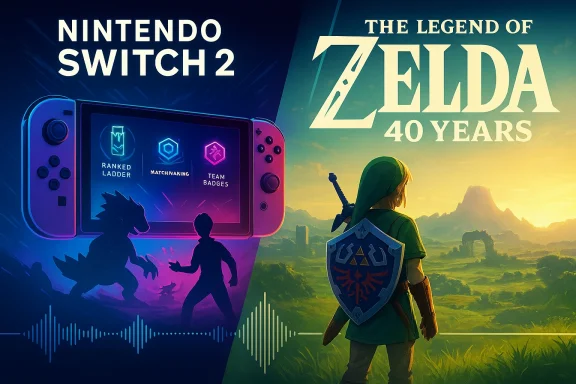
Pokemon Champions is already shaping up to be more than a routine new release, and the early chatter from Game Informer suggests Nintendo is positioning it as a serious competitive platform rather than a side mode attached to a bigger RPG. The timing matters, too: the game arrived on Nintendo Switch 2 on April 8, with mobile versions still planned for later in 2026, giving The Pokémon Company a multi-device runway for competitive play. On the same episode of The Game Informer Show, the crew also used the occasion of The Legend of Zelda’s 40th anniversary to revisit one of gaming’s most enduring franchises, underscoring how Nintendo is trying to balance the future of live competitive play with the weight of legacy. The result is a story about two very different kinds of platform strategy colliding in one podcast: new-school infrastructure and old-school prestige.
Nintendo has spent the last several years learning how to stretch its biggest intellectual properties across different formats without diluting what makes them resonate. For Pokémon, that has meant a steady push toward more connected, more social, and more long-lived experiences, even as the mainline RPG series continues to carry the brand’s traditional identity. A dedicated competitive title like Pokémon Champions fits that broader direction because it is not trying to be everything at once. Instead, it appears built to concentrate the battle-centric side of the franchise into a cleaner, more persistent product.
That distinction matters because the Pokémon audience is unusually segmented. Some players care most about the story campaigns, some about collecting, and others about optimized battling, team-building, and tournament ecosystems. A focused competitive release can reduce friction for that latter group while creating a more legible competitive ladder for newcomers. In theory, it is the sort of product that can make the Pokémon battle scene feel more official, more accessible, and more durable.
The Nintendo Switch 2 launch is also significant because it signals that Pokémon Champions is being treated as a flagship piece of the new hardware story. That suggests Nintendo sees the title as more than a stopgap between mainline generations. The later iOS and Android rollout further hints at a platform-agnostic strategy where the battleground is not just the console ecosystem, but the broader mobile gaming market.
Meanwhile, Zelda’s 40th anniversary offers a very different kind of context. The series has become one of Nintendo’s clearest examples of reinvention done carefully, from the original NES dungeon-crawling roots to the open-air redesigns of the modern era. Any anniversary conversation around Zelda is inevitably a referendum on the balance between nostalgia and evolution, because every generation of the franchise has left behind a devoted constituency. That is why anniversary retrospectives are never just fan service; they are a way of measuring what kind of design philosophy still holds power four decades in.
The Game Informer episode described in the source material uses that contrast well. Pokémon Champions is discussed as an immediate, practical competitive product, while Zelda’s anniversary becomes a reflective conversation about design history and personal attachment. That pairing captures something important about Nintendo right now: it is shipping into the future while also mining its catalog for emotional legitimacy.
Charles Harte’s early impression, as described in the episode recap, seems to have focused first on what the game is trying to be rather than on any single mechanic. That is often where the real story lives. If a title nails its identity, the systems underneath can evolve; if it confuses players about its purpose, even strong mechanics may not matter.
From a business standpoint, that also helps The Pokémon Company turn battle culture into a more recurring service layer. A title built around competition is far more naturally suited to seasonal updates, event rotations, and long-term retention than a one-and-done single-player adventure.
That matters because Pokémon is one of the few brands capable of moving hardware conversation on its own. If a launch-window title earns a reputation as the place to play competitive Pokémon, it can help anchor the system’s first year in a way that a generic third-party release cannot. It also gives Nintendo another chance to show how the new hardware handles multiplayer infrastructure, responsiveness, and cross-device continuity.
Of course, the success of that strategy depends on whether the eventual mobile version feels like a full participant rather than a second-class companion. A competitive game with a split release schedule must avoid fragmenting its community before it has even matured.
The challenge is that mobile competitive games are judged by different standards. Convenience is expected, but so is polish. If the mobile version is too simplified, it risks losing credibility with the competitive core. If it is too complex, it may struggle to onboard the very audience it is meant to attract.
Still, the big question is whether Pokémon Champions can preserve competitive seriousness while expanding access. That tension has broken plenty of games before. Accessibility brings scale, but scale without coherence can flatten the depth that competitive fans care about most.
The episode structure also matters. Pokémon Champions leads off the runtime, which signals priority and energy. In media terms, placement often reflects editorial confidence: if a topic opens the show, it is not being treated as filler. It is being treated as the main event.
That is why the language around “proper competitive platform” is so important. It implies the game is not a gimmick or a side project. It is an attempt to formalize one of Pokémon’s deepest play styles into a standalone destination.
That diversity is the point. Zelda remains relevant because it can be interpreted in several ways without losing its center. It is a series about exploration, but also about constraint, puzzle logic, and the emotional charge of discovery.
Those are not theoretical questions. They shape what Nintendo fans expect from the brand, and they influence how the company allocates its design talent across the franchise.
For Zelda, that is especially fraught because the franchise is split between traditions. One camp values the classic formula of dungeons, items, and linear progression. Another camp values the modern reinvention that gave players more freedom than ever before. A 40th anniversary conversation has to hold both truths at once.
And that is the real advantage of a franchise like Zelda. Even after 40 years, it still invites argument in a healthy way. Its fans do not merely remember it; they debate it.
People of Note, which launched on April 7 across PS5, Xbox Series X/S, Switch 2, and PC, sounds like the sort of release that benefits from getting even brief mainstream podcast attention. A multi-platform launch in a crowded calendar needs awareness as much as it needs critical enthusiasm. Quick discussion can help a game like that remain visible after the launch-day buzz fades.
That broader lens makes the Pokémon and Zelda segments feel even more intentional. One is about the future of competitive play, the other about the preservation of legacy. Together, they sketch the outline of gaming culture in 2026: always looking forward, but never fully done looking back.
That combination is important because it reflects two forms of power. One is operational: how to structure a competitive game so it can survive and grow. The other is cultural: how to keep a 40-year-old franchise feeling essential.
Nintendo needs both. It needs the systems that keep players engaged today, and it needs the mythology that keeps them emotionally invested for tomorrow.
Zelda’s anniversary will likely generate a different kind of momentum, one built less on mechanics than on shared memory. The most interesting part may be how Nintendo and surrounding media frame the series’ future while honoring its past. Anniversary coverage is strongest when it does more than reminisce; it should sharpen the question of what comes next.
In that sense, the episode described by Games.gg is more than a roundup of recent releases. It is a snapshot of how Nintendo continues to operate at two speeds, one looking toward the next platform cycle and the other measuring time in decades. That balance has always been the company’s real competitive advantage, and in 2026 it may be more important than ever.
Source: games.gg Pokémon Champions And Zelda's 40th Anniversary Event 2026 | GAMES.GG
 Background
Nintendo has spent the last several years learning how to stretch its biggest intellectual properties across different formats without diluting what makes them resonate. For Pokémon, that has meant a steady push toward more connected, more social, and more long-lived experiences, even as the mainline RPG series continues to carry the brand’s traditional identity. A dedicated competitive title like Pokémon Champions fits that broader direction because it is not trying to be everything at once. Instead, it appears built to concentrate the battle-centric side of the franchise into a cleaner, more persistent product.That distinction matters because the Pokémon audience is unusually segmented. Some players care most about the story campaigns, some about collecting, and others about optimized battling, team-building, and tournament ecosystems. A focused competitive release can reduce friction for that latter group while creating a more legible competitive ladder for newcomers. In theory, it is the sort of product that can make the Pokémon battle scene feel more official, more accessible, and more durable.
The Nintendo Switch 2 launch is also significant because it signals that Pokémon Champions is being treated as a flagship piece of the new hardware story. That suggests Nintendo sees the title as more than a stopgap between mainline generations. The later iOS and Android rollout further hints at a platform-agnostic strategy where the battleground is not just the console ecosystem, but the broader mobile gaming market.
Meanwhile, Zelda’s 40th anniversary offers a very different kind of context. The series has become one of Nintendo’s clearest examples of reinvention done carefully, from the original NES dungeon-crawling roots to the open-air redesigns of the modern era. Any anniversary conversation around Zelda is inevitably a referendum on the balance between nostalgia and evolution, because every generation of the franchise has left behind a devoted constituency. That is why anniversary retrospectives are never just fan service; they are a way of measuring what kind of design philosophy still holds power four decades in.
The Game Informer episode described in the source material uses that contrast well. Pokémon Champions is discussed as an immediate, practical competitive product, while Zelda’s anniversary becomes a reflective conversation about design history and personal attachment. That pairing captures something important about Nintendo right now: it is shipping into the future while also mining its catalog for emotional legitimacy.
Pokemon Champions as a Competitive Platform
The biggest takeaway from the early Pokémon Champions discussion is that the game is being framed as a purpose-built competitive experience, not a mainline entry padded with battle content. That is a meaningful difference. A dedicated competitive format can be tuned for clarity, matchmaking, and rule consistency in ways that a sprawling RPG often cannot, especially when the developer wants to support both console and mobile audiences.Charles Harte’s early impression, as described in the episode recap, seems to have focused first on what the game is trying to be rather than on any single mechanic. That is often where the real story lives. If a title nails its identity, the systems underneath can evolve; if it confuses players about its purpose, even strong mechanics may not matter.
Why a Dedicated Battle Game Matters
A competitive Pokémon game lives or dies on structure. Players need clear rules, stable balance expectations, and a sense that the ladder is meaningful. A focused product can also improve onboarding for newer players who might otherwise bounce off the complexity of mainline breeding, move sets, and hidden optimization systems.- It can simplify entry for casual competitors.
- It can create a more visible ranked ecosystem.
- It can make tournament support easier to understand.
- It can reduce the friction of switching between story play and battle prep.
- It can establish a single home for competitive updates and metagame changes.
From a business standpoint, that also helps The Pokémon Company turn battle culture into a more recurring service layer. A title built around competition is far more naturally suited to seasonal updates, event rotations, and long-term retention than a one-and-done single-player adventure.
Switch 2 and the Hardware Story
Launching on Nintendo Switch 2 gives the game an immediate halo effect. New hardware launches are about more than raw performance; they are about defining what the platform is for. By attaching Pokémon Champions to the Switch 2 early, Nintendo is making a statement that competitive play belongs at the center of the new system’s identity.That matters because Pokémon is one of the few brands capable of moving hardware conversation on its own. If a launch-window title earns a reputation as the place to play competitive Pokémon, it can help anchor the system’s first year in a way that a generic third-party release cannot. It also gives Nintendo another chance to show how the new hardware handles multiplayer infrastructure, responsiveness, and cross-device continuity.
Launch Timing and Platform Expectations
The source notes that Pokémon Champions launched on April 8, with iOS and Android versions planned later in the year. That staggered rollout suggests Nintendo and The Pokémon Company are using the Switch 2 version as the prestige front door while reserving mobile for broader reach. That sequence is smart because it lets the console version set standards before the audience expands.- The Switch 2 version can establish the core competitive identity.
- Mobile can widen the funnel later without diluting launch attention.
- Cross-platform expectations may improve player retention.
- The console release helps legitimize the game as a “real” competitive product.
- Mobile support could eventually deepen the user base beyond traditional Nintendo owners.
Of course, the success of that strategy depends on whether the eventual mobile version feels like a full participant rather than a second-class companion. A competitive game with a split release schedule must avoid fragmenting its community before it has even matured.
Mobile Expansion and Audience Reach
The planned iOS and Android release later in 2026 is the clearest sign that Nintendo and The Pokémon Company want Pokémon Champions to operate as a broad service, not a closed platform experiment. Mobile is where the franchise can meet dormant fans, younger players, and battle-curious players who may never buy a dedicated console. That makes it a growth engine, not just an add-on.The challenge is that mobile competitive games are judged by different standards. Convenience is expected, but so is polish. If the mobile version is too simplified, it risks losing credibility with the competitive core. If it is too complex, it may struggle to onboard the very audience it is meant to attract.
The Cross-Platform Balancing Act
The strongest mobile competitive games usually succeed by making the essentials effortless while preserving depth for those who seek it. Pokémon Champions will need to walk that line carefully if it wants to satisfy both competitive veterans and first-time battlers.- Mobile must be fast to start and easy to understand.
- Console and mobile need consistent account and progression logic.
- Matchmaking should feel fair across different device types.
- The interface has to be readable on smaller screens.
- The game must avoid turning convenience into oversimplification.
Still, the big question is whether Pokémon Champions can preserve competitive seriousness while expanding access. That tension has broken plenty of games before. Accessibility brings scale, but scale without coherence can flatten the depth that competitive fans care about most.
The Game Informer Signal
The Game Informer Show segment is notable not just because it mentions Pokémon Champions, but because it frames the game as something worth discussing in the context of first impressions and competitive ambition. That suggests the title has already generated enough curiosity to earn real editorial attention only two days after launch. For a brand as large as Pokémon, that kind of early conversation helps establish momentum.The episode structure also matters. Pokémon Champions leads off the runtime, which signals priority and energy. In media terms, placement often reflects editorial confidence: if a topic opens the show, it is not being treated as filler. It is being treated as the main event.
Early Impressions as Market Validation
Early impressions are not reviews, but they still shape perception. In a competitive game especially, initial commentary can color how players think about matchmaking, pacing, accessibility, and the overall tone of the meta. Even before the community settles, the first wave of feedback can create a narrative about whether a game is welcoming or intimidating.- Opening a podcast with the game signals editorial importance.
- First impressions can influence launch-week curiosity.
- Competitive games often rely on word-of-mouth legitimacy.
- A positive framing helps a new format feel established faster.
- Critical but fair coverage can identify growing pains early.
That is why the language around “proper competitive platform” is so important. It implies the game is not a gimmick or a side project. It is an attempt to formalize one of Pokémon’s deepest play styles into a standalone destination.
Zelda at 40: Legacy, Identity, and Reinvention
The Legend of Zelda 40th anniversary conversation is a reminder that Nintendo’s biggest series survive not by standing still, but by redefining themselves at just the right moments. The franchise has accumulated enough history to support multiple camps of fandom, each with its own sacred era. Some players cherish the original quest structure, others the cinematic sweep of later 3D entries, and still others the systemic freedom of the modern open-world approach.That diversity is the point. Zelda remains relevant because it can be interpreted in several ways without losing its center. It is a series about exploration, but also about constraint, puzzle logic, and the emotional charge of discovery.
From NES Roots to Modern Openness
The anniversary framing, as described in the source, ties directly into a magazine feature collecting reactions from across the industry. That kind of retrospective works because Zelda is one of the rare series where nearly every entry feels like a referendum on design values. The series has not merely evolved; it has repeatedly challenged its own assumptions.- The earliest games established adventure and danger.
- Later titles leaned into cinematic structure and character-driven storytelling.
- Portable and side entries expanded tone and experimentation.
- Breath of the Wild reoriented the franchise around player agency.
- The series keeps returning to the idea that discovery should feel earned.
Those are not theoretical questions. They shape what Nintendo fans expect from the brand, and they influence how the company allocates its design talent across the franchise.
Why Anniversary Coverage Still Matters
Anniversary moments are powerful because they turn a series into a cultural object. When a franchise reaches 40 years, it is no longer just a product line; it is part of the medium’s shared memory. That means every retrospective becomes a small act of canon-making, with critics and fans deciding which entries define the series for the next generation.For Zelda, that is especially fraught because the franchise is split between traditions. One camp values the classic formula of dungeons, items, and linear progression. Another camp values the modern reinvention that gave players more freedom than ever before. A 40th anniversary conversation has to hold both truths at once.
Competing Eras, Same Franchise
That tension is what gives Zelda its unusual staying power. A stagnant series can become comfort food, but a series that changes too much can lose identity. Zelda has managed, more often than not, to change without severing the core fantasy.- Classic fans want structured dungeon mastery.
- Modern fans want open-ended exploration.
- Speedrunners value systems that can be broken creatively.
- Newcomers often enter through the most accessible modern entry point.
- Nintendo can use anniversaries to test which era resonates most broadly.
And that is the real advantage of a franchise like Zelda. Even after 40 years, it still invites argument in a healthy way. Its fans do not merely remember it; they debate it.
Other Releases in the Episode
The episode’s quick-hit coverage of People of Note and Shadow Tactics: Blades of the Shogun adds useful texture. These mentions remind listeners that big-franchise nostalgia is only one part of the gaming conversation. Smaller or older titles often show up in these segments as proof that the market is still full of niche ideas and long-tail ports.People of Note, which launched on April 7 across PS5, Xbox Series X/S, Switch 2, and PC, sounds like the sort of release that benefits from getting even brief mainstream podcast attention. A multi-platform launch in a crowded calendar needs awareness as much as it needs critical enthusiasm. Quick discussion can help a game like that remain visible after the launch-day buzz fades.
The Value of Short Mentions
Shadow Tactics: Blades of the Shogun is even more telling. Its Switch 2 port arrived on March 18, long after the original PC release in December 2016, which makes it a classic example of how older strategy and stealth titles can find fresh life on portable hardware. The Switch family has always been good to tactical games, and that remains true on the Switch 2 if the port is solid.- Smaller titles benefit from editorial exposure.
- Older strategy games can thrive on portable convenience.
- Multi-platform launches need visibility windows.
- Port quality often matters more than novelty.
- Long-tail games keep the software ecosystem diverse.
That broader lens makes the Pokémon and Zelda segments feel even more intentional. One is about the future of competitive play, the other about the preservation of legacy. Together, they sketch the outline of gaming culture in 2026: always looking forward, but never fully done looking back.
Competitive Nintendo in 2026
Nintendo’s recent pattern suggests a company that understands the value of platform identity better than most. A game like Pokémon Champions on Switch 2 is not just a product; it is part of a larger story about how Nintendo wants the new hardware era to feel. A 40th anniversary Zelda discussion, meanwhile, reminds audiences that the company’s legacy brands still carry enormous emotional weight.That combination is important because it reflects two forms of power. One is operational: how to structure a competitive game so it can survive and grow. The other is cultural: how to keep a 40-year-old franchise feeling essential.
The Broader Market Implication
The market will be watching to see whether Nintendo can make a serious competitive Pokémon game feel indispensable without alienating traditional fans. If it can, the company may have found a new template for franchise segmentation. If it cannot, the title risks becoming a useful experiment rather than a durable pillar.- Competitive clarity may become a bigger Nintendo priority.
- Mobile expansion can broaden the reach of core franchises.
- Legacy celebration still drives community engagement.
- Hardware launches increasingly depend on software identity.
- Cross-platform support is no longer optional for major ecosystems.
Nintendo needs both. It needs the systems that keep players engaged today, and it needs the mythology that keeps them emotionally invested for tomorrow.
Strengths and Opportunities
The early signs around Pokémon Champions and Zelda’s 40th anniversary point to a company that knows how to turn timing into leverage. Nintendo has a chance to use Switch 2 momentum, mobile reach, and franchise history in a way that reinforces all three at once.- Pokémon Champions can consolidate competitive play into one clearer destination.
- The Switch 2 launch gives the game instant hardware relevance.
- The planned mobile versions could expand the audience far beyond console owners.
- Zelda’s 40th anniversary keeps one of Nintendo’s crown jewels culturally visible.
- The Game Informer discussion creates early editorial momentum around both topics.
- A focused competitive title could simplify onboarding for newer battle players.
- Anniversary conversation can renew attention on series identity and design philosophy.
Risks and Concerns
For all the promise here, the same factors that make these moves attractive also create pressure. A competitive Pokémon game can stumble if it is too shallow, too fragmented, or too dependent on post-launch fixes. And anniversary celebrations can feel repetitive if they lean too heavily on nostalgia without offering new perspective.- The mobile rollout could fragment the Pokémon Champions community.
- Competitive balancing may become contentious if updates feel too slow.
- A Switch 2-first strategy could alienate players still outside the new hardware cycle.
- Overreliance on nostalgia can make Zelda anniversary coverage feel predictable.
- Cross-platform expectations may be hard to satisfy on different device classes.
- If the game’s identity is unclear, it may be dismissed as a spinoff rather than a platform.
- Early impressions can harden quickly, especially in competitive communities.
Looking Ahead
The next few months will tell us whether Pokémon Champions can become the kind of competitive home base that Pokémon has long lacked, or whether it will settle into a more modest role as an interesting experiment. The arrival of mobile versions later in 2026 will be especially revealing, because that is when the audience will widen and expectations will get harder to manage. If the game can keep its identity intact through that expansion, it will have a real chance to matter long term.Zelda’s anniversary will likely generate a different kind of momentum, one built less on mechanics than on shared memory. The most interesting part may be how Nintendo and surrounding media frame the series’ future while honoring its past. Anniversary coverage is strongest when it does more than reminisce; it should sharpen the question of what comes next.
- Watch for competitive features that define Pokémon Champions’ long-term loop.
- Track how mobile integration affects matchmaking and community health.
- Pay attention to whether Nintendo positions the game as a service or a release.
- Look for anniversary commentary that compares classic Zelda with modern reinvention.
- See whether Nintendo uses the moment to hint at future franchise direction.
In that sense, the episode described by Games.gg is more than a roundup of recent releases. It is a snapshot of how Nintendo continues to operate at two speeds, one looking toward the next platform cycle and the other measuring time in decades. That balance has always been the company’s real competitive advantage, and in 2026 it may be more important than ever.
Source: games.gg Pokémon Champions And Zelda's 40th Anniversary Event 2026 | GAMES.GG
