

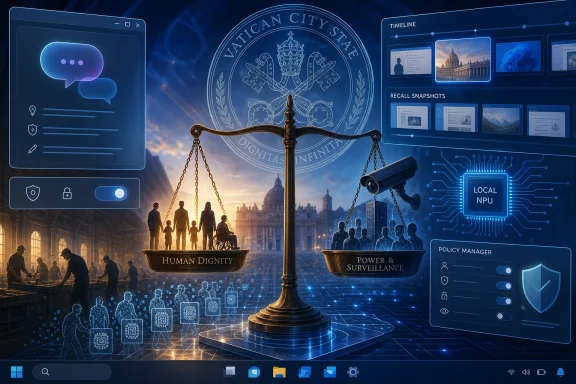
Pope Leo XIV released his first encyclical, Magnifica Humanitas, on May 25, 2026, at the Vatican, using the 135th anniversary of Rerum Novarum to warn that artificial intelligence must serve human dignity rather than concentrate power. The document is not an anti-technology tract. It is a demand that the AI boom be judged by its effect on workers, truth, freedom, war, and the human person. For a Windows world now being rebuilt around Copilot, Recall, local neural processors, and agentic software, the Pope’s intervention lands uncomfortably close to home.
The remarkable thing about Magnifica Humanitas is not that a pope has opinions about technology. The Catholic Church has spent more than a century trying to place moral guardrails around industrial capitalism, labor markets, communications media, nuclear weapons, and bioethics. What is new is the target: not merely machines, but the logic of machine-shaped society.
Leo’s argument is that AI is not neutral infrastructure in the way a spreadsheet or a database might appear to be neutral. It is a technology that mediates attention, labor, knowledge, memory, images, relationships, and eventually political authority. That makes it less like a faster calculator and more like an operating system for social life.
That is why the encyclical matters to Windows users and IT administrators, even those with no interest in Vatican politics. Microsoft has spent the past two years trying to make AI ambient in Windows 11: Copilot in the shell, AI-assisted search, image generation in familiar apps, Recall snapshots on Copilot+ PCs, and a steady push toward on-device models running on NPUs. The PC is no longer just where work happens. It is becoming a sensor, assistant, archive, and interpreter of work.
Leo’s warning is therefore not floating above the technology industry. It is aimed directly at the architecture now being sold as the future of personal computing. If the machine can see what we do, summarize what we read, suggest what we write, remember what we forgot, and act on our behalf, then the old consumer-tech bargain — convenience in exchange for data, opacity, and lock-in — starts to look too small for the stakes.
Magnifica Humanitas tries to perform a similar move for the AI age. The factory has become the data center. The assembly line has become the model pipeline. The company town has become the platform ecosystem. The worker is still present, but now the threat is not only exhaustion or underpayment; it is substitution, surveillance, deskilling, and dependency.
The Waterford column by Fr Liam Power captures this continuity well, even while compressing the theology into newspaper space. Leo is not saying that AI should be smashed or that automation is inherently immoral. He is saying that a society that treats human beings as inputs to be optimized will eventually build systems that do exactly that.
That is the part of the argument the tech industry usually tries to route around. The preferred language is “productivity,” “augmentation,” “efficiency,” and “personalization.” Those words are not meaningless. AI really can help doctors detect disease, help disabled users navigate software, help students translate difficult material, and help small teams do work once reserved for large organizations. But the encyclical asks the question that marketing decks avoid: who receives the productivity, who loses the bargaining power, and who gets to inspect the machinery?
Recall is the clearest example because it collapses so many anxieties into one feature. The idea is simple enough: a PC that can remember what appeared on screen and help users find it later. Microsoft revised the feature after fierce privacy criticism, making it opt-in, tying access to Windows Hello Enhanced Sign-in Security, emphasizing local storage, and adding controls over snapshots. Those changes matter.
But the controversy was never only about whether the database was encrypted properly. It was about whether a general-purpose computer should become a continuously searchable memory of human activity. Even if the data never leaves the device, the cultural shift is large. The user is invited to treat forgetting as a bug, context as a dataset, and private workflow as material for machine indexing.
That is exactly where Leo’s language about the human person cuts against the grain of platform design. A humane computer should assist memory without turning life into a compliance log. It should automate drudgery without making judgment feel obsolete. It should help users act, not quietly train them to outsource agency.
Leo’s concern is that the rewards will be sharply asymmetrical. Those who own models, compute, distribution channels, and enterprise contracts will capture outsized gains. Workers whose knowledge becomes automatable will be asked to compete with systems trained partly on the accumulated output of people like them. The result may not be mass unemployment in the simple, cinematic sense. It may be something more familiar: fewer entry-level paths, more contractorized work, lower wages in routine knowledge roles, and a premium on a narrow class of AI-literate specialists.
That distinction matters for IT pros. The risk is not just that help desk jobs vanish overnight. It is that organizations use AI to stretch teams thinner, reduce training pipelines, and hide operational fragility behind chat interfaces. A junior admin who once learned by doing may instead be told to trust a generated runbook. A developer who once read the docs may accept a plausible code sample. A support worker who once escalated judgment may be measured against a bot’s response time.
The Church’s social teaching language can sound distant from enterprise procurement, but its test is brutally practical: does the technology increase the dignity and capacity of the people who use it, or does it merely increase the leverage of those who deploy it?
That concentration has consequences. If a handful of firms control the foundation models, cloud APIs, productivity suites, and device platforms, they do not merely sell tools. They shape defaults. They decide which features are bundled, which models are available, which safety filters apply, which telemetry is collected, and which users are nudged toward paid tiers.
For WindowsForum readers, this is not theoretical. Microsoft’s advantage is not only model access through OpenAI and its own research. It is the installed base of Windows, Microsoft 365, Azure, GitHub, Teams, Edge, Defender, and enterprise identity. AI can be threaded through all of it. That integration can be powerful, but it also makes opting out harder because the tool becomes the environment.
The encyclical’s insistence on regulation and shared standards is therefore not bureaucratic nostalgia. It is a recognition that individual consent dialogs cannot govern systems whose real power comes from scale, opacity, and dependency. A user can toggle a feature. A society has to govern an infrastructure.
AI intensifies this because it makes prediction cheap and categorization scalable. The more actions are recorded, the more preferences are inferred. The more preferences are inferred, the more behavior can be shaped. The more behavior can be shaped, the easier it becomes to call manipulation “personalization.”
Leo’s warning about algorithms recording actions and preferences should be read in this light. The danger is not only that “Big Tech oligarchs” might spy on people in some crude caricature. The danger is that systems designed to anticipate us may gradually narrow the range of what we expect from ourselves.
On a PC, that may begin innocently: suggested replies, recommended files, summarized meetings, generated images, automated settings, ranked search results. Over time, the machine becomes less a tool and more a layer of interpretation between the user and the world. That layer may be helpful. It may also be commercially interested, institutionally monitored, or impossible to audit.
But local AI does not solve the moral problem by itself. A surveillance system can be local. A manipulative interface can be local. A biased classifier can be local. A feature that changes workplace expectations can be local. Security architecture is necessary, but it is not a substitute for political and ethical judgment.
The same is true of “opt-in” design. Opt-in is better than opt-out, especially for sensitive features. Yet users often make choices inside ecosystems where defaults, prompts, licensing, management policies, and institutional pressure do the real persuading. If an employer standardizes on an AI workflow, the individual employee’s consent becomes largely ceremonial.
This is where Leo’s critique of efficiency becomes useful. The question is not merely whether the feature is secure. It is whether the feature teaches organizations to value speed over responsibility, prediction over trust, and measurable output over human development.
The United States remains more fragmented, with executive actions, agency guidance, state-level rules, procurement standards, and sector-specific enforcement doing work that a single comprehensive statute has not done. That patchwork suits some technology companies because it preserves room to maneuver. It frustrates enterprises that need predictable compliance obligations across jurisdictions.
Leo’s call for international regulation is ambitious, perhaps unrealistically so. But the alternative is not no regulation. The alternative is regulation by platform terms, procurement contracts, insurance exclusions, app-store rules, cloud service agreements, and whatever lawsuits arrive after the damage is done.
That is not democratic governance. It is governance by whoever controls the stack.
Leo’s call to “disarm” AI is not a technical proposal in the narrow sense. It is a moral demand to resist the assumption that every powerful technology must be absorbed into military competition. The line between civilian and military AI will not be clean, especially when the underlying infrastructure is cloud compute, chips, models, and data pipelines shared across sectors.
Windows administrators know this dual-use problem in a more mundane form. Remote management tools can maintain fleets or compromise them. Scripting can automate patching or ransomware deployment. Credential systems can protect identity or become the keys to an empire. AI adds speed, scale, and plausible deniability to that old truth.
The Pope’s point is not that technology causes war. It is that technology shaped by domination will find uses that reinforce domination. In an era of synthetic media, automated vulnerability discovery, AI-assisted phishing, and autonomous weapons research, that warning is not pious decoration.
This matters because product design always contains a theory of the user. A good tool assumes the user has agency worth strengthening. A manipulative tool assumes the user has impulses worth exploiting. A paternalistic tool assumes the user has judgment worth bypassing. An extractive tool assumes the user has behavior worth monetizing.
Much of modern software already nudges people toward passivity. Feeds decide what matters. Notifications decide what interrupts. Autocomplete decides how sentences end. Recommendation systems decide what comes next. AI can either deepen that passivity or challenge it.
The humane path is harder. It requires systems that explain themselves, expose uncertainty, preserve user control, and leave room for silence, error, learning, and refusal. Those values are not anti-innovation. They are the difference between a tool that expands the person and a tool that slowly replaces the person’s habits of thought.
Microsoft has also done more than many rivals to formalize responsible AI processes, publish transparency materials, and build enterprise controls. That should count for something. But process is not proof. The real test is whether Windows AI features remain legible, manageable, removable, and respectful of different risk tolerances.
For sysadmins, the questions are concrete. Can this feature be disabled by policy? What data is captured? Where is it stored? Who can access it? Is it used for training? What logs exist? How does it behave under compromise? What happens in regulated environments? Can users distinguish local inference from cloud processing? Can an organization say no without breaking the product roadmap?
Those are not niche objections from privacy absolutists. They are the questions that determine whether AI becomes trusted infrastructure or another layer of shadow IT with better branding.
The industry’s strongest argument is that AI will produce abundance: more knowledge, faster discovery, better medicine, cheaper services, and new forms of creativity. That argument deserves to be taken seriously. But abundance without governance can still be dehumanizing if it destroys the social conditions that let people participate with dignity.
The Church’s counterargument is not that scarcity is noble. It is that human beings need more than outputs. They need work that forms responsibility, communities that sustain trust, institutions that can contest power, and technologies that remain subordinate to moral ends.
This is why the encyclical’s language may outlast many of today’s model names. Models will change. Benchmarks will change. Copilot branding may change. But the question “what place does the human person have in this system?” will keep returning.
That means treating privacy controls as core architecture, not public-relations patches. It means making enterprise management first-class from day one. It means refusing to hide material changes in vague release notes. It means designing AI tools that invite verification rather than obedience. It means admitting that some contexts — children, patients, employees under discipline, confidential legal work, sensitive government systems — require stronger defaults than consumer productivity demos.
It also means recognizing that local communities matter. WindowsForum readers have always performed an informal civic function in the Microsoft ecosystem: testing, complaining, documenting, reverse-engineering, warning, and teaching. In the AI era, that role becomes more important, not less. Community scrutiny is one of the few counterweights to platform inevitability.
The industry likes to describe skepticism as fear of change. Sometimes it is. But often skepticism is the first sign that users understand the product better than the pitch deck does.
That framing should resonate with anyone responsible for Windows endpoints, Microsoft 365 tenants, identity systems, compliance programs, developer workflows, or family PCs. The AI question is no longer “Should I try this chatbot?” It is “How much of my environment should become machine-interpreted, and under whose rules?”
The answer will not be the same for every user or organization. A researcher, a school district, a hospital, a law firm, a game developer, and a home user will draw different lines. But they all need lines. Without them, convenience becomes policy by stealth.
 The Vatican Has Entered the AI Platform War
The remarkable thing about Magnifica Humanitas is not that a pope has opinions about technology. The Catholic Church has spent more than a century trying to place moral guardrails around industrial capitalism, labor markets, communications media, nuclear weapons, and bioethics. What is new is the target: not merely machines, but the logic of machine-shaped society.Leo’s argument is that AI is not neutral infrastructure in the way a spreadsheet or a database might appear to be neutral. It is a technology that mediates attention, labor, knowledge, memory, images, relationships, and eventually political authority. That makes it less like a faster calculator and more like an operating system for social life.
That is why the encyclical matters to Windows users and IT administrators, even those with no interest in Vatican politics. Microsoft has spent the past two years trying to make AI ambient in Windows 11: Copilot in the shell, AI-assisted search, image generation in familiar apps, Recall snapshots on Copilot+ PCs, and a steady push toward on-device models running on NPUs. The PC is no longer just where work happens. It is becoming a sensor, assistant, archive, and interpreter of work.
Leo’s warning is therefore not floating above the technology industry. It is aimed directly at the architecture now being sold as the future of personal computing. If the machine can see what we do, summarize what we read, suggest what we write, remember what we forgot, and act on our behalf, then the old consumer-tech bargain — convenience in exchange for data, opacity, and lock-in — starts to look too small for the stakes.
Rerum Novarum Was About Factories; Magnifica Humanitas Is About Models
The symbolism of the anniversary is doing real work. Rerum Novarum, issued by Leo XIII in 1891, was a response to the industrial age’s brutal rearrangement of labor, capital, and family life. It rejected the idea that labor was merely a commodity whose price should be set by market power alone. It insisted that wages, property, unions, and the state had to be evaluated through the dignity of the worker.Magnifica Humanitas tries to perform a similar move for the AI age. The factory has become the data center. The assembly line has become the model pipeline. The company town has become the platform ecosystem. The worker is still present, but now the threat is not only exhaustion or underpayment; it is substitution, surveillance, deskilling, and dependency.
The Waterford column by Fr Liam Power captures this continuity well, even while compressing the theology into newspaper space. Leo is not saying that AI should be smashed or that automation is inherently immoral. He is saying that a society that treats human beings as inputs to be optimized will eventually build systems that do exactly that.
That is the part of the argument the tech industry usually tries to route around. The preferred language is “productivity,” “augmentation,” “efficiency,” and “personalization.” Those words are not meaningless. AI really can help doctors detect disease, help disabled users navigate software, help students translate difficult material, and help small teams do work once reserved for large organizations. But the encyclical asks the question that marketing decks avoid: who receives the productivity, who loses the bargaining power, and who gets to inspect the machinery?
The Windows Desktop Is Becoming a Moral Interface
Microsoft’s AI strategy makes Leo’s warning feel less abstract than it might have in the smartphone era. Windows is the environment where office labor, software development, education, administration, design, finance, and government work still converge. When Microsoft adds AI to Windows, it is not merely adding a feature to a consumer gadget. It is changing the default interface of institutional life.Recall is the clearest example because it collapses so many anxieties into one feature. The idea is simple enough: a PC that can remember what appeared on screen and help users find it later. Microsoft revised the feature after fierce privacy criticism, making it opt-in, tying access to Windows Hello Enhanced Sign-in Security, emphasizing local storage, and adding controls over snapshots. Those changes matter.
But the controversy was never only about whether the database was encrypted properly. It was about whether a general-purpose computer should become a continuously searchable memory of human activity. Even if the data never leaves the device, the cultural shift is large. The user is invited to treat forgetting as a bug, context as a dataset, and private workflow as material for machine indexing.
That is exactly where Leo’s language about the human person cuts against the grain of platform design. A humane computer should assist memory without turning life into a compliance log. It should automate drudgery without making judgment feel obsolete. It should help users act, not quietly train them to outsource agency.
The Worker Is Still the First Test
The encyclical’s labor argument is the most immediate and the least mystical. AI is already reshaping hiring, customer support, software development, marketing, legal review, translation, design, and administrative work. Some roles will be enhanced. Some will be hollowed out. Some will disappear behind the polite phrase “workflow transformation.”Leo’s concern is that the rewards will be sharply asymmetrical. Those who own models, compute, distribution channels, and enterprise contracts will capture outsized gains. Workers whose knowledge becomes automatable will be asked to compete with systems trained partly on the accumulated output of people like them. The result may not be mass unemployment in the simple, cinematic sense. It may be something more familiar: fewer entry-level paths, more contractorized work, lower wages in routine knowledge roles, and a premium on a narrow class of AI-literate specialists.
That distinction matters for IT pros. The risk is not just that help desk jobs vanish overnight. It is that organizations use AI to stretch teams thinner, reduce training pipelines, and hide operational fragility behind chat interfaces. A junior admin who once learned by doing may instead be told to trust a generated runbook. A developer who once read the docs may accept a plausible code sample. A support worker who once escalated judgment may be measured against a bot’s response time.
The Church’s social teaching language can sound distant from enterprise procurement, but its test is brutally practical: does the technology increase the dignity and capacity of the people who use it, or does it merely increase the leverage of those who deploy it?
The New Inequality Is Compute, Data, and Permission
Leo’s critique of concentrated wealth maps neatly onto the AI market. The most advanced systems require massive capital expenditure, specialized chips, energy-hungry data centers, privileged access to training data, and distribution through cloud platforms and operating systems. This is not a garage revolution in the romantic 1970s sense. It is an infrastructure race.That concentration has consequences. If a handful of firms control the foundation models, cloud APIs, productivity suites, and device platforms, they do not merely sell tools. They shape defaults. They decide which features are bundled, which models are available, which safety filters apply, which telemetry is collected, and which users are nudged toward paid tiers.
For WindowsForum readers, this is not theoretical. Microsoft’s advantage is not only model access through OpenAI and its own research. It is the installed base of Windows, Microsoft 365, Azure, GitHub, Teams, Edge, Defender, and enterprise identity. AI can be threaded through all of it. That integration can be powerful, but it also makes opting out harder because the tool becomes the environment.
The encyclical’s insistence on regulation and shared standards is therefore not bureaucratic nostalgia. It is a recognition that individual consent dialogs cannot govern systems whose real power comes from scale, opacity, and dependency. A user can toggle a feature. A society has to govern an infrastructure.
Surveillance Does Not Need a Dictator Anymore
The most chilling part of the AI debate is that social control no longer requires a single central tyrant. It can emerge from ordinary optimization. Platforms optimize engagement. Employers optimize productivity. Insurers optimize risk. Governments optimize fraud detection, border control, policing, and public services. Each optimization can be defended as rational, limited, and efficient.AI intensifies this because it makes prediction cheap and categorization scalable. The more actions are recorded, the more preferences are inferred. The more preferences are inferred, the more behavior can be shaped. The more behavior can be shaped, the easier it becomes to call manipulation “personalization.”
Leo’s warning about algorithms recording actions and preferences should be read in this light. The danger is not only that “Big Tech oligarchs” might spy on people in some crude caricature. The danger is that systems designed to anticipate us may gradually narrow the range of what we expect from ourselves.
On a PC, that may begin innocently: suggested replies, recommended files, summarized meetings, generated images, automated settings, ranked search results. Over time, the machine becomes less a tool and more a layer of interpretation between the user and the world. That layer may be helpful. It may also be commercially interested, institutionally monitored, or impossible to audit.
The False Comfort of Local AI
One answer to these fears has been on-device AI. Copilot+ PCs, NPUs, local models, and encrypted local stores all promise a version of machine intelligence that does not require sending every request to the cloud. This is a meaningful improvement in some contexts. Local processing can reduce exposure, latency, and dependence on remote services.But local AI does not solve the moral problem by itself. A surveillance system can be local. A manipulative interface can be local. A biased classifier can be local. A feature that changes workplace expectations can be local. Security architecture is necessary, but it is not a substitute for political and ethical judgment.
The same is true of “opt-in” design. Opt-in is better than opt-out, especially for sensitive features. Yet users often make choices inside ecosystems where defaults, prompts, licensing, management policies, and institutional pressure do the real persuading. If an employer standardizes on an AI workflow, the individual employee’s consent becomes largely ceremonial.
This is where Leo’s critique of efficiency becomes useful. The question is not merely whether the feature is secure. It is whether the feature teaches organizations to value speed over responsibility, prediction over trust, and measurable output over human development.
AI Governance Is Moving Faster Than Corporate Comfort
The encyclical arrives at a moment when AI regulation is no longer hypothetical. The EU AI Act entered into force in 2024 and is moving through staged application, with major obligations landing across 2025 and 2026. Governments are trying to categorize risk, assign duties to providers and deployers, regulate general-purpose models, and create transparency requirements that did not exist when the current AI boom began.The United States remains more fragmented, with executive actions, agency guidance, state-level rules, procurement standards, and sector-specific enforcement doing work that a single comprehensive statute has not done. That patchwork suits some technology companies because it preserves room to maneuver. It frustrates enterprises that need predictable compliance obligations across jurisdictions.
Leo’s call for international regulation is ambitious, perhaps unrealistically so. But the alternative is not no regulation. The alternative is regulation by platform terms, procurement contracts, insurance exclusions, app-store rules, cloud service agreements, and whatever lawsuits arrive after the damage is done.
That is not democratic governance. It is governance by whoever controls the stack.
The Military Shadow Is Not a Side Issue
The encyclical’s concern about war and domination may sound remote from desktop computing, but it belongs in the same argument. AI is dual-use by nature. The same advances in computer vision, prediction, language processing, simulation, and autonomous decision-making that power commercial tools can also support targeting, surveillance, cyber operations, propaganda, and command systems.Leo’s call to “disarm” AI is not a technical proposal in the narrow sense. It is a moral demand to resist the assumption that every powerful technology must be absorbed into military competition. The line between civilian and military AI will not be clean, especially when the underlying infrastructure is cloud compute, chips, models, and data pipelines shared across sectors.
Windows administrators know this dual-use problem in a more mundane form. Remote management tools can maintain fleets or compromise them. Scripting can automate patching or ransomware deployment. Credential systems can protect identity or become the keys to an empire. AI adds speed, scale, and plausible deniability to that old truth.
The Pope’s point is not that technology causes war. It is that technology shaped by domination will find uses that reinforce domination. In an era of synthetic media, automated vulnerability discovery, AI-assisted phishing, and autonomous weapons research, that warning is not pious decoration.
The Pope Is Also Warning Against Bad Anthropology
The deepest claim in Magnifica Humanitas is not about jobs or privacy, though those are the parts most likely to shape policy debate. It is about what kind of creature the human person is. AI systems tempt society to define intelligence as output, relationship as simulation, creativity as recombination, and judgment as prediction. That may be useful for engineering. It is disastrous as anthropology.This matters because product design always contains a theory of the user. A good tool assumes the user has agency worth strengthening. A manipulative tool assumes the user has impulses worth exploiting. A paternalistic tool assumes the user has judgment worth bypassing. An extractive tool assumes the user has behavior worth monetizing.
Much of modern software already nudges people toward passivity. Feeds decide what matters. Notifications decide what interrupts. Autocomplete decides how sentences end. Recommendation systems decide what comes next. AI can either deepen that passivity or challenge it.
The humane path is harder. It requires systems that explain themselves, expose uncertainty, preserve user control, and leave room for silence, error, learning, and refusal. Those values are not anti-innovation. They are the difference between a tool that expands the person and a tool that slowly replaces the person’s habits of thought.
Microsoft Should Read This as a Product Review
The Vatican did not write Magnifica Humanitas as a Windows feature review, but Microsoft would be foolish not to read it that way. The company has already learned that users will revolt when AI feels imposed, opaque, or too intimate. Recall’s rocky path showed that even a technically clever feature can fail the trust test if people believe the product team has normalized a boundary crossing.Microsoft has also done more than many rivals to formalize responsible AI processes, publish transparency materials, and build enterprise controls. That should count for something. But process is not proof. The real test is whether Windows AI features remain legible, manageable, removable, and respectful of different risk tolerances.
For sysadmins, the questions are concrete. Can this feature be disabled by policy? What data is captured? Where is it stored? Who can access it? Is it used for training? What logs exist? How does it behave under compromise? What happens in regulated environments? Can users distinguish local inference from cloud processing? Can an organization say no without breaking the product roadmap?
Those are not niche objections from privacy absolutists. They are the questions that determine whether AI becomes trusted infrastructure or another layer of shadow IT with better branding.
The Human-Centered AI Slogan Has Run Out of Time
Every major technology company now speaks the language of human-centered AI. The phrase has become so common that it risks meaning almost nothing. Leo’s encyclical raises the price of using it. If AI is truly human-centered, then workers cannot be treated as transition costs, users cannot be treated as behavioral datasets, and societies cannot be told to accept concentration as the inevitable price of progress.The industry’s strongest argument is that AI will produce abundance: more knowledge, faster discovery, better medicine, cheaper services, and new forms of creativity. That argument deserves to be taken seriously. But abundance without governance can still be dehumanizing if it destroys the social conditions that let people participate with dignity.
The Church’s counterargument is not that scarcity is noble. It is that human beings need more than outputs. They need work that forms responsibility, communities that sustain trust, institutions that can contest power, and technologies that remain subordinate to moral ends.
This is why the encyclical’s language may outlast many of today’s model names. Models will change. Benchmarks will change. Copilot branding may change. But the question “what place does the human person have in this system?” will keep returning.
The PC Industry Gets a Moral Stress Test
The near-term challenge for the Windows ecosystem is not to stop AI development. That will not happen, and it should not happen. The challenge is to make AI features boringly accountable before they become invisibly mandatory.That means treating privacy controls as core architecture, not public-relations patches. It means making enterprise management first-class from day one. It means refusing to hide material changes in vague release notes. It means designing AI tools that invite verification rather than obedience. It means admitting that some contexts — children, patients, employees under discipline, confidential legal work, sensitive government systems — require stronger defaults than consumer productivity demos.
It also means recognizing that local communities matter. WindowsForum readers have always performed an informal civic function in the Microsoft ecosystem: testing, complaining, documenting, reverse-engineering, warning, and teaching. In the AI era, that role becomes more important, not less. Community scrutiny is one of the few counterweights to platform inevitability.
The industry likes to describe skepticism as fear of change. Sometimes it is. But often skepticism is the first sign that users understand the product better than the pitch deck does.
Leo’s AI Challenge Lands Directly on the Windows Desktop
The most practical reading of Magnifica Humanitas is not that Catholics now have an AI policy paper or that the Vatican has joined the pundit class. It is that one of the world’s oldest institutions has identified the AI boom as a civilizational design problem, not a feature-release cycle.That framing should resonate with anyone responsible for Windows endpoints, Microsoft 365 tenants, identity systems, compliance programs, developer workflows, or family PCs. The AI question is no longer “Should I try this chatbot?” It is “How much of my environment should become machine-interpreted, and under whose rules?”
The answer will not be the same for every user or organization. A researcher, a school district, a hospital, a law firm, a game developer, and a home user will draw different lines. But they all need lines. Without them, convenience becomes policy by stealth.
- AI features in Windows should be judged not only by usefulness, but by whether users and administrators can understand, govern, and disable them.
- Local processing improves the privacy story, but it does not automatically make a feature humane, safe, or appropriate.
- The labor impact of AI will be measured as much in weakened career ladders and reduced bargaining power as in outright job losses.
- Regulation will increasingly shape AI deployment, especially for organizations operating across the EU, the United States, and other jurisdictions.
- The most important AI question for IT leaders is not whether a vendor says a system is responsible, but whether the organization can independently verify how it behaves.
References
- Primary source: waterford-news.ie
Published: 2026-05-31T11:50:31.934628
Fr Liam Power: Pope Leo - AI must serve humanity - Opinion - Waterford News & Star
A Question of Faith is Fr Liam Power's fortnightly columnwww.waterford-news.ie
- Related coverage: axios.com
5 ways Pope Leo says AI could warp humanity
Why the Pope wants to slow down AI development.www.axios.com
- Related coverage: theweek.com
Pope tackles AI in encyclical celebrating humanity | The Week
AI “must be at the service of all, and of the common good,” the pope said, calling it an “instrument of domination”theweek.com - Related coverage: theatlantic.com
Pope Leo Is Challenging Much More Than Big Tech - The Atlantic
Leo’s new encyclical challenges much more than Big Tech.www.theatlantic.com
- Related coverage: vaticannews.va
Pope Leo’s ‘Magnifica humanitas’: AI must serve humanity not concentrate power - Vatican News
Marking the 135th anniversary of Rerum novarum, Pope Leo XIV releases his first encyclical, entitled ‘Magnifica humanitas: On Safeguarding the Human ...www.vaticannews.va - Related coverage: villanova.edu
Pope Leo XIV Releases First Encyclical, “Magnifica Humanitas” | Villanova University
On May 25, 2026, Pope Leo XIV released his first papal encyclical, “Magnifica Humanitas: On Safeguarding the Human Person in the Time of Artificial Intelligence.” The letter— true to its title’s meaning of “magnificent humanity”—addresses how society...www.villanova.edu
- Related coverage: usccb.org
In first encyclical, Pope Leo urges world to 'disarm' AI amid increased reliance
Presenting the first encyclical of his papacy, Pope Leo XIV warned that artificial intelligence risks deepening inequality, weakening human relationships and...www.usccb.org - Related coverage: mecc.org
His Holiness Pope Leo XIV’s First Encyclical ‘Magnifica humanitas’: AI must serve humanity not concentrate power — The Middle East Council of Churches
Marking the 135th anniversary of Rerum novarum, His Holiness Pope Leo XIV releases his first Encyclical, entitled ‘Magnifica humanitas: On Safeguarding the Human Person in the Time of Artificial Intelligence.’ He appeals for the safeguarding of humanity, promotion of truth, dignity of work, social jwww.mecc.org
- Related coverage: academyforlife.va
- Related coverage: lemonde.fr
AI, peace and humanity: The pope's resounding warning
EDITORIAL. On May 25, Pope Leo XIV released his first encyclical, dedicated to AI. The document's necessary warnings are addressed to the whole world, at a time when informed political debate about AI's impact on humanity is rare.www.lemonde.fr - Related coverage: societyofmaryusa.org
Pope Leo will publish first encyclical, ‘Magnifica Humanitas,’ on preserving humanity in the A.I. age on May 25 - America Magazine
PDF documentwww.societyofmaryusa.org
