

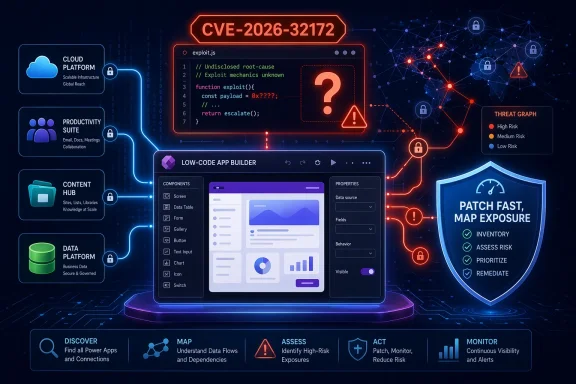
Microsoft has published CVE-2026-32172 as a Power Apps Remote Code Execution issue, but the public record is still thin on root-cause detail. In Microsoft’s Security Update Guide, the vulnerability page exists, yet the page itself may require JavaScript and the broader MSRC material available here does not expose technical internals beyond the classification and the confidence language the user supplied. That means the most defensible conclusion right now is that Microsoft is treating the issue as a real RCE-class vulnerability in Power Apps, but the exact exploit mechanics are not yet fully disclosed in the materials available to us.
Power Apps sits in a part of Microsoft’s ecosystem where low-code convenience meets enterprise trust. That makes any remote code execution finding especially sensitive, because the platform is often used to build business workflows, internal tools, and app experiences that are assumed to be safe by design. Microsoft’s recent Security Update Guide efforts have emphasized more structured vulnerability disclosure, including CVSS-aligned descriptions and broader transparency around CVEs, which is relevant here because CVE-2026-32172 appears in that modern disclosure model even if the technical details are still sparse.
What makes this particular case noteworthy is the confidence metric you included. That metric is essentially a measure of how certain we are that the vulnerability exists and how credible the technical understanding is. In practical terms, a confirmed vendor-tracked RCE with an assigned CVE carries much more operational urgency than a hypothetical flaw, a third-party suspicion, or a fuzzing result that has not been validated. Microsoft’s own vulnerability-disclosure posture has increasingly leaned toward clearer, machine-readable, and more precise classification, which is why the presence of a CVE in the update guide matters even before the exploit story is public.
For defenders, the bigger issue is not just “can code run?” but “where does Power Apps sit in the trust chain?” Low-code platforms often have broad connectivity to identity, data sources, connectors, and automation workflows. A serious flaw in that stack can become a bridge into SharePoint, Dataverse, Microsoft 365, or downstream line-of-business systems, depending on how the environment is configured. Microsoft’s Power Platform security guidance repeatedly frames the platform as part of an enterprise security boundary, not a toy app environment, and that is why RCE in this context should be read as a platform-level concern rather than a single-app defect.
The absence of detailed exploit mechanics also cuts both ways. It limits attacker guidance, which is good, but it also limits defender specificity, which is frustrating. When a vulnerability is confirmed but not fully explained, security teams have to rely more heavily on patching, exposure review, and platform-wide hardening rather than elegant point mitigations. That is a familiar pattern in Microsoft security: broad classes of bugs are often public before the full chain is understood, and the window between disclosure and weaponization can be short once technical confidence rises.
Remote code execution vulnerabilities have a special place in Microsoft’s security history because they often define the difference between a nuisance bug and a full compromise. Across years of MSRC disclosures, the company has consistently treated RCE issues as high-priority, especially when the vulnerable component is network-reachable or embedded in a widely deployed service. Microsoft’s Security Update Guide now presents these issues with CVSS context and structured descriptions, which helps defenders understand attack vector and impact even when the underlying root cause remains unpublished.
The confidence metric you quoted is also meaningful in a historical sense. Security teams have learned that not every published CVE is equally mature. Some are highly confirmed, with reproducible proofs and vendor acknowledgment. Others begin as theory, then become more certain as researchers corroborate the weakness. A metric that captures this distinction is valuable because it tells defenders whether they are dealing with a speculative concern or an already validated path to exploitation. In the case of CVE-2026-32172, the vendor-assigned CVE strongly suggests the latter.
Microsoft’s broader transparency efforts are also relevant. The company has recently emphasized machine-readable CSAF publication and more structured vulnerability data distribution, which is part of a larger industry trend toward quicker remediation and automation. That does not eliminate uncertainty in the early days of a disclosure, but it does mean customers can expect a more formalized record over time. For a product like Power Apps, where enterprise administrators need to act before every technical detail is public, that formal record is often enough to justify immediate triage.
What the disclosure does not yet tell us is equally important. We do not have authoritative public confirmation here of the specific code path, root cause category, or exploitation conditions. That means any claim about deserialization, auth bypass, file upload abuse, connector abuse, or formula injection would be speculation unless Microsoft or a trusted researcher publishes it. For now, the most responsible framing is that the vulnerability exists, Microsoft has recognized it, and the exact technical vector remains unrevealed in the accessible sources.
That uncertainty does not reduce urgency for administrators. In fact, it often increases the need to patch quickly because defenders cannot yet build precise compensating controls around the flaw. Microsoft has historically used the Security Update Guide to anchor remediation even when the narrative around a CVE is still sparse, and that is exactly why organizations should treat the guide as the source of operational truth once an update is posted.
The business risk also expands because Power Apps is usually deployed by departments that are not traditional software engineering teams. That means security ownership may be diffuse. A central platform team may manage the environment, but individual makers often build the apps, wire the connectors, and decide which data sources are in scope. A flaw in the platform can therefore ripple through citizen-developer projects that were never reviewed like conventional production software.
From an attacker’s perspective, that environment is attractive precisely because it is dense with trust. If an RCE exists inside the platform, it may offer a direct path to steal tokens, manipulate data flows, or pivot into broader Microsoft services. Even if the eventual exploit requires some precondition, the mere fact that code execution is on the table is enough to justify fast mitigation. Any enterprise platform that can touch business data deserves a faster response than a normal line-of-business app.
The second step is to follow Microsoft’s remediation guidance as soon as it appears in the Security Update Guide or related support channels. When a CVE is assigned, the canonical answer usually becomes patch, update, or mitigate according to Microsoft’s published release path. Microsoft’s recent move toward more structured vulnerability publishing is meant to help with exactly this kind of response.
The third step is to think like an attacker and ask what adjacent systems the platform can reach. If Power Apps is connected to sensitive APIs, SharePoint, Dataverse, or internal services, then the incident should be treated as a potential trust-chain event rather than a standalone bug. The biggest mistakes in low-code security usually come from assuming that the platform boundary is also the trust boundary. It is not.
The company’s recent focus on transparency matters because enterprises need to sort through enormous patch volumes and decide what is truly urgent. Microsoft’s own vulnerability-descriptions initiative was meant to make the Security Update Guide more actionable by including CVSS attributes and richer metadata. That context becomes especially useful when the technical write-up is incomplete, because the classification still gives defenders a reliable signal about attack class and likely impact.
We have seen this pattern before across Microsoft’s ecosystem: a high-value platform gets a formal CVE, the vendor confirms the bug class, and defenders are asked to move fast while the full exploit story continues to develop. That is a normal rhythm in modern security. Normal, however, does not mean low-risk. In Microsoft’s world, broad platform trust plus remote reachability is often enough to justify immediate action.
The second thing to watch is whether Microsoft adds companion guidance for Power Platform administrators. If the issue involves a broader trust boundary, Microsoft may eventually recommend connector restrictions, environment hardening, or additional logging. That would not be unusual, because Microsoft’s recent security posture has been to pair vulnerability disclosure with practical remediation advice whenever possible.
The third factor is telemetry. If exploitation indicators surface later, the incident will shift from “patch now” to “patch, hunt, and contain.” That progression is familiar in modern Microsoft disclosures, where the difference between a newly published vulnerability and a real-world campaign can be very short. The best teams will treat this as a prompt to review access paths, inventory, and logging immediately rather than as a waiting game.
Source: MSRC Security Update Guide - Microsoft Security Response Center
 Overview
Power Apps sits in a part of Microsoft’s ecosystem where low-code convenience meets enterprise trust. That makes any remote code execution finding especially sensitive, because the platform is often used to build business workflows, internal tools, and app experiences that are assumed to be safe by design. Microsoft’s recent Security Update Guide efforts have emphasized more structured vulnerability disclosure, including CVSS-aligned descriptions and broader transparency around CVEs, which is relevant here because CVE-2026-32172 appears in that modern disclosure model even if the technical details are still sparse.What makes this particular case noteworthy is the confidence metric you included. That metric is essentially a measure of how certain we are that the vulnerability exists and how credible the technical understanding is. In practical terms, a confirmed vendor-tracked RCE with an assigned CVE carries much more operational urgency than a hypothetical flaw, a third-party suspicion, or a fuzzing result that has not been validated. Microsoft’s own vulnerability-disclosure posture has increasingly leaned toward clearer, machine-readable, and more precise classification, which is why the presence of a CVE in the update guide matters even before the exploit story is public.
For defenders, the bigger issue is not just “can code run?” but “where does Power Apps sit in the trust chain?” Low-code platforms often have broad connectivity to identity, data sources, connectors, and automation workflows. A serious flaw in that stack can become a bridge into SharePoint, Dataverse, Microsoft 365, or downstream line-of-business systems, depending on how the environment is configured. Microsoft’s Power Platform security guidance repeatedly frames the platform as part of an enterprise security boundary, not a toy app environment, and that is why RCE in this context should be read as a platform-level concern rather than a single-app defect.
The absence of detailed exploit mechanics also cuts both ways. It limits attacker guidance, which is good, but it also limits defender specificity, which is frustrating. When a vulnerability is confirmed but not fully explained, security teams have to rely more heavily on patching, exposure review, and platform-wide hardening rather than elegant point mitigations. That is a familiar pattern in Microsoft security: broad classes of bugs are often public before the full chain is understood, and the window between disclosure and weaponization can be short once technical confidence rises.
Background
Power Apps has become one of Microsoft’s most strategically important business platforms because it lets organizations build applications without a traditional software-development cycle. That convenience is also what makes it security-relevant. The more a platform centralizes workflows, permissions, and connectors, the more attractive it becomes to attackers looking for a high-leverage foothold rather than a random endpoint. Microsoft’s own security FAQs for Power Platform discuss enterprise security concerns around app-building and trust boundaries, reinforcing the idea that low-code does not mean low-risk.Remote code execution vulnerabilities have a special place in Microsoft’s security history because they often define the difference between a nuisance bug and a full compromise. Across years of MSRC disclosures, the company has consistently treated RCE issues as high-priority, especially when the vulnerable component is network-reachable or embedded in a widely deployed service. Microsoft’s Security Update Guide now presents these issues with CVSS context and structured descriptions, which helps defenders understand attack vector and impact even when the underlying root cause remains unpublished.
The confidence metric you quoted is also meaningful in a historical sense. Security teams have learned that not every published CVE is equally mature. Some are highly confirmed, with reproducible proofs and vendor acknowledgment. Others begin as theory, then become more certain as researchers corroborate the weakness. A metric that captures this distinction is valuable because it tells defenders whether they are dealing with a speculative concern or an already validated path to exploitation. In the case of CVE-2026-32172, the vendor-assigned CVE strongly suggests the latter.
Microsoft’s broader transparency efforts are also relevant. The company has recently emphasized machine-readable CSAF publication and more structured vulnerability data distribution, which is part of a larger industry trend toward quicker remediation and automation. That does not eliminate uncertainty in the early days of a disclosure, but it does mean customers can expect a more formalized record over time. For a product like Power Apps, where enterprise administrators need to act before every technical detail is public, that formal record is often enough to justify immediate triage.
Why the confidence score matters
The confidence metric is not the same thing as severity, but it influences how seriously defenders should treat an advisory. If a vulnerability is fully confirmed, then patching, compensating controls, and exposure review become immediate priorities. If the technical details are still partly unproven, the response might be more cautious, but not optional.- High confidence means the vulnerability is likely real and reproducible.
- Lower confidence may mean the issue is suspected but not fully validated.
- Vendor acknowledgment is a major signal that the problem is not just theoretical.
- RCE-class impact always raises the urgency bar.
- Enterprise platforms deserve faster action because blast radius is larger.
What Microsoft’s Disclosure Tells Us
The key fact is straightforward: Microsoft has assigned a CVE to a Power Apps remote code execution vulnerability, and that alone implies the issue is serious enough to merit formal lifecycle tracking. Microsoft’s Security Update Guide is designed to provide the canonical public record for vulnerabilities, even though the page can be difficult to read directly without JavaScript. The update-guide model exists precisely so Microsoft can document severity, product scope, and patch state in a more systematic way.What the disclosure does not yet tell us is equally important. We do not have authoritative public confirmation here of the specific code path, root cause category, or exploitation conditions. That means any claim about deserialization, auth bypass, file upload abuse, connector abuse, or formula injection would be speculation unless Microsoft or a trusted researcher publishes it. For now, the most responsible framing is that the vulnerability exists, Microsoft has recognized it, and the exact technical vector remains unrevealed in the accessible sources.
That uncertainty does not reduce urgency for administrators. In fact, it often increases the need to patch quickly because defenders cannot yet build precise compensating controls around the flaw. Microsoft has historically used the Security Update Guide to anchor remediation even when the narrative around a CVE is still sparse, and that is exactly why organizations should treat the guide as the source of operational truth once an update is posted.
What is confirmed versus what is inferred
A clean separation helps avoid overstatement. We can confirm that Microsoft has a Power Apps CVE labeled as remote code execution. We can infer that the issue is serious, likely patch-worthy, and potentially enterprise-wide in impact. We cannot, from the sources available here, infer the exact exploit technique with confidence.- Confirmed: Microsoft is tracking CVE-2026-32172.
- Confirmed: The issue is classified as remote code execution.
- Inferred: The vulnerability is important enough for immediate enterprise attention.
- Not confirmed here: The exact root cause or exploit chain.
- Not confirmed here: Whether exploitation is public or active.
Why Power Apps RCE Is Different
A remote code execution flaw in Power Apps is not just another application bug because the platform lives close to identity, data, and business logic. Low-code tools are often trusted to move quickly and safely through enterprise workflows, which means they tend to have wide connector permissions and broad visibility across services. If an attacker can turn that trust into code execution, the result may be a lot more than one compromised app.The business risk also expands because Power Apps is usually deployed by departments that are not traditional software engineering teams. That means security ownership may be diffuse. A central platform team may manage the environment, but individual makers often build the apps, wire the connectors, and decide which data sources are in scope. A flaw in the platform can therefore ripple through citizen-developer projects that were never reviewed like conventional production software.
From an attacker’s perspective, that environment is attractive precisely because it is dense with trust. If an RCE exists inside the platform, it may offer a direct path to steal tokens, manipulate data flows, or pivot into broader Microsoft services. Even if the eventual exploit requires some precondition, the mere fact that code execution is on the table is enough to justify fast mitigation. Any enterprise platform that can touch business data deserves a faster response than a normal line-of-business app.
Enterprise workflow risk
Power Apps often operates in environments where business continuity is tied to custom apps. That means disruption is costly, but compromise is worse. The dilemma for administrators is familiar: the same customizations that drive productivity can also widen the attack surface.- Business logic is often distributed across many small apps.
- Connectors can widen access to valuable data sources.
- Ownership is decentralized, which complicates patch accountability.
- Security reviews may lag behind the pace of app creation.
- A platform flaw can affect many apps at once.
What Defenders Should Do First
The first step is to determine exposure. If you run Power Apps or rely on connected Microsoft cloud workflows, you need to identify which environments, tenants, and business processes are using the affected platform components. In Microsoft ecosystems, inventory is always the first battle, because you cannot prioritize what you cannot see. Microsoft’s Power Platform guidance and security FAQ material both reinforce the need for governance and awareness of what is deployed, where, and by whom.The second step is to follow Microsoft’s remediation guidance as soon as it appears in the Security Update Guide or related support channels. When a CVE is assigned, the canonical answer usually becomes patch, update, or mitigate according to Microsoft’s published release path. Microsoft’s recent move toward more structured vulnerability publishing is meant to help with exactly this kind of response.
The third step is to think like an attacker and ask what adjacent systems the platform can reach. If Power Apps is connected to sensitive APIs, SharePoint, Dataverse, or internal services, then the incident should be treated as a potential trust-chain event rather than a standalone bug. The biggest mistakes in low-code security usually come from assuming that the platform boundary is also the trust boundary. It is not.
Practical response checklist
A good response plan should be simple enough to execute under pressure and detailed enough to avoid blind spots.- Identify all Power Apps environments in the tenant.
- Check Microsoft’s update guidance for CVE-2026-32172.
- Inventory connectors and permissions tied to affected apps.
- Review admin logs and audit trails for unusual behavior.
- Prioritize internet-facing or highly privileged workflows first.
- Validate that compensating controls do not depend on the vulnerable component.
How This Fits Microsoft’s Broader Security Pattern
Microsoft has spent the last few years publishing more context around vulnerabilities, including cloud-service CVEs, structured descriptions, and clearer notification workflows. That is not just a communications improvement; it reflects the reality that modern Microsoft products increasingly blur the line between software, service, and platform. Power Apps is a prime example of that shift, because its security posture depends on both local application behavior and cloud-integrated service trust.The company’s recent focus on transparency matters because enterprises need to sort through enormous patch volumes and decide what is truly urgent. Microsoft’s own vulnerability-descriptions initiative was meant to make the Security Update Guide more actionable by including CVSS attributes and richer metadata. That context becomes especially useful when the technical write-up is incomplete, because the classification still gives defenders a reliable signal about attack class and likely impact.
We have seen this pattern before across Microsoft’s ecosystem: a high-value platform gets a formal CVE, the vendor confirms the bug class, and defenders are asked to move fast while the full exploit story continues to develop. That is a normal rhythm in modern security. Normal, however, does not mean low-risk. In Microsoft’s world, broad platform trust plus remote reachability is often enough to justify immediate action.
Why the update-guide model matters
The modern update guide gives enterprises a single place to track remediation, but it also signals a broader philosophy: disclosure should be machine-readable, timely, and operationally useful. That is good for defenders, but it also creates pressure to act before all details are known. The tradeoff is unavoidable.- More structure helps automation and patch orchestration.
- Better metadata improves triage across large estates.
- Early CVE publication reduces uncertainty about vendor acknowledgment.
- Incomplete technical detail still leaves room for caution.
- Security teams must balance speed with validation.
Strengths and Opportunities
Microsoft’s handling of this issue, at least at the disclosure level, has a few clear advantages. A formal CVE tells customers the issue is real, the Security Update Guide provides a canonical tracking point, and the broader Power Platform security guidance gives organizations a framework for treating the platform as part of enterprise risk management rather than a shadow IT convenience layer. That combination creates a workable path for remediation even before every technical detail is public.- Formal vendor acknowledgment increases confidence that the issue exists.
- Security Update Guide tracking supports consistent remediation.
- Power Platform governance guidance helps organizations map exposure.
- RCE-class labeling gives defenders a clear urgency signal.
- Low-code platform reviews may uncover other hidden trust-chain weaknesses.
- Patch response can be centralized in tenant administration.
- The event can improve inventory discipline around citizen-developed apps.
Risks and Concerns
The biggest risk is that organizations will underestimate a Power Apps flaw because it sits in a low-code environment rather than a traditional server product. That would be a mistake. Enterprise low-code systems often have deep access to data, identity, and workflow automation, and a remote code execution flaw in that layer could be exploited to move laterally or manipulate business processes. Convenience does not reduce blast radius; it often increases it.- The exact exploit mechanics are still unclear, making compensating controls harder.
- Admin ownership may be fragmented across business units.
- Connectors can expose sensitive downstream systems.
- Delayed patching may widen the attack window.
- Citizen-developed apps may not be inventoried well.
- A platform compromise could affect many workflows at once.
- Overconfidence in Microsoft-hosted services can mask real risk.
Looking Ahead
The next meaningful milestone will be Microsoft’s fuller public update on CVE-2026-32172, whether that appears as a more detailed Security Update Guide entry, a support advisory, or a related blog post. Until then, defenders should act on the classification itself rather than wait for a polished exploit narrative. In Microsoft security, the early metadata is often the signal that matters most operationally.The second thing to watch is whether Microsoft adds companion guidance for Power Platform administrators. If the issue involves a broader trust boundary, Microsoft may eventually recommend connector restrictions, environment hardening, or additional logging. That would not be unusual, because Microsoft’s recent security posture has been to pair vulnerability disclosure with practical remediation advice whenever possible.
The third factor is telemetry. If exploitation indicators surface later, the incident will shift from “patch now” to “patch, hunt, and contain.” That progression is familiar in modern Microsoft disclosures, where the difference between a newly published vulnerability and a real-world campaign can be very short. The best teams will treat this as a prompt to review access paths, inventory, and logging immediately rather than as a waiting game.
- Watch for a fuller Microsoft advisory with scope and remediation details.
- Check whether Power Platform governance guidance changes in response.
- Review connectors and privileged workflows tied to Power Apps.
- Monitor for exploitation reports or new threat intelligence.
- Validate inventory and patch status across all Power Apps environments.
Source: MSRC Security Update Guide - Microsoft Security Response Center
