

Mark Hamblin’s take on AI is striking in its practical simplicity: use AI where it reduces clicks, removes repetitive checks, and surfaces the exceptions that deserve human attention — and you get measurable operational lift without wholesale disruption. In a recent AI Agent & Copilot Podcast conversation, Hamblin, president of Insight Works (DMS Companies), laid out three grounded AI priorities his team is pursuing — internal process automation, higher‑quality marketing and content, and product enhancement — and illustrated each with concrete examples, from automated labor‑time validation in Shop Floor Insight to agentic production scheduling and an experimental “Agent Playground” for user‑driven automation. Those examples aren’t speculative: they map to existing product capabilities and to the broader agent‑first platform story Microsoft and partners articulated at Ignite 2025. The lesson for Windows and Dynamics 365 practitioners is clear: the AI era is best approached as a disciplined automation and governance challenge, not a one‑off technology stunt.
AI in business software has moved fast from “helpful draft” scenarios to agentic automation — AI agents that can watch, reason over business data, and take pre‑authorized actions. Vendors and systems integrators are responding: they’re embedding AI into ERP, MES, and CRM workflows and building governance layers so those agents can be managed, audited, and limited to specific responsibilities. Microsoft’s 2025 product narrative made agents a central platform construct (Agent 365, Copilot Studio, Work IQ), and the AI Agent & Copilot Summit is positioning itself as the partner ecosystem’s practical forum to convert agent prototypes into production outcomes. Insight Works occupies a practical niche: it is an ISV that builds operations‑facing apps (Warehouse Insight, Shop Floor Insight, etc. for Microsoft Dynamics 365 Business Central. Those apps historically reduced manual entry and sped shop‑floor workflows; the current phase is to add intelligence to the workflow — turning validations and approvals into algorithmic checks and surfacing only the true exceptions to human supervisors. That shift is incremental but powerful: it preserves established ERP integrations while accelerating the value customers already expect from Shop Floor Insight and related modules.
Industry platform moves reinforce this scenario: Microsoft’s Agent‑centric strategy (Agent 365, Copilot Studio, Work IQ) explicitly targets multi‑step orchestration and governance of agent workflows across enterprise applications, which is precisely the infrastructure needed to run bounded, auditable scheduling agents. Independent coverage from analyst and news outlets confirms Microsoft’s push to make agents manageable at scale. But there are two important caveats:
The near‑term playbook for Windows and Dynamics 365 organizations is clear: pilot the low‑risk wins (time validation, exception scoring, templated content generation), instrument outcomes rigorously, and keep human oversight close while you build the trust and data maturity agents require. Experimental items such as user “Agent Playgrounds” and ultra‑large decision‑space autonomous schedulers are worth tracking, but they should be validated by reproducible pilots and clear governance before wider rollout.
Conclusion
AI is no longer an abstract potential — it’s a practical accelerator when applied to the right operational problems. Insight Works’ story, as told by Mark Hamblin, is instructive because it emphasizes modest, measurable use cases instead of moonshots. For Windows and Dynamics practitioners, the path forward is to marry that pragmatic lens with the platform and governance primitives now emerging across the ecosystem: pilot with purpose, instrument with rigor, and scale only when data quality and controls are proven. The payoff is tangible: fewer clicks, fewer exceptions, and more time for people to do the work that machines cannot.
Source: Cloud Wars AI Agent & Copilot Podcast: Insight Works' Mark Hamblin on How AI Transforms Process, Products
 Background / Overview
AI in business software has moved fast from “helpful draft” scenarios to agentic automation — AI agents that can watch, reason over business data, and take pre‑authorized actions. Vendors and systems integrators are responding: they’re embedding AI into ERP, MES, and CRM workflows and building governance layers so those agents can be managed, audited, and limited to specific responsibilities. Microsoft’s 2025 product narrative made agents a central platform construct (Agent 365, Copilot Studio, Work IQ), and the AI Agent & Copilot Summit is positioning itself as the partner ecosystem’s practical forum to convert agent prototypes into production outcomes. Insight Works occupies a practical niche: it is an ISV that builds operations‑facing apps (Warehouse Insight, Shop Floor Insight, etc. for Microsoft Dynamics 365 Business Central. Those apps historically reduced manual entry and sped shop‑floor workflows; the current phase is to add intelligence to the workflow — turning validations and approvals into algorithmic checks and surfacing only the true exceptions to human supervisors. That shift is incremental but powerful: it preserves established ERP integrations while accelerating the value customers already expect from Shop Floor Insight and related modules. How Insight Works is Applying AI: Three Practical Pillars
Mark Hamblin framed Insight Works’ AI adoption around three pragmatic, repeatable pillars. Each is straightforward and implementable inside most mid‑market manufacturing deployments.1) Internal process development and automation
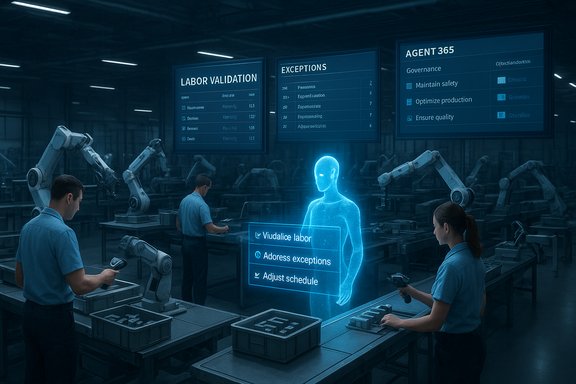
Insight Works uses AI to reduce the repetitive manual work that slows teams down. Examples Hamblin described include:- Auto‑validating time entries and attendance against business rules so supervisors only see exceptions rather than every time card.
- Using AI agents to triage operational alerts and create curated, prioritized action lists for planners and managers.
- Building small automation playbooks — the fastest returns come from focused, repeatable tasks.
2) Marketing and content quality
AI is being used to accelerate content production — not to replace human marketers, but to scale and improve quality:- Generative templates to create localized campaigns, product copy, and demo scripts fast.
- AI‑assisted editing and brand‑tone enforcement that preserve messaging while increasing output velocity.
3) Product enhancements and agentic features
Insight Works is embedding intelligence into its product suite, most visibly into Shop Floor Insight and scheduling tools:- Automating labor time validation and exception approvals within Shop Floor Insight to eliminate routine supervisor reviews.
- Exploring agentic scheduling that evaluates large combinatorial decision spaces and surfaces the small set of schedule changes or conflicts that need human attention.
- Experimenting with an “Agent Playground” where business users can prototype automation rules and agent behaviors before production rollout.
Deep Dive: Shop Floor Insight — from barcode MES to AI‑assisted validation
Shop Floor Insight is an established MES add‑on for Dynamics 365 Business Central. Its core strengths — barcode scanning, touch terminals, and real‑time data capture for time, material, quality, and rework — are proven and widely deployed. Microsoft AppSource and partner press materials describe the app as a mature solution for eliminating manual time entry and improving accuracy in labor and production accounting. What’s new is the addition of AI to enhance the app’s supervisory workflows:- Exception‑first approvals: Shop Floor Insight already implements exception‑based approval flows (for overtime, missing punches, or payroll rules). The incremental AI step is to apply pattern detection and contextual rules to reduce false positives and automatically approve records that meet learned or codified policies. This converts a review‑heavy process into a lightweight audit step.
- Automated labor validation: By combining time capture, production order context, shift patterns, and historical norms, an AI layer can flag anomalies — e.g., unusual overtime, overlapping job claims, or unlikely productivity spikes — and create a risk score that prioritizes supervisor attention.
- Integration and reporting: Validated shop‑floor data flows directly into Business Central and Power BI dashboards for role‑based reporting and trend analysis, preserving the ERP’s single source of truth.
Agents and production scheduling: promise and complexity
Hamblin’s podcast comments about agents analyzing “millions of decision points” to improve production scheduling point to a class of advanced use cases that are both enticing and technically challenging. The concept is familiar: modern scheduling optimization considers materials, capacity, sequence constraints, changeover times, labor availability, and exception handling — quickly generating combinatorial decision spaces that are beyond manual analysis.Industry platform moves reinforce this scenario: Microsoft’s Agent‑centric strategy (Agent 365, Copilot Studio, Work IQ) explicitly targets multi‑step orchestration and governance of agent workflows across enterprise applications, which is precisely the infrastructure needed to run bounded, auditable scheduling agents. Independent coverage from analyst and news outlets confirms Microsoft’s push to make agents manageable at scale. But there are two important caveats:
- Data readiness: Good agentic scheduling depends on timely, accurate input (machine availability, material status, real‑time production counts). Organizations without disciplined telemetry and real‑time events will see poor agent performance.
- Governance and explainability: When an agent suggests or executes a schedule change that affects downstream orders or shipments, you must be able to trace the decision, see the constraints evaluated, and rollback if needed. That’s why platform control planes like Agent 365 matter — they provide audit trails and access controls.
Adoption, change management, and the speed problem
Hamblin’s candid view about mixed reactions to AI adoption is a practical antidote to hype: AI can produce rapid prototypes (sometimes built in hours), but the real adoption gap is organizational. Two dynamics make change management harder now than in prior technology waves:- Rapid capability shifts: AI model capability and platform features can change dramatically in months. That makes multi‑year roadmaps fragile and demands continuous re‑evaluation.
- Unpredictable development paths: Vendors add features, new models appear, and governance primitives evolve; this creates uncertainty about which investments will be future‑proof.
Strengths: what stands out in Insight Works’ approach
- Practical, outcome‑oriented use cases: Hamblin’s three pillars map to high‑ROI workstreams rather than speculative features. That focus reduces deployment friction.
- Product continuity: Adding AI to Shop Floor Insight preserves existing integrations with Business Central and Power BI, protecting ERP investment while adding value.
- Emphasis on governance and supervision: Treating agents as augmentation tools that reduce supervisor review rather than replace human judgment is a safe, pragmatic posture that eases adoption.
- Ecosystem alignment: Insight Works’ product choices fit the broader Microsoft agent and Copilot narrative, giving customers an interoperable path (Copilot Studio, Agent 365, Work IQ) for scaling agentic automation.
Risks and unanswered questions
No enterprise move is risk‑free. The key risks to call out, and the practical mitigations, are:- Data quality and grounding risk: Agents only be as reliable as the data they consume. If shop‑floor counts are delayed or inaccurate, automated approvals and scheduling changes can do more harm than good. Mitigation: enforce data hygiene pipelines, implement edge filtering, and keep humans in the loop for high‑risk actions.
- Explainability and auditability: Complex agent decisions must be auditable and reversible. Mitigation: require decision logs, preserve the “why” behind actions, and adopt an approval escalation policy for any schedule or payroll change beyond a threshold.
- Security and access control: Agents that can act on ERP systems create new privileges to secure. Mitigation: apply zero‑trust principles, least privilege for agent identities, and tenant‑level agent governance (Agent 365‑style registries).
- Over‑automation and trust erosion: Automating everything erodes operator expertise and can create fragile operations when models fail. Mitigation: incremental rollouts, training, and periodic human spot checks.
- Unverifiable or immature features: Some names and tools mentioned in the podcast — for example, “Agent Playground” as an end‑user automation sandbox — are promising but not yet widely documented or available. Treat such items as experimental: validate with vendor roadmaps and pilots before committing.
How to validate vendor claims before you commit
When a vendor (or a podcast guest) describes an AI capability, validate with a two‑step fact check:- Confirm product documentation and marketplace listings. Look for feature callouts in AppSource/product pages and vendor release notes; for Shop Floor Insight the AppSource listing and vendor press pieces confirm the app’s exception‑based approvals and barcode MES foundation.
- Ask for reproducible demos that map to your data. Request a short proof‑of‑value that uses a sanitized slice of your production data (time cards, production counts, shift calendars) and measure exactly how many exceptions are reduced, how much supervisor time is saved, and the effect on payroll accuracy.
Recommended roadmap for IT leaders and manufacturing managers
- Inventory your data sources and event latencies. Map where real‑time counts, operator inputs, and telemetry come from and measure delays.
- Pilot low‑risk, high‑ROI automation: start with labor‑time validation rules and exception scoring in your MES. Measure exceptions reduced and supervisor hours saved.
- Define explicit governance: agent registry, roles, permitted actions, audit logs, and escalation paths. Leverage platform controls (tenant‑level registries/Agent 365 constructs where available).
- Train supervisors and operators: run an AI Flight‑school style program so teams know how agents behave and when to override them.
- Expand to scheduling pilots once your data fabric is reliable; run shadow mode comparisons for at least one full planning cycle.
- Build continual feedback loops: capture false positives, missed exceptions, and agent performance metrics to retrain and tune thresholds.
- Iterate and scale only after clear KPIs are met.
What to expect from the partner and platform ecosystem in 2026
- More agent governance primitives in major clouds, enabling agent registries, lifecycle controls, and identity‑bound agents integrated with enterprise identity systems.
- Maturing of Copilot/agent tooling so non‑developers can author constrained automations safely (low‑code builders) while larger companies retain pro‑code pipelines for heavy‑duty scheduling and optimization.
- Continued emphasis on hybrid edge→cloud pipelines for trustworthy shop‑floor telemetry, since manufacturing use cases can’t tolerate stale or noisy inputs.
Final assessment: pragmatic, productized, and ready for cautious scaling
Mark Hamblin’s message is straightforward and aligned with what enterprise IT teams should be hearing: deploy AI where it removes routine manual steps, shore up the data fabric first, and govern agents as you would any privileged service. Insight Works’ evolution of Shop Floor Insight from a barcode MES toward AI‑assisted validation and exception management is a textbook example of incremental innovation that preserves ERP investments while unlocking measurable operational gains. At the platform level, Microsoft’s push toward agent governance and Copilot‑centric workflows makes it realistic to imagine agentic scheduling at scale — but only if organizations invest in data readiness, explainability, and governance.The near‑term playbook for Windows and Dynamics 365 organizations is clear: pilot the low‑risk wins (time validation, exception scoring, templated content generation), instrument outcomes rigorously, and keep human oversight close while you build the trust and data maturity agents require. Experimental items such as user “Agent Playgrounds” and ultra‑large decision‑space autonomous schedulers are worth tracking, but they should be validated by reproducible pilots and clear governance before wider rollout.
Conclusion
AI is no longer an abstract potential — it’s a practical accelerator when applied to the right operational problems. Insight Works’ story, as told by Mark Hamblin, is instructive because it emphasizes modest, measurable use cases instead of moonshots. For Windows and Dynamics practitioners, the path forward is to marry that pragmatic lens with the platform and governance primitives now emerging across the ecosystem: pilot with purpose, instrument with rigor, and scale only when data quality and controls are proven. The payoff is tangible: fewer clicks, fewer exceptions, and more time for people to do the work that machines cannot.
Source: Cloud Wars AI Agent & Copilot Podcast: Insight Works' Mark Hamblin on How AI Transforms Process, Products
