

Premera Blue Cross is emerging as one of the clearer examples of how Copilot and Copilot Studio are moving from AI curiosity to operational infrastructure. In Microsoft’s customer story, the health plan describes a shift from experimenting with a few helpful agents to using them for real workflow relief, including a contract exhibit process that dropped from 30–45 minutes to about three minutes. The bigger signal is cultural: a non-engineering workforce is learning to build its own automation with guardrails, and that is changing how people think about problem-solving inside the organization. osoft’s enterprise AI strategy has been building toward this kind of story for years. First came the broad promise of productivity assistance, then the practical question of whether AI could be embedded into actual work instead of living in a chat window. The Premera example shows that the answer is increasingly yes, especially when organizations combine Microsoft 365, Copilot, and Copilot Studio into a governed environment where employees can build tools that fit their own workflows.
Premera Blue Cross ing novelty. It is a health plan where trust, privacy, and consistency matter more than hype, which makes the adoption story especially meaningful. The company’s story highlights a familiar enterprise challenge: employees spend too much time moving data between systems, checking documents, and handling repetitive tasks that do not require human judgment every step of the way. Microsoft’s customer story frames Copilot Studio as the layer that lets those workflows be redesigned from the inside rather than merely patched from above.
That context matters because healthcare orld of specialized language, regulated processes, and high stakes. Even small delays ripple outward into member service, billing, and internal coordination. When a team can shave dozens of minutes off a contract exhibit workflow, the gain is not just speed; it is capacity, attention, and a lower chance that urgent work gets buried under administrative drag.
Microsoft has spent the last few years proving that Copilot i assistant. Separate customer stories show the company applying Copilot to customer service, internal productivity, and custom workflow automation across industries. Premera fits that broader pattern, but it stands out because it shows citizen development in a carefully controlled environment rather than a greenfield tech shop chasing fast iteration. That makes it a stronger indicator of mainstream adoption than a flashy demo ever would be.
The most important backdrop is that enterprise AI is now moving from what can it do? to what can ordinary employees safely build with it? That is where Copilot Studio has become strategically important. Microsoft is no longer selling only AI output; it is selling the means of producing tailored, governed, domain-specific agents that can be deployed by people who know the process best.
The Premera story is not about a single grand transformation. It is about a series of small, targeted agents that solved concrete pain points one at a time. That is often how successful enterprise AI deployments begin: with narrow use cases that are easy to understand, easy to validate, and visible enough to create internal momentum.
One early example is the Let’s Be Clear agent, which was built to help employees communicate more clearly. That may sound modest, but in a highly specialarer writing can reduce confusion, prevent rework, and improve coordination across teams. A separate acronym agent served a similar purpose by reducing friction in a world full of internal shorthand, which is exactly the sort of thing AI can handle well when the problem is not intelligence but translation.
That human verification step is not a weakness; it is what makes the solution enterprise-grade. It acknowledges that healthcare workflows often require judgment, accountability, and confidence in thectice, the agent is not replacing a worker but compressing the boring part of the task so the worker can focus on confirmation and exception handling.
The significance is deeper than one faster workflow. Once employees see an agent cut time by an order of magnitude, the mental model changes. AI stops feeling like a sandbox feature and starts feeling like a tool that caoperational bottlenecks. That is the moment when organizations begin to move from experimentation to expectation.
That matters because the first wave of enterprise AI often looked easier than it was. Plenty of organizations could produce a draft, summarize a meeting, or generate a marketing outline. Fewer could connect AI to the operational machinery of the business. Premera’s example sits squaategory, where the value is rooted in workflow completion rather than content generation alone.
For Premera, the appeal is not flashy automation for its own sake. It is the ability to unlock time without sacrificing oversight. That distinction is crucial in healthcare, where a bad automation story can quickly become a trust story, and a trust problem can become a business problem. The Premera story suggests Microsoft understands that the practical adoption path runs through measured, auditable wins.
The cultural effect is also easy to overlook. When a non-engineer can build an agent and see it work, the organization begins to look less like a passive technology consumer and more like an internal innovation lab. That shift tends to produce more ideas, more ownership, and far less waiting around for the next software cycle.
This is especially relevant in healthcare because not every process is equally automatable. Some steps are clerical, some are judgment-based, and some require both human context and policy awareness. The human-in-the-loop model respects those boundaries while still delivering a meaningful reduction in manual effort. That balance is what makes adoption more sustainable than a pure automation pitch.
Premera’s approach suble automation* can actually increase ambition rather than suppress it. Once teams know there is a review step and that workflows are not being handed over blindly, they are more likely to experiment. That is a subtle but important organizational effect, because fear of errors often kills internal innovation before it begins.
The broader lesson is that enterprise AI doesn’t have to be all-or-nothing. It can be incremental, partial, and deeply practical. The most useful agents often do one thing extremely well and then get out of the way. That may sound unglamorous, but it is exactly how technology becomes mainstream.
The platform is also becoming more credible because it is no longer just about prompts. Microsoft has been adding orchestration, model choice, moderation tools, and connections into broader enterprise systems. That makes Copilot Studio feel less like a novelty builder and more like an operating layer for business workflows.
That does not mean technical oversight disappears. On the contrary, it becomes more important because more people can create agents faster. The challenge shifts from building the thing to governing the thing, which is exactly why Microsoft has been adding controls alongside capability. In other words, the platform is trying to make safe speed possible.
The strategic upside for Microsoft is obvious. If employees begin creating useful agents directly inside the Microsoft ecosystem, the company becomes more deeply embedded in day-to-day operations. That makes Copilot less of a feature and more of a habit, and habits are what create long-term platform value.
rs the barrier to internal automation.
But the deeper productivity story is not just about individual tasks. It is about what people do with the time they get back. Microsoft frames this as freeing staff from repetitive work so they can focus on higher-value activities, which is exactly the right lens for a health plan with a few thousand employees and a member base that expects fast, reliable service.
This matters for consumer percepdirectly. Members do not care whether a workflow is powered by AI; they care whether claims, contracts, and service interactions move quickly and accurately. If the internal process improves, the external experience usually improves with it. That is one reason enterprise AI often yields its best returns behind the scenes.
A hidden benefit is that employees are alson low-value cognitive load. Manual copying, checking, and routing are mentally draining because they demand attention without offering much judgment. Removing that burden can improve morale as well as throughput, which is a combination many organizations underestimate.
That is a notable statement about Microsoft’s enterprise positioning. To win in regulated industries, Copilot must be more than smart. It must able, and boring in the right way. The software has to do useful work without becoming a governance headache, which is a far harder standard than consumer AI faces.
That said, legitimacy does not eliminate caution. The presence of a human verifier in the process tells you that Premera is not outsourcing responsibility to the model. It is using the model as an accelerant, not an authoction will matter to every other regulated buyer watching this story.
The broader market implication is that the most defensible enterprise AI use cases may be the ones where AI handles structure, not judgment. In those cases, the organization can preserve compliance and accountability while still capturing meaningful efficiency ore realistic adoption path than the fantasy of fully autonomous business operations.
The story also complements Microsoft’s larger effort to position Copilot as the operating layer for work. Across its customer stories and product updates, Microsoft keeps reinforcing a simple message: AI works best when it is embedded in the systems people already use. Premera adds a highly credible, regulated-industry example to that thesis.
That creates a strong enterprise sales argument. If a customer already runs email, documents, identity, collaboration, and workflow tooling through Microsoft, then Copilot Studio becomes the path of least resistance for AI adoption. Premera is essentially a case study in why that bundling strategy can be powerful when pinternal champions.
The strategic challenge for Microsoft is to keep the story coherent as it expands. More capability can create more confusion if customers cannot easily distinguish between assistant, agent, and platform. The company is making real progress, but clarity will be just as important as feature velocity.
The broader test for Microsoft will be whether these wins can be repeated at scale without losing control, consistency, or user trust. If the company can keep combining ease of use with strong guardrails, Copilot Studio could become the default way many enterprises build internal AI workflows. If it cannot, the story may remain impressive but isolated.
What to watch next:
Source: Microsoft Premera Blue Cross makes AI mainstream with Copilot and Copilot Studio | Microsoft Customer Stories
Premera Blue Cross ing novelty. It is a health plan where trust, privacy, and consistency matter more than hype, which makes the adoption story especially meaningful. The company’s story highlights a familiar enterprise challenge: employees spend too much time moving data between systems, checking documents, and handling repetitive tasks that do not require human judgment every step of the way. Microsoft’s customer story frames Copilot Studio as the layer that lets those workflows be redesigned from the inside rather than merely patched from above.
That context matters because healthcare orld of specialized language, regulated processes, and high stakes. Even small delays ripple outward into member service, billing, and internal coordination. When a team can shave dozens of minutes off a contract exhibit workflow, the gain is not just speed; it is capacity, attention, and a lower chance that urgent work gets buried under administrative drag.
Microsoft has spent the last few years proving that Copilot i assistant. Separate customer stories show the company applying Copilot to customer service, internal productivity, and custom workflow automation across industries. Premera fits that broader pattern, but it stands out because it shows citizen development in a carefully controlled environment rather than a greenfield tech shop chasing fast iteration. That makes it a stronger indicator of mainstream adoption than a flashy demo ever would be.
The most important backdrop is that enterprise AI is now moving from what can it do? to what can ordinary employees safely build with it? That is where Copilot Studio has become strategically important. Microsoft is no longer selling only AI output; it is selling the means of producing tailored, governed, domain-specific agents that can be deployed by people who know the process best.
 What Premera Actually Built
The Premera story is not about a single grand transformation. It is about a series of small, targeted agents that solved concrete pain points one at a time. That is often how successful enterprise AI deployments begin: with narrow use cases that are easy to understand, easy to validate, and visible enough to create internal momentum.One early example is the Let’s Be Clear agent, which was built to help employees communicate more clearly. That may sound modest, but in a highly specialarer writing can reduce confusion, prevent rework, and improve coordination across teams. A separate acronym agent served a similar purpose by reducing friction in a world full of internal shorthand, which is exactly the sort of thing AI can handle well when the problem is not intelligence but translation.
The contract exhibit agent
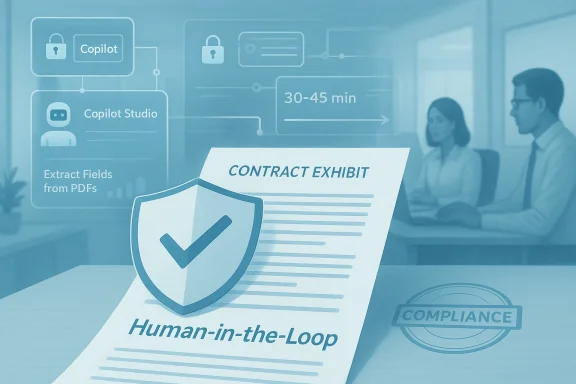
The standout use case was the contract exhibit agent, which automated a labor-heavy process involving document intake, data extraction, verifiWhat had taken between 30 and 45 minutes was reduced to roughly three minutes, according to the Microsoft story. The key design choice was to keep a human in the loop, with the agent extracting information and employees double-checking the output before the work moved forward.That human verification step is not a weakness; it is what makes the solution enterprise-grade. It acknowledges that healthcare workflows often require judgment, accountability, and confidence in thectice, the agent is not replacing a worker but compressing the boring part of the task so the worker can focus on confirmation and exception handling.
The significance is deeper than one faster workflow. Once employees see an agent cut time by an order of magnitude, the mental model changes. AI stops feeling like a sandbox feature and starts feeling like a tool that caoperational bottlenecks. That is the moment when organizations begin to move from experimentation to expectation.
- The use cases are tightly scoped rather than broad and abstract.
- The agents solve communication and routing problems, not just drafting.
- Human review remains part of the workflow.
- The biggest value is reduction of manual data entry.
capacity rather than just convenience.
Why the Story Matters Beyond Healthcare
Premera’s importance is not limited to the health insurance market. It is a signal that Copilot Studio is becoming usable in environments where mistakes are costly and process quality matters. If a payer can safelse agents, then many other regulated industries will see that as permission to try.That matters because the first wave of enterprise AI often looked easier than it was. Plenty of organizations could produce a draft, summarize a meeting, or generate a marketing outline. Fewer could connect AI to the operational machinery of the business. Premera’s example sits squaategory, where the value is rooted in workflow completion rather than content generation alone.
From assistant to workflow layer
This is where Microsoft’s broader Copilot strategy becomes visible. The company has been steadily pushing Copilot toward a role where it is embedded in documents, email, data, and business processes rather than isolated as a chatbot. Recent Microsoft customer storieon show the same pattern across different scenarios: AI that routes, summarizes, extracts, and hands off work at the right moment.For Premera, the appeal is not flashy automation for its own sake. It is the ability to unlock time without sacrificing oversight. That distinction is crucial in healthcare, where a bad automation story can quickly become a trust story, and a trust problem can become a business problem. The Premera story suggests Microsoft understands that the practical adoption path runs through measured, auditable wins.
The cultural effect is also easy to overlook. When a non-engineer can build an agent and see it work, the organization begins to look less like a passive technology consumer and more like an internal innovation lab. That shift tends to produce more ideas, more ownership, and far less waiting around for the next software cycle.
- Enterprise AI adoption usually steatable tasks.
- Regulated industries care more about reliability than novelty.
- Workflow automation is more valuable than simple text generation.
- AI becomes strategic when it sits inside process, not outside it.
- Internal confidence often grows faster than formal ROI models.
The Human-in-the-Loop Model
Microsoft’s she Premera story is not “let the machine do everything.” It is that AI should remove friction while preserving accountability. The contract exhibit agent extracts data, presents it for verification, and then routes it onward. That is a measured design, and in enterprise AI, measured designs are usually the ones that last.This is especially relevant in healthcare because not every process is equally automatable. Some steps are clerical, some are judgment-based, and some require both human context and policy awareness. The human-in-the-loop model respects those boundaries while still delivering a meaningful reduction in manual effort. That balance is what makes adoption more sustainable than a pure automation pitch.
Guardrails as a feature
The story nt Microsoft has been making across its Copilot portfolio: governance is not an obstacle to AI value; it is what enables the value to scale. Tools that can be built by employees are only useful if the organization can define boundaries, manage access, and preserve trust. In regulated environments, those controls are the difference between pilot theater and production adoption.Premera’s approach suble automation* can actually increase ambition rather than suppress it. Once teams know there is a review step and that workflows are not being handed over blindly, they are more likely to experiment. That is a subtle but important organizational effect, because fear of errors often kills internal innovation before it begins.
The broader lesson is that enterprise AI doesn’t have to be all-or-nothing. It can be incremental, partial, and deeply practical. The most useful agents often do one thing extremely well and then get out of the way. That may sound unglamorous, but it is exactly how technology becomes mainstream.
- Verification protects trust in regulated workflows.
- Human review lowers the risk of bad outputs becoming bad decisions.
- Governance increases the odds that employees will actually adopt AI.
- Narrow agents are easral-purpose ones.
- Responsible automation is often the fastest path to scale.
Copilot Studio as the Enabler
Premera’s story is really a Copilot Studio story in disguise. The platform matters because it gives organizations a way to create agents around real business pain without asking ecome a software engineering team. That democratization is one of the strongest arguments Microsoft has for the product.The platform is also becoming more credible because it is no longer just about prompts. Microsoft has been adding orchestration, model choice, moderation tools, and connections into broader enterprise systems. That makes Copilot Studio feel less like a novelty builder and more like an operating layer for business workflows.
Why citizen development matters
The quote from Premera’s leader is the kind of line Microsoft wants every customer story to contain: if a person without an engineering background can build a functioning agent, then the threshold for participation drops dramatically. That matters because enterprise AI adoption is often constrained less by technology than by talent bottlenecks. Copilot Studio reduces that dependency by letting domain experts shape the tools themselves.That does not mean technical oversight disappears. On the contrary, it becomes more important because more people can create agents faster. The challenge shifts from building the thing to governing the thing, which is exactly why Microsoft has been adding controls alongside capability. In other words, the platform is trying to make safe speed possible.
The strategic upside for Microsoft is obvious. If employees begin creating useful agents directly inside the Microsoft ecosystem, the company becomes more deeply embedded in day-to-day operations. That makes Copilot less of a feature and more of a habit, and habits are what create long-term platform value.
rs the barrier to internal automation.
- Domain experts can prototype solutions faster.
- IT and governance still provide the guardrails.
- Platform depth matters as much as model quality.
- Adoption grows when builders are close to the business problem.
The Productivity Argument
The most concrete business value in the Premera story is time. Taki45 minutes down to about three minutes is the sort of result that changes staffing conversations, service levels, and internal expectations. It is also the kind of metric executives can understand immediately.But the deeper productivity story is not just about individual tasks. It is about what people do with the time they get back. Microsoft frames this as freeing staff from repetitive work so they can focus on higher-value activities, which is exactly the right lens for a health plan with a few thousand employees and a member base that expects fast, reliable service.
Time back, better work
The phrase “time back” is more useful than “automation” because it shifts the conversation away from headcount replacement. In a member-focused business, the goal is not fewer people; it is better use of the people already there. That is especially important in operational environments where one delayed task can create a bottleneck downstream.This matters for consumer percepdirectly. Members do not care whether a workflow is powered by AI; they care whether claims, contracts, and service interactions move quickly and accurately. If the internal process improves, the external experience usually improves with it. That is one reason enterprise AI often yields its best returns behind the scenes.
A hidden benefit is that employees are alson low-value cognitive load. Manual copying, checking, and routing are mentally draining because they demand attention without offering much judgment. Removing that burden can improve morale as well as throughput, which is a combination many organizations underestimate.
- Faster workflows can improve member-facing turnaround.
- Time savings create capacity for higher-valueual entry lowers fatigue and rework.
- Productivity gains can be cultural as much as numerical.
- Better internal throughput usually benefits the customer experience.
Trust, Privacy, and the Health Plan Reality
Premera’s AI adoption story would not be compelling if it ignored the sensitivities of healthcare. In this sector, data handling is not a side issue; it is tct that Premera is embracing Copilot and Copilot Studio at all suggests it sees the tools as compatible with the trust requirements of its business, provided the right controls are in place.That is a notable statement about Microsoft’s enterprise positioning. To win in regulated industries, Copilot must be more than smart. It must able, and boring in the right way. The software has to do useful work without becoming a governance headache, which is a far harder standard than consumer AI faces.
Why healthcare adoption is a milestone
Healthcare payers are often conservative for good reason. Their processes affect ey, and real access to care. When they adopt AI to assist with document routing or communication clarity, it signals that the product has crossed from experimental novelty into operational legitimacy.That said, legitimacy does not eliminate caution. The presence of a human verifier in the process tells you that Premera is not outsourcing responsibility to the model. It is using the model as an accelerant, not an authoction will matter to every other regulated buyer watching this story.
The broader market implication is that the most defensible enterprise AI use cases may be the ones where AI handles structure, not judgment. In those cases, the organization can preserve compliance and accountability while still capturing meaningful efficiency ore realistic adoption path than the fantasy of fully autonomous business operations.
- Regulated industries demand auditability.
- AI must support, not replace, accountability.
- Structured work is safer to automate than judgment calls.
- Trust is the prerequisite for broader deployment.
- Healthcare creates a high bar that other sectors will n This Means for Microsoft
The story also complements Microsoft’s larger effort to position Copilot as the operating layer for work. Across its customer stories and product updates, Microsoft keeps reinforcing a simple message: AI works best when it is embedded in the systems people already use. Premera adds a highly credible, regulated-industry example to that thesis.
Competitive implications
This matters competitively because Microsoft is no longer only competing on model quality or chatbot polish. It is competing on distribution, governance, workflow integration, and the ability to help customers build their own agents. Rivals can match pieces of that stack, but few can combine all of it inside an ecosystem as pervasive as Microsoft 365.That creates a strong enterprise sales argument. If a customer already runs email, documents, identity, collaboration, and workflow tooling through Microsoft, then Copilot Studio becomes the path of least resistance for AI adoption. Premera is essentially a case study in why that bundling strategy can be powerful when pinternal champions.
The strategic challenge for Microsoft is to keep the story coherent as it expands. More capability can create more confusion if customers cannot easily distinguish between assistant, agent, and platform. The company is making real progress, but clarity will be just as important as feature velocity.
- Microsoft gains a credible regulated-industry success story.
- Copilot Studio becomes more than a niche builder tool.
- Platform bundling strengthens enterprise adoption economics.
- Workflow integration is a better moat than model bragging rights.
- Product clarity will matter as the portfolio expands.
Strengths and Opportunities
The Premera story works because it is practical, measurable, and culturally resonant. It shows that AI can improve day-to-day work without demanding a radical rewrite of the organization. It also shows that ordinary employees can become creators when the platform is approachable enough, which is exactly the sort of capability enterprise buyers want to see before they scale further.- Clear ROI from a documented time reduction.
- Strong fit for regulated, process-heavy industries.
- Human-in-thes trust.
- Citizen development broadens internal innovation.
- Communication-focused agents have low implementation friction.
- Document-processing use cases are easy to justify.
- Microsoft can use stories like this to expand platform adoption.
Risks and Concerns
The biggest risk is not that the technology will fail outright. It is that organizations may overestimate how much automation they can safely absorb, especially once a few early wins create enthusiasm. The other risk is governance drift: as more employees build agents, the chance of inconsistent controls, poor documentation, or duplicated logic rises quickly.- Overconfidence after one successful pilot.
- Governance complexity as agent counts rise.
- Inconsistent quality if different teams tune differently.
- Data access concerns in regulated workflows.
- Hidden maintenance burden behind “simple” automations.
- Human review can still become a bottleneck if volumes grow.
- Brand confusion if Copilot experiences feel too fragmented.
Looking Ahead
The next phase of this story will be less about whether Copilotout how deeply it can be embedded into business process design. Premera has shown that useful automation can start with a few tightly scoped agents and expand from there. That makes the company an important signal for other healthcare organizations considering the same path.The broader test for Microsoft will be whether these wins can be repeated at scale without losing control, consistency, or user trust. If the company can keep combining ease of use with strong guardrails, Copilot Studio could become the default way many enterprises build internal AI workflows. If it cannot, the story may remain impressive but isolated.
What to watch next:
- More healthcare and insurance customers adopting similar agent patterns.
- Whether document-processing agents become a mainstream Copilot Studio oft continues balancing ease of building with governance controls.
- Whether internal citizen development accelerates beyond pilot teams.
- How quickly time-savings stories turn into broader process redesign.
Source: Microsoft Premera Blue Cross makes AI mainstream with Copilot and Copilot Studio | Microsoft Customer Stories
