

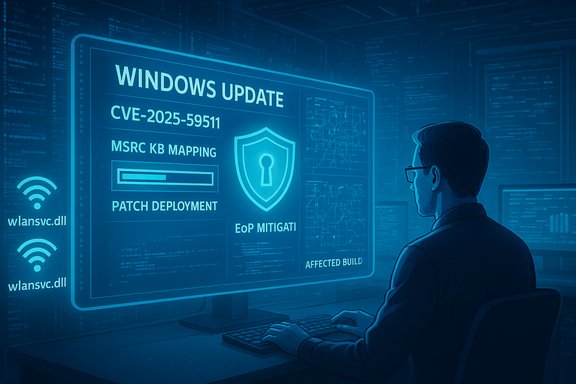
Microsoft’s security telemetry now lists CVE-2025-59511 as an elevation‑of‑privilege issue affecting the Windows WLAN/WLAN AutoConfig service, and administrators should treat any new WLAN service CVE as high priority until vendor KB mappings and patch packages are validated and applied. The public record for this identifier is sparse and — at the time of writing — the authoritative Microsoft Security Update Guide entry is the primary source of truth, so immediate action should focus on confirming the MSRC KB mapping for affected builds and deploying the supplied updates.
The Windows WLAN infrastructure (WLAN AutoConfig, typically hosted by wlansvc.dll and related inbox components) is responsible for wireless profile management, connection negotiation, and certain device‑to‑service interactions. Historically, vulnerabilities in WLAN and WLAN‑adjacent services have been categorized as local elevation‑of‑privilege (EoP), information disclosure, or occasionally remote‑triggerable issues — depending on the specific code path and attacker preconditions. Past examples of WLAN‑related CVEs show a mix of memory‑safety defects (use‑after‑free, out‑of‑bounds) and access‑control or TOCTOU weaknesses that can be escalated by an attacker who already has local execution capabilities. Rapid7 and other vulnerability databases retain multiple prior WLAN service advisories that follow this pattern. Because CVE identifiers and vendor KBs can be fragmented between trackers, the single most important operational fact is: the Microsoft Security Update Guide (MSRC) entry for a CVE is the authoritative mapping from CVE → KB → affected builds; verify that mapping before automated patching. Multiple independent community writeups and enterprise advisories reiterate the same operational workflow: identify the KB(s) that apply to your exact Windows build, stage and validate the update, then deploy.
If your team needs a concise remediation playbook for deployment (pilot → verification → staged rollout → hunting) or a short list of EDR detection rules tuned for WLAN‑service EoP indicators, prepare to run that plan immediately after confirming MSRC’s KB mapping for your builds and obtaining the vendor update packages.
Source: MSRC Security Update Guide - Microsoft Security Response Center
 Background / Overview
The Windows WLAN infrastructure (WLAN AutoConfig, typically hosted by wlansvc.dll and related inbox components) is responsible for wireless profile management, connection negotiation, and certain device‑to‑service interactions. Historically, vulnerabilities in WLAN and WLAN‑adjacent services have been categorized as local elevation‑of‑privilege (EoP), information disclosure, or occasionally remote‑triggerable issues — depending on the specific code path and attacker preconditions. Past examples of WLAN‑related CVEs show a mix of memory‑safety defects (use‑after‑free, out‑of‑bounds) and access‑control or TOCTOU weaknesses that can be escalated by an attacker who already has local execution capabilities. Rapid7 and other vulnerability databases retain multiple prior WLAN service advisories that follow this pattern. Because CVE identifiers and vendor KBs can be fragmented between trackers, the single most important operational fact is: the Microsoft Security Update Guide (MSRC) entry for a CVE is the authoritative mapping from CVE → KB → affected builds; verify that mapping before automated patching. Multiple independent community writeups and enterprise advisories reiterate the same operational workflow: identify the KB(s) that apply to your exact Windows build, stage and validate the update, then deploy.What we can confirm right now
- The CVE label CVE‑2025‑59511 has been recorded in Microsoft’s update tracker as an issue affecting Windows WLAN service components and classified as an Elevation of Privilege vulnerability. The MSRC entry is the canonical advisory for affected SKUs and remediation mapping.
- Historically, Windows WLAN service vulnerabilities follow a recognizable set of technical patterns: memory corruption (use‑after‑free, heap overflow, out‑of‑bounds), improper access control, or race/TOCTOU conditions. These classes of bugs are frequently high‑value for attackers because the WLAN service often runs with elevated privileges. Community and vendor summaries for other recent WLAN‑adjacent CVEs show similar classifications and remediation instructions (patch via Microsoft updates).
- Independent vulnerability trackers and central indices (NVD / commercial DBs) commonly index Windows WLAN issues — for example, related Windows WLAN and AutoConfig vulnerabilities in 2025 were logged and classified as information‑disclosure or local EoP bugs, with vendor advisories mapping to October 2025 updates. These independent records corroborate that the class of risk and necessary operational response (patch, verify KB mapping) are consistent across sources.
Why this matters: the operational threat model
Windows local elevation‑of‑privilege vulnerabilities are particularly valuable to attackers because they convert a low‑privilege foothold into full system control. For WLAN‑service EoP bugs, the typical attacker chain is:- Obtain a local foothold (phishing, malicious installer, compromised user account, or sandbox escape).
- Trigger the vulnerable WLAN code path (through an API, service interaction, or crafted input).
- Exploit memory corruption or bypass checks to manipulate tokens, impersonate SYSTEM, or execute code with elevated privileges.
- Disable security controls, install persistence, exfiltrate data, or move laterally.
Technical analysis — how WLAN service bugs are typically abused
Memory‑safety defects and races
- Use‑after‑free (UAF): Asynchronous workflows inside WLAN service code (device enumeration, profile callbacks) create many short‑lived objects; a UAF arises when an object is freed while stale pointers remain. An attacker can sometimes reallocate the freed memory with controlled data and cause a privileged dereference to execute attacker‑supplied pointers (vtable overwrite, function pointer hijack).
- Out‑of‑bounds / heap overflow: Incorrect buffer handling in protocol parsing or configuration parsing can let an attacker overwrite adjacent heap metadata or pointers, enabling control‑flow redirection in a privileged service context.
- TOCTOU / race conditions: WLAN AutoConfig workflows are inherently concurrent; improper synchronization or non‑atomic checks can let attackers swap or replace resources between check and use, bypassing access controls.
Access control weaknesses
- Some CVEs in the WLAN/AutoConfig area are classified as improper access control (CWE‑284) or insufficient validation. These do not always rely on low‑level memory corruption; instead, they allow a caller to perform actions that should be restricted to elevated callers. Attackers exploit these by calling the vulnerable API from a low‑privilege process and then abusing the service’s privileged execution context.
Validation and corroboration — what to check now
- Confirm the MSRC entry for CVE‑2025‑59511 — use the Microsoft Security Update Guide to map CVE → KB article(s) and the exact affected build(s). The MSRC page is the authoritative source for this mapping.
- Cross‑check NVD / third‑party trackers — verify whether NVD (or other trusted feeds) has a corresponding entry and whether they match the vendor’s CWE and CVSS metadata. For related WLAN issues in 2025, NVD and commercial vendors have indexed out‑of‑bounds and information‑disclosure variants; compare their technical tags to the MSRC guidance for context.
- Validate KB applicability for each Windows build in inventory — do not assume a single KB covers all serviced branches; Microsoft often releases multiple KB packages (security-only vs cumulative; different servicing branches) for the same CVE.
- Check your patch management logs and Windows Update metadata to ensure targeted machines have the patched packages installed and that installations did not fail due to prerequisites or driver conflicts.
Immediate mitigations and recommended remediation timeline
Apply the vendor update as the primary mitigation. If you cannot patch immediately, implement layered compensating controls to reduce exploitability.- Immediate (0–24 hours)
- Confirm MSRC KB mapping for CVE‑2025‑59511 and identify the exact KB(s) for each OS build in your estate.
- Stage the patch to a representative pilot group (including admin workstations and domain controllers where applicable).
- Increase telemetry collection and hunting (EDR/ SIEM) for EoP indicators (service crashes, token duplication, unexpected SYSTEM process creation).
- Short term (24–72 hours)
- Deploy patches using your standard phased approach (pilot → canary → broad rollout). Use WSUS, SCCM/ConfigMgr, Intune or equivalent.
- Verify installation by checking the presence of updated binaries and KBs on endpoints; reconcile with inventory sources.
- Harden hosts that cannot be patched immediately by reducing local interactive access, enforcing least privilege, and tightening network segmentation for management channels.
- If you cannot patch immediately (workarounds)
- Do not broadly disable essential services that break security posture (disabling the WLAN AutoConfig or other core network services can have negative side effects).
- Consider temporary isolation of high‑value devices (admin workstations, VDI hosts) from untrusted networks and restrict local interactive logins.
- Deploy application allow‑listing or WDAC on high‑risk endpoints to prevent attacker payload execution.
- Increase monitoring for suspicious activity on unpatched hosts.
Detection and hunting guidance
Detecting exploitation of a local EoP in a privileged service requires a blend of host and network telemetry. Prioritize these signals:- Service crashes and restarts of wlansvc, AutoConfig, or any associated svchost instance handling WLAN services.
- Unusual process token operations — creation of processes under SYSTEM that were spawned by a user process, or token duplication/impersonation activity.
- Parent/child process lineage anomalies — user processes spawning services or privileged processes, or abnormal child processes shortly after network or USB/WiFi activity.
- Registry or service configuration changes executed by low‑privilege users.
- File writes to protected locations (Program Files, System32) performed by user context processes.
- Endpoint telemetry: memory‑dump collection on suspicious crashes, module load events that show modified DLLs, and EDR detections for typical exploit patterns (heap grooming, vtable overwrites).
- Alert on Event IDs tied to service crashes and correlate with process creation logs.
- Hunt for processes calling CreateProcessAsUser/ImpersonateLoggedOnUser followed by unexpected SYSTEM actions.
- Raise the logging fidelity of process creation, module load, and registry write events for several days during patch deployment.
Risk analysis — strengths, exposures and what to watch for
Notable strengths (reasons to act with confidence)
- Vendor supplied fixes are typically available for high‑priority CVEs in the MSRC Update Guide; applying vendor patches directly mitigates the underlying code defects. Confirming the MSRC KB mapping reduces the risk of false positives or incomplete updates.
- The attack vector for most WLAN EoP items is local — reducing immediate mass‑exploitation risk compared with unauthenticated remote RCEs. However, local EoP defects are still valuable post‑compromise.
Exposures and operational risks
- Chaining risk: a local EoP is a force multiplier for adversaries who already have initial access (malicious attachments, supply‑chain installers, compromised accounts). A single patched host is not sufficient if lateral movement vectors remain open.
- CVE → KB fragmentation: third‑party trackers sometimes list divergent KB mappings; automation that relies solely on non‑vendor feeds can miss the correct update for a given build. Always reconcile with MSRC.
- PoC emergence: once a patch is public, security researchers may publish proof‑of‑concepts that lower the barrier to exploitation — escalate patching priority for unpatched hosts when a PoC appears.
Unverifiable or uncertain points (flagged)
- At the time this article was prepared, some public aggregator searches did not return a fully detailed independent record for CVE‑2025‑59511 beyond the vendor’s own MSRC entry. Where a CVE lacks wide independent corroboration, treat vendor advisory text as authoritative and prudent for remediation; avoid relying on incomplete third‑party summaries. If third‑party PoCs appear, validate provenance before running them in lab environments.
Practical checklist for IT teams (rapid action list)
- Map CVE‑2025‑59511 to the exact KB(s) for each Windows build in your environment via the Microsoft Security Update Guide.
- Stage the update to a test pilot group that includes representative device models and admin hosts.
- Verify patch success: confirm KB install history, inspect updated DLL/EXE versions, and reconcile with inventory.
- Deploy enterprise‑wide using your normal phased approach (WSUS / ConfigMgr / Intune).
- Increase EDR/SIEM detection and hunting for 7–14 days post‑deployment for EoP indicators.
- For systems that cannot be patched immediately, reduce local interactive access, apply application allow‑listing, and isolate critical hosts from untrusted networks.
- Document and measure compliance — record remediation status and any failed installs for follow‑up.
Longer‑term lessons and hardening measures
- Focus on vulnerability posture beyond monthly patching cycles: reduce the number of permanently elevated local accounts, enforce least privilege for standard users, and use application control (WDAC / AppLocker) for high‑value endpoints.
- Improve telemetry for privilege escalation indicators: process lineage, token operations, service crash dumps, and module load events.
- Validate that any legacy or third‑party drivers that interact with WLAN stacks are up to date and supported; vendor driver removals or replacements (as seen in other October 2025 updates) can have operational consequences and must be coordinated.
- Maintain playbooks for rapid response to PoC publication (accelerated patching windows, threat hunting runbooks, and communication to business stakeholders).
Conclusion
CVE‑2025‑59511 has been recorded as a Windows WLAN Service elevation‑of‑privilege vulnerability in Microsoft’s Security Update Guide, and the authoritative operational response is immediate validation of the MSRC KB mapping followed by rapid, staged patch deployment. Treat the issue as a high‑priority local EoP: patch promptly, verify installations, and increase endpoint telemetry and hunting for EoP indicators during the rollout window. Historical patterns for WLAN and other privileged Windows components show that local EoP primitives are frequently weaponized once proof‑of‑concepts circulate; disciplined patch hygiene, least privilege, and focused detection are the most effective defenses.If your team needs a concise remediation playbook for deployment (pilot → verification → staged rollout → hunting) or a short list of EDR detection rules tuned for WLAN‑service EoP indicators, prepare to run that plan immediately after confirming MSRC’s KB mapping for your builds and obtaining the vendor update packages.
Source: MSRC Security Update Guide - Microsoft Security Response Center
