

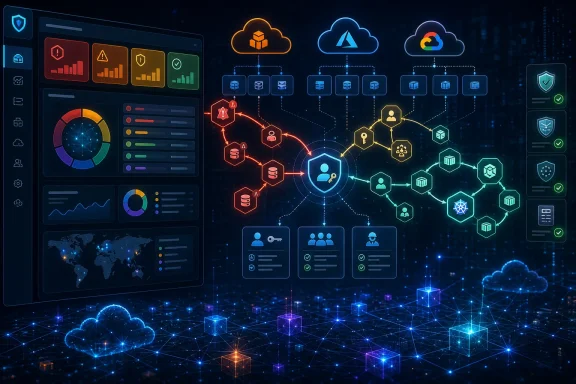
Palo Alto Networks’ Prisma Cloud is a cloud-native application protection platform that combines posture management, workload protection, container security, identity context, and compliance monitoring across AWS, Microsoft Azure, Google Cloud, and other enterprise cloud environments. Its pitch is simple: one console, one risk model, one place to see how cloud mistakes become breach paths. The more complicated truth is that Prisma Cloud is not just a product; it is Palo Alto Networks’ bet that security buyers are tired enough of tool sprawl to accept platform gravity. That bet matters to admins and engineers because “unified” security can either reduce noise or concentrate a great deal of operational complexity behind a very expensive dashboard.
Cloud security has become a taxonomy problem before it is even a technical one. CSPM, CWPP, CIEM, CDR, CNAPP, DSPM, IaC scanning, API security, container runtime defense: the acronyms read like a procurement spreadsheet that escaped containment. Prisma Cloud’s argument is that these categories are no longer separable in the real world, because an exposed bucket, an overprivileged identity, a vulnerable image, and a reachable workload are often parts of the same attack path.
That is why Palo Alto Networks leans so heavily on the phrase cloud-native application protection platform. CNAPP is less a single feature than a consolidation story: security starts in code, continues through build pipelines, watches cloud configuration, and follows workloads into runtime. In that framing, Prisma Cloud is not competing only with older posture-management tools; it is competing with the entire idea that enterprises can stitch together half a dozen specialized scanners and still get a coherent risk picture.
The supplied product write-up captures the front-of-house version of that story well enough. A security team logs in, sees a wall of cloud accounts, risk scores, compliance checks, exposed resources, and workload alerts, and tries to determine which red tile actually deserves attention. That last clause is the whole business. Nobody buys a CNAPP because they want more findings; they buy it because the cloud has made “finding” cheap and prioritization expensive.
The risk for Prisma Cloud is that the same breadth that makes it attractive also makes it hard to evaluate. A narrow container scanner can be judged by image coverage, false positives, and runtime controls. A broad CNAPP has to be judged by whether it changes behavior across security, platform engineering, DevOps, compliance, and incident response teams. That is a much higher bar than a dashboard demo can prove.
That history matters because it explains both the product’s breadth and some of its friction. Prisma Cloud is the result of a market consolidation cycle: posture management, container defense, serverless visibility, infrastructure-as-code scanning, and workload protection were pulled into a common commercial envelope. For buyers, that can be a relief. For operators, it can also mean dealing with product seams that only become visible after the procurement win.
Palo Alto Networks’ broader strategy is unmistakable. The company does not want to be merely the firewall vendor that followed customers into the cloud. It wants to be the security platform vendor whose controls span the network edge, SASE, cloud workloads, security operations, and now AI-era application risk. Prisma Cloud is one pillar in that transformation, and it is especially important because cloud security budgets are increasingly tied to long-term application architecture decisions.
The stock-market angle in the supplied article is therefore not random, though it is easy to overstate. Prisma Cloud is part of the recurring software and subscription revenue narrative that investors care about when they look at Palo Alto Networks. But for WindowsForum readers, the more useful point is operational rather than financial: when a vendor’s cloud platform becomes strategically important to Wall Street, customers should expect aggressive integration, aggressive bundling, and aggressive account management.
That is not inherently bad. Platform investment can mean faster feature delivery, better integrations, and a more consistent control plane. It can also mean that the product roadmap starts serving the vendor’s consolidation thesis as much as the customer’s immediate pain.
The valuable thing is not that Prisma Cloud can tell you an S3 bucket is public or a Kubernetes image contains a critical CVE. Plenty of tools can do that, including native cloud provider services and open-source utilities. The valuable thing is the connective tissue: whether the platform can show that a public resource, reachable workload, vulnerable package, permissive role, and sensitive data store create a plausible path an attacker might use.
This is where CNAPP platforms try to move beyond compliance theater. In old-school posture management, every failed policy looked similarly urgent until a human sorted through context. In a modern risk graph, the platform attempts to rank findings based on exposure, exploitability, identity permissions, data sensitivity, and workload importance. The promise is not fewer problems. The promise is fewer wrong first problems.
That distinction will be familiar to anyone who has managed Windows patching at scale. A vulnerability list is not a remediation plan. Admins still need to know which systems are internet-facing, which are business-critical, which have compensating controls, and which are trapped behind change windows. Prisma Cloud is applying that same prioritization logic to cloud-native infrastructure, where assets are more ephemeral and ownership is often blurrier.
The danger is false confidence. A risk graph is only as good as its inputs, integrations, policies, and assumptions. If cloud accounts are incompletely onboarded, identity data is stale, tags are inconsistent, or runtime agents are missing from critical clusters, the graph can look authoritative while quietly omitting the sharpest edges.
This is why CSPM remains the foundation of the CNAPP pitch. Before runtime defense and code scanning can matter, an organization needs to know what exists. Cloud platforms make it easy to create resources and harder to sustain a clean inventory, especially when DevOps teams are moving faster than governance processes built for data centers.
Prisma Cloud connects to cloud environments largely through APIs for posture and inventory use cases, which makes initial visibility less invasive than inline inspection. That is a practical advantage. Security teams can often begin by granting read-heavy permissions, collecting metadata, and surfacing misconfigurations without immediately re-architecting traffic flows or deploying agents everywhere.
But API-based visibility also creates a psychological trap. Because onboarding can appear straightforward, executives may assume the hard work is done once accounts are connected. In reality, the hard work begins when findings need owners, exceptions need governance, policies need tuning, and teams need to agree on what “critical” means in the context of their own business.
Azure-heavy shops should pay particular attention to this point. Microsoft Defender for Cloud already gives many organizations a native baseline for posture, recommendations, workload protection, and regulatory views. Prisma Cloud’s value in those environments depends on whether it can unify Azure with AWS, Google Cloud, Kubernetes, and code pipelines in a way that beats native tooling plus process discipline. That is a real value proposition, but not an automatic one.
Prisma Cloud’s heritage from Twistlock is important here. Container security is not just scanning images in a registry, though that remains a core capability. The harder problem is deciding which image vulnerabilities matter once containers are running, whether runtime behavior deviates from expectations, and how policies should be enforced without breaking production workloads.
In Kubernetes environments, this usually means some combination of admission controls, image scanning, runtime monitoring, host or node protections, and policy integration with CI/CD systems. Done well, the platform catches risky artifacts before deployment and watches for suspicious behavior afterward. Done badly, it becomes another source of noisy tickets that developers learn to route around.
This is where admins will recognize an old pattern in a new costume. Security tooling that arrives after engineering workflows are already mature often becomes a tax. Security tooling that integrates into pull requests, build pipelines, registries, and deployment gates has a better chance of changing outcomes. Prisma Cloud’s “code to cloud” story is therefore not marketing fluff, but it is also not self-executing. The organization has to wire it into how software actually ships.
For Windows-centric teams moving into containers, especially with hybrid estates that include Windows Server workloads, Linux containers, AKS, Azure Arc, and legacy deployment models, the cultural shift can be bigger than the technical one. Prisma Cloud may show the relationship between a vulnerable image and a deployed workload, but somebody still has to own the fix. In many enterprises, that “somebody” is where the remediation process collapses.
Prisma Cloud’s inclusion of identity context is part of a wider industry turn toward permissions and entitlement analysis. The reason is straightforward: many serious cloud incidents do not require exotic exploits if an attacker can obtain credentials with excessive permissions. A boring misconfiguration becomes dangerous when paired with an identity that can read data, create infrastructure, disable logging, or move laterally.
This is also where traditional vulnerability severity begins to fail. A medium-severity issue on an isolated workload may be less urgent than a modest exposure attached to a role with broad administrative reach. A public endpoint is worrying, but a public endpoint connected to secrets, privileged identities, and sensitive data is a different class of problem. Cloud risk is combinatorial.
For admins used to Active Directory cleanup projects, this should sound familiar and unpleasant. The difference is that cloud identity sprawl can grow at DevOps speed. Temporary experiments become permanent roles. Emergency permissions become normal permissions. Automation credentials outlive the pipeline they were created for. A CNAPP can reveal that mess, but it cannot substitute for governance that prevents the same mess from regenerating every quarter.
The AI turn only intensifies this pressure. As enterprises experiment with agentic workflows, automated development assistants, and machine-to-machine operations, non-human identities will multiply. Palo Alto Networks’ broader messaging around AI security and cloud identity should be read in that context: the vendor sees the next security budget forming around machine identities, application context, and runtime control.
The sensible path is usually narrower. Start with the cloud accounts or subscriptions that matter most. Confirm inventory accuracy. Map ownership. Tune policies against real risk rather than vendor defaults. Establish exception processes. Decide how findings flow into ticketing systems and who has authority to close or defer them. Then expand coverage.
The temptation is to connect everything immediately because the platform can technically see everything. That produces a gratifying demo and a miserable month. Dashboards fill with low-priority findings, duplicate alerts, policy violations that no one intends to fix, and compliance failures inherited from years of unmanaged cloud growth. The first impression becomes “this tool is noisy,” when the real issue is that the organization asked it to narrate a decade of entropy in one sitting.
Role-based access is just as important as detection logic. Developers do not need every enterprise compliance violation. Compliance teams do not need raw runtime telemetry from every container. Security operations teams need escalation signals, not a full inventory fire hose. If Prisma Cloud becomes a single console that everyone hates for different reasons, the platform strategy has failed at the human layer.
This is also why procurement should include implementation reality, not just feature comparison. The cost of Prisma Cloud is not only subscription pricing per resource, workload, or negotiated enterprise tier. It is the time spent defining policies, cleaning tags, integrating with service management, deploying defenders or agents where needed, educating teams, and suppressing findings that are technically accurate but operationally useless.
That matters because cloud estates are elastic. If licensing tracks workloads, hosts, resources, images, or combinations of features, security coverage can suddenly become a budget question when engineering teams scale up environments. A platform meant to improve visibility can create incentives to limit visibility if cost models are poorly understood.
Good security architecture avoids that trap by planning coverage tiers. Production environments, internet-facing systems, regulated workloads, and sensitive data paths may justify deeper runtime controls. Development and ephemeral environments may need posture scanning and code checks but not the same level of agent-based monitoring. The exact model depends on licensing, risk appetite, and operational maturity.
The worst outcome is selective blindness. If teams decide not to onboard certain accounts or clusters because licensing feels too expensive, the CNAPP’s risk graph becomes partial. Partial visibility can still be useful, but only if everyone understands its limits. A beautiful executive dashboard that excludes awkward corners of the estate is worse than an ugly spreadsheet that tells the truth.
Investors may see Prisma Cloud as high-margin recurring revenue. Customers should see the same fact from the other side: this is a recurring operational dependency. Once a platform becomes embedded in cloud governance, vulnerability management, compliance evidence, and developer workflows, switching costs rise. That is exactly what Palo Alto Networks wants, and it is exactly what buyers should negotiate with eyes open.
The case for Prisma Cloud is strongest when organizations need consistent risk management across several clouds and deployment models. Native tools tend to be deepest in their own ecosystems. A central security team trying to compare AWS exposure, Azure subscriptions, Google Cloud projects, Kubernetes clusters, and container registries may reasonably prefer one cross-cloud model over three or four native consoles.
The case is weaker when an organization is mostly single-cloud, heavily standardized, and already mature in native controls. A Microsoft-first enterprise with Defender for Cloud, Sentinel, Entra governance, Intune, and Azure Policy may find that Prisma Cloud adds value mostly at the margins unless it also has meaningful AWS, Google Cloud, or container complexity. Conversely, a company with decentralized cloud adoption may find native-only governance politically and technically fragmented.
This is not a theological debate. It is a fit question. Prisma Cloud’s platform logic is powerful when the customer’s environment is fragmented enough to need a unifying layer. It is wasteful when the customer buys the unifying layer before admitting that its main problem is unmanaged ownership, unclear standards, or a lack of remediation capacity.
The vendor’s “single pane of glass” pitch should therefore be treated with suspicion and respect. Suspicion, because single panes of glass have been promised in enterprise IT since the dawn of dashboards. Respect, because cloud security genuinely does need correlation across layers that old point products were never designed to understand.
A misconfigured cloud workload can expose credentials that touch internal systems. A compromised CI/CD pipeline can produce artifacts deployed into enterprise applications. An overprivileged service principal can interact with Azure resources that support Windows workloads. A vulnerable container image can sit behind an application used by domain-joined clients. The blast radius does not respect org charts.
For sysadmins, Prisma Cloud and its rivals represent a shift from server-centric control to relationship-centric control. The question is no longer merely whether a machine is patched. It is whether the workload is exposed, whether its identity is overprivileged, whether its image contains exploitable packages, whether its secrets are reachable, whether its infrastructure was defined safely, and whether its runtime behavior makes sense.
That can feel like security moving the goalposts. In reality, the goalposts moved when infrastructure became programmable. Cloud resources are created by templates, APIs, pipelines, and developers with enough permissions to move quickly. Security tools now have to understand those creation paths, not just the resulting machines.
WindowsForum readers should also note the compliance angle. Many organizations still prove control through audits that assume relatively stable assets. Cloud-native environments are dynamic, which makes evidence collection harder. Prisma Cloud’s compliance views can help, but they should not be mistaken for compliance itself. Auditors may like reports; attackers do not care about reports.
Security products often fail not because they miss findings, but because they find too much truth too quickly. An enterprise that has never enforced tagging standards, resource ownership, least privilege, or secure build pipelines may experience Prisma Cloud as an accusation machine. Every red tile becomes a reminder that cloud agility was purchased with governance debt.
That is why the platform’s success depends on remediation plumbing. Findings need to become tickets. Tickets need owners. Owners need service-level expectations. Exceptions need expiration dates. Security teams need escalation paths when business units decline to fix exposed systems. Without that machinery, the CNAPP becomes a very expensive way to produce meetings.
There is also a trust problem. Developers and platform teams will judge Prisma Cloud by false positives, duplicate findings, and whether the tool understands context. If the first wave of alerts feels arbitrary, teams will resist. If the platform consistently identifies attack paths that make intuitive sense, it can earn credibility. The difference is not the logo; it is tuning, integration, and governance.
Palo Alto Networks has the advantage of scale, brand recognition, and a broad security portfolio. That helps in boardrooms. It does not automatically help in a Kubernetes namespace owned by a team trying to ship a feature before quarter-end. The product has to win both rooms.
 Prisma Cloud Sells Order in a Cloud Security Market Built on Disorder
Cloud security has become a taxonomy problem before it is even a technical one. CSPM, CWPP, CIEM, CDR, CNAPP, DSPM, IaC scanning, API security, container runtime defense: the acronyms read like a procurement spreadsheet that escaped containment. Prisma Cloud’s argument is that these categories are no longer separable in the real world, because an exposed bucket, an overprivileged identity, a vulnerable image, and a reachable workload are often parts of the same attack path.That is why Palo Alto Networks leans so heavily on the phrase cloud-native application protection platform. CNAPP is less a single feature than a consolidation story: security starts in code, continues through build pipelines, watches cloud configuration, and follows workloads into runtime. In that framing, Prisma Cloud is not competing only with older posture-management tools; it is competing with the entire idea that enterprises can stitch together half a dozen specialized scanners and still get a coherent risk picture.
The supplied product write-up captures the front-of-house version of that story well enough. A security team logs in, sees a wall of cloud accounts, risk scores, compliance checks, exposed resources, and workload alerts, and tries to determine which red tile actually deserves attention. That last clause is the whole business. Nobody buys a CNAPP because they want more findings; they buy it because the cloud has made “finding” cheap and prioritization expensive.
The risk for Prisma Cloud is that the same breadth that makes it attractive also makes it hard to evaluate. A narrow container scanner can be judged by image coverage, false positives, and runtime controls. A broad CNAPP has to be judged by whether it changes behavior across security, platform engineering, DevOps, compliance, and incident response teams. That is a much higher bar than a dashboard demo can prove.
Palo Alto Networks Assembled Prisma Cloud for the Platform Era
Prisma Cloud did not arrive as a single, pristine invention. Palo Alto Networks introduced the Prisma brand in 2019 as a broader cloud security suite, with Prisma Public Cloud building on RedLock and adjacent cloud assets. Around the same period, the company moved aggressively into container and serverless security with the acquisitions of Twistlock and PureSec, adding capabilities that would become central to the modern Prisma Cloud story.That history matters because it explains both the product’s breadth and some of its friction. Prisma Cloud is the result of a market consolidation cycle: posture management, container defense, serverless visibility, infrastructure-as-code scanning, and workload protection were pulled into a common commercial envelope. For buyers, that can be a relief. For operators, it can also mean dealing with product seams that only become visible after the procurement win.
Palo Alto Networks’ broader strategy is unmistakable. The company does not want to be merely the firewall vendor that followed customers into the cloud. It wants to be the security platform vendor whose controls span the network edge, SASE, cloud workloads, security operations, and now AI-era application risk. Prisma Cloud is one pillar in that transformation, and it is especially important because cloud security budgets are increasingly tied to long-term application architecture decisions.
The stock-market angle in the supplied article is therefore not random, though it is easy to overstate. Prisma Cloud is part of the recurring software and subscription revenue narrative that investors care about when they look at Palo Alto Networks. But for WindowsForum readers, the more useful point is operational rather than financial: when a vendor’s cloud platform becomes strategically important to Wall Street, customers should expect aggressive integration, aggressive bundling, and aggressive account management.
That is not inherently bad. Platform investment can mean faster feature delivery, better integrations, and a more consistent control plane. It can also mean that the product roadmap starts serving the vendor’s consolidation thesis as much as the customer’s immediate pain.
The Real Product Is the Risk Graph, Not the Scanner
A casual description of Prisma Cloud often starts with scanning. It scans cloud accounts for misconfigurations. It scans container images for vulnerabilities. It scans infrastructure-as-code templates for risky defaults. It scans serverless functions, workloads, permissions, and exposed services. That is all true, but it undersells the product’s central ambition.The valuable thing is not that Prisma Cloud can tell you an S3 bucket is public or a Kubernetes image contains a critical CVE. Plenty of tools can do that, including native cloud provider services and open-source utilities. The valuable thing is the connective tissue: whether the platform can show that a public resource, reachable workload, vulnerable package, permissive role, and sensitive data store create a plausible path an attacker might use.
This is where CNAPP platforms try to move beyond compliance theater. In old-school posture management, every failed policy looked similarly urgent until a human sorted through context. In a modern risk graph, the platform attempts to rank findings based on exposure, exploitability, identity permissions, data sensitivity, and workload importance. The promise is not fewer problems. The promise is fewer wrong first problems.
That distinction will be familiar to anyone who has managed Windows patching at scale. A vulnerability list is not a remediation plan. Admins still need to know which systems are internet-facing, which are business-critical, which have compensating controls, and which are trapped behind change windows. Prisma Cloud is applying that same prioritization logic to cloud-native infrastructure, where assets are more ephemeral and ownership is often blurrier.
The danger is false confidence. A risk graph is only as good as its inputs, integrations, policies, and assumptions. If cloud accounts are incompletely onboarded, identity data is stale, tags are inconsistent, or runtime agents are missing from critical clusters, the graph can look authoritative while quietly omitting the sharpest edges.
Multi-Cloud Visibility Is the Feature Enterprises Want and the Problem They Created
Prisma Cloud’s support for AWS, Azure, Google Cloud, and other environments speaks directly to large enterprises that have discovered multi-cloud by accident, merger, or departmental autonomy. A central security team may think it has three cloud providers. The billing department may reveal twenty-seven accounts, five forgotten subscriptions, and a development project running under a business unit nobody told security about.This is why CSPM remains the foundation of the CNAPP pitch. Before runtime defense and code scanning can matter, an organization needs to know what exists. Cloud platforms make it easy to create resources and harder to sustain a clean inventory, especially when DevOps teams are moving faster than governance processes built for data centers.
Prisma Cloud connects to cloud environments largely through APIs for posture and inventory use cases, which makes initial visibility less invasive than inline inspection. That is a practical advantage. Security teams can often begin by granting read-heavy permissions, collecting metadata, and surfacing misconfigurations without immediately re-architecting traffic flows or deploying agents everywhere.
But API-based visibility also creates a psychological trap. Because onboarding can appear straightforward, executives may assume the hard work is done once accounts are connected. In reality, the hard work begins when findings need owners, exceptions need governance, policies need tuning, and teams need to agree on what “critical” means in the context of their own business.
Azure-heavy shops should pay particular attention to this point. Microsoft Defender for Cloud already gives many organizations a native baseline for posture, recommendations, workload protection, and regulatory views. Prisma Cloud’s value in those environments depends on whether it can unify Azure with AWS, Google Cloud, Kubernetes, and code pipelines in a way that beats native tooling plus process discipline. That is a real value proposition, but not an automatic one.
Container Security Turns the Dashboard Into an Engineering Conversation
The supplied article is right to highlight container and Kubernetes coverage, because this is where Prisma Cloud stops being only a security-operations console and starts intruding into engineering workflows. Containers changed the unit of security from “server” to “artifact plus runtime environment.” A vulnerable base image may be built by one team, deployed by another, orchestrated by a platform team, and exposed by a cloud networking decision.Prisma Cloud’s heritage from Twistlock is important here. Container security is not just scanning images in a registry, though that remains a core capability. The harder problem is deciding which image vulnerabilities matter once containers are running, whether runtime behavior deviates from expectations, and how policies should be enforced without breaking production workloads.
In Kubernetes environments, this usually means some combination of admission controls, image scanning, runtime monitoring, host or node protections, and policy integration with CI/CD systems. Done well, the platform catches risky artifacts before deployment and watches for suspicious behavior afterward. Done badly, it becomes another source of noisy tickets that developers learn to route around.
This is where admins will recognize an old pattern in a new costume. Security tooling that arrives after engineering workflows are already mature often becomes a tax. Security tooling that integrates into pull requests, build pipelines, registries, and deployment gates has a better chance of changing outcomes. Prisma Cloud’s “code to cloud” story is therefore not marketing fluff, but it is also not self-executing. The organization has to wire it into how software actually ships.
For Windows-centric teams moving into containers, especially with hybrid estates that include Windows Server workloads, Linux containers, AKS, Azure Arc, and legacy deployment models, the cultural shift can be bigger than the technical one. Prisma Cloud may show the relationship between a vulnerable image and a deployed workload, but somebody still has to own the fix. In many enterprises, that “somebody” is where the remediation process collapses.
Identity Is the Cloud Risk Multiplier Vendors Can No Longer Ignore
The cloud has made identity a perimeter, a privilege system, an automation layer, and an attack surface. Human users matter, but so do service principals, managed identities, access keys, workload identities, CI/CD tokens, and machine credentials scattered across build systems and cloud accounts. Any CNAPP that treats identity as a side panel rather than a first-class risk signal is missing the plot.Prisma Cloud’s inclusion of identity context is part of a wider industry turn toward permissions and entitlement analysis. The reason is straightforward: many serious cloud incidents do not require exotic exploits if an attacker can obtain credentials with excessive permissions. A boring misconfiguration becomes dangerous when paired with an identity that can read data, create infrastructure, disable logging, or move laterally.
This is also where traditional vulnerability severity begins to fail. A medium-severity issue on an isolated workload may be less urgent than a modest exposure attached to a role with broad administrative reach. A public endpoint is worrying, but a public endpoint connected to secrets, privileged identities, and sensitive data is a different class of problem. Cloud risk is combinatorial.
For admins used to Active Directory cleanup projects, this should sound familiar and unpleasant. The difference is that cloud identity sprawl can grow at DevOps speed. Temporary experiments become permanent roles. Emergency permissions become normal permissions. Automation credentials outlive the pipeline they were created for. A CNAPP can reveal that mess, but it cannot substitute for governance that prevents the same mess from regenerating every quarter.
The AI turn only intensifies this pressure. As enterprises experiment with agentic workflows, automated development assistants, and machine-to-machine operations, non-human identities will multiply. Palo Alto Networks’ broader messaging around AI security and cloud identity should be read in that context: the vendor sees the next security budget forming around machine identities, application context, and runtime control.
The Best Deployment Is the One That Starts Narrow
The supplied article notes that initial setup can take weeks in large environments. That is not a minor caveat; it is the implementation story. A CNAPP touches too many teams to succeed as a purely security-led installation dumped into production and declared operational.The sensible path is usually narrower. Start with the cloud accounts or subscriptions that matter most. Confirm inventory accuracy. Map ownership. Tune policies against real risk rather than vendor defaults. Establish exception processes. Decide how findings flow into ticketing systems and who has authority to close or defer them. Then expand coverage.
The temptation is to connect everything immediately because the platform can technically see everything. That produces a gratifying demo and a miserable month. Dashboards fill with low-priority findings, duplicate alerts, policy violations that no one intends to fix, and compliance failures inherited from years of unmanaged cloud growth. The first impression becomes “this tool is noisy,” when the real issue is that the organization asked it to narrate a decade of entropy in one sitting.
Role-based access is just as important as detection logic. Developers do not need every enterprise compliance violation. Compliance teams do not need raw runtime telemetry from every container. Security operations teams need escalation signals, not a full inventory fire hose. If Prisma Cloud becomes a single console that everyone hates for different reasons, the platform strategy has failed at the human layer.
This is also why procurement should include implementation reality, not just feature comparison. The cost of Prisma Cloud is not only subscription pricing per resource, workload, or negotiated enterprise tier. It is the time spent defining policies, cleaning tags, integrating with service management, deploying defenders or agents where needed, educating teams, and suppressing findings that are technically accurate but operationally useless.
Pricing Turns Cloud Security Into a Capacity Planning Exercise
Enterprise subscription pricing is often opaque because it is negotiated around scale, modules, commitments, and account strategy. Prisma Cloud is no exception. The supplied article’s description of pricing as subscription-based and commonly tied to resources or workloads is directionally right, but the practical buyer experience is more nuanced: licensing models become part of architecture conversations.That matters because cloud estates are elastic. If licensing tracks workloads, hosts, resources, images, or combinations of features, security coverage can suddenly become a budget question when engineering teams scale up environments. A platform meant to improve visibility can create incentives to limit visibility if cost models are poorly understood.
Good security architecture avoids that trap by planning coverage tiers. Production environments, internet-facing systems, regulated workloads, and sensitive data paths may justify deeper runtime controls. Development and ephemeral environments may need posture scanning and code checks but not the same level of agent-based monitoring. The exact model depends on licensing, risk appetite, and operational maturity.
The worst outcome is selective blindness. If teams decide not to onboard certain accounts or clusters because licensing feels too expensive, the CNAPP’s risk graph becomes partial. Partial visibility can still be useful, but only if everyone understands its limits. A beautiful executive dashboard that excludes awkward corners of the estate is worse than an ugly spreadsheet that tells the truth.
Investors may see Prisma Cloud as high-margin recurring revenue. Customers should see the same fact from the other side: this is a recurring operational dependency. Once a platform becomes embedded in cloud governance, vulnerability management, compliance evidence, and developer workflows, switching costs rise. That is exactly what Palo Alto Networks wants, and it is exactly what buyers should negotiate with eyes open.
Native Cloud Tools Remain the Quiet Counterargument
Prisma Cloud’s biggest competitor is not always another CNAPP vendor. Sometimes it is the combination of AWS Security Hub, Amazon GuardDuty, Microsoft Defender for Cloud, Google Security Command Center, Kubernetes-native tooling, open-source scanners, and a disciplined security engineering team. Native tools have improved substantially, and they are often already present in enterprise agreements.The case for Prisma Cloud is strongest when organizations need consistent risk management across several clouds and deployment models. Native tools tend to be deepest in their own ecosystems. A central security team trying to compare AWS exposure, Azure subscriptions, Google Cloud projects, Kubernetes clusters, and container registries may reasonably prefer one cross-cloud model over three or four native consoles.
The case is weaker when an organization is mostly single-cloud, heavily standardized, and already mature in native controls. A Microsoft-first enterprise with Defender for Cloud, Sentinel, Entra governance, Intune, and Azure Policy may find that Prisma Cloud adds value mostly at the margins unless it also has meaningful AWS, Google Cloud, or container complexity. Conversely, a company with decentralized cloud adoption may find native-only governance politically and technically fragmented.
This is not a theological debate. It is a fit question. Prisma Cloud’s platform logic is powerful when the customer’s environment is fragmented enough to need a unifying layer. It is wasteful when the customer buys the unifying layer before admitting that its main problem is unmanaged ownership, unclear standards, or a lack of remediation capacity.
The vendor’s “single pane of glass” pitch should therefore be treated with suspicion and respect. Suspicion, because single panes of glass have been promised in enterprise IT since the dawn of dashboards. Respect, because cloud security genuinely does need correlation across layers that old point products were never designed to understand.
Windows Shops Should Care Because Cloud Risk Rarely Stays in the Cloud
It is tempting for traditional Windows admins to view CNAPP platforms as someone else’s problem: the cloud team’s console, the DevSecOps team’s backlog, the CISO’s dashboard. That separation is increasingly artificial. Hybrid identity, endpoint management, cloud-hosted line-of-business apps, Azure subscriptions, Microsoft 365 integrations, and CI/CD pipelines have made cloud security part of the Windows estate by another name.A misconfigured cloud workload can expose credentials that touch internal systems. A compromised CI/CD pipeline can produce artifacts deployed into enterprise applications. An overprivileged service principal can interact with Azure resources that support Windows workloads. A vulnerable container image can sit behind an application used by domain-joined clients. The blast radius does not respect org charts.
For sysadmins, Prisma Cloud and its rivals represent a shift from server-centric control to relationship-centric control. The question is no longer merely whether a machine is patched. It is whether the workload is exposed, whether its identity is overprivileged, whether its image contains exploitable packages, whether its secrets are reachable, whether its infrastructure was defined safely, and whether its runtime behavior makes sense.
That can feel like security moving the goalposts. In reality, the goalposts moved when infrastructure became programmable. Cloud resources are created by templates, APIs, pipelines, and developers with enough permissions to move quickly. Security tools now have to understand those creation paths, not just the resulting machines.
WindowsForum readers should also note the compliance angle. Many organizations still prove control through audits that assume relatively stable assets. Cloud-native environments are dynamic, which makes evidence collection harder. Prisma Cloud’s compliance views can help, but they should not be mistaken for compliance itself. Auditors may like reports; attackers do not care about reports.
The Dashboard Is Only as Mature as the Organization Behind It
The most generous reading of Prisma Cloud is that it gives large organizations a fighting chance to see cloud risk as attackers might see it: connected, contextual, and fast-moving. The least generous reading is that it lets executives buy a sophisticated mirror for problems their teams lack the authority or staffing to fix. Both readings can be true in the same company.Security products often fail not because they miss findings, but because they find too much truth too quickly. An enterprise that has never enforced tagging standards, resource ownership, least privilege, or secure build pipelines may experience Prisma Cloud as an accusation machine. Every red tile becomes a reminder that cloud agility was purchased with governance debt.
That is why the platform’s success depends on remediation plumbing. Findings need to become tickets. Tickets need owners. Owners need service-level expectations. Exceptions need expiration dates. Security teams need escalation paths when business units decline to fix exposed systems. Without that machinery, the CNAPP becomes a very expensive way to produce meetings.
There is also a trust problem. Developers and platform teams will judge Prisma Cloud by false positives, duplicate findings, and whether the tool understands context. If the first wave of alerts feels arbitrary, teams will resist. If the platform consistently identifies attack paths that make intuitive sense, it can earn credibility. The difference is not the logo; it is tuning, integration, and governance.
Palo Alto Networks has the advantage of scale, brand recognition, and a broad security portfolio. That helps in boardrooms. It does not automatically help in a Kubernetes namespace owned by a team trying to ship a feature before quarter-end. The product has to win both rooms.
Prisma Cloud’s Promise Lives or Dies in the First Ninety Days
Prisma Cloud is best understood as a consolidation platform for organizations whose cloud risk has outgrown point tools, native consoles, and spreadsheet-driven governance. It can connect posture, workload, container, identity, and compliance signals into a more useful risk picture, but it cannot magically create ownership or remediation discipline. The early deployment period is where the platform either becomes an operating model or another dashboard in the rotation.- Prisma Cloud’s strongest value is correlation across cloud configuration, workload exposure, identity permissions, vulnerabilities, and runtime context.
- Large enterprises should treat onboarding as a phased governance project rather than a quick API connection exercise.
- Azure-first organizations should compare Prisma Cloud against Microsoft’s native security stack before assuming a third-party CNAPP is automatically additive.
- Container-heavy teams will get the most value when scanning and runtime controls are integrated into CI/CD workflows, not bolted on after deployment.
- Pricing and licensing should be evaluated against expected cloud growth, because partial coverage can weaken the platform’s core risk model.
- The platform’s executive appeal is consolidation, but its operational success depends on whether engineers trust and act on its findings.
References
- Primary source: AD HOC NEWS
Published: 2026-06-22T19:30:41.887663
Prisma Cloud from Palo Alto Networks Inc. - CNAPP platform unifies cloud security at scale
Prisma Cloud brings CNAPP, CSPM and container security into a single platform that maps risks across AWS, Azure and Google Cloud for large enterprises. This bestseller drives the price of Palo Alto Networks shares (ISIN US6974351057).www.ad-hoc-news.de - Related coverage: paloaltonetworks.com
Palo Alto Networks Introduces Prisma: The Secure Way to Cloud - Palo Alto Networks
Palo Alto Networks (NYSE: PANW) today announced Prisma™, a new cloud security suite designed to help its customers lead a more secure digital life. The world needs cloud security that is...www.paloaltonetworks.com - Related coverage: techtarget.com
Palo Alto Networks buys Twistlock, PureSec for container security | TechTarget
Palo Alto Networks' acquisitions of container security startup Twistlock and serverless security vendor PureSec illustrate IT shops' growing need for more granular control. Whether they'll choose a broad packaged suite or assemble their own tool set remains to be seen.www.techtarget.com - Related coverage: paloaltonetworks.it
Palo Alto Networks introduce Prisma: The Secure Way to Cloud - Palo Alto Networks
Milano, 30 maggio 2019 – Palo Alto Networks, leader globale nella cybersecurity, introduce Prisma™, una nuova piattaforma di sicurezza cloud progettata per garantire esperienze digitali più sicure ai propri clienti. Il mondo ha bisogno che la sicurezza cloud sia più semplice, più protetta e...www.paloaltonetworks.it - Related coverage: icwt.cloud
Prisma Cloud - Palo Alto Networks | In Cloud We Trust
Prisma Cloud is a comprehensive CNAPP platform covering CSPM, CWPP, CIEM, and code security in one unified solution for AWS, Azure, GCP, and OCI. The system protects the entire path from code to cloud by scanning IaC templates, images, runtime workloads, and cloud configurations. Integration... icwt.cloud
- Related coverage: paloaltonetworks.tw
Palo Alto Networks正式推出Prisma通往雲端安全之路 - Palo Alto Networks
2019年6月25日 Palo Alto Networks (NYSE: PANW)今日正式宣布推出Prisma™,一個嶄新雲端安全解決方案將可帶領客戶通往更加安全的數位生活。世界需要一個比以往更簡單、更安全且更完善的雲端安全解決方案。透過簡化存取、數據保護和保障應用程式來改變雲端使用體驗,將可為雲端安全建立新的標準。Prisma建立在Palo Alto Networks現有成功的雲端防護產品上,且能透過此解決方案實現前所未有的新體驗。目前擁有近9,000個企業客戶,未來Prisma的解決方案很快將成為Palo Alto Networks全球最大的雲端安全業務。www.paloaltonetworks.tw
- Related coverage: paloaltonetworks.jp
クラウド ワークロード保護(CWP) | CWPP - Palo Alto Networks
Cloud workload protection ensures workloads that move across cloud environments are secure. Explore Palo Alto Networks’ CWP solution offerings.www.paloaltonetworks.jp - Related coverage: paloaltonetworks.de
Palo Alto Networks präsentiert Prisma – der sichere Weg in die Cloud - Palo Alto Networks
München/Wien/Zürich, den 29. Mai 2019 - Palo Alto Networks stellt heute Prisma™ vor. Die neue Cloud-Sicherheits-Suite hilft Unternehmen, in der digitalen Welt sicher zu agieren. Nutzer brauchen Cloud-Sicherheit, die einfacher, effektiver und umfassender ist als je zuvor. Dies ist der neue...www.paloaltonetworks.de - Related coverage: paloaltonetworks.cn
Prisma Cloud | 全面的云安全 - Palo Alto Networks
cloud native security, data security, AI security, application security, cloud security, cloud native security platform, Prisma Cloud, CNAPP, AI-SPMwww.paloaltonetworks.cn - Related coverage: upwind.io
- Related coverage: docs.prismacloud.io
