• Thread Author
Microsoft's Xbox division quietly flipped a strategic switch on March 5: the next-generation console now carries an internal codename — Project Helix — and Microsoft's new gaming CEO, Asha Sharma, has publicly signalled the company is moving forward with first‑party hardware that blurs the line between console and PC. The public confirmation — a short post from Sharma and an Xbox teaser — does more than name a project; it crystallizes a long‑running pivot inside Microsoft toward a Windows‑rooted, open, console‑style device that aims to play both Xbox and PC games by default.

A cozy gaming setup with Windows 11 on the screen, an Xbox Series X, glowing logo, and controller.Background / Overview​

Microsoft's Xbox strategy has been in flux for several years. The company has steadily moved the Xbox ecosystem toward Windows-native engineering: the Xbox PC app has become an aggregating launcher, Windows received a new console‑style option called the Xbox Full Screen Experience (FSE), and Microsoft partnered closely with OEMs like ASUS on the ROG Xbox Ally devices that shipped with a controller‑first shell layered over Windows 11. Those moves were not isolated experiments — they read as a deliberate set of building blocks for a hybrid living‑room device.
On the silicon front, Microsoft is again working with AMD on custom semi‑custom silicon. AMD's CEO, Dr. Lisa Su, publicly said the company's semi‑custom SoC work for Microsoft's next console is “progressing well to support a launch in 2027,” giving the industry a tentative window while also reminding readers that supplier readiness and a formal ship date are not synonymous. Independently, outlets that track console chip design have associated the project with an AMD internal codename — Magnus — though the specifics reported by leakers remain unverified.
Project Helix is therefore the result of two converging trends: (1) Microsoft’s software work to make Windows behave like a polished, controller‑first console shell, and (2) a continued hardware partnership with AMD to build a high‑end, console‑class SoC family. The combination is intended to produce an Xbox that is both familiar to console players and unshackled by closed, console‑only software restrictions.

What Microsoft actually confirmed (and what it didn’t)​

  • What Microsoft confirmed: the Xbox team is using Project Helix as the internal codename for next‑gen console hardware, and leadership is publicly recommitting to first‑party hardware under Asha Sharma’s tenure. Sharma explicitly stated Project Helix will "lead in performance and play your Xbox and PC games."
  • What Microsoft did not provide: MSRP, formal product name, official hardware specs, final ship window, or which first‑party titles (if any) will be exclusive to the platform. Microsoft also did not lock in a 2027 launch date; that timeline comes from AMD’s investor comments, not Microsoft’s product announcement.
That limited confirmation is intentional. Microsoft’s communications pattern here matches a staged partner‑and‑developer first approach: a codename and strategic framing now, details closer to GDC and subsequent publisher/OEM briefings.

The technical thesis: a “consolized” Windows 11 PC​

The clearest and most consequential technical takeaway from the Helix reveal is the product architecture Microsoft appears to be pursuing: a Windows‑first machine that behaves like a console by default. This is not Microsoft moving to Linux or to a proprietary embedded OS; it is a deliberate choice to keep Windows 11 — and therefore the full PC software ecosystem — beneath a console‑grade shell (the Xbox Full Screen Experience) that can be the device's primary UI. Early engineering work on the Full Screen Experience demonstrates how this could work: a session posture that boots directly into a controller‑first launcher, aggregates games across storefronts, and lets users “exit to Windows” when they want to run other apps.
Why that matters:
  • For users it promises the best of both worlds: a simple, TV‑first play experience on the sofa — similar to the polished feel of a console — plus the flexibility to run Steam, Epic, GOG, Battle.net, and standard Windows apps when desired.
  • For developers and partners it changes certification and support models: Microsoft will need to guarantee console‑grade performance and QA for titles that target the default Xbox experience, while simultaneously supporting the large and unpredictable compatibility matrix of Windows apps.
  • For Microsoft’s business model it alters the unit economics: hardware becomes a more PC‑like product with potential for broader software revenue capture from multiple storefronts, but that comes at the cost of increased complexity for support and QA.
These platform engineering shifts have been visible in public Windows Insider builds and in the ASUS ROG Xbox Ally family, which implemented the Full Screen Experience as a launcher option and a default on Ally devices. Microsoft has been expanding that experience to other Windows handhelds and PCs, indicating the company intends the experience to be platform‑agnostic within Windows 11.

The hardware story: AMD, “Magnus,” and plausible capabilities​

AMD’s public comments in early February put silicon work on the table: the company said the semi‑custom SoC for Microsoft's next console is moving along and could support a 2027 launch. That statement is meaningful — AMD is Microsoft’s historical partner on Xbox silicon and will likely continue to deliver custom APUs tuned for console power curves. But the exact hardware configuration remains a mixture of credible rumor and supply‑chain speculation.
What we can treat as plausible:
  • AMD involvement and an internally used SoC codename (industry reporting cites “Magnus” as an AMD internal name).
  • A focus on high overall performance that targets modern PC and console expectations (4K, high frame rates, hardware‑accelerated ray tracing, and dedicated neural processing), consistent with AMD’s semi‑custom roadmap.
What should be treated as unverified or leaked:
  • Specific core counts, GPU CU numbers, and die layouts reported in leaks. These claims have circulated publicly but have not been corroborated by Microsoft or AMD, and they should be treated with caution until either firm releases documentation or hardware. We will flag such reports when they emerge, but they remain rumor until verified.
One additional hardware trend to watch is on‑device AI. Microsoft’s recent handheld work (the Xbox Ally X) includes an on‑device NPU that powers features such as AI‑assisted clip curation and device‑side super resolution — features that both improve user experience and reduce cloud dependency. It is virtually certain that a next‑gen Xbox designed in 2026–2027 will include an NPU of some kind. Users should expect AI features targeted at capture, upscaling, power efficiency, and asynchronous content generation/curation.

What Project Helix could mean for games and exclusives​

The Helix architecture raises the sharpest strategic questions around software — specifically, whether Xbox will double‑down on console exclusives or prioritize openness and scale.
Recent corporate moves and reporting have shown Microsoft is less wedded to strict console exclusivity than past generations. Several high‑profile Xbox franchises are now being positioned to appear on non‑Xbox platforms in some form, and Microsoft’s broader multiplatform deals have made the business case modular rather than binary. That reality is central to the value equation for Helix: if Xbox first‑party games continue to arrive on PlayStation and other platforms, then Helix competes primarily on hardware, price, OS experience, and the convenience of running Xbox console titles alongside PC libraries.
Practical implications:
  • For existing Xbox fans: Helix could be compelling if Microsoft delivers a flawless “turn on and play” TV experience with seamless Game Pass integration and superior hardware value.
  • For PlayStation or PC‑first players: the ability to buy Xbox console titles on PlayStation or run them on PC diminishes the exclusivity advantage that historically drove console hardware buys.
  • For developers: a Windows‑based Xbox reduces porting friction to PC and may broaden install bases, but it also complicates certification and performance assumptions for developers who build for locked hardware. Microsoft will need to provide robust platform APIs and testing tools to make the target attractive.
The net result is a hardware narrative that has to win on convenience and price rather than purely on exclusive IP.

The upside: why this could work​

  • Largest combined catalog: A Helix device that runs Xbox console games natively while giving access to Steam, Epic, and other PC stores would effectively offer the broadest single‑device library in gaming, especially if Microsoft can ensure high compatibility and controller ergonomics. That is a powerful consumer proposition for anyone already invested in Xbox and Windows ecosystems.
  • Potential price leverage: Microsoft’s procurement scale could allow aggressive component pricing for a first‑party Helix SKU, delivering more performance per dollar than comparably specced retail PCs — if Microsoft chooses to subsidize hardware or pursue thin margins on devices to grow platform reach. That is not guaranteed but is a plausible strategic lever.
  • Console UX with PC openness: If Microsoft can deliver a console‑grade boot experience with instant usability while keeping Windows available for creators and power users, Helix could bridge two consumer segments: the casual, TV‑first audience and the power user who wants full PC functionality.

The risks and friction points​

  • Positioning confusion — Is Helix a console, a PC, or a new category? Consumers buy into clear value promises. If Helix is priced like a gaming PC but messaged like a console, mainstream buyers could hesitate. Retailers and warranty channels will also need clear classification for point‑of‑sale placements and returns handling.
  • Support complexity — A Windows‑rooted device multiplies support vectors: updates to Windows, OEM drivers, third‑party storefronts, anti‑cheat interactions, and game patches can each break the "console‑like" behavior users expect. Microsoft must commit substantial QA and long‑tail support resources if Helix is to feel as reliable as prior closed consoles.
  • Developer burden and certification — Developers rely on deterministic hardware for performance tuning. A hybrid platform that allows third‑party stores and a full desktop increases variability. Microsoft will need to preserve a predictable development target (firm firmware, consistent drivers, and robust profiling tools) to keep first‑party and third‑party studios happy.
  • The exclusivity trade — If the biggest first‑party games continue to appear on PlayStation and other platforms, Helix’s unique draw diminishes. Microsoft may have to choose between more openness and more platform differentiation — both strategic choices carry enormous long‑term consequences.
  • Price‑to‑value perception — Game Pass’s revised pricing (Ultimate tier increased to $29.99/month in Microsoft’s 2025 overhaul) has altered the subscription calculus for many players; subscriptions no longer feel like an uncontested bargain. Consumers evaluating a Helix purchase will weigh hardware cost plus subscription cost against building a comparable PC or staying on PlayStation. Microsoft must manage that perception carefully.

Strategic recommendations Microsoft should consider (if Helix is to succeed)​

  • Define a clear product taxonomy:
  • 1.1. Publish a simple “modes” story for Helix: default TV‑first console mode vs. advanced Windows mode, each with guaranteed behaviors and support commitments.
  • 1.2. Offer a clear warranty and support path for both modes.
  • Lock a deterministic baseline for developers:
  • 2.1. Release a set of certified drivers, firmware, and testing tools that guarantee a stable hardware target for party and third‑party studios.
  • 2.2. Provide a “Console Mode SDK” that enforces console‑grade behavior while in FSE, reducing variability.
  • Price and bundle strategically:
  • 3.1. Consider subsidized SKUs or trade‑in programs to lower entry cost, or tier hardware SKUs with clear tradeoffs between price and upgradability.
  • 3.2. Bundle sweeteners (temporary Game Pass credits, cloud storage, or creator tools) to reduce upfront friction.
  • Commit to a long‑term content strategy:
  • 4.1. Decide whether Microsoft will keep flagship titles exclusive, timed, or broadly multiplatform, and align hardware marketing with that decision.
  • 4.2. If openness is the chosen path, double down on services and UX to make Helix the most convenient way to play on TV.
  • Prioritize reliability and low‑maintenance updates:
  • 5.1. Ensure Helix can apply Windows security and feature updates in ways that do not break the console experience.
  • 5.2. Provide an “update rollback” and robust diagnostics to keep households from being the test lab.

Industry and community reaction so far​

Reaction across press and community forums is a mix of cautious optimism and skepticism. Reporters see Project Helix as a logical next step given Microsoft’s prior moves; enthusiast communities are energized by the prospect of a consolized, open device but remain wary of price, polish, and the product’s ability to feel like a console when necessary. Internally generated forum threads and early commentary emphasize that Microsoft has already built many of the software primitives needed for Helix — the main remaining workstreams are hardware margins, Windows stability, and developer tooling.

What to watch next (timeline and signals)​

  • GDC and partner briefings: Microsoft indicated that conversations with partners and studios will continue into the Game Developers Conference window. Expect developer‑oriented sessions that clarify certification, SDKs, and testing targets.
  • AMD announcements and earnings commentary: AMD’s comments provided a tentative 2027 window; any new AMD public roadmap disclosure will materially narrow expectations for the Helix launch. Monitor for formal product naming or silicon details from AMD.
  • FSE public rollout and quality signals: Microsoft must demonstrate that Full Screen Experience on Windows 11 is polished and robust on a broad set of hardware. Consumer satisfaction on that front will be the leading indicator for Helix’s usability proposition.
  • First‑party release commitments: whether Microsoft opts to keep flagship franchises time‑exclusive, permanently exclusive, or multiplatform will be the single biggest influence on Helix demand. Expect continued debate and incremental announcements here.

Bottom line​

Project Helix is the clearest public evidence yet that Microsoft intends to pivot Xbox hardware into a new category: a consolized Windows 11 gaming PC designed to sit in living rooms and treat Xbox console games as first‑class citizens while leaving the wider PC ecosystem accessible underneath. That architecture is technically elegant and commercially ambitious, but it also brings a long list of operational risks: support complexity, potential consumer confusion, and a tenuous content strategy if first‑party exclusives continue to migrate to other platforms.
If Microsoft executes the UX flawlessly, commits to a deterministic developer target, and chooses a pricing and content strategy that gives the device a clear reason to exist, Project Helix could be the most consequential Xbox hardware shift since the original Xbox. If it fails to deliver on the console‑grade polish or tries to be everything to everyone without strong positioning, it risks being a costly experiment that pleases neither console die‑hards nor PC purists.
Either way, Project Helix is a bet on the future of platform convergence: a living‑room device that acknowledges the economic and technical reality of PC gaming while trying to preserve the simplicity and user experience that made consoles successful. The success of that bet will be decided over the next 12–24 months, as Microsoft fleshes out hardware details, developer commitments, and the all‑important price/performance equation.

In the weeks ahead, expect detailed developer sessions at GDC, additional technical primers from partners, and more public signals about how Microsoft plans to reconcile Windows openness with console reliability. For now, Project Helix is a clear statement of intent: Microsoft wants to bring the convenience of consoles together with the openness of PCs — and the industry will be watching closely to see whether the company can make that combination feel like a single, uncompromised product.

Source: Windows Central Xbox just dropped the Project Helix codename and confirmed new hardware
 

Xbox’s surprise confirmation of Project Helix — a next‑generation console that Microsoft explicitly frames as able to “lead in performance and play your Xbox and PC games” — has reignited a debate that’s been simmering for years: can Microsoft marry the locked‑down simplicity of a living‑room console with the openness and vast library of the Windows PC ecosystem? Recent reporting and internal commentary suggest the company is doing precisely that: building a consolized Windows 11 machine that boots into an Xbox‑style, controller‑first shell but still leaves the full Windows desktop and third‑party PC storefronts accessible underneath.
The claim that Project Helix will be “the most open Xbox ever,” able to run Steam, Epic, GOG, Battle.net, Riot, and more, comes from industry reporting and follows months of signals from Microsoft — the Xbox Full Screen Experience (FSE) work in Windows Insider builds, OEM devices like the ROG Xbox Ally, and moves in the Xbox PC app that aggregate third‑party libraries. If true, this is a structural shift in how Microsoft positions Xbox hardware: less a closed, single‑store appliance and more a living‑room Windows PC with a console‑grade front end.

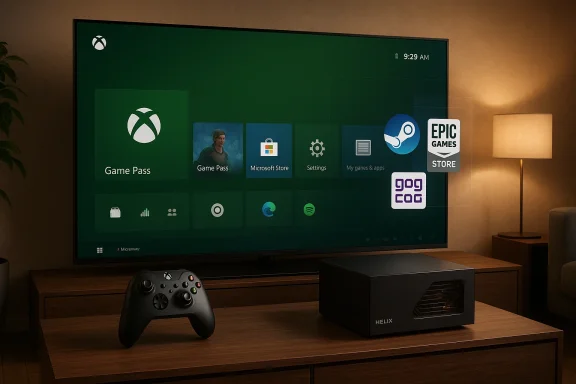
Living room setup with a large TV showing Xbox Game Pass, a controller, and a console on a wooden table.Background: how we got here​

Microsoft’s engineering and product signals over the last 18–24 months form the scaffolding for Project Helix. Two pieces of work are particularly important.
First, the Xbox Full Screen Experience (FSE): an optional Windows session posture that behaves like a console launcher — controller first, aggregated game library, and simplified TV‑style navigation — while running on top of Windows 11. FSE has already shipped in Insider builds and been used on Xbox‑branded handheld hardware, demonstrating the company’s intention to offer a consistent console‑like UX on Windows devices.
Second, the evolution of the Xbox PC app into an aggregator: Microsoft has been rolling updates that let the Xbox app surface installed titles from other PC storefronts and launch third‑party clients or their games directly, reducing friction between ecosystems. That aggregator behaviour is an important precursor to a Helix device that can legitimately claim to support Steam and similar stores.
On the hardware side, public comments from AMD and multiple reporting threads point to a continued Microsoft‑AMD partnership for semi‑custom silicon, and investor commentary has been read as implying a possible 2027 hardware window. Those statements are meaningful but not the same as a formal ship date from Microsoft; they should be treated as correlated signals rather than hard commitments.

What reporters are saying — “most open Xbox ever”​

Leading industry reporters who have tracked Helix for months are repeating a consistent thesis: Project Helix will be a Windows‑rooted machine that boots into an Xbox front end, but also allows users to exit to the Windows desktop and run other PC stores natively. This is the core of the “most open Xbox ever” line — the idea that Microsoft will, by design, enable users to install and use Steam, Epic Games Store, GOG, Battle.net, Riot Client and more. The claim is echoed in coverage and community analysis that ties Helix to the FSE and to earlier partner hardware experiments.
Important nuance: Microsoft’s official messaging has emphasised the codename and strategic intent — “play your Xbox and PC games” — without disclosing exact mechanics, final SDKs, or a full launch roadmap. That gap leaves room for interpretation and change as engineering and partner negotiations continue.

Technical architecture (what Helix likely is — and what it likely isn’t)​

The consolized Windows thesis​

The clearest technical interpretation is straightforward: Helix is a Windows‑first device designed to behave like a console by default. That means:
  • Windows 11 remains the underlying OS.
  • The Xbox Full Screen Experience acts as the default, controller‑first shell.
  • Users can exit to Windows for full desktop functionality, including installing other storefronts and running Windows apps.
That architecture preserves the entire PC software stack while making the living‑room UX feel familiar and immediate. It’s an elegant technical compromise: you get a deterministic, console‑grade session for couch play and the power of Windows when you need it.

Silicon and performance expectations​

Multiple reports and AMD commentary indicate Microsoft will again work with AMD on a semi‑custom APU for its next console family. Public remarks from AMD executives were interpreted to mean the partner work is progressing and could support a 2027 timeframe; leak reporting has circulated internal AMD codenames and speculative specs. These hardware threads are plausible given historical partnerships, but specific core counts, GPU CU numbers, die layouts, and exact NPU configurations remain unverified and should be treated as rumor until Microsoft or AMD publish official specifications.
One consistent prediction across analysis is that Helix will target modern console expectations — high‑resolution output, ray tracing, and on‑device AI acceleration — because these are now baseline capabilities for a premium living‑room device. On‑device NPUs are likely, given recent Microsoft handhelds and the platform’s growing use of AI features, but the exact feature set will be revealed by Microsoft later.

Storefronts, DRM, and ecosystem openness — real opportunities and real friction​

The headline that Helix will support Steam, Epic, GOG and others is both powerful and disruptive. If Helix truly ships with the ability to install and run alternate stores, the device will offer the broadest single‑device library in gaming: first‑party Xbox console titles, Game Pass, and the entire PC storefront landscape on a TV‑first hardware SKU. That proposition could change how consumers think about purchasing and game libraries.
But the practical reality is complicated:
  • Anti‑cheat and DRM: Many PC games rely on anti‑cheat drivers and kernel‑level components that have historically been problematic on console ecosystems. Supporting a variety of anti‑cheat systems across multiple stores on a single hardware SKU raises compatibility, stability, and security challenges. Microsoft will need a robust compatibility program and vendor collaboration to prevent store‑level breakage.
  • Storefront UX and discovery: Surfacing multiple storefronts within a single front end is doable (the Xbox PC app is already testing library aggregation), but discovery and monetization are still seller choices. Microsoft can aggregate and launch third‑party titles, but those partners may resist or require contractual terms for placement and telemetry.
  • Certification and a deterministic target: Developers expect a reliable performance baseline for console releases. Helix’s Windows base introduces variability (drivers, background services, anti‑cheat hooks) that could make console‑grade certification harder unless Microsoft publishes a strict “Console Mode SDK” and enforces certified drivers and firmware for titles targeting the FSE. Community proposals and internal analysis point to the need for a two‑mode approach: a locked console mode for developers and an open Windows mode for power users.

Support, updates, and the household experience​

A Windows‑rooted console introduces new support vectors that Microsoft must manage if Helix is to feel like a dependable family device.
  • Windows and driver updates: Windows feature and security updates can change runtime behaviour. Microsoft will need update rollback options, staged updates for console mode, and strong diagnostic tooling to avoid households becoming beta test labs. Forum analysis and engineering recommendations emphasise the importance of deterministic update behavior and rollback.
  • Long‑tail support complexity: The combination of Windows patches, third‑party storefront updates, and game patches multiplies points of potential failure. Microsoft must either centralize QA for the console mode or accept a higher support load. That decision will have operational cost implications and will shape the device’s retail warranty and support model.
  • Warranty and retail classification: Is Helix a console for law/regulatory/warranty purposes or a consumer PC? Retail placement, returns handling, and support contracts all hinge on this classification. Misalignment here could erode consumer confidence at launch.

Developer economics and first‑party content strategy​

Helix forces a strategic choice about exclusives and platform differentiation. Microsoft can—at the same time—be more open and still hold platform advantages, but only if the hardware or services provide clear incremental value.
  • If Microsoft continues to release marquee Xbox titles broadly (including PlayStation and PC), Helix’s unique selling point shifts toward hardware value, price, and convenience rather than exclusive software.
  • If Microsoft restricts or time‑gates key first‑party content to Helix and Xbox platforms, it regains a traditional console advantage but at the cost of openness and developer reach.
Internal analysis argues the device will likely compete on convenience and integrated services first, not absolute exclusives, because Microsoft has already moved many titles to multiplatform deals. That implies Helix’s commercial success will rest on hardware value, Game Pass integration, and the convenience of playing console‑grade titles on a TV alongside PC libraries.

Consumer experience: two modes or one?​

A pragmatic model for Helix is a two‑mode device:
  • Default “Console Mode” (FSE): boots straight into a controller‑first shell, Game Pass integration, and a curated home experience that mimics prior Xbox consoles.
  • Advanced “Windows Mode”: exit to the desktop, install Steam, Epic, or any other PC software, and use the device like a living‑room PC.
This “modes” approach gives consumers choice and solves several problems: it preserves the streamlined console UX for casual users and households while enabling power users to access the broader PC ecosystem. Forum proposals and product design discussions have recommended explicit warranty, update, and support commitments for both modes to reduce confusion and lower support cost.
Benefits of this approach include:
  • Broadest content access on one device.
  • Familiar console UX for non‑technical users.
  • A clear pathway for developers to target a deterministic console experience.
But the model requires crystal‑clear messaging from Microsoft at retail and in setup flows: customers must understand what the device is and how their purchases behave across modes.

Risks and where Microsoft must be careful​

Project Helix is ambitious. The idea is technically elegant, but execution risk is high. Key risks:
  • Support overhead and stability: Windows updates, third‑party stores, and anti‑cheat drivers create complexity that can break the “turn on and play” promise consumers expect from consoles. Microsoft will need strong QA and vendor coordination.
  • Consumer confusion: If Helix is priced like a PC but messaged like a console (or vice versa), customers could be left unsure what they bought. Retail classification, warranty language, and marketing must be consistent.
  • Developer fragmentation: Without a strict certified “console mode” target, studios may hesitate to invest in Helix‑specific optimizations. A clearly documented Console Mode SDK and certified driver set are essential.
  • Business tension with storefront partners: Valve, Epic, and others have their own interests. While Microsoft can allow their clients to run, neutral placement and discoverability could become contentious if marketplace economics or telemetry are involved.
  • Unverified hardware claims: Leaked specs and chip codenames should be treated cautiously. Public AMD comments suggest partner work, but exact performance and launch timing are not confirmed by Microsoft. Flag these as speculative until formal specs are released.

A concrete set of recommendations (what Microsoft should do)​

If Microsoft wants Helix to succeed as an “open but reliable” living‑room platform, the company should take the following steps — practical, technical and commercial.
  • Publish a clear “Modes” story at launch: precisely define Console Mode vs Windows Mode and the guarantees for each (updates, rollback, warranty).
  • Ship a certified Console Mode SDK: enforce certified drivers, firmware, and an API set developers can rely on to produce console‑grade builds targeting the FSE.
  • Commit to robust update instrumentation: staged Windows feature updates, rollback options, and automated diagnostics to prevent household breakage.
  • Negotiate anti‑cheat and driver commitments with major vendors before launch: ensure that popular PC anti‑cheat stacks will behave on Helix or provide vetted alternative pathways for online play.
  • Create retail and support playbooks: classify Helix clearly for retailers and support partners so consumers receive consistent information at purchase and post‑purchase.
  • Offer tiered hardware/SKU options or subsidized entry models: this reduces the price friction when comparing Helix to build‑your‑own PCs and helps position the device for mainstream living‑room adoption.
These are not window dressing; they address the operational realities that will determine whether Helix feels like a console or a complex PC at the hands of the average buyer.

Why Project Helix matters (and what success looks like)​

If Microsoft executes, Helix could reshape the living‑room device category:
  • It would offer the single most comprehensive library of playable content on a TV device: Game Pass, Xbox console titles, and the entire PC storefront ecosystem, all accessible from one machine.
  • It could lower the friction for developers shipping to both console and PC by reducing porting work and providing new testing and certification tools.
  • It would represent a decisive embrace of a future where Windows and Xbox experiences are intentionally integrated rather than merely interoperable.
Success looks like this: Helix powers on to a clean TV interface, Game Pass titles run flawlessly out of the box, and power users can exit to Windows and install Steam, Epic, or other stores without the system feeling unstable. Microsoft’s support and update story must make the device feel as reliable as prior consoles while preserving power user freedom.

What to watch next​

  • Formal Microsoft product pages and developer documentation for Project Helix and the Console Mode SDK.
  • Official hardware specs from Microsoft or AMD; treat AMD investor comments as a signal but not proof of launch timing.
  • Microsoft’s statements on anti‑cheat and driver commitments, and early partner reactions from Valve, Epic, and popular anti‑cheat vendors.
  • Early hands‑on with Helix prototypes or developer kits to see how well the FSE preserves console simplicity under Windows.

Conclusion​

Project Helix is one of the most consequential gambles Microsoft has made with Xbox hardware in a generation: build a device that’s both a console and a Windows PC, preserve the simplicity of a living‑room experience, and unlock the enormous breadth of PC storefronts. The potential payoff is enormous — a single hardware SKU that truly consolidates console and PC libraries — but the execution bar is equally high.
Microsoft has laid many of the building blocks: the Xbox Full Screen Experience, the Xbox PC app’s aggregation features, and partner hardware experiments. What remains is the hard work of making Windows behave like a dependable console platform — a task that will require firm commitments on certification, updates, anti‑cheat, and retail positioning. If Microsoft can meet that engineering and operational bar, Helix could deliver on the promise of being the most open Xbox ever without losing the reliability players expect from consoles. If it can’t, the device risks becoming a costly middle ground: too PC‑like for mainstream living‑room buyers and not open enough for power users.
For readers and the industry alike, the next months — developer documentation, AMD and Microsoft announcements, and GDC briefings — will be decisive. Expect intense scrutiny, cautious optimism, and a long list of technical and business questions that Microsoft must answer before Helix can realize its ambitious promise.

Source: Pure Xbox https://www.purexbox.com/news/2026/...ct-helix-the-most-open-xbox-ever-says-report/
 

Microsoft’s new gaming chief confirmed it in a single line that will change the conversation around consoles: Project Helix is the codename for Xbox’s next-generation hardware, and it “will lead in performance and play your Xbox and PC games.”

Dimly lit gaming setup with Xbox Series X, keyboard, and mouse, as a dark shooter game runs on the monitor.Background / Overview​

The Project Helix announcement — delivered by Microsoft Gaming CEO Asha Sharma during an internal Team Xbox update and amplified by an official Xbox post — is short on specs but long on implications. The message makes two things explicit: Microsoft intends to ship a new, first‑party Xbox device; and that device will be positioned to run both traditional Xbox console titles and PC games. ([pcgamer.com](The next Xbox is codenamed Project Helix, and it will 'play your Xbox and PC games' an idea plucked from thin air. Microsoft has been nudging Xbox and Windows closer together for years: the Xbox Full Screen Experience (FSE) in Windows 11, a more aggressive Xbox PC app that aggregates libraries, and OEM experiments such as the ROG Xbox Ally handhelds show the company testing the mechanics of a TV‑first Windows machine that behaves like a console out of the box. Those signals have culminated in Project Helix’s public naming today, turning a pattern of engineering moves into an explicit product thesis.
At the same time, partners in the supply chain have provided corroborating signals. AMD told investors in February that their semi‑custom SoC work for Microsoft’s next console “is progressing well to support a launch in 2027,” which industry outlets widely quoted as a tentative window for the platform’s arrival. That statement is a vendor confirmation of readiness, not a consumer ship date from Microsoft, but it materially tightens expectations.

What Microsoft actually said — and what it didn’t​

Asha Sharma’s post reads like a strategic framing rather than a technical brief. The notable lines are clear: the prct Helix), the positioning claim (“will lead in performance”), and the promise of playing both Xbox and PC games. The official Xbox account also posted a short animation confirming the codename publicly. No MSRP, SKU structure, detailed hardware specifications, or formal launch date accompanied the reveal.
Why that matters: Microsoft has deliberately separated the narrative (we are returning to first‑party hardware and blurring console/PC boundaries) from the hard engineering details that determine success (silicon choices, certification targets, anti‑cheat commitments). That staging buys Microsoft time to negotiate with pechnical guardrails while signalling intent to developers and retail partners ahead of Game Developers Conference (GDC).

The technical thesis: a consolized Windows 11 PC​

The most plausible architecture for Project Helix — based on public engineering signals and prior Microsoft products — ishine that behaves like a console by default*. In practice that means:
  • Windows 11 remains the underlying operating system.
  • The Xbox Full Screen Experience (FSE) operates as the device’s default,l for TV play.
  • Users can “exit to Windows” to access the full desktop, install third‑party storefronts, and run standard Windows apps.
This approach preserves the complete Windows software stack rministic, living‑room experience: easy, controller‑first play for most users, and full PC flexibility for power users. The ROG Xbox Ally family demonstrated the feasibility of this approach in handheld form and the FSE work in Insider builds provides a software precedent.

Why a consolized Windows box is attractive​

  • Single‑device librarve Xbox console titles and allows PC storefronts, it becomes the broadest single‑device library in gaming — Game Pass + console catalog + Steam/Epic/GOG/Battle.net, all accessible on the TV.
  • Lower porting friction: Developers shippinole could benefit from reduced porting complexity if Microsoft publishes deterministic Console Mode APIs and certification tooling.
  • Strategic leverage for services: Microsoft can lean into Game Pass and cross‑device services while enabling alternative store access, broadening revenue oppngle storefront.

Why it’s technically hard​

  • Anti‑cheat and kernel drivers: Many PC multiplayer titles rely on kernel‑level or privileged anti‑cheat drivers that have historically been challenging to support across divergent platforms. Ensuring compatibility across multiple anti‑cheat vendors on a single hardware SKU will require pre‑launch coordination.
  • Update determinism: Windows feature and driver updates can change runtime behavior. To preserve the classic “turn on and play” console promise, Microsoft will need staged, rollback‑capable updates when the system is in Console Mode.
  • Certification complexity: Console development thrives on a deterministic hardware target. A Windows‑rooted device expands the variability matrix (drivers, background services, user‑installed software). Microsoft must either provide a locked Console Mode SDK or accept fragmentation r: AMD, “Magnus” talk, and what to expect
Historically, every Xbox generation since the Xbox One has used custom AMD silicon. Public remarks from AMD CEO Dr. Lisa Su in February indicated the company’s semi‑custom work for Microsoft is “progressing well” to support a potential 2027 launch, which suggests Microsoft and AMD remain partners for Helix’s APU. That vendor confirmation is important, but it is not a Microsoft specification release.
Industry leak threads have circulated internal AMD codenames such as “Magnus” for Microsoft’s new SoC, but those details remain unverified and should be treated with caution until AMD or Microsoft publish official technical documentation. Claims about core counts, compute unit numbers, NPU characteristics, or node process should be flagged as rumor until independently confirmed.
Most independent analysis converges on a set of plausible hardware priorities for a premium next‑gen device:
  • High aggregate compute targeting 4K HDR and high frame rates.
  • Hardware‑accelerated ray tracing.
  • On‑device neural processing units (NPUs) to accelerate AI features like upscaling, capture intelligence, and UI assistance.
  • Fast SSD and memory subsystems matching modern console expectations.
Those are design goals co industry baselines — expected, not guaranteed.

Ecosystem friction points: anti‑cheat, DRM, and storefront politics​

The headline promise — that Helix “will play your Xbox and PC games” — can tiple ways. It could mean:
  • Native support for PC games (install and run Steam/Epic/GOG/Battle.net titles natively in Windows on Helix).
  • Streaming of PC games from cloud appliances or the user’ compatibility layer where Microsoft certifies specific PC titles to run within Console Mode.
Each option has different technical and commercial implications, and Microsoft’s phrasing leaves space for any of them. Independent coverage has noted this ambiguity and cautioned against assuming full native parity across every PC title. (arstechnica.com)
Key friction points to watch:
  • Anti‑cheat compatibility across multiple vendors (Easy Anti‑Cheat, BattlEye, Riot Vanguard, etc.) could cause stabi issues unless vendors commit to Helix‑compatible drivers or Microsoft isolates Console Mode net play with platform‑vetted alternatives.
  • DRM and store integrations: Aggregating g; enabling install, update, and DRM support across storefronts is operationally heavy and likely to prompt complex partner negotiations.
  • Certification policy: Developers wle target for performance tuning. Without clear Console Mode guarantees, studios could hesitate to optimize for Helix as a unique platform.

Support, updates, and the household UX​

A big part of the console promise is reliability. Microsoft will have to solve the support problem for Helix to feel like a mainstream living‑room device rather than a PC that happens to plug into a TV.
  • Windows and driver updates need a deterministic, consumer‑safe cadence when the device is in Console Mode, including staged rollouts and rollback points to prevent disrupted play.
  • Diagnostic tooling must let support agents and users quickly triage whether a problem stems from the console layer, Windows services, or third‑party storefronts.
  • Retail classification matters: Is Helix sold as a console or a PC for warranty, return, and regulatory purposes? That choice affects retail placement and customer expectations.
Without strong, visible commitments on these fronts, Helird to manage” device for non‑technical buyers — a fatal flaw for mainstream console adoption.

Business strategy and exclusives: the new calculus​

Project Helix sits amid a larger strategic tension inside Microsoft: the long‑running split between openness (release on many platforms) and plate hardware demand with must‑have first‑party titles). Microsoft’s recent posture has trended toward broader availability for flagship franchises, and the Helix architecture further reduces the need for absolute platform exclusives to drive adoption.
The value proposition for Helix therefore shifts from exclusive IP to a combination of:
  • Hardware performance and price‑to‑value.
  • Unmatched convenience (Game Pass + console titles + PC storefront access onor living‑room UX and support guarantees.
If Microsoft continues to make major first‑party titles multiplatform, Helix’s competitive edge will hinge more on hardware vaubscription/service convenience than on keeping big games off rival platforms.

What Microsoft should do (a practical checklist)​

Multiple community and engineering analyses converge on a handful of pragmatic would make Helix viable at scale. The core idea: provide two clearly defined modes with deterministic guarantees and robust developer tools.
  • Publish a clear “Modes” story
  • Console Moistic update cadence, certified drivers, rollback support, and a Console Mode SDK with enforced behavior.
  • Windows Mode (advanced): full desktop access, user responsibility for installing third‑party stores and driified Console Mode SDK
  • Enforce a stable driver and firmware baseline for developers targeting FSE to enable console‑grade QA and optimizations.
  • Negotiate anti‑cheat and DRM commitments pre‑launch
  • Secure vendor commitments or platform alternatives for popular online titleentation.
  • Commit to staged updates and a robust rollback story
  • Prevent households from becoming de facto beta testers by offering controlled rollouts and quick recovery paths when updates break the console experience.
  • Price and bundle strategically
  • Offer tiered SKUs or subsidized eniction compared to custom‑built PCs and to position Helix as a mainstream living‑room choice.
  • Clarify retail and warranty classification
  • Ensure consistent point‑of‑sale messaging so buyers understand whether they are purchasing a console, a PC, or a hybrid and what that meupport.
If Microsoft adopts these commitments, Helix stands a chance of delivering both openness and the frictionless living‑room experience that mainstream buyers expect. If it does not, Helix risks becomineases neither mainstream console buyers nor hardcore PC users.

Risks and downside scenarios​

Project Helix is ambitious. The most likely failure modes are operational rather than conceptual:
  • Too PC‑like s priced near comparable‑spec PCs but still messaged like a console, mainstream buyers may balk. Clear SKU segmentation matters.
  • Support burden: The combination of Windows patches, OEM drivers, third‑party storefront updates, and game patches multiplies the points ofe household. Microsoft must invest in long‑tail support or accept increased return rates and lower net promoter scores.
  • Developer hesitation: Without a locked Console Mode, studios may be reluctant to optimize for Helix as a unique target. That would undermine the hardware’s ability to showcase exclusive technical features.
  • Storefront and partner friction: Valve, Epic, and other storefronts have their own commercial priorities. Aggregation without clear neutral dcould provoke disputes or degrade user experience.
These risks are solvable — but only with explicit, enforceable commitments across Microsoft’s hardware, OS, and developer outreach teams. The alternative is a high‑cost hardware play that underdelivers on the sity consumers expect from consoles.

What this means for gamers, developers, and the market​

For gamers: If Microsoft executes, Helix promises the convenience of a single living‑room box with access to Game Pass, the Xbox console catalog, and the breadth of PC storefronts. That’s compelling if the device truly behaves like a console out of the box and remains affordable. If execution falters, early adopters may encounter instability, com and confusing purchase expectations.
For developers: A Windows‑rooted Xbox lowers porting friction between PC and console but raises the bar for trong certification tooling and a Console Mode SDK so developers can still rely on a deterministic baseline for performance tuning.
For the market: Helix would accelerate the convergence of PC and console ompetitors to clarify their own strategies for openness, exclusivity, and developer tooling. It also makes service bn economics more central to hardware decisions. AMD’s comments about a possible 2027 window add marketplace pressure for Microsoft to tighten its tof major developer events.

Short checklist for what to watch next​

  • Microsoft developer documentation clarifying Console Mode guarantees and the Console Mode SDK.
  • Formal hardware specs from Microsoft or AMD (not vendor investor comments).
  • Anti‑cheat vendor commitments and public partner statements from Valve, Epic, and major publishers.
  • Pricing and SKU announcements that clarify whether Helix is a subsidized console or a premium living‑room PC.
  • Early hands‑on and developer kit leaks that demonstrate whether Console Mode is truly deterministic or merely a launcher on a full PC stack.

Conclusion​

clearest signal yet that Microsoft intends to pivot its first‑party hardware strategy toward a hybrid that fuses console simplicity with PC openness. The promise is powerful: a single device that delivers Game Pass, the Xbox console library, and native PC storefronts on the TV. But the execution bar is unusually high. Microsoft needs airtight plans for certification, anti‑cheat compatibility, staged updates, and retail clarity — and it must communicate those plans well before broad consumer availability.
AMD’s investor comment tn is “progressing well to support a launch in 2027” gives a plausible timetable for when the technical puzzle pieces might align, but it’s a supplier signal, not a finished product roadmap. Until Microsoft publishes product pages, SDKs, and vendor commitments, many questions remain open — and many of the most consequential risks remain socialized in the implementation details rather than the marketing copy.
If Microsoft can deliver a genuine console‑grade experience on a Windows foundation — with clear mode separation, robust partner agreements, and consumer‑friendly pricing — Project Helix could redefine the living‑room device. If it cannot, the company risks creating a complex hybrid that satisfies neither the casual TV player nor the power PC user. The next few months, especially GDC and partner briefings, will determine whether Project Helix is an elegant evolution of Xbox or an overambitious experiment in need of refinement.

Source: TechPowerUp Xbox Project Helix Officially Tipped As Next-Gen Console, Will "Play Your Xbox and PC Games" | TechPowerUp}
 

Microsoft’s Xbox division has publicly given the next-generation box a name — Project Helix — and framed it as a device that will “lead in performance and play your Xbox and PC games,” a revelation that signals Microsoft is intentionally blurring the line between console simplicity and PC openness.

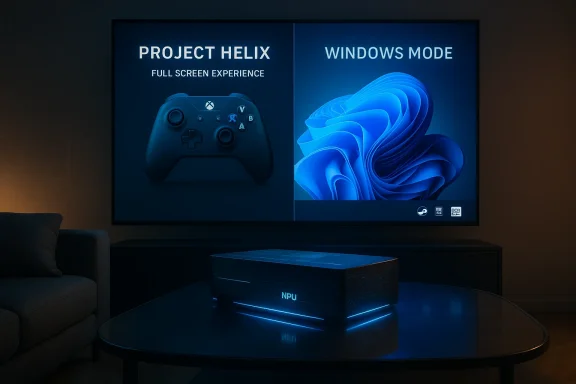
Dim living room with a large screen split into Project Helix and Windows Mode, and a glowing NPU box on a glass table.Background​

Microsoft’s move to name and position Project Helix is the culmination of a visible engineering trajectory: the Xbox Full Screen Experience (FSE) in Windows 11, work on the Xbox PC app as a library aggregator, and OEM partner devices that layered a controller-first shell over Windows. Together these pieces create a credible path toward a TV-first Windows device that behaves like a traditional console by default but exposes the full Windows environment when desired.
Industry signals also point to continued hardware partnership with AMD: public comments from AMD leadership have been read by the press as indicating semi-custom SoC work for Microsoft is progressing and could support a 2027 window. That AMD commentary is a vendor-side signal, not an official Microsoft ship date, and should be treated as a provisional timeline rather than a confirmed launch.
What Microsoft explicitly confirmed in its public messaging was limited but strategic: the internal codename Project Helix and an intent to deliver first‑party hardware designed to run both Xbox console titles and PC games. Microsoft did not publish MSRP, SKU structure, formal hardware specifications, or a firm launch date in the reveal.

Overview: What “play your Xbox and PC games” could actually mean​

The phrase “play your Xbox and PC games” is intentionally broad and technically ambiguous. There are three technically distinct ways Microsoft could be promising this support, each with different engineering and commercial tradeoffs:
  • Native Windows mode: Helix ships running full Windows 11 under a controller-first FSE shell by default, and users can “exit to Windows” to install and run third-party PC storefronts (Steam, Epic, GOG, Battle.net) natively. This preserves the broadest compatibility but increases variance and support complexity.
  • Certified “Console Mode” runtime: Microsoft offers a deterministic, locked console‑grade runtime (a hardened FSE) that supports a curated set of PC titles certified to run within that environment, while other titles run only in the full Windows desktop. This balances reliability and openness but requires a robust certification and vendor coordination program.
  • Hybrid / streaming or compatibility layers: The device could rely on streaming, virtualization, or compatibility sandboxing for some PC titles — delivering the appearance of broad compatibility without guaranteeing native parity for every title. Microsoft’s phrasing leaves room for hybrid implementations.
The practical takeaway: the promise is powerful, but the engineering implementation — and the consumer experience that follows — will determine whether Helix is painless for mainstream buyers or a high-maintenance hybrid for enthusiasts.

Technical architecture: a “consolized” Windows 11 PC​

The most plausible architecture, given public engineering signals, is a Windows‑first machine that boots into an Xbox-style shell. In this model:
  • Windows 11 is the underlying OS.
  • The Xbox Full Screen Experience (FSE) is the default, controller‑first UI optimized for TV use.
  • Users can exit to Windows to access desktop apps, alternative storefronts, or system settings.
This preserves Windows’ ecosystem while offering a console-like living-room experience out of the box. The ROG Xbox Ally family and FSE builds in the Windows Insider channel have acted as practical prototypes for this approach.
Why Microsoft would choose this route is obvious: it unlocks the largest aggregate game library on a single device — first‑party Xbox console titles + Game Pass + PC storefronts — and reduces friction when shipping titles across console and PC variants. But it also brings significant technical burdens, which we’ll unpack below.

Silicon and performance expectations​

Historically, Microsoft’s home consoles have been built on custom AMD silicon, and early industry reporting plus AMD’s comments suggest the Helix work follows the same pattern. Public numbers about core counts, compute-unit counts, or die layout remain unverified leaks; the only reliable signal is AMD’s indication that semi‑custom SoC work is progressing and that a 2027 window is plausible. Treat detailed hardware specs circulating in leaks as rumors until Microsoft or AMD publishes official documentation.
Design priorities most analysts expect for a premium next-gen Xbox include:
  • High aggregate compute for 4K output and competitive frame rates.
  • Hardware‑accelerated ray tracing.
  • Fast NVMe storage and high‑bandwidth memory subsystems.
  • On‑device neural processing units (NPUs) to accelerate AI features like upscaling, capture intelligence, and UI assistance.
On‑device NPUs are especially credible: Microsoft’s recent handheld efforts include NPUs used for capture and AI assists, and industry trends make NPUs a near‑certainty for premium hardware designed in 2026–2027. But again: precise NPU configuration or performance claims remain unverified until official disclosure.

The store and DRM problem: openness vs. stability​

The headline benefit of Helix — having access to Steam, Epic, GOG and others on your TV console — is a game‑changer in concept. But implementing that benefit is technically and commercially complex.
Key friction points:
  • Anti‑cheat systems: Many PC multiplayer games use kernel‑level anti-cheat drivers (Easy Anti‑Cheat, BattlEye, Riot Vanguard) that have historically been problematic across varying kernel and driver environments. Supporting multiple anti‑cheat stacks on one SKU will require pre-launch vendor commitments or alternative platform-level protections.
  • DRM and store integration: Enabling installs, updates, and DRM across multiple storefronts is operationally heavy. Microsoft can aggregate and launch third‑party titles, but those partners may demand particular terms for placement, telemetry, or UX that complicate the “open” marketing message.
  • Discovery and monetization: Surfacing multiple storefronts within a single front-end raises discovery, recommendation, and monetization issues. Aggregation is technically feasible; agreeing on prominence and telemetry is a commercial negotiation.
These are solvable problems, but solving them requires early, explicit commitments from anti‑cheat vendors, third‑party store operators, and Microsoft’s own platform teams. Without those agreements, Helix risks being “open in name” while being fragmented in practice.

Support, updates, and the household experience​

A console's perceived value rests heavily on reliability: the promise of “turn on and play.” A Windows-rooted Helix must preserve that perception despite the more volatile nature of PC software.
Critical operational requirements:
  • Deterministic update cadence for Console Mode: When a device is in its TV‑first mode, feature and driver updates must be staged, tested, and rollback-capable to avoid disrupting the living‑room experience. Windows servicing unpredictability is the core operational risk here.
  • Certified drivers and rollback tooling: Microsoft must publish a stable, certified driver and firmware baseline for titles targeting the Console Mode and provide rollback paths when updates create regressions.
  • Diagnostic and support playbooks: Support agents need clear diagnostics to determine whether an issue is rooted in Console Mode, Windows, or third‑party storefronts. This is essential for consumer trust and low-friction returns or warranty claims.
The alternative is acceptance of a higher support load and potential erosion of the console promise: a device that “feels” like a PC on the sofa instead of a turnkey living-room appliance.

Developer relations and certification​

Developers have long relied on a deterministic hardware target to tune performance and QA console releases. A hybrid Helix model complicates that expectation.
What Microsoft must provide to maintain developer confidence:
  • A Console Mode SDK and certification program that enforces a stable runtime and driver stack when developers target FSE.
  • Robust profiling and testing tools that replicate retail console conditions.
  • Clear guidance on which PC features and anti‑cheat systems will be supported in Console Mode versus Windows mode.
If Microsoft fails to deliver a credible deterministic target, studios may hesitate to optimize for Helix specifically, reducing the platform's attractiveness as a first‑party launch target.

Business strategy and exclusives: the content calculus​

Project Helix shifts the calculus around what drives hardware purchases. Historically, platform exclusives have been a primary motivator for console adoption. Microsoft’s recent moves toward multiplatform availability for many flagship franchises reduce the leverage of exclusives as a reason to buy new hardware.
For Helix to succeed commercially, Microsoft likely needs a combination of:
  • Competitive hardware price-to-performance, possibly enabled by procurement scale and strategic margins.
  • Service integration and convenience — fast Game Pass access, seamless Game Pass credits, and frictionless sign-ins that make Helix the most convenient way to consume Xbox content on a TV.
  • A clear message on content — whether first‑party titles remain exclusive, timed, or multi-platform will directly influence demand.
In short, Helix may need to compete less on lock‑in exclusives and more on convenience, UX polish, and value — a fundamentally different hardware pitch than previous generations.

Practical checklist: what Microsoft should do now​

Industry analysis converges on a pragmatic roadmap that would materially reduce Helix’s execution risk:
  • Publish a clear “Modes” story: define Console Mode (deterministic, supported) vs. Windows Mode (advanced, user-managed).
  • Release a Console Mode SDK with certified drivers and firmware baselines for developers targeting the FSE.
  • Negotiate explicit anti‑cheat commitments with major vendors prior to launch and offer vetted alternatives where necessary.
  • Commit to staged, rollback-capable updates for Console Mode and provide robust diagnostic tooling for support teams.
  • Clarify retail classification and warranty (is Helix a console for regulation and returns or a PC?), which affects store placement and consumer expectations.
  • Consider tiered SKUs or subsidized entry to address price sensitivity and position Helix competitively vs. custom-built PCs.
These items are not window dressing; they address the precise engineering, support, and policy work needed to make Helix feel like a console to mainstream buyers while preserving PC openness for enthusiasts.

Risks and likely failure modes​

Even with careful planning, Helix can fail in several predictable ways:
  • Positioning confusion: If Helix is marketed like a console but priced like a PC, mainstream buyers will wait, and the SKU will stall.
  • Anti‑cheat fragmentation: If major anti‑cheat vendors decline to support Console Mode, a large swath of PC multiplayer titles could be unusable in the TV-first experience.
  • Update regressions: Windows updates or poorly coordinated driver releases could break the console experience, undermining trust in the device’s reliability.
  • Developer hesitancy: Without a deterministic console target and strong testing tools, studios might avoid Helix-optimized releases, leaving the device to compete only on hardware and service convenience.
  • Perception of limited openness: If installing third‑party stores is possible but awkward, or subject to heavy restrictions, the “most open Xbox ever” message will ring hollow.
Each of these failure modes is fixable — but only with early, explicit commitments and cross‑industry coordination.

What to watch next (timeline and signals)​

The clearest short‑term indicators to track are:
  • GDC developer briefings and Microsoft communications clarifying certification, SDKs, and the Console Mode guarantee.
  • AMD investor updates and roadmap disclosures that narrow launch timing beyond the initial 2027 window signaled by vendor comments. Remember: the 2027 implication comes from AMD remarks and is not a Microsoft release date.
  • Public quality signals from FSE in Windows Insider and OEM devices: broad polish and reliability there materially increase Helix’s chances of feeling like a console at retail.
  • Anti‑cheat and storefront partner statements: explicit vendor commitments to support Helix’s console runtime would remove the most salient technical blocker.
These signals will determine whether Helix is primarily a bold strategic pivot that Microsoft can operationalize or a concept that founders on implementation complexity.

Final analysis: balance of opportunity vs. execution risk​

Project Helix is one of the most consequential directional pivots Microsoft could make with Xbox hardware: a device that genuinely combines the simplicity and polish of a console with the library breadth and flexibility of a PC would be transformative for consumers and developers alike. The upside is enormous: the broadest single‑device library on a TV, simplified porting for developers, and new leverage for Microsoft services like Game Pass.
But the execution bar is unusually high. Microsoft must solve anti‑cheat fragmentation, deliver deterministic Console Mode guarantees, negotiate storefront terms, classify the device clearly for retail and warranty, and commit to update discipline that preserves the “turn on and play” promise. Without those commitments, Helix risks becoming an unwieldy middle ground — too PC‑like for casual living‑room buyers and not open enough for power users.
If Microsoft executes on the checklist above, communicates transparently with partners and consumers, and prices the device competitively, Helix could legitimately redefine what an Xbox is. If the company leaves critical details vague, the product may excite enthusiasts but disappoint mainstream buyers who demand the simplicity consoles have historically delivered.

Project Helix is an audacious idea with immense promise; the next months of developer documentation, partner announcements, and technical previews will determine whether it becomes the industry’s next standard or a well-intentioned experiment that highlights the hard realities of converging two very different product categories.

Source: TechPowerUp Xbox Project Helix Officially Tipped As Next-Gen Console, Will "Play Your Xbox and PC Games"
 

Microsoft’s brief public confirmation that the next Xbox carries the internal codename Project Helix has reshaped a long-running industry conversation: the company appears to be building a living‑room device that intentionally blurs the lines between a console and a Windows PC, promising console polish and the breadth of PC game libraries in a single box.

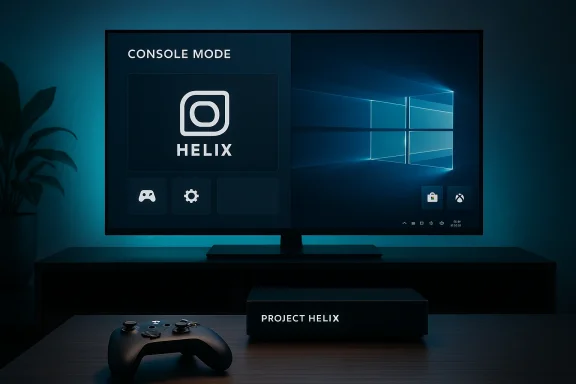
Dimly lit gaming setup with a large console-mode monitor displaying Helix, an Xbox controller, and a Project Helix box.Background / Overview​

Asha Sharma, Microsoft’s recently appointed executive leading the gaming organization, publicly used the Project Helix codename while describing the company’s hardware roadmap and saying the device “will lead in performance and play your Xbox and PC games.” That message is short on hardware specifics but is long on implication: Microsoft is signaling a return to first‑party hardware and a strategic pivot toward a hybrid console/PC experience that tightly integrates Xbox and Windows engineering work.
This reveal follows visible engineering steps Microsoft has already taken: a controller‑first Full Screen Experience (FSE) for Windows 11, the Xbox PC app’s gradual evolution into a library aggregator, and OEM experiments that shipped Windows machines tuned for a TV‑style, controller‑first experience. At the same time, semiconductor partner signals—most notably from AMD leadership—suggest silicon work is underway that could support a launch window in the 2026–2027 timeframe; that vendor timing is a readiness indicator, not a Microsoft ship date. The public story, then, is deliberate and staged: codename and strategic intent now; technical detail, developer tooling, and retail positioning later.

What Microsoft actually said — and what remains unconfirmed​

  • What Microsoft confirmed: an internal codename (Project Helix) and strategic positioning that the next device will “lead in performance” and can “play your Xbox and PC games.”
  • What Microsoft didn’t confirm: retail name(s), MSRP, SKU tiers, detailed hardware specifications, the final OS/runtime design, anti‑cheat and DRM policies, or a formal ship date.
  • What remains speculative: whether Project Helix will natively run third‑party PC storefronts on day one, how anti‑cheat integration will work across competing vendors, and how Microsoft will classify the device for warranty/regulatory purposes.
Because the announcement is intentionally thin, readers should treat claims about full Steam/Epic/GOG support and specific silicon specs as plausible scenarios rather than confirmed fact until Microsoft or its partners publish technical documentation or a product page.

The consolized Windows thesis — what Project Helix likely is​

A TV‑first Windows 11 device with a console shell​

The most defensible interpretation of the messaging and Microsoft’s recent work is that Project Helix will be a Windows‑rooted device that behaves like a console by default. In practical terms:
  • Windows 11 (or a closely related, OEM‑supported Windows runtime) sits beneath the device.
  • A controller‑first Xbox Full Screen Experience (FSE) acts as the default shell, optimized for TV navigation and game discovery.
  • Users can exit to Windows to access the full desktop, install PC storefronts, and run other Windows apps — a model that preserves the openness of the PC ecosystem for advanced users.
This architecture reconciles two competing goals: preserve the simple, “turn‑on‑and‑play” living‑room UX that defines consoles, while exposing the enormous breadth of PC content for users who want it. The approach also explains Microsoft’s incremental rollout of FSE to Windows devices and the Xbox app’s aggregator behavior, which act as incremental prototypes for a Helix product experience.

Two operating modes — why they matter​

To make the hybrid promise realistic for both consumers and developers, Microsoft will almost certainly need to define at least two operational modes:
  • Console Mode (default): A locked, deterministic runtime tuned for reliability, certified drivers/firmware, staged updates with rollback, and a Console Mode SDK that lets developers optimize for a stable hardware target. This is what preserves the classic console promise.
  • Windows Mode (advanced): Full desktop access where users accept Windows‑style variance, can install third‑party stores and drivers, and bear greater responsibility for compatibility and updates.
Without a clear and enforced modes story, Helix risks becoming confusing at retail and support—neither a pure console nor a straightforward PC.

Hardware expectations and the AMD connection​

Microsoft’s historical pattern and public vendor comments point to continued collaboration with AMD on semi‑custom silicon for the next Xbox family. Industry reporting and AMD leadership commentary indicate AMD’s semi‑custom SoC work for Microsoft is progressing and could support a 2027 readiness window. That should be read as a supplier readiness signal—not a firm Microsoft ship date.
What we can plausibly expect in a premium next‑gen Xbox architecture:
  • A high‑throughput APU tuned for TV resolution targets (4K HDR) and modern frame‑rate expectations.
  • Hardware‑accelerated ray tracing and modern GPU feature sets to remain competitive with PC and rival consoles.
  • A fast, custom NVMe storage subsystem and memory architecture designed for low latency streaming of assets.
  • On‑device neural processing (NPU) to accelerate local AI features — capture intelligence, super‑resolution upscaling, and UI/UX assistance — mirroring the broader industry trend toward on‑device AI.
What remains unverified are any concrete core counts, compute unit numbers, process nodes, or NPU specifications circulating in leaks. Treat those as rumor until Microsoft or AMD release official specs.

Software and store ecosystem: openness vs. determinism​

Project Helix’s most consequential claim is functional: it will “play your Xbox and PC games.” That phrase can be implemented three very different ways, each with different technical, legal, and business consequences:
  • Native Windows mode: Helix runs full Windows and allows users to install third‑party stores (Steam, Epic, GOG, etc.) and native PC titles. This maximizes openness but increases the variability Microsoft must support and the number of potential failure modes (anti‑cheat drivers, DRM conflicts, driver updates).
  • Certified Console Mode runtime: Microsoft certifies a curated set of PC titles and vendors to run inside a hardened console‑like runtime. This balances reliability and openness but requires heavy vendor coordination and a formal certification program.
  • Hybrid / Streaming / Compatibility layers: For titles that can’t run natively due to driver restrictions or anti‑cheat, Microsoft might use streaming, sandboxing, or compatibility layers to provide the “illusion” of native support. This reduces friction but sacrifices parity and might introduce latency or quality differences.
The headline scenario—native Steam/Epic support on day one—would be disruptive in the industry and beneficial to consumers. It is also the most operationally complex: multiple anti‑cheat vendors (Easy Anti‑Cheat, BattlEye, Riot Vanguard, etc.) have historically required kernel‑level drivers that present stability and security challenges. Microsoft will need explicit commitments from anti‑cheat vendors or a platform model that isolates online multiplayer to vetted configurations.

Anti‑cheat, DRM, and platform security — the hard plumbing​

Supporting a broad PC library on a device intended to feel like a console introduces hard technical plumbing problems:
  • Anti‑cheat drivers: Many PC multiplayer titles use privileged kernel drivers. Allowing arbitrary kernel drivers on a consumer living‑room device compromises the deterministic QA model that consoles rely on. Microsoft must either require vendors to ship Helix‑compatible anti‑cheat variants or isolate multiplayer to a platform‑vetted path.
  • Windows updates and driver drift: Windows feature and security updates can change runtime behavior unexpectedly. For Helix to preserve console reliability, Microsoft must provide staged update channels, rollback capability while in Console Mode, and a guarantee that Console Mode behavior won’t be silently altered by a background Windows feature update.
  • DRM and storefront integration: Enabling multiple storefronts complicates discovery, telemetry, and monetization. Microsoft will need to negotiate placement and UX for third‑party stores inside the FSE or accept a more neutral aggregation that favors user choice.
These are not purely engineering problems; they involve business negotiation with anti‑cheat vendors, third‑party store operators, and platform partners.

Developer implications — certification, performance targets, and tooling​

Developers have historically relied on deterministic hardware targets to tune performance and streaming behavior. A Project Helix that exposes Windows underneath introduces variability unless Microsoft provides a strict, certified target:
  • A Console Mode SDK and a set of certified driver/firmware images would let studios build with confidence against an ensured baseline.
  • Robust profiling, telemetry, and submission tooling will be required so studios can optimize for both Console Mode and Windows Mode without doubling their QA cost.
  • Clear platform policy on exclusivity, timed releases, and multiplatform deals will determine whether Helix hardware alone can materially drive adoption.
If Microsoft fails to provide deterministic developer guarantees, studios will treat Helix like a nebulous PC target and avoid deep optimization—undermining the device’s promise of console‑grade performance.

Consumer experience and support — what success looks like​

For mainstream living‑room buyers, success is simple: turn it on, sign in, and play. For Helix to deliver that promise while exposing PC openness, Microsoft must:
  • Ship with a default Console Mode that is as stable and simple as prior Xbox consoles.
  • Offer transparent, simple choices for power users who want to access Windows and third‑party stores.
  • Provide a warranty and retail classification that match consumer expectations (is this a console or a PC?).
  • Deliver a staged update and rollback strategy so household devices aren’t left in a broken state after a Windows update.
  • Invest in long‑tail support: Helix’s variance comes with a support cost, and Microsoft must staff and train support teams to triage whether an issue is caused by the console shell, Windows, an installed PC store, or a third‑party driver.
Without these commitments, Helix risks becoming a high‑maintenance device for mainstream customers.

Business strategy: exclusives, Game Pass, and the new calculus​

Project Helix alters the strategic calculus for exclusives and services:
  • If Xbox first‑party titles continue to appear on other platforms, Helix’s differential advantage shifts from exclusive content to hardware value, price/performance, and convenience (Game Pass + console and PC libraries).
  • Microsoft can use procurement scale and service bundling (Game Pass credits, cloud perks) to make Helix compelling on price alone, but that requires careful SKU planning and possible subsidies.
  • Openness reduces the leverage of exclusives to drive hardware purchases, so Microsoft must decide whether Helix will compete on content exclusivity or on being the most convenient way to access a massive combined library.
The company’s long‑term choices—timed exclusives, platform availability, and pricing—will determine whether Helix enlarges Xbox’s installed base or merely reshuffles where existing players choose to play.

Risks, tradeoffs, and the upside​

The upside​

  • A successful Helix could become the most comprehensive living‑room game device: Game Pass, Xbox console titles, and much of the PC storefront ecosystem on one machine.
  • Developers could benefit from reduced porting friction between console and PC targets.
  • Consumers would gain an unprecedented single‑device library and the convenience of console UX with PC breadth.

The tradeoffs and risks​

  • Support complexity: Windows’s openness multiplies support vectors and makes consumer reliability harder to guarantee.
  • Certification friction: Developers need a deterministic target; otherwise, optimization becomes expensive.
  • Anti‑cheat and multiplayer fragility: Kernel‑level drivers and vendor cooperation are unresolved problems.
  • Positioning confusion: Consumers and retailers buy clear categories; a hybrid device must have an unambiguous value proposition.
  • Content calculus: If major first‑party games remain multiplatform, Helix must win on price, hardware, or convenience rather than exclusives.
Microsoft’s execution on update determinism, developer tools, and partner agreements will decide whether Helix is a triumph or a costly experiment.

A pragmatic checklist — what Microsoft should publish next​

  • Publish a clear “Modes” story: define Console Mode guarantees (rollback, certified drivers, update cadence) and Windows Mode tradeoffs.
  • Release a Console Mode SDK and certified driver/firmware baselines so developers can target a deterministic platform.
  • Negotiate anti‑cheat vendor commitments and publish a compatibility roadmap for popular multiplayer titles.
  • Clarify retail classification, warranty terms, and support workflows so consumers and retailers know what they are buying.
  • Offer initial SKU/price guidance and a launch bundle strategy that makes the hardware an attractive value proposition versus build‑your‑own PCs.
  • Provide a partner and storefront integration policy that explains how third‑party stores will be surfaced in FSE and what placement rules exist.
Delivering this checklist would materially reduce the major obstacles to mainstream adoption.

Timeline and signals to watch​

  • Developer sessions at the upcoming Game Developers Conference (GDC) are likely venues for Microsoft to clarify certification and SDK details.
  • AMD public roadmap commentary and earnings calls will narrow expectations for any 2026–2027 readiness window. Vendor statements that a semi‑custom SoC is ready to support a 2027 launch are supplier signals—they do not replace a Microsoft product announcement.
  • Public FSE quality signals from Windows Insider builds and OEM partners will indicate how close the console‑grade shell is to being retail‑ready.
  • Early hands‑on previews with developer kits (if Microsoft issues them) will reveal whether the device’s default turn‑on‑and‑play experience meets console expectations.
Until those signals converge, expect cautious optimism and continued industry scrutiny.

Conclusion​

Project Helix is one of the boldest platform bets Microsoft has signaled in years: build a living‑room device that keeps the simplicity and reliability of a console while unlocking the rich, messy universe of PC gaming. The plan aligns with Microsoft’s long‑running engineering direction—Full Screen Experience on Windows, a more aggressive Xbox PC app, and tighter Windows+Xbox integration—but the devil is in the operational details.
If Microsoft can deliver a truly deterministic Console Mode, negotiate anti‑cheat and storefront commitments, and present a clear retail and support story, Helix could reframe how consumers think about TV‑based gaming. Conversely, without those commitments it risks being neither the pure console many households want nor the fully open PC power users demand.
For now, Project Helix is a statement of intent with enormous promise and equally enormous execution risk. The next few months—GDC sessions, vendor roadmaps, and Microsoft’s developer briefings—will determine whether Helix is a seamless convergence of console and PC or an ambitious idea that remains, for consumers, a work in progress.

Source: Techlusive Xbox’s next console ‘Project Helix’ confirmed, could blend PC and console gaming
 

Microsoft’s Xbox division has publicly given its next-generation hardware a name: Project Helix, a codename that comes with a single, seismic promise — the box will “lead in performance and play your Xbox and PC games.” That short, carefully worded reveal, posted by Microsoft Gaming CEO Asha Sharma and amplified by an official Xbox teaser, marks a clear strategic shift: Microsoft is positioning its next Xbox as a hybrid device that intentionally blurs the line between a living‑room console and a Windows PC.

A sleek, angular game console rests on a glass coffee table as a large TV shows Xbox game tiles.Background​

The Project Helix announcement is minimalist by design. Microsoft’s public messaging so far confirms three things and leaves the rest deliberately vague: an internal codename (Project Helix), a positioning claim about leading performance, and the assertion that the device will be capable of running both Xbox console titles and PC games. No retail name, price, SKU structure, or formal ship date accompanied the reveal, and Microsoft has framed the conversation as a staged developer‑and‑partner rollout ahead of detailed briefings expected at the Game Developers Conference (GDC).
That ambiguity is important. The message signals intent to developers and partners while giving Microsoft time to finalize technical and commercial details that will determine whether this hybrid vision is feasible at scale. Industry signals — especially public comments from a hardware partner about readiness of a semi‑custom SoC for a possible 2027 timeframe — provide a tentative timeline and confirm that major engineering work is underway, but they are supplier readiness signals rather than consumer ship dates.

What “play your Xbox and PC games” actually implies​

The simplest reading of the language is direct: Project Helix should be able to run titles that are currently sold and distributed for Windows PCs as well as the Xbox console catalog. But that phrase can be implemented in at least three very different technical and commercial ways — each with distinct consequences for players, developers, and the industry.

Three implementation models​

  • Native Windows mode
    The device runs full Windows (likely Windows 11 or a closely related runtime), boots into a controller‑first shell by default, and allows users to “exit to Windows” to install and run PC storefronts such as Steam, Epic, GOG, and Battle.net. This maximizes openness but introduces variability and long‑tail support complexity.
  • Certified Console Mode runtime
    Microsoft provides a hardened, deterministic console‑grade runtime (a controller‑first Full Screen Experience) that is the default for most users; certain PC titles and stores are certified to run inside that environment, while others run only in the full desktop mode. This balances reliability with openness but requires a formal certification program and partner buy‑in.
  • Hybrid compatibility / sandboxing / streaming
    For titles that cannot run natively due to driver or anti‑cheat constraints, Microsoft could provide compatibility layers, sandboxed environments, or certified streaming paths to deliver the experience on TV without full native parity. This reduces friction but risks parity loss and added complexity.
Each approach creates tradeoffs between user freedom and the deterministic quality consumers expect from consoles. The crucial product design question for Microsoft is whether Helix will prioritize a console‑grade living‑room experience first and openness second, or whether it will adopt true PC openness at the cost of predictable reliability.

The “consolized Windows” thesis — a plausible architecture​

A convergent reading of Microsoft’s recent engineering work points to a coherent technical thesis: Project Helix will be a Windows‑rooted device that behaves like a console by default. Microsoft has already shipped Windows features and partner devices that act as prototypes for this model, notably a controller‑first Full Screen Experience (FSE) in Windows and OEM products that layered a console‑style shell over Windows.

How a consolized Windows device would work​

  • Boot to FSE (Console Mode): a simplified, controller‑first UI optimized for TV, with Game Pass and the Xbox catalog front and center.
  • Exit to Windows (Power/User Mode): a full Windows desktop session for power users who want to install third‑party stores, tools, or PC apps.
  • Deterministic baseline for developers: Microsoft would publish a Console Mode SDK with certified drivers and firmware to give studios a stable performance target.
  • Staged updates and rollback: Console Mode must receive update treatment that preserves reliability, with staged rollouts and rollback capability to prevent broken play for households.
This dual‑mode approach is elegant on paper: preserve the console UX for the mainstream living‑room buyer while exposing the full power of Windows for enthusiasts. But it demands operational commitments — particularly around updates, drivers, and certified anti‑cheat support — that are far more complex than those faced by a traditional console.

Hardware expectations and the AMD partnership​

Historically, Microsoft has partnered with AMD for custom silicon across multiple Xbox generations. Public signals from AMD leadership indicate that AMD is developing a semi‑custom SoC for Microsoft and that the silicon work is progressing toward a potential readiness window in 2027. That aligns with industry lifecycle expectations and suggests Microsoft is targeting a premium, performance‑focused product.

Likely hardware priorities​

  • High aggregate compute to target 4K HDR and high frame rates
  • Robust hardware‑accelerated ray tracing and modern GPU feature set
  • Fast NVMe storage and optimized memory subsystem for low‑latency asset streaming
  • On‑device neural processing unit (NPU) to accelerate AI‑driven features like upscaling, capture intelligence, and UI assistance
These priorities mirror the current state of competition: consoles must deliver both raw frame‑rate performance and AI‑assisted features to remain competitive with gaming PCs. If Microsoft positions Helix as a performance leader, expectations for silicon, cooling, power delivery, and thermal headroom will be higher — and so will the final price if Microsoft does not subsidize hardware aggressively.

Software ecosystem implications: stores, anti‑cheat, and DRM​

The promise of running PC games implies friction points that are not merely technical but also commercial and legal. Microsoft will have to reconcile multiple storefronts, varied DRM schemes, and a patchwork of anti‑cheat solutions — all on a device meant to behave like a dependable console.

Anti‑cheat is the chokepoint​

Many AAA multiplayer PC titles rely on kernel‑level anti‑cheat drivers. Allowing arbitrary kernel‑mode drivers on a living‑room device undermines the deterministic QA model consoles rely on. Microsoft faces a few options:
  • Negotiate Helix‑compatible variants with major anti‑cheat vendors and require their adoption.
  • Limit multiplayer for uncertified PC titles or route online play through a platform‑vetted path.
  • Use sandboxing, virtualization, or streaming to avoid exposing console mode to kernel‑mode drivers.
Each option requires complex negotiations and technical work. The easiest route for Microsoft is to publish a clear certification pathway and secure vendor commitments before broad consumer availability.

Storefronts and discovery​

Aggregating or permitting multiple stores changes discovery, telemetry, and monetization. If Helix ships with native Steam/Epic/GOG support, Microsoft must define how those stores interoperate with Game Pass and the Xbox‑first discovery experience. Aggregation can be a competitive advantage for consumers — the broadest installable library on a TV device — but partner storefronts will also demand fairness in placement, telemetry access, and user journey control.

Updates and system determinism​

Windows updates and driver changes can alter runtime behavior. To preserve the console promise, Microsoft must implement staged update channels, rollback capabilities for Console Mode, and a clear support path when the device operates in the full Windows mode. Without these systems, a Helix user could suddenly find that a platform update breaks the “just turn on and play” experience.

Developer and business implications​

Project Helix affects developer workflows, business models, and the calculus of first‑party exclusivity.

For developers​

A deterministic Console Mode SDK would be essential. Studios rely on a stable hardware target to tune performance and QA. If Microsoft offers that baseline while also enabling an open Windows mode, developers could ship to both PC and console from the same codebase with fewer frictions. But if the platform remains too variable, studios will hesitate to optimize for Helix as a unique target.

For Microsoft’s business model​

The device shifts the value proposition away from strict platform exclusives and closer to the combination of hardware performance, Game Pass convenience, and a single‑device catalog. Microsoft must decide whether its flagship franchises remain time‑exclusive or broadly multiplatform. The commercial draw of Helix will hinge on a mix of subscription economics, the hardware price‑to‑value ratio, and whether Helix delivers a superior living‑room experience that justifies purchase over building a comparable PC.

Risks and the most likely failure modes​

Project Helix is ambitious, and the most likely problems are operational rather than conceptual.
  • Positioning confusion
    If Helix is priced like a PC but positioned like a console, mainstream buyers may hesitate. Retailers and warranty channels need clear classification and messaging.
  • Support burden
    A Windows‑rooted device increases the number of possible failure modes — Windows patches, driver updates, third‑party stores, and game patches all compound support demands. Microsoft must invest in long‑tail support or face high return rates and low customer satisfaction.
  • Anti‑cheat and multiplayer incompatibilities
    Without pre‑launch vendor commitments, many popular PC multiplayer titles could be unplayable in Console Mode or require degraded experiences.
  • Developer hesitation
    If Microsoft cannot deliver a locked Console Mode with certified drivers and testing tools, studios may shy away from Helix as a primary optimization target.
  • Price‑to‑value mismatch
    If Helix’s hardware cost is too close to comparable gaming PCs but without PC‑level expandability or modability, consumers may prefer to build or buy a PC instead.
These risks are real but solvable — provided Microsoft adopts a clear engineering and partner playbook.

A practical checklist Microsoft should follow​

If Helix is to succeed, Microsoft will need to make concrete, customer‑facing commitments in several priority areas. The list below is pragmatic and relatively short; delivering on these items will dramatically reduce the chance of a rocky launch.
  • Publish a clear “Modes” story
  • Define Console Mode (default) vs. Windows Mode (advanced), and publish the guarantees for each.
  • Release a Console Mode SDK and certified driver program
  • Provide studios with a deterministic target and enforce certified drivers/firmware for Console Mode.
  • Negotiate anti‑cheat commitments pre‑launch
  • Secure compatibility or vendor‑specific Helix drivers for major multiplayer anti‑cheat stacks.
  • Implement staged updates and rollback for Console Mode
  • Ensure Windows feature updates cannot silently break the default living‑room experience.
  • Clarify retail classification and warranty terms
  • Tell consumers whether Helix is sold as a console, a PC, or a hybrid and what that means for returns and service.
  • Price and SKU strategy with clear tradeoffs
  • Offer tiered SKUs or subsidized entry models to make Helix competitive with both consoles and entry‑level gaming PCs.
  • Publicly demonstrate turnkey third‑party store support (or be explicit about limits)
  • If Helix will run Steam and others on day one, show working demos and outline the support model.

Market impact and competitive positioning​

Project Helix, if executed well, could be the most consequential hardware move Microsoft has made since the original Xbox: it would accelerate platform convergence by offering the broadest TV‑accessible library in gaming. That could reshape consumer expectations — and put pressure on competitors.
  • For Sony: Helix reduces the exclusivity advantage; Sony’s own PC strategy and first‑party timing decisions will matter more than ever.
  • For PC OEMs: A successful Helix could capture a segment of living‑room PC demand currently satisfied by small form‑factor gaming PCs.
  • For Valve and cloud services: Helix could coexist with cloud gaming but would offer a differentiated on‑device performance advantage for local play.
The eventual market outcome will depend on pricing, content strategy, and the technical quality of the Console Mode experience.

Timeline: what to watch next​

  • GDC developer sessions: Microsoft has signaled it will discuss Helix with partners and studios at GDC; expect developer‑facing details on certification and SDKs.
  • AMD disclosures and earnings: AMD’s roadmap and public comments will narrow expectations for silicon and readiness windows.
  • Microsoft product pages and SDK release: published docs, developer kits, and hardware specs will transform speculation into a verifiable product roadmap.
  • Anti‑cheat vendors and third‑party storefront statements: watch for explicit commitments from Easy Anti‑Cheat, BattlEye, Valve, Epic, and the major publishers.
These signals will determine whether Project Helix is primarily a marketing thesis today or a concrete hardware strategy with a path to customers.

Conclusion​

Project Helix is a bold, coherent response to a decade of blurring boundaries between console and PC ecosystems. Microsoft’s public framing — a console that will “lead in performance and play your Xbox and PC games” — sets a high bar and raises a clear set of technical and commercial questions. The conceptual payoff is enormous: a single living‑room device that combines console simplicity with the breadth of the PC library would be a compelling proposition for many players.
But ambition is only half the story. Execution will hinge on the hard plumbing: certified anti‑cheat support, deterministic Console Mode guarantees, staged update and rollback mechanisms, clear retail and warranty classification, and a pricing strategy that makes sense against both consoles and gaming PCs. If Microsoft can deliver on those operational requirements, Project Helix could redefine what an Xbox is and how people think about gaming platforms. If it cannot, Helix risks becoming a confusing hybrid that pleases neither console purists nor PC enthusiasts.
For now, Project Helix is a strategic statement and a promise. The industry will be watching closely over the next months — at GDC, in partner briefings, and in AMD’s silicon roadmap — to see whether Microsoft can turn that promise into a product that truly unites the best of consoles and PCs.

Source: Digital Trends Microsoft’s next Xbox console is Project Helix, and it will run PC games too
 

Microsoft’s surprise confirmation of Project Helix — a next‑generation Xbox that “will lead in performance and play your Xbox and PC games” — has reignited a long‑running debate about the future of consoles, PCs, and what it means for living‑room gaming. The early reaction from enthusiasts, journalists, and developer circles is a mix of cautious optimism and practical skepticism: readers praise the concept’s ambition while warning Microsoft that the real work begins now — in pricing, platform guarantees, anti‑cheat and update engineering, and developer tooling.

A large TV shows a split-screen Xbox dashboard with games in a cozy orange-lit living room.Background / Overview​

Project Helix was publicly teased by Microsoft Gaming CEO Asha Sharma on March 5, 2026, who framed it as the company’s next‑generation console and explicitly said it will support both Xbox and PC games. The public messaging makes no pretence: Microsoft intends to blur the lines between consoles and Windows gaming, shipping a TV‑first device that — at least on paper — can run PC storefronts and apps under a controller‑first experience.
Industry reporting and vendor commentary link Project Helix to an AMD semi‑custom system‑on‑chip codenamed Magnus, and several outlets have read AMD’s public signals as consistent with a 2027 availability window. Those vendor comments are best treated as supplier signals — useful and plausible, but distinct from a formal Microsoft ship date or MSRP.
What Microsoft has confirmed publicly is intentionally high level: a performance‑first device that will “play your Xbox and PC games,” and further discussion with partners and studios is scheduled around developer events. What the industry and communities are debating now is not whether the idea is possible — Windows already runs on TV devices and controller‑first shells exist — but whether Microsoft can deliver a device that feels like a reliable, simple console for mainstream users while exposing the openness and breadth of Windows for enthusiasts.

What readers and communities are saying​

Early sentiment: hopeful, pragmatic, worried about price​

Across subreddits, comment threads, and reader responses to initial coverage, the majority reaction is favorable to the concept’s core promise: a single device that brings Game Pass, Xbox console libraries, and native PC storefronts to the TV. Many readers framed the move as a natural next step given Microsoft’s previous cross‑platform investments. But the earliest recurring worry — expressed repeatedly in community threads — is pricing. Enthusiasts expect a Magnus‑class device to land at a premium price; $1,000 is widely discussed as a plausible retail point based on current memory and silicon pressures. If Helix is priced too close to a comparable gaming PC, mainstream buyers may hesitate.

The "modes" question: console mode vs. Windows mode​

Readers keenly emphasize the need for a clear two‑mode product story: a default, locked‑down Console Mode (the Xbox Full Screen Experience — FSE — tailored for TV) and an advanced Windows Mode for power users who want native Steam, Epic, or other PC storefronts. That framing recurs in community proposals and technical writeups: Console Mode must be deterministic and supported; Windows Mode is the escape hatch for enthusiasts. Without that distinction, Helix risks being “too PC‑like for casual TV buyers and not open enough for power users.”

Concerns about exclusives and value​

The device’s commercial attractiveness will hinge on more than hardware: first‑party content strategy and Game Pass economics still matter. Polls of Xbox users show a strong rump of fans expect at least some first‑party exclusives; if Microsoft continues to ship marquee titles broadly to PlayStation and PC, Helix must compete on convenience and price rather than exclusive software. Community sentiment ties the device’s perceived worth to the availability and timing of exclusive titles.

Technical and operational analysis​

Hardware: the Magnus SoC and performance expectations​

Leaked and vendor‑reported details suggest AMD is developing a Magnus semi‑custom APU for Microsoft, potentially built on Zen 6 CPU cores and RDNA 5 GPU architecture, with advanced memory and integrated NPU elements. If those leaks hold true, Helix would be a generational leap over Xbox Series‑class hardware — but leaks are leaks, and Microsoft has not published formal specs. Treat chip codenames and alleged memory counts as provisional until AMD or Microsoft confirm.
Key engineering tradeoffs Microsoft must solve:
  • Determinism: Consoles gain a lot from a fixed hardware target. A Helix that shares a single hardware SKU across markets can preserve this — if Microsoft ships certified drivers and a Console Mode runtime that guarantees behavior for developers.
  • Power, thermals, and acoustics: A living‑room device will be judged as much by noise and heat as by frame rates; conserving a console‑like quietness at high performance is a nontrivial mechanical and thermal engineering challenge.
  • Price vs. performance: The more ambitious the silicon (GDDR7, many GPU CUs, integrated NPU), the higher the bill of materials — and the more difficult it is to hit a consumer‑friendly MSRP.
Community and internal analyses highlight a realistic payoff if Microsoft hits the thermals, driver stability, and price goals — but warn that edge cases (power users installing arbitrary kernel drivers, poorly tested updates, anti‑cheat drivers) will be costly if mishandled.

Software and platform: Full Screen Experience and certification​

Microsoft’s Xbox Full Screen Experience (FSE) in Windows 11 provides the conceptual basis for Helix. The challenge is making FSE robust enough to feel like a console’s “turn on and play” experience even while running on a full Windows stack. To preserve that feeling, Microsoft must:
  • Ship a hardened Console Mode with certified drivers and a Console Mode SDK so studios have a stable target for performance tuning.
  • Implement staged Windows updates, rollback capability, and an update‑channel story that keeps Console Mode behavior stable after feature updates.
  • Publish warranty and support flows that explain the difference between Console Mode and Windows Mode behavior and liability.
These operational items are repeatedly flagged in community briefs as the core work that will determine whether Helix behaves like a console or becomes a high‑maintenance PC in the living room.

Anti‑cheat, DRM, and multiplayer integrity​

Perhaps the single hardest technical business problem for an open console is anti‑cheat. Many multiplayer PC games use privileged kernel drivers and DRM components that have historically interfered with console‑grade stability. Microsoft has two conceptual paths:
  • Negotiate Helix‑compatible variants with anti‑cheat vendors so popular multiplayer titles work in Console Mode.
  • Limit Console Mode to curated certified games for online play and require Windows Mode installs for more experimental or non‑certified titles.
Both paths have tradeoffs: vendor agreements require time and bargaining power; a curated approach constrains the breadth of “playable on day one.” Community analysts argue Microsoft must secure vendor commitments pre‑launch or provide a technical isolation model (sandboxing or hypervisor partitioning) that preserves multiplayer integrity without breaking the console promise.

Business strategy and competitive impact​

Pricing, SKUs, and positioning​

Readers and analysts converge on one blunt truth: pricing will decide whether Helix is a niche luxury device or a mainstream successor to the Xbox family. Given memory market volatility and potential GDDR7 costs, early estimates floating around $999 are widely circulated — a realistic starting point for community expectations. Microsoft must decide whether to:
  • Subsidize entry SKUs (like a Helix Lite) to preserve mainstream accessibility, or
  • Offer premium hardware that targets enthusiasts and justifies a higher MSRP with bundled services and exclusives.
SKU segmentation — e.g., a base console‑first Helix SKU and an advanced Helix Pro for desktop‑like Windows Mode users — is one practical way to manage price sensitivity while delivering choice. Community proposals favor transparent trade‑offs for each SKU so consumers understand exactly what they’re buying.

Exclusivity and Game Pass calculus​

Microsoft’s broader content strategy — whether first‑party titles remain multiplatform, timed exclusive, or fully exclusive — will strongly influence Helix adoption. If top Xbox franchises are continuously cross‑released, Helix’s differentiator will be hardware + convenience (Game Pass integration, seamless TV UX, and bundled services). If Microsoft re‑embraces exclusivity for flagship titles, Helix reclaims a classic console leverage point — at the cost of openness.
User polling suggests many Xbox fans still want some level of exclusivity to drive hardware adoption. Microsoft’s choice here is strategic: use openness to maximize reach, or use exclusivity to drive device demand. Both have tradeoffs in developer relations, retail partnerships, and public perception.

Competitive dynamics: Sony, Valve, and PC OEMs​

A successful Helix would pressure Sony’s console strategy and Valve’s handheld/Steam ecosystem in different ways: Helix’s breadth of library (console + PC) reduces the exclusivity gap and offers a unique living‑room device proposition. For PC OEMs, Helix could capture a portion of living‑room small form‑factor (SFF) demand currently satisfied by boutique gaming PCs. For Valve and cloud players, Helix would sit alongside streaming options as a local‑play performance leader.
The outcome depends on execution: if Helix delivers a genuinely simple TV experience with the breadth of PC storefronts available in Windows Mode, it reshapes expectations. If Helix falls short on polish or becomes too expensive, it will leave the market muddled.

Practical recommendations — what Microsoft must publish before launch​

Communities and internal analyses converge on a pragmatic checklist Microsoft should publish early and clearly:
  • A clear “Modes” story: define Console Mode guarantees (update cadence, rollback capability, warranty limits) and Windows Mode tradeoffs.
  • A Console Mode SDK and certified driver baseline: give developers a deterministic target so studios can optimize without doubling QA.
  • Anti‑cheat and multiplayer compatibility commitments: secure vendor statements or publish a compatibility roadmap for major PC multiplayer titles.
  • A staged update and rollback system: prevent households from becoming de facto beta testers after Windows updates.
  • Pricing and SKU clarity: publish entry, mid, and premium SKUs (or clearly explain tradeoffs) early to set expectations.
  • Retail and warranty playbooks: classify Helix consistently so point‑of‑sale and support channels provide the same message.
These items aren’t marketing window dressing — they’re operational pillars. Missing any of them risks a fractured launch with high return rates and reputational damage.

Strengths and opportunities​

  • Single‑device convenience: Helix’s promise of consolidating console and PC libraries could be the most compelling consumer proposition in a generation — one device, one living‑room, one remote/controller-centric UX. Communities consistently cite this as the biggest upside.
  • Developer efficiency: If Microsoft provides robust tooling and a certified Console Mode target, studios could reduce porting friction between PC and console builds, ultimately speeding cross‑release and reducing QA costs.
  • Service bundling leverage: Game Pass remains a powerful lever; bundling credits, cloud perks, and subscription sweeteners can meaningfully lower effective entry cost and align Helix around Microsoft’s service ecosystem.

Risks and failure modes​

  • Support complexity: Windows’s openness creates many more failure modes (drivers, third‑party store interactions, anti‑cheat) than a closed console. Without investment in long‑tail support, Helix could create customer dissatisfaction at scale.
  • Positioning confusion: If Helix is priced like a PC but marketed like a console, mainstream buyers and retailers will be confused — hurting sell‑through and after‑sales support experiences. Clear taxonomy at retail matters.
  • Anti‑cheat and multiplayer fragility: Failure to secure vendor commitments or technical isolation for kernel‑level drivers can render many PC multiplayer titles unplayable in Console Mode — a launch‑breaking issue for an openness play.
  • Developer hesitation: Without a console‑grade, deterministic target, studios may avoid deep optimization for Helix, reducing the hardware’s ability to deliver technical differentiators and undermining its competitive story.

Verdict: ambitious, plausible — but execution‑dependent​

Project Helix is a high‑stakes strategic pivot: a device that unites Xbox console titles, Game Pass convenience, and the breadth of Windows PC storefronts. The idea is both logical and exciting, and it maps to consumer desires for simpler PC gaming on the TV. But every public and community analysis agrees on one central point: the idea is only the start. Microsoft’s success will be measured in the months ahead by concrete commitments — SKU strategy, a clear modes story, certified consoles SDKs, anti‑cheat vendor agreements, and a robust update/rollback story.
If Microsoft publishes those commitments and executes on them, Helix could become the most consequential Xbox hardware move in years: a genuine convergence device that expands Xbox’s reach without alienating casual living‑room buyers. If Microsoft tries to “be everything to everyone” without clear guarantees, Helix risks becoming a costly middle ground that pleases neither console die‑hards nor PC purists.

What to watch next (timeline and signals)​

  • GDC sessions and developer briefings: look for the Console Mode SDK, certification documentation, and anti‑cheat vendor commitments. These will be the clearest operational signals.
  • Formal hardware specs from Microsoft or AMD: confirm or refute current Magnus and GDDR7 rumors with vendor disclosures. Treat AMD investor commentary as helpful but provisional until formal発売 windows and specs are published.
  • SKU and pricing announcements: Microsoft must clarify whether Helix will be a subsidized mainstream product or a premium enthusiast device — the market reaction will hinge on the MSRP and available SKUs.
  • Third‑party storefront and anti‑cheat statements: explicit commitments from Valve, Epic, Easy Anti‑Cheat, BattlEye, and others will determine the breadth of playable PC multiplayer titles at launch.

Conclusion​

Project Helix is a bold, coherent answer to a decade of blurred lines between consoles and PCs. The promise of a consolized Windows machine that “plays your Xbox and PC games” opens an enticing set of consumer possibilities and developer efficiencies. But the real test isn’t the codename or the chip; it’s the plumbing: certification, anti‑cheat, update determinism, SKU strategy, and honest communication with partners and customers.
Readers are right to be excited — and right to press Microsoft for specifics. For Helix to succeed, Microsoft must turn the idea’s strategic elegance into an operational roadmap with concrete, customer‑facing guarantees. Otherwise, this could become a high‑cost experiment rather than the definitive living‑room device many hope it will be.

Source: Windows Central We asked how you feel about Xbox's "Project Helix" — here's what you said
 

Microsoft’s brief confirmation that a new Xbox exists — codenamed Project Helix — landed like a teaser more than a reveal, but the implications are already reverberating through the industry: a next‑generation box that promises to “lead in performance” while also playing PC games changes the product and platform calculus for Microsoft, its partners, and players.

Xbox console with illuminated vent, wireless controller, on a wooden table in front of a TV.Background / Overview​

For years Microsoft has nudged Xbox and Windows closer together: cross‑buy Game Pass titles, Play Anywhere releases, the Xbox PC app and the Xbox Full‑Screen Experience in Windows 11. Those moves set the stage for a single device that can legitimately claim both console simplicity and PC openness. Project Helix — announced publicly in a short statement from Microsoft Gaming CEO Asha Sharma — makes that piice will “play your Xbox and PC games” and is positioned as a performance leader.
The announcement was intentionally light on specs and looked more like a strategic flag‑planting than a product launch. That was by design: Microsoft has time, supply‑chain complexity, and a delicate ecosystem of partners and first‑party studios to consider before committing to final hardware, pricing, or a shipping window. Still, the message is clear — hardware is back at the center of Xbox strategy under new leadership.

What Project Helix actually is — and what it might be​

What we know​

  • Microsoft publicly used the codename Project Helix and the phrase “will lead in performance and play your Xbox and PC games,” attributed to Asha Sharma. This is the most concrete line in a deliberately compressed public message.
  • Microsoft’s recent engineering and product moves — the Xbox Full‑Screen Experience in Windows, collaborations with OEMs on handheld Windows gaming devices, and the release of Xbox‑branded hardware built by partners — create a plausible technical foundation for a hybrid console/PC.
  • Partner signals suggest the underlying silicon will continue to be co‑engineered with AMD; industry commentary from AMD leadership has hinted at a potential 2027 window for next‑gen Microsoft hardware. That gives a plausible multi‑year product runway rather than an immediate ship date.

What we don’t know (and why it matters)​

  • Specifications. There is zero verified public specification data: CPU/GPU architecture, memory configuration, storage type, and any custom accelerators (for AI or media) are unknown. Without these numbers, “lead in performance” is marketing, not measurable fact.
  • Form factor and OS. Microsoft could ship a sealed console with a console‑first UI, a Windows‑rooted device that can “exit to Windows,” or some hybrid mode that blurs those lines. Each choice has implications for performance tuning, certification, and the developer experience.
  • Price, launch date, and manufacturing. Component pricing and availability — especially DRAM and NVMe storage — remain volatile. Microsoft may also opt for an OEM‑manufactured model (as it did with the Xbox‑branded ROG handheld) to reduce capital risk. These decisions will determine consumer adoption more than marketing copy.

Technical possibilities and tradeoffs​

A hybrid console‑PC: advantages​

If Project Helix truly runs both Xbox and PC games natively, the device could offer:
  • Access to vast libraries. Consoles benefit from curated storefronts; PCs have Steam, Epic, and hundreds of storefronts. Combining them opens a near‑unlimited catalog.
  • Developer flexibility. Studios could ship one build that targets both environments, simplifying multiplatform development and patching if APIs and runtimes are aligned.
  • Hardware extensibility. A Windows base could allow peripherals and software not typically permitted on sealed consoles, from mod tools to third‑party storefronts.

The tradeoffs​

  • Certification and support fragmentation. Consoles have tightly defined driver stacks, QA processes, and platform services. A Windows‑based box complicates that model and could increase support costs and day‑one compatibility variability.
  • Performance tuning. PC titles expect heterogeneous hardware; ensuring predictable performance across a console that tolerates PC apps is a major engineering commitment.
  • Security and user experience. Allowing users to “exit to Windows” invites a host of security, privacy, and family‑safety questions that console users expect to be simpler. Balancing openness with the living‑room simplicity that consoles promise is nontrivial.
Industry threads and community analyses already point toward these tradeoffs, describing Project Helix as less a traditional sealed appliance and more a Windows 11 machine with a console‑forward UI — a promising but fraught direction.

Business strategy: why Microsoft is doing this​

Reasserting the Xbox brand​

Microsoft’s gaming division has been in a difficult moment. The Activision Blizzard acquisition remains one of the largest bets in gaming — a deal widely reported as about $69 billion — and it anchored Microsoft’s push to own major franchises. That acquisition brought studios and IP such as Call of Duty into the Microsoft fold, but the payoff requires strong hardware and platform momentum.
A hardware announcement signals a renewed commitment to the living‑room and to the Xbox brand identity: consoles are highly visible brand ships in a way that subscription services alone are not. A well‑executed console — especially one that blurs PC and console — could reposition Xbox as the nucleus of a new Microsoft gaming ecosystem.

The ecosystem calculus: Game Pass, first‑party content, and platform reach​

Microsoft has leaned heavily into Game Pass as the primary distributiehicle. Game Pass has consumer appeal and broad reach but raises questions about long‑term profitability and perceptions of value. Hardware sales help monetize first‑party content in traditional ways and can be a brand funnel into subscription services.
Project Helix, if integrated tightly with Game Pass, could:
  • Increase Game Pass subscriptions by lowering friction for playing PC titles on the big screen.
  • Make Xbox hardware more than a box — a gateway between subscription access and owned content.
  • Provide a compelling narrative for the “return of Xbox” under the new CEO while also giving Microsoft leverage with third‑party publishers and partners.

Financial reality: Microsoft’s gaming business under pressure​

Microsoft’s most recent quarterly disclosures show a 9% year‑over‑year drop in Gaming revenue and a 32% decline in Xbox hardware revenue in the quarter that ended December 31, 2025. Those declines rippled through analyst coverage and community discussion and are a clear backdrop to any hardware decision. Microsoft’s reports cite lower console volumes and a quieter release slate as drivers.
For readers tracking the numbers, the headline points are:
  • Gaming revenue decreased by roughly $623 million (a 9% drop) in the quarter under discussion.
  • Xbox hardware revenue was down 32%, driven by lower unit sales — not simply price changes. That decline reduces the installed base and the market for first‑party full‑price games.
These financial pressures explain why Microsoft is both doubling down on subscription services (to smooth revenue) ane as strategically necessary to maintain brand and franchise value.

Strengths Microsoft brings to Project Helix​

  • Deep first‑party catalog and IP ownership. Microsoft now controls studios that produce high‑profile franchises, and owning that content is a strategic lever for hardware adoption. The Activision acquisition, plus previous buys like Bethesda and Playground Games, mean Microsoft holds tentpole franchises.
  • Cloud and services scale. Azure and Microsoft’s cloud expertise can be used for features such as streaming, multiplayer backends, and potentially cloud‑assisted optimization or syncing between PC and console instances.
  • Partner relationships. Microsoft has already worked with OEMs like ASUS (the ROG Xbox Ally family) and other PC vendors on handheld and console‑like devices. The company can choose to manufacture in‑house or partner for lower capex risk.
  • Engineering alignment with AMD. Public comments from AMD leadership suggest the silicon roadmap is in sync with Microsoft’s plans; Lisa Su indicated the semi‑custom SoC work could support a 2027 launch. That alignment is essential to achieving the “lead in performance” claim.

The biggest risks and downsides​

1. Pricing and component costs​

Even a technically excellent box can fail if it’s priced out of the market. Memory and storage costs remain a variable in 2026, and premium components needed to credibly “lead in performance” are expensive. Microsoft must choose between aggressive pricing that compresses margins or premium pricing that limits adoption and exacerbates the hardware revenue slump. Supply chain constraints further complicate a timely launch.

2. Confusing product identity​

If Microsoft ships a console that is effectively a Windows PC, it will need to clearly explain the difference between Project Helix and a typical Windows gaming PC or the Xbox Full‑Screen Experience devices in the market. Consumers dislike ambiguous value propositions; clarity is essential.

3. Developer and partner alignment​

Third‑party studios and middleware providers will need clear guidance and stable SDKs. Fragmentation between “console mode” and “Windows mode” could increase QA burden and push studios to optimize for the more conservative of the two environments.

4. Backlash on platform openness and exclusivity choices​

Microsoft’s decision in recent years to publish some previously exclusive titles on rival hardware generated pushback from long‑time Xbox fans. If Project Helix is touted as a console revival but Microsoft continues a multi‑platform-first approach, some of the most vocal fans may consider the ambition half‑realized.

5. Game Pass economics and content cadence​

Game Pass is a phenomenal acquisition funnel but is financially sensitive to content quality and subscriber churn. A hardware revival must be matched by a steady pipeline of compelling first‑party releases — a weakness the earnings report explicitly referenced when it noted a quieter slate of titles. Fable and a handful of other big releases in 2026 are important, but they must be followed by consistent quality to sustain hardware interest.

What developers and partners are likely to watch at GDC​

The Game Developers Conference is the natural staging ground for deeper disclosure: technical sessions, partner presentations, and developer briefings give Microsoft the platform to:
  • Show the Project Helix developer kit and API surface.
  • Outline certification and QA processes for console vs. PC modes.
  • Announce launch partners and first‑party exclusives or timed‑platform windows.
  • Explain tooling for performance profiling and cross‑build testing.
The initial public message intentionally reserved these technical disclosures for conversations with partners at GDC; that is precisely where Microsoft can address the fragmentation and QA concerns that a hybrid device raises.

Scenario planning: three plausible directions for Project Helix​

1. Console‑first, Windows‑backed (the “sealed but powerful” scenario)​

Microsoft ships a locked‑down appliance that boots to an Xbox UI and keeps Windows components hidden except for certified partner features. This maximizes the support model solidity that consoles rely on but retains some Windows interop under the hood for PC game compatibility.
Pros: predictable performance, low support overhead, familiar console UX.
Cons: diminished openness and fewer PC‑native advantages.

2. Consolized Windows 11 (the “exit to Windows” scenario)​

The device runs full Windows 11 beneath a console‑first shell and allows users to exit to a regular Windows desktop, run Steam, and install unofficial apps.
Pros: greatest flexibility and store access; strong pitch for PC gamers.
Cons: complex support, driver variability, and potential security/usability issues.

3. Two‑mode hybrid with strict partnership controls (the “managed openness” scenario)​

Microsoft offers a console mode for living‑room TV play and a controlled “PC Mode” with a curated list of Windows storefronts and validated titles. Access to modding and third‑party stores would be governed by partnership agreements.
Pros: compromise between openness and control, easier to explain and certify.
Cons: still complex for developers, and some users will chafe at limitations.
Which path Microsoft chooses will determine developer buy‑in and consumer reception more than the marketing claim that the device “leads in performance.” Industry analyses and community threads already lean toward a consolized Windows machine strategy, but the final product decisions remain to be revealed.

Early reactions and the community mood​

Reaction has been mixed. Enthusiasts and analysts who have watched Microsoft converge Xbox and Windows for years see Project Helix as the logical continuation of that strategy — a chance to unify experiences and reclaim living‑room relevance. Others regard the announcement as a headline without substance, pointing out that Microsoft had been signaling hardware plans for months and that true judgment awaits specs, price, and release timing.
Community forum discussions capture this ambivalence: optimism about ambition on one side and concern about execution on the other — especially given studio closures, layoffs, and a quieter release slate that contributed to the recent revenue decline. In other words, the brand needs a win, but a product must deliver both on performance and on a simplified consumer story to be a real brand revival.

Concrete short‑term milestones to watch​

  • GDC disclosures (immediate). Developer documentation, kits, and Microsoft’s platform roadmap will be illuminating.
  • Supply and manufacturing signals. Any manufacturing partner reveal (in‑house versus OEM) will reveal Microsoft’s risk appetite.
  • Pricing guidance. Even a price band will change the market conversation; premium pricing makes “leading performance” credible, but narrows adoption.
  • First‑party release schedule alignment. How Microsoft coordinates hardware availability with tentpole releases like Fable will indicate whether they intend to use software to drive hardware adoption.

Final assessment: can Project Helix revive Xbox?​

Project Helix is a meaningful strategic move because it acknowledges a central fact: Microsoft’s future in gaming requires both powerful hardware and platform openness. The device can be a symbolic return of Xbox as a consumer‑facing brand while also serving as a practical bridge between subscription services, first‑party content, and the sprawling PC gaming ecosystem.
That said, the history of console launches shows that proofs of concept and rhetoric do not translate automatically into market success. The three variables that will determine whether Project Helix revives the brand are:
  • Performance vs. price balance. Consumers will evaluate whether “leading performance” is meaningfully better than current gen and whether that superiority justifies the price. If Microsoft positions Project Helix as a premium device and misses on ecosystem generosity, it risks low adoption.
  • Clear product identity and simplicity. Gamers want a clear value proposition. A hybrid device must be explained succinctly: what it is, who it’s for, and why it’s better than a PC or a sealed console.
  • A dependable pipeline of compelling, exclusive content and developer goodwill. Hardware is a platform story. The device will only revive a brand if players believe they’ll get unique value — either through exclusive games, superior integration with Game Pass, or a drastically better living‑room PC experience.
If Microsoft can execute on all three, Project Helix could be a watershed. If it fails to set expectations, pricing, and developer tooling clearly, it risks being just another ambitious product that didn’t move the needle on a brand that needs not only a bold headline but sustained wins.

Project Helix is not a promise of instant redemption; it is a strategic pivot that raises the stakes and the technical complexity for Microsoft and its partners. The coming GDC week will be the company’s first chance to move from teaser to technical narrative — and that narrative will determine whether Project Helix becomes the moment Xbox reinvented itself for the modern gaming landscape, or another well‑intentioned experiment that leaves the hard work of revival to future hardware and software cycles.

Source: AOL.com https://www.aol.com/articles/xbox-confirms-console-coming-revive-115607712.html
 

Back
Top