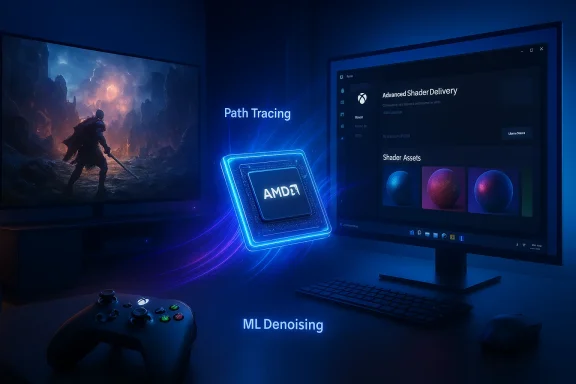
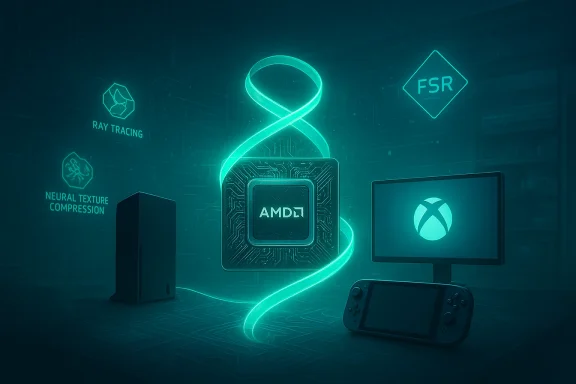
Microsoft says its next-generation console platform, codenamed Project Helix, will begin reaching developers as alpha hardware in 2027, and it will bring a new full‑screen “Xbox mode” to Windows 11 as soon as April — announcements that together mark the clearest signal yet that Microsoft is positioning its next Xbox as a hybrid console‑PC platform built around a custom AMD system‑on‑chip and a rendering stack heavy on ray/path tracing, machine learning, and tighter Windows integration.
Project Helix was the headline item in Microsoft Gaming’s developer‑facing presentations at the Xbox Developer Summit during GDC 2026. Xbox’s next‑generation lead framed Helix not as a minor incremental refresh, but as a platform intended to “play your Xbox console and PC games” and to deliver what the company describes as an order of magnitude uplift in ray tracing performance and a new era of ML‑assisted rendering and frame generation. Microsoft also confirmed Helix is being built in close partnership with AMD and that early alpha hardware will be made available to studios starting in 2027. At the same time, Microsoft is rolling the Xbox full‑screen experience out to Windows 11 — rebranded as Xbox mode — starting in April and initially targeting select markets and devices, building on the early debut of the mode on ROG Xbox Ally handhelds.
These two moves — shipping developer kits for a new console architecture, and baking a console‑style full‑screen, controller‑focused mode into Windows — are linked in Microsoft’s messaging. The company is pitching a more unified development story across Xbox console, Windows PC, and handheld devices, with a single Game Development Kit (GDK) and shared platform technologies intended to reduce friction for studios targeting both PC and Xbox ecosystems.
First, Helix signals Microsoft’s ambition to erase — or at least blur — the boundary between console and PC. By explicitly saying Helix will run both Xbox console titles and PC games, Microsoft is doubling down on a cross‑platform play that aims to make the company’s first‑party ecosystem native to both Windows and Xbox hardware.
Second, the technical road map Microsoft sketched — custom SoC, path tracing, ML upscaling/frame generation, neural compression — maps onto industry trends that AMD and other partners have been pursuing. If Microsoft can deliver meaningful hardware gains in ray/path tracing and combine those with ML upscaling and frame generation, it could raise visual fidelity and perceived performance in a way that’s attractive to developers and players alike.
Third, integrating a console‑style experience directly into Windows via Xbox mode is a platform play. It reduces friction for players who want a living‑room, controller‑first experience while preserving the openness (and revenue diversity) of PC storefronts. For developers, a more consistent runtime and tooling across Windows and Xbox could eliminate duplicate engineering work and shorten the time it takes to ship titles across both platforms.
What Microsoft made explicit:
However, the rollout strategy matters. Microsoft plans a phased rollout in April to select markets; earlier previews and leaks have shown Xbox mode running on devices with Windows 11 25H2 Release Preview builds. OEM cooperation and driver support will determine how smoothly this lands across the fragmented Windows hardware base.
But the path forward is littered with practical questions. Marketing claims — especially around “orders of magnitude” — need independent verification. The timeline implied by alpha dev kits in 2027 gives developers time to prepare, but it also implies a multi‑year rollout that will test supply chains, SDK maturity, and developer buy‑in. Xbox mode’s April rollout to Windows 11 is a more immediate step and a useful bridge to Helix’s broader vision, but its real value will depend on consistent implementation across a very fragmented Windows hardware ecosystem.
For Windows and Xbox enthusiasts, the takeaway is simple: Microsoft has set an ambitious technical agenda and a coherent strategic narrative. Now the industry — third‑party studios, OEMs, AMD, and independent reviewers — must validate whether Helix’s promise will translate into measurable, widely available gains for players. Until then, treat the GDC announcements as an exciting blueprint, and plan development and purchasing decisions around the realistic pace of hardware and software delivery rather than headline claims alone.
Conclusion
Project Helix and Xbox mode together sketch a future where Microsoft treats console and PC as two faces of the same platform. If the company and its partners deliver on the promises of custom silicon, ML‑assisted rendering, and a unified development stack, the result could be a meaningful generational shift in how games look and run. The prudent stance for developers, reviewers, and players alike is to prepare for the possibilities, demand verifiable benchmarks and technical disclosures, and watch the alpha dev kit program in 2027 for the first concrete evidence that Helix’s ambition can be realized in silicon and software.
Source: Gematsu Project Helix alpha development kits to ship in 2027; Xbox mode coming to Windows 11 in April
 Background / Overview
Project Helix was the headline item in Microsoft Gaming’s developer‑facing presentations at the Xbox Developer Summit during GDC 2026. Xbox’s next‑generation lead framed Helix not as a minor incremental refresh, but as a platform intended to “play your Xbox console and PC games” and to deliver what the company describes as an order of magnitude uplift in ray tracing performance and a new era of ML‑assisted rendering and frame generation. Microsoft also confirmed Helix is being built in close partnership with AMD and that early alpha hardware will be made available to studios starting in 2027. At the same time, Microsoft is rolling the Xbox full‑screen experience out to Windows 11 — rebranded as Xbox mode — starting in April and initially targeting select markets and devices, building on the early debut of the mode on ROG Xbox Ally handhelds.These two moves — shipping developer kits for a new console architecture, and baking a console‑style full‑screen, controller‑focused mode into Windows — are linked in Microsoft’s messaging. The company is pitching a more unified development story across Xbox console, Windows PC, and handheld devices, with a single Game Development Kit (GDK) and shared platform technologies intended to reduce friction for studios targeting both PC and Xbox ecosystems.
What Microsoft announced at GDC 2026
Project Helix: the core claims
- Helix is powered by a custom AMD system‑on‑chip (SoC) co‑designed with Microsoft for next‑generation DirectX and AMD’s FSR upscaling technology.
- The hardware will support path tracing alongside significantly improved ray tracing performance — Microsoft described this as “an order of magnitude” improvement versus current generation capabilities.
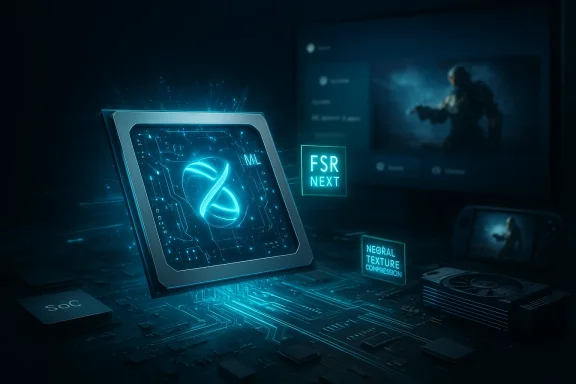
- The platform integrates machine learning directly into graphics and compute pipelines, including next‑generation FSR (branded internally as FSR Next) and ML Multi‑Frame Generation for upscaling and frame synthesis.
- Other architecture highlights called out at the summit included neural texture compression / deep texture compression, GPU directed work graph execution, next‑gen ray regeneration techniques, and DirectStorage with Zstd compression.
- Alpha versions of Project Helix hardware (developer kits) are planned to begin shipping to studios in 2027.
Xbox mode for Windows 11
- Microsoft will start rolling Xbox mode to Windows 11 in April, starting in specific markets and devices.
- Xbox mode is described as a controller‑optimized, full‑screen Xbox experience on Windows that preserves the openness of the platform while reducing background services and desktop overhead for gaming.
- The full‑screen mode first appeared on the ROG Xbox Ally handhelds; Microsoft plans a broader rollout to other Windows handhelds and PCs.
Why this matters: strategic context
Microsoft’s twin announcements are important for three interlocking reasons.First, Helix signals Microsoft’s ambition to erase — or at least blur — the boundary between console and PC. By explicitly saying Helix will run both Xbox console titles and PC games, Microsoft is doubling down on a cross‑platform play that aims to make the company’s first‑party ecosystem native to both Windows and Xbox hardware.
Second, the technical road map Microsoft sketched — custom SoC, path tracing, ML upscaling/frame generation, neural compression — maps onto industry trends that AMD and other partners have been pursuing. If Microsoft can deliver meaningful hardware gains in ray/path tracing and combine those with ML upscaling and frame generation, it could raise visual fidelity and perceived performance in a way that’s attractive to developers and players alike.
Third, integrating a console‑style experience directly into Windows via Xbox mode is a platform play. It reduces friction for players who want a living‑room, controller‑first experience while preserving the openness (and revenue diversity) of PC storefronts. For developers, a more consistent runtime and tooling across Windows and Xbox could eliminate duplicate engineering work and shorten the time it takes to ship titles across both platforms.
Technical dive: what’s new (and what’s still vague)
Custom AMD SoC and rendering pipeline
Microsoft says Helix uses a custom AMD SoC designed with a new generation of DirectX and FSR. That combination suggests Microsoft is again working closely with AMD on GPU‑level IP (compute, ray tracing engines, ML accelerators) tuned to Microsoft’s pipeline — similar in spirit to prior console partnerships but explicitly focused on ML and next‑gen ray tracing.What Microsoft made explicit:
- Support for path tracing and more capable ray tracing cores.
- A rendering stack that includes FSR Next (an evolution of AMD’s spatial/temporal upscalers) plus ML‑based multi‑frame generation for frame synthesis.
- A set of engine primitives such as ray regeneration, GPU directed work graphs, and neural/deep texture compression.
- Microsoft’s “order of magnitude” claim for ray tracing is emphatic but qualitative. Microsoft did not publish performance charts or raw specs at GDC, so the exact scaling (e.g., TFLOPs, RT‑TFLOPs, RT cores count, dedicated ML hardware specs) is not publicly verifiable yet.
- How work will be divided between dedicated ray/path tracing silicon, programmable compute, and ML accelerators is not detailed.
- The power, thermals, and die‑area tradeoffs that will determine retail performance and cost remain unknown.
Machine learning in the render loop
Microsoft is explicit about putting intelligence into the graphics and compute pipeline. The named technologies — FSR Next and ML Multi‑Frame Generation — indicate two applications of ML:- Upscaling / reconstruction: Using neural networks to upscale lower internal resolutions with fewer artifacts at higher perceived detail, a familiar approach in modern engines.
- Frame generation: Synthesizing intermediate frames using ML to multiply output frame rate without linearly increasing GPU load (similar in principle to what some PC tools and TVs do today).
Compression, streaming, and DirectStorage
Microsoft’s mention of neural texture compression and DirectStorage + Zstd aligns with the broader industry focus on reducing I/O bottlenecks and maximizing usable memory bandwidth. If Helix’s toolchain includes genuinely better texture compression schemes that are fast to decode on‑chip, developers could ship larger, higher‑quality texture sets without a linear increase in storage and memory pressure. That directly helps the move toward denser, more immersive worlds.Xbox mode on Windows 11: what to expect
Xbox mode is Microsoft’s attempt to offer a console‑like, controller‑first experience inside Windows without stripping users of openness. Practically, the mode:- Boots to a full‑screen Xbox UI that prioritizes controller navigation, library browsing, and a simplified launcher experience.
- Reduces background Windows services and shell overhead to lower memory and CPU usage when gaming.
- Preserves access to other PC storefronts and the Game Bar, according to Microsoft’s messaging.
However, the rollout strategy matters. Microsoft plans a phased rollout in April to select markets; earlier previews and leaks have shown Xbox mode running on devices with Windows 11 25H2 Release Preview builds. OEM cooperation and driver support will determine how smoothly this lands across the fragmented Windows hardware base.
Strengths and opportunities
- Unified developer platform: A single GDK and shared runtime across Xbox and Windows could reduce porting cost and help studios optimize once for multiple targets.
- Visual leap potential: If Helix delivers materially better RT/path tracing performance plus ML upscaling and framegen, developers will have new levers for visual fidelity and framerate headroom.
- Handheld and living‑room synergy: Xbox mode for Windows 11 improves the cross‑device user experience and helps Microsoft compete with console UI paradigms in the PC space.
- Game preservation and catalog leverage: Microsoft’s promise to roll out “new ways to play iconic games” during its 25th anniversary hints at renewed backwards‑compatibility or remaster efforts that leverage Helix tech for older titles.
- Partnered silicon: Co‑design with AMD can yield optimized silicon and software stacks faster than a one‑off in‑house design.
Risks, unknowns, and practical concerns
- Marketing language vs. measurable gains: Phrases like “order of magnitude» are powerful headlines, but without published specs or benchmarks they remain marketing claims. Independent testing is required to substantiate performance uplifts.
- Timeline ambiguity: Alpha dev kits in 2027 are an important milestone, but they do not equate to a retail release date. Historically, the gap between dev kits and launch can range from months to years, and a 2027 dev cycle implies the earliest reasonable retail windows are likely late 2027 or 2028.
- Supply chain and cost: Advanced SoC designs, increased silicon complexity for RT/ML accelerators, and the use of higher‑bandwidth memory or specialized encoders could push costs up. Microsoft will need to balance retail price against performance expectations.
- Developer adoption: New rendering primitives and ML workflows require time to adopt. Smaller studios may prioritize current‑gen consoles and PC markets rather than invest early in Helix‑specific features until the install base scales.
- Quality and latency of ML frame generation: While frame synthesis can improve perceived framerate, it can also introduce tearing, ghosting, or motion artifacts if not carefully tuned. VR and competitive multiplayer titles will be particularly sensitive to input‑to‑display latency and perceived smoothness.
- Windows fragmentation risks: Xbox mode must integrate with drivers, overlays, and third‑party launchers. Fragmentation in how different OEMs implement the mode or how storefront overlays interact could produce inconsistent user experiences.
- Monetization and platform openness: Microsoft’s emphasis on Windows openness is important, but any deeper integration between Xbox mode and Microsoft services could raise questions about discoverability bias or preferential treatment for Microsoft storefronts and Game Pass titles.
- Unverifiable technical claims: Several named features (neural texture compression, GPU directed work graph execution) are promising but lack published implementation details. Until Microsoft or partners publish technical papers or SDK docs, these are developer promises rather than proven capabilities.
What developers should do now: a practical checklist
- Study the unified GDK plans and pipeline changes. Start assessing how existing rendering pipelines map to the new primitives Microsoft discussed. Look for Microsoft’s follow‑up SDK documentation and early dev kit notes once available.
- Prototype ML‑assisted workflows. Invest time in experimenting with ML upscaling and frame synthesis on PC hardware to understand quality tradeoffs and artifact modes before Helix dev kits arrive.
- Optimize for streaming and compressed assets. Prepare textures and assets with a view to higher‑efficiency compression and streaming; design systems that can gracefully scale quality based on available memory and I/O.
- Plan for multiple execution targets. Maintain platform‑agnostic game logic while isolating renderer layers so you can quickly adopt Helix‑specific features without a full rewrite.
- Engage with Microsoft early. If you’re targeting Helix, plan to join preview programs and provide feedback on the dev kits once they ship.
What gamers and PC buyers should expect
- Don’t expect retail Helix consoles immediately after dev kits ship. Developer hardware in 2027 suggests consumer product timing will lag; a realistic expectation is late‑2027 or 2028 for a full retail launch, contingent on manufacturing and software readiness.
- Xbox mode arriving in April is a near‑term change that will affect handheld and living‑room PC experiences. Expect a controller‑first UI and reduced desktop overhead when enabled, but also anticipate teething issues as the feature rolls out across different OEM hardware.
- If you are shopping for a gaming handheld or Windows PC, consider how important a console‑style full‑screen experience is to you. Early adopters of devices like the ROG Xbox Ally will be first to try Xbox mode, but broader availability will depend on OEM updates and Microsoft’s staged rollout.
- Visual improvements from Helix (if delivered) are likely to be most visible in titles that invest in path tracing and heavy lighting simulation; older titles may benefit indirectly through upscaling and enhanced post‑process pipelines.
Competitive implications: Playstation, Valve, and PC GPU makers
Microsoft’s Helix ambitions reshape the competitive map. Sony, AMD, and Nvidia are simultaneously pushing their own solutions for ray tracing, ML upscalers, and hardware acceleration. A few strategic observations:- Microsoft’s tight AMD collaboration may parallel Sony’s own AMD partnership for its next console generation, creating a dynamic where AMD’s architecture underpins multiple major consoles.
- Valve and other PC‑first actors continue to push modular hardware and open PC ecosystems; Microsoft’s Helix could accelerate hybrid console‑PC convergence but will have to compete on price, software library, and compatibility.
- GPU makers will be watching whether ML‑centric rendering primitives and compression techniques become mainstream — a shift like that favors those who offer both the hardware primitives and the ML toolchain integration.
Hold the headlines: what to verify when technical details are released
When Microsoft and AMD publish deeper technical documents, press kits, or when independent testing by hardware reviewers becomes available, look for verification of these concrete items:- Measured ray tracing and path tracing performance (benchmarks vs. current consoles and high‑end PC GPUs).
- Details of the SoC: GPU compute units, RT core counts, dedicated ML accelerators (or inference units), memory bandwidth, and memory type.
- Power draw and thermal envelope in retail hardware versus dev kits.
- Quality and latency metrics for ML Multi‑Frame Generation — particularly how it handles fast motion, complex particle effects, and multiplayer input latency.
- The practical impact of neural texture compression on memory footprint and streaming performance.
- Developer feedback from studios that receive alpha dev kits in 2027, including how easy it is to adopt the new primitives and how much engineering effort is required.
Final analysis: ambition matched to caution
Project Helix is the clearest statement yet that Microsoft intends to blur console and PC boundaries and to center future visual advancements on a combination of ray/path tracing plus machine learning. The potential upside is compelling: more realistic lighting, more immersive worlds, and higher perceived frame rates without pushing power budgets impossibly high.But the path forward is littered with practical questions. Marketing claims — especially around “orders of magnitude” — need independent verification. The timeline implied by alpha dev kits in 2027 gives developers time to prepare, but it also implies a multi‑year rollout that will test supply chains, SDK maturity, and developer buy‑in. Xbox mode’s April rollout to Windows 11 is a more immediate step and a useful bridge to Helix’s broader vision, but its real value will depend on consistent implementation across a very fragmented Windows hardware ecosystem.
For Windows and Xbox enthusiasts, the takeaway is simple: Microsoft has set an ambitious technical agenda and a coherent strategic narrative. Now the industry — third‑party studios, OEMs, AMD, and independent reviewers — must validate whether Helix’s promise will translate into measurable, widely available gains for players. Until then, treat the GDC announcements as an exciting blueprint, and plan development and purchasing decisions around the realistic pace of hardware and software delivery rather than headline claims alone.
Conclusion
Project Helix and Xbox mode together sketch a future where Microsoft treats console and PC as two faces of the same platform. If the company and its partners deliver on the promises of custom silicon, ML‑assisted rendering, and a unified development stack, the result could be a meaningful generational shift in how games look and run. The prudent stance for developers, reviewers, and players alike is to prepare for the possibilities, demand verifiable benchmarks and technical disclosures, and watch the alpha dev kit program in 2027 for the first concrete evidence that Helix’s ambition can be realized in silicon and software.
Source: Gematsu Project Helix alpha development kits to ship in 2027; Xbox mode coming to Windows 11 in April