Project Helix is not a reason to stop buying an Xbox Series X|S or a gaming PC today. It is a reason to avoid treating the next Xbox as a routine console refresh: Microsoft has confirmed a custom-AMD, Windows-adjacent direction that promises console and PC game playability, but it has only committed to developer alpha hardware beginning in 2027—not a retail launch date.
For Series X|S owners, the practical answer is to keep the hardware if it still serves the TV, library, and Game Pass setup you already have. For PC gamers, buy or upgrade on the merits of the games and performance you need now. For anyone considering a future Project Helix purchase, wait for the details Microsoft has not yet supplied: price, Windows interface design, performance targets, storage, accessories, and the exact rules around console and PC software compatibility.
Microsoft laid out the broad direction on March 11, 2026, describing Project Helix as its next-generation first-party console with a custom AMD system-on-chip designed to play Xbox console and PC games. That is a consequential promise, but it leaves a long gap between strategy and a product someone can put beneath a television.
Laura Fryer’s June warning about Xbox hardware economics matters in that gap. As discussed in WindowsForum’s earlier coverage of Fryer’s comments, the original Xbox team member argued that the cost and risk of hardware—concerns she had when Xbox began in 2001—look even sharper amid AI-driven pressure on components. That is not proof that Xbox consoles are ending. It is a warning that bespoke, subsidized hardware and an increasingly open Windows gaming platform may pull Microsoft toward difficult compromises.
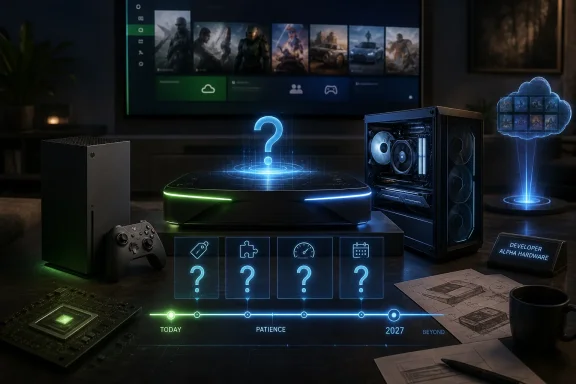
The most important fact is also the easiest to overlook: Xbox has not announced a consumer release date for Project Helix. Its March update said hardware alpha units are planned for developers beginning in 2027. Alpha hardware is an early development milestone, not a store shelf commitment, and buyers should resist turning it into a countdown clock for a launch purchase.
Microsoft’s stated design goal is unusually broad. Project Helix is supposed to play Xbox console and PC games, while retaining playability for games across four Xbox generations. Xbox also says Xbox Play Anywhere now covers more than 1,500 titles, giving players a meaningful existing bridge between its console and PC ecosystems.
That bridge is the central opportunity—and the central source of uncertainty. A conventional console purchase is usually simple: buy the box, buy the games made for it, and expect a tightly controlled experience. A Windows-based or Windows-connected Xbox could offer a wider catalog and more flexible software model, but it also raises unanswered questions about setup complexity, storefront boundaries, driver support, updates, input behavior, and how much of the familiar console experience remains deliberately closed.
Microsoft is trying to be both console-first for its core audience and cross-device across PC, mobile, and cloud. Those aims can coexist, but they create a real trade-off for buyers. The more Helix behaves like a PC, the more capability it may offer; the more it behaves like a classic Xbox, the more predictable it should be.
The immediate decision should come down to the system you own, not a future machine with no published retail specification. Keep a Series X|S if it remains the simplest way to play the games you want on the display you own, especially if your library, controllers, storage, and household habits are already organized around Xbox.
There are only a few reasons to make a different move now:
That does not make one model inherently better. It means the choice is likely to become more personal: convenience and consistency versus openness and control.
Helix could eventually become a compelling living-room alternative for players who want PC and Xbox libraries in one device. But Microsoft has not disclosed the hardware performance level, operating environment, price, upgradeability, or whether PC games will be delivered through an interface that resembles a console dashboard, a conventional Windows desktop, or something new.
That absence of detail matters more than the phrase “plays PC games.” PC gaming is not a single standardized experience. It includes different launchers, account systems, graphics settings, anti-cheat requirements, controller behavior, display configurations, mods, and peripherals. Microsoft’s ambition may reduce that friction, but buyers should not assume the hard edges disappear merely because the next Xbox uses Windows technology or shares a broader PC strategy.
The better PC rule is straightforward: upgrade when the machine in front of you is the bottleneck. Do not defer a needed GPU, CPU, storage, or display decision for a future device whose retail specification has not been revealed.
Related WindowsForum analysis of Microsoft’s Windows-powered Xbox vision is useful here because the living-room PC concept has appeal precisely where traditional PC gaming can feel least polished. The missing information is whether Microsoft can preserve that polish without restricting the openness that makes a PC attractive.
AI-driven demand could make hardware planning less forgiving, according to Fryer’s June comments. If component costs rise or availability tightens, Microsoft may face familiar choices: absorb more cost, charge more for hardware, reduce ambition, or lean harder on software and services to make the economics work.
Those pressures could explain why Microsoft is presenting Helix as a broader Xbox-and-PC proposition instead of simply promising a faster console. A system that reaches console customers while participating in Windows gaming gives Microsoft more possible ways to sell games and services. It also risks making the value proposition harder to explain if the device lands too close to a gaming PC in price or complexity.
WindowsForum readers should watch for the details that reveal which compromise Microsoft has chosen. Price is obvious, but it is not enough. The practical signals will be how accounts work, whether existing controllers and accessories carry forward, how Play Anywhere ownership is presented, how PC game compatibility is defined, and whether Microsoft can keep a console-like update and recovery experience.
The broader Xbox strategy may also keep changing before Helix arrives. Reporting around possible shifts in exclusivity has already fueled debate, including in WindowsForum’s coverage of Xbox’s reported strategic reset. That uncertainty is another reason not to buy hardware based on assumptions about future game availability.
A prospective Helix buyer should wait for Microsoft to answer five concrete questions:
No. Microsoft has not announced a consumer launch date for Helix, and it says the new platform will preserve playability across four Xbox generations. Selling a working console now creates a long, unnecessary gap unless you already prefer another platform.
Is Project Helix confirmed to run all Windows PC games?
No. Xbox said it is designed to play Xbox console and PC games, but it has not published the compatibility rules, storefront support, interface details, or software limitations needed to make an “all PC games” claim.
Does Xbox Play Anywhere guarantee that my games will work on Helix?
Not from the information currently available. Xbox says Play Anywhere has more than 1,500 titles, which is an important foundation, but Microsoft has not yet detailed how every entitlement and title category will appear on Project Helix.
When should prospective buyers start paying close attention?
The next meaningful milestone is the planned shipment of Project Helix alpha hardware to developers beginning in 2027. Consumer pricing, specifications, and a release date—not developer hardware alone—are the signals that should drive a purchase decision.
Project Helix may ultimately be Microsoft’s most ambitious attempt to combine the reach of Windows gaming with the reliability expected from an Xbox console. But until the company turns that ambition into retail hardware with clear prices and compatibility rules, the sensible move is to buy for today’s games and treat Helix as a product to evaluate later, not a promise to purchase now.
For Series X|S owners, the practical answer is to keep the hardware if it still serves the TV, library, and Game Pass setup you already have. For PC gamers, buy or upgrade on the merits of the games and performance you need now. For anyone considering a future Project Helix purchase, wait for the details Microsoft has not yet supplied: price, Windows interface design, performance targets, storage, accessories, and the exact rules around console and PC software compatibility.
Microsoft laid out the broad direction on March 11, 2026, describing Project Helix as its next-generation first-party console with a custom AMD system-on-chip designed to play Xbox console and PC games. That is a consequential promise, but it leaves a long gap between strategy and a product someone can put beneath a television.
Laura Fryer’s June warning about Xbox hardware economics matters in that gap. As discussed in WindowsForum’s earlier coverage of Fryer’s comments, the original Xbox team member argued that the cost and risk of hardware—concerns she had when Xbox began in 2001—look even sharper amid AI-driven pressure on components. That is not proof that Xbox consoles are ending. It is a warning that bespoke, subsidized hardware and an increasingly open Windows gaming platform may pull Microsoft toward difficult compromises.
 Project Helix Is a Platform Direction, Not Yet a Buying Product
The most important fact is also the easiest to overlook: Xbox has not announced a consumer release date for Project Helix. Its March update said hardware alpha units are planned for developers beginning in 2027. Alpha hardware is an early development milestone, not a store shelf commitment, and buyers should resist turning it into a countdown clock for a launch purchase.Microsoft’s stated design goal is unusually broad. Project Helix is supposed to play Xbox console and PC games, while retaining playability for games across four Xbox generations. Xbox also says Xbox Play Anywhere now covers more than 1,500 titles, giving players a meaningful existing bridge between its console and PC ecosystems.
That bridge is the central opportunity—and the central source of uncertainty. A conventional console purchase is usually simple: buy the box, buy the games made for it, and expect a tightly controlled experience. A Windows-based or Windows-connected Xbox could offer a wider catalog and more flexible software model, but it also raises unanswered questions about setup complexity, storefront boundaries, driver support, updates, input behavior, and how much of the familiar console experience remains deliberately closed.
Microsoft is trying to be both console-first for its core audience and cross-device across PC, mobile, and cloud. Those aims can coexist, but they create a real trade-off for buyers. The more Helix behaves like a PC, the more capability it may offer; the more it behaves like a classic Xbox, the more predictable it should be.
Series X|S Owners Should Buy Time, Not Speculation
A current Xbox Series X or Series S owner does not need to upgrade in anticipation of Helix. Microsoft’s four-generation playability promise is aimed at continuity, and the company’s investment in Play Anywhere suggests it wants game libraries to travel rather than reset at the next hardware boundary.The immediate decision should come down to the system you own, not a future machine with no published retail specification. Keep a Series X|S if it remains the simplest way to play the games you want on the display you own, especially if your library, controllers, storage, and household habits are already organized around Xbox.
There are only a few reasons to make a different move now:
- Buy a Series X|S now if you specifically want a low-friction living-room console and can purchase it at a price you consider worthwhile for the games available today.
- Wait if your main motivation is access to the next Xbox generation, because Project Helix has no announced consumer date or price.
- Move toward a PC now only if you value PC-native flexibility today, rather than assuming Helix will deliver the same experience at a future unknown cost.
- Avoid replacing a working Series X|S solely for future-proofing, because Microsoft has announced direction and developer timing, not the consumer product details needed to compare value.
That does not make one model inherently better. It means the choice is likely to become more personal: convenience and consistency versus openness and control.
PC Gamers Should Upgrade for Present Workloads
PC gamers have the least reason to pause a necessary upgrade for Project Helix. If a current system cannot run the games, display resolution, frame-rate target, or creative workloads you care about, a PC purchase remains defensible because it solves an immediate need independent of Microsoft’s next-console schedule.Helix could eventually become a compelling living-room alternative for players who want PC and Xbox libraries in one device. But Microsoft has not disclosed the hardware performance level, operating environment, price, upgradeability, or whether PC games will be delivered through an interface that resembles a console dashboard, a conventional Windows desktop, or something new.
That absence of detail matters more than the phrase “plays PC games.” PC gaming is not a single standardized experience. It includes different launchers, account systems, graphics settings, anti-cheat requirements, controller behavior, display configurations, mods, and peripherals. Microsoft’s ambition may reduce that friction, but buyers should not assume the hard edges disappear merely because the next Xbox uses Windows technology or shares a broader PC strategy.
The better PC rule is straightforward: upgrade when the machine in front of you is the bottleneck. Do not defer a needed GPU, CPU, storage, or display decision for a future device whose retail specification has not been revealed.
Related WindowsForum analysis of Microsoft’s Windows-powered Xbox vision is useful here because the living-room PC concept has appeal precisely where traditional PC gaming can feel least polished. The missing information is whether Microsoft can preserve that polish without restricting the openness that makes a PC attractive.
The Economics Could Shape the Product More Than the Marketing
Fryer’s point is not that a custom console chip is impossible. Microsoft has explicitly said Project Helix uses a custom AMD SoC. The issue is whether the old console model—large up-front hardware investment, long design cycles, supply commitments, and pressure to hit a consumer-friendly price—fits a market where component demand is under greater pressure.AI-driven demand could make hardware planning less forgiving, according to Fryer’s June comments. If component costs rise or availability tightens, Microsoft may face familiar choices: absorb more cost, charge more for hardware, reduce ambition, or lean harder on software and services to make the economics work.
Those pressures could explain why Microsoft is presenting Helix as a broader Xbox-and-PC proposition instead of simply promising a faster console. A system that reaches console customers while participating in Windows gaming gives Microsoft more possible ways to sell games and services. It also risks making the value proposition harder to explain if the device lands too close to a gaming PC in price or complexity.
WindowsForum readers should watch for the details that reveal which compromise Microsoft has chosen. Price is obvious, but it is not enough. The practical signals will be how accounts work, whether existing controllers and accessories carry forward, how Play Anywhere ownership is presented, how PC game compatibility is defined, and whether Microsoft can keep a console-like update and recovery experience.
The broader Xbox strategy may also keep changing before Helix arrives. Reporting around possible shifts in exclusivity has already fueled debate, including in WindowsForum’s coverage of Xbox’s reported strategic reset. That uncertainty is another reason not to buy hardware based on assumptions about future game availability.
The Best Purchase Framework Is Deliberately Unexciting
The right decision is less about predicting whether Xbox “becomes Windows” and more about separating announced capabilities from desired capabilities. Project Helix has credible strategic signals: custom AMD silicon, Xbox and PC game ambitions, four-generation playability, and a sizable Play Anywhere catalog. It does not yet have the retail facts needed for a rational pre-purchase decision.A prospective Helix buyer should wait for Microsoft to answer five concrete questions:
- What will the retail hardware cost, and what performance class will it target?
- Which PC game stores, launchers, and ownership models will work directly on the device?
- How will four-generation Xbox compatibility function in practice, including digital licenses and accessories?
- Will the interface retain console simplicity, or will users need to manage PC-like settings and troubleshooting?
- What consumer launch date follows the developer alpha hardware planned for 2027?
Frequently Asked Questions
Should I sell my Xbox Series X or Series S before Project Helix arrives?No. Microsoft has not announced a consumer launch date for Helix, and it says the new platform will preserve playability across four Xbox generations. Selling a working console now creates a long, unnecessary gap unless you already prefer another platform.
Is Project Helix confirmed to run all Windows PC games?
No. Xbox said it is designed to play Xbox console and PC games, but it has not published the compatibility rules, storefront support, interface details, or software limitations needed to make an “all PC games” claim.
Does Xbox Play Anywhere guarantee that my games will work on Helix?
Not from the information currently available. Xbox says Play Anywhere has more than 1,500 titles, which is an important foundation, but Microsoft has not yet detailed how every entitlement and title category will appear on Project Helix.
When should prospective buyers start paying close attention?
The next meaningful milestone is the planned shipment of Project Helix alpha hardware to developers beginning in 2027. Consumer pricing, specifications, and a release date—not developer hardware alone—are the signals that should drive a purchase decision.
Project Helix may ultimately be Microsoft’s most ambitious attempt to combine the reach of Windows gaming with the reliability expected from an Xbox console. But until the company turns that ambition into retail hardware with clear prices and compatibility rules, the sensible move is to buy for today’s games and treat Helix as a product to evaluate later, not a promise to purchase now.
References
- Primary source: blogs.windows.com
Windows PC gaming in 2025: Handheld innovation, Arm progress and DirectX advances
For decades, Windows has been the platform for PC gaming: open, flexible and built with players in mind. From the days of classics like Diablo to today’s cutting-edge experiences powered by DirectX and AI-driven graphics, Windows has partblogs.windows.com - Independent coverage: windowscentral.com
Xbox Price Tracker: Here are the best places to find in-stock Xbox consoles before prices go up in 13 days | Windows Central
A live tracker for every Xbox Series X|S deal before prices rise sharply on August 1 — and potentially again in 2027 as hardware costs continue climbing.www.windowscentral.com - Independent coverage: gamesradar.com
Making sense of Xbox's messy return to console exclusivity | GamesRadar+
Matt Booty, Matthew Ball, and the devs behind Halo, Fable, and Gears help us understand what Xbox is doing – "There has to be a reason for people to buy an Xbox"www.gamesradar.com - Independent coverage: ebs.publicnow.com
- Independent coverage: digitalcitizen.life
Original Xbox Founder Says Microsoft’s Old Hardware Fears Are Returning As AI Costs Rise
Laura Fryer, one of the original Xbox founders, believes Microsoft is facing many of the same hardware concerns that existed when the company first entered the console market more than 25 years ago. In a new discussion about Xbox’s future, Fryer said rising component costs and AI related supply...www.digitalcitizen.life
- Independent coverage: news.xbox.com