

DataBank has filed plans for Project Indo, a proposed 200-megawatt data center campus on 69 acres at 218 Industrial Park Road in Cartersville, Georgia, near U.S. 411, with the first phase potentially opening in 2032. The filing, reported by Data Center Dynamics and followed locally by Northwest Georgia outlets, puts Bartow County deeper into the national argument over where AI-era infrastructure should live. This is not just another industrial project with a code name and a site plan. It is a test of whether small and mid-sized communities can extract durable public value from hyperscale computing without surrendering control over land, power, water, and growth.
For years, data centers were easy to miss because the internet liked to pretend it lived nowhere. The cloud had regions and availability zones, not neighbors, school districts, substations, and road frontage. Project Indo is another reminder that the physical internet is now arriving in county commission chambers, planning packets, and local zoning text.
According to Data Center Dynamics, DataBank’s proposed Cartersville campus would total about 1.1 million square feet and carry an estimated full-build value of $2.4 billion. The company has reportedly filed for a 288-megawatt utility grid connection, a figure that matters as much as the square footage because electricity is now the defining constraint in data center development.
The location is not incidental. Cartersville sits northwest of Atlanta, close enough to the metro region’s fiber, logistics, and business ecosystem, but far enough from the urban core to offer large tracts, industrial land, and access to transmission infrastructure. The site at 218 Industrial Park Road is already industrial, currently associated with Colloid Environmental Technologies Company, according to reporting on the filing.
That makes Project Indo easier to defend than proposals that push directly into agricultural or residential land. But it does not make the politics simple. In Northwest Georgia, “data center” has become a phrase that carries promise, suspicion, and exhaustion in nearly equal measure.
That context can make a 200-megawatt campus sound moderate. It is not. A 200-megawatt data center is a major industrial electricity customer, and a 288-megawatt grid-connection request is the sort of number that forces utilities, regulators, and local governments to think in decades rather than permitting cycles.
The tension is that data center scale is now relative. Compared with an 1,800-megawatt mega-campus, Project Indo looks contained. Compared with the ordinary commercial development most residents imagine when they hear “industrial park,” it is enormous.
That gap between insider scale and public intuition is where much of the conflict begins. Developers talk about campuses, phased delivery, closed-loop cooling, tax base, and power procurement. Residents hear that an industrial building larger than many shopping malls may be coming to town, tied to a power load that sounds like a city.
It is not, however, a state veto. The host local government retains the authority to decide whether a project goes forward. That distinction matters in Bartow because a DRI filing can feel to residents like the decisive moment, when in reality it is often the beginning of a more granular local fight over zoning, utilities, development conditions, and public commitments.
For Project Indo, the DRI process gives the region a formal notice that another large electricity-intensive campus is in the pipeline. It does not answer the hardest questions. Who pays for upstream grid upgrades? How much revenue flows to the county versus the city or state? How enforceable are local conditions on noise, lighting, water, landscaping, and backup generation?
Those questions are not anti-technology questions. They are governance questions. If data centers are now essential infrastructure, then the public conversation around them has to become more sophisticated than either boosterism or blanket opposition.
That should shape how Bartow reads the filing. This is not simply a local real estate deal; it is part of a regional capacity strategy. Atlanta has moved from a secondary data center market into one of the country’s most active targets for cloud, colocation, and AI infrastructure.
The reasons are not mysterious. The Southeast offers population growth, business migration, comparatively available land, important fiber routes, and a political climate that has generally welcomed large industrial investment. Georgia also has a growing track record of data center recruitment, though that record is now colliding with public concern over tax incentives, grid costs, and land use.
For DataBank, Cartersville may be the next logical edge of the Atlanta market. For Bartow County, that same logic can feel like a wave: once the first few projects establish the county as viable, more developers follow the map.
Bartow County Commissioner Steve Taylor made a version of that argument in comments reported by WRGA, saying data centers can provide high-paying jobs and substantial revenue, even if they do not produce vast employment numbers. He also suggested the county has an appetite limit, not a desire to blanket agricultural land with server farms.
That is a more honest pitch than pretending data centers are jobs engines on the scale of automobile plants or logistics hubs. They are not. Their construction phases can be labor-intensive, and their permanent technical roles can be well-paid, but the long-term staffing footprint is relatively modest for the amount of land, capital, and power involved.
The better case for data centers is fiscal and strategic, not employment-heavy. The harder question is whether local governments negotiate that fiscal upside aggressively enough before approval, or whether communities are asked to accept vague promises while developers secure the concrete entitlements.
Georgia has already become a major front in the national struggle over data center load growth. Utilities must plan for large customers years before those customers draw power, and the wrong forecast can impose costs on everyone. The right forecast can still require expensive generation, transmission, substations, and land.
Developers often argue that large-load customers can pay their way through special contracts, dedicated infrastructure, or direct utility arrangements. Residents worry that the broader grid is not so neatly segmented and that ordinary ratepayers will eventually absorb part of the cost of serving enormous new demand. Both claims can be true depending on tariff design, regulatory oversight, and the details of each interconnection.
This is why “the site is near a substation” is useful information but not a complete answer. Proximity can reduce some infrastructure friction, but a data center campus of this size is not powered by convenience alone. It requires planning across transmission, generation, backup systems, and operating agreements that most zoning hearings are not built to examine.
That is an important shift. The data center industry knows that water-intensive cooling is politically vulnerable, particularly in fast-growing regions where drought, reservoirs, and household demand are already sensitive topics. A developer that cannot explain its water profile clearly should expect skepticism.
Still, “closed loop” should not become a magic phrase that ends scrutiny. Cooling design, backup systems, humidification, fire suppression, wastewater, construction impacts, and emergency operations all deserve plain-English disclosure. Communities do not need marketing assurances; they need operating conditions that can be measured and enforced.
The larger lesson is that data centers are no longer judged only by what happens inside the building. Their public legitimacy depends on the systems around them: power, water, roads, light, noise, stormwater, tax structure, and land-use compatibility.
That is the story across much of the country. Data centers are often treated as industrial or commercial uses, but they behave differently from warehouses, factories, office parks, and distribution centers. They may generate less truck traffic than logistics facilities, but they can demand far more power. They may employ fewer people, but they can produce far greater taxable equipment value. They may have low water use in some designs, but the public needs proof.
Local rules are trying to catch up to a sector that has moved faster than municipal vocabulary. Downlighting requirements, buffering, noise limits, self-supplied or dedicated power expectations, and cooling restrictions are not anti-growth measures. They are an attempt to make the invisible infrastructure of the internet visible enough to govern.
The risk is that rules written in the middle of a development boom become either too weak to matter or too reactive to be durable. Bartow’s challenge is to write standards that survive the next proposal, not just the one currently on the agenda.
Georgia is not Northern Virginia, but it is now facing an accelerated version of the same bargain. Atlanta’s growth as a data center market means surrounding counties will see more proposals, not fewer. Bartow, Floyd, Coweta, Douglas, and other communities are not just competing for projects; they are collectively defining the shape of Georgia’s digital infrastructure map.
The AI boom has intensified this pressure. Traditional cloud growth was already enough to drive new capacity, but AI training and inference have changed the power conversation. The industry’s appetite for megawatts has become so large that data center announcements increasingly read like energy announcements with buildings attached.
That does not mean every project is reckless. It means every project deserves scrutiny proportional to its load, not just its footprint. The era when a data center could be waved through as a quiet warehouse for computers is over.
For Project Indo, the public should want specifics early. Not slogans about innovation. Not generic assurances about sustainability. Specific commitments on energy procurement, ratepayer protection, water use, noise performance, emergency generators, construction traffic, public reporting, tax treatment, and what happens if the project changes hands.
This is especially important because data center projects often use code names, special-purpose entities, and phased schedules. Those tools are common in economic development, but they can leave residents feeling that the real deal is happening somewhere out of view. Transparency is not a luxury in this context; it is the price of public trust.
A community can support a data center and still demand hard terms. In fact, support without hard terms is not growth policy. It is optimism with a site plan.
Microsoft, Amazon, Google, Meta, Apple, Oracle, DataBank, Switch, Equinix, and others are building or leasing the infrastructure that makes modern computing feel instant. Windows itself has become more cloud-dependent, from Microsoft 365 and OneDrive to Copilot-era AI features and enterprise management through Intune, Entra ID, Defender, and Azure services.
That dependence has consequences. The cloud is not an abstraction floating above the politics of electricity and land. It is a network of buildings that require permits, substations, water systems, fiber routes, tax deals, and public tolerance.
The next time a user complains that AI features are being pushed into every app, or an admin budgets for cloud backup and endpoint management, there is a local infrastructure story underneath. Project Indo is one of the places where that story may become concrete.
A fair bargain would recognize both sides of the ledger. Data centers can strengthen the tax base, modernize local industry, and place Georgia in the path of a major economic transformation. They can also concentrate energy demand, alter land-use patterns, and create public costs that are easy to underestimate before construction begins.
The public argument should move past caricature. Residents are not Luddites for asking who pays for power upgrades. Developers are not villains for building facilities that modern computing plainly requires. Local officials are not automatically captured because they see revenue upside, but they are accountable for proving that the upside is real and durable.
Project Indo’s long timeline gives Bartow an advantage. If the first phase is not expected until 2032, there is time to get the rules right. The county should use that time as leverage, not as an excuse to defer the hard questions.
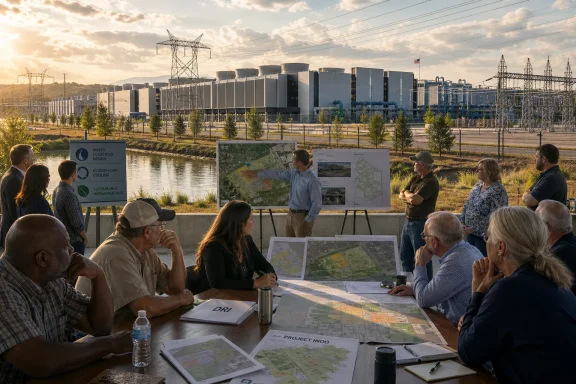 Bartow County Is Becoming a Front Door for the AI Buildout
For years, data centers were easy to miss because the internet liked to pretend it lived nowhere. The cloud had regions and availability zones, not neighbors, school districts, substations, and road frontage. Project Indo is another reminder that the physical internet is now arriving in county commission chambers, planning packets, and local zoning text.According to Data Center Dynamics, DataBank’s proposed Cartersville campus would total about 1.1 million square feet and carry an estimated full-build value of $2.4 billion. The company has reportedly filed for a 288-megawatt utility grid connection, a figure that matters as much as the square footage because electricity is now the defining constraint in data center development.
The location is not incidental. Cartersville sits northwest of Atlanta, close enough to the metro region’s fiber, logistics, and business ecosystem, but far enough from the urban core to offer large tracts, industrial land, and access to transmission infrastructure. The site at 218 Industrial Park Road is already industrial, currently associated with Colloid Environmental Technologies Company, according to reporting on the filing.
That makes Project Indo easier to defend than proposals that push directly into agricultural or residential land. But it does not make the politics simple. In Northwest Georgia, “data center” has become a phrase that carries promise, suspicion, and exhaustion in nearly equal measure.
The Project Is Smaller Than Bartow’s Mega-Campus Proposals, But It Is Not Small
Project Indo is not the biggest data center proposal Bartow County has seen. The Atlanta Journal-Constitution previously reported on Project Bunkhouse, a proposed $19 billion campus in Bartow County that would dwarf conventional industrial development and reshape any local conversation around power demand. Georgia Media Group has also reported on Project Springbank, another multibillion-dollar Bartow proposal.That context can make a 200-megawatt campus sound moderate. It is not. A 200-megawatt data center is a major industrial electricity customer, and a 288-megawatt grid-connection request is the sort of number that forces utilities, regulators, and local governments to think in decades rather than permitting cycles.
The tension is that data center scale is now relative. Compared with an 1,800-megawatt mega-campus, Project Indo looks contained. Compared with the ordinary commercial development most residents imagine when they hear “industrial park,” it is enormous.
That gap between insider scale and public intuition is where much of the conflict begins. Developers talk about campuses, phased delivery, closed-loop cooling, tax base, and power procurement. Residents hear that an industrial building larger than many shopping malls may be coming to town, tied to a power load that sounds like a city.
The DRI Process Warns the Region, But It Does Not Decide the Future
The Development of Regional Impact process is often misunderstood because its name sounds more muscular than it is. Georgia’s Department of Community Affairs describes DRIs as a way to flag large projects whose effects may extend beyond one local jurisdiction. It is meant to improve communication, surface impacts, and give neighboring governments a chance to see what is coming.It is not, however, a state veto. The host local government retains the authority to decide whether a project goes forward. That distinction matters in Bartow because a DRI filing can feel to residents like the decisive moment, when in reality it is often the beginning of a more granular local fight over zoning, utilities, development conditions, and public commitments.
For Project Indo, the DRI process gives the region a formal notice that another large electricity-intensive campus is in the pipeline. It does not answer the hardest questions. Who pays for upstream grid upgrades? How much revenue flows to the county versus the city or state? How enforceable are local conditions on noise, lighting, water, landscaping, and backup generation?
Those questions are not anti-technology questions. They are governance questions. If data centers are now essential infrastructure, then the public conversation around them has to become more sophisticated than either boosterism or blanket opposition.
DataBank’s Atlanta Footprint Makes This a Strategy, Not a One-Off
DataBank is not a speculative newcomer with a render and a dream. The company operates dozens of data centers across the United States, and Data Center Dynamics reported that it already has six facilities in the Atlanta area totaling 177 megawatts and more than 750,000 square feet. Project Indo would be its largest site in the Atlanta market and its farthest from downtown.That should shape how Bartow reads the filing. This is not simply a local real estate deal; it is part of a regional capacity strategy. Atlanta has moved from a secondary data center market into one of the country’s most active targets for cloud, colocation, and AI infrastructure.
The reasons are not mysterious. The Southeast offers population growth, business migration, comparatively available land, important fiber routes, and a political climate that has generally welcomed large industrial investment. Georgia also has a growing track record of data center recruitment, though that record is now colliding with public concern over tax incentives, grid costs, and land use.
For DataBank, Cartersville may be the next logical edge of the Atlanta market. For Bartow County, that same logic can feel like a wave: once the first few projects establish the county as viable, more developers follow the map.
The Jobs Argument Is Real, But It Is Not the Whole Argument
Local governments like data centers for a reason. They can bring large capital investment, high taxable value, and relatively limited demands on schools and public services compared with residential growth. In a county trying to fund services or reduce property-tax pressure, a large data center can look like a machine that converts land into public revenue.Bartow County Commissioner Steve Taylor made a version of that argument in comments reported by WRGA, saying data centers can provide high-paying jobs and substantial revenue, even if they do not produce vast employment numbers. He also suggested the county has an appetite limit, not a desire to blanket agricultural land with server farms.
That is a more honest pitch than pretending data centers are jobs engines on the scale of automobile plants or logistics hubs. They are not. Their construction phases can be labor-intensive, and their permanent technical roles can be well-paid, but the long-term staffing footprint is relatively modest for the amount of land, capital, and power involved.
The better case for data centers is fiscal and strategic, not employment-heavy. The harder question is whether local governments negotiate that fiscal upside aggressively enough before approval, or whether communities are asked to accept vague promises while developers secure the concrete entitlements.
Power Is the Argument That Refuses to Stay Local
If Project Indo becomes controversial, the center of gravity will likely be electricity. Water, noise, and aesthetics matter, but power demand is the issue that connects a Bartow County site plan to statewide utility planning and household bills.Georgia has already become a major front in the national struggle over data center load growth. Utilities must plan for large customers years before those customers draw power, and the wrong forecast can impose costs on everyone. The right forecast can still require expensive generation, transmission, substations, and land.
Developers often argue that large-load customers can pay their way through special contracts, dedicated infrastructure, or direct utility arrangements. Residents worry that the broader grid is not so neatly segmented and that ordinary ratepayers will eventually absorb part of the cost of serving enormous new demand. Both claims can be true depending on tariff design, regulatory oversight, and the details of each interconnection.
This is why “the site is near a substation” is useful information but not a complete answer. Proximity can reduce some infrastructure friction, but a data center campus of this size is not powered by convenience alone. It requires planning across transmission, generation, backup systems, and operating agreements that most zoning hearings are not built to examine.
Water Fears Have Changed, But They Have Not Disappeared
Many modern data center developers emphasize closed-loop cooling or lower-water designs, especially in communities where water anxiety can stop a project before it gets to the technical details. Bartow officials have reportedly said they do not want data centers that are major water users, and local discussions have focused on closed-loop systems that recirculate water rather than continuously consuming huge volumes.That is an important shift. The data center industry knows that water-intensive cooling is politically vulnerable, particularly in fast-growing regions where drought, reservoirs, and household demand are already sensitive topics. A developer that cannot explain its water profile clearly should expect skepticism.
Still, “closed loop” should not become a magic phrase that ends scrutiny. Cooling design, backup systems, humidification, fire suppression, wastewater, construction impacts, and emergency operations all deserve plain-English disclosure. Communities do not need marketing assurances; they need operating conditions that can be measured and enforced.
The larger lesson is that data centers are no longer judged only by what happens inside the building. Their public legitimacy depends on the systems around them: power, water, roads, light, noise, stormwater, tax structure, and land-use compatibility.
Bartow’s New Rules Show the County Knows the Old Playbook Is Not Enough
Georgia Media Group reported that Bartow County’s Planning Commission backed a text amendment to create more explicit rules for data centers, including conditions that had previously appeared in individual zoning cases. The timing is telling. Project Indo arrived as local government was already trying to retrofit its ordinance book for an industry that did not fit neatly into older categories.That is the story across much of the country. Data centers are often treated as industrial or commercial uses, but they behave differently from warehouses, factories, office parks, and distribution centers. They may generate less truck traffic than logistics facilities, but they can demand far more power. They may employ fewer people, but they can produce far greater taxable equipment value. They may have low water use in some designs, but the public needs proof.
Local rules are trying to catch up to a sector that has moved faster than municipal vocabulary. Downlighting requirements, buffering, noise limits, self-supplied or dedicated power expectations, and cooling restrictions are not anti-growth measures. They are an attempt to make the invisible infrastructure of the internet visible enough to govern.
The risk is that rules written in the middle of a development boom become either too weak to matter or too reactive to be durable. Bartow’s challenge is to write standards that survive the next proposal, not just the one currently on the agenda.
The Southeast Is Learning Northern Virginia’s Lesson Late
Northern Virginia became “Data Center Alley” because the economics were too compelling and the infrastructure advantages were too real to ignore. Only later did many communities fully internalize the trade-offs: transmission corridors, land scarcity, noise complaints, diesel backup concerns, and a regional identity tied to an industry that hides in windowless buildings.Georgia is not Northern Virginia, but it is now facing an accelerated version of the same bargain. Atlanta’s growth as a data center market means surrounding counties will see more proposals, not fewer. Bartow, Floyd, Coweta, Douglas, and other communities are not just competing for projects; they are collectively defining the shape of Georgia’s digital infrastructure map.
The AI boom has intensified this pressure. Traditional cloud growth was already enough to drive new capacity, but AI training and inference have changed the power conversation. The industry’s appetite for megawatts has become so large that data center announcements increasingly read like energy announcements with buildings attached.
That does not mean every project is reckless. It means every project deserves scrutiny proportional to its load, not just its footprint. The era when a data center could be waved through as a quiet warehouse for computers is over.
Local Control Is Valuable Only If It Is Used Before the Deal Is Done
The phrase “local control” can be comforting, but it is not self-executing. A county has leverage before land is rezoned, development agreements are signed, tax incentives are granted, and utility arrangements become politically embedded. After that, leverage narrows.For Project Indo, the public should want specifics early. Not slogans about innovation. Not generic assurances about sustainability. Specific commitments on energy procurement, ratepayer protection, water use, noise performance, emergency generators, construction traffic, public reporting, tax treatment, and what happens if the project changes hands.
This is especially important because data center projects often use code names, special-purpose entities, and phased schedules. Those tools are common in economic development, but they can leave residents feeling that the real deal is happening somewhere out of view. Transparency is not a luxury in this context; it is the price of public trust.
A community can support a data center and still demand hard terms. In fact, support without hard terms is not growth policy. It is optimism with a site plan.
Windows Users Should Care Because the Cloud Has a Zip Code
For a WindowsForum audience, Project Indo may seem at first like a local Georgia land-use story. It is more than that. Every Windows PC increasingly assumes fast access to cloud identity, cloud storage, AI services, telemetry, security updates, gaming infrastructure, collaboration platforms, and remote compute.Microsoft, Amazon, Google, Meta, Apple, Oracle, DataBank, Switch, Equinix, and others are building or leasing the infrastructure that makes modern computing feel instant. Windows itself has become more cloud-dependent, from Microsoft 365 and OneDrive to Copilot-era AI features and enterprise management through Intune, Entra ID, Defender, and Azure services.
That dependence has consequences. The cloud is not an abstraction floating above the politics of electricity and land. It is a network of buildings that require permits, substations, water systems, fiber routes, tax deals, and public tolerance.
The next time a user complains that AI features are being pushed into every app, or an admin budgets for cloud backup and endpoint management, there is a local infrastructure story underneath. Project Indo is one of the places where that story may become concrete.
Project Indo Turns a County Road Into a Cloud Policy Debate
The most important thing about Project Indo is not whether Bartow County should reflexively approve or reject it. The important thing is that the project forces a more mature conversation about digital infrastructure. If the cloud is essential, then communities hosting it should not be treated as passive real estate.A fair bargain would recognize both sides of the ledger. Data centers can strengthen the tax base, modernize local industry, and place Georgia in the path of a major economic transformation. They can also concentrate energy demand, alter land-use patterns, and create public costs that are easy to underestimate before construction begins.
The public argument should move past caricature. Residents are not Luddites for asking who pays for power upgrades. Developers are not villains for building facilities that modern computing plainly requires. Local officials are not automatically captured because they see revenue upside, but they are accountable for proving that the upside is real and durable.
Project Indo’s long timeline gives Bartow an advantage. If the first phase is not expected until 2032, there is time to get the rules right. The county should use that time as leverage, not as an excuse to defer the hard questions.
The Deal Bartow Should Demand Before the Servers Arrive
Project Indo is still a proposal, and that makes this the moment when public expectations matter most. The concrete takeaways are less about whether Bartow is becoming a data center county and more about whether it can become one on its own terms.- DataBank’s Project Indo would be a major 200-megawatt campus, not a routine industrial building with servers inside.
- The Development of Regional Impact process alerts the region to the project’s scale, but local government remains the decisive venue for approval and enforceable conditions.
- Bartow County’s emerging data center rules are necessary because older zoning categories were not designed for facilities defined primarily by power load.
- The central public issue is electricity, including who pays for generation, transmission, substations, and risk if projected demand changes.
- Water, noise, lighting, tax treatment, and emergency backup systems should be governed through measurable commitments rather than broad assurances.
- The project’s possible 2032 first phase gives officials time to negotiate a stronger public bargain before momentum hardens into inevitability.
References
- Primary source: The Rome News-Tribune
Published: 2026-07-07T14:30:08.613926
Loading…
www.northwestgeorgianews.com - Related coverage: georgiamediagroup.org
Loading…
georgiamediagroup.org - Related coverage: wrganews.com
Loading…
www.wrganews.com - Related coverage: coosavalleynews.com
Loading…
coosavalleynews.com - Related coverage: datacenterdynamics.com
Loading…
www.datacenterdynamics.com - Related coverage: ajc.com
Loading…
www.ajc.com
- Related coverage: irecruit.co
Loading…
www.irecruit.co - Related coverage: usdatacenterprojects.com
Loading…
usdatacenterprojects.com - Related coverage: nwgrc.gov
Loading…
www.nwgrc.gov - Related coverage: scienceforgeorgia.org
Loading…
scienceforgeorgia.org - Related coverage: wwals.net
Loading…
wwals.net
