

Scams are no longer a background nuisance for freelancers and microbusinesses — they are an everyday, costly risk that can bankrupt a one‑person shop as easily as it disrupts a multinational.
ESET’s practical primer for micro businesses lays out why the “too small to matter” assumption is dangerously wrong: criminals treat small enterprises as low‑resistance gateways to money, credentials, and resaleable data, and modern tools — especially AI — let scammers scale sophisticated lures with terrifying ease. ESET’s guide walks through the most common scams that target small offices/home offices (SOHO), gives a basic incident response checklist, and recommends low‑cost, easy‑to‑manage protections tailored to businesses without dedicated IT teams.
This article expands on that guidance, verifies the headline claims with independent sources, and offers a practical, prioritized playbook for busy owners who need to harden their operations without becoming full‑time sysadmins.
But a buyer should weigh capabilities against operational needs and privacy trade‑offs:
ESET’s SOHO‑oriented recommendations are a sensible starting point — validated by independent data on the scale of the problem and by industry recognition of prevention‑focused endpoint products — but they do not replace the core operational practices every small business must adopt. Take thirty minutes this week to update critical passwords, enable MFA, and document a two‑step payment approval rule. Those minutes are the best cheap insurance you’ll buy this year.
Acknowledgement: This article summarizes ESET’s guidance while verifying headline statistics with independent reports (Feedzai/GASA, ITRC, UK Government, U.S. Chamber Index) and noting product recognition in IDC MarketScape. Where ESET cites individual local news anecdotes, readers should regard those as illustrative and, when relying on them, seek the original reporting for confirmation.
Source: ESET https://www.eset.com/blog/en/what-is/common-scams-targeting-small-businesses/
 Overview
ESET’s practical primer for micro businesses lays out why the “too small to matter” assumption is dangerously wrong: criminals treat small enterprises as low‑resistance gateways to money, credentials, and resaleable data, and modern tools — especially AI — let scammers scale sophisticated lures with terrifying ease. ESET’s guide walks through the most common scams that target small offices/home offices (SOHO), gives a basic incident response checklist, and recommends low‑cost, easy‑to‑manage protections tailored to businesses without dedicated IT teams. This article expands on that guidance, verifies the headline claims with independent sources, and offers a practical, prioritized playbook for busy owners who need to harden their operations without becoming full‑time sysadmins.
Background: the scale and speed of the problem
The numbers ESET quotes underline why small businesses must take scams seriously. Independent research confirms the scale:- The Global Anti‑Scam Alliance (GASA) / Feedzai Global State of Scams 2025 found consumers worldwide lost an estimated $442 billion to scams in the previous 12 months — a global economic drag measured in hundreds of billions. ESET’s article rounds to $444 billion; the underlying Feedzai/GASA data documents the same order of magnitude.
- The Identity Theft Resource Center (ITRC) and companion press coverage report that roughly 80–81% of small U.S. businesses (firms with under 500 employees) reported a security or data breach in the last year in recent surveys — an alarming prevalence. This figure has been widely cited across industry reporting and the ITRC’s own summaries.
- Survey data show cyberthreats are front‑of‑mind for owners: the MetLife & U.S. Chamber of Commerce Small Business Index reported 60% of small businesses named cybersecurity among their top concerns in Q1 2024.
- The UK Government’s Cyber Security Breaches Survey (2025 release) reports that around four in ten micro businesses (1–9 employees) identified a cyber breach or attack in the prior 12 months, and the average short‑term direct cost for micro/small businesses that experienced an outcome was in the low thousands of pounds — again underscoring that hits are both frequent and material.
What scams are small businesses actually seeing (and why they work)
ESET catalogues the scams that matter for SOHO users; below I summarize each, why it is effective, and the modern twists driven by AI and platform abuse.1) Phishing and spearphishing
- What it is: Emails, SMS, QR codes or voice calls that trick people into giving credentials, installing malware, or making payments.
- Why it works: Speed, urgency, and social proof. With AI, attackers generate highly believable, personalized messages (spearphishing) that mimic tone, names, and context.
- Modern vector: Platform‑hosted forms, legitimate services (e.g., HubSpot, SharePoint) abused as hosting for credential‑harvesting pages make detection harder. Recent campaigns show attackers using reputable platforms to bypass filters.
2) Business Email Compromise (BEC)
- What it is: An attacker spoofs or hijacks a trusted internal/external email address (CEO, accountant, vendor) and instructs payments or data transfers.
- Why it works: Payment requests are often rushed and not verified. Add convincing forged threads and the result is a wire to the attacker.
- Modern twist: Deepfake audio and synthetic video have been used in high‑value cases to impersonate executives on calls. ESET notes deepfakes increase plausibility; law‑enforcement reports document multimillion‑dollar examples.
3) Fake invoices / vendor fraud
- What it is: Fraudulent invoices made to look like legitimate suppliers.
- Why it works: Busy teams pay routine bills without double‑checking account numbers or contact details.
- Defense: Verify payment instructions by phone, not by email replies. Set up structured payment approvals.
4) Renewal, government and legal impersonation scams
- What it is: Urgent notices demanding renewal fees or claiming regulatory non‑compliance; fake legal representatives offering “help” for a fee.
- Why it works: Fear and a desire to avoid disruption trigger impulsive payments.
- Note: These often land as well‑crafted emails or even ads; treat legal or government requests with formal verification (call the agency through its published phone number).
5) Fake loan offers and recovery scams
- What it is: Upfront “processing” or “insurance” fees for loans that never arrive, or scams promising to recover lost funds in exchange for a fee.
- Why it works: Money anxiety makes businesses vulnerable; criminals use urgent faux‑official paperwork to appear credible.
6) Tech support and delivery scams
- What it is: Calls or popups claiming your machine is infected and asking for remote access (or installing a “delivery” app to fix a phantom shipping issue).
- Why it works: Users trust branded notifications and want to resolve problems fast. Remote access equals full control.
Real‑world anecdotes, verification, and caveats
ESET includes anecdotal stories to illustrate how seemingly trivial clicks cause account takeovers. Those stories are useful teaching tools — but readers deserve to know which claims are independently confirmed.- ESET references a Cleveland entrepreneur’s Instagram account takeover following a “vote in a contest” link; ESET attributes the anecdote to CNBC. I could not locate the original CNBC item in public archives during verification, so treat the anecdote as illustrative of a known pattern rather than an independently corroborated case in this article. If you rely on a single‑case narrative for planning, always confirm the original reporting.
- ESET also cites a southern Maine art‑studio owner who lost funds after allowing a purported bank representative to screen‑share a phone; ESET attributes this to WGME reporting and notes FTC case activity in Maine. Local reporting of bank‑impersonation scams is consistent with FTC and local press data — but as with social anecdotes, verify details before drawing policy conclusions for your business.
Practical protection for micro businesses: the prevention checklist
Small businesses can measurably reduce risk with a short list of prioritized actions that require little technical overhead or budget.Immediate (low friction, high value)
- Enable Multi‑Factor Authentication (MFA) on every service that supports it (email, bank, payment processors, cloud storage). MFA stops many credential‑theft attempts in their tracks.
- Train everyone once a quarter on the top 3 scams: phishing links, fake invoices, and payment redirection. Short, scenario‑based sessions beat long slides.
- Adopt a simple payment verification policy: always verify change of supplier payment details by phone call to an existing number on file, never by email alone.
- Keep devices patched: set devices to install security updates automatically outside business hours.
- Back up critical data to an immutable off‑site location and verify restores quarterly.
- Use a managed small‑business antivirus that includes anti‑phishing and web‑filtering layers; ESET suggests its SOHO offering as an option.
Technical controls to implement as budget allows
- Enable email authentication standards (SPF, DKIM, DMARC) for your domain to reduce spoofing risks.
- Use unique passwords (or a reputable password manager) and prohibit reuse for business accounts.
- Segregate business and personal devices and accounts as far as practical.
- Consider a basic endpoint management policy: disk encryption, firewall, and automatic updates.
Response plan (the simplest playbook)
- If you suspect compromise, stop the bleeding: disconnect the affected device from the network and change passwords from a clean device.
- Preserve evidence: save emails, copies of invoices, and transaction receipts.
- Notify your bank immediately if money was wired; many banks have reversal procedures that are more successful the sooner you act.
- Report to relevant authorities (FBI IC3 in the U.S., local consumer protection in other countries) and notify affected customers if personal data may have leaked.
- Rebuild: recover from backups, change all privileged credentials, and run a full malware scan.
Evaluating ESET’s product claims: strengths and realistic limits
ESET positions its Small Business Security Smulti‑layered package built for nontechnical owners: anti‑phishing, ransomware remediation, safe banking, browser protection, VPN, device encryption, and central management for up to 25 devices. ESET also highlights an IDC MarketScape recognition for consumer/SOHO protection as evidence all teams. These product claims are corroborated by ESET press and the IDC MarketScape citation.But a buyer should weigh capabilities against operational needs and privacy trade‑offs:
- Performance and usability: ESET’s prevention‑first, lightweight agent is frequently praised in reviews and vendor literature for low overhead; that’s a real advantage for resource‑constrained machines.
- Feature completeness: The suite bundles many functions useful for small businesses (anti‑phishing, ransomware remediation, VPN). That reduces the number of vendors you must manage, which is valuable for owners who prefer one console.
- VPN privacy caveat: Some third‑party assessments and product‑comparison notes highlight that bundled VPN components may be operated by an external provider. For privacy‑sensitive or regulated businesses, that raises data‑sovereignty questions and may require contractual review or substitution with a preferred VPN. In other words, check who operates the VPN and whether its logging and audit posture meet your needs.
- Ransomware recovery: Endpoint protection can prevent many attacks, but recovery depends on tested backups and an incident playbook. Independent testing has shown that remediation features reduce exposure, but no product can guarantee recovery without backups and risk planning.
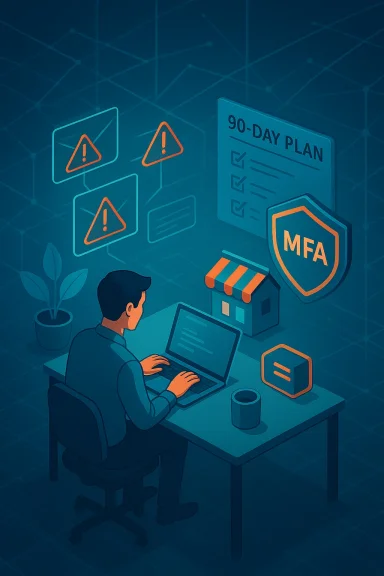
A realistic, budget‑friendly 90‑day plan for a one‑person business
- Days 1–7: Enable MFA on email, bank, payment processors; change passwords to a password manager and unique values.
- Days 8–21: Purchase and deploy a lightweight endpoint protection product with anti‑phishing/web filtering. Configure automatic updates and disk encryption.
- Days 22–30: Create automated nightly backups to an off‑site immutable target; perform a restore test.
- Days 31–60: Document payment verification policy and train anyone who can approve payments—even if that’s only you. Run a phishing‑simulation test using a free awareness training tool.
- Days 61–90: Rehearse the incident response steps (isolate, notify bank, preserve evidence, restore from backup). Subscribe to a simple breach notification/monitoring service for your business email and domain.
Where small businesses should watch next: AI, platform abuse, and supplier chains
- AI‑accelerated spearphishing: As ESET notes, AI reduces the time and skill needed to craft tailored scams. Expect a ricurate messages that mimic prior conversations, social posts, or invoices. Automated detection and a human vigilance habit will both be necessary. ww.eset.com/blog/en/what-is/common-scams-targeting-small-businesses/)
- Legitimate platforms abused as delivery mechanisms: Attackers are increasingly using reputable services (cloud forms, marketing tools, trial domains) to host phishing pages or redirect links that evade filters — making link provenance checks and conversation verification critical. Recent campaigns that abused test domains and marketing tools show this technique is growing.
- Supply‑chain/payment redirection schemes: As invoice and vendor fraud scale, your downstream supplier verification and accounts‑payable controls will be the last line of defense.
Strengths and risks — a quick forensic evaluation of ESET’s guidance
- Strengths:
- ESET’s SOHO focus and layered recommendations match the real‑world constraints of freelancers and micro businesses.
- The guidance pairs behavioral controls (training, verification) with product recommendations that simplify management for nontechnical owners.
- Industry recognition (IDC MarketScape) and independent reports support ESET’s prevention‑first technical claims.
- Risks / cautions:
- Anecdotes in vendor blogs are effective teaching tools but should be treated as illustrative; confirm original reporting when possible. ESET’s anecdotes align with common scam patterns, even if a single referenced piece could not be instantly located for independent verification.
- Bundled VPNs or cloud services may be operated by third parties; privacy‑sensitive firms should check operators, logging policies, and contractual terms.
- No single vendor or product is a silver bullet; recovery depends on tested backups and an incident plan complementary to endpoint prevention.
Final word: make prevention an operational habit, not a project
Scams will not go away. They will become faster and more believable as attackers adopt the same automation and AI tools that fuel legitimate productivity gains. The good news is that many of the steps that protect micro businesses are low‑cost, low‑friction, and high‑impact: MFA, backups, basic training, payment verification, and a reputable endpoint solution with anti‑phishing capabilities.ESET’s SOHO‑oriented recommendations are a sensible starting point — validated by independent data on the scale of the problem and by industry recognition of prevention‑focused endpoint products — but they do not replace the core operational practices every small business must adopt. Take thirty minutes this week to update critical passwords, enable MFA, and document a two‑step payment approval rule. Those minutes are the best cheap insurance you’ll buy this year.
Acknowledgement: This article summarizes ESET’s guidance while verifying headline statistics with independent reports (Feedzai/GASA, ITRC, UK Government, U.S. Chamber Index) and noting product recognition in IDC MarketScape. Where ESET cites individual local news anecdotes, readers should regard those as illustrative and, when relying on them, seek the original reporting for confirmation.
Source: ESET https://www.eset.com/blog/en/what-is/common-scams-targeting-small-businesses/
