

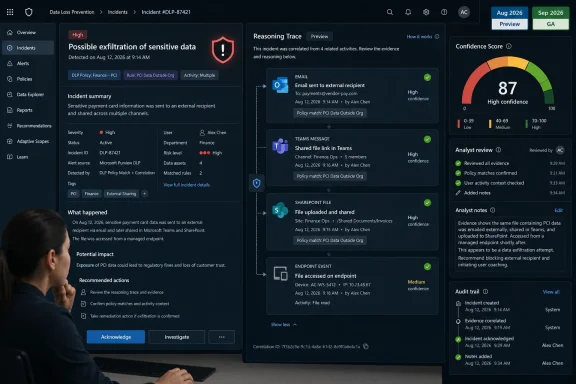
Microsoft plans to add reasoning traces and confidence scores to its Purview Data Security Triage Agent for Data Loss Prevention, with preview availability scheduled for August 2026 and general availability planned for September 2026 in worldwide standard multi-tenant Microsoft 365 environments. The feature sounds modest, but it cuts straight into the trust problem that has dogged security automation since the first wave of “AI-assisted” consoles arrived. Microsoft is not just adding another dashboard field; it is acknowledging that analysts cannot operationalize an opaque agent that simply declares an alert risky or routine. In DLP, where false positives waste time and false negatives can become reportable incidents, explainability is not decoration — it is the product.
The Purview Data Security Triage Agent sits in one of the least forgiving corners of enterprise security: data loss prevention alert review. DLP systems are built to catch sensitive information moving through email, Teams, SharePoint, OneDrive, endpoints, browsers, and other channels, but anyone who has administered one knows the unpleasant bargain. The more aggressively you tune the system, the more noise it produces; the more you suppress the noise, the more risk you accept.
Microsoft’s new roadmap item, ID 560597, says the agent will surface a reasoning trace alongside each decision and attach a confidence score to agent-triaged alerts. That is a small sentence with large implications. It means the agent’s output is being reframed from a black-box answer into something closer to analyst evidence: a judgment, a rationale, and a signal about how much weight to give it.
That matters because the current promise of security agents is often stronger than the operational reality. A triage agent that says “low risk” without explaining why still creates work for the human analyst, because the analyst must now audit the agent instead of auditing the alert. If that verification process takes as long as the original review, automation has merely moved the bottleneck.
Microsoft’s description is unusually direct about this. It says customers have reported a trust gap, and that analysts fall back to manual review when they cannot see why the agent made a decision or how confident it is. That is the most important sentence in the roadmap entry, because it admits the missing layer between demo-friendly AI and production-grade security operations.
The hard part is context. A spreadsheet with payroll data attached to an email may be a serious violation, or it may be a scheduled transfer to an approved benefits provider. A developer copying code to a removable drive may be theft, or it may be a lab machine workflow nobody documented. A Teams message containing a customer identifier may be routine support work, while the same identifier in a personal webmail upload may be a firing offense.
That is why DLP alert queues become graveyards. They contain real risk, harmless business activity, badly tuned policies, edge cases, duplicates, and enough ambiguity to exhaust even a mature SOC. Analysts do not simply ask whether sensitive data was detected. They ask who moved it, where it went, whether the destination is expected, whether the user has a history of risky behavior, whether the data is regulated, whether the action was blocked or merely audited, and whether similar events are happening across the organization.
A triage agent is attractive precisely because this context-gathering work is repetitive. Microsoft’s Purview agent is positioned to analyze DLP alerts, assess risk, and help prioritize what security teams should investigate first. The agent can operate across Microsoft 365 workloads and endpoint signals, depending on how the tenant is configured. In theory, that makes it well suited to the messy middle of DLP operations: not writing policy, not making final legal determinations, but helping decide which alerts deserve scarce human attention.
But “in theory” is doing a lot of work there. If the agent compresses a complicated chain of evidence into a single categorization, it may save time only for organizations willing to trust it blindly. Most security teams are not willing to do that, and regulated organizations often cannot.
The useful version of this feature is different. A confidence score should tell an analyst when the agent’s decision is routine enough to batch, when it is uncertain enough to review, and when it is confidently flagging something that deserves escalation. It should also help managers measure when automation is improving rather than merely accelerating mistakes.
That is especially important in DLP because triage quality is not just about catching the “bad” events. It is also about allowing ordinary work to continue. Over-blocking sensitive workflows can make users route around controls, store data in worse places, or pressure IT to loosen policies. Under-reacting can allow data to leave the organization. The confidence score becomes valuable only if it helps teams find the zone between those failures.
The roadmap language suggests Microsoft understands this operational angle. The stated goal is not to replace analysts outright, but to give them an auditable output they can validate and progressively rely on over time. That word “progressively” is doing real work. Security teams do not adopt automation in one leap; they build trust through observed performance, exception handling, and post-incident review.
The confidence score should therefore be treated less like a grade and more like a routing signal. High-confidence, low-risk alerts might be sampled rather than reviewed one by one. Low-confidence alerts might remain in the human queue. High-confidence, high-risk alerts might trigger faster escalation. The score matters because it can reshape the workflow, not because it makes the agent look smarter.
A reasoning trace gives the alert a narrative. It can show the factors the agent considered: the sensitive information involved, the policy that fired, the destination, the user context, the historical pattern, the business justification, or whatever signals Microsoft exposes in the final implementation. That does not automatically make the decision correct, but it gives analysts something concrete to challenge.
This is where explainability becomes a control, not a comfort blanket. A useful reasoning trace lets a human say, “The agent rated this low risk because the destination was an approved partner domain and the file was previously labeled for external sharing.” It also lets a human say, “The agent missed that this user is under investigation, so we need to escalate despite the low confidence or low severity.” Both outcomes are better than staring at a black-box verdict.
The trace also matters for training the organization. If analysts can see why the agent reaches certain conclusions, they can identify bad assumptions in policy design, labeling practices, or data classification. A surprising number of DLP failures are not caused by the DLP engine itself. They are caused by incomplete labels, stale exception lists, inconsistent group membership, weak ownership metadata, and business processes that evolved faster than the security model.
An explainable agent can expose those organizational weaknesses. That may make the product feel less magical, but it makes it more useful. The most valuable security tools do not merely produce alerts; they teach the enterprise where its control plane is lying to itself.
That pitch is not wrong. The volume problem is real. Sensitive data is no longer sitting neatly in file shares and mailboxes; it is in collaborative documents, chat threads, synced folders, browser sessions, endpoints, SaaS services, and increasingly in prompts and agent outputs. A human-only triage model cannot keep up with that surface area unless the organization accepts long delays or shallow review.
But Microsoft’s incentives are also worth reading carefully. The Purview triage agent runs in the orbit of Microsoft Security Copilot, and Microsoft has been steadily tying advanced security automation to consumption-based or premium licensing models. The agent is not just a feature; it is part of a larger commercial architecture in which Microsoft wants customers to buy into AI-assisted operations across the security stack.
That makes trust a business requirement for Microsoft, not merely a user-experience concern. If customers test the agent and decide they still need to manually re-check every decision, consumption stalls. If legal, compliance, and security leadership cannot defend the agent’s decisions, adoption stalls. If analysts view the tool as another opaque recommendation engine, it becomes shelfware with a futuristic label.
Reasoning traces and confidence scores are Microsoft’s attempt to solve that adoption barrier. The company does not need every analyst to believe the agent is infallible. It needs them to believe the agent is inspectable, measurable, and useful enough to change the queue.
Roadmap dates can move, especially for features tied to security workflows and AI-generated explanations. Microsoft has to get more than the UI right. The company must decide how much of the agent’s reasoning to expose, how to present confidence without creating false precision, how to log the output, and how to keep the explanation useful without leaking sensitive content unnecessarily.
For WindowsForum’s IT pro audience, the timing matters less as a calendar event and more as a deployment sequence. The right time to prepare is before the feature appears in the tenant, because explainable automation is only as strong as the environment it explains. If DLP policies are sloppy, labels are inconsistent, endpoint evidence collection is disabled, or alert ownership is unclear, the agent’s reasoning trace may simply make those problems more visible.
There is also a governance question. Who is allowed to rely on an agent-triaged alert? Can a high-confidence low-risk decision close an alert automatically? Must certain data types always receive human review? Does legal need access to reasoning traces? How long are these traces retained? Are they discoverable in an investigation? Microsoft’s feature will not answer all of those questions for customers.
The preview period should therefore be treated as an evaluation window, not a victory lap. Organizations should compare agent decisions against human decisions, track disagreement patterns, and decide where automation is safe. The goal should not be to prove the agent is impressive. The goal should be to discover where it is dependable.
The same applies to labels. Microsoft Purview depends heavily on classification, sensitivity labels, policy conditions, and contextual signals. If sensitive documents are unlabeled, mislabeled, or inconsistently handled across departments, an agent’s reasoning will inherit that ambiguity. A polished explanation based on poor metadata is still a poor decision.
This is why administrators should resist the temptation to view confidence scores as a shortcut around foundational work. The agent may help prioritize DLP alerts, but it cannot magically resolve every classification gap or business-process exception. If anything, the more explainable the agent becomes, the more visible those gaps will be.
That visibility is not a bad thing. A reasoning trace can become an internal diagnostic tool. It can show which policies are generating low-confidence decisions, which business units produce ambiguous alerts, which data types lack enough context, and which exceptions are undermining risk scoring. In a mature program, those findings can feed back into better DLP rules, better labeling, and better user education.
In an immature program, they may create friction. Analysts may distrust the agent because the agent is reasoning from bad inputs. Business owners may object to findings that reveal unmanaged workflows. Compliance teams may ask why long-standing exceptions exist at all. The feature’s success will depend on whether organizations are willing to fix the system around the agent, not just judge the agent in isolation.
The trap is assuming that explainability eliminates risk. It does not. A clear explanation can still be wrong, incomplete, or based on misleading inputs. Confidence scores can create automation bias, where analysts defer to the tool because it appears quantified. Reasoning traces can become boilerplate if they are too generic. Worse, teams under staffing pressure may use the presence of a trace as permission to reduce review before they have evidence that the system performs well.
That risk is not theoretical. Security operations already suffer from alert fatigue, dashboard fatigue, and risk-score fatigue. Many tools have trained analysts to click through machine-generated recommendations without deeply trusting them. If Microsoft wants this feature to matter, the trace must be specific enough to support real review, and the confidence score must be calibrated enough to support real workflow decisions.
There is also a subtle design challenge around language. If the reasoning trace reads like a confident human analyst, users may overtrust it. If it reads like a generic template, users will ignore it. Microsoft needs to strike the right tone: factual, bounded, and evidence-linked. The agent should not sound like it knows more than it does.
The best implementation would make uncertainty visible. It would say, in effect, “Here is why this appears low risk, here are the signals used, here are the signals missing, and here is how confident the agent is.” That kind of output helps analysts make decisions. A vague paragraph saying the event “appears consistent with normal business activity” does not.
The endpoint angle is particularly important. Purview DLP can include device-based signals, but endpoint coverage depends on configuration, evidence collection, and the broader state of Microsoft Defender integration. If an organization expects the agent to reason about risky file movement on Windows devices, it must ensure the endpoint telemetry exists and is usable. Otherwise, the agent may be strong in Microsoft 365 workloads but weaker where users actually move data.
The same is true for Microsoft Defender XDR integration. DLP alerts do not live in isolation from broader security operations. A data exfiltration concern may intersect with account compromise, suspicious device behavior, unusual sign-in patterns, or insider risk signals. The more Microsoft can connect Purview triage to the broader Defender context, the more useful the reasoning trace becomes.
But there is a practical administrative burden here. Someone has to own the policies. Someone has to tune the alerts. Someone has to validate the agent. Someone has to decide whether the confidence score affects closure, escalation, sampling, or reporting. Microsoft can provide the feature, but customers must build the operating model.
That is why this roadmap item is bigger than it looks. It is not simply a UI enhancement. It is a test of whether Microsoft’s agentic security story can survive contact with the people who carry pagers, answer audit requests, and explain to executives why a sensitive file left the company.
Security teams should start by running the agent’s decisions alongside existing analyst workflows. The point is to build a disagreement dataset: where the agent and analyst align, where they diverge, and which kinds of alerts produce weak explanations. That dataset will be more valuable than any launch-day impression.
Teams should also inspect whether the reasoning trace is useful across different alert types. A trace for an Exchange DLP alert may be easier to interpret than one involving endpoint file movement. A SharePoint oversharing case may depend heavily on labels and site permissions. A Teams message may present different evidentiary challenges. The feature’s value will vary by workload.
The confidence score should be tested the same way. Does high confidence correlate with analyst agreement? Are certain policies always low confidence? Does the score behave differently for regulated data, source code, HR files, or financial information? A confidence score that cannot be mapped to operational outcomes is just decoration.
Most importantly, organizations should decide in advance what “good enough” means. If the agent agrees with analysts 90 percent of the time on low-risk alerts, is that sufficient for sampling? If it misses a certain category of high-risk events, does that block automation entirely? If the trace is strong but confidence is low, which signal wins? These are governance decisions, not UI preferences.
A chatbot-style answer is ephemeral. A triage decision attached to a DLP alert is operational evidence. If it influences whether an alert is closed, escalated, or ignored, it belongs in the same governance conversation as analyst notes, case management records, and incident response documentation.
That will be welcomed by some teams and feared by others. Auditable automation gives compliance leaders something they can review. It gives SOC managers a way to measure adoption. It gives analysts a defensible basis for trusting or rejecting the agent. But it also creates a record of when the organization relied on automation and whether that reliance was reasonable.
This is where Microsoft’s language about progressive reliance becomes important. The company is not saying customers should hand over DLP triage wholesale. It is saying the feature should let teams validate the agent’s output and increase trust over time. That is the responsible version of the story, and it is the version IT leaders should hold Microsoft to.
If the final implementation supports that model, it could reduce one of the biggest barriers to AI security operations: the gap between recommendation and accountability. If it does not, the feature will become another example of AI being sprinkled over a hard workflow without changing the economics of the work.
 Microsoft’s Agent Now Has to Show Its Work
The Purview Data Security Triage Agent sits in one of the least forgiving corners of enterprise security: data loss prevention alert review. DLP systems are built to catch sensitive information moving through email, Teams, SharePoint, OneDrive, endpoints, browsers, and other channels, but anyone who has administered one knows the unpleasant bargain. The more aggressively you tune the system, the more noise it produces; the more you suppress the noise, the more risk you accept.Microsoft’s new roadmap item, ID 560597, says the agent will surface a reasoning trace alongside each decision and attach a confidence score to agent-triaged alerts. That is a small sentence with large implications. It means the agent’s output is being reframed from a black-box answer into something closer to analyst evidence: a judgment, a rationale, and a signal about how much weight to give it.
That matters because the current promise of security agents is often stronger than the operational reality. A triage agent that says “low risk” without explaining why still creates work for the human analyst, because the analyst must now audit the agent instead of auditing the alert. If that verification process takes as long as the original review, automation has merely moved the bottleneck.
Microsoft’s description is unusually direct about this. It says customers have reported a trust gap, and that analysts fall back to manual review when they cannot see why the agent made a decision or how confident it is. That is the most important sentence in the roadmap entry, because it admits the missing layer between demo-friendly AI and production-grade security operations.
DLP Has Always Been a Human Judgment Problem Wearing a Policy Engine Costume
DLP is often sold as a rules problem. Find credit card numbers. Detect Social Security numbers. Block uploads to unsanctioned cloud services. Prevent source code from leaving the network. In practice, those rules are only the beginning.The hard part is context. A spreadsheet with payroll data attached to an email may be a serious violation, or it may be a scheduled transfer to an approved benefits provider. A developer copying code to a removable drive may be theft, or it may be a lab machine workflow nobody documented. A Teams message containing a customer identifier may be routine support work, while the same identifier in a personal webmail upload may be a firing offense.
That is why DLP alert queues become graveyards. They contain real risk, harmless business activity, badly tuned policies, edge cases, duplicates, and enough ambiguity to exhaust even a mature SOC. Analysts do not simply ask whether sensitive data was detected. They ask who moved it, where it went, whether the destination is expected, whether the user has a history of risky behavior, whether the data is regulated, whether the action was blocked or merely audited, and whether similar events are happening across the organization.
A triage agent is attractive precisely because this context-gathering work is repetitive. Microsoft’s Purview agent is positioned to analyze DLP alerts, assess risk, and help prioritize what security teams should investigate first. The agent can operate across Microsoft 365 workloads and endpoint signals, depending on how the tenant is configured. In theory, that makes it well suited to the messy middle of DLP operations: not writing policy, not making final legal determinations, but helping decide which alerts deserve scarce human attention.
But “in theory” is doing a lot of work there. If the agent compresses a complicated chain of evidence into a single categorization, it may save time only for organizations willing to trust it blindly. Most security teams are not willing to do that, and regulated organizations often cannot.
Confidence Is Useful Only When It Changes Behavior
A confidence score is not magic. Security products have displayed risk scores, severity labels, and probability bands for years, sometimes with more aesthetic confidence than statistical rigor. If Microsoft simply adds a number that looks authoritative but cannot be interpreted, tuned, or audited, it will become another column analysts learn to ignore.The useful version of this feature is different. A confidence score should tell an analyst when the agent’s decision is routine enough to batch, when it is uncertain enough to review, and when it is confidently flagging something that deserves escalation. It should also help managers measure when automation is improving rather than merely accelerating mistakes.
That is especially important in DLP because triage quality is not just about catching the “bad” events. It is also about allowing ordinary work to continue. Over-blocking sensitive workflows can make users route around controls, store data in worse places, or pressure IT to loosen policies. Under-reacting can allow data to leave the organization. The confidence score becomes valuable only if it helps teams find the zone between those failures.
The roadmap language suggests Microsoft understands this operational angle. The stated goal is not to replace analysts outright, but to give them an auditable output they can validate and progressively rely on over time. That word “progressively” is doing real work. Security teams do not adopt automation in one leap; they build trust through observed performance, exception handling, and post-incident review.
The confidence score should therefore be treated less like a grade and more like a routing signal. High-confidence, low-risk alerts might be sampled rather than reviewed one by one. Low-confidence alerts might remain in the human queue. High-confidence, high-risk alerts might trigger faster escalation. The score matters because it can reshape the workflow, not because it makes the agent look smarter.
The Reasoning Trace Is the Feature Auditors Will Care About
The reasoning trace may prove more important than the confidence score. In security operations, a decision without a rationale is difficult to defend after the fact. If a data incident later surfaces, the organization needs to explain what it knew, what the system flagged, who reviewed it, and why a particular action was or was not taken.A reasoning trace gives the alert a narrative. It can show the factors the agent considered: the sensitive information involved, the policy that fired, the destination, the user context, the historical pattern, the business justification, or whatever signals Microsoft exposes in the final implementation. That does not automatically make the decision correct, but it gives analysts something concrete to challenge.
This is where explainability becomes a control, not a comfort blanket. A useful reasoning trace lets a human say, “The agent rated this low risk because the destination was an approved partner domain and the file was previously labeled for external sharing.” It also lets a human say, “The agent missed that this user is under investigation, so we need to escalate despite the low confidence or low severity.” Both outcomes are better than staring at a black-box verdict.
The trace also matters for training the organization. If analysts can see why the agent reaches certain conclusions, they can identify bad assumptions in policy design, labeling practices, or data classification. A surprising number of DLP failures are not caused by the DLP engine itself. They are caused by incomplete labels, stale exception lists, inconsistent group membership, weak ownership metadata, and business processes that evolved faster than the security model.
An explainable agent can expose those organizational weaknesses. That may make the product feel less magical, but it makes it more useful. The most valuable security tools do not merely produce alerts; they teach the enterprise where its control plane is lying to itself.
Microsoft Is Selling Agentic Security, but the Buyer Is Still the SOC
This roadmap item lands in the middle of Microsoft’s broader push to insert Copilot and agentic workflows into security and compliance. Purview now sits at the intersection of data governance, insider risk, DLP, information protection, and AI-era data exposure. Microsoft’s pitch is straightforward: as data sprawls across Microsoft 365 and AI tools make it easier to retrieve and redistribute information, security teams need automated help to understand what is happening.That pitch is not wrong. The volume problem is real. Sensitive data is no longer sitting neatly in file shares and mailboxes; it is in collaborative documents, chat threads, synced folders, browser sessions, endpoints, SaaS services, and increasingly in prompts and agent outputs. A human-only triage model cannot keep up with that surface area unless the organization accepts long delays or shallow review.
But Microsoft’s incentives are also worth reading carefully. The Purview triage agent runs in the orbit of Microsoft Security Copilot, and Microsoft has been steadily tying advanced security automation to consumption-based or premium licensing models. The agent is not just a feature; it is part of a larger commercial architecture in which Microsoft wants customers to buy into AI-assisted operations across the security stack.
That makes trust a business requirement for Microsoft, not merely a user-experience concern. If customers test the agent and decide they still need to manually re-check every decision, consumption stalls. If legal, compliance, and security leadership cannot defend the agent’s decisions, adoption stalls. If analysts view the tool as another opaque recommendation engine, it becomes shelfware with a futuristic label.
Reasoning traces and confidence scores are Microsoft’s attempt to solve that adoption barrier. The company does not need every analyst to believe the agent is infallible. It needs them to believe the agent is inspectable, measurable, and useful enough to change the queue.
The Calendar Says Preview in August, but the Real Rollout Starts After GA
The roadmap currently lists preview availability for August 2026 and general availability for September 2026. The feature is marked as in development for Microsoft Purview on the web, targeting worldwide standard multi-tenant cloud customers. Those dates are close enough to be meaningful but still far enough away that administrators should treat them as planning signals rather than immovable commitments.Roadmap dates can move, especially for features tied to security workflows and AI-generated explanations. Microsoft has to get more than the UI right. The company must decide how much of the agent’s reasoning to expose, how to present confidence without creating false precision, how to log the output, and how to keep the explanation useful without leaking sensitive content unnecessarily.
For WindowsForum’s IT pro audience, the timing matters less as a calendar event and more as a deployment sequence. The right time to prepare is before the feature appears in the tenant, because explainable automation is only as strong as the environment it explains. If DLP policies are sloppy, labels are inconsistent, endpoint evidence collection is disabled, or alert ownership is unclear, the agent’s reasoning trace may simply make those problems more visible.
There is also a governance question. Who is allowed to rely on an agent-triaged alert? Can a high-confidence low-risk decision close an alert automatically? Must certain data types always receive human review? Does legal need access to reasoning traces? How long are these traces retained? Are they discoverable in an investigation? Microsoft’s feature will not answer all of those questions for customers.
The preview period should therefore be treated as an evaluation window, not a victory lap. Organizations should compare agent decisions against human decisions, track disagreement patterns, and decide where automation is safe. The goal should not be to prove the agent is impressive. The goal should be to discover where it is dependable.
Explainability Will Expose the Quality of Your DLP Program
There is an uncomfortable truth behind this feature: explainability can make weak programs look worse before it makes them better. If the agent’s trace says it rated an alert as low risk because a destination was trusted, and the trusted-domain list is a dumping ground of old exceptions, the problem is not the model. It is the governance process that fed the model.The same applies to labels. Microsoft Purview depends heavily on classification, sensitivity labels, policy conditions, and contextual signals. If sensitive documents are unlabeled, mislabeled, or inconsistently handled across departments, an agent’s reasoning will inherit that ambiguity. A polished explanation based on poor metadata is still a poor decision.
This is why administrators should resist the temptation to view confidence scores as a shortcut around foundational work. The agent may help prioritize DLP alerts, but it cannot magically resolve every classification gap or business-process exception. If anything, the more explainable the agent becomes, the more visible those gaps will be.
That visibility is not a bad thing. A reasoning trace can become an internal diagnostic tool. It can show which policies are generating low-confidence decisions, which business units produce ambiguous alerts, which data types lack enough context, and which exceptions are undermining risk scoring. In a mature program, those findings can feed back into better DLP rules, better labeling, and better user education.
In an immature program, they may create friction. Analysts may distrust the agent because the agent is reasoning from bad inputs. Business owners may object to findings that reveal unmanaged workflows. Compliance teams may ask why long-standing exceptions exist at all. The feature’s success will depend on whether organizations are willing to fix the system around the agent, not just judge the agent in isolation.
The Security Upside Is Real, but So Is the Automation Trap
The strongest argument for Microsoft’s update is that it aligns with how good analysts already work. They do not treat every alert identically. They weigh context, confidence, severity, and business impact. They document why an alert was closed or escalated. A triage agent that exposes its reasoning can support that process rather than pretending to replace it.The trap is assuming that explainability eliminates risk. It does not. A clear explanation can still be wrong, incomplete, or based on misleading inputs. Confidence scores can create automation bias, where analysts defer to the tool because it appears quantified. Reasoning traces can become boilerplate if they are too generic. Worse, teams under staffing pressure may use the presence of a trace as permission to reduce review before they have evidence that the system performs well.
That risk is not theoretical. Security operations already suffer from alert fatigue, dashboard fatigue, and risk-score fatigue. Many tools have trained analysts to click through machine-generated recommendations without deeply trusting them. If Microsoft wants this feature to matter, the trace must be specific enough to support real review, and the confidence score must be calibrated enough to support real workflow decisions.
There is also a subtle design challenge around language. If the reasoning trace reads like a confident human analyst, users may overtrust it. If it reads like a generic template, users will ignore it. Microsoft needs to strike the right tone: factual, bounded, and evidence-linked. The agent should not sound like it knows more than it does.
The best implementation would make uncertainty visible. It would say, in effect, “Here is why this appears low risk, here are the signals used, here are the signals missing, and here is how confident the agent is.” That kind of output helps analysts make decisions. A vague paragraph saying the event “appears consistent with normal business activity” does not.
Windows Shops Should Read This as a Purview Maturity Test
For many Windows-centric organizations, Purview is already bundled into the Microsoft 365 security and compliance conversation. E5 licensing, Defender integration, endpoint DLP, sensitivity labels, Insider Risk Management, and Sentinel all pull administrators toward a Microsoft-first data security stack. The new triage explainability feature strengthens that pull, but it also raises the bar for operating the stack well.The endpoint angle is particularly important. Purview DLP can include device-based signals, but endpoint coverage depends on configuration, evidence collection, and the broader state of Microsoft Defender integration. If an organization expects the agent to reason about risky file movement on Windows devices, it must ensure the endpoint telemetry exists and is usable. Otherwise, the agent may be strong in Microsoft 365 workloads but weaker where users actually move data.
The same is true for Microsoft Defender XDR integration. DLP alerts do not live in isolation from broader security operations. A data exfiltration concern may intersect with account compromise, suspicious device behavior, unusual sign-in patterns, or insider risk signals. The more Microsoft can connect Purview triage to the broader Defender context, the more useful the reasoning trace becomes.
But there is a practical administrative burden here. Someone has to own the policies. Someone has to tune the alerts. Someone has to validate the agent. Someone has to decide whether the confidence score affects closure, escalation, sampling, or reporting. Microsoft can provide the feature, but customers must build the operating model.
That is why this roadmap item is bigger than it looks. It is not simply a UI enhancement. It is a test of whether Microsoft’s agentic security story can survive contact with the people who carry pagers, answer audit requests, and explain to executives why a sensitive file left the company.
The August Preview Should Be Treated Like a Control Validation Exercise
When the preview arrives, the worst rollout plan would be to turn on the feature, admire the new fields, and immediately route low-confidence work to humans while burying high-confidence work in automation. That may eventually be the right destination, but it is not the first step. The first step is validation.Security teams should start by running the agent’s decisions alongside existing analyst workflows. The point is to build a disagreement dataset: where the agent and analyst align, where they diverge, and which kinds of alerts produce weak explanations. That dataset will be more valuable than any launch-day impression.
Teams should also inspect whether the reasoning trace is useful across different alert types. A trace for an Exchange DLP alert may be easier to interpret than one involving endpoint file movement. A SharePoint oversharing case may depend heavily on labels and site permissions. A Teams message may present different evidentiary challenges. The feature’s value will vary by workload.
The confidence score should be tested the same way. Does high confidence correlate with analyst agreement? Are certain policies always low confidence? Does the score behave differently for regulated data, source code, HR files, or financial information? A confidence score that cannot be mapped to operational outcomes is just decoration.
Most importantly, organizations should decide in advance what “good enough” means. If the agent agrees with analysts 90 percent of the time on low-risk alerts, is that sufficient for sampling? If it misses a certain category of high-risk events, does that block automation entirely? If the trace is strong but confidence is low, which signal wins? These are governance decisions, not UI preferences.
The Agent Is Becoming Part of the Audit Trail
The most durable impact of this feature may be cultural. Once an agent produces a reasoning trace, its output becomes part of the record of how the organization handled risk. That changes how teams should think about AI assistance.A chatbot-style answer is ephemeral. A triage decision attached to a DLP alert is operational evidence. If it influences whether an alert is closed, escalated, or ignored, it belongs in the same governance conversation as analyst notes, case management records, and incident response documentation.
That will be welcomed by some teams and feared by others. Auditable automation gives compliance leaders something they can review. It gives SOC managers a way to measure adoption. It gives analysts a defensible basis for trusting or rejecting the agent. But it also creates a record of when the organization relied on automation and whether that reliance was reasonable.
This is where Microsoft’s language about progressive reliance becomes important. The company is not saying customers should hand over DLP triage wholesale. It is saying the feature should let teams validate the agent’s output and increase trust over time. That is the responsible version of the story, and it is the version IT leaders should hold Microsoft to.
If the final implementation supports that model, it could reduce one of the biggest barriers to AI security operations: the gap between recommendation and accountability. If it does not, the feature will become another example of AI being sprinkled over a hard workflow without changing the economics of the work.
The Useful Signal Is Not the Score, but the Pattern Behind It
The concrete lesson for administrators is that the new feature should be measured by workflow impact, not novelty. A confidence score and reasoning trace are valuable only if they help teams close safe alerts faster, escalate dangerous alerts sooner, and improve the policies that generate ambiguous ones.- The feature is currently planned for preview in August 2026 and general availability in September 2026 for Microsoft Purview on the web in worldwide standard multi-tenant environments.
- The reasoning trace should be evaluated as audit evidence, not as a decorative explanation attached to an AI decision.
- The confidence score should be mapped to actual triage actions, such as sampling, escalation, human review, or policy tuning.
- The preview period should be used to compare agent decisions against analyst decisions before any broad automation is introduced.
- Weak labels, stale exceptions, incomplete endpoint telemetry, and noisy DLP policies will limit the value of the agent’s explanations.
- The feature is best understood as a maturity test for Purview operations, not as a replacement for DLP governance.
References
- Primary source: Microsoft 365 Roadmap
Published: 2026-06-24T23:15:55.6812517Z
Microsoft 365 Roadmap | Microsoft 365
The Microsoft 365 Roadmap lists updates that are currently planned for applicable subscribers. Check here for more information on the status of new features and updates.www.microsoft.com
- Official source: learn.microsoft.com
Get started with the Microsoft Purview Triage Agent in Data Loss Prevention | Microsoft Learn
Prepare for and deploy the Microsoft Purview triage agent in Microsoft Purview Data Loss Prevention.learn.microsoft.com - Official source: marketplace.microsoft.com
Data Security Triage Agent in Data Loss Prevention
The Data Security Triage Agent streamlines alert triage by identifying & prioritizing data loss riskmarketplace.microsoft.com
- Official source: enablement.microsoft.com
Microsoft Purview – Microsoft Adoption
Microsoft Purview unifies data security, governance, and compliance solutions for the era of AI.enablement.microsoft.com - Official source: cdn-dynmedia-1.microsoft.com
- Official source: techcommunity.microsoft.com
</rdf:Alt> </dc:title> <dc:description> <rdf:Alt> <rdf:li xml:lang="x-default"/> </rdf:Alt> </dc:description> <dc:creator> <rdf:Seq> <rdf:li>Microso
</rdf:Alt> </dc:description> <dc:creator> <rdf:Seq> <rdf:li>Microsoft Office Usertechcommunity.microsoft.com
- Official source: cdn-dynmedia-1htbprolmicrosofthtbprolcom-s.evpn.library.nenu.edu.cn
- Related coverage: rite.org.ro
- Official source: marketingassets.microsoft.com
SEC_24_JUL_EB_EN-US_Crash_Course_In_Microsoft_Purview_CORE
An asian gorgeous mother carrying her baby and working on laptop at home.marketingassets.microsoft.com
