

Microsoft has launched Microsoft Purview integration for Azure AI Foundry in worldwide standard multi-tenant clouds, letting Foundry administrators enable Purview at the subscription level so interaction data from apps and agents can flow into centralized AI compliance and governance systems. The feature, tracked as Microsoft 365 Roadmap ID 537271, moved from preview availability in December 2025 to general availability in May 2026 and was still being updated on June 26, 2026. That chronology matters because this is not merely another admin-center switch; it is Microsoft turning AI experimentation into something compliance teams can inventory, search, retain, classify, and police.
The bet is simple: if enterprises are going to build fleets of custom agents, Microsoft wants the audit trail, policy surface, and risk dashboard to live inside Purview. For Windows shops already standardized on Entra, Defender, Microsoft 365, Azure, and Purview, this is the kind of integration that can make AI governance feel native rather than bolted on. For everyone else, it is another reminder that the most consequential AI platform decisions may be made less by model benchmarks than by who owns the logs.
For the last two years, “AI governance” has often meant three things: a policy PDF, a procurement checklist, and a nervous security team watching employees paste sensitive data into tools faster than IT can write guidance. Microsoft’s Purview integration with Azure AI Foundry is an attempt to collapse that gap. The company is saying that AI interactions should not live in a separate compliance universe simply because they were produced by a chatbot, agent, or model endpoint.
The subscription-level enablement is the key design choice. Rather than asking each app team to invent its own compliance pipeline, Foundry administrators can activate Purview coverage for a subscription, after which interaction data from Foundry-built apps and agents is routed into Microsoft’s broader compliance fabric. That makes governance less dependent on individual developer discipline and more dependent on platform configuration.
This will be attractive to enterprises precisely because AI projects are proliferating outside traditional software release cycles. A team can build a customer-service summarizer, an internal helpdesk agent, a procurement assistant, and a legal-review bot without creating the kind of conventional application estate that IT knows how to track. Purview’s role is to make these interactions visible as enterprise data events, not as mysterious side effects of innovation.
The move also clarifies what Microsoft thinks Purview is becoming. It is no longer only the place where compliance officers manage retention, eDiscovery, labels, and data loss prevention for email, documents, and collaboration workloads. It is being positioned as a control plane for AI data itself — the prompts, responses, context, and possibly the risky data flows that emerge when employees and agents start using models as a normal part of work.
Purview is Microsoft’s answer to that asymmetry. The integration gives administrators a way to bring AI interaction data into familiar compliance workflows rather than leaving each Foundry project to produce its own bespoke logs. In practical terms, that can mean auditability, classification, retention, data-loss-prevention enforcement, insider-risk signals, eDiscovery readiness, and security posture management tied to AI usage.
The distinction matters because logs alone are not governance. Enterprises have plenty of logs they never read, cannot interpret, or cannot map back to business risk. Purview’s promise is that AI interactions become part of the same policy and investigation machinery that already exists for Microsoft 365 and other governed data surfaces.
That is also why Microsoft’s phrasing around “all apps and agents” is important. If the integration is enabled at the subscription level, the intended administrative model is broad coverage rather than per-agent opt-in. For compliance teams, broad coverage is the difference between a dashboard they can trust and a dashboard they have to caveat every time an executive asks whether the company knows where its AI data is going.
Once agents become normal, the prompt-response exchange stops being a novelty and starts looking like an enterprise record. It may contain sensitive information. It may show decision-making. It may reveal whether an employee tried to bypass policy. It may be needed in a regulatory inquiry, lawsuit, incident investigation, or internal audit.
That is the real significance of routing Foundry interaction data into Purview. Microsoft is preparing for a world in which AI usage is not a side channel but a first-class business process. The compliance system must therefore understand AI interactions not as screenshots, exports, or after-the-fact reports, but as governable artifacts.
This is where the integration becomes more than a convenience feature. If AI agents are eventually allowed to initiate transactions, summarize evidence, recommend actions, draft communications, or automate business processes, then the organization needs a way to answer basic questions: who used the agent, what data did it touch, what did it output, which policy applied, and how long must that record be retained?
The more autonomous the agent, the less tolerable “trust us, the app team has logs somewhere” becomes. Purview gives Microsoft a ready-made narrative: build quickly in Foundry, but keep the evidence trail in the compliance stack.
In many organizations, AI governance is still being negotiated among security, legal, compliance, infrastructure, application development, and business units. The group that gets the first workable system often sets the pattern for everyone else. Microsoft would like that pattern to be Foundry plus Purview, not a patchwork of SaaS dashboards, custom logging, and manually exported transcripts.
This is also a land grab against two kinds of competitors. The first is the obvious one: rival cloud AI platforms that want to be the default place enterprises build agents. The second is subtler: standalone AI governance vendors that promise cross-platform visibility across models, prompts, datasets, and risks. Microsoft’s advantage is that many enterprises already have Purview entitlements, Microsoft 365 compliance teams, Entra identities, and Azure subscriptions.
That does not automatically make Microsoft’s approach better. It does make it easier to adopt. In enterprise technology, “already in the admin center” has defeated many technically elegant competitors.
The May 2026 general availability date also suggests Microsoft believes the feature is no longer just for early adopters. Preview features can be explained away as experiments. GA features become candidates for architecture standards, procurement requirements, and security baselines. Once a control is generally available, auditors and internal risk teams begin asking why it was not enabled.
But the integration also makes AI development less private. Interaction data flowing into Purview means prompts and responses may be subject to audit, retention, discovery, classification, and policy review. Developers who treated model calls as transient runtime behavior will need to adjust to the idea that those interactions can become regulated enterprise evidence.
That is not a bad thing, but it changes the culture around experimentation. Hackathon-style prototypes built in cloud subscriptions have a way of becoming production-adjacent. Once Purview is enabled, those interactions may be visible to security and compliance teams. The upside is accountability; the downside is that app teams may feel watched before their designs have matured.
The healthiest organizations will handle this by separating experimentation environments from production-grade AI subscriptions, with clear policies for what data can be used in each. The least healthy will either disable governance to preserve speed or enable it without explaining the implications. Both choices invite trouble.
Microsoft’s platform design nudges customers toward the middle path: make governance the default, but let administrators decide when and where it applies. That is sensible, though it places real responsibility on Azure subscription owners and Foundry administrators. A toggle is only as good as the operating model around it.
If a company faces a discovery request, a data-handling inquiry, or an internal investigation, it needs records that are complete enough to be useful and governed enough to be defensible. AI interactions complicate that because they can blend user intent, retrieved enterprise data, generated content, and tool actions. Without a compliance layer, the organization may have either too little information or too much unstructured exhaust.
Purview’s integration with Foundry is designed to turn that exhaust into managed information. Retention policies can matter when AI interactions become business records. eDiscovery can matter when generated outputs influence decisions. Data loss prevention can matter when a user or agent attempts to expose sensitive information. Insider risk and communication compliance can matter when AI tools become part of employee behavior.
This is Microsoft’s strongest argument: AI governance should not be a parallel compliance universe. It should reuse the controls organizations already understand. The same teams that manage sensitive labels, retention, investigations, and compliance posture should not have to learn an entirely separate discipline just because the interface changed from Outlook to an agent.
There is a catch. AI interactions are not exactly like email or documents. They are dynamic, contextual, and often intermediate. A prompt may include fragments of sensitive data; a response may infer something sensitive without quoting a source; an agent may call tools whose logs live elsewhere. Purview can centralize governance, but it cannot make AI data simple.
There is also the boundary between Foundry and everything adjacent to Foundry. Enterprises may use Foundry endpoints, Azure OpenAI patterns, Copilot Studio, third-party model APIs, open-source agent frameworks, custom middleware, and SaaS tools with embedded AI. Purview’s Foundry integration strengthens Microsoft’s governed path, but it does not by itself solve the entire AI sprawl problem.
That makes architecture discipline critical. If developers route sensitive workloads through Foundry-covered subscriptions, Purview becomes a meaningful control. If teams scatter model calls across unmanaged services, the dashboard becomes partial. The integration rewards standardization and exposes the cost of avoiding it.
Microsoft likely understands this. The company’s broader AI security and governance strategy has been to tie together Entra identity, Defender protection, Purview compliance, and Foundry development. The more customers adopt that stack as a unified pattern, the more Microsoft can claim end-to-end enterprise AI control. The less they do, the more Purview becomes one governed island in a sea of exceptions.
This is where sysadmins and cloud platform teams will have more influence than they may expect. They will decide whether Foundry subscriptions are treated as enterprise production platforms or just another developer sandbox. That decision will determine whether Purview integration becomes a compliance backbone or a box checked during a roadmap review.
The Foundry-Purview integration follows that pattern almost perfectly. Developers get a Microsoft-hosted AI app and agent factory. Administrators get subscription-scoped enablement. Compliance teams get AI interactions inside Purview. Executives get a story about innovation with guardrails.
This is not merely a cloud feature; it is Microsoft extending the Windows enterprise governance tradition into AI. The old endpoint question was whether a device was joined, patched, encrypted, protected, and compliant. The new AI question is whether an agent is identifiable, governed, monitored, and subject to policy. Different surface, same control-plane logic.
That continuity will appeal to organizations that prefer integrated Microsoft management over best-of-breed assembly. It will also unsettle those wary of putting too much governance telemetry into one vendor’s ecosystem. The stronger Purview becomes as the system of record for AI compliance, the harder it may be to switch platforms later.
This is the classic Microsoft bargain. You get integration, administrative familiarity, and procurement simplicity. You also get gravity.
In theory, posture management can show where sensitive data is being used in AI interactions, which apps or agents are generating risk, and which controls are missing. That matters because many AI risks are not dramatic breaches. They are routine misuses: employees pasting customer records into prompts, agents retrieving documents beyond their intended scope, generated summaries exposing confidential details, or prototypes quietly becoming business-critical.
The practical value is prioritization. Security teams already drown in alerts. A governance system that merely says “AI happened” is not enough. A useful system must help teams decide which AI activity deserves attention and which can be accepted as normal business use.
Microsoft’s advantage is that Purview can potentially correlate AI interaction data with existing information protection context: sensitivity labels, classifications, user identities, retention rules, and compliance policies. That is more powerful than a generic prompt log because it connects AI behavior to the organization’s existing data map.
Still, posture dashboards can create false comfort. They are only as complete as the workloads feeding them, and only as effective as the policies behind them. If an organization’s labeling strategy is weak, its AI posture view will inherit that weakness. Purview can amplify governance maturity; it cannot conjure it out of nothing.
With Foundry integration, Microsoft is moving Purview closer to the moment where sensitive information enters or leaves an AI workflow. That is important because waiting until generated content is copied into an email or document may be too late. The risky event may have happened at prompt time, retrieval time, or response generation time.
For administrators, this suggests a future in which AI DLP policies become as normal as Exchange transport rules or SharePoint sensitivity labels. The enforcement points will differ, but the governance logic will be familiar: detect sensitive content, apply policy, block or warn where appropriate, and preserve evidence.
For developers, this could produce frustrating edge cases. An agent that works in testing may behave differently when real data triggers compliance controls. A workflow that seems technically correct may be blocked because it mixes sensitive categories in an unauthorized way. That friction is not accidental; it is the point of governance.
The better development teams will treat Purview policy as part of the application environment, not as a production surprise. Testing AI apps without compliance controls will increasingly look like testing network software without authentication. It may prove the code runs, but it does not prove the system is deployable.
Enterprises should also be careful about the phrase “interaction data.” Different stakeholders may assume different levels of detail. A compliance officer may expect full prompt and response content. A security engineer may care about metadata, classifications, and policy events. A privacy officer may ask how long interaction records are retained and who can access them. A developer may worry about debugging data being exposed.
Those are not implementation footnotes. They are governance design questions. Before enabling broad capture, organizations should decide what they are collecting, why they are collecting it, how long they keep it, who can search it, and what happens when the interaction itself contains regulated or privileged information.
There is also the multicloud and multi-model reality. Microsoft can provide its strongest governance story inside its own ecosystem, but few large enterprises will use only one AI platform. The more fragmented the AI estate, the more important it becomes to define which workloads must use Foundry and which exceptions require separate controls.
The launch therefore creates a new baseline, not an endpoint. After May 2026, a Microsoft-centric enterprise can reasonably ask why custom AI apps and agents are not governed through Purview where possible. That question will shape architecture reviews, security approvals, and procurement decisions.
The first job is inventory. Organizations need to know which Foundry resources exist, who owns them, which apps and agents use them, and whether they process sensitive or regulated data. Without that inventory, subscription-level enablement risks being either too narrow to matter or too broad to understand.
The second job is policy alignment. If Purview already governs Microsoft 365 content but AI interactions have different retention, privacy, or investigation requirements, those differences must be explicit. AI data should not fall into a policy bucket merely because no one created a better one.
The third job is communication. Users and developers should know that AI interactions in governed environments may be subject to compliance review. That does not need to be framed as surveillance. It should be framed as the cost of using enterprise data with enterprise AI systems.
The fourth job is exception handling. Some research, testing, or low-risk experimentation may not require the same treatment as production agents handling customer data. Conversely, some regulated workflows may need stricter controls than the default. The integration gives administrators a lever; it does not tell them exactly when to pull it.
Microsoft’s version is particularly aggressive because it can connect developer tooling, identity, endpoint security, compliance, and productivity data. Foundry is not just a model playground. Purview is not just a compliance archive. Entra is not just authentication. Defender is not just endpoint protection. Together, they become an enterprise AI operating environment.
That is good news for customers who want fewer integration projects. It is less comfortable for customers who want governance independent from the vendor hosting the workload. A cloud-native governance stack may see more and enforce more, but it is also shaped by the platform provider’s assumptions and commercial incentives.
This tension will define the next phase of enterprise AI adoption. Businesses want speed, but regulators want accountability. Developers want flexible model access, but security teams want standardized controls. Executives want AI everywhere, but legal teams want evidence when something goes wrong.
Purview integration with Foundry is Microsoft’s attempt to make those tensions manageable inside its ecosystem. It is not neutral infrastructure. It is a strategic control point.
That messy middle is where the integration will either prove itself or become another dashboard with optimistic coverage. Microsoft has the advantage of owning many of the enterprise surfaces involved, but customers still have to do the organizational work. Governance fails less often because a feature is missing than because ownership is unclear.
The best sign for Microsoft is that Purview maps to roles that already exist. Compliance managers, security admins, legal discovery teams, data governance leads, and Microsoft 365 administrators know why retention, DLP, auditing, and classification matter. Foundry gives those teams a new AI surface to govern without asking them to abandon their operating model.
The risk is that AI moves faster than the governance rollout. If business units already have agents in production before Purview policies are defined, the organization may spend the next year retrofitting controls. That is expensive, politically awkward, and technically incomplete.
This is why the GA milestone matters. The responsible enterprise reaction is not applause; it is a work item. Find the subscriptions, understand the data, enable the integration where appropriate, test the policies, and document the decision.
The bet is simple: if enterprises are going to build fleets of custom agents, Microsoft wants the audit trail, policy surface, and risk dashboard to live inside Purview. For Windows shops already standardized on Entra, Defender, Microsoft 365, Azure, and Purview, this is the kind of integration that can make AI governance feel native rather than bolted on. For everyone else, it is another reminder that the most consequential AI platform decisions may be made less by model benchmarks than by who owns the logs.
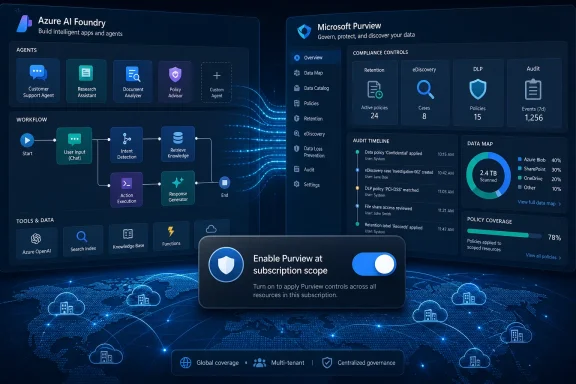 Microsoft Moves AI Governance From Slideware to Subscription Scope
For the last two years, “AI governance” has often meant three things: a policy PDF, a procurement checklist, and a nervous security team watching employees paste sensitive data into tools faster than IT can write guidance. Microsoft’s Purview integration with Azure AI Foundry is an attempt to collapse that gap. The company is saying that AI interactions should not live in a separate compliance universe simply because they were produced by a chatbot, agent, or model endpoint.The subscription-level enablement is the key design choice. Rather than asking each app team to invent its own compliance pipeline, Foundry administrators can activate Purview coverage for a subscription, after which interaction data from Foundry-built apps and agents is routed into Microsoft’s broader compliance fabric. That makes governance less dependent on individual developer discipline and more dependent on platform configuration.
This will be attractive to enterprises precisely because AI projects are proliferating outside traditional software release cycles. A team can build a customer-service summarizer, an internal helpdesk agent, a procurement assistant, and a legal-review bot without creating the kind of conventional application estate that IT knows how to track. Purview’s role is to make these interactions visible as enterprise data events, not as mysterious side effects of innovation.
The move also clarifies what Microsoft thinks Purview is becoming. It is no longer only the place where compliance officers manage retention, eDiscovery, labels, and data loss prevention for email, documents, and collaboration workloads. It is being positioned as a control plane for AI data itself — the prompts, responses, context, and possibly the risky data flows that emerge when employees and agents start using models as a normal part of work.
Foundry Gives Developers Speed; Purview Gives Auditors a Handle
Azure AI Foundry, now increasingly framed under the broader Microsoft Foundry banner, is Microsoft’s factory floor for building AI applications and agents. It gives developers access to models, orchestration tools, evaluation, deployment paths, and enterprise integration points. That makes it powerful, but it also creates the predictable enterprise problem: the easier it becomes to build AI systems, the harder it becomes to know what those systems are doing.Purview is Microsoft’s answer to that asymmetry. The integration gives administrators a way to bring AI interaction data into familiar compliance workflows rather than leaving each Foundry project to produce its own bespoke logs. In practical terms, that can mean auditability, classification, retention, data-loss-prevention enforcement, insider-risk signals, eDiscovery readiness, and security posture management tied to AI usage.
The distinction matters because logs alone are not governance. Enterprises have plenty of logs they never read, cannot interpret, or cannot map back to business risk. Purview’s promise is that AI interactions become part of the same policy and investigation machinery that already exists for Microsoft 365 and other governed data surfaces.
That is also why Microsoft’s phrasing around “all apps and agents” is important. If the integration is enabled at the subscription level, the intended administrative model is broad coverage rather than per-agent opt-in. For compliance teams, broad coverage is the difference between a dashboard they can trust and a dashboard they have to caveat every time an executive asks whether the company knows where its AI data is going.
The Agent Era Turns Every Prompt Into a Record
The old mental model of enterprise AI was a user typing a prompt into a chatbot and getting an answer. That model is already too small. The newer model is agents: software that can call tools, reason over business data, chain steps together, and act inside workflows that may touch sales records, HR documents, support tickets, source code, contracts, and customer communications.Once agents become normal, the prompt-response exchange stops being a novelty and starts looking like an enterprise record. It may contain sensitive information. It may show decision-making. It may reveal whether an employee tried to bypass policy. It may be needed in a regulatory inquiry, lawsuit, incident investigation, or internal audit.
That is the real significance of routing Foundry interaction data into Purview. Microsoft is preparing for a world in which AI usage is not a side channel but a first-class business process. The compliance system must therefore understand AI interactions not as screenshots, exports, or after-the-fact reports, but as governable artifacts.
This is where the integration becomes more than a convenience feature. If AI agents are eventually allowed to initiate transactions, summarize evidence, recommend actions, draft communications, or automate business processes, then the organization needs a way to answer basic questions: who used the agent, what data did it touch, what did it output, which policy applied, and how long must that record be retained?
The more autonomous the agent, the less tolerable “trust us, the app team has logs somewhere” becomes. Purview gives Microsoft a ready-made narrative: build quickly in Foundry, but keep the evidence trail in the compliance stack.
The Roadmap Timing Says Microsoft Knows the Governance Window Is Narrow
The roadmap entry’s timing is revealing. Preview in December 2025, general availability in May 2026, and a late-June update suggest Microsoft is moving this feature into production posture while enterprises are still standardizing their AI operating models. That is exactly when platform defaults matter most.In many organizations, AI governance is still being negotiated among security, legal, compliance, infrastructure, application development, and business units. The group that gets the first workable system often sets the pattern for everyone else. Microsoft would like that pattern to be Foundry plus Purview, not a patchwork of SaaS dashboards, custom logging, and manually exported transcripts.
This is also a land grab against two kinds of competitors. The first is the obvious one: rival cloud AI platforms that want to be the default place enterprises build agents. The second is subtler: standalone AI governance vendors that promise cross-platform visibility across models, prompts, datasets, and risks. Microsoft’s advantage is that many enterprises already have Purview entitlements, Microsoft 365 compliance teams, Entra identities, and Azure subscriptions.
That does not automatically make Microsoft’s approach better. It does make it easier to adopt. In enterprise technology, “already in the admin center” has defeated many technically elegant competitors.
The May 2026 general availability date also suggests Microsoft believes the feature is no longer just for early adopters. Preview features can be explained away as experiments. GA features become candidates for architecture standards, procurement requirements, and security baselines. Once a control is generally available, auditors and internal risk teams begin asking why it was not enabled.
Compliance Teams Get Visibility, but Developers Get New Friction
For developers, this integration is both helpful and constraining. Helpful because it can remove a major obstacle to production approval: the dreaded late-stage compliance review. If Purview coverage is part of the platform, developers can argue that their Foundry apps and agents inherit a recognizable governance model rather than needing to design one from scratch.But the integration also makes AI development less private. Interaction data flowing into Purview means prompts and responses may be subject to audit, retention, discovery, classification, and policy review. Developers who treated model calls as transient runtime behavior will need to adjust to the idea that those interactions can become regulated enterprise evidence.
That is not a bad thing, but it changes the culture around experimentation. Hackathon-style prototypes built in cloud subscriptions have a way of becoming production-adjacent. Once Purview is enabled, those interactions may be visible to security and compliance teams. The upside is accountability; the downside is that app teams may feel watched before their designs have matured.
The healthiest organizations will handle this by separating experimentation environments from production-grade AI subscriptions, with clear policies for what data can be used in each. The least healthy will either disable governance to preserve speed or enable it without explaining the implications. Both choices invite trouble.
Microsoft’s platform design nudges customers toward the middle path: make governance the default, but let administrators decide when and where it applies. That is sensible, though it places real responsibility on Azure subscription owners and Foundry administrators. A toggle is only as good as the operating model around it.
Purview Becomes the AI Memory Microsoft Can Sell to Regulators
Regulators do not usually care whether an AI app was built with the most fashionable orchestration library. They care whether an organization can explain, control, and evidence its handling of data. Purview’s value proposition is therefore less about AI magic than institutional memory.If a company faces a discovery request, a data-handling inquiry, or an internal investigation, it needs records that are complete enough to be useful and governed enough to be defensible. AI interactions complicate that because they can blend user intent, retrieved enterprise data, generated content, and tool actions. Without a compliance layer, the organization may have either too little information or too much unstructured exhaust.
Purview’s integration with Foundry is designed to turn that exhaust into managed information. Retention policies can matter when AI interactions become business records. eDiscovery can matter when generated outputs influence decisions. Data loss prevention can matter when a user or agent attempts to expose sensitive information. Insider risk and communication compliance can matter when AI tools become part of employee behavior.
This is Microsoft’s strongest argument: AI governance should not be a parallel compliance universe. It should reuse the controls organizations already understand. The same teams that manage sensitive labels, retention, investigations, and compliance posture should not have to learn an entirely separate discipline just because the interface changed from Outlook to an agent.
There is a catch. AI interactions are not exactly like email or documents. They are dynamic, contextual, and often intermediate. A prompt may include fragments of sensitive data; a response may infer something sensitive without quoting a source; an agent may call tools whose logs live elsewhere. Purview can centralize governance, but it cannot make AI data simple.
The Subscription Toggle Hides a Hard Boundary Problem
The phrase “all apps and agents” sounds clean until an enterprise maps its real cloud estate. Azure subscriptions are often divided by business unit, environment, project, geography, acquisition history, or cost center. Some are tightly managed; others are inherited archaeology. Enabling Purview subscription by subscription may be administratively straightforward, but deciding which subscriptions are in scope can be politically messy.There is also the boundary between Foundry and everything adjacent to Foundry. Enterprises may use Foundry endpoints, Azure OpenAI patterns, Copilot Studio, third-party model APIs, open-source agent frameworks, custom middleware, and SaaS tools with embedded AI. Purview’s Foundry integration strengthens Microsoft’s governed path, but it does not by itself solve the entire AI sprawl problem.
That makes architecture discipline critical. If developers route sensitive workloads through Foundry-covered subscriptions, Purview becomes a meaningful control. If teams scatter model calls across unmanaged services, the dashboard becomes partial. The integration rewards standardization and exposes the cost of avoiding it.
Microsoft likely understands this. The company’s broader AI security and governance strategy has been to tie together Entra identity, Defender protection, Purview compliance, and Foundry development. The more customers adopt that stack as a unified pattern, the more Microsoft can claim end-to-end enterprise AI control. The less they do, the more Purview becomes one governed island in a sea of exceptions.
This is where sysadmins and cloud platform teams will have more influence than they may expect. They will decide whether Foundry subscriptions are treated as enterprise production platforms or just another developer sandbox. That decision will determine whether Purview integration becomes a compliance backbone or a box checked during a roadmap review.
Windows Shops Should See the Microsoft 365 Pattern Repeating
WindowsForum readers have seen this movie before. Microsoft often wins enterprise control points by embedding governance into the places customers already work. Group Policy, Active Directory, Intune, Defender, Entra, and Purview all reflect the same instinct: make the managed path easier, deeper, and more auditable than the unmanaged path.The Foundry-Purview integration follows that pattern almost perfectly. Developers get a Microsoft-hosted AI app and agent factory. Administrators get subscription-scoped enablement. Compliance teams get AI interactions inside Purview. Executives get a story about innovation with guardrails.
This is not merely a cloud feature; it is Microsoft extending the Windows enterprise governance tradition into AI. The old endpoint question was whether a device was joined, patched, encrypted, protected, and compliant. The new AI question is whether an agent is identifiable, governed, monitored, and subject to policy. Different surface, same control-plane logic.
That continuity will appeal to organizations that prefer integrated Microsoft management over best-of-breed assembly. It will also unsettle those wary of putting too much governance telemetry into one vendor’s ecosystem. The stronger Purview becomes as the system of record for AI compliance, the harder it may be to switch platforms later.
This is the classic Microsoft bargain. You get integration, administrative familiarity, and procurement simplicity. You also get gravity.
Security Posture Management Is the Feature Behind the Feature
The roadmap item emphasizes Purview enablement and AI interaction data, but the deeper story is posture management. Enterprises do not only need to investigate AI incidents after they happen; they need to see risky usage patterns before those patterns become incidents. That is where Purview’s data security posture management for AI becomes central.In theory, posture management can show where sensitive data is being used in AI interactions, which apps or agents are generating risk, and which controls are missing. That matters because many AI risks are not dramatic breaches. They are routine misuses: employees pasting customer records into prompts, agents retrieving documents beyond their intended scope, generated summaries exposing confidential details, or prototypes quietly becoming business-critical.
The practical value is prioritization. Security teams already drown in alerts. A governance system that merely says “AI happened” is not enough. A useful system must help teams decide which AI activity deserves attention and which can be accepted as normal business use.
Microsoft’s advantage is that Purview can potentially correlate AI interaction data with existing information protection context: sensitivity labels, classifications, user identities, retention rules, and compliance policies. That is more powerful than a generic prompt log because it connects AI behavior to the organization’s existing data map.
Still, posture dashboards can create false comfort. They are only as complete as the workloads feeding them, and only as effective as the policies behind them. If an organization’s labeling strategy is weak, its AI posture view will inherit that weakness. Purview can amplify governance maturity; it cannot conjure it out of nothing.
Data Loss Prevention Moves Closer to the Prompt
Data loss prevention has always been an imperfect art. It works best when it is close enough to the data flow to understand context, but not so intrusive that users route around it. AI raises the stakes because the prompt is both an input field and a potential exfiltration channel.With Foundry integration, Microsoft is moving Purview closer to the moment where sensitive information enters or leaves an AI workflow. That is important because waiting until generated content is copied into an email or document may be too late. The risky event may have happened at prompt time, retrieval time, or response generation time.
For administrators, this suggests a future in which AI DLP policies become as normal as Exchange transport rules or SharePoint sensitivity labels. The enforcement points will differ, but the governance logic will be familiar: detect sensitive content, apply policy, block or warn where appropriate, and preserve evidence.
For developers, this could produce frustrating edge cases. An agent that works in testing may behave differently when real data triggers compliance controls. A workflow that seems technically correct may be blocked because it mixes sensitive categories in an unauthorized way. That friction is not accidental; it is the point of governance.
The better development teams will treat Purview policy as part of the application environment, not as a production surprise. Testing AI apps without compliance controls will increasingly look like testing network software without authentication. It may prove the code runs, but it does not prove the system is deployable.
The Feature’s Limits Are as Important as Its Launch
It would be a mistake to read this launch as Microsoft solving AI governance in one stroke. The integration is a major building block, not a magic containment field. It applies to Foundry-based apps and agents in covered subscriptions, and its effectiveness depends on configuration, licensing, policy design, organizational adoption, and the completeness of Microsoft’s supported capabilities.Enterprises should also be careful about the phrase “interaction data.” Different stakeholders may assume different levels of detail. A compliance officer may expect full prompt and response content. A security engineer may care about metadata, classifications, and policy events. A privacy officer may ask how long interaction records are retained and who can access them. A developer may worry about debugging data being exposed.
Those are not implementation footnotes. They are governance design questions. Before enabling broad capture, organizations should decide what they are collecting, why they are collecting it, how long they keep it, who can search it, and what happens when the interaction itself contains regulated or privileged information.
There is also the multicloud and multi-model reality. Microsoft can provide its strongest governance story inside its own ecosystem, but few large enterprises will use only one AI platform. The more fragmented the AI estate, the more important it becomes to define which workloads must use Foundry and which exceptions require separate controls.
The launch therefore creates a new baseline, not an endpoint. After May 2026, a Microsoft-centric enterprise can reasonably ask why custom AI apps and agents are not governed through Purview where possible. That question will shape architecture reviews, security approvals, and procurement decisions.
Administrators Now Own the Gap Between Innovation and Evidence
The immediate operational burden falls on administrators. Foundry admins and Azure subscription owners must understand where the feature is available, which subscriptions host AI workloads, and how Purview integration interacts with existing compliance policies. This is not a task to leave buried in a release note.The first job is inventory. Organizations need to know which Foundry resources exist, who owns them, which apps and agents use them, and whether they process sensitive or regulated data. Without that inventory, subscription-level enablement risks being either too narrow to matter or too broad to understand.
The second job is policy alignment. If Purview already governs Microsoft 365 content but AI interactions have different retention, privacy, or investigation requirements, those differences must be explicit. AI data should not fall into a policy bucket merely because no one created a better one.
The third job is communication. Users and developers should know that AI interactions in governed environments may be subject to compliance review. That does not need to be framed as surveillance. It should be framed as the cost of using enterprise data with enterprise AI systems.
The fourth job is exception handling. Some research, testing, or low-risk experimentation may not require the same treatment as production agents handling customer data. Conversely, some regulated workflows may need stricter controls than the default. The integration gives administrators a lever; it does not tell them exactly when to pull it.
The Cloud Control Plane Eats Another Category
There is a broader industry trend hiding beneath the roadmap entry: AI governance is being absorbed into cloud control planes. At first, companies bought or built separate tools to track prompts, evaluate models, scan outputs, and manage risk. Now the hyperscalers are moving those capabilities closer to the platforms where AI systems are built and deployed.Microsoft’s version is particularly aggressive because it can connect developer tooling, identity, endpoint security, compliance, and productivity data. Foundry is not just a model playground. Purview is not just a compliance archive. Entra is not just authentication. Defender is not just endpoint protection. Together, they become an enterprise AI operating environment.
That is good news for customers who want fewer integration projects. It is less comfortable for customers who want governance independent from the vendor hosting the workload. A cloud-native governance stack may see more and enforce more, but it is also shaped by the platform provider’s assumptions and commercial incentives.
This tension will define the next phase of enterprise AI adoption. Businesses want speed, but regulators want accountability. Developers want flexible model access, but security teams want standardized controls. Executives want AI everywhere, but legal teams want evidence when something goes wrong.
Purview integration with Foundry is Microsoft’s attempt to make those tensions manageable inside its ecosystem. It is not neutral infrastructure. It is a strategic control point.
The Real Test Will Be the Messy Middle of Enterprise AI
The easiest demo for this feature is a clean Foundry app, a well-labeled dataset, an administrator enabling Purview, and a compliance dashboard lighting up with useful signals. The real enterprise will be messier. Some agents will be prototypes. Some will be built by consultants. Some will call APIs outside Azure. Some will use data that is poorly classified. Some will be owned by business teams that do not think of themselves as software teams at all.That messy middle is where the integration will either prove itself or become another dashboard with optimistic coverage. Microsoft has the advantage of owning many of the enterprise surfaces involved, but customers still have to do the organizational work. Governance fails less often because a feature is missing than because ownership is unclear.
The best sign for Microsoft is that Purview maps to roles that already exist. Compliance managers, security admins, legal discovery teams, data governance leads, and Microsoft 365 administrators know why retention, DLP, auditing, and classification matter. Foundry gives those teams a new AI surface to govern without asking them to abandon their operating model.
The risk is that AI moves faster than the governance rollout. If business units already have agents in production before Purview policies are defined, the organization may spend the next year retrofitting controls. That is expensive, politically awkward, and technically incomplete.
This is why the GA milestone matters. The responsible enterprise reaction is not applause; it is a work item. Find the subscriptions, understand the data, enable the integration where appropriate, test the policies, and document the decision.
The Foundry-Purview Deal Changes the AI Checklist
The practical upshot is that Microsoft has changed what a reasonable AI deployment checklist looks like for its own cloud customers. A Foundry app that handles enterprise data should now be evaluated not only by model quality, latency, cost, and security design, but by whether its interactions are visible to Purview. That is a meaningful shift.- Organizations using Azure AI Foundry should identify which subscriptions host apps or agents that process business, customer, employee, regulated, or confidential data.
- Foundry administrators should treat Purview enablement as a production governance decision rather than a cosmetic roadmap feature.
- Compliance teams should define retention, eDiscovery, DLP, insider-risk, and access-review expectations for AI interaction data before broad deployment.
- Developers should test AI applications under the same governance conditions they expect in production, including policies that may affect prompts, responses, or sensitive data flows.
- Security teams should assume Purview improves visibility only for workloads that actually feed it, and they should continue hunting for unmanaged AI usage outside the Microsoft-governed path.
- Executives should understand that adopting Foundry plus Purview is not just a technical choice; it is a commitment to Microsoft’s integrated model for enterprise AI control.
References
- Primary source: Microsoft 365 Roadmap
Published: 2026-06-26T22:01:51.0909953Z
Microsoft 365 Roadmap | Microsoft 365
The Microsoft 365 Roadmap lists updates that are currently planned for applicable subscribers. Check here for more information on the status of new features and updates.www.microsoft.com
- Official source: learn.microsoft.com
Microsoft Foundry documentation | Microsoft Learn
The AI app and agent factory - build, optimize, and govern AI apps and agents at scale.learn.microsoft.com - Related coverage: m365admin.handsontek.net
Microsoft Purview: Azure AI Foundry integration with Microsoft Purview for AI - M365 Admin
Purview enablement in AI Foundry, allows Foundry admins to activate Microsoft Purview on their subscription. Once enabled, AI interaction data from all apps and agents flows into Purview for centralized compliance, governance, and posture management of AI data. Product Release phase Preview...m365admin.handsontek.net - Official source: techcommunity.microsoft.com
Announcing New Microsoft Purview Capabilities to Protect GenAI Agents | Microsoft Community Hub
As organizations accelerate their adoption of agentic AI, a new and urgent challenge is emerging: how to protect the rapidly growing number of... techcommunity.microsoft.com
- Official source: azure.microsoft.com
- Related coverage: itpro.com
Microsoft unveils Foundry overhaul for managing, optimizing AI agents | IT Pro
The hyperscaler is aiming to simplify AI agent oversight, as organizations grapple with the increasingly complicated business of processing and paying for outputswww.itpro.com
- Official source: marketingassets.microsoft.com
IDC MarketScape: Worldwide Unified AI Governance Platforms 2025–2026 Vendor Assessment
PDF documentmarketingassets.microsoft.com
- Official source: cdn-dynmedia-1.microsoft.com
Slide 1: Microsoft Purview Data Governance Roadmap H1 CY2025
PDF documentcdn-dynmedia-1.microsoft.com
- Related coverage: resources.wisdominterface.com
Harnessing the power of Azure AI Foundry across organizations
PDF documentresources.wisdominterface.com
