

A Seeking Alpha analysis argues that Invesco QQQ Trust has become a concentrated wager on artificial intelligence because its largest technology holdings dominate the Nasdaq-100, while the business case for funding ever-larger AI infrastructure buildouts remains financially unsettled in 2026. That is the right concern, even if the headline overshoots the evidence. The AI business model is not clearly collapsing; it is being stress-tested in public by capital expenditures that now look less like normal cloud expansion and more like an industry-wide margin call on future demand. For Windows users, developers, and enterprise IT buyers, the market drama matters because the same companies inflating the index are also deciding what AI gets built into Windows, Microsoft 365, Azure, browsers, security tooling, and workplace software.
The Invesco QQQ Trust has always been a technology-heavy product, but the AI cycle has made that concentration more explicit. A buyer of QQQ is not simply buying “the Nasdaq” in any broad cultural sense. They are buying a fund whose performance is heavily tied to a handful of mega-cap companies with overlapping exposure to AI chips, cloud infrastructure, enterprise software, advertising automation, and consumer devices.
That does not make QQQ defective. It makes it honest. Index products are often sold as diversified, but market-cap weighting quietly turns yesterday’s winners into today’s largest bets. When Nvidia, Microsoft, Apple, Amazon, Alphabet, Meta, Broadcom, and other AI-adjacent giants swell in value, QQQ becomes more dependent on whether investors continue believing that AI will justify the valuation premium.
The risk is not merely that one AI company disappoints. The risk is that the AI trade has become circular. Hyperscalers spend hundreds of billions on data centers, GPUs, networking, memory, power, and cooling. Semiconductor companies book the revenue. Cloud providers point to growing AI demand. Investors reward both sides. Then the same capital-market confidence helps justify the next round of spending.
That loop can continue for longer than skeptics expect. It can also break faster than executives would like. QQQ sits at the center of that loop because it packages the beneficiaries, suppliers, and platform owners into a single liquid instrument that millions of investors treat as a default tech allocation.
The more precise argument is that the AI investment case has moved from the easy phase to the hard phase. The easy phase was narrative: generative AI worked well enough to shock consumers, scare incumbents, and create a plausible new computing platform. The hard phase is accounting: someone must prove that the infrastructure required to run these models can earn returns above its depreciation, energy costs, chip refresh cycles, and software pricing pressure.
That distinction matters because bubbles rarely begin with fake technology. They often begin with real technology, real user demand, and real revenue — then extrapolate those facts into unreasonable capital intensity. Railroads, fiber networks, dot-com infrastructure, crypto mining, and electric-vehicle supply chains all produced useful assets. The financial damage came from building too much, too soon, at prices that assumed permanent scarcity.
AI may follow a similar pattern. The models are useful. The demand is real. The strategic value is obvious. But a useful technology is not automatically a good business model at any price, especially when every major platform company is trying to spend its way into the same future at the same time.
That race began as a scarcity trade. In 2023 and 2024, the companies with access to high-end Nvidia GPUs had a meaningful advantage. Developers needed compute, model labs needed training clusters, and enterprise customers wanted AI features even when they were not yet sure how deeply those features would change productivity. If you had capacity, you had leverage.
By 2026, the wager is larger and more dangerous. Hyperscalers are no longer merely filling obvious unmet demand. They are building for a future in which AI workloads become a permanent computing layer across business software, search, advertising, coding, cybersecurity, gaming, productivity suites, and consumer devices. That may happen, but the buildout is arriving before the profit pools are fully visible.
This is where the Seeking Alpha thesis bites hardest. If QQQ’s largest constituents are being valued as if AI infrastructure will become a high-return platform layer, investors need evidence that customers will pay enough for that layer. So far, the evidence is mixed. Cloud revenue is growing, AI products are proliferating, and developer adoption is substantial, but many AI features remain bundled, discounted, subsidized, or justified as retention tools rather than standalone profit engines.
The deeper concern is that cloud companies are simultaneously vendors and buyers in the same story. Microsoft can say AI demand is strong while also spending aggressively to supply OpenAI, Azure customers, Copilot workloads, and internal products. Amazon can frame AI as a driver of AWS growth while building massive capacity ahead of demand. Meta can justify its spending as essential to ranking, ads, assistants, and future devices. Each case has logic. Together, they look like an arms race with no obvious disarmament mechanism.
That gives Microsoft a stronger monetization story than many AI pure plays. Copilot for Microsoft 365 can be sold into existing enterprise relationships. GitHub Copilot has a clear productivity pitch for developers. Azure AI services can attach to cloud budgets that already exist. Security Copilot and AI-driven management tools can be framed as labor-saving in areas where skilled staff are expensive and scarce.
But Microsoft also shows why the model is so demanding. AI is not like adding another ribbon button to Word. It requires inference capacity, orchestration, model routing, data governance, security boundaries, compliance tooling, and a user experience that justifies the subscription premium. If enterprises treat Copilot as a nice-to-have rather than a must-have, Microsoft must either lower prices, bundle more aggressively, or absorb more cost.
That is the uncomfortable edge of the AI PC and Windows AI story. Local NPUs can reduce some inference burden and enable on-device features, but the most valuable enterprise scenarios still lean heavily on cloud identity, organizational data, model access, and Microsoft Graph integration. The Copilot vision is therefore not just software; it is a recurring claim on infrastructure.
Microsoft can probably afford that claim better than almost anyone. The question for investors is whether “can afford” is the same as “earns exceptional returns.” For administrators, the question is different but related: whether Microsoft’s need to monetize AI will turn optional features into licensing pressure, product defaults, and bundled complexity.
That is also why Nvidia’s success creates a second-order risk for QQQ. If hyperscalers spend at extraordinary levels, Nvidia benefits. If hyperscalers slow spending because capacity catches up, depreciation bites, or customer demand disappoints, Nvidia’s growth rate becomes harder to defend. The shovel seller is not immune to the mine owner’s economics.
The market has been willing to assign rich valuations to the AI supply chain because demand seemed structurally undersupplied. That assumption weakens as custom silicon matures, model efficiency improves, and cloud providers push more workloads onto their own accelerators. Nvidia can still win in that world, but it may not capture the same share of incremental spending indefinitely.
This does not require a dramatic “AI is fake” conclusion. It only requires a more normal technology cycle. Prices fall. Utilization matters. Customers negotiate. Competitors catch up at the margins. Software improves enough to reduce brute-force compute needs. The most dangerous sentence in any infrastructure boom is: this time, capacity will never be enough.
Generative AI has already found real footholds in coding assistance, customer support, document drafting, summarization, search, analytics, and security triage. Those are not trivial use cases. In some organizations, they are material enough to justify real spending.
The problem is variance. A coding assistant may be a bargain for one development team and a compliance headache for another. A document assistant may save hours for a consultant and produce little value for a task worker. A customer-service bot may reduce costs in one workflow and create escalation misery in another. AI’s value is not evenly distributed, which makes broad, per-seat monetization harder than the industry’s preferred slide decks imply.
This is where enterprise buyers gain leverage. If every major vendor adds AI, customers can compare results. If multiple models can perform similar tasks, model access becomes commoditized. If AI features are bundled into existing suites, the revenue becomes harder to separate from ordinary renewal uplift. If regulators and legal teams raise the cost of deployment, adoption slows.
The result is not necessarily collapse. It is margin compression. The first wave of AI pricing assumed novelty and scarcity. The next wave will be judged against budgets, measurable productivity, risk, and procurement discipline. That is a colder world than the one investors priced during the early boom.
Advertising may cover some of the gap. AI can improve ad targeting, creative generation, ranking, recommendations, and commerce discovery. Meta and Google have credible arguments here because their core businesses already monetize attention at scale. If AI makes their ad systems more efficient, it can pay for itself indirectly.
But AI search and AI assistants can also cannibalize existing models. If an AI answer replaces a search results page, fewer ads may be shown. If users ask an assistant instead of browsing sites, publishers lose traffic and ad inventory. If content creation becomes cheaper, the web fills with more low-cost material, making discovery worse and increasing the need for more AI filtering.
Subscriptions help but do not solve everything. A minority of power users will pay for premium models, faster access, coding tools, image generation, or agentic workflows. The broader consumer market is more price-sensitive, especially when free tiers remain available and model quality keeps improving across providers.
That leaves platform lock-in as the most plausible consumer strategy. Put AI into the operating system, the browser, the phone, the search box, the app store, the productivity suite, and the social feed. Make it ambient. Make it hard to avoid. Then monetize it indirectly through retention, ads, hardware upgrades, and ecosystem gravity.
For Windows users, that future is already visible. AI features are becoming part of the operating environment rather than standalone applications. The business model may not be “users pay for AI” so much as “users remain inside platforms that use AI to defend their existing profit pools.”
AI may rhyme with that history. The technology is real, and its long-term effects may be profound. The question is who captures the value, on what timeline, and after how much capital is wasted. Cisco was a great company selling real equipment into a real networking revolution, yet its dot-com peak still became a cautionary tale about paying too much for the obvious future.
QQQ investors do not need AI to fail in order to suffer. They only need the market to lower its expectations. A company can grow revenue and still disappoint if investors priced faster growth. A cloud provider can build useful assets and still face lower returns if too many competitors build similar assets. A chipmaker can remain dominant and still rerate if customers digest capacity.
This is the difference between a technology thesis and an investment thesis. AI can change computing while AI stocks underperform. AI can become standard in Windows and Office while Microsoft’s incremental AI margins disappoint. AI can make developers more productive while the providers of AI infrastructure fight over a shrinking pool of excess profit.
The market often struggles with that separation. It wants category winners. It wants clean narratives. It wants a single chart showing exponential demand. But mature technology markets are messier. They distribute value unevenly, punish overcapacity, and turn miracles into line items.
That could mean more pressure to adopt Microsoft 365 Copilot, more AI-linked differentiation between Windows editions, and more features that require newer silicon. It could mean security tools that increasingly assume cloud AI analysis. It could mean developer environments where AI assistance becomes standard, then expected, then difficult to opt out of.
For sysadmins, the issue is governance. AI features touch identity, data loss prevention, audit logs, retention policies, endpoint management, and compliance. A model that can summarize a document can also expose sensitive information if permissions are sloppy. A tool that can automate help-desk work can also create new failure modes at scale.
For developers, the issue is dependency. AI coding tools are useful, but they introduce questions about code provenance, licensing, testing, security review, and skill formation. If vendors subsidize these tools during the land-grab phase and raise prices later, organizations may discover that their workflows have quietly absorbed a new recurring cost.
For ordinary Windows users, the issue is agency. AI assistants will increasingly appear in places that used to be simple search boxes, menus, settings panels, and support flows. Some of that will be helpful. Some of it will be promotional. The economics of AI will influence how much control users retain over where the assistant appears, what it can access, and whether it can be fully disabled.
That is healthy. The early AI boom rewarded imagination, and imagination was necessary because the technology arrived before the business models matured. But capital markets eventually demand proof. If hyperscalers spend like utilities, they will be judged on utilization. If software companies price AI like a premium product, they will be judged on renewal rates. If chipmakers command scarcity margins, they will be judged on whether scarcity persists.
The most optimistic version of the story is that AI becomes a new general-purpose computing layer. In that version, the current spending looks aggressive but rational. Data centers become the factories of digital labor. Microsoft, Amazon, Google, Meta, Nvidia, Broadcom, and others earn durable returns because demand keeps expanding as costs fall.
The more cautious version is that AI becomes important but less profitable than expected. It improves software, search, coding, advertising, and operations, but competition and efficiency gains pass much of the value to customers. That would still be a technological success. It would simply be a harder environment for the valuations embedded in QQQ.
The bearish version is that the industry builds far ahead of economically useful demand, forcing write-downs, slower capex, layoffs, pricing resets, and a rerating of the AI complex. That would not mean AI disappears. It would mean the market confused strategic necessity with unlimited profitability.
Those questions are not anti-technology. They are the questions that determine whether a platform becomes a profit engine or a subsidized feature. The cloud era trained investors to believe that infrastructure scale produces durable margins, but AI infrastructure may behave differently. It is more hardware-intensive, more energy-constrained, and more exposed to rapid model-efficiency improvements.
Model efficiency is especially awkward for the bull case. Better software can increase demand by making AI cheaper and more useful, but it can also reduce the need for brute-force compute. If inference costs fall quickly, customers benefit. If training becomes more efficient, the largest GPU clusters may still matter, but the panic premium around capacity could fade.
Depreciation is the quiet villain. Data centers are long-lived assets, but AI accelerators can age quickly when new generations offer better performance per watt. A cloud provider that overbuilds at peak hardware prices may still use the equipment, but the return profile can deteriorate as newer capacity arrives and customers expect lower prices.
This is why “AI demand is growing” is not enough. Demand must grow fast enough, at the right price, with high enough utilization, for long enough, to justify the capital already being committed. That is a much narrower claim than the public conversation often admits.
That variety matters. A broad selloff in AI-linked names would not hit every company the same way. Some will turn spending into durable advantage. Some will discover that they built expensive capacity into a price war. Some will use AI mostly to protect existing businesses rather than create new ones.
Management discipline is now the differentiator. The best companies will be the ones that can say no, shift workloads to cheaper silicon, prove customer value, and avoid mistaking competitor spending for customer demand. The worst will treat capex as strategy by itself.
This is where the market’s impatience may help. Investors are beginning to ask harder questions about returns, timing, and free cash flow. That pressure can force better disclosure and more disciplined deployment. It can also expose which AI narratives were built on vibes rather than unit economics.
For IT buyers, that discipline is useful. Vendors under pressure to prove AI value may offer better trials, clearer controls, more transparent pricing, and stronger integration. Vendors desperate to defend AI margins may do the opposite. The next procurement cycle will reveal which path dominates.
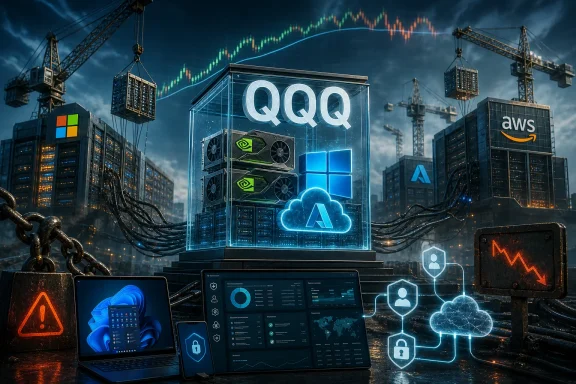 QQQ Has Become the Retail Wrapper Around the AI Arms Race
The Invesco QQQ Trust has always been a technology-heavy product, but the AI cycle has made that concentration more explicit. A buyer of QQQ is not simply buying “the Nasdaq” in any broad cultural sense. They are buying a fund whose performance is heavily tied to a handful of mega-cap companies with overlapping exposure to AI chips, cloud infrastructure, enterprise software, advertising automation, and consumer devices.That does not make QQQ defective. It makes it honest. Index products are often sold as diversified, but market-cap weighting quietly turns yesterday’s winners into today’s largest bets. When Nvidia, Microsoft, Apple, Amazon, Alphabet, Meta, Broadcom, and other AI-adjacent giants swell in value, QQQ becomes more dependent on whether investors continue believing that AI will justify the valuation premium.
The risk is not merely that one AI company disappoints. The risk is that the AI trade has become circular. Hyperscalers spend hundreds of billions on data centers, GPUs, networking, memory, power, and cooling. Semiconductor companies book the revenue. Cloud providers point to growing AI demand. Investors reward both sides. Then the same capital-market confidence helps justify the next round of spending.
That loop can continue for longer than skeptics expect. It can also break faster than executives would like. QQQ sits at the center of that loop because it packages the beneficiaries, suppliers, and platform owners into a single liquid instrument that millions of investors treat as a default tech allocation.
The Collapse Claim Gets the Direction Right but the Timing Wrong
Calling the AI business model “collapsing” is too neat. Microsoft, Amazon, Google, Meta, Nvidia, and Broadcom are not distressed companies searching for a last-minute story. They are among the most profitable enterprises in modern capitalism, and several still throw off enough cash to fund projects that would bankrupt ordinary firms.The more precise argument is that the AI investment case has moved from the easy phase to the hard phase. The easy phase was narrative: generative AI worked well enough to shock consumers, scare incumbents, and create a plausible new computing platform. The hard phase is accounting: someone must prove that the infrastructure required to run these models can earn returns above its depreciation, energy costs, chip refresh cycles, and software pricing pressure.
That distinction matters because bubbles rarely begin with fake technology. They often begin with real technology, real user demand, and real revenue — then extrapolate those facts into unreasonable capital intensity. Railroads, fiber networks, dot-com infrastructure, crypto mining, and electric-vehicle supply chains all produced useful assets. The financial damage came from building too much, too soon, at prices that assumed permanent scarcity.
AI may follow a similar pattern. The models are useful. The demand is real. The strategic value is obvious. But a useful technology is not automatically a good business model at any price, especially when every major platform company is trying to spend its way into the same future at the same time.
Hyperscalers Are Spending Like Scarcity Will Last Forever
The defining feature of the current AI cycle is not chatbot adoption. It is capital expenditure. Microsoft, Amazon, Alphabet, Meta, Oracle, and a wider set of cloud and data-center players are racing to secure GPUs, custom accelerators, power contracts, networking hardware, land, water, and grid access.That race began as a scarcity trade. In 2023 and 2024, the companies with access to high-end Nvidia GPUs had a meaningful advantage. Developers needed compute, model labs needed training clusters, and enterprise customers wanted AI features even when they were not yet sure how deeply those features would change productivity. If you had capacity, you had leverage.
By 2026, the wager is larger and more dangerous. Hyperscalers are no longer merely filling obvious unmet demand. They are building for a future in which AI workloads become a permanent computing layer across business software, search, advertising, coding, cybersecurity, gaming, productivity suites, and consumer devices. That may happen, but the buildout is arriving before the profit pools are fully visible.
This is where the Seeking Alpha thesis bites hardest. If QQQ’s largest constituents are being valued as if AI infrastructure will become a high-return platform layer, investors need evidence that customers will pay enough for that layer. So far, the evidence is mixed. Cloud revenue is growing, AI products are proliferating, and developer adoption is substantial, but many AI features remain bundled, discounted, subsidized, or justified as retention tools rather than standalone profit engines.
The deeper concern is that cloud companies are simultaneously vendors and buyers in the same story. Microsoft can say AI demand is strong while also spending aggressively to supply OpenAI, Azure customers, Copilot workloads, and internal products. Amazon can frame AI as a driver of AWS growth while building massive capacity ahead of demand. Meta can justify its spending as essential to ranking, ads, assistants, and future devices. Each case has logic. Together, they look like an arms race with no obvious disarmament mechanism.
Microsoft Is the Cleanest Example of the Opportunity and the Trap
For WindowsForum readers, Microsoft is the most important company in this debate because it connects the investor story to the software stack people actually use. Microsoft is not just another QQQ component riding the AI wave. It is the company trying to make AI unavoidable across Windows, Office, GitHub, Dynamics, Defender, Azure, Teams, Edge, and the developer ecosystem.That gives Microsoft a stronger monetization story than many AI pure plays. Copilot for Microsoft 365 can be sold into existing enterprise relationships. GitHub Copilot has a clear productivity pitch for developers. Azure AI services can attach to cloud budgets that already exist. Security Copilot and AI-driven management tools can be framed as labor-saving in areas where skilled staff are expensive and scarce.
But Microsoft also shows why the model is so demanding. AI is not like adding another ribbon button to Word. It requires inference capacity, orchestration, model routing, data governance, security boundaries, compliance tooling, and a user experience that justifies the subscription premium. If enterprises treat Copilot as a nice-to-have rather than a must-have, Microsoft must either lower prices, bundle more aggressively, or absorb more cost.
That is the uncomfortable edge of the AI PC and Windows AI story. Local NPUs can reduce some inference burden and enable on-device features, but the most valuable enterprise scenarios still lean heavily on cloud identity, organizational data, model access, and Microsoft Graph integration. The Copilot vision is therefore not just software; it is a recurring claim on infrastructure.
Microsoft can probably afford that claim better than almost anyone. The question for investors is whether “can afford” is the same as “earns exceptional returns.” For administrators, the question is different but related: whether Microsoft’s need to monetize AI will turn optional features into licensing pressure, product defaults, and bundled complexity.
The Nvidia Problem Is Really a Customer Problem
Nvidia is often treated as the purest winner of the AI boom, and for good reason. Its GPUs, networking, software ecosystem, and developer lock-in made it the toll collector for the first great generative AI buildout. If everyone needs compute, the company selling the shovels gets paid before anyone knows whether the gold mine is profitable.That is also why Nvidia’s success creates a second-order risk for QQQ. If hyperscalers spend at extraordinary levels, Nvidia benefits. If hyperscalers slow spending because capacity catches up, depreciation bites, or customer demand disappoints, Nvidia’s growth rate becomes harder to defend. The shovel seller is not immune to the mine owner’s economics.
The market has been willing to assign rich valuations to the AI supply chain because demand seemed structurally undersupplied. That assumption weakens as custom silicon matures, model efficiency improves, and cloud providers push more workloads onto their own accelerators. Nvidia can still win in that world, but it may not capture the same share of incremental spending indefinitely.
This does not require a dramatic “AI is fake” conclusion. It only requires a more normal technology cycle. Prices fall. Utilization matters. Customers negotiate. Competitors catch up at the margins. Software improves enough to reduce brute-force compute needs. The most dangerous sentence in any infrastructure boom is: this time, capacity will never be enough.
Enterprise Buyers Are Not Paying for Magic Forever
The business case for AI depends on customers who are willing to pay. That sounds obvious, but much of the market debate still treats adoption as if it automatically converts into attractive revenue. Enterprise IT departments know better. They test, pilot, secure, govern, restrict, negotiate, and sometimes quietly abandon tools that looked impressive in demos.Generative AI has already found real footholds in coding assistance, customer support, document drafting, summarization, search, analytics, and security triage. Those are not trivial use cases. In some organizations, they are material enough to justify real spending.
The problem is variance. A coding assistant may be a bargain for one development team and a compliance headache for another. A document assistant may save hours for a consultant and produce little value for a task worker. A customer-service bot may reduce costs in one workflow and create escalation misery in another. AI’s value is not evenly distributed, which makes broad, per-seat monetization harder than the industry’s preferred slide decks imply.
This is where enterprise buyers gain leverage. If every major vendor adds AI, customers can compare results. If multiple models can perform similar tasks, model access becomes commoditized. If AI features are bundled into existing suites, the revenue becomes harder to separate from ordinary renewal uplift. If regulators and legal teams raise the cost of deployment, adoption slows.
The result is not necessarily collapse. It is margin compression. The first wave of AI pricing assumed novelty and scarcity. The next wave will be judged against budgets, measurable productivity, risk, and procurement discipline. That is a colder world than the one investors priced during the early boom.
The Consumer AI Story Still Has a Revenue Hole
Consumer AI is even more complicated. Hundreds of millions of people have tried chatbots, image generators, AI search, writing tools, and app-based assistants. The usage numbers can be enormous, but consumer internet history is full of products that achieved scale before proving durable profits.Advertising may cover some of the gap. AI can improve ad targeting, creative generation, ranking, recommendations, and commerce discovery. Meta and Google have credible arguments here because their core businesses already monetize attention at scale. If AI makes their ad systems more efficient, it can pay for itself indirectly.
But AI search and AI assistants can also cannibalize existing models. If an AI answer replaces a search results page, fewer ads may be shown. If users ask an assistant instead of browsing sites, publishers lose traffic and ad inventory. If content creation becomes cheaper, the web fills with more low-cost material, making discovery worse and increasing the need for more AI filtering.
Subscriptions help but do not solve everything. A minority of power users will pay for premium models, faster access, coding tools, image generation, or agentic workflows. The broader consumer market is more price-sensitive, especially when free tiers remain available and model quality keeps improving across providers.
That leaves platform lock-in as the most plausible consumer strategy. Put AI into the operating system, the browser, the phone, the search box, the app store, the productivity suite, and the social feed. Make it ambient. Make it hard to avoid. Then monetize it indirectly through retention, ads, hardware upgrades, and ecosystem gravity.
For Windows users, that future is already visible. AI features are becoming part of the operating environment rather than standalone applications. The business model may not be “users pay for AI” so much as “users remain inside platforms that use AI to defend their existing profit pools.”
The Dot-Com Analogy Is Useful Because It Is Imperfect
Every AI bear case eventually reaches for the dot-com bubble, and every AI bull case says the comparison is lazy. Both sides have a point. The late-1990s internet boom produced absurd valuations, failed companies, and massive capital destruction. It also produced the infrastructure and habits that made the modern internet economy possible.AI may rhyme with that history. The technology is real, and its long-term effects may be profound. The question is who captures the value, on what timeline, and after how much capital is wasted. Cisco was a great company selling real equipment into a real networking revolution, yet its dot-com peak still became a cautionary tale about paying too much for the obvious future.
QQQ investors do not need AI to fail in order to suffer. They only need the market to lower its expectations. A company can grow revenue and still disappoint if investors priced faster growth. A cloud provider can build useful assets and still face lower returns if too many competitors build similar assets. A chipmaker can remain dominant and still rerate if customers digest capacity.
This is the difference between a technology thesis and an investment thesis. AI can change computing while AI stocks underperform. AI can become standard in Windows and Office while Microsoft’s incremental AI margins disappoint. AI can make developers more productive while the providers of AI infrastructure fight over a shrinking pool of excess profit.
The market often struggles with that separation. It wants category winners. It wants clean narratives. It wants a single chart showing exponential demand. But mature technology markets are messier. They distribute value unevenly, punish overcapacity, and turn miracles into line items.
The Windows Angle Is Not the Stock Price but the Stack
WindowsForum is not an investing site, but the QQQ debate belongs here because AI infrastructure economics will shape the software choices facing users and administrators. If the AI buildout remains expensive, vendors will keep looking for ways to push costs into subscriptions, enterprise agreements, premium tiers, and hardware refresh cycles.That could mean more pressure to adopt Microsoft 365 Copilot, more AI-linked differentiation between Windows editions, and more features that require newer silicon. It could mean security tools that increasingly assume cloud AI analysis. It could mean developer environments where AI assistance becomes standard, then expected, then difficult to opt out of.
For sysadmins, the issue is governance. AI features touch identity, data loss prevention, audit logs, retention policies, endpoint management, and compliance. A model that can summarize a document can also expose sensitive information if permissions are sloppy. A tool that can automate help-desk work can also create new failure modes at scale.
For developers, the issue is dependency. AI coding tools are useful, but they introduce questions about code provenance, licensing, testing, security review, and skill formation. If vendors subsidize these tools during the land-grab phase and raise prices later, organizations may discover that their workflows have quietly absorbed a new recurring cost.
For ordinary Windows users, the issue is agency. AI assistants will increasingly appear in places that used to be simple search boxes, menus, settings panels, and support flows. Some of that will be helpful. Some of it will be promotional. The economics of AI will influence how much control users retain over where the assistant appears, what it can access, and whether it can be fully disabled.
The Market Is Asking for Proof, Not Poetry
The next phase of the AI cycle will be less forgiving because the claims are becoming measurable. Enterprises can calculate whether Copilot saves enough time. Cloud customers can compare model costs. Investors can watch depreciation. Regulators can test privacy promises. Developers can decide whether tools improve output or merely shift review work.That is healthy. The early AI boom rewarded imagination, and imagination was necessary because the technology arrived before the business models matured. But capital markets eventually demand proof. If hyperscalers spend like utilities, they will be judged on utilization. If software companies price AI like a premium product, they will be judged on renewal rates. If chipmakers command scarcity margins, they will be judged on whether scarcity persists.
The most optimistic version of the story is that AI becomes a new general-purpose computing layer. In that version, the current spending looks aggressive but rational. Data centers become the factories of digital labor. Microsoft, Amazon, Google, Meta, Nvidia, Broadcom, and others earn durable returns because demand keeps expanding as costs fall.
The more cautious version is that AI becomes important but less profitable than expected. It improves software, search, coding, advertising, and operations, but competition and efficiency gains pass much of the value to customers. That would still be a technological success. It would simply be a harder environment for the valuations embedded in QQQ.
The bearish version is that the industry builds far ahead of economically useful demand, forcing write-downs, slower capex, layoffs, pricing resets, and a rerating of the AI complex. That would not mean AI disappears. It would mean the market confused strategic necessity with unlimited profitability.
The Numbers Have Started to Matter More Than the Demos
The AI boom’s first demos were astonishing because they made computers feel conversational. The current investor debate is less romantic. How much does inference cost? How long do GPUs remain state of the art? How much power is available? How many enterprise users renew after pilots? How much AI revenue is truly incremental?Those questions are not anti-technology. They are the questions that determine whether a platform becomes a profit engine or a subsidized feature. The cloud era trained investors to believe that infrastructure scale produces durable margins, but AI infrastructure may behave differently. It is more hardware-intensive, more energy-constrained, and more exposed to rapid model-efficiency improvements.
Model efficiency is especially awkward for the bull case. Better software can increase demand by making AI cheaper and more useful, but it can also reduce the need for brute-force compute. If inference costs fall quickly, customers benefit. If training becomes more efficient, the largest GPU clusters may still matter, but the panic premium around capacity could fade.
Depreciation is the quiet villain. Data centers are long-lived assets, but AI accelerators can age quickly when new generations offer better performance per watt. A cloud provider that overbuilds at peak hardware prices may still use the equipment, but the return profile can deteriorate as newer capacity arrives and customers expect lower prices.
This is why “AI demand is growing” is not enough. Demand must grow fast enough, at the right price, with high enough utilization, for long enough, to justify the capital already being committed. That is a much narrower claim than the public conversation often admits.
The AI Trade Is Becoming a Test of Management Discipline
The companies inside QQQ are not equally exposed. Apple has been more restrained and device-centered. Microsoft has tied AI to enterprise software and Azure. Amazon views AI through AWS and logistics-scale infrastructure. Alphabet has both the threat and opportunity of AI search. Meta is using AI to defend advertising while also chasing assistants, wearables, and future interfaces. Nvidia and Broadcom sit closer to the supply chain.That variety matters. A broad selloff in AI-linked names would not hit every company the same way. Some will turn spending into durable advantage. Some will discover that they built expensive capacity into a price war. Some will use AI mostly to protect existing businesses rather than create new ones.
Management discipline is now the differentiator. The best companies will be the ones that can say no, shift workloads to cheaper silicon, prove customer value, and avoid mistaking competitor spending for customer demand. The worst will treat capex as strategy by itself.
This is where the market’s impatience may help. Investors are beginning to ask harder questions about returns, timing, and free cash flow. That pressure can force better disclosure and more disciplined deployment. It can also expose which AI narratives were built on vibes rather than unit economics.
For IT buyers, that discipline is useful. Vendors under pressure to prove AI value may offer better trials, clearer controls, more transparent pricing, and stronger integration. Vendors desperate to defend AI margins may do the opposite. The next procurement cycle will reveal which path dominates.
The AI Trade Has Moved From Wonder to Warranty
The concrete lesson from the QQQ debate is not to declare AI dead. It is to stop treating AI exposure as automatically bullish, especially when that exposure comes bundled through a concentrated index fund whose largest holdings increasingly depend on the same capex cycle.- QQQ is no longer just a broad technology proxy; it is heavily exposed to the market’s confidence in AI infrastructure, cloud growth, semiconductors, and mega-cap platform economics.
- The strongest bearish argument is not that AI is useless, but that current spending may require profit margins and customer adoption that have not yet been proven.
- Microsoft remains one of the best-positioned AI monetizers, but its advantage depends on converting Copilot, Azure AI, GitHub, security, and Windows integration into durable paid usage rather than bundled expectation.
- Nvidia can remain an extraordinary company while still facing risk if hyperscaler spending slows, custom silicon improves, or capacity scarcity fades.
- Enterprise customers should expect AI features to become more deeply embedded in software contracts, management tools, endpoint strategy, and compliance workflows.
- The next phase of the AI cycle will be judged less by demos and more by utilization, renewals, pricing power, depreciation, and measurable productivity gains.
References
- Primary source: Seeking Alpha
Published: 2026-06-22T16:31:03.699736
QQQ: The AI Business Model Is Collapsing (NASDAQ:QQQ) | Seeking Alpha
AI bubble risk: falling token prices, GPU oversupply, and mismatched AI capex may break the business model and hit QQQ. Click here to read my analysis.seekingalpha.com
