

Quantexa’s announcement of Quantexa Unify for Microsoft Fabric promises to turn fractured enterprise data estates into a single, trusted foundation for analytics and AI — delivering advanced entity resolution, no-code configuration, and embedded Power BI visibility inside the Fabric ecosystem — and is being positioned by the vendor as generally available to Microsoft Fabric customers and discoverable through the Microsoft commercial channels.
For years IT teams and analytics leaders have chased the “Enterprise 360” ideal: a contextual, consolidated view of people, organizations, accounts and locations that lets analytics, compliance and automation run from a single source of truth. That ambition is now colliding with new pressures — exploding data volumes, distributed SaaS systems, strict privacy controls, and the operational demands of production-grade generative AI — pushing enterprises toward platform approaches that combine governance, scale and semantic context. Microsoft Fabric, anchored by OneLake and integrated workloads (SQL, Real‑time, Power BI, and AI surfaces), is precisely the platform many enterprises are adopting to meet those needs.
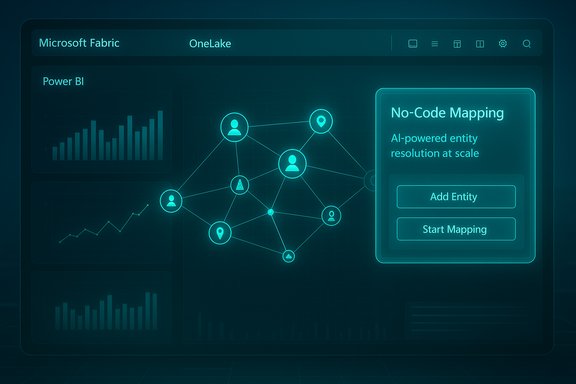
Quantexa has built a Decision Intelligence platform grounded in entity resolution and graph-driven context for several enterprise problems — from KYC and fraud to customer 360 and data management. Quantexa Unify is the company’s workload designed to live inside Microsoft Fabric: it reads data from OneLake, performs large-scale entity matching and consolidation, surfaces data-quality dashboards in Power BI, and produces consolidated outputs ready for downstream analytics and Copilot-driven workflows. The vendor presents Unify as a native Fabric workload that reduces manual MDM overhead and accelerates time-to-insight for Fabric customers.
Practical next steps for any organization evaluating Unify are to request the vendor’s detailed technical deployment plan, confirm the exact Marketplace/Fabric listing and entitlements, obtain real customer references in a similar vertical or data profile, and run a measured PoC on representative data to validate accuracy, throughput and cost models. These steps will turn the vendor promise into operational certainty and protect against the common mismatch between marketing language and production reality.
Source: The Manila Times Quantexa Announces General Availability of Quantexa Unify for Microsoft Fabric
 Background
For years IT teams and analytics leaders have chased the “Enterprise 360” ideal: a contextual, consolidated view of people, organizations, accounts and locations that lets analytics, compliance and automation run from a single source of truth. That ambition is now colliding with new pressures — exploding data volumes, distributed SaaS systems, strict privacy controls, and the operational demands of production-grade generative AI — pushing enterprises toward platform approaches that combine governance, scale and semantic context. Microsoft Fabric, anchored by OneLake and integrated workloads (SQL, Real‑time, Power BI, and AI surfaces), is precisely the platform many enterprises are adopting to meet those needs.Quantexa has built a Decision Intelligence platform grounded in entity resolution and graph-driven context for several enterprise problems — from KYC and fraud to customer 360 and data management. Quantexa Unify is the company’s workload designed to live inside Microsoft Fabric: it reads data from OneLake, performs large-scale entity matching and consolidation, surfaces data-quality dashboards in Power BI, and produces consolidated outputs ready for downstream analytics and Copilot-driven workflows. The vendor presents Unify as a native Fabric workload that reduces manual MDM overhead and accelerates time-to-insight for Fabric customers.
What Quantexa Unify claims to deliver
Quantexa’s product materials and press communications describe Unify as an AI-powered entity resolution and master‑data solution built for Microsoft Fabric. Key product claims and capabilities include:- Native OneLake connectivity — read and map data directly from OneLake without heavy extraction or copy cycles.
- Advanced entity matching and linking — probabilistic, graph-augmented resolution across people, organizations, locations, accounts and custom entity types at scale.
- No-code configuration and mapping — visual point‑and‑click interfaces for business and data users to map fields and validate matching rules.
- Embedded observability — Power BI dashboards showing match quality, duplicate rates, lineage and remediation workflows.
- Scalability for large estates — engineered to operate at billions of records, with vendor claims of high throughput and enterprise scale.
- Integration with Microsoft AI surfaces — outputs that feed Microsoft 365 Copilot, Copilot Studio and Azure AI/Foundry workflows for analytics, RAG (retrieval‑augmented generation) and automated decisioning.
Verifying the claims — what independent sources show
Because Quantexa’s announcement and the surrounding marketing claims will shape procurement and architecture conversations, it is important to verify the highest-impact statements against independent sources.- Quantexa’s product page for Unify details the OneLake connectivity, entity-resolution approach, and embedded Power BI dashboards. This is the vendor’s primary product description for the workload.
- Quantexa and related press wires previously announced an immediate availability/preview launch for the Unify Workload at Microsoft Ignite in November 2024; independent trade coverage (enterprise press outlets) reported the launch and echoed vendor claims about accuracy and scale. The archives show a November Ignite announcement and product presence in the Marketplace or Fabric Workload Hub as early as late 2024. These historical notices are important context for adoption and availability timelines.
- Quantexa cites an independently commissioned TEI (Total Economic Impact) study — and public materials reference a Forrester TEI-style analysis with a reported three‑year 228% ROI figure and payback under eight months. That ROI figure appears in multiple Quantexa press items and vendor summaries, but the underlying TEI report should be reviewed directly by buyers to confirm the composite assumptions, sample size and applicability to a particular vertical.
Why Quantexa’s approach matters (the upside)
- Fewer manual ETL and MDM bottlenecks. Quantexa’s value proposition focuses on automated, AI‑assisted entity resolution that reduces the manual matching, deduplication and consolidation work that typically delays analytics projects by months. Embedding that capability inside Fabric removes a major friction point between raw data and analytics-ready models.
- Contextualized data for AI and Copilot. High‑quality, de‑duplicated atomic records are the most important input for reliable generative-AI outputs and for model training. By producing consolidated entity graphs and enriched records, Unify can raise the fidelity of downstream Copilot prompts, RAG results and ML pipelines. This matters because generative systems amplify data‑quality problems if the underlying data is inconsistent or duplicated.
- Business‑user accessibility with governance. No‑code mapping and embedded Power BI dashboards aim to put data-quality remediation and validation into the hands of business analysts while retaining governance controls through Fabric and OneLake. If implemented correctly, that combination speeds remediation cycles while preserving audit trails.
- Procurement and platform economics. Packaging Unify as a Fabric workload or Marketplace listing makes it easier for Microsoft-centric customers to buy, provision and meter the workload alongside their existing Fabric spend — simplifying vendor management and commercial alignment. The marketplace route also supports internal procurement constructs such as consumption commitments.
Where caution is required (the risks and open questions)
- “GA” vs “Preview” confusion. Trade reporting and Quantexa’s early releases show variability in language between preview availability, immediate availability at Ignite and full GA. Enterprise Times and other independent articles flagged this ambiguity at launch time; procurement teams should confirm the precise GA date, supported SLAs and feature parity between preview and GA listings before contracting. Marketing blur between preview and GA is common in the data-platform world and can impact support expectations and compliance requirements.
- Accuracy claims need operational validation. Vendor materials reference high accuracy rates and broad matching outcomes (vendor claims vary, sometimes citing 99% accuracy for specific matching projects). Those numbers are strongly dependent on the datasets, golden‑record definitions, training metadata and pre/post‑match human review rules. Independent trials on representative customer data are essential; accuracy claims should be treated as vendor-stated until a customer completes a PoC and verifies false‑positive/false‑negative rates in their environment.
- Governance and privacy dependencies. Unify’s ability to reconcile PII, link cross‑system identities and enrich records raises legitimate privacy and compliance questions. A workload that aggregates PII across systems increases the need for robust Purview classification, retention policies, consent management, and least‑privilege access. Fabric’s governance primitives (Entra identity, Purview labeling, role-based access) reduce risk but do not eliminate the need for disciplined operational controls.
- Microsoft-centric lock‑in. Quantexa Unify is purpose-built for Fabric and OneLake. That delivers tight integration and simplified operations for Microsoft-first estates, but it also means that firms with heterogenous lake strategies (multi-cloud or Snowflake-first environments) should evaluate portability, exportability of resolved golden records, and vendor commitments for multi-platform support. Architecture decisions should factor in potential future migrations.
- Cost and performance trade-offs. Entity resolution at scale is compute- and I/O-intensive. Customers should model ingestion, matching cycles and refresh cadences to estimate ongoing compute costs inside Fabric (especially if high-frequency matching and near‑real‑time resolution is required). The vendor’s scalability claims are encouraging, but independent benchmarking on representative data volumes is prudent.
Realistic enterprise use cases
- Regulatory KYC and financial crime detection. Consolidating cross-system identity fragments is a core KYC problem; Quantexa’s existing customer base uses its platform for KYC and AML workflows. Bringing that capability into Fabric reduces the friction of feeding analytics and case-management outputs into Power BI and other downstream tools.
- Customer 360 and single customer view for CX. Marketing, support and revenue teams benefit from deduplicated, enriched customer profiles for personalization and churn prediction. Unify can reduce end-to-end time to actionable 360 views when integrated with CRM, telemetry and billing data in OneLake.
- Data foundation for trustworthy Copilot experiences. When Copilot and other agents draw on the same consolidated, authoritative records, their outputs are less likely to contradict transactional systems. Using Unify’s resolved dataset as the ground truth for Copilot prompts reduces hallucination risk driven by duplicated or inconsistent inputs.
- Master data modernization after M&A. Entity matching across merged systems is one of the most common post-merger integration headaches. Automated entity resolution that runs at scale and writes back cleansed records can dramatically shorten M&A integration timelines.
Implementation checklist — a recommended path to production
- Inventory and classify the data sources to be consolidated (schemas, PII sensitivity, update cadence).
- Define success metrics for matching: precision, recall, acceptable false-positive thresholds, SLA for match latency.
- Run a scoped PoC on a representative sample (not a toy dataset). Validate match quality, performance, and the human‑in‑the‑loop remediation workflow.
- Validate governance controls: Entra service principals, Purview labels, table-level access policy and audit logging inside OneLake/Fabric.
- Measure cost: prototyped matching runs should be cost-modeled for compute, storage, and network egress to estimate ongoing runbooks.
- Operationalize lineage and reverse‑write strategy: ensure that golden records and mapping decisions are reproducible and that downstream systems receive versioned, auditable updates.
- Plan for continuous monitoring: implement Power BI health dashboards, alerting on duplicate rate drift, and scheduled re-resolution windows for changing data.
Procurement and vendor diligence tips
- Ask for the exact Marketplace or Fabric Workload Hub entry and verify entitlement, support tiers and SLA. Confirm whether the product is available as a Marketplace managed offer or as an in-tenant workload, and ask how billing and support will be handled inside your existing Microsoft commercial constructs.
- Require a sample TEI or TCO model that maps vendor ROI claims to your organization’s volumes, operational costs, and risk profile. Quantexa publishes a TEI-style ROI narrative in its press materials; customers should request the underlying assumptions and sample size before treating the ROI as universal.
- Validate data security posture with an architecture diagram that shows where resolved data resides, who can access it, and how write‑back is controlled (if used). Ensure that Purview classification and Entra‑based access controls are demonstrably enforced.
- Demand proof points: reference customers in your industry, measurable outcomes from PoC runs (precision/recall), and documented support pathways for scaling matching jobs into billions of records. Independent trade coverage provides color but procurement should rely on references with similar data characteristics.
Final assessment — practical value against realistic expectations
Quantexa Unify for Microsoft Fabric represents a logical, pragmatic extension of both vendors’ strategies: Quantexa brings entity resolution and contextual graph capabilities, and Microsoft Fabric supplies the unified lake, governance and analytics surfaces where consolidated data matters most. For organizations already invested in Fabric and OneLake, Unify reduces integration friction and can materially shorten the time from raw data to decision‑ready assets. The vendor’s TEI/ROI messaging is compelling; if the underlying assumptions align with a customer’s environment, the economic case can be strong. Yet, marketing claims must be validated: independent coverage flagged ambiguity between preview and GA language at launch and stressed the need for real-world performance validation. Accuracy claims and broad productivity numbers are dataset-dependent; they cannot substitute for a rigorous PoC. Customers should insist on representative testing, governance checklists and cost modeling before committing to large-scale rollouts.Conclusion
Quantexa Unify for Microsoft Fabric is a strategically sensible product for Microsoft-first enterprises that need fast, governed entity resolution embedded where their analytics and copilots run. It promises to simplify master data consolidation and to provide trusted, contextual records that power analytics, KYC, fraud detection and Copilot-driven automation. The strongest path forward for buyers is a short, measurable PoC that focuses on match quality, governance completeness and operational cost — and direct verification of the product’s Marketplace/Fabric Workload Hub status and GA commitments in your tenant.Practical next steps for any organization evaluating Unify are to request the vendor’s detailed technical deployment plan, confirm the exact Marketplace/Fabric listing and entitlements, obtain real customer references in a similar vertical or data profile, and run a measured PoC on representative data to validate accuracy, throughput and cost models. These steps will turn the vendor promise into operational certainty and protect against the common mismatch between marketing language and production reality.
Source: The Manila Times Quantexa Announces General Availability of Quantexa Unify for Microsoft Fabric
