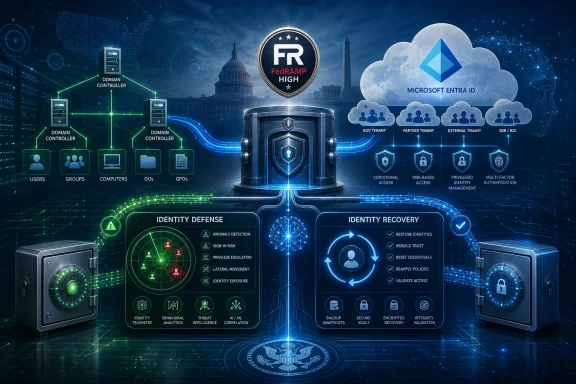
Quest Software announced on July 8, 2026, in Austin, Texas, that Quest Identity Defense and Quest Identity Recovery for Entra ID are available as a FedRAMP High authorized SaaS offering in Microsoft Azure Government for federal and regulated customers operating hybrid Microsoft identity estates. The announcement, distributed through GlobeNewswire and carried by The Manila Times, is more than another compliance badge in the crowded identity-security market. It is a signal that the fight over Active Directory, Microsoft Entra ID, and the identity control plane has moved from tooling preference to procurement gatekeeping. In the AI era, the vendors that can promise detection, containment, and recovery inside government-grade cloud boundaries will have an advantage over those still selling identity security as a dashboard.
FedRAMP High authorization is not glamorous, and that is exactly why it matters. It is the sort of certification that rarely excites a conference keynote but can decide whether a federal agency, defense contractor, hospital system, or energy operator can even evaluate a cloud service. Quest is pitching its new authorization as a way to bring identity threat detection and recovery into environments where “almost compliant” is not a useful category.
The company says Identity Defense and Identity Recovery for Entra ID are now available through a FedRAMP High authorized offering in Microsoft Azure Government. Quest also claims it is the only purpose-built identity threat detection and response provider for hybrid Active Directory and Microsoft Entra ID with a FedRAMP High authorized SaaS offering. That claim is carefully worded, as all market-leadership claims are, but the positioning is clear: Quest wants to be seen not merely as an AD recovery veteran, but as the high-assurance identity-resilience vendor for Microsoft-centric estates.
That distinction matters because the Microsoft identity stack is rarely tidy in the real world. Federal and regulated organizations often run hybrid identity for years, sometimes permanently, because legacy applications, domain-joined workloads, privileged administrative models, and compliance boundaries do not vanish when Entra ID becomes the strategic control plane. The risk lives in the seam between old and new.
Quest is trying to sell into that seam. Identity Defense promises discovery of identity exposure, prioritization of Tier 0 risk, proactive containment, and protection of critical identity assets. Identity Recovery promises a tested path to restore identity trust after ransomware, destructive change, or administrative compromise. Together, they form a sharper argument than “detect bad things”: identity security is only useful if the organization can still govern, contain, and recover after the directory is no longer trustworthy.
That is why ransomware operators and intrusion groups have spent years treating identity as infrastructure, not as a login screen. Compromise the right administrator, service principal, synchronization path, domain controller, or federation component, and the attacker no longer needs to break into every system one by one. The attacker can ask the estate to open itself.
Quest’s release leans into the claim that AI-driven exploitation is accelerating this problem. Vendors have every incentive to attach their products to AI risk, and buyers should read those claims with healthy skepticism. But the underlying point is not frivolous: automation makes it easier to enumerate exposures, test privilege paths, abuse stale credentials, and move through sprawling hybrid environments faster than human defenders can manually inspect them.
The AI framing also reflects a subtler shift. Enterprises are adding machine identities, service accounts, automation agents, workload identities, and increasingly autonomous assistants at the same time that security teams are trying to reduce standing privilege. The number of identities is expanding just as the tolerance for identity ambiguity is shrinking.
That is the context in which FedRAMP High becomes strategically useful. It tells regulated buyers that the vendor is not asking them to lower their assurance bar in order to modernize identity defense. Quest is saying the high-security market can have SaaS identity resilience without stepping outside the government-cloud trust envelope.
The High baseline is aimed at systems where loss of confidentiality, integrity, or availability could have severe or catastrophic effects. For identity security, that mapping is unusually direct. If an identity platform that watches, protects, or restores privileged access is itself weak, unavailable, or outside the authorized boundary, it becomes another dependency the agency has to defend.
Microsoft’s Azure Government already occupies a central place in this ecosystem, with Microsoft Learn documentation describing Azure Government’s FedRAMP High authorization posture and related compliance coverage. Quest’s move into Azure Government is therefore not just a hosting choice. It is a way to meet buyers where their regulated workloads, procurement language, and cloud-control expectations already live.
This is especially important for organizations handling controlled unclassified information, defense-related workloads, healthcare data, financial systems, and critical infrastructure operations. These buyers do not simply ask whether a product is technically useful. They ask whether the product can survive the audit trail, the contracting process, the incident-response review, and the inevitable architecture board.
The result is a paradox of modern security procurement: the best product may not be buyable, and the buyable product may not be the most elegant. FedRAMP High authorization helps Quest escape that trap. It does not prove the product is the best identity-security platform on the market, but it does make the platform much easier to defend in the rooms where regulated technology decisions are actually made.
Quest’s differentiator has long been its proximity to the messy operational world of Microsoft identity. Active Directory recovery is not a theoretical exercise. It involves system state, domain controllers, replication, privileged groups, password histories, backup integrity, malware persistence, and the uncomfortable question of whether restored infrastructure can be trusted after an attacker has owned the directory.
That history gives Quest a credible story when it connects Identity Defense with Identity Recovery. Detecting an exposed Tier 0 path is useful. Containing a threat before it becomes domain-wide compromise is better. Being able to recover identity services after ransomware or destructive administrative change is the part many boards only understand after the first disaster.
This is where Quest’s announcement has teeth. A FedRAMP High authorized detection tool would be notable. A FedRAMP High authorized recovery path for Entra ID is more strategically interesting, because cloud identity has become the recovery dependency for everything else. If administrators cannot authenticate, if privileged roles cannot be trusted, or if conditional access and application access have been corrupted, the broader recovery effort slows or stalls.
The industry has spent years telling customers to assume breach. The identity version of that doctrine is harsher: assume the directory may become untrustworthy. Quest is arguing that regulated organizations need not only visibility into that scenario, but rehearsed recovery under a security authorization model their auditors and contracting officers can accept.
For WindowsForum.com readers, this is not news; it is Tuesday. The gap between Microsoft’s cloud-forward identity vision and the actual topology of enterprise identity is where many security programs live. Hybrid identity is not a temporary inconvenience for many organizations. It is the operating model.
That is why Quest’s emphasis on both Active Directory and Entra ID is more than marketing completeness. Attackers do not respect product boundaries. A weakness in on-prem AD can become a cloud problem through synchronization and privilege escalation. A compromised cloud administrator can create consequences for applications and services that still depend on legacy identity assumptions.
The hard part is that hybrid identity multiplies responsibility. Security teams must understand the AD forest, Entra tenant, sync tooling, privileged access model, service principals, administrative roles, application permissions, conditional access, and recovery dependencies. Many organizations still do not have a complete map of those relationships.
Quest is betting that the market will reward platforms that speak both languages. That bet looks sound. Pure-cloud identity tooling can miss legacy privilege paths. Traditional AD tools can underplay cloud role abuse and service-principal risk. The buyer increasingly wants one operational view, not another console that stops at the boundary where the attacker keeps going.
AI does not magically make every attacker elite. It does, however, lower the cost of reconnaissance, scripting, lure generation, log parsing, and attack-path experimentation. In identity environments full of stale groups, over-permissioned service accounts, abandoned applications, weak recovery processes, and inconsistent conditional access, speed matters.
The bigger issue is not that AI creates identity risk from nothing. The bigger issue is that AI amplifies the advantage attackers already had: defenders operate through tickets, change windows, governance committees, and fragmented toolsets, while attackers chain together whatever works. If machine assistance makes that chaining faster, the directory becomes even more valuable as a target.
There is also a second AI problem that is less theatrical but more durable. Enterprises are creating new non-human identities to support automation, agents, data pipelines, cloud services, and AI workflows. Those identities often need access to sensitive data and systems. They may not have owners in the same way human accounts do, and they may persist long after the project that created them has changed.
That is why Quest’s recent acquisition of Anetac matters. In a June 17 GlobeNewswire announcement, Quest said it acquired Anetac to add AI-powered continuous visibility into human, non-human, and agentic identities. ISMG’s reporting on the acquisition described Anetac as an identity observability startup intended to complement Quest’s protection and recovery capabilities. The timing makes the FedRAMP High announcement look less like an isolated certification and more like a piece of a broader platform consolidation strategy.
That mismatch is becoming untenable. If AI agents are allowed to act across systems, retrieve data, initiate workflows, and interact with enterprise applications, then they become privileged actors whether the organization calls them that or not. Their access paths need to be visible, governed, monitored, and recoverable.
Quest’s platform story is that Identity Defense, Identity Recovery, and Anetac’s observability can eventually converge into a unified approach. That is ambitious, and integration after acquisition is always easier in a press release than in a product roadmap. Customers should watch how quickly Anetac’s capabilities become operationally meaningful inside Quest’s Security Management Platform, rather than merely appearing on slides.
Still, the direction is logical. Identity security cannot remain a human-account discipline in a world of automated workloads and agentic systems. The more enterprises depend on software actors, the more identity becomes a graph of delegated authority rather than a directory of users.
That shift is particularly relevant to federal and regulated buyers. These organizations are under pressure to adopt AI but cannot treat the resulting identity sprawl as experimental residue. The same agencies and contractors that need FedRAMP High cloud services will also need assurance that machine and agent identities are not invisible superusers.
That gives Quest a large addressable market, but it also creates a delicate positioning problem. Microsoft itself continues to expand security, identity governance, conditional access, privileged access, logging, and recovery capabilities. Any vendor building around Microsoft identity must prove that it adds operational depth without looking like a temporary patch for a platform gap Microsoft will eventually close.
Quest’s answer is specialization. The company argues that it operates at the identity control plane, with deeper AD and Entra visibility, active protection for critical identity assets, and recovery capabilities beyond what native platforms provide. That is a credible pitch for complex regulated environments, where native tools are often necessary but not sufficient.
The constraint is that customers will expect Quest to keep pace with Microsoft’s changes. Entra ID evolves quickly. Azure Government capabilities arrive under different constraints than commercial-cloud features. Security teams are already struggling to reconcile Microsoft 365, Defender, Sentinel, Entra, Purview, Intune, and third-party tooling. A specialized Quest platform must reduce friction, not add another layer of identity bureaucracy.
For sysadmins, the practical question is not whether Quest has a clever market category. It is whether the platform helps answer operational questions faster. Which Tier 0 assets are exposed? Which privileged paths cross AD and Entra ID? Which accounts or service principals should be contained now? If the tenant or directory is damaged, what is the tested route back to trust?
Agencies and contractors will want to understand which components are inside the authorized boundary, how data flows between on-premises AD and Azure Government, what telemetry is collected, where it is stored, how recovery operations are initiated, and what customer responsibilities remain. They will also want clarity around identity data sensitivity, privileged connector architecture, logging retention, incident response, and integration with existing government-cloud monitoring.
The same caution applies to the phrase “only purpose-built ITDR provider” in Quest’s announcement. It may be true under Quest’s definition of purpose-built, hybrid AD-and-Entra coverage, SaaS delivery, and FedRAMP High authorization. But customers should compare capabilities, authorization scope, and operational fit rather than treating any “only” claim as a substitute for due diligence.
That skepticism does not weaken the announcement. It makes the announcement more important. FedRAMP High authorization is not a magic shield; it is an assurance framework that gives buyers a starting point for deeper evaluation. Quest has moved itself into a more serious procurement conversation, and serious procurement conversations come with serious scrutiny.
The organizations most likely to care are also the ones least able to improvise after identity compromise. Federal civilian agencies, Department of Defense organizations, state and local governments, education institutions, defense industrial base companies, energy operators, healthcare systems, and financial institutions all have different regulatory drivers. They share one problem: when identity fails, the incident becomes systemic.
Identity resilience is the ability to maintain or restore trusted access decisions under stress. That includes knowing which accounts matter most, which systems depend on them, which privileges are toxic in combination, which recovery paths have been tested, and which controls survive a destructive event. It is not solved by a single product, but products can either help or hinder it.
Quest wants its Security Management Platform to sit across that lifecycle: exposure discovery, risk prioritization, containment, protection, modernization, and recovery. That is a broad promise. The danger with broad promises is that they can collapse into platform theater, where everything is unified in the diagram and fragmented in the console.
The opportunity is equally real. Security teams are tired of stitching together identity posture findings, SIEM alerts, privileged access workflows, backup procedures, and recovery runbooks after the incident has already started. A platform that can connect identity risk to recovery readiness would solve a painful operational gap.
FedRAMP High raises the stakes because it brings that platform argument into high-assurance environments. If Quest can make identity resilience practical for agencies and regulated enterprises, it will have something more durable than another acronym. It will have a story that aligns with how security leaders now think about survivability.
Boards and executives now understand that identity compromise can halt operations, enable data theft, derail cloud services, and delay recovery from ransomware. They may not understand Kerberos tickets or Entra service principals, but they understand that nobody can work if nobody can safely log in. Identity has become a business-continuity dependency.
That creates pressure on Windows and identity administrators from both sides. Security teams want reduced standing privilege, better telemetry, and faster containment. Business leaders want modernization, cloud adoption, and AI enablement. Auditors want evidence. Incident responders want recovery paths that were tested before the breach.
Quest’s announcement is best understood against that pressure. It offers regulated buyers a way to tell a coherent story: we are defending identity, we are preparing for recovery, and we are doing it with a SaaS platform that meets a high government assurance bar. Whether that story holds in practice depends on implementation, but the story itself is aligned with the moment.
For administrators, the lesson is not that FedRAMP High automatically makes Quest the right tool. The lesson is that identity recovery and resilience are no longer optional side quests. If the organization cannot explain how it would restore trust after AD or Entra compromise, it has not finished its ransomware plan.
A strong FedRAMP High offering must also respect the complexity of customer environments. Federal and regulated organizations often have segmented networks, privileged access workstations, disconnected enclaves, legacy domains, multiple tenants, cross-cloud dependencies, and strict change-control windows. The product that works elegantly in a demo tenant may struggle in the architecture diagram nobody wants to admit is real.
Quest’s long history with Microsoft identity gives it an advantage here. The company knows the enterprise AD world is full of exceptions, inherited designs, partial migrations, and political scars. If it can bring that realism into a SaaS model that satisfies FedRAMP High expectations, it will have a meaningful edge.
The company also has to avoid overplaying AI. Security buyers have become fluent in vendor AI language, and many are tired of being told every old problem is now new because a model is involved. Quest’s stronger argument is not that AI changes everything. It is that identity was already the control plane, automation is increasing the number and speed of identity decisions, and regulated environments need resilient defenses that are authorized for their risk model.
The announcement also reinforces a broader trend: identity security is becoming a lifecycle discipline. Posture management, threat detection, containment, privileged access, disaster recovery, and modernization are converging because attackers already treat them as one system. Vendors are catching up to the attacker’s map.
For Windows estates, the hybrid dimension remains the hard part. Any organization that still depends on AD while expanding Entra ID needs to understand how privilege, synchronization, recovery, and logging behave across that boundary. A FedRAMP High SaaS offering focused on both sides of that boundary is therefore worth attention, even for buyers that ultimately choose another path.
The decision should still be evidence-driven. Regulated customers should ask Quest to show the authorization boundary, deployment architecture, identity data handling, recovery workflow, customer responsibility matrix, integration roadmap for Anetac capabilities, and proof of recovery testing in environments resembling their own. Marketing claims start the conversation; architecture decides it.
 Quest Turns Compliance Into a Product Argument
FedRAMP High authorization is not glamorous, and that is exactly why it matters. It is the sort of certification that rarely excites a conference keynote but can decide whether a federal agency, defense contractor, hospital system, or energy operator can even evaluate a cloud service. Quest is pitching its new authorization as a way to bring identity threat detection and recovery into environments where “almost compliant” is not a useful category.The company says Identity Defense and Identity Recovery for Entra ID are now available through a FedRAMP High authorized offering in Microsoft Azure Government. Quest also claims it is the only purpose-built identity threat detection and response provider for hybrid Active Directory and Microsoft Entra ID with a FedRAMP High authorized SaaS offering. That claim is carefully worded, as all market-leadership claims are, but the positioning is clear: Quest wants to be seen not merely as an AD recovery veteran, but as the high-assurance identity-resilience vendor for Microsoft-centric estates.
That distinction matters because the Microsoft identity stack is rarely tidy in the real world. Federal and regulated organizations often run hybrid identity for years, sometimes permanently, because legacy applications, domain-joined workloads, privileged administrative models, and compliance boundaries do not vanish when Entra ID becomes the strategic control plane. The risk lives in the seam between old and new.
Quest is trying to sell into that seam. Identity Defense promises discovery of identity exposure, prioritization of Tier 0 risk, proactive containment, and protection of critical identity assets. Identity Recovery promises a tested path to restore identity trust after ransomware, destructive change, or administrative compromise. Together, they form a sharper argument than “detect bad things”: identity security is only useful if the organization can still govern, contain, and recover after the directory is no longer trustworthy.
The Identity Control Plane Has Become the Blast Radius
The phrase identity control plane can sound like vendor wallpaper until something goes wrong. In a Microsoft environment, Active Directory and Entra ID are not just authentication systems; they are the map of who can touch what, which machines trust which accounts, which applications can impersonate which services, and which administrators can change the rules. When that layer fails, security tools downstream inherit the failure.That is why ransomware operators and intrusion groups have spent years treating identity as infrastructure, not as a login screen. Compromise the right administrator, service principal, synchronization path, domain controller, or federation component, and the attacker no longer needs to break into every system one by one. The attacker can ask the estate to open itself.
Quest’s release leans into the claim that AI-driven exploitation is accelerating this problem. Vendors have every incentive to attach their products to AI risk, and buyers should read those claims with healthy skepticism. But the underlying point is not frivolous: automation makes it easier to enumerate exposures, test privilege paths, abuse stale credentials, and move through sprawling hybrid environments faster than human defenders can manually inspect them.
The AI framing also reflects a subtler shift. Enterprises are adding machine identities, service accounts, automation agents, workload identities, and increasingly autonomous assistants at the same time that security teams are trying to reduce standing privilege. The number of identities is expanding just as the tolerance for identity ambiguity is shrinking.
That is the context in which FedRAMP High becomes strategically useful. It tells regulated buyers that the vendor is not asking them to lower their assurance bar in order to modernize identity defense. Quest is saying the high-security market can have SaaS identity resilience without stepping outside the government-cloud trust envelope.
FedRAMP High Is the Procurement Moat Everyone Pretends Is Just Hygiene
FedRAMP is often described as a standardized approach to cloud security authorization for the U.S. government. That description is true, but incomplete. In practice, FedRAMP is also a market filter, a procurement accelerator, and a vendor credibility test for anyone selling cloud services into federal agencies and the contractors that support them.The High baseline is aimed at systems where loss of confidentiality, integrity, or availability could have severe or catastrophic effects. For identity security, that mapping is unusually direct. If an identity platform that watches, protects, or restores privileged access is itself weak, unavailable, or outside the authorized boundary, it becomes another dependency the agency has to defend.
Microsoft’s Azure Government already occupies a central place in this ecosystem, with Microsoft Learn documentation describing Azure Government’s FedRAMP High authorization posture and related compliance coverage. Quest’s move into Azure Government is therefore not just a hosting choice. It is a way to meet buyers where their regulated workloads, procurement language, and cloud-control expectations already live.
This is especially important for organizations handling controlled unclassified information, defense-related workloads, healthcare data, financial systems, and critical infrastructure operations. These buyers do not simply ask whether a product is technically useful. They ask whether the product can survive the audit trail, the contracting process, the incident-response review, and the inevitable architecture board.
The result is a paradox of modern security procurement: the best product may not be buyable, and the buyable product may not be the most elegant. FedRAMP High authorization helps Quest escape that trap. It does not prove the product is the best identity-security platform on the market, but it does make the platform much easier to defend in the rooms where regulated technology decisions are actually made.
Quest’s Real Bet Is Recovery, Not Just Detection
The identity-security market has been flooded with acronyms: ITDR, CIEM, IGA, PAM, DSPM-adjacent identity analytics, and more. Each category captures part of the problem. The trouble is that many tools are better at producing findings than restoring trust.Quest’s differentiator has long been its proximity to the messy operational world of Microsoft identity. Active Directory recovery is not a theoretical exercise. It involves system state, domain controllers, replication, privileged groups, password histories, backup integrity, malware persistence, and the uncomfortable question of whether restored infrastructure can be trusted after an attacker has owned the directory.
That history gives Quest a credible story when it connects Identity Defense with Identity Recovery. Detecting an exposed Tier 0 path is useful. Containing a threat before it becomes domain-wide compromise is better. Being able to recover identity services after ransomware or destructive administrative change is the part many boards only understand after the first disaster.
This is where Quest’s announcement has teeth. A FedRAMP High authorized detection tool would be notable. A FedRAMP High authorized recovery path for Entra ID is more strategically interesting, because cloud identity has become the recovery dependency for everything else. If administrators cannot authenticate, if privileged roles cannot be trusted, or if conditional access and application access have been corrupted, the broader recovery effort slows or stalls.
The industry has spent years telling customers to assume breach. The identity version of that doctrine is harsher: assume the directory may become untrustworthy. Quest is arguing that regulated organizations need not only visibility into that scenario, but rehearsed recovery under a security authorization model their auditors and contracting officers can accept.
Hybrid Microsoft Identity Remains the Enterprise’s Unfinished Migration
Every Microsoft identity modernization story eventually collides with Active Directory. Entra ID is the strategic cloud identity platform, but AD remains deeply embedded in enterprise Windows estates. Kerberos, LDAP, Group Policy, legacy applications, line-of-business systems, domain joins, file servers, and privileged administrative models continue to make AD difficult to retire.For WindowsForum.com readers, this is not news; it is Tuesday. The gap between Microsoft’s cloud-forward identity vision and the actual topology of enterprise identity is where many security programs live. Hybrid identity is not a temporary inconvenience for many organizations. It is the operating model.
That is why Quest’s emphasis on both Active Directory and Entra ID is more than marketing completeness. Attackers do not respect product boundaries. A weakness in on-prem AD can become a cloud problem through synchronization and privilege escalation. A compromised cloud administrator can create consequences for applications and services that still depend on legacy identity assumptions.
The hard part is that hybrid identity multiplies responsibility. Security teams must understand the AD forest, Entra tenant, sync tooling, privileged access model, service principals, administrative roles, application permissions, conditional access, and recovery dependencies. Many organizations still do not have a complete map of those relationships.
Quest is betting that the market will reward platforms that speak both languages. That bet looks sound. Pure-cloud identity tooling can miss legacy privilege paths. Traditional AD tools can underplay cloud role abuse and service-principal risk. The buyer increasingly wants one operational view, not another console that stops at the boundary where the attacker keeps going.
AI Gives the Sales Pitch Urgency, but the Risk Was Already Here
Quest’s release invokes AI-driven exploitation, and President and General Manager Tod Weber argues that attackers are using AI to find unique vulnerabilities and reach what he calls the organization’s “crown jewels” in the identity layer. That is the sort of quote that fits neatly into 2026 security marketing. It is also a claim that deserves separation from the hype around it.AI does not magically make every attacker elite. It does, however, lower the cost of reconnaissance, scripting, lure generation, log parsing, and attack-path experimentation. In identity environments full of stale groups, over-permissioned service accounts, abandoned applications, weak recovery processes, and inconsistent conditional access, speed matters.
The bigger issue is not that AI creates identity risk from nothing. The bigger issue is that AI amplifies the advantage attackers already had: defenders operate through tickets, change windows, governance committees, and fragmented toolsets, while attackers chain together whatever works. If machine assistance makes that chaining faster, the directory becomes even more valuable as a target.
There is also a second AI problem that is less theatrical but more durable. Enterprises are creating new non-human identities to support automation, agents, data pipelines, cloud services, and AI workflows. Those identities often need access to sensitive data and systems. They may not have owners in the same way human accounts do, and they may persist long after the project that created them has changed.
That is why Quest’s recent acquisition of Anetac matters. In a June 17 GlobeNewswire announcement, Quest said it acquired Anetac to add AI-powered continuous visibility into human, non-human, and agentic identities. ISMG’s reporting on the acquisition described Anetac as an identity observability startup intended to complement Quest’s protection and recovery capabilities. The timing makes the FedRAMP High announcement look less like an isolated certification and more like a piece of a broader platform consolidation strategy.
Anetac Points to the Identity Market’s Next Boundary
The Anetac acquisition gives Quest a way to talk about the part of identity security that many organizations still handle poorly: the identities that are not employees. Service accounts, application identities, API credentials, bots, agents, and automation frameworks often live in the shadows of governance programs designed around joiner-mover-leaver processes for humans.That mismatch is becoming untenable. If AI agents are allowed to act across systems, retrieve data, initiate workflows, and interact with enterprise applications, then they become privileged actors whether the organization calls them that or not. Their access paths need to be visible, governed, monitored, and recoverable.
Quest’s platform story is that Identity Defense, Identity Recovery, and Anetac’s observability can eventually converge into a unified approach. That is ambitious, and integration after acquisition is always easier in a press release than in a product roadmap. Customers should watch how quickly Anetac’s capabilities become operationally meaningful inside Quest’s Security Management Platform, rather than merely appearing on slides.
Still, the direction is logical. Identity security cannot remain a human-account discipline in a world of automated workloads and agentic systems. The more enterprises depend on software actors, the more identity becomes a graph of delegated authority rather than a directory of users.
That shift is particularly relevant to federal and regulated buyers. These organizations are under pressure to adopt AI but cannot treat the resulting identity sprawl as experimental residue. The same agencies and contractors that need FedRAMP High cloud services will also need assurance that machine and agent identities are not invisible superusers.
Microsoft’s Ecosystem Is the Prize and the Constraint
Quest’s announcement is inseparable from Microsoft’s dominance in enterprise identity. Active Directory remains foundational to Windows networks, and Entra ID has become central to Microsoft 365, Azure, and modern cloud authentication. For many organizations, identity modernization is effectively Microsoft identity modernization.That gives Quest a large addressable market, but it also creates a delicate positioning problem. Microsoft itself continues to expand security, identity governance, conditional access, privileged access, logging, and recovery capabilities. Any vendor building around Microsoft identity must prove that it adds operational depth without looking like a temporary patch for a platform gap Microsoft will eventually close.
Quest’s answer is specialization. The company argues that it operates at the identity control plane, with deeper AD and Entra visibility, active protection for critical identity assets, and recovery capabilities beyond what native platforms provide. That is a credible pitch for complex regulated environments, where native tools are often necessary but not sufficient.
The constraint is that customers will expect Quest to keep pace with Microsoft’s changes. Entra ID evolves quickly. Azure Government capabilities arrive under different constraints than commercial-cloud features. Security teams are already struggling to reconcile Microsoft 365, Defender, Sentinel, Entra, Purview, Intune, and third-party tooling. A specialized Quest platform must reduce friction, not add another layer of identity bureaucracy.
For sysadmins, the practical question is not whether Quest has a clever market category. It is whether the platform helps answer operational questions faster. Which Tier 0 assets are exposed? Which privileged paths cross AD and Entra ID? Which accounts or service principals should be contained now? If the tenant or directory is damaged, what is the tested route back to trust?
Regulated Buyers Will Read the Fine Print
FedRAMP High authorization is a major credential, but buyers should still read the boundary documentation closely. In FedRAMP conversations, the authorization is attached to a system and its defined controls, not to every possible way a vendor’s brand might be deployed. The words “available through a FedRAMP High authorized offering” matter because scope matters.Agencies and contractors will want to understand which components are inside the authorized boundary, how data flows between on-premises AD and Azure Government, what telemetry is collected, where it is stored, how recovery operations are initiated, and what customer responsibilities remain. They will also want clarity around identity data sensitivity, privileged connector architecture, logging retention, incident response, and integration with existing government-cloud monitoring.
The same caution applies to the phrase “only purpose-built ITDR provider” in Quest’s announcement. It may be true under Quest’s definition of purpose-built, hybrid AD-and-Entra coverage, SaaS delivery, and FedRAMP High authorization. But customers should compare capabilities, authorization scope, and operational fit rather than treating any “only” claim as a substitute for due diligence.
That skepticism does not weaken the announcement. It makes the announcement more important. FedRAMP High authorization is not a magic shield; it is an assurance framework that gives buyers a starting point for deeper evaluation. Quest has moved itself into a more serious procurement conversation, and serious procurement conversations come with serious scrutiny.
The organizations most likely to care are also the ones least able to improvise after identity compromise. Federal civilian agencies, Department of Defense organizations, state and local governments, education institutions, defense industrial base companies, energy operators, healthcare systems, and financial institutions all have different regulatory drivers. They share one problem: when identity fails, the incident becomes systemic.
The Market Is Moving From Identity Security to Identity Resilience
The most interesting word in Quest’s announcement is not AI, FedRAMP, or even Entra. It is resilience. Security vendors have spent years selling prevention and detection, but identity compromise has repeatedly shown that prevention can fail and detection can arrive late. Resilience asks what happens next.Identity resilience is the ability to maintain or restore trusted access decisions under stress. That includes knowing which accounts matter most, which systems depend on them, which privileges are toxic in combination, which recovery paths have been tested, and which controls survive a destructive event. It is not solved by a single product, but products can either help or hinder it.
Quest wants its Security Management Platform to sit across that lifecycle: exposure discovery, risk prioritization, containment, protection, modernization, and recovery. That is a broad promise. The danger with broad promises is that they can collapse into platform theater, where everything is unified in the diagram and fragmented in the console.
The opportunity is equally real. Security teams are tired of stitching together identity posture findings, SIEM alerts, privileged access workflows, backup procedures, and recovery runbooks after the incident has already started. A platform that can connect identity risk to recovery readiness would solve a painful operational gap.
FedRAMP High raises the stakes because it brings that platform argument into high-assurance environments. If Quest can make identity resilience practical for agencies and regulated enterprises, it will have something more durable than another acronym. It will have a story that aligns with how security leaders now think about survivability.
The Windows Admin’s Problem Has Become the Board’s Problem
For decades, Active Directory hygiene was treated as an administrative discipline: group cleanup, delegation review, domain controller patching, backup validation, privileged-account management, and occasional painful forest-recovery planning. Important work, yes, but often invisible unless something broke. That invisibility is over.Boards and executives now understand that identity compromise can halt operations, enable data theft, derail cloud services, and delay recovery from ransomware. They may not understand Kerberos tickets or Entra service principals, but they understand that nobody can work if nobody can safely log in. Identity has become a business-continuity dependency.
That creates pressure on Windows and identity administrators from both sides. Security teams want reduced standing privilege, better telemetry, and faster containment. Business leaders want modernization, cloud adoption, and AI enablement. Auditors want evidence. Incident responders want recovery paths that were tested before the breach.
Quest’s announcement is best understood against that pressure. It offers regulated buyers a way to tell a coherent story: we are defending identity, we are preparing for recovery, and we are doing it with a SaaS platform that meets a high government assurance bar. Whether that story holds in practice depends on implementation, but the story itself is aligned with the moment.
For administrators, the lesson is not that FedRAMP High automatically makes Quest the right tool. The lesson is that identity recovery and resilience are no longer optional side quests. If the organization cannot explain how it would restore trust after AD or Entra compromise, it has not finished its ransomware plan.
The Real Test Comes After Authorization
The first test for Quest was achieving the authorization. The next test is operational adoption. High-assurance buyers will not judge the company solely by the announcement; they will judge it by deployment friction, documentation quality, support responsiveness, integration depth, and whether the platform produces fewer surprises during audits and incidents.A strong FedRAMP High offering must also respect the complexity of customer environments. Federal and regulated organizations often have segmented networks, privileged access workstations, disconnected enclaves, legacy domains, multiple tenants, cross-cloud dependencies, and strict change-control windows. The product that works elegantly in a demo tenant may struggle in the architecture diagram nobody wants to admit is real.
Quest’s long history with Microsoft identity gives it an advantage here. The company knows the enterprise AD world is full of exceptions, inherited designs, partial migrations, and political scars. If it can bring that realism into a SaaS model that satisfies FedRAMP High expectations, it will have a meaningful edge.
The company also has to avoid overplaying AI. Security buyers have become fluent in vendor AI language, and many are tired of being told every old problem is now new because a model is involved. Quest’s stronger argument is not that AI changes everything. It is that identity was already the control plane, automation is increasing the number and speed of identity decisions, and regulated environments need resilient defenses that are authorized for their risk model.
The Practical Read for Microsoft-Centric Regulated Shops
Quest’s certification does not eliminate the need for native Microsoft controls, disciplined administration, or recovery planning. It does, however, widen the set of tools that regulated organizations can consider without immediately colliding with cloud authorization constraints. That is a tangible change for teams that have watched commercial SaaS security products remain out of reach because the compliance boundary did not work.The announcement also reinforces a broader trend: identity security is becoming a lifecycle discipline. Posture management, threat detection, containment, privileged access, disaster recovery, and modernization are converging because attackers already treat them as one system. Vendors are catching up to the attacker’s map.
For Windows estates, the hybrid dimension remains the hard part. Any organization that still depends on AD while expanding Entra ID needs to understand how privilege, synchronization, recovery, and logging behave across that boundary. A FedRAMP High SaaS offering focused on both sides of that boundary is therefore worth attention, even for buyers that ultimately choose another path.
The decision should still be evidence-driven. Regulated customers should ask Quest to show the authorization boundary, deployment architecture, identity data handling, recovery workflow, customer responsibility matrix, integration roadmap for Anetac capabilities, and proof of recovery testing in environments resembling their own. Marketing claims start the conversation; architecture decides it.
Quest’s FedRAMP Move Narrows the Excuses
Quest’s July 8 announcement gives federal and regulated Microsoft customers a clearer option for identity defense and recovery inside a high-assurance SaaS model. It also puts pressure on competitors to clarify whether they can match the same combination of hybrid AD and Entra ID focus, recovery depth, and government-cloud authorization.- Quest Identity Defense and Quest Identity Recovery for Entra ID are now positioned as part of a FedRAMP High authorized offering in Microsoft Azure Government.
- The announcement matters most for organizations that must defend hybrid Active Directory and Entra ID environments without moving identity telemetry and recovery workflows outside approved cloud boundaries.
- The real value proposition is not merely identity threat detection, but the combination of exposure discovery, containment, and recovery after ransomware or administrative compromise.
- Quest’s Anetac acquisition suggests the company is preparing for identity-security problems involving non-human, machine, and agentic AI identities, not just human user accounts.
- Regulated buyers should treat the authorization as a strong procurement signal while still validating scope, architecture, data handling, and recovery procedures in detail.
References
- Primary source: The Manila Times
Published: 2026-07-08T10:30:08.955545
Quest Software Strengthens Identity Security and Resilience for the AI Era, Achieving FedRAMP® High Authorized Certification for Identity Defense and Identity Recovery | The Manila Times
New certification reinforces Quest’s leadership in identity security and resilience, enabling federal and regulated organizations to protect and recover the identity control plane with the highest level of government-grade assurance www.manilatimes.net
- Related coverage: globenewswire.com
Clearlake-backed Quest Software Acquires Anetac to Advance
Clearlake-backed Quest Software Acquires Anetac to Advance Identity Security for the Agentic AI Era, strengthening Quest's Security Platform...www.globenewswire.com - Related coverage: quest.com
Quest Software Acquires Identity Observability Vendor Anetac - News
Quest Software purchased an identity observability startup founded by the longtime leader of vArmour to continuously monitor identities and detect abnormal behavior across an environment. The Austin, Texas-based data management and cybersecurity vendor said its buy of Silicon Valley-based Anetac...www.quest.com - Related coverage: blog.quest.com
Identity Security for the New AI Reality - The Quest Blog
The rules of enterprise security have changed, and most organizations haven’t caught up. AI is scaling. Automation is accelerating. And identities are no longer just human. That’s why today we’re taking a decisive step...blog.quest.com - Related coverage: trysignalbase.com
Anetac Acquired by Quest Software | M&A News | Signalbase
Quest Software, a global enterprise software company, has acquired Anetac, a specialist in AI-powered Identity Vulnerability Management, for an undisclosed amount. This corporate acquisition sees Quest Software integrating Anetac's innovative platform into its security portfolio, marking a...www.trysignalbase.com - Official source: learn.microsoft.com
Configure Microsoft Entra ID to meet FedRAMP High Impact level - Microsoft Entra | Microsoft Learn
Overview of how you can meet a FedRAMP High Impact level for your organization by using Microsoft Entra ID.learn.microsoft.com
- Related coverage: tipranks.com
- Related coverage: app.dealroom.co
Quest Software acquires Anetac to strengthen identity security for AI-driven enterprises | Dealroom.co
Quest Software, backed by Clearlake Capital, has acquired Anetac, an AI-powered identity security provider, to strengthen its capabilities in managing human, non-human and agentic identities. Financial terms were not disclosed. The acquisition addresses growing security risks as machine...app.dealroom.co - Related coverage: support-public.cfm.quest.com
- Related coverage: okta.com
- Related coverage: s21.q4cdn.com