

Qwen3.5-0.8B is a genuine, unusually compact multimodal model that can run locally on Windows 10, but the “zero-click” installation claims circulating around it blur several important technical realities. The model itself is compelling: it packages text and image understanding, tool calling, a hybrid attention architecture, and a native 262,144-token context specification into roughly 0.8 billion language-model parameters. Yet Windows users should treat advertised requirements such as 16GB of RAM, 80GB of scratch storage, and an RTX 3060 as generic or mismatched guidance rather than requirements for this specific model—and they should not mistake a one-command Ollama launch for a literally zero-click, zero-risk deployment.
Qwen is Alibaba Cloud’s family of open-weight language and multimodal models. The project has evolved from conventional decoder-only models into a broad range of dense, mixture-of-experts, reasoning, coding, vision, and agent-oriented systems intended to compete across both cloud and local inference.
The Qwen3.5 family arrived in early 2026, with the smaller 9B, 4B, 2B, and 0.8B releases becoming publicly available on March 2, 2026. Qwen3.5-0.8B sits at the bottom of that range, but “smallest” does not mean stripped of every modern feature.
Qwen3.5 pushes further into hybrid architectures, multimodal input, long-context processing, and agent integration. The 0.8B edition matters because it attempts to move those features into a class of model that can run on ordinary PCs, compact servers, development boards, and—in sufficiently optimized form—even mobile hardware.
Developers can use a model of this size as a classifier, extraction engine, interface layer, routing model, structured-output generator, or component inside a larger retrieval system. In many of those roles, running a huge general-purpose model would waste memory, electricity, bandwidth, and money.
The figure of roughly 873 million parameters seen in third-party descriptions is therefore plausible as a package-level count, but users should not treat parameter totals from different tools as perfectly interchangeable.
That distinction changes nearly every hardware calculation. An 8B model may need several gigabytes of memory even after aggressive quantization, whereas a quantized 0.8B model package can fit in roughly 1GB, including overhead and multimodal components in common local distributions.
This architecture is central to the model’s attempt to support long contexts without imposing the full computational cost of standard attention at every layer.
Gated DeltaNet belongs to this broader family of efficient sequence mechanisms. Its gating controls how information is written, retained, and replaced, while delta-style updates allow the state to change as new tokens arrive.
The benefit is not simply lower memory use. A well-designed hybrid system can preserve fast sequential processing while periodically using full attention to recover relationships that a compressed recurrent state might otherwise miss.
The design reflects an important industry trend. Rather than choosing between Transformers and state-space or linear-attention models, developers are combining them, assigning each mechanism the work it performs most efficiently.
Windows users running the model through a simple desktop runtime may not automatically receive every optimization described in the research configuration. Support depends on the inference engine, model conversion, backend, and version in use.
That makes the core setup much less demanding than the shared 16GB-RAM and 80GB-disk recommendations suggest.
A more accurate sequence is:
Windows users should explicitly select the 0.8B tag. Otherwise, they may download several gigabytes of model data and conclude incorrectly that Qwen3.5-0.8B itself requires far more memory than it does.
A graphical client simplifies routine use, but it also adds another software layer. Users should understand where prompts are stored, whether telemetry is enabled, and whether the client makes any external network requests.
Those recommendations may describe a general local-AI workstation or a larger Qwen model, but they do not accurately represent the minimum needed to run Qwen3.5-0.8B.
Token generation is not exclusively a single-core workload. Local inference engines use vector instructions, multiple threads, memory bandwidth, and sometimes integrated graphics or discrete GPU acceleration.
A more practical breakdown is:
For Windows 10, a sensible range is:
Five to 10GB of free storage is a more reasonable minimum for basic experimentation. Keeping 20GB or more free is sensible for general Windows health, updates, temporary data, and future model downloads, but that is not the same as saying the model consumes 20GB.
Eighty gigabytes becomes relevant only when a user plans to download several larger models, retain multiple quantizations, build containers, perform fine-tuning, or process large collections of media.
A supported GPU can still improve speed. NVIDIA support tends to be straightforward when the installed driver and compute capability meet the runtime’s requirements, while AMD acceleration varies more by card, driver, backend, and Windows support status.
The often-repeated phrase “minimum 8B VRAM” appears to confuse 8GB of VRAM with an 8-billion-parameter model. Neither is a minimum requirement for Qwen3.5-0.8B.
In practice, a supported maximum is not the same as an efficient everyday setting.
The hybrid architecture reduces some of the scaling pressure associated with full attention, yet the periodic gated-attention layers still require context-related resources. A 262K prompt may therefore be technically supported while remaining impractical on a low-memory Windows PC.
Windows users should begin with a context limit between 4K and 16K. They can move to 32K or 64K when the task clearly benefits from it and the hardware remains responsive.
The strongest long-context workflow will often use retrieval rather than dumping everything into one conversation. A retrieval system searches a document collection, selects relevant passages, and sends only the most useful material to the model.
Descriptions that call the model natively multimodal are broadly fair, but “multimodal” should not be interpreted as equally strong mastery of text, images, video, and audio.
Its small parameter count limits subtle interpretation. Tiny text, dense tables, ambiguous diagrams, specialist medical imagery, and complex spatial reasoning can cause errors.
Ollama’s listing emphasizes text and image input. A Windows application may add video support by extracting frames, but that capability belongs partly to the application pipeline rather than solely to the language model.
For dependable extraction, developers should validate output against schemas and business rules. The model should not be allowed to invent missing values simply because an automation pipeline expects every field to be populated.
The model can be prompted or configured to emit JSON and select tools, but the surrounding runtime remains responsible for parsing, validation, permission control, execution, and error handling.
Production code should:
This separation is a security boundary. A model should never receive unrestricted PowerShell, file-system, registry, browser, or network access simply because it supports tool calling.
Calling this “autonomous” can conceal the amount of engineering required. A safe agent needs least-privilege permissions, explicit approval gates, audit logs, isolated execution, and deterministic safeguards outside the model.
That is particularly relevant for Windows 10 systems excluded from Windows 11 by Microsoft’s hardware requirements.
Qwen3.5-0.8B can turn such a PC into:
Local does not automatically mean private, however. A front end may synchronize conversations, a plugin may contact external services, or an agent may invoke web tools. Users need to inspect the complete application path, not just the model’s location.
The model’s small footprint changes the economics of inference by reducing hardware needs and allowing more instances per server.
Local processing can reduce network dependency and cloud inference fees. It can also support environments where latency, connectivity, or data-residency rules prevent routine cloud use.
A layered system might work as follows:
A narrowly trained 0.8B model may outperform a much larger general model on a carefully defined classification or extraction task. The key is representative data, disciplined evaluation, and safeguards against catastrophic forgetting or overfitting.
That fact is more consequential than whether Qwen3.5-0.8B can generate 20 or 40 tokens per second.
Running this stack on an unpatched operating system compounds the risk. A private local model is not a security control if its host is vulnerable.
At minimum, restrict the service to the local machine, use a standard user account, block unnecessary inbound connections, maintain backups, and avoid granting agent tools administrative rights.
Runtime support for Qwen3.5 was still evolving after release, with some high-performance frameworks initially requiring development or nightly builds. Stable implementation across Ollama, llama.cpp, Transformers, vLLM, SGLang, and hardware-specific engines will determine how much of the architecture’s theoretical efficiency reaches everyday users.
Users should compare quantizations on their actual workload rather than assuming that the smallest download is always best. A slightly larger 6-bit or 8-bit package may provide better accuracy while still fitting easily in system memory.
Microsoft’s own Windows AI strategy increasingly emphasizes neural processing units and Windows 11 integration. Qwen’s advantage is that it can remain runtime-agnostic and usable on a much broader range of existing hardware, including Windows 10 PCs that lack an NPU.
Success will depend on putting deterministic policy around probabilistic output. The model can interpret intent, but conventional software should decide what is permitted.
Qwen3.5-0.8B is a meaningful release for Windows users because it demonstrates how quickly capabilities once associated with heavyweight AI systems are moving into sub-billion-parameter packages. It can run on Windows 10 with far less hardware than some reports imply, and it offers a practical route into local text, image, JSON, and tool-oriented experimentation. The responsible interpretation, however, is not that every old PC has gained a flawless 262K-context autonomous agent with one click; it is that developers and enthusiasts now have an efficient building block whose value depends on realistic context settings, careful output validation, restricted permissions, accurate model selection, and—especially on Windows 10—a secure and properly maintained host.
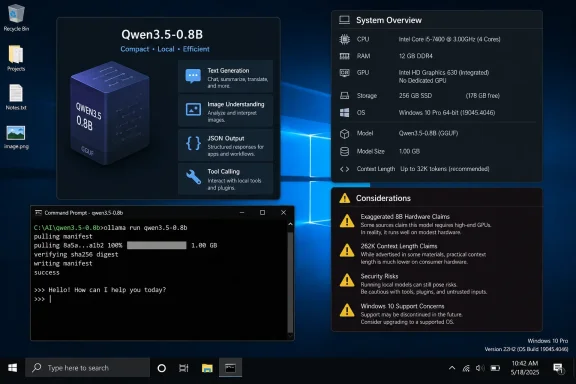 Background
Qwen is Alibaba Cloud’s family of open-weight language and multimodal models. The project has evolved from conventional decoder-only models into a broad range of dense, mixture-of-experts, reasoning, coding, vision, and agent-oriented systems intended to compete across both cloud and local inference.The Qwen3.5 family arrived in early 2026, with the smaller 9B, 4B, 2B, and 0.8B releases becoming publicly available on March 2, 2026. Qwen3.5-0.8B sits at the bottom of that range, but “smallest” does not mean stripped of every modern feature.
From Qwen to Qwen3.5
Earlier Qwen generations followed the same broad scaling pattern seen across the open-model ecosystem: release several parameter sizes, provide base and instruction-tuned variants, and let users choose between speed and capability. Qwen3 expanded that strategy with explicit thinking modes and a wider selection of dense and sparse models.Qwen3.5 pushes further into hybrid architectures, multimodal input, long-context processing, and agent integration. The 0.8B edition matters because it attempts to move those features into a class of model that can run on ordinary PCs, compact servers, development boards, and—in sufficiently optimized form—even mobile hardware.
Why sub-billion-parameter models matter
A sub-billion model will not match a leading cloud system on open-ended reasoning, complex programming, or factual breadth. Its value comes from low cost, low latency, privacy, and specialization, especially when the task is narrow and repeatable.Developers can use a model of this size as a classifier, extraction engine, interface layer, routing model, structured-output generator, or component inside a larger retrieval system. In many of those roles, running a huge general-purpose model would waste memory, electricity, bandwidth, and money.
What Qwen3.5-0.8B Actually Is
The official model is described as a causal language model with a vision encoder. The language component contains approximately 0.8 billion parameters, while some distributions and runtimes may report slightly different totals depending on whether they count auxiliary components, embeddings, or the vision stack.The figure of roughly 873 million parameters seen in third-party descriptions is therefore plausible as a package-level count, but users should not treat parameter totals from different tools as perfectly interchangeable.
Core specifications
The most important published characteristics include:- The language model has approximately 0.8 billion parameters.
- The architecture uses 24 layers and a 1,024-dimensional hidden representation.
- The model combines Gated DeltaNet layers with conventional gated attention layers.
- The native maximum context specification is 262,144 tokens.
- It accepts text and image input, with multimodal handling provided through a vision encoder.
- It supports thinking and non-thinking operation, although non-thinking mode is the default.
- It can produce structured output and participate in tool-calling workflows when the runtime and prompt template support those features.
- The broader Qwen3.5 design targets 201 languages and dialects.
“0.8B” does not mean an 8B model
One of the biggest problems with the installation guidance being shared online is that it repeatedly refers to requirements for a “stable 8B model.” Qwen3.5-0.8B is not an 8B model. It is approximately one-tenth that size.That distinction changes nearly every hardware calculation. An 8B model may need several gigabytes of memory even after aggressive quantization, whereas a quantized 0.8B model package can fit in roughly 1GB, including overhead and multimodal components in common local distributions.
The Hybrid Architecture Explained
Qwen3.5-0.8B does not rely exclusively on the standard self-attention mechanism used by conventional Transformers. It alternates mostly linear-attention-style Gated DeltaNet blocks with periodic gated attention blocks.This architecture is central to the model’s attempt to support long contexts without imposing the full computational cost of standard attention at every layer.
Gated DeltaNet layers
Traditional self-attention compares token representations across a sequence, creating costs that can grow sharply as the prompt becomes longer. Linear or recurrent alternatives summarize prior information into a state, potentially reducing the cost of processing long sequences.Gated DeltaNet belongs to this broader family of efficient sequence mechanisms. Its gating controls how information is written, retained, and replaced, while delta-style updates allow the state to change as new tokens arrive.
The benefit is not simply lower memory use. A well-designed hybrid system can preserve fast sequential processing while periodically using full attention to recover relationships that a compressed recurrent state might otherwise miss.
Periodic gated attention
According to the model configuration, Qwen3.5-0.8B organizes its hidden layers into a repeated pattern containing several Gated DeltaNet blocks followed by a standard gated-attention block. This gives the model occasional opportunities to perform more explicit token-to-token interaction.The design reflects an important industry trend. Rather than choosing between Transformers and state-space or linear-attention models, developers are combining them, assigning each mechanism the work it performs most efficiently.
Multi-token prediction
Qwen3.5 was also trained with multi-token prediction. In a compatible serving stack, this can support speculative or multi-token generation strategies that attempt to produce more than one token per expensive model step.Windows users running the model through a simple desktop runtime may not automatically receive every optimization described in the research configuration. Support depends on the inference engine, model conversion, backend, and version in use.
Running It on Windows 10
Ollama officially remains available for Windows 10 or later, making it one of the simplest ways to test Qwen3.5-0.8B. Its model library offers a roughly 1GB Qwen3.5-0.8B package with text and image input and a listed 256K context capacity.That makes the core setup much less demanding than the shared 16GB-RAM and 80GB-disk recommendations suggest.
A realistic installation sequence
Calling the process “zero-click” is marketing shorthand at best. A user still needs to download an application, install it, obtain the model, wait for the model files to be pulled, and interact with it through a terminal, desktop client, or API.A more accurate sequence is:
- Confirm that Windows 10 is fully patched and, where applicable, enrolled in Extended Security Updates.
- Install current graphics drivers if GPU acceleration is expected.
- Download and install a trusted local inference runtime such as Ollama.
- Open PowerShell, Windows Terminal, Command Prompt, or a compatible graphical front end.
- Pull and launch the specific
qwen3.5:0.8bmodel rather than an unspecifiedqwen3.5default. - Test short text prompts before adding images, large documents, tools, or long context.
- Monitor RAM, GPU memory, CPU use, storage, and response quality before integrating the model into automation.
Selecting the correct tag matters
Using a generic model-family name can select a larger default model depending on the runtime’s current library configuration. That may explain why some guides recommend hardware more appropriate for an 8B or 9B model.Windows users should explicitly select the 0.8B tag. Otherwise, they may download several gigabytes of model data and conclude incorrectly that Qwen3.5-0.8B itself requires far more memory than it does.
Command line versus graphical clients
Ollama provides the local model service, but users do not have to remain in a command-line interface. Compatible chat applications can connect to its local API and provide conversation history, model controls, document attachment, and image input.A graphical client simplifies routine use, but it also adds another software layer. Users should understand where prompts are stored, whether telemetry is enabled, and whether the client makes any external network requests.
The Real Hardware Requirements
The hardware guidance attached to the July 20 report appears internally inconsistent. It says that high CPU performance is needed for token latency, 16GB of RAM is the minimum for stable “8B” loading, 80GB of storage is needed for scratch space, and an RTX 3060 or Radeon RX 6600 is required for “8B VRAM offloading.”Those recommendations may describe a general local-AI workstation or a larger Qwen model, but they do not accurately represent the minimum needed to run Qwen3.5-0.8B.
Processor requirements
A modern CPU with strong single-thread and memory performance will improve responsiveness, but the model does not require a workstation-class processor. Four reasonably modern physical cores can be enough for basic experimentation, and additional cores can improve prompt processing depending on the backend.Token generation is not exclusively a single-core workload. Local inference engines use vector instructions, multiple threads, memory bandwidth, and sometimes integrated graphics or discrete GPU acceleration.
A more practical breakdown is:
- Older dual-core systems may run the model but can feel sluggish.
- Recent quad-core and six-core processors should offer usable text interaction.
- Modern desktop CPUs can provide fast output without a discrete GPU.
- GPU acceleration matters more for image processing, high concurrency, and aggressively long prompts than for basic short-form chat.
Memory requirements
A quantized 0.8B model can run on systems with far less than 16GB of RAM. The downloadable Ollama package is approximately 1GB, although total process memory will be higher because the runtime must also allocate working buffers, context state, image-processing components, operating-system memory, and application overhead.For Windows 10, a sensible range is:
- 4GB of system RAM is an experimental floor, not a comfortable target.
- 8GB can support ordinary short-context text use if other applications are limited.
- 16GB provides comfortable headroom for images, larger prompts, and multitasking.
- 32GB becomes useful for testing longer contexts, several models, or development tools simultaneously.
Disk-space requirements
Qwen3.5-0.8B does not need 80GB of free storage for ordinary operation. The model package itself is around 1GB in the widely available Ollama distribution, with additional space needed for the application, caches, logs, temporary files, and any other models.Five to 10GB of free storage is a more reasonable minimum for basic experimentation. Keeping 20GB or more free is sensible for general Windows health, updates, temporary data, and future model downloads, but that is not the same as saying the model consumes 20GB.
Eighty gigabytes becomes relevant only when a user plans to download several larger models, retain multiple quantizations, build containers, perform fine-tuning, or process large collections of media.
Graphics hardware
An RTX 3060 or Radeon RX 6600 is not required. Qwen3.5-0.8B can run on a CPU, and its small size makes it a particularly appropriate choice for systems without high-end graphics.A supported GPU can still improve speed. NVIDIA support tends to be straightforward when the installed driver and compute capability meet the runtime’s requirements, while AMD acceleration varies more by card, driver, backend, and Windows support status.
The often-repeated phrase “minimum 8B VRAM” appears to confuse 8GB of VRAM with an 8-billion-parameter model. Neither is a minimum requirement for Qwen3.5-0.8B.
The 262K Context Window Reality Check
A native 262,144-token context window is one of the model’s most eye-catching specifications. In theory, that is enough capacity for very large document collections, extensive chat histories, source-code repositories, logs, or long multimodal prompts.In practice, a supported maximum is not the same as an efficient everyday setting.
Model weights are only part of memory use
The model’s weights remain relatively small regardless of prompt length, but context processing creates additional state. Attention caches, recurrent states, token buffers, vision tokens, and runtime workspaces all consume memory.The hybrid architecture reduces some of the scaling pressure associated with full attention, yet the periodic gated-attention layers still require context-related resources. A 262K prompt may therefore be technically supported while remaining impractical on a low-memory Windows PC.
Long prompts increase latency
Even when a prompt fits into memory, the model must read and encode it. Feeding hundreds of thousands of tokens can take much longer than generating an answer from a short prompt, especially on a CPU.Windows users should begin with a context limit between 4K and 16K. They can move to 32K or 64K when the task clearly benefits from it and the hardware remains responsive.
Context capacity is not comprehension quality
A model may accept information without using every detail reliably. This is particularly important for a 0.8B model, whose limited capacity can constrain its ability to reason over a massive prompt.The strongest long-context workflow will often use retrieval rather than dumping everything into one conversation. A retrieval system searches a document collection, selects relevant passages, and sends only the most useful material to the model.
Multimodal Capabilities and Their Limits
Qwen3.5-0.8B includes a vision encoder and can accept image input in compatible runtimes. This opens the door to screenshot interpretation, basic document analysis, user-interface assistance, object identification, and visual question answering.Descriptions that call the model natively multimodal are broadly fair, but “multimodal” should not be interpreted as equally strong mastery of text, images, video, and audio.
Image understanding
The model can analyze images presented alongside text. Useful examples include asking it to identify visible controls in a screenshot, summarize a chart, extract prominent text, or describe an object.Its small parameter count limits subtle interpretation. Tiny text, dense tables, ambiguous diagrams, specialist medical imagery, and complex spatial reasoning can cause errors.
Video claims need qualification
Some Qwen-family systems support video by sampling or encoding frames, and software can transform a video into a sequence of images for a multimodal model. That does not mean every local Qwen3.5-0.8B runtime provides seamless native video ingestion.Ollama’s listing emphasizes text and image input. A Windows application may add video support by extracting frames, but that capability belongs partly to the application pipeline rather than solely to the language model.
Document extraction
A small vision-language model can be effective for constrained document tasks when layouts are predictable. It might identify a total on an invoice, extract a date from a form, or classify a scanned page.For dependable extraction, developers should validate output against schemas and business rules. The model should not be allowed to invent missing values simply because an automation pipeline expects every field to be populated.
JSON, Function Calling, and Agent Workflows
Structured output and tool use are among the most valuable features in Qwen3.5-0.8B. They also create the greatest difference between merely chatting with a model and building an application around it.The model can be prompted or configured to emit JSON and select tools, but the surrounding runtime remains responsible for parsing, validation, permission control, execution, and error handling.
Native JSON is not automatic correctness
JSON mode can encourage syntactically structured output. It does not guarantee that every field contains correct information or that the response always matches an application’s exact schema.Production code should:
- Validate output against a defined JSON schema.
- Reject unexpected properties and invalid data types.
- Set length, time, and recursion limits.
- Handle malformed output without silently guessing.
- Record enough diagnostic information to investigate failures.
- Avoid placing credentials or sensitive data directly into model prompts.
Function calling requires an executor
The model does not directly execute a Windows function merely because it writes a function-call object. A host application receives that object, decides whether it is permitted, runs the associated code, and sends the result back.This separation is a security boundary. A model should never receive unrestricted PowerShell, file-system, registry, browser, or network access simply because it supports tool calling.
“Agent scaffolds” are not autonomy
An agent scaffold typically combines a model with a loop, tools, memory, and stopping rules. The model proposes an action, software executes it, the result returns to the model, and the loop continues until the objective is complete or a limit is reached.Calling this “autonomous” can conceal the amount of engineering required. A safe agent needs least-privilege permissions, explicit approval gates, audit logs, isolated execution, and deterministic safeguards outside the model.
Consumer Impact
For consumers, Qwen3.5-0.8B lowers the barrier to local AI. It can operate without sending every prompt to a remote provider, and its small model package makes experimentation practical on PCs that would struggle with 7B, 8B, or 9B alternatives.That is particularly relevant for Windows 10 systems excluded from Windows 11 by Microsoft’s hardware requirements.
A second life for older PCs
Many Windows 10 machines still have capable Intel Core or AMD Ryzen processors, adequate RAM, and SSD storage. They may lack a supported TPM configuration or approved processor for Windows 11, but they can still run lightweight local AI.Qwen3.5-0.8B can turn such a PC into:
- A private drafting and rewriting assistant.
- A local interface for searching personal notes.
- A lightweight image and screenshot analyzer.
- A classification engine for files or messages.
- A home-automation command parser.
- An offline educational or language-practice tool.
Privacy benefits
Local processing can keep prompts and source material on the PC. That is valuable for personal journals, unpublished writing, private photographs, and internal documents.Local does not automatically mean private, however. A front end may synchronize conversations, a plugin may contact external services, or an agent may invoke web tools. Users need to inspect the complete application path, not just the model’s location.
Enterprise and Developer Impact
Enterprises are unlikely to adopt a 0.8B model as a universal employee assistant. They may find it highly effective as a low-cost component deployed close to data sources, endpoints, factory systems, or branch offices.The model’s small footprint changes the economics of inference by reducing hardware needs and allowing more instances per server.
Edge and endpoint deployment
A compact model can process information where it is generated. Potential uses include form triage, equipment-log classification, multilingual routing, visual inspection assistance, and extraction from standardized documents.Local processing can reduce network dependency and cloud inference fees. It can also support environments where latency, connectivity, or data-residency rules prevent routine cloud use.
Model routing
One promising role is to use Qwen3.5-0.8B as a front-end router. It can classify a request, estimate its complexity, extract metadata, and decide whether to answer locally or forward the problem to a larger model.A layered system might work as follows:
- The 0.8B model receives and classifies the request.
- A policy engine checks sensitivity, cost, and permitted destinations.
- Simple tasks remain local.
- Complex tasks move to a larger on-premises or cloud model.
- The small model formats or validates the final response.
Fine-tuning and specialization
The official guidance positions the model for prototyping, research, development, and task-specific fine-tuning. Its size makes experiments more accessible than they would be with a large foundation model.A narrowly trained 0.8B model may outperform a much larger general model on a carefully defined classification or extraction task. The key is representative data, disciplined evaluation, and safeguards against catastrophic forgetting or overfitting.
Windows 10 Is Now the Bigger Risk
Windows 10 reached the end of normal support on October 14, 2025. As of July 21, 2026, a standard Windows 10 installation that is not covered by an applicable Extended Security Updates program is no longer receiving the normal stream of Microsoft security fixes.That fact is more consequential than whether Qwen3.5-0.8B can generate 20 or 40 tokens per second.
Local AI expands the attack surface
Installing an inference service introduces executables, model files, local network ports, APIs, caches, and potentially third-party user interfaces. Adding tools or agents may expose the file system, shell, browser, email, or business applications.Running this stack on an unpatched operating system compounds the risk. A private local model is not a security control if its host is vulnerable.
Safer deployment choices
Windows 10 users should enroll in an appropriate ESU option where eligible, migrate to a supported Windows version, or place the AI workload on a maintained Linux system. Organizations should not use unsupported Windows 10 endpoints for sensitive model processing merely because the model itself works.At minimum, restrict the service to the local machine, use a standard user account, block unnecessary inbound connections, maintain backups, and avoid granting agent tools administrative rights.
Strengths and Opportunities
Qwen3.5-0.8B succeeds by fitting modern model features into a compact package rather than by competing directly with the largest systems.- Its roughly 1GB Ollama distribution makes local multimodal experimentation accessible to ordinary PCs.
- CPU-only operation allows users to begin without buying a discrete graphics card.
- The hybrid architecture offers an efficient foundation for long-context and edge-oriented research.
- Text and image input enables richer applications than a text-only sub-billion model could support.
- Structured output and tool calling make it useful as an application component, not only a chatbot.
- Support for many languages creates opportunities for multilingual routing, translation assistance, and localized interfaces.
- Its small size makes fine-tuning, evaluation, and parallel deployment more affordable.
- Local execution can reduce latency, recurring cloud charges, and exposure of sensitive prompts.
Risks and Concerns
The greatest danger comes from expectations that exceed the model’s real capacity or from automation that trusts its output without verification.- A 0.8B model can hallucinate facts, misread images, omit constraints, and fail on multi-step reasoning.
- The 262K context specification may encourage prompts that consume substantial memory and still exceed the model’s effective comprehension.
- “Zero-click” language understates installation, configuration, security, and model-selection requirements.
- Third-party hardware recommendations may accidentally describe an 8B or 9B model rather than the 0.8B release.
- Function calling can become dangerous when applications execute model-selected actions without validation or approval.
- Local chat clients may introduce telemetry, cloud synchronization, plugins, or insecure API exposure.
- Windows 10’s post-support status increases the risk of hosting new AI services on inadequately patched PCs.
- Quantization improves memory efficiency but can reduce accuracy, with the effect varying by task and quantization method.
- A long multilingual support list does not guarantee uniform quality across all 201 languages and dialects.
fb3d63463ad55df8ab6dcb470149e652 contains 32 hexadecimal characters, which matches the conventional length of an MD5 digest, not a SHA-1 or SHA-256 checksum. Calling it a “SHA sum” is therefore technically suspect unless the publisher explains a nonstandard truncation scheme.What to Watch Next
The next phase will depend as much on inference software as on the model weights. Better Windows backends, more mature AMD and Intel acceleration, optimized vision processing, and improved long-context memory management could make the model substantially more useful without changing its parameter count.Runtime support for Qwen3.5 was still evolving after release, with some high-performance frameworks initially requiring development or nightly builds. Stable implementation across Ollama, llama.cpp, Transformers, vLLM, SGLang, and hardware-specific engines will determine how much of the architecture’s theoretical efficiency reaches everyday users.
Better quantization
New quantization techniques may preserve more of the original model’s capability at 4-bit or similarly compact precision. For a model this small, even modest quality improvements can make the difference between a dependable classifier and an unreliable one.Users should compare quantizations on their actual workload rather than assuming that the smallest download is always best. A slightly larger 6-bit or 8-bit package may provide better accuracy while still fitting easily in system memory.
On-device AI competition
Qwen3.5-0.8B competes with compact models from Microsoft, Google, Meta, IBM, Hugging Face, and other open-model developers. The relevant comparison is not only benchmark score but also license, runtime support, multimodal capability, tool use, memory consumption, language coverage, and fine-tuning behavior.Microsoft’s own Windows AI strategy increasingly emphasizes neural processing units and Windows 11 integration. Qwen’s advantage is that it can remain runtime-agnostic and usable on a much broader range of existing hardware, including Windows 10 PCs that lack an NPU.
More specialized local agents
The most credible local agents will be constrained rather than general. A tiny model might organize downloads, classify screenshots, prepare structured notes, inspect a known log format, or control a limited set of smart-home actions.Success will depend on putting deterministic policy around probabilistic output. The model can interpret intent, but conventional software should decide what is permitted.
Qwen3.5-0.8B is a meaningful release for Windows users because it demonstrates how quickly capabilities once associated with heavyweight AI systems are moving into sub-billion-parameter packages. It can run on Windows 10 with far less hardware than some reports imply, and it offers a practical route into local text, image, JSON, and tool-oriented experimentation. The responsible interpretation, however, is not that every old PC has gained a flawless 262K-context autonomous agent with one click; it is that developers and enthusiasts now have an efficient building block whose value depends on realistic context settings, careful output validation, restricted permissions, accurate model selection, and—especially on Windows 10—a secure and properly maintained host.
References
- Primary source: nazillianlik.com
Published: 2026-07-20T17:45:58+00:00
Loading…
nazillianlik.com