

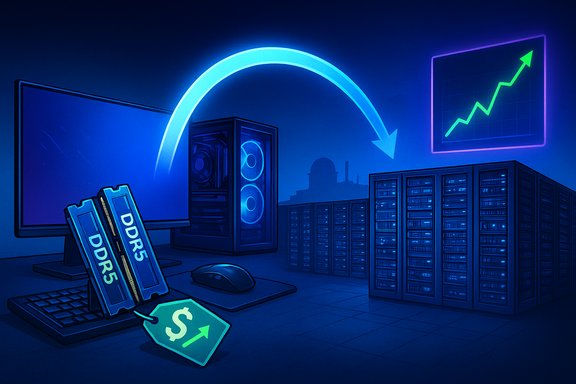
The memory market has flipped from predictable commodity to geopolitical, AI-driven gold rush — and that flip is already painful at the retail checkout. Over the past few months consumer RAM prices have surged dramatically, a major DRAM vendor has announced it will stop selling consumer-branded memory, and industry trackers warn of a multiyear upcycle that will push higher memory, SSD, and PC prices well into 2026 and beyond. This feature explains how we got here, what the technical and commercial drivers really are, which product lines and buyers will be hit hardest, and practical steps Windows users, builders, and IT teams can take to weather a RAM-driven price shock.
The global semiconductor memory market has long been concentrated: a handful of vendors — historically Samsung, SK hynix, and Micron — account for the lion’s share of DRAM production. That concentration makes the market efficient in calm years, but fragile when demand rebalances quickly.
Beginning in 2024 and accelerating through 2025, a discrete external force — the commercial buildout of AI datacenters and large inference/training clusters — has reallocated production and buyer priority inside those manufacturers. AI infrastructure requires enormous volumes of high-performance memory: High Bandwidth Memory (HBM) for accelerators, large-capacity DDR5 and server DRAM for hosts, and huge quantities of NAND flash for fast, high-capacity storage. Buyers for hyperscalers and cloud providers are placing multi-year, high-volume contracts and paying premiums — and wafer capacity is being redirected to serve them first.
The upshot: consumer-oriented commodity DRAM and NAND wafer supply has thinned, contract prices have jumped in steps, and retail prices for the modules enthusiasts buy have spiked. One major supplier has announced it will wind down its consumer brand in early 2026, and independent market trackers are warning that the worst supply tightness could come in early 2026 once distribution inventories are exhausted.
That reallocation creates two effects at once:
What changed
Short-term outcomes you may see:
Also important: some announced fab projects or capacity expansions are specific to advanced or HBM production. That helps hyperscale customers but doesn’t immediately translate to more mainstream DDR5 capacity if the economics keep manufacturers focused on the higher‑margin segments.
This is not a simple seasonal blip. New production capacity takes years and multibillion-dollar investments to bring online, and until those fabs and packaging lines are ramped and yielding, price volatility and constrained availability are realistic outcomes. For consumers and IT professionals, the practical response is a mix of guarded buying (purchase when necessary), smart planning (lock in quotes and diversify suppliers when possible), and temporary software mitigations to delay costly hardware upgrades.
Finally, keep expectations grounded: if you’re budgeting for a PC upgrade, expect memory and storage to represent a larger share of the cost in the near term. Watch vendor announcements about production timelines and treat promotional retail bargains as windows — not guarantees — in a market that has, for now, swung decisively in favor of AI datacenter buyers.
Source: Windows Central https://www.windowscentral.com/hardware/ram-price-crisis-what-need-know/
 Background / Overview
The global semiconductor memory market has long been concentrated: a handful of vendors — historically Samsung, SK hynix, and Micron — account for the lion’s share of DRAM production. That concentration makes the market efficient in calm years, but fragile when demand rebalances quickly.Beginning in 2024 and accelerating through 2025, a discrete external force — the commercial buildout of AI datacenters and large inference/training clusters — has reallocated production and buyer priority inside those manufacturers. AI infrastructure requires enormous volumes of high-performance memory: High Bandwidth Memory (HBM) for accelerators, large-capacity DDR5 and server DRAM for hosts, and huge quantities of NAND flash for fast, high-capacity storage. Buyers for hyperscalers and cloud providers are placing multi-year, high-volume contracts and paying premiums — and wafer capacity is being redirected to serve them first.
The upshot: consumer-oriented commodity DRAM and NAND wafer supply has thinned, contract prices have jumped in steps, and retail prices for the modules enthusiasts buy have spiked. One major supplier has announced it will wind down its consumer brand in early 2026, and independent market trackers are warning that the worst supply tightness could come in early 2026 once distribution inventories are exhausted.
Why RAM prices are spiking
The simple economics: supply, demand, and prioritization
When a small number of producers control core capacity, where that capacity is sold is a choice. Over the last 18 months, the most lucrative buyers have been hyperscale AI customers. They order in volume, commit to long purchase schedules, and pay for prioritized production and packaging. Memory manufacturers have reallocated wafer starts, production runs, and advanced packaging to meet those contracts because they deliver significantly higher margins than commodity consumer DRAM and client SSDs.That reallocation creates two effects at once:
- Immediate scarcity for commodity DDR and mainstream NAND.
- Upward pressure on contract pricing that ripples into spot markets and, eventually, retail SKUs.
Different DRAM products, different priorities
Not all memory is fungible. Key memory classes include:- DDR5 — the high-speed DIMM family used in modern desktops, laptops, and servers; consumer DDR5 modules are what gamers and PC builders buy.
- Server DRAM (RDIMM/LRDIMM) — used in enterprise servers and workstations; typically prioritized by enterprise buyers.
- HBM (High Bandwidth Memory) — stacked, vertically interconnected DRAM used on accelerators (GPUs, AI chips) for training and inference. HBM has fewer suppliers, larger die sizes, and higher-value contracts.
- NAND Flash — used for SSDs and storage; AI infrastructure also consumes large-capacity, high-end NAND.
Micron exits the consumer market — what that means
One watershed moment was a major DRAM vendor’s decision to cease consumer-branded shipments by the end of its fiscal Q2, leaving only two of the big three players continuing to supply the retail market in the same volumes.What changed
- The company announced it will stop shipping consumer-branded memory and SSDs under its long-standing retail name after a transition period that ends in February 2026.
- The vendor framed the move as a strategic prioritization of higher‑margin enterprise and AI customers; it will continue to sell enterprise-branded products but will wind down retail SKUs and retail channel presence.
- Less competition at retail — one fewer large-scale consumer-focused supplier reduces price pressure and narrows SKU diversity for mid-range and budget segments.
- SKU thinning — entry-level and midrange DDR and SATA/NVMe product lines are likely to shrink first, pushing buyers toward fewer brands or higher-priced options.
- Warranty and support caveat — publicly announced continuations of warranty and support for already-sold retail products are common in such wind-downs, but future product refreshes and replacements will be more complicated.
- Procurement risk for small OEMs, system integrators, and hobbyists who relied on the discontinued brand’s predictable retail distribution and pricing.
Market signals and price evidence
Multiple industry indicators converged in late 2025 to show this wasn’t an anecdotal blip:- Contract and spot DRAM indices saw double-digit and, in some subsegments, near‑triple‑digit percentage jumps in short windows as buyers re-priced long and short contracts.
- Memory module retailers and price trackers recorded consumer DDR5 kit prices multiplying in mere months, with some popular 64GB kits moving from low‑hundreds of dollars into mid‑to‑high three‑hundreds or more.
- Major OEMs began to notify customers and enterprise channels that current price quotes and block buys would change imminently; multiple vendors warned that system pricing could climb by double digits if the component situation did not normalize.
- Market participants that assemble retail modules and SSDs warned that December contract prices for DRAM and NAND rose dramatically month‑on‑month, and that distribution inventories will be exhausted into early 2026.
Who will feel the pain — and when
Immediate consumer pain: PC builders and enthusiasts
The sharpest retail price movements have been visible in DDR5 kits and mainstream NVMe SSDs. For PC builders, memory suddenly plays a disproportionate role in system cost, forcing trade-offs at the time of purchase: lower storage capacity, older CPU options, or fewer GPU dollars.Short-term outcomes you may see:
- Popular RAM kit SKUs out of stock or stretched across retailers.
- Retail price jumps that make previously sensible upgrades suddenly expensive.
- Prebuilt system BOMs (bill of materials) that become less competitive for OEMs, prompting price increases or spec downgrades.
Mid-term OEM & enterprise consequences
Large OEMs and enterprise customers buy memory on contract, but they are not immune:- Some OEMs have warned clients that pricing windows will change and that quotes issued now could expire at the end of the year.
- Enterprise server makers may raise bid prices or push for different memory densities and BOM configurations.
- IT procurement teams will face workload scheduling and budgeting headaches as lead times stretch and memory costs climb.
Broader consumer electronics risk: phones, consoles, and cars
DRAM and NAND are ubiquitous. Smartphone, TV, console, camera, and automotive systems all use DRAM or NAND. If mainstream NAND wafer starts and DRAM capacity remain constrained, cost pressure can move across product lines, raising the retail price of a wide array of devices or forcing spec compromises.Technical primer: DRAM vs. HBM vs. NAND (short and essential)
- DRAM (Dynamic Random Access Memory): The volatile memory family used for working memory in PCs and servers. Desktop DDR5 is a DRAM variant packaged on DIMMs.
- HBM (High Bandwidth Memory): A stacked DRAM variant that achieves very high bandwidth by vertically stacking memory dies and using an interposer. HBM is critical for GPU and accelerator performance in AI workloads.
- NAND Flash: Non-volatile memory used for SSDs and persistent storage; NAND has its own supply constraints and is also being purchased aggressively for AI storage needs.
How long will the crisis last?
There are two structural levers that could restore balance, and neither is quick:- Demand retreat: If hyperscaler AI spending moderates, datacenter allocation pressure could ease. That is possible but would require a material slowing in hyperscale investment cycles — not a likely short-term bet given AI’s centrality to product roadmaps and services today.
- New capacity: Building and qualifying new DRAM/NAND fabs, advanced packaging plants, and associated back-end test/assembly lines takes years and billions of dollars. Even announced factory projects often target production ramp in 2027–2029 or later.
Also important: some announced fab projects or capacity expansions are specific to advanced or HBM production. That helps hyperscale customers but doesn’t immediately translate to more mainstream DDR5 capacity if the economics keep manufacturers focused on the higher‑margin segments.
Strengths and potential mitigations in the market
There are constructive counterpoints that could soften the blow:- Manufacturers are investing: Several suppliers and governments have announced or are supporting major fab and assembly investments. These initiatives will raise global capacity once they ramp.
- OEM flexibility: Hardware vendors can adjust BOMs, offer alternate SKUs with slightly different memory configurations, or ramp promotions to move inventory in ways that smooth consumer impact.
- Software and architectural fixes: Some memory pressure at the user level comes from inefficient software (large Electron/Chromium apps, expanded background caches). App vendors can mitigate memory usage with engineering changes that reduce the need for hardware upgrades for many users.
Practical advice: what to do now (consumers, builders, IT)
For Windows users and gamers
- If you need to buy RAM or a new PC and you can’t postpone, consider buying sooner rather than later — current price windows may be the best available until allocation stabilizes.
- Re-evaluate upgrade priorities: for many users, 16 GB is still the practical minimum for modern Windows multitasking. If you’re a creator or streamer, target 32 GB if you can afford it.
- Monitor memory‑hungry apps: long-running Electron/Chromium-based clients can consume multiple gigabytes. Use Task Manager to identify runaway processes; temporary mitigations include restarting the app, disabling hardware acceleration, or using web versions.
- If your laptop is soldered and non-upgradeable, buy to your future needs today — upgrades later may be impossible.
For PC builders and small integrators
- Inventory current stock and re-evaluate pricing windows.
- Lock in contract pricing where possible for 2026 builds.
- Diversify suppliers and consider alternative module speeds/timings that meet performance targets at lower cost.
- Communicate potential lead-time and price risk to customers.
For enterprise IT procurement
- Audit your memory and storage needs now; forecast for 2026 and consider early purchasing windows for critical projects.
- Use staged procurement and staggered deployment to reduce shock to budgets.
- Evaluate VM consolidation, paging strategy, and software memory optimization before committing to expensive memory upgrades.
Risks, trade-offs, and what to watch
Key risks- Pricing persistence: If AI demand remains high and memory producers prioritize enterprise/HBM indefinitely, consumer prices could remain elevated for multiple years.
- Downstream inflation: Higher memory and NAND prices can increase overall device costs across PCs, laptops, and even consumer electronics, stalling upgrade cycles and slowing refresh-driven market growth.
- Supply concentration: With fewer consumer-focused suppliers, single‑vendor failures, geopolitical events, or capacity decisions have larger market consequences.
- Spec compromises: OEMs may ship more devices with lower base memory or smaller SSDs, shifting the upgrade cost burden to buyers later.
- Announcements of new fab capacity and concrete production timelines from memory manufacturers.
- Contract price indices and spot IC prices for key DRAM die sizes.
- OEM and distributor pricing windows, especially any official notice that quoted prices will expire on a set date.
- Vendor statements about shipping priorities and allocation — they often presage commercial availability changes.
Claims and caveats — where the record is clean, and where caution is warranted
Many high‑level facts are verifiable via company press releases and industry trackers:- Major DRAM manufacturers moved capacity and prioritized AI datacenter customers.
- At least one leading consumer-facing memory brand publicly announced a wind-down of retail shipments scheduled to end in February of the announced fiscal quarter.
- Industry trackers reported steep month‑on‑month contract price rises for certain DRAM and NAND categories in late 2025, and module makers warned of larger price impacts in early 2026.
- Specific allocation percentages between vendor and buyer (for example, precise fractions of wafer starts committed to a single hyperscaler) are often reported as industry leaks or estimates; treat exact percentages as indicative, not definitive.
- Market forecasts beyond production‑start timelines for new fabs should be treated as conditional: investments can be delayed, subsidized capacity can alter economics, and demand trajectories can change.
How to save money or delay pain
- Prioritize essential upgrades now. If you already have a functional PC, deferring non-critical upgrades until at least mid-2026 or until multiple fab ramps are underway may be sensible.
- Consider certified refurbished devices from reputable channels — they can offer good performance at lower cost during component price spikes.
- Bundle purchases (buy a larger SSD or slightly more RAM now if it saves future upgrade costs) when your device allows it.
- Use software options to optimize memory use: limit background apps, disable unnecessary startup services, and choose browser tab-management extensions that suspend unused tabs.
Conclusion
The memory market is undergoing a structural shift driven by the economics of AI infrastructure: higher-margin HBM and enterprise DRAM contracts are reordering how wafer starts and packaging capacity are allocated. That reallocation has immediate retail consequences — higher DDR5 and mainstream SSD prices, thinning of consumer SKUs, and procurement pressure for OEMs and enterprise buyers.This is not a simple seasonal blip. New production capacity takes years and multibillion-dollar investments to bring online, and until those fabs and packaging lines are ramped and yielding, price volatility and constrained availability are realistic outcomes. For consumers and IT professionals, the practical response is a mix of guarded buying (purchase when necessary), smart planning (lock in quotes and diversify suppliers when possible), and temporary software mitigations to delay costly hardware upgrades.
Finally, keep expectations grounded: if you’re budgeting for a PC upgrade, expect memory and storage to represent a larger share of the cost in the near term. Watch vendor announcements about production timelines and treat promotional retail bargains as windows — not guarantees — in a market that has, for now, swung decisively in favor of AI datacenter buyers.
Source: Windows Central https://www.windowscentral.com/hardware/ram-price-crisis-what-need-know/
