

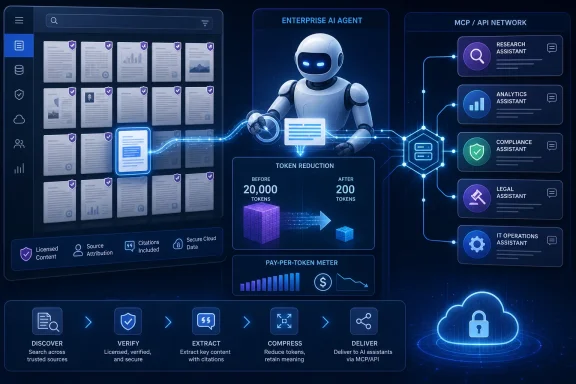
RavenPack has launched a token-based content licensing system on Bigdata.com that it says lets AI agents retrieve and pay for only the small excerpts needed to answer a question, rather than sending whole documents into an LLM context window. The company claims the approach can reduce context-token consumption by up to 100× in a typical 20,000-token-versus-200-token example.
According to RavenPack’s July 20 announcement, Bigdata.com indexes and enriches material from more than 170 providers, then meters retrieval at the token level. Content providers set a price per token, while customers pay for the licensed passages their agents actually consume. Retrieved material is intended to carry both attribution and a per-use license for grounding an AI response.
The launch is aimed at a familiar problem for organizations running agentic AI workloads: input context can become the dominant recurring cost. An agent that repeatedly searches, reasons, and revises may pull large volumes of source material into a paid model context even when only a sentence or paragraph is relevant.
RavenPack’s premise is that the cheaper route is not necessarily selecting a lower-cost model, but filtering source material before it reaches the model. Its example assumes a conventional workflow sends a 20,000-token document to the model for a question whose answer occupies about 200 tokens. If Bigdata.com consistently identifies only that relevant portion, the input bill would fall sharply and the model would have less irrelevant material to interpret.
That is a plausible retrieval-architecture benefit, but the 100× figure is RavenPack’s own claim. It will vary by document size, query complexity, model pricing, retrieval accuracy, and how much surrounding context is required for a trustworthy answer. The announcement did not disclose public pricing, benchmark methodology, or independent validation of the claimed savings.
That wording does not establish that the service is built into Microsoft 365 Copilot, Copilot Studio, Windows Copilot, or Microsoft’s enterprise data-governance stack. Administrators should treat it as a third-party data and retrieval service until the specific integration model is documented: authentication, tenant isolation, data residency, logging, source licensing, retention, and Microsoft Purview compatibility all matter more than a connector label.
The platform also promises to honor customers’ existing provider agreements, while charging retrieval costs only where appropriate. That could be useful for enterprises trying to avoid separate integrations and licenses for every newswire, research vendor, transcript service, or data feed an agent may query.
According to RavenPack’s July 20 announcement, Bigdata.com indexes and enriches material from more than 170 providers, then meters retrieval at the token level. Content providers set a price per token, while customers pay for the licensed passages their agents actually consume. Retrieved material is intended to carry both attribution and a per-use license for grounding an AI response.
 A retrieval cost pitch, not a new model
The launch is aimed at a familiar problem for organizations running agentic AI workloads: input context can become the dominant recurring cost. An agent that repeatedly searches, reasons, and revises may pull large volumes of source material into a paid model context even when only a sentence or paragraph is relevant.RavenPack’s premise is that the cheaper route is not necessarily selecting a lower-cost model, but filtering source material before it reaches the model. Its example assumes a conventional workflow sends a 20,000-token document to the model for a question whose answer occupies about 200 tokens. If Bigdata.com consistently identifies only that relevant portion, the input bill would fall sharply and the model would have less irrelevant material to interpret.
That is a plausible retrieval-architecture benefit, but the 100× figure is RavenPack’s own claim. It will vary by document size, query complexity, model pricing, retrieval accuracy, and how much surrounding context is required for a trustworthy answer. The announcement did not disclose public pricing, benchmark methodology, or independent validation of the claimed savings.
Copilot connection needs scrutiny
For Windows-centric IT teams, the notable claim is integration. RavenPack says Bigdata.com is “natively connected” to Claude, ChatGPT, and Microsoft Copilot, and can be reached by other AI agents through Model Context Protocol (MCP) or an API.That wording does not establish that the service is built into Microsoft 365 Copilot, Copilot Studio, Windows Copilot, or Microsoft’s enterprise data-governance stack. Administrators should treat it as a third-party data and retrieval service until the specific integration model is documented: authentication, tenant isolation, data residency, logging, source licensing, retention, and Microsoft Purview compatibility all matter more than a connector label.
The platform also promises to honor customers’ existing provider agreements, while charging retrieval costs only where appropriate. That could be useful for enterprises trying to avoid separate integrations and licenses for every newswire, research vendor, transcript service, or data feed an agent may query.
What admins should do
Organizations evaluating the service should ask RavenPack for concrete answers before connecting it to production Copilot or agent workflows:- Which Microsoft Copilot products are supported, and through which connector or MCP deployment path?
- Where are prompts, retrieved excerpts, logs, and licensing records stored?
- How are source citations exposed to users and retained for audit?
- What are the per-token rates, minimums, and controls for spend limits?
- Can retrieval quality and token savings be measured against the organization’s existing RAG pipeline?
References
- Primary source: PR Newswire UK
Published: 2026-07-20T13:00:00+00:00
Bigdata.com Launches the Tokenization of Content: Precision Grounding That Cuts AI Token Consumption by up to 100×
/PRNewswire/ -- RavenPack today launched the Tokenization of Content on Bigdata.com, the first platform where AI agents retrieve, license, and pay for premium... www.prnewswire.co.uk


