

Razer’s Seiren V3 Pro, reviewed by PC Gamer on July 3, 2026, is a $250 dynamic USB-C and XLR streaming microphone aimed at creators who want near-studio voice capture without committing fully to pro audio gear. The hardware is more serious than the usual RGB desk ornament, and the feature set is broader than many gaming-branded microphones. But the review lands on a sharper point: Razer has built a flexible microphone whose weakest link is the very automation meant to make it effortless.
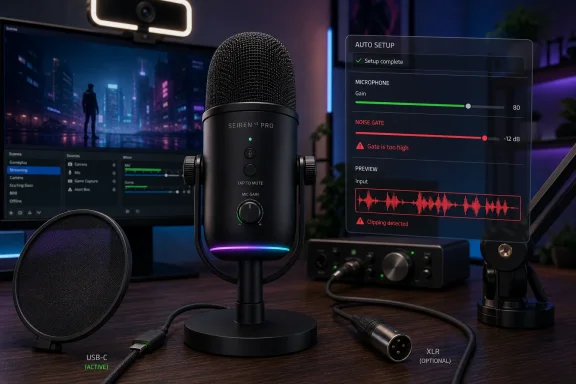
The Seiren V3 Pro is not Razer’s first microphone, but it feels like a different kind of pitch. This is not merely a small condenser mic with gamer lighting and a software wrapper. It is a dynamic microphone with USB-C and XLR connectivity, a 30 mm capsule, 32-bit/96 kHz capture, 32-bit float support through Synapse, a physical gain wheel, tap-to-mute control, a removable pop filter, and just enough Chroma lighting to remind you which company made it.
That matters because the streaming microphone market has matured. Five years ago, the upgrade path for many gamers was simply “stop using a headset mic.” In 2026, the buyer Razer is chasing has probably heard of Shure, may know what an audio interface is, and has seen enough podcast rigs on YouTube to know what “broadcast-style” hardware is supposed to look like.
PC Gamer’s Andy Edser frames the Seiren V3 Pro as a direct challenge to the Shure MV7+, and that comparison is unavoidable. Shure owns a lot of mindshare in this category because the MV7 line translated the company’s studio reputation into a USB-friendly creator product. Razer’s counterargument is not that it has made the more refined mic; it is that it has made the more adaptable one.
The result is a product that seems designed for the modern creator desk: one day Discord, the next day Twitch, the next day a podcast, and maybe later an XLR interface if the hobby becomes a workflow. That is a smart read of the market. It is also a harder promise to fulfill than it looks.
That distinction matters for Windows users and streamers because microphones are now on camera almost as often as they are in the audio chain. A webcam frame full of keyboards, monitors, lights, and mic arms has become its own kind of workplace. A mic that looks credible without screaming for attention is doing more than vanity work; it is part of the user’s presentation layer.
The inclusion of both USB-C and XLR is the practical headline. USB-C gives the owner immediate plug-and-play access, including Razer’s software processing. XLR gives the same buyer a path into mixers, preamps, and audio interfaces later. The important caveat, noted in PC Gamer’s review, is that the two connections cannot be used simultaneously.
That limitation is not surprising, but it does separate “versatile” from “everything at once.” The Seiren V3 Pro can fit into multiple setups over its lifetime. It is not a magic bridge that sends processed USB audio to a PC while simultaneously behaving as a traditional XLR mic in another chain.
The 32-bit float support is similarly useful but easy to oversell. Razer’s own marketing positions it as a way to preserve wider dynamic range and reduce clipping when volume suddenly spikes. That is plausible for streamers who move from whispering to shouting when a horror game does what horror games do. But for most users, microphone technique, gain staging, and processing choices will matter more than the bit-depth badge on the box.
PC Gamer’s testing reflects that reality. In close-up use, the Seiren V3 Pro can produce a rich, pleasing vocal tone after some software adjustment. In a desktop position, it remains usable, but it needs gain, compression, and noise suppression to compensate for the distance.
That trade-off should be familiar to anyone who has tried to make a desk mic behave like a boom-mounted broadcast mic. The further the microphone sits from your mouth, the more room sound and background noise become part of the signal. No amount of “AI” language changes the physics.
Razer deserves credit for including a desktop stand, because it makes the product usable out of the box in a way some competitors are not. But the best-case setup for a dynamic creator mic is still a boom arm or a close placement. Buyers who imagine the Seiren V3 Pro sitting politely beside a monitor while producing radio voice may be disappointed unless they are ready to tune around the problem.
This is where the Windows enthusiast audience should be especially skeptical of marketing words like studio. Studio sound is not just a capsule specification. It is room treatment, mic placement, gain structure, monitoring, compression, EQ, and sometimes years of learning what not to do.
That is important because good voice sound often comes from small corrections rather than one magic button. A high-pass or low-cut move can remove rumble. A presence lift can help intelligibility. Compression can tame volume swings. A noise gate can keep a room from breathing between phrases.
Razer’s advantage is that it can expose those controls in a familiar peripheral software environment rather than forcing users into a digital audio workstation or third-party audio chain. For streamers and gamers, that convenience is not trivial. Many people want to sound better in OBS, Discord, Teams, and game chat without building a miniature broadcast studio.
But this is also where the company inherits the burden of being Razer. Synapse is powerful, but it is another resident software layer on a Windows PC already full of launchers, overlays, updaters, device agents, and capture tools. For enthusiasts, that may be acceptable. For IT pros and creators who value predictable systems, every extra background service is another variable.
The Seiren V3 Pro therefore lives in two worlds. As a USB mic, it is a consumer peripheral. As a processed creator mic, it becomes part of the Windows audio stack. That means driver behavior, app routing, sample-rate settings, startup reliability, and software updates can matter as much as the metal tube on the desk.
According to PC Gamer, Synapse asks the user to speak normally, samples room ambience, asks for a primary use case such as streaming or podcasting, and then sets processing automatically. In the reviewer’s desktop-position test, the result was an overly aggressive noise gate that clipped words badly enough to miss parts of speech. Repeated attempts reportedly produced similar trouble, with the system struggling to choose gain properly and ignoring useful compressor and AI noise suppression settings.
That is not a small bug in the experience. A bad noise gate can be worse than background noise because it destroys speech. Listeners can tolerate some hiss or room tone; they are far less forgiving when consonants vanish or sentences sound chopped into pieces.
The irony is that the Seiren V3 Pro seems to include the tools needed to solve the problem manually. PC Gamer was able to get good results by adjusting gain, easing the gate, applying suppression, and adding compression. The microphone is not failing because it lacks capability. It is failing because its guided setup appears to choose the wrong defaults.
That should worry Razer because auto setup is not just a convenience feature. It is a trust feature. The user who buys a $250 microphone because the box promises professional results may reasonably expect the software to avoid obvious mistakes. If the first recording sounds broken, many users will blame the mic, not the gate threshold.
That is a subtle but crucial difference in this category. In pro audio, flexibility is often prized because engineers want control. In creator hardware, flexibility can become a liability if it creates too many ways to get a bad result. The buyer wants the confidence of a professional chain without necessarily becoming the engineer of that chain.
Razer’s product strategy is to offer more knobs. Shure’s advantage is that it makes fewer of those knobs feel necessary. That is why the MV7+ comparison hurts: not because Razer lacks features, but because Shure has made the absence of fiddling feel like the premium feature.
For Windows users, this also intersects with the larger pattern of peripheral software. Gamers are used to mice with lift-off distance sliders, keyboards with macro layers, headsets with spatial audio profiles, and now microphones with DSP chains. The question is no longer whether software can improve hardware. It is whether software can do so without becoming homework.
The Seiren V3 Pro’s manual controls suggest Razer’s audio team knows what good processing looks like. The auto setup suggests the company has not yet made that knowledge reliably available to the person who most needs it. That gap is the difference between an enthusiast product and a truly mainstream creator tool.
Razer’s value argument is strongest for the user who wants one mic to cover several futures. Today it can sit on the desk over USB-C. Tomorrow it can move onto an arm. Later it can plug into an XLR chain. Along the way, Synapse can provide EQ, compression, noise gating, and noise reduction without requiring separate software.
The danger is that buyers do not experience value as a spec sheet. They experience it as the first recording, the first stream, the first Discord call where friends either say “you sound great” or “what happened to your mic?” If auto setup creates the second response, the price becomes harder to justify.
PC Gamer’s verdict is therefore balanced in a way that feels right. The Seiren V3 Pro is capable, handsome, and flexible. It is also not cheap, not effortless, and not clearly superior to the best-known alternative in the exact use case many buyers care about most.
For some users, that will be fine. Tinkerers may prefer Razer’s flexibility. Streamers who change positions, switch between close-up and desktop use, and like tuning their chain may find the Seiren V3 Pro satisfying. But users looking for the simplest route to “podcast voice” may still find Shure’s ecosystem more reassuring.
That trend is not inherently bad. Many users record and stream from imperfect rooms. They need help dealing with fans, mechanical keyboards, untreated walls, open windows, and inconsistent speaking volume. Hardware DSP and companion apps can make better audio accessible to people who will never learn a full production suite.
But the more intelligence vendors add, the more accountability they assume. If an app claims to detect your room and configure your voice chain, it must be conservative enough not to ruin intelligibility. If it offers noise gates, it should avoid thresholds that chop normal speech. If it detects a desktop use case, it should understand that distance changes gain and noise behavior.
This is especially relevant for WindowsForum readers because many of us have seen the cumulative effect of “helpful” device software. Each vendor solves its own product in isolation. The user gets the aggregate: multiple background agents, tray icons, update prompts, virtual devices, and audio enhancements that sometimes conflict with one another.
A microphone like the Seiren V3 Pro can absolutely be part of a clean Windows setup. But the best version of that setup depends on Razer making Synapse trustworthy enough that users do not have to fight it. In this category, reliability is not just uptime. It is sounding the same today as you did yesterday.
A weak capsule would be easy to dismiss. A flimsy build would make the verdict simple. But Razer appears to have built a serious piece of hardware with useful controls and strong tuning potential. The issue is that its signature convenience feature can push users toward bad audio before they discover what the mic can really do.
That creates a practical recommendation: treat auto setup as a rough draft at best. If you buy this microphone, expect to spend time listening to recordings, adjusting gate thresholds, setting gain manually, trying compression, and testing EQ presets in the apps you actually use. Do not assume that one Synapse wizard pass will represent the product at its best.
This is not necessarily a deal-breaker for the target audience. Many streamers enjoy tweaking. Many Windows enthusiasts would rather have too many controls than too few. But Razer’s marketing leans on simplicity, and the review suggests the product is better understood as configurable rather than effortless.
That distinction should shape buyer expectations. The Seiren V3 Pro is not a cheat code for studio sound. It is a capable dynamic microphone with a software workbench attached.
 Razer Has Stopped Pretending Streamers Only Need a Flashy Desk Mic
The Seiren V3 Pro is not Razer’s first microphone, but it feels like a different kind of pitch. This is not merely a small condenser mic with gamer lighting and a software wrapper. It is a dynamic microphone with USB-C and XLR connectivity, a 30 mm capsule, 32-bit/96 kHz capture, 32-bit float support through Synapse, a physical gain wheel, tap-to-mute control, a removable pop filter, and just enough Chroma lighting to remind you which company made it.That matters because the streaming microphone market has matured. Five years ago, the upgrade path for many gamers was simply “stop using a headset mic.” In 2026, the buyer Razer is chasing has probably heard of Shure, may know what an audio interface is, and has seen enough podcast rigs on YouTube to know what “broadcast-style” hardware is supposed to look like.
PC Gamer’s Andy Edser frames the Seiren V3 Pro as a direct challenge to the Shure MV7+, and that comparison is unavoidable. Shure owns a lot of mindshare in this category because the MV7 line translated the company’s studio reputation into a USB-friendly creator product. Razer’s counterargument is not that it has made the more refined mic; it is that it has made the more adaptable one.
The result is a product that seems designed for the modern creator desk: one day Discord, the next day Twitch, the next day a podcast, and maybe later an XLR interface if the hobby becomes a workflow. That is a smart read of the market. It is also a harder promise to fulfill than it looks.
The Hardware Makes a Better First Impression Than the Pitch
The most encouraging part of the Seiren V3 Pro is that Razer appears to understand the physical grammar of a serious microphone. PC Gamer describes a chunky, professional-looking chassis with a restrained RGB ring, a one-sided adjustable mount, a screw-in desktop base, and a boom-arm socket. In other words, it looks less like a gaming accessory trying to be noticed and more like a production tool that happens to come from Razer.That distinction matters for Windows users and streamers because microphones are now on camera almost as often as they are in the audio chain. A webcam frame full of keyboards, monitors, lights, and mic arms has become its own kind of workplace. A mic that looks credible without screaming for attention is doing more than vanity work; it is part of the user’s presentation layer.
The inclusion of both USB-C and XLR is the practical headline. USB-C gives the owner immediate plug-and-play access, including Razer’s software processing. XLR gives the same buyer a path into mixers, preamps, and audio interfaces later. The important caveat, noted in PC Gamer’s review, is that the two connections cannot be used simultaneously.
That limitation is not surprising, but it does separate “versatile” from “everything at once.” The Seiren V3 Pro can fit into multiple setups over its lifetime. It is not a magic bridge that sends processed USB audio to a PC while simultaneously behaving as a traditional XLR mic in another chain.
The 32-bit float support is similarly useful but easy to oversell. Razer’s own marketing positions it as a way to preserve wider dynamic range and reduce clipping when volume suddenly spikes. That is plausible for streamers who move from whispering to shouting when a horror game does what horror games do. But for most users, microphone technique, gain staging, and processing choices will matter more than the bit-depth badge on the box.
Dynamic Mics Reward Technique, Not Wishful Thinking
The Seiren V3 Pro being a dynamic microphone is one of its biggest strengths and one of its built-in compromises. Dynamic mics are generally less sensitive than desktop condenser microphones, which can help in noisy rooms where keyboards, fans, and traffic are unwanted guests. But they also tend to want proximity. You need to speak close enough and with enough level for the mic to do its best work.PC Gamer’s testing reflects that reality. In close-up use, the Seiren V3 Pro can produce a rich, pleasing vocal tone after some software adjustment. In a desktop position, it remains usable, but it needs gain, compression, and noise suppression to compensate for the distance.
That trade-off should be familiar to anyone who has tried to make a desk mic behave like a boom-mounted broadcast mic. The further the microphone sits from your mouth, the more room sound and background noise become part of the signal. No amount of “AI” language changes the physics.
Razer deserves credit for including a desktop stand, because it makes the product usable out of the box in a way some competitors are not. But the best-case setup for a dynamic creator mic is still a boom arm or a close placement. Buyers who imagine the Seiren V3 Pro sitting politely beside a monitor while producing radio voice may be disappointed unless they are ready to tune around the problem.
This is where the Windows enthusiast audience should be especially skeptical of marketing words like studio. Studio sound is not just a capsule specification. It is room treatment, mic placement, gain structure, monitoring, compression, EQ, and sometimes years of learning what not to do.
Synapse Is the Real Product, for Better and Worse
The Seiren V3 Pro is not just a microphone; it is a microphone plus a software environment. Through Razer Synapse, users get access to processing tools including AI noise reduction, a noise gate, compression, and parametric EQ presets. PC Gamer’s review is broadly positive on the manual controls, especially the EQ presets, which the reviewer says offer sensible starting points for podcast-style processing.That is important because good voice sound often comes from small corrections rather than one magic button. A high-pass or low-cut move can remove rumble. A presence lift can help intelligibility. Compression can tame volume swings. A noise gate can keep a room from breathing between phrases.
Razer’s advantage is that it can expose those controls in a familiar peripheral software environment rather than forcing users into a digital audio workstation or third-party audio chain. For streamers and gamers, that convenience is not trivial. Many people want to sound better in OBS, Discord, Teams, and game chat without building a miniature broadcast studio.
But this is also where the company inherits the burden of being Razer. Synapse is powerful, but it is another resident software layer on a Windows PC already full of launchers, overlays, updaters, device agents, and capture tools. For enthusiasts, that may be acceptable. For IT pros and creators who value predictable systems, every extra background service is another variable.
The Seiren V3 Pro therefore lives in two worlds. As a USB mic, it is a consumer peripheral. As a processed creator mic, it becomes part of the Windows audio stack. That means driver behavior, app routing, sample-rate settings, startup reliability, and software updates can matter as much as the metal tube on the desk.
The Auto Setup Feature Fails the Product’s Own Beginner Promise
The most revealing part of PC Gamer’s review is not that the Seiren V3 Pro needs tweaking. Many good microphones do. The problem is that Razer’s auto setup feature appears to make bad decisions in exactly the scenario where it should protect inexperienced users from themselves.According to PC Gamer, Synapse asks the user to speak normally, samples room ambience, asks for a primary use case such as streaming or podcasting, and then sets processing automatically. In the reviewer’s desktop-position test, the result was an overly aggressive noise gate that clipped words badly enough to miss parts of speech. Repeated attempts reportedly produced similar trouble, with the system struggling to choose gain properly and ignoring useful compressor and AI noise suppression settings.
That is not a small bug in the experience. A bad noise gate can be worse than background noise because it destroys speech. Listeners can tolerate some hiss or room tone; they are far less forgiving when consonants vanish or sentences sound chopped into pieces.
The irony is that the Seiren V3 Pro seems to include the tools needed to solve the problem manually. PC Gamer was able to get good results by adjusting gain, easing the gate, applying suppression, and adding compression. The microphone is not failing because it lacks capability. It is failing because its guided setup appears to choose the wrong defaults.
That should worry Razer because auto setup is not just a convenience feature. It is a trust feature. The user who buys a $250 microphone because the box promises professional results may reasonably expect the software to avoid obvious mistakes. If the first recording sounds broken, many users will blame the mic, not the gate threshold.
Shure’s Shadow Is Really a Software Shadow
The Shure MV7+ looms over this review because it represents a different kind of polish. PC Gamer’s argument is not that the Razer cannot sound good. It is that the Shure more reliably gets to a polished, streaming-friendly tone with less work.That is a subtle but crucial difference in this category. In pro audio, flexibility is often prized because engineers want control. In creator hardware, flexibility can become a liability if it creates too many ways to get a bad result. The buyer wants the confidence of a professional chain without necessarily becoming the engineer of that chain.
Razer’s product strategy is to offer more knobs. Shure’s advantage is that it makes fewer of those knobs feel necessary. That is why the MV7+ comparison hurts: not because Razer lacks features, but because Shure has made the absence of fiddling feel like the premium feature.
For Windows users, this also intersects with the larger pattern of peripheral software. Gamers are used to mice with lift-off distance sliders, keyboards with macro layers, headsets with spatial audio profiles, and now microphones with DSP chains. The question is no longer whether software can improve hardware. It is whether software can do so without becoming homework.
The Seiren V3 Pro’s manual controls suggest Razer’s audio team knows what good processing looks like. The auto setup suggests the company has not yet made that knowledge reliably available to the person who most needs it. That gap is the difference between an enthusiast product and a truly mainstream creator tool.
A $250 Microphone Has to Beat “Good Enough”
At $250, the Seiren V3 Pro is not priced like an impulse upgrade for someone who only needs clearer Discord audio. It sits in the zone where buyers start comparing not only other USB microphones, but also entry-level XLR setups, used gear, boom arms, audio interfaces, and software plugins. That is a crowded and unforgiving space.Razer’s value argument is strongest for the user who wants one mic to cover several futures. Today it can sit on the desk over USB-C. Tomorrow it can move onto an arm. Later it can plug into an XLR chain. Along the way, Synapse can provide EQ, compression, noise gating, and noise reduction without requiring separate software.
The danger is that buyers do not experience value as a spec sheet. They experience it as the first recording, the first stream, the first Discord call where friends either say “you sound great” or “what happened to your mic?” If auto setup creates the second response, the price becomes harder to justify.
PC Gamer’s verdict is therefore balanced in a way that feels right. The Seiren V3 Pro is capable, handsome, and flexible. It is also not cheap, not effortless, and not clearly superior to the best-known alternative in the exact use case many buyers care about most.
For some users, that will be fine. Tinkerers may prefer Razer’s flexibility. Streamers who change positions, switch between close-up and desktop use, and like tuning their chain may find the Seiren V3 Pro satisfying. But users looking for the simplest route to “podcast voice” may still find Shure’s ecosystem more reassuring.
Windows Audio Keeps Becoming a Creator Battlefield
The Seiren V3 Pro is also part of a broader shift: Windows peripherals are moving deeper into software-defined production. A microphone used to be a relatively simple input device. Now it is a signal-processing endpoint with firmware, companion software, profile management, noise suppression, RGB state, and sometimes AI branding layered on top.That trend is not inherently bad. Many users record and stream from imperfect rooms. They need help dealing with fans, mechanical keyboards, untreated walls, open windows, and inconsistent speaking volume. Hardware DSP and companion apps can make better audio accessible to people who will never learn a full production suite.
But the more intelligence vendors add, the more accountability they assume. If an app claims to detect your room and configure your voice chain, it must be conservative enough not to ruin intelligibility. If it offers noise gates, it should avoid thresholds that chop normal speech. If it detects a desktop use case, it should understand that distance changes gain and noise behavior.
This is especially relevant for WindowsForum readers because many of us have seen the cumulative effect of “helpful” device software. Each vendor solves its own product in isolation. The user gets the aggregate: multiple background agents, tray icons, update prompts, virtual devices, and audio enhancements that sometimes conflict with one another.
A microphone like the Seiren V3 Pro can absolutely be part of a clean Windows setup. But the best version of that setup depends on Razer making Synapse trustworthy enough that users do not have to fight it. In this category, reliability is not just uptime. It is sounding the same today as you did yesterday.
The Seiren V3 Pro Is a Good Mic Hiding Behind a Risky First Run
The most frustrating products are often not the bad ones. They are the good ones that make a poor first impression. The Seiren V3 Pro, as described by PC Gamer, fits that mold.A weak capsule would be easy to dismiss. A flimsy build would make the verdict simple. But Razer appears to have built a serious piece of hardware with useful controls and strong tuning potential. The issue is that its signature convenience feature can push users toward bad audio before they discover what the mic can really do.
That creates a practical recommendation: treat auto setup as a rough draft at best. If you buy this microphone, expect to spend time listening to recordings, adjusting gate thresholds, setting gain manually, trying compression, and testing EQ presets in the apps you actually use. Do not assume that one Synapse wizard pass will represent the product at its best.
This is not necessarily a deal-breaker for the target audience. Many streamers enjoy tweaking. Many Windows enthusiasts would rather have too many controls than too few. But Razer’s marketing leans on simplicity, and the review suggests the product is better understood as configurable rather than effortless.
That distinction should shape buyer expectations. The Seiren V3 Pro is not a cheat code for studio sound. It is a capable dynamic microphone with a software workbench attached.
The Real Verdict Is Written in the Noise Gate
The Seiren V3 Pro’s lesson for buyers is narrower and more useful than a simple thumbs-up or thumbs-down. It is a strong product if you are willing to participate in the sound. It is a shakier product if you expect the software to make all the right calls.- The Razer Seiren V3 Pro is a $250 dynamic microphone with USB-C and XLR connectivity, aimed at streamers, podcasters, and creators who want room to grow.
- PC Gamer found that the microphone can produce rich, polished voice capture, especially in a close-up position with manual tuning.
- The included Synapse processing tools appear to be genuinely useful, particularly the EQ presets, compression, noise suppression, and manual controls.
- The auto setup feature is the weak point, with PC Gamer reporting overly aggressive gating and poor automatic choices in desktop use.
- The Shure MV7+ remains the more intimidating competitor because it more reliably delivers a finished creator sound with less user intervention.
- The Seiren V3 Pro makes the most sense for users who value flexibility and are willing to tune their audio chain rather than depend on a setup wizard.
References
- Primary source: PC Gamer
Published: 2026-07-03T16:00:49.670350
Razer Seiren V3 Pro microphone review | PC Gamer
The latest Review,,,reviews, breaking news, comment, reviews and features from the experts at PC Gamerwww.pcgamer.com - Related coverage: razer.com
Dynamic USB-C Streaming Microphone - Seiren V3 Pro | Razer United States
Seiren V3 Pro dynamic mic for streaming, recording, and podcasting with USB-C/XLR, 32-bit float audio, AI noise reduction, Synapse control. Learn more. www.razer.com
- Related coverage: tomshardware.com
Razer Seiren V3 Pro Review: USB, XLR, and 32-bit float | Tom's Hardware
Two things you probably don't need in a gaming mic.www.tomshardware.com - Related coverage: windowscentral.com
Razer Seiren V3 Pro review: USB‑C + XLR dynamic mic for streamers | Windows Central
Razer’s flagship dynamic mic returns with better tuning, smarter software, and creator‑ready features.www.windowscentral.com - Related coverage: gamingtrend.com
- Related coverage: trendhunter.com

- Related coverage: t3.com
Razer brings the studio into your home – Seiren V3 Pro is a pro standard mic with consumer simplicity | T3
The Razer Seiren V3 Pro offers studio-grade 32-bit float recording but with ease-of-use and plug-and-playwww.t3.com - Related coverage: los40.com
Razer presenta el Seiren V3 Pro: un micrófono “de estudio” para todos los públicos | Dispositivos | LOS40
USB-C, XLR y 32 bits: el micrófono de Razer que borra la línea entre pro y streamerlos40.com - Related coverage: gamesradar.com
Best Razer headsets 2026: the top sets compared | GamesRadar+
One of the best Razer headsets is a surefire way to enhance your gaming experience on any platform.www.gamesradar.com - Related coverage: dl.razer.com
