

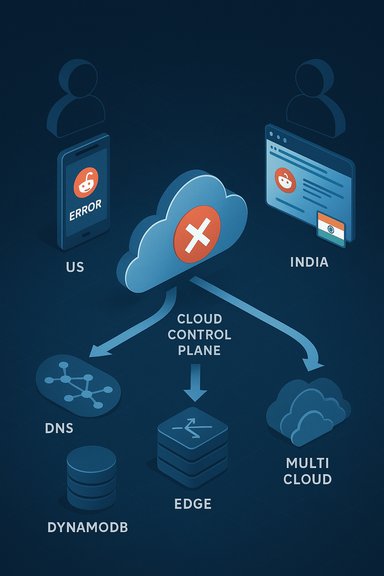
Reddit users in the United States, India and several other countries were hit by a widespread outage on November 4, 2025, leaving tens of thousands unable to load feeds, post or even log in—an interruption the company said it had identified and was actively fixing while the incident renewed focus on how DNS and cloud control‑plane dependencies can amplify a single failure into a multi‑region disruption.
The November 4 outage echoed a string of high‑profile cloud incidents this autumn, including a major Amazon Web Services (AWS) disruption in October that centered on DNS resolution failures for DynamoDB in the US‑EAST‑1 region and an Azure outage caused by an inadvertent configuration change to Azure Front Door. Those earlier events showed how failures in DNS or edge control planes can cascade through many dependent services; the recent Reddit outage occurred against that unsettled backdrop. This piece summarizes what is verifiably known about the Reddit incident, places it in the context of recent cloud outages, evaluates the technical causes and business risks, and offers practical mitigation guidance for IT teams and end users—particularly Windows‑centric enterprises that rely on cloud services and web apps.
Source: SSBCrack News Reddit Faces Widespread Outage Affecting Users in the US and India - SSBCrack News
 Background
The November 4 outage echoed a string of high‑profile cloud incidents this autumn, including a major Amazon Web Services (AWS) disruption in October that centered on DNS resolution failures for DynamoDB in the US‑EAST‑1 region and an Azure outage caused by an inadvertent configuration change to Azure Front Door. Those earlier events showed how failures in DNS or edge control planes can cascade through many dependent services; the recent Reddit outage occurred against that unsettled backdrop. This piece summarizes what is verifiably known about the Reddit incident, places it in the context of recent cloud outages, evaluates the technical causes and business risks, and offers practical mitigation guidance for IT teams and end users—particularly Windows‑centric enterprises that rely on cloud services and web apps.What happened: concise incident summary
- Outage footprint: Reports from outage tracker services showed a rapid surge of problem reports for Reddit worldwide; many outlets recorded more than 20,000 reports within minutes, with the largest clusters in the United States and hundreds of reports from India. Reddit posted that it had “identified the issue and a fix is being implemented.”
- Symptom set: Users reported login failures, slow or incomplete loading of subreddits, image/video content not rendering, and elevated error rates in both web and native mobile clients. Downdetector‑style data that aggregates user reports indicated the majority of complaints targeted the mobile app, followed by the website.
- Company response: Reddit acknowledged elevated error rates and said an identified fix was being implemented while monitoring for regressions—language consistent with a targeted codepath or infrastructure remediation rather than an immediate, undifferentiated platform collapse. Several news outlets repeated the company update while outage trackers continued to show elevated user reports during the remediation window.
Timeline and technical signals
User reports and rapid escalation
Outage tracker data and social streams registered a rapid spike in complaints shortly after users began seeing errors. In similar incidents the initial signal is almost always user reports combined with automated monitoring alarms; both were visible in this event. The distribution of problem reports (app > web > server connection) and the geographical clustering (US, UK, India) match the pattern seen in prior Reddit incidents and in platform‑wide application faults.What vendors and monitoring showed
Independent monitoring firms and news coverage of the earlier October 20 AWS event revealed how a DNS malfunction for a crucial managed API (DynamoDB) can prevent services from finding backend endpoints and thereby produce application‑level failures even when compute continues to operate. The October AWS issue was traced to DNS resolution problems for DynamoDB in the US‑EAST‑1 region, produced long tails of queued requests, and required staged mitigation and throttling to restore stability. Those technical dynamics are relevant context for interpreting the Reddit outage because DNS and edge control‑plane failures create similar symptoms. Microsoft’s Azure outage later in October further illustrated how an “inadvertent configuration change” in an edge traffic service (Azure Front Door) could trigger widespread DNS and routing degradation that blocked access to portals and many services until a rollback and traffic rerouting were completed. That incident underscores the fragility of distributed control planes and the speed with which configuration errors can cause global service degradation.What is NOT verified (and what to treat cautiously)
- Any immediate public assertion that Reddit’s November 4 outage was caused by AWS, Azure, or any other single upstream provider is not verifiable from current public reporting. While the broader cloud incidents earlier in the month raised plausible links and historical precedent, direct attribution requires platform status pages or vendor post‑mortems to confirm dependencies. Treat cross‑service speculation as provisional.
- Published dollar‑value cost estimates for outages (for example, headline figures claiming tens of millions per hour) are usually rough extrapolations and should be flagged as speculative unless derived from a company’s internal telemetry or a rigorous economic model. Some outlets reported large cost estimates for the October AWS outage; those numbers are plausible at scale but not independently verified.
Why DNS and control‑plane dependencies matter
DNS is the internet’s address book—and a single point of amplification
DNS translates hostnames into IP addresses. When a critical API endpoint or edge domain fails to resolve reliably—whether because of configuration errors, propagation failures, or control‑plane bugs—clients and SDKs that depend on that name will experience timeouts and retries. Those retries create additional load and can quickly produce “retry storms” that saturate connection pools and rate‑limiters, turning a modest fault into a broad outage. The October AWS incident demonstrates precisely this chain: DNS problems for DynamoDB triggered SDK failures and cascading errors across services that rely on small, high‑frequency metadata writes.Control‑plane and edge routing add complexity
Modern clouds use distributed edge services (CDNs, global load balancers, Front Door / AFD equivalents) to route traffic and perform TLS/SNI termination, WAF checks and global failover. Those systems must maintain consistent configuration across many nodes. A bad configuration, a partially applied rollback, or a logic bug can cause inconsistent DNS answers or routing tables at the edge—producing availability problems that are difficult to debug because there is no single “down” server to point at. Microsoft’s October Azure incident, which stemmed from an AFD configuration change, is the clearest recent example.How big was the Reddit outage — numbers and verification
- Reported problem volume: Multiple independent news outlets and outage aggregators reported more than 20,000 problem reports within minutes of the November 4 outage, with Downdetector‑style counts showing the largest concentration in the United States. Several outlets also recorded more than 500 reports from India during the peak reporting window. Those figures are consistent across several coverage streams and reflect user‑side complaint volume—useful as an external signal but not a precise measure of total affected users.
- Distribution of affected clients: Trending reports indicate a larger share of incidents reported against the mobile app (roughly 60‑65% in multiple summaries), followed by the website and then server connection reports. That distribution suggests the failing codepath likely touches app‑side code or API endpoints heavily used by mobile clients—though again that remains an informed inference rather than a confirmed root cause.
- Verification note: Downdetector aggregates user reports and is a valuable real‑time signal, but it is not a deterministic measure of customer impact. It captures symptom reports from end users and is therefore biased toward regions and user populations that actively file complaints. Use those numbers as indicative of reach and immediacy, not as a definitive count of impacted accounts.
Strengths and weaknesses in vendor responses
What was handled well
- Rapid public acknowledgement: Reddit and cloud providers have improved incident transparency by publishing status updates early in the incident window. Acknowledgement reduces speculation and gives customers and admins concrete status to react to. The November 4 Reddit statement followed that playbook.
- Incremental mitigation techniques: In past incidents (notably AWS on October 20), vendors applied staged mitigations—DNS fixes, targeted reroutes, and throttling to reduce retry storms—rather than broad shutdowns, which helps to stabilize systems while preserving data integrity. Those techniques are industry best practice.
Where risk remains
- Concentration risk: Major cloud regions and core managed services (control planes, global NoSQL endpoints, global load balancers) remain concentrated. When those primitives fail, many downstream services can fail in identical ways. The October and late‑October incidents exposed this systemic fragility.
- Observability gaps for customers: When edge or DNS problems occur inside a provider network, customers can struggle to tell whether the problem is upstream or in their own stack. That ambiguity delays effective remediation and makes automated failover harder. Better cross‑provider telemetry and more transparent status pages would help.
- SLA and compensation limitations: Traditional SLA models do not compensate well for systemic incidents that cascade across many customers. Enterprises need contractual and architectural mitigations beyond vendor SLAs. Public discussions following the October AWS event highlighted the mismatch between real‑world economic cost and standard cloud SLA refunds.
Practical implications for Windows users and enterprises
For IT and SRE teams
- Design for failure in control planes:
- Assume any global control‑plane or edge service can fail; architect fallback paths that avoid single‑region or single‑API dependencies.
- Implement DNS resilience:
- Use multiple authoritative DNS providers when possible, and design clients to fail fast to avoid retry amplification. Test DNS cache flushing and TTL behavior in routine failure drills.
- Multi‑cloud and multi‑region strategies:
- Where business impact is high, use diverse control planes (multi‑region, multi‑cloud) for critical identity and configuration services to reduce correlated failure risk.
- Harden monitoring and runbooks:
- Build runbooks that explicitly include DNS, CDN/AFD, and identity control‑plane failures. Ensure playbooks include steps for flushing caches, rolling back recent configuration changes, and re‑routing traffic.
- Test failover and rollback procedures:
- Regularly exercise failback and emergency rollback procedures for both provider and customer configurations—practice reduces recovery time during real incidents.
- Protect administrative access:
- Keep out‑of‑band admin paths for cloud management (separate from the affected control plane) so teams can orchestrate recovery even when primary consoles are degraded.
For Windows desktop and endpoint teams
- Local DNS cache guidance: When services recover after a DNS‑related fault, clients may still hold stale records. Educate helpdesk teams and power users to flush local DNS caches (ipconfig /flushdns) or restart clients as a triage step.
- Credential and identity resilience: If Azure AD or federated sign‑ins are affected, ensure fallback access for privileged accounts (break‑glass accounts) and maintain an offline authentication plan for mission‑critical operations.
- Patch and incident windows: Schedule updates and critical workflows with awareness of cloud provider maintenance windows to reduce overlap with potential provider incidents.
What users should do during an outage
- Check official status pages first: Use the platform’s status feed for verified updates and recommended actions.
- Avoid mass retries: If a client is failing, instruct users to avoid repeated refreshes—excess requests can exacerbate retry storms for the platform and delay recovery.
- Document incidents: Capture timestamps, error messages, and screenshots for post‑incident analysis and reimbursement claims if applicable.
- Use alternate channels: For business operations, maintain alternative collaboration channels (email, phone bridge, alternate chat) that do not depend on the affected service.
Critical analysis and longer‑term risks
The November 4 Reddit outage is symptomatic of a recurring structural issue in modern internet architecture: convenience has concentrated critical primitives (DNS, global NoSQL control planes, edge routing) in a few highly optimized services, and when those primitives fail the failure modes look identical across many unrelated applications. The recent AWS DNS‑centric outage and the Azure Front Door configuration failure show two distinct technical vectors—DNS resolution and control‑plane configuration—that produce similar, rapid global impacts. Both incidents underline the same strategic risks:- Opaque dependency graphs: Many companies do not fully map the transitive dependencies that link their apps to cloud control planes and third‑party edge services. That gap prevents accurate risk assessment and effective disaster recovery planning.
- Speed of failure vs. speed of remediation: Outages triggered by DNS or configuration errors can cascade faster than teams can diagnose, increasing the value of short, rehearsed mitigations and out‑of‑band controls.
- Economic externalities: The real economic cost of outages often dwarfs SLA refunds; businesses must weigh architecture and redundancy costs against potential revenue and reputational loss.
Final assessment and recommendations
- Immediate takeaway: Reddit’s November 4 outage produced tens of thousands of user reports and was handled with a targeted remediation approach; however, public reporting does not yet attribute the root cause to a single upstream provider. Treat any such attribution as provisional until vendor post‑mortems are published.
- Short term: Organizations should update runbooks to include DNS‑centric failures, train helpdesk staff to perform local DNS cache flushes and provide clear user guidance to avoid retry storms.
- Medium term: Enterprises hosting customer‑facing Windows services should model critical failure scenarios that include control‑plane and edge failures, adopt multi‑region and multi‑cloud strategies for lifeline services (identity, feature flags, session stores), and negotiate clearer resilience guarantees with providers.
- Long term: The industry needs better cross‑provider telemetry standards and cleaner abstractions that make transitive dependencies visible. Regulators and enterprise procurement teams should consider contractual incentives for demonstrable resilience and transparent post‑incident analysis.
Conclusion
The Reddit outage on November 4 is the latest reminder that the modern internet’s convenience comes with correlated fragility: DNS, edge control planes and global managed APIs are powerful enablers—but they are also high‑leverage failure points. While platform teams work faster than ever to acknowledge and remediate incidents, the defensive posture for IT organizations must evolve beyond trusting a single provider’s promises. Practical steps—DNS hardening, failover rehearsals, out‑of‑band admin access and multi‑region design—are effective, achievable mitigations that reduce business exposure. The recent string of outages should be treated as a call to action: design defensively, instrument obsessively, and test relentlessly.Source: SSBCrack News Reddit Faces Widespread Outage Affecting Users in the US and India - SSBCrack News
