

Two hyperscaler outages within ten days — an October AWS incident traced to DynamoDB/DNS and a late‑October Azure failure tied to an Azure Front Door configuration change — have reopened an old but urgent conversation: the cloud gives scale and speed, but concentrated dependence on a handful of providers creates systemic fragility that can cascade into business, operational and even safety risks. The narrative in the following pages pulls together the CXOToday report and primary post‑incident accounts, validates the major technical and market claims where public data exists, flags unverifiable or inconsistent figures, and lays out a pragmatic playbook IT leaders can use to reduce their blast radius without throwing away the agility that public cloud delivers.
The market context matters because concentration amplifies impact. Independent market tracking shows Amazon Web Services (AWS), Microsoft Azure and Google Cloud together control roughly two‑thirds of the public cloud infrastructure market; Synergy Research reports Q2 2025 shares around 30% for AWS, 20% for Azure and 13% for Google. That footprint explains why a single regional or control‑plane fault at any of the Big Three can be visible — and painful — across industries. A short timeline of the high‑profile 2025 incidents:
Source: CXOToday.com Have cloud outages become more frequent, or enterprises are more dependent now
 Background / Overview
The market context matters because concentration amplifies impact. Independent market tracking shows Amazon Web Services (AWS), Microsoft Azure and Google Cloud together control roughly two‑thirds of the public cloud infrastructure market; Synergy Research reports Q2 2025 shares around 30% for AWS, 20% for Azure and 13% for Google. That footprint explains why a single regional or control‑plane fault at any of the Big Three can be visible — and painful — across industries. A short timeline of the high‑profile 2025 incidents:- Mid‑June: a Google Cloud Platform (GCP) outage rooted in identity/quota/IAM functions caused multi‑hour disruptions that affected dozens of dependent services, including some third‑party platforms.
- October 20, 2025: a major AWS US‑EAST‑1 disruption traced to a bug in DynamoDB’s DNS automation produced widespread DNS resolution failures and cascading errors for many downstream services.
- October 29, 2025: Microsoft reported an “inadvertent configuration change” in Azure Front Door (AFD), its global edge routing and application delivery fabric. The change propagated across points of presence, producing authentication failures and portal rendering problems that affected Microsoft 365, Xbox/Minecraft sign‑in paths and numerous third‑party sites. Microsoft mitigated the event by blocking further AFD changes and rolling back to a last‑known‑good configuration.
What exactly failed — short technical summaries
1) AWS — DynamoDB DNS automation (October 20, 2025)
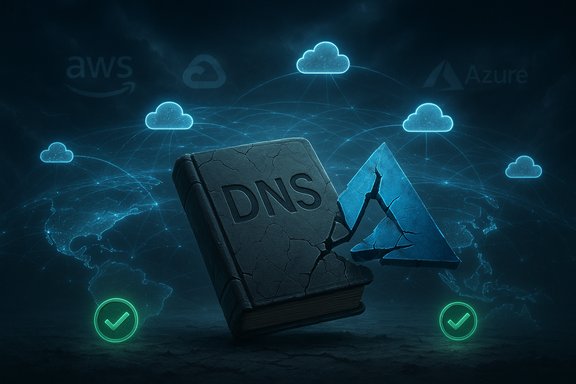
AWS’s public technical narrative and independent reconstructions point to a bug in automation that manages DynamoDB endpoint DNS entries. A faulty update produced an empty or incorrect DNS record in the US‑EAST‑1 control systems; because many AWS subsystems rely on DynamoDB for control‑plane state, DNS resolution failures cascaded into a broad set of API and orchestration errors. Independent monitoring vendors observed failures beginning early in the UTC morning and recovery over several hours. The outage’s visible footprint was enormous because DynamoDB sits on many critical dependency paths. Why DNS? DNS is the internet’s address book; if the address book is wrong or blank, clients can’t find the server even when the server is healthy. The problem is worsened by automation, caching and the way control‑plane dependencies bind services together.2) Microsoft Azure — Azure Front Door configuration change (October 29, 2025)
Microsoft identified an inadvertent configuration change in Azure Front Door (AFD) as the proximate trigger. AFD handles TLS termination, global HTTP(S) routing and edge security responsibilities for many Microsoft services and customers. When the misapplied configuration propagated, token issuance endpoints and global routing rules degraded in many PoPs (points of presence). Microsoft’s immediate mitigation was to freeze AFD changes, roll back to a validated configuration and fail the Azure Portal away from affected routes to restore management access. Recovery was staged and measured in hours rather than minutes. Why this kind of failure matters: AFD is both the public ingress and, in many deployments, an identity/management path. If the fabric that authenticates and routes traffic is impaired, admins can lose the very consoles they need to fix problems, complicating remediation.3) Google Cloud — IAM / quota check cascading failure (June 12–13, 2025)
Google reported an issue in identity/quota validation logic that caused token validation and several management‑plane APIs to fail, which in turn affected a wide range of Google services and third‑party platforms that depend on Google Cloud infrastructure or hosted components. Cloudflare and others publicly acknowledged dependent features were disrupted; Google and independent coverage recorded progressive recovery over several hours. The technical lesson: identity functions are glue — when the glue breaks, everything that needs authentication stops.Are outages becoming more frequent, or just more visible?
This is the core debate. Two separate datasets inform the answer.- Incident counts and durations: Parametrix’s Cloud Outage Risk Report 2024 documents an increase in critical outages (those causing major service interruptions) from 40 in 2023 to 47 in 2024 — an 18% year‑over‑year jump — and shows aggregate critical‑event duration rising to roughly 221 hours in 2024 (a meaningful increase from prior years). Parametrix also finds human error a leading cause of outages. Those results indicate that high‑impact events have become more persistent.
- Visibility and impact: Analysts at Gartner (quoted in contemporaneous reporting) caution that the frequency of incidents may not be dramatically higher, but that impact and visibility have risen because more business‑critical systems — from airline check‑in to consumer voice assistants — now run on the public cloud. In short: the number of catastrophic events is up modestly, but the number of systems affected by any single event has increased due to concentration. That makes public outages feel more frequent and more consequential.
Verifying the headline claims (markets, trackers, insured loss estimates)
- Market concentration: Synergy Research’s Q2 2025 market data support the claim that AWS, Azure and GCP together control a dominant share of the infrastructure market (Synergy cites ~30/20/13 for Q2). Those numbers are a near‑term snapshot and are consistent across market trackers for the quarter. Conclusion: the market concentration figures cited in the CXOToday piece are verifiable.
- Incident trackers: public outage aggregation sites and network analytics vendors reported large spikes for each event. Downdetector and Ookla published enormous user‑report totals during the AWS October incident (tens of millions of user‑reported events across affected services in some tallies) and five‑figure spikes for the Azure AFD event. These crowd‑sourced trackers are noisy but directionally useful. Treat their raw totals as indicators of user‑perceived impact, not as precise counts of affected enterprise seats.
- Insured loss estimate: cyber risk modeler CyberCube published a preliminary insured‑loss range of roughly $38 million to $581 million for the October AWS outage; multiple trade publications and insurance outlets reported that range. CyberCube explicitly positions the higher number as a worst‑case ceiling and suggests most insured losses will cluster near the low end. Conclusion: the CyberCube range is real and publicly reported; readers should treat the upper bound as conservative worst‑case modeling.
- Parametrix causation figures: Parametrix’s report attributes a large share of outages to human error and records the 221‑hour aggregate figure for 2024. Slight discrepancies between outlets (for instance, 66% vs 68% human error shares cited in different reports) exist in secondary reporting; the Parametrix primary release and Reuters coverage indicate human error as the dominant cause. Where numbers conflict by a few percentage points, treat them as rounded or updated figures rather than categorical contradictions.
- Items not independently verifiable: the CXOToday story cites a Greyhound CIO Pulse 2025 stat — that organizations with >60% cloud workload suffered 7.4× higher revenue loss per hour of outage — and adoption metrics like "17% independently routed failover" and "11% chaos engineering drills." I could not locate publicly available Greyhound Research materials to confirm those exact figures at the time of writing. Those claims should be treated as attributed reporting from the CXOToday piece and verified against Greyhound’s original release before being used in contract language or board materials. Flagged as unverifiable pending direct access to the Greyhound report.
Root causes: patterns that recur
The three major failure modes evident across these incidents are:- Control‑plane misconfiguration and human error. Inadvertent changes, insufficient canarying and automation gaps continue to be a leading cause of high‑impact outages. Parametrix’s data confirm human error as the largest single cause.
- DNS and routing fragility. DNS is a brittle dependency: caching, TTLs and propagation delays make DNS problems linger even after fixes are applied. The AWS DynamoDB incident was effectively a DNS failure on a critical endpoint, and DNS anomalies were central to the Azure AFD symptom set.
- Identity/management plane failures. IAM and token‑validation pathways are central to sign‑in and automation. When they fail, admins and pipelines lose ability to manage and authenticate, making any recovery slower and more brittle. The GCP June incident made this painfully clear.
Business impact: practical magnitudes and insurance signals
- Visibility translates into real revenue, reputational and operational damage. For customer‑facing services, an hour of downtime can mean millions of dollars in lost transactions, increased customer support costs and long‑term churn risk. The Parametrix and CyberCube analyses underscore that aggregated financial exposure can be substantial even for short outages, especially where commerce or fintech rails are affected.
- Insurers are watching. CyberCube’s model shows insured loss potential in the low double‑digit to hundreds of millions of dollars for the October AWS event; insurers expect the actual numbers to cluster near the low end because many companies will be reimbursed by AWS or elect not to claim for short outages. The practical takeaway: insured risk remains manageable at the industry level, but single organizations must still prepare for uninsured operational loss and reputational damage.
- Tracker numbers should be interpreted carefully. Downdetector and Ookla provide rapid public telemetry of user‑reported failures and are valuable for mapping perceived impact, but they do not replace provider telemetry or customer logs when calculating business loss. Use them as one signal among many.
Practical mitigation: an enterprise playbook for reducing hyperscaler risk
No single strategy eliminates risk. The most effective programs layer technical, process and contractual measures to reduce blast radius and recovery time.Architecture & engineering (technical)
- Map dependencies. Create a complete dependency graph that includes identity providers, CDN/edge fabrics, DNS providers, and any function‑as‑service or managed DBs in the critical path. This is the foundation of meaningful resilience planning.
- Design for control‑plane failure. Don't rely on a single identity or routing plane for both public traffic and management consoles. Where possible, configure management paths that do not use the same global edge fabric as public endpoints.
- Multi‑region failover (within provider). For many apps, hot‑standby in a secondary region is far easier and cheaper than multi‑cloud. Ensure replication is consistent and failovers are rehearsed.
- Multi‑cloud selectively. Multi‑cloud is not a binary solution; use multi‑cloud for critical, high‑value flows where reconciliation and latency are tractable. Expect higher costs and operational complexity.
- Edge‑aware DNS and multiple DNS providers. Use intelligent DNS failover, conservative TTL strategies for critical endpoints, and plan for cache‑related recovery tails.
- Resilient authentication patterns. Implement cached tokens, shortlived offline sessions, or a secondary SSO path for essential admin functions so users can continue critical operations when IAM is impaired.
- Circuit breakers and exponential backoff. Prevent retry storms from amplifying outages and overloading backup paths.
- Canarying and deployment safety gates. High‑impact control‑plane changes must pass automated safety checks, limited canaries and human review before global propagation.
- Chaos engineering and rehearsals. Run regular game days that simulate cross‑region, cross‑provider and identity failures; validate runbooks and recovery times. (Note: real adoption rates for multi‑provider chaos drills appear low in some reports; practice matters.
Process & procurement
- Runbooks and automated failover scripts. Ensure runbooks are executable via scripts and not solely dependent on GUIs that may be down during an incident.
- SLA and contract clauses. Negotiate rights to incident forensic reports, more meaningful SLA credit calculations and defined notification obligations for high‑impact control‑plane faults.
- Insurance and loss modeling. Use realistic modeling (including cyber‑aggregation scenarios) to assess insured vs uninsured exposure; consider aggregated event scenarios where multiple clients are affected simultaneously.
Organizational & governance
- Board‑level visibility for systemic vendor concentration risk. Put concentration metrics and scenario planning on the risk register.
- Cross‑functional exercises. Include legal, communications and customer support in outage rehearsals so post‑incident response is coordinated and fast.
- Supplier transparency demands. Require clearer post‑incident RCAs and remediation commitments in vendor governance channels.
Cost, complexity and the realistic path forward
- True multi‑cloud active‑active setups are expensive: they require duplicated compute, complicated data synchronisation and staff capable of operating multiple provider ecosystems. For many organizations the right compromise is selective multi‑region resilience combined with targeted multi‑cloud for only a few mission‑critical paths. The exact balance is an organizational calculus of risk tolerance, customer exposure and budget.
- Cloud hyperscalers are not blind to these risks. The October incidents have already provoked public commitments to better canarying, rollback mechanics and post‑incident transparency. Those operational improvements matter, but they will not eliminate the need for customer‑side resilience design.
Where public claims should be treated cautiously
- Greyhound CIO Pulse 2025 figures (the 7.4× revenue loss figure and the detailed multi‑cloud adoption percentages cited in the CXOToday piece) were not located in an independently accessible Greyhound Research release. Treat these as attributed claims from the CXOToday article until the Greyhound source is published or supplied. Confirm contractually sensitive numbers directly with the vendor before embedding them in risk models.
- Downdetector raw totals can vary between snapshots and between services. They are helpful for trend‑spotting but not for audited loss accounting. Use provider telemetry and internal logs to calculate exact impact.
- Parametrix percentage points: some outlets report slight variances in Parametrix's percentages for human error and year‑over‑year increases; they are directionally consistent and Parametrix’s primary report is the definitive source. Where exact percentages matter, cite the primary Parametrix release to avoid rounding differences.
A concise, actionable checklist for the next 90 days
- Map your external dependencies (DNS, edge/CDN, identity, managed DBs, messaging). Update the dependency graph and identify count of services that transit each provider’s control‑plane.
- Run one full failover drill for your highest‑revenue customer flow — measure RTO and RPO, then fix gaps.
- Implement a separate management‑plane access path (or cached‑token strategy) for admin consoles and document emergency procedures.
- Harden deployment safety for any configuration that touches ingress or identity: automated condition checks, limited canaries, rollback triggers.
- Revisit DNS TTL strategy and add a secondary authoritative DNS provider for critical public endpoints.
- Re‑assess cyber‑insurance models against aggregated cloud‑dependency loss scenarios and update procurement clauses accordingly.
Conclusion
The recent chain of high‑impact outages is a sobering reminder that cloud convenience and scale bring correlated risk. The evidence shows that the number of catastrophic incidents has risen modestly, but the real inflection is in their impact — more services now sit on top of the same control‑plane primitives, and when those primitives hiccup the consequences are immediate and wide. Market concentration figures from Synergy Research, incident tallies and modeling from Parametrix and CyberCube, and provider post‑incident narratives together build a coherent picture: outages will remain inevitable, but they need not be catastrophic for carefully prepared organisations. Build resilience into architecture and procurement, rehearse recovery plans, demand better transparency from hyperscalers, and treat control‑plane changes as high‑risk events that deserve the same guardrails as database or network upgrades. Where a single control‑plane mistake once affected a handful of developers, it can now disrupt airlines, banks and gaming platforms; that changed scale obliges a changed response.Source: CXOToday.com Have cloud outages become more frequent, or enterprises are more dependent now
