

Australian aged care provider Regis has been using RegiCare Assist since September 2025 to summarize clinical handover notes, flag resident concerns, and sort overnight reports across its 72-home network, with the AI system built on Microsoft Copilot Studio and Microsoft Foundry alongside Cognizant. The story is not that AI has suddenly become a nurse. It is that one of healthcare’s least glamorous bottlenecks — the daily grind of reading, sorting, and prioritizing paperwork — is becoming a serious test case for enterprise AI. Regis’ deployment shows both the promise and the fragility of this new wave: the assistant can compress a 68-page report into three pages, but only if humans design it carefully enough that no resident disappears between the lines.
Every technology cycle eventually discovers healthcare, and healthcare usually responds by reminding the technology industry that messy human systems do not behave like demo scripts. Aged care is even harder. Residents are frail, staffing is stretched, records are repetitive but clinically meaningful, and the cost of missing a small change can be severe.
That is why Regis’ use of AI is more interesting than the usual “Copilot saves time” customer story. The company did not start with a moonshot diagnosis engine or a robot caregiver. It started with a mundane operational problem: clinical care managers were spending hours reading progress notes, incident reports, and handover documents before they could begin making decisions.
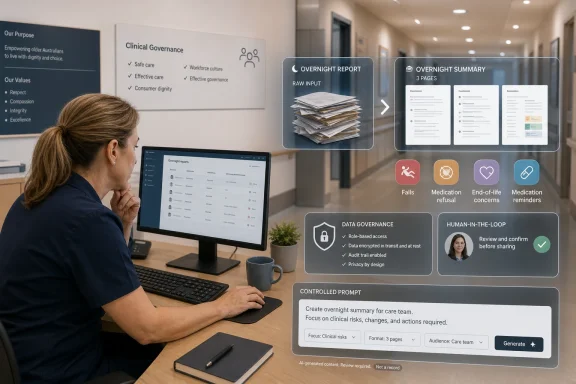
In the Microsoft account, clinical care manager Dorkas Sangalang begins her morning in a Melbourne Regis home by getting up to speed on overnight concerns: falls, medication refusal, residents nearing end of life, and other issues that must be raised with nurses and personal care assistants. In Cairns, clinical care manager Mariamma George describes a 68-page 24-hour report that RegiCare Assist turns into a three-page summary within minutes. That is not glamorous AI. It is triage for the information layer of care.
The distinction matters. In care settings, “paperwork” is not merely bureaucracy; it is memory, accountability, and risk management. The same notes that slow people down are also the record that keeps teams aligned across shifts. Regis is trying to reduce the burden without treating the burden as disposable.
RegiCare Assist is narrow, controlled, and attached to a workflow that already exists. It does not appear to be freely roaming through clinical systems making autonomous decisions. Instead, it summarizes uploaded reports, organizes issues into categories, and presents managers with a clearer morning picture.
That restraint is the point. Enterprise AI has often failed when companies tried to apply it as a general-purpose intelligence layer before deciding exactly where accountability sits. Regis’ deployment works as a case study because the AI has a defined job: read the big bundle of notes faster than a human can, surface what may matter, and leave judgment with the care team.
This is where Microsoft’s agent strategy is strongest. The company does not need to convince every organization that AI should replace entire workflows. It needs to convince them that AI can sit inside existing Microsoft-secured environments, use approved data, respect permissions, and remove enough friction to justify the cost and risk. A three-page morning clinical summary is a more concrete pitch than an abstract promise of “transformation.”
That human-in-the-loop framing is not just ethical positioning. It is operational risk control. Aged care notes are filled with subtlety: a change in appetite, agitation, medication refusal, pain cues, infection signs, bowel movements, family concerns, and end-of-life observations. A summary can help prioritize, but it can also flatten context.
Regis appears to have recognized that risk early. The company involved frontline clinical managers in development, not merely as future users but as the people most likely to spot where an apparently helpful summary could become dangerous. That is the difference between deploying AI as a workplace tool and imposing it as a management fad.
The system’s click-based interface with approved prompts is another telling detail. Free-form chat is seductive because it feels powerful, but in a safety-sensitive environment, ambiguity is a liability. By steering users toward approved prompts and predefined workflows, Regis is reducing the chance that a vague question produces a dangerously incomplete answer.
That is the kind of detail that should make every CIO both excited and uneasy. On one hand, it shows how tunable these systems are. On the other, it shows how much safety can depend on wording that would seem trivial in ordinary software.
Traditional enterprise systems fail in familiar ways: a field is missing, a database query is wrong, a permission is misconfigured, an interface misleads the user. Generative AI adds another layer of failure, where the same underlying data can produce a different emphasis depending on how the instruction is phrased. In healthcare-adjacent settings, that is not a cosmetic issue.
Regis’ response was to spend time engineering prompts and structuring the assistant around resident safety. That phrase — prompt engineering — often gets treated as a novelty or a meme in software circles. Here, it becomes something closer to clinical workflow design. The wording of the instruction shapes the reliability of the handover.
That is a meaningful improvement over a generic chatbot, especially in regulated or high-risk settings. A care provider does not want an assistant guessing what the policy might be. It wants the assistant to reflect the organization’s actual procedures and terminology.
But RAG is not a guarantee of correctness. Retrieval can miss relevant material, rank the wrong passage highly, or present policy text in a way that seems more definitive than it is. The model can still summarize poorly, omit edge cases, or overstate confidence. In the Regis example, the safety work is not the presence of RAG alone; it is the combination of RAG, approved prompts, secure deployment, user training, and continued human review.
That is the broader lesson for IT leaders. “We use RAG” is becoming the new “we use encryption” — important, but not sufficient. The real question is how the system behaves under pressure, how its outputs are checked, and what happens when the AI produces something incomplete.
Aged care records are intensely personal. They can include medication, cognitive status, continence, infection signs, behavioral changes, family interactions, end-of-life care, and other details that residents and families reasonably expect to remain protected. Any AI tool working with this material must be judged not only on productivity but on data governance.
Microsoft’s enterprise AI pitch is built around exactly that concern: keep customer data inside controlled environments, respect permissions, and make AI palatable to risk-averse industries. Regis choosing Microsoft for security and ease of use fits that strategy neatly. It also underlines why consumer-grade AI habits cannot simply be imported into clinical operations.
The danger is not only a dramatic data breach. It is also quiet overexposure: too many staff accessing too much summarized information, sensitive details appearing in outputs where they are not needed, or copied summaries escaping into less controlled channels. AI makes information more usable, but making information more usable also makes it easier to mishandle.
Manual upload has drawbacks. It adds friction, creates room for user error, and limits adoption to people willing and able to perform the extra step. It also keeps the AI slightly outside the system of record, which can be safer during early deployment but less efficient over time.
Integration changes the equation. Once RegiCare Assist is connected directly to the care management system, it can become part of the daily operating rhythm rather than a separate assistant. That may improve consistency, but it also raises the bar for governance, logging, access control, failure handling, and auditability.
This is where many enterprise AI pilots stall. A chatbot can be piloted quickly. A workflow-integrated AI system touches identity, permissions, compliance, user experience, change management, and vendor support. Regis’ next phase will likely be more technically and organizationally consequential than the initial launch.
But Hassan also says it is still too early to know whether the AI assistant has improved clinical governance. That caveat deserves emphasis. In healthcare and aged care, saving time is not the same as improving outcomes. A shorter report can be better, worse, or merely faster depending on what it preserves and what it omits.
The right measures will be harder than counting minutes saved. Regis will need to look at whether issues are identified earlier, whether follow-ups are completed more reliably, whether escalation patterns improve, and whether staff trust the tool without becoming complacent. It will also need to watch for automation bias, where people give too much weight to what the assistant surfaced and too little to what it missed.
This is the line every AI deployment in care must walk. The system is valuable if it makes competent professionals more aware and more available. It becomes risky if it teaches them to scan the summary and assume the underlying record has nothing more to say.
That makes the sector an obvious target for AI vendors, but also a dangerous place for overclaiming. If an assistant reduces paperwork, the temptation will be to treat that time savings as capacity that can be harvested elsewhere. The better interpretation is that some of that recovered time should be returned to care itself.
Sangalang’s comment about having more time to walk the floor and sit with residents is the human center of the story. Technology companies often describe productivity as if the saved time simply vanishes into an efficiency ledger. In care work, saved time can mean noticing a resident’s discomfort earlier, talking with a family member properly, or giving staff a less frantic start to the day.
That is the optimistic reading. The more cynical reading is that AI becomes another way to keep overloaded systems functioning without fixing staffing, funding, or workload. Both possibilities can be true at once. The tool can help, and the system can still ask too much of the people using it.
Most enterprises already live inside Microsoft identity, compliance, endpoint management, and productivity ecosystems. That gives Microsoft a distribution advantage, but it also puts pressure on IT departments. If business units can build AI agents with low-code tools, central IT needs policy before the pilots multiply.
Regis’ approach suggests a pattern worth studying. Pick a constrained workflow. Involve frontline users. Use approved prompts. Ground the assistant in organizational knowledge. Keep the human decision-maker visible. Run it in a controlled environment. Treat integration as a second-stage decision, not the first move.
That may sound slower than the AI hype cycle wants. It is also the only version likely to survive contact with clinical, legal, and reputational risk. The organizations that win with AI agents will not be the ones that build the most bots. They will be the ones that decide which workflows deserve automation, which require augmentation, and which should remain stubbornly human.
That still leaves practical lessons for every organization considering similar tools:
 The Real Target Is Not Care, but the Administrative Fog Around It
Every technology cycle eventually discovers healthcare, and healthcare usually responds by reminding the technology industry that messy human systems do not behave like demo scripts. Aged care is even harder. Residents are frail, staffing is stretched, records are repetitive but clinically meaningful, and the cost of missing a small change can be severe.That is why Regis’ use of AI is more interesting than the usual “Copilot saves time” customer story. The company did not start with a moonshot diagnosis engine or a robot caregiver. It started with a mundane operational problem: clinical care managers were spending hours reading progress notes, incident reports, and handover documents before they could begin making decisions.
In the Microsoft account, clinical care manager Dorkas Sangalang begins her morning in a Melbourne Regis home by getting up to speed on overnight concerns: falls, medication refusal, residents nearing end of life, and other issues that must be raised with nurses and personal care assistants. In Cairns, clinical care manager Mariamma George describes a 68-page 24-hour report that RegiCare Assist turns into a three-page summary within minutes. That is not glamorous AI. It is triage for the information layer of care.
The distinction matters. In care settings, “paperwork” is not merely bureaucracy; it is memory, accountability, and risk management. The same notes that slow people down are also the record that keeps teams aligned across shifts. Regis is trying to reduce the burden without treating the burden as disposable.
Microsoft’s Agent Pitch Finds a More Convincing Use Case Than Office Chatter
Microsoft has spent the past two years trying to sell businesses on the idea that AI agents are the next productivity layer: not just chatbots, but task-oriented systems that sit inside corporate workflows. Copilot Studio is the low-code front end for building and customizing those agents, while Microsoft Foundry supplies the larger AI platform underneath. Regis gives Microsoft something more persuasive than another slide deck about summarizing meetings.RegiCare Assist is narrow, controlled, and attached to a workflow that already exists. It does not appear to be freely roaming through clinical systems making autonomous decisions. Instead, it summarizes uploaded reports, organizes issues into categories, and presents managers with a clearer morning picture.
That restraint is the point. Enterprise AI has often failed when companies tried to apply it as a general-purpose intelligence layer before deciding exactly where accountability sits. Regis’ deployment works as a case study because the AI has a defined job: read the big bundle of notes faster than a human can, surface what may matter, and leave judgment with the care team.
This is where Microsoft’s agent strategy is strongest. The company does not need to convince every organization that AI should replace entire workflows. It needs to convince them that AI can sit inside existing Microsoft-secured environments, use approved data, respect permissions, and remove enough friction to justify the cost and risk. A three-page morning clinical summary is a more concrete pitch than an abstract promise of “transformation.”
The Most Important Design Choice Was Keeping the Human in Charge
Regis’ chief nursing officer, Rameez Hassan, reportedly told staff the AI was there to support them, not replace clinical judgment or decision-making. That sounds like standard corporate reassurance, but in this context it is also the architecture of the system. The assistant can flag, summarize, and sort; the manager still decides what requires action.That human-in-the-loop framing is not just ethical positioning. It is operational risk control. Aged care notes are filled with subtlety: a change in appetite, agitation, medication refusal, pain cues, infection signs, bowel movements, family concerns, and end-of-life observations. A summary can help prioritize, but it can also flatten context.
Regis appears to have recognized that risk early. The company involved frontline clinical managers in development, not merely as future users but as the people most likely to spot where an apparently helpful summary could become dangerous. That is the difference between deploying AI as a workplace tool and imposing it as a management fad.
The system’s click-based interface with approved prompts is another telling detail. Free-form chat is seductive because it feels powerful, but in a safety-sensitive environment, ambiguity is a liability. By steering users toward approved prompts and predefined workflows, Regis is reducing the chance that a vague question produces a dangerously incomplete answer.
Prompt Engineering Becomes Patient Safety Work
The most revealing anecdote in Microsoft’s story is not the 68-page report becoming three pages. It is Regis CIO Imtiaz Bhayat explaining that the word “all” mattered. When the team asked the assistant to summarize residents with needs to be addressed, some people could drop off; when it asked for all residents with needs to be addressed, the output captured everybody.That is the kind of detail that should make every CIO both excited and uneasy. On one hand, it shows how tunable these systems are. On the other, it shows how much safety can depend on wording that would seem trivial in ordinary software.
Traditional enterprise systems fail in familiar ways: a field is missing, a database query is wrong, a permission is misconfigured, an interface misleads the user. Generative AI adds another layer of failure, where the same underlying data can produce a different emphasis depending on how the instruction is phrased. In healthcare-adjacent settings, that is not a cosmetic issue.
Regis’ response was to spend time engineering prompts and structuring the assistant around resident safety. That phrase — prompt engineering — often gets treated as a novelty or a meme in software circles. Here, it becomes something closer to clinical workflow design. The wording of the instruction shapes the reliability of the handover.
RAG Helps, but It Does Not Make the System Magic
RegiCare Assist uses retrieval-augmented generation, or RAG, drawing from Regis’ clinical policies and procedures to ground responses in an approved knowledge base. In theory, this is exactly how enterprise AI should be used. Instead of asking a model to improvise from broad training data, the system retrieves relevant internal material and generates answers around it.That is a meaningful improvement over a generic chatbot, especially in regulated or high-risk settings. A care provider does not want an assistant guessing what the policy might be. It wants the assistant to reflect the organization’s actual procedures and terminology.
But RAG is not a guarantee of correctness. Retrieval can miss relevant material, rank the wrong passage highly, or present policy text in a way that seems more definitive than it is. The model can still summarize poorly, omit edge cases, or overstate confidence. In the Regis example, the safety work is not the presence of RAG alone; it is the combination of RAG, approved prompts, secure deployment, user training, and continued human review.
That is the broader lesson for IT leaders. “We use RAG” is becoming the new “we use encryption” — important, but not sufficient. The real question is how the system behaves under pressure, how its outputs are checked, and what happens when the AI produces something incomplete.
The Privacy Stakes Are Higher Than the Productivity Pitch
Microsoft’s article says RegiCare Assist runs within Regis’ secure environment with strict controls on how data is accessed and shared. That is not a footnote. It is central to whether deployments like this can scale.Aged care records are intensely personal. They can include medication, cognitive status, continence, infection signs, behavioral changes, family interactions, end-of-life care, and other details that residents and families reasonably expect to remain protected. Any AI tool working with this material must be judged not only on productivity but on data governance.
Microsoft’s enterprise AI pitch is built around exactly that concern: keep customer data inside controlled environments, respect permissions, and make AI palatable to risk-averse industries. Regis choosing Microsoft for security and ease of use fits that strategy neatly. It also underlines why consumer-grade AI habits cannot simply be imported into clinical operations.
The danger is not only a dramatic data breach. It is also quiet overexposure: too many staff accessing too much summarized information, sensitive details appearing in outputs where they are not needed, or copied summaries escaping into less controlled channels. AI makes information more usable, but making information more usable also makes it easier to mishandle.
The Manual Upload Is a Small Detail with Big Enterprise Meaning
For now, Regis managers still manually upload the 24-hour report into RegiCare Assist. The company’s next priority is integrating the assistant with its existing care management system so that upload step disappears. That planned upgrade may sound like a convenience feature, but it is where the deployment moves from helpful tool to embedded infrastructure.Manual upload has drawbacks. It adds friction, creates room for user error, and limits adoption to people willing and able to perform the extra step. It also keeps the AI slightly outside the system of record, which can be safer during early deployment but less efficient over time.
Integration changes the equation. Once RegiCare Assist is connected directly to the care management system, it can become part of the daily operating rhythm rather than a separate assistant. That may improve consistency, but it also raises the bar for governance, logging, access control, failure handling, and auditability.
This is where many enterprise AI pilots stall. A chatbot can be piloted quickly. A workflow-integrated AI system touches identity, permissions, compliance, user experience, change management, and vendor support. Regis’ next phase will likely be more technically and organizationally consequential than the initial launch.
The Productivity Claim Is Plausible, but the Clinical Claim Is Still Unproven
Regis says feedback from clinicians has been positive, and managers report lower anxiety and more confidence in handling daily notes. Those are meaningful early signals. If a care manager spends less time grinding through repetitive documentation and more time walking the floor, residents may benefit.But Hassan also says it is still too early to know whether the AI assistant has improved clinical governance. That caveat deserves emphasis. In healthcare and aged care, saving time is not the same as improving outcomes. A shorter report can be better, worse, or merely faster depending on what it preserves and what it omits.
The right measures will be harder than counting minutes saved. Regis will need to look at whether issues are identified earlier, whether follow-ups are completed more reliably, whether escalation patterns improve, and whether staff trust the tool without becoming complacent. It will also need to watch for automation bias, where people give too much weight to what the assistant surfaced and too little to what it missed.
This is the line every AI deployment in care must walk. The system is valuable if it makes competent professionals more aware and more available. It becomes risky if it teaches them to scan the summary and assume the underlying record has nothing more to say.
Aged Care Is a Stress Test for the AI Agent Economy
There is a reason this example lands differently from AI summarizing sales calls or drafting marketing copy. Aged care is labor-intensive, emotionally demanding, and administratively dense. Staff shortages and compliance burdens are not abstract management problems; they affect the amount of attention available for vulnerable people.That makes the sector an obvious target for AI vendors, but also a dangerous place for overclaiming. If an assistant reduces paperwork, the temptation will be to treat that time savings as capacity that can be harvested elsewhere. The better interpretation is that some of that recovered time should be returned to care itself.
Sangalang’s comment about having more time to walk the floor and sit with residents is the human center of the story. Technology companies often describe productivity as if the saved time simply vanishes into an efficiency ledger. In care work, saved time can mean noticing a resident’s discomfort earlier, talking with a family member properly, or giving staff a less frantic start to the day.
That is the optimistic reading. The more cynical reading is that AI becomes another way to keep overloaded systems functioning without fixing staffing, funding, or workload. Both possibilities can be true at once. The tool can help, and the system can still ask too much of the people using it.
Windows Shops Should Read This as a Governance Story
For WindowsForum readers, the obvious Microsoft angle is Copilot Studio and Foundry. But the more important lesson is not which brand name appears in the architecture diagram. It is how a Microsoft-based organization can turn AI from a general-purpose novelty into a governed workflow tool.Most enterprises already live inside Microsoft identity, compliance, endpoint management, and productivity ecosystems. That gives Microsoft a distribution advantage, but it also puts pressure on IT departments. If business units can build AI agents with low-code tools, central IT needs policy before the pilots multiply.
Regis’ approach suggests a pattern worth studying. Pick a constrained workflow. Involve frontline users. Use approved prompts. Ground the assistant in organizational knowledge. Keep the human decision-maker visible. Run it in a controlled environment. Treat integration as a second-stage decision, not the first move.
That may sound slower than the AI hype cycle wants. It is also the only version likely to survive contact with clinical, legal, and reputational risk. The organizations that win with AI agents will not be the ones that build the most bots. They will be the ones that decide which workflows deserve automation, which require augmentation, and which should remain stubbornly human.
The Three-Page Summary Is Only as Good as the Safety Net Around It
Regis’ deployment is persuasive because it is specific. It does not ask us to believe that AI will reinvent aged care overnight. It asks us to believe that a clinical manager drowning in notes can benefit from a safer, faster way to see the morning’s risks.That still leaves practical lessons for every organization considering similar tools:
- AI is most useful when it is aimed at a painful, repetitive workflow that staff already understand well.
- Summarization in care settings must be treated as a safety-sensitive function, not a convenience feature.
- Approved prompts and constrained interfaces can be more valuable than open-ended chat when the cost of ambiguity is high.
- Retrieval-augmented generation improves grounding, but it does not remove the need for testing, auditing, and human review.
- Integration with systems of record should come after governance is mature enough to handle the additional risk.
- Early staff confidence is encouraging, but clinical governance improvements require evidence beyond anecdotal time savings.
References
- Primary source: Microsoft Source
Published: Mon, 18 May 2026 23:11:01 GMT
At aged care provider Regis, AI takes on paperwork so staff can focus on residents - Source Asia
Regis Aged Care uses AI with Microsoft Foundry and Copilot Studio to reduce admin work and help staff focus on resident care.news.microsoft.com - Official source: learn.microsoft.com
Official Microsoft Copilot Studio documentation - Microsoft Copilot Studio | Microsoft Learn
Discover how to build AI-driven agents easily with Microsoft Copilot Studio with online training courses, docs, and videos. Learn how to quickly and simply integrate chat into your website.learn.microsoft.com - Related coverage: regis.com.au
About Regis – Regis Aged Care
About Regis Regis has cared for older Australians for nearly 30 years. Beginning with 104 residents in regional Victoria, we now care for more than 7,200 people Australia-wide. From Blackburn South to Bulimba, Norwood to Woodlands, we are proud to provide high-quality aged care and services...www.regis.com.au - Official source: developer.microsoft.com
Build agents, your way | Microsoft Developer
From low-code to pro-code, choose the right tool for the task. Build with familiar workflows, integrate with your stack, and deploy to a trusted platform.developer.microsoft.com - Official source: adoption.microsoft.com
Microsoft Copilot Studio – Microsoft Adoption
Deliver value and employee satisfaction with our tools for Microsoft 365 Copilot Chat, Microsoft 365 Copilot, and agent deployment and adoption.adoption.microsoft.com - Official source: microsoft.com
Microsoft Copilot Studio | Create AI Agents
Build AI agents with Microsoft Copilot Studio. Enhance your workflows with powerful AI bots and seamless Microsoft 365 Copilot integrations.www.microsoft.com
- Related coverage: au.linkedin.com
Regis Aged Care | LinkedIn
Regis Aged Care | 42,066 followers on LinkedIn. Regis Aged Care is a leading private provider of quality residential aged care to older Australians. | Founded 30 years ago, Regis currently provides services to 9,000 older Australians through residential aged care Homes, Home Care service hubs...au.linkedin.com
- Related coverage: windowscentral.com
Microsoft doubles down on agentic AI — Agent 365 prepares for a future with over 1 billion agents | Windows Central
Microsoft kicked off Ignite with a major push into agentic AI, unveiling Agent 365 as its newest tool for automating workflows.www.windowscentral.com - Official source: cdn-dynmedia-1.microsoft.com
