

The Better Business Bureau’s Connecticut office is warning that job seekers in multiple states have reported a remote proofreading scam using the name Coast Healthcare Management, LLC, a Hartford address, Microsoft Teams chat interviews, and a $60-an-hour offer to lure applicants. The scheme is not remarkable because it is technically sophisticated; it is remarkable because it understands the modern job market so well. It turns legitimate platforms, familiar collaboration software, and ordinary remote-work habits into a credibility machine. For Windows users and IT departments, the warning is less about one fake job and more about the way employment scams now ride on everyday productivity infrastructure.
The reported Coast Healthcare Management approach follows a pattern that has become depressingly familiar: a job seeker posts or updates a résumé on LinkedIn or Indeed, receives an unsolicited email from someone claiming to be a recruiter, and is invited into a remote hiring process that feels plausible enough to continue. In this case, job seekers reported being offered part-time editing or proofreading work at $60 per hour, supposedly for a healthcare management company using a Hartford, Connecticut address.
That hourly rate is the hook, but not the whole trick. Plenty of specialized contract work can pay well, and remote white-collar hiring no longer requires a conference room, a handshake, or even a phone call at the first stage. The scam borrows that ambiguity. It does not need to impersonate the old office; it only needs to impersonate the new hiring funnel.
The reported use of Microsoft Teams is especially telling. Teams has become one of the default places where real work happens, particularly in corporate, healthcare, education, and government-adjacent environments. A Teams interview does not feel exotic. It feels like Monday.
That familiarity gives scammers cover. If a stranger asks for personal information over an obscure messaging app, many applicants pause. If the request comes after a “Teams interview,” a sample task, a job description, and a signature block with a company name and address, the same request can feel like onboarding.
A chat-only interview lets a scammer run multiple victims at once. It avoids accents, background noise, awkward timing, and the need to convincingly portray a real hiring manager on video. It also produces a written trail that can be copied, pasted, translated, and reused across applicants. In scam economics, chat scales.
The format also exploits a post-pandemic norm. Remote interviews are legitimate. Asynchronous screening is legitimate. Text-based recruiter communication is legitimate. The scammer’s advantage is that every legitimate convenience creates a shadow version that can be abused.
The key distinction is depth. Real hiring processes usually become more specific over time: names, teams, reporting lines, job duties, employment status, benefits, tax forms, onboarding portals, and live human contact begin to line up. Scam processes often stay oddly generic while rushing toward sensitive data. They simulate hiring, but they do not withstand scrutiny.
In the reports described by BBB, that collapse came before some applicants shared their address or phone number. That is the point at which the victim’s skepticism had to beat the scammer’s momentum. The best defense was not a security product. It was the old instinct that something “too good to be true” deserved a search before a disclosure.
This is a classic credibility prop. Scammers often use real addresses, mail drops, coworking spaces, virtual office suites, or addresses associated with unrelated businesses. They can attach a plausible location to a fake operation without ever occupying that location in any meaningful sense.
The BBB report says the job offers used the name Coast Healthcare Management, LLC and an address at 45 S Main St. in Hartford. It also says BBB Connecticut found a website for a business by the same name in Cypress, California and attempted to reach the company several times over several months without receiving a response. That uncertainty matters. It is possible for scammers to impersonate real companies, dormant companies, similarly named companies, or businesses with only a thin online footprint.
That is why the phrase “using the name” is more precise than “the company did it.” Corporate identity theft is a routine feature of employment scams. A real company’s name can be dragged into a fraudulent campaign without the company being the operator. A fake company can also borrow the aesthetics of a real one. The target does not have to know which is which to get hurt.
Résumé databases are rich with exactly the information a scammer needs to personalize a pitch. Work history, location, skills, certifications, writing samples, and job preferences all help a bogus recruiter sound less bogus. The more complete the profile, the easier it is to build a credible first message.
This is the uncomfortable bargain of online job hunting. Applicants need visibility to be found by real employers, but that visibility also creates reconnaissance material for fraud. The same keywords that help recruiters find a proofreader help scammers find someone likely to respond to a proofreading offer.
For IT pros, this is familiar terrain. Publicly exposed information becomes pretexting fuel. LinkedIn is already a favorite source for spear-phishing campaigns against employees; it should surprise no one that it is also a feeder system for job scams against individuals.
The $60-an-hour rate pushes the offer into “unusually attractive” territory without making it cartoonish. A promise of $300 an hour would repel more applicants. A promise of $18 an hour would not generate the same urgency. Sixty dollars is high enough to excite and just low enough to rationalize.
Scammers often choose job categories that are hard to verify from the outside. Editing, data entry, document review, customer support, payroll assistant, virtual assistant, and quality assurance roles can all be described vaguely. They also make it easier to request sample tasks or onboarding paperwork without providing much company-specific detail.
Healthcare adds another layer of credibility. Healthcare organizations produce mountains of documentation and often contract for administrative support. But healthcare also implies compliance, privacy, and bureaucracy, which can make requests for forms and identity details seem normal earlier than they should.
Employment scams frequently move from “you are hired” to “complete onboarding” with suspicious speed. That is where the scammer’s goal becomes visible. The interview is not primarily to assess the applicant; it is to manufacture consent for the next request.
Some scams go after money directly, using fake checks for equipment purchases or asking applicants to buy software from a designated vendor. Others harvest identity documents. Some do both. A fake employer can use the language of payroll, direct deposit, tax compliance, background checks, and device provisioning to make invasive requests sound routine.
The safest rule is procedural rather than emotional: no sensitive data until the employer has been independently verified, the job has been confirmed through an official channel, and the applicant has interacted with a real organization rather than a single inbound contact. Trust should not be granted because a stranger knows how to format an email signature.
The same is true of Outlook, SharePoint, Google Docs, DocuSign, Zoom, Slack, and any other mainstream collaboration platform. Scammers prefer familiar tools because familiar tools reduce friction. A victim who would never install a random executable may still click into a meeting link, open a shared document, or follow instructions in a chat.
There is also a subtle Windows angle here. Many job seekers use personal Windows laptops for interviews, document editing, and onboarding tasks. A fake employer can ask them to install “time tracking” software, “secure document” viewers, remote access tools, or payroll apps. At that point, a job scam can cross from fraud into endpoint compromise.
Even when no malware is involved, the account risk is real. A scammer who gets a Microsoft account, LinkedIn account, email account, or job-board credential can turn one victim into a launchpad for more fraud. The employment pitch is simply the social-engineering wrapper.
A high-paying unsolicited role, a generic job description, a chat-only interview, limited questions, rapid movement toward personal data, inconsistent company geography, and difficulty confirming the employer independently form a cluster. That cluster is much more important than any one element.
This is where many victims get trapped. They evaluate each red flag in isolation and explain it away. The recruiter is busy. The company is remote. The address is probably a branch office. The chat interview is just a screening. The high pay reflects urgency. The website looks professional enough.
Scams thrive in that space between possible and probable. The better question is not “Could this be legitimate?” Many scams could be. The better question is “Has this employer earned the level of trust it is asking for?” In the reported Coast Healthcare Management offers, the answer for many applicants appears to have been no.
That sounds simple, but scammers work hard to keep victims inside the funnel. They create urgency, flatter the applicant, and present the process as already underway. They know that every extra verification step creates a chance for the illusion to break.
The company’s website is useful, but not sufficient. Look for signs of life: leadership names, physical presence, domain history, consistent contact information, actual job postings, business registrations, licensing where relevant, and a broader web footprint that predates the job offer. A polished website created for a scam can look better than a neglected site for a real small business.
Applicants should also search the company name with terms like “scam,” “job offer,” “recruiter,” and the supposed recruiter’s name. In this case, the existence of BBB Scam Tracker reports gave at least one applicant enough information to stop before sharing more personal data. That is exactly how public reporting is supposed to work.
Employees looking for side work may use the same personal devices they use for work-from-home access. Laid-off workers may still have sensitive files on home machines. Contractors and consultants may be targeted because their résumés disclose client names, software stacks, or regulated-industry experience. A fake recruiter asking about document workflows can accidentally or deliberately collect operational intelligence.
Security awareness programs often train employees to spot invoice fraud, password phishing, and fake IT support calls. Employment scams deserve a place in that training, especially in sectors where staff are accustomed to remote collaboration and document-heavy workflows. The social engineering is not fundamentally different; only the pretext changes.
There is also a reputational risk for companies whose names are impersonated. A business may have nothing to do with a scam but still receive angry calls, bad reviews, or law-enforcement inquiries because its name appeared in fraudulent emails. Organizations should monitor for fake job postings and publish clear hiring-process expectations on their careers pages.
A simple statement helps: the company only uses email addresses from its official domain, does not conduct text-only interviews, does not ask applicants to purchase equipment from specified vendors, and does not request bank details before a formal offer. Those statements will not stop every scam, but they give applicants something concrete to compare against.
Microsoft can fight abuse through account controls, suspicious-link detection, tenant protections, and reporting channels. LinkedIn and Indeed can police fake postings, suspicious recruiter accounts, and abuse patterns. Email providers can filter obvious fraud. But none of these systems can reliably determine whether a plausible conversation about a plausible job is legitimate in real time.
That leaves users in the middle. We have trained people to accept digital workflows as normal, then told them to detect fraud by vibes. The modern applicant is expected to know the difference between lean remote hiring and a social-engineering operation. That is a lot to ask of someone who may be unemployed, underpaid, or eager for flexible work.
The better answer is layered friction at the moments that matter. Platforms can make it easier to verify recruiter affiliation. Companies can publish hiring rules. Job boards can warn users when messages move off-platform too quickly. Collaboration tools can make external and newly created identities more obvious. None of that removes personal responsibility, but it stops pretending that awareness alone can carry the load.
Job seekers routinely send résumés into portals with no response, complete unpaid assessments, accept opaque screening, and navigate recruiters who may or may not understand the role. Against that backdrop, a fast reply from an interested employer can feel like relief. The scammer’s advantage is emotional as much as technical.
That is why the “easy hire” warning remains so important. A real employer may move quickly, but it should still care who it is hiring. It should ask relevant questions. It should provide verifiable details. It should not treat identity information as the price of continuing the conversation.
The best scams mimic bad business practices. If legitimate employers rely on impersonal chat, vague job descriptions, outsourced recruiting, and rushed onboarding, they make the scammer’s costume easier to wear. Better hiring hygiene is a fraud-prevention measure.
The BBB warning should be read less as a one-off alert about a Hartford address than as another sign that remote-work trust is becoming a contested space. Job seekers will keep relying on online platforms, employers will keep using digital interviews, and scammers will keep inserting themselves wherever identity is assumed rather than verified. The next defense will not be a return to the old office; it will be a hiring culture that makes legitimacy easier to prove before applicants are asked to pay for trust with their personal data.
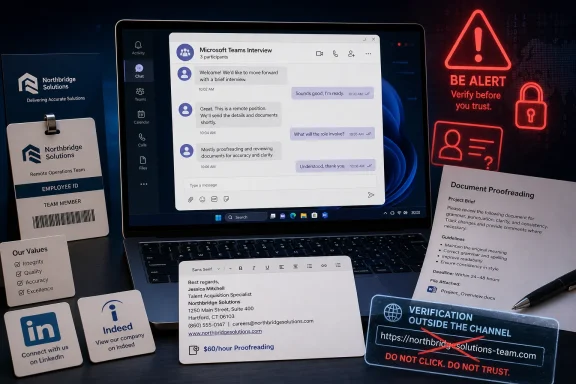 The Scam Works Because It Looks Like Work
The reported Coast Healthcare Management approach follows a pattern that has become depressingly familiar: a job seeker posts or updates a résumé on LinkedIn or Indeed, receives an unsolicited email from someone claiming to be a recruiter, and is invited into a remote hiring process that feels plausible enough to continue. In this case, job seekers reported being offered part-time editing or proofreading work at $60 per hour, supposedly for a healthcare management company using a Hartford, Connecticut address.That hourly rate is the hook, but not the whole trick. Plenty of specialized contract work can pay well, and remote white-collar hiring no longer requires a conference room, a handshake, or even a phone call at the first stage. The scam borrows that ambiguity. It does not need to impersonate the old office; it only needs to impersonate the new hiring funnel.
The reported use of Microsoft Teams is especially telling. Teams has become one of the default places where real work happens, particularly in corporate, healthcare, education, and government-adjacent environments. A Teams interview does not feel exotic. It feels like Monday.
That familiarity gives scammers cover. If a stranger asks for personal information over an obscure messaging app, many applicants pause. If the request comes after a “Teams interview,” a sample task, a job description, and a signature block with a company name and address, the same request can feel like onboarding.
Chat-Only Interviews Are the New Phishing Landing Page
The reported interview format should set off alarms: Microsoft Teams, exclusively by chat, only a few questions, and then movement toward personal details. That is not just a lazy interview. It is an operational choice.A chat-only interview lets a scammer run multiple victims at once. It avoids accents, background noise, awkward timing, and the need to convincingly portray a real hiring manager on video. It also produces a written trail that can be copied, pasted, translated, and reused across applicants. In scam economics, chat scales.
The format also exploits a post-pandemic norm. Remote interviews are legitimate. Asynchronous screening is legitimate. Text-based recruiter communication is legitimate. The scammer’s advantage is that every legitimate convenience creates a shadow version that can be abused.
The key distinction is depth. Real hiring processes usually become more specific over time: names, teams, reporting lines, job duties, employment status, benefits, tax forms, onboarding portals, and live human contact begin to line up. Scam processes often stay oddly generic while rushing toward sensitive data. They simulate hiring, but they do not withstand scrutiny.
In the reports described by BBB, that collapse came before some applicants shared their address or phone number. That is the point at which the victim’s skepticism had to beat the scammer’s momentum. The best defense was not a security product. It was the old instinct that something “too good to be true” deserved a search before a disclosure.
A Hartford Address Gives the Pitch a Local Costume
The Hartford address is not incidental. Physical addresses still carry authority, even in a remote-first labor market. A street address in a real city makes an email signature look less disposable and gives an applicant something to glance at without necessarily verifying.This is a classic credibility prop. Scammers often use real addresses, mail drops, coworking spaces, virtual office suites, or addresses associated with unrelated businesses. They can attach a plausible location to a fake operation without ever occupying that location in any meaningful sense.
The BBB report says the job offers used the name Coast Healthcare Management, LLC and an address at 45 S Main St. in Hartford. It also says BBB Connecticut found a website for a business by the same name in Cypress, California and attempted to reach the company several times over several months without receiving a response. That uncertainty matters. It is possible for scammers to impersonate real companies, dormant companies, similarly named companies, or businesses with only a thin online footprint.
That is why the phrase “using the name” is more precise than “the company did it.” Corporate identity theft is a routine feature of employment scams. A real company’s name can be dragged into a fraudulent campaign without the company being the operator. A fake company can also borrow the aesthetics of a real one. The target does not have to know which is which to get hurt.
The Job Boards Are Not the Villains, but They Are Part of the Attack Surface
Targets reportedly said they were contacted after posting résumés on LinkedIn and Indeed. That does not mean those platforms created the scam, any more than email created phishing. But it does mean modern job platforms are part of the attack surface.Résumé databases are rich with exactly the information a scammer needs to personalize a pitch. Work history, location, skills, certifications, writing samples, and job preferences all help a bogus recruiter sound less bogus. The more complete the profile, the easier it is to build a credible first message.
This is the uncomfortable bargain of online job hunting. Applicants need visibility to be found by real employers, but that visibility also creates reconnaissance material for fraud. The same keywords that help recruiters find a proofreader help scammers find someone likely to respond to a proofreading offer.
For IT pros, this is familiar terrain. Publicly exposed information becomes pretexting fuel. LinkedIn is already a favorite source for spear-phishing campaigns against employees; it should surprise no one that it is also a feeder system for job scams against individuals.
The $60-an-Hour Proofreading Role Is Designed to Lower Defenses
A remote proofreading job is a smart lure because it sounds accessible but not absurd. It does not require specialized hardware. It does not require a professional license. It can be done from anywhere. It is plausible for someone with writing, administrative, healthcare, legal, or academic experience.The $60-an-hour rate pushes the offer into “unusually attractive” territory without making it cartoonish. A promise of $300 an hour would repel more applicants. A promise of $18 an hour would not generate the same urgency. Sixty dollars is high enough to excite and just low enough to rationalize.
Scammers often choose job categories that are hard to verify from the outside. Editing, data entry, document review, customer support, payroll assistant, virtual assistant, and quality assurance roles can all be described vaguely. They also make it easier to request sample tasks or onboarding paperwork without providing much company-specific detail.
Healthcare adds another layer of credibility. Healthcare organizations produce mountains of documentation and often contract for administrative support. But healthcare also implies compliance, privacy, and bureaucracy, which can make requests for forms and identity details seem normal earlier than they should.
The First Data Request Is the Real Interview
The victim’s danger usually begins when the fake employer asks for personal information. An address and phone number may sound harmless, but they are building blocks. Add a date of birth, Social Security number, bank account, driver’s license image, or tax form, and a fake job becomes identity theft.Employment scams frequently move from “you are hired” to “complete onboarding” with suspicious speed. That is where the scammer’s goal becomes visible. The interview is not primarily to assess the applicant; it is to manufacture consent for the next request.
Some scams go after money directly, using fake checks for equipment purchases or asking applicants to buy software from a designated vendor. Others harvest identity documents. Some do both. A fake employer can use the language of payroll, direct deposit, tax compliance, background checks, and device provisioning to make invasive requests sound routine.
The safest rule is procedural rather than emotional: no sensitive data until the employer has been independently verified, the job has been confirmed through an official channel, and the applicant has interacted with a real organization rather than a single inbound contact. Trust should not be granted because a stranger knows how to format an email signature.
Teams Is a Venue, Not a Verification Badge
Microsoft Teams appearing in a hiring process proves only that someone can use Teams or claim to use it. It does not prove that the company is real, the recruiter is authorized, or the job exists. This distinction is easy to forget because enterprise tools carry institutional weight.The same is true of Outlook, SharePoint, Google Docs, DocuSign, Zoom, Slack, and any other mainstream collaboration platform. Scammers prefer familiar tools because familiar tools reduce friction. A victim who would never install a random executable may still click into a meeting link, open a shared document, or follow instructions in a chat.
There is also a subtle Windows angle here. Many job seekers use personal Windows laptops for interviews, document editing, and onboarding tasks. A fake employer can ask them to install “time tracking” software, “secure document” viewers, remote access tools, or payroll apps. At that point, a job scam can cross from fraud into endpoint compromise.
Even when no malware is involved, the account risk is real. A scammer who gets a Microsoft account, LinkedIn account, email account, or job-board credential can turn one victim into a launchpad for more fraud. The employment pitch is simply the social-engineering wrapper.
The Red Flags Are Stronger in Combination
No single detail proves a job is fake. Remote work is real. Teams interviews are real. Contract proofreading jobs are real. Recruiters do contact people from job boards. The problem is the pattern.A high-paying unsolicited role, a generic job description, a chat-only interview, limited questions, rapid movement toward personal data, inconsistent company geography, and difficulty confirming the employer independently form a cluster. That cluster is much more important than any one element.
This is where many victims get trapped. They evaluate each red flag in isolation and explain it away. The recruiter is busy. The company is remote. The address is probably a branch office. The chat interview is just a screening. The high pay reflects urgency. The website looks professional enough.
Scams thrive in that space between possible and probable. The better question is not “Could this be legitimate?” Many scams could be. The better question is “Has this employer earned the level of trust it is asking for?” In the reported Coast Healthcare Management offers, the answer for many applicants appears to have been no.
Verification Has to Leave the Conversation
The most important defensive move is to verify outside the channel where the offer arrived. If a recruiter emails you, do not use only the phone number, website, calendar link, or Teams invite in that email. Search for the company independently, find its official domain, locate its careers page, and contact the company through a published channel.That sounds simple, but scammers work hard to keep victims inside the funnel. They create urgency, flatter the applicant, and present the process as already underway. They know that every extra verification step creates a chance for the illusion to break.
The company’s website is useful, but not sufficient. Look for signs of life: leadership names, physical presence, domain history, consistent contact information, actual job postings, business registrations, licensing where relevant, and a broader web footprint that predates the job offer. A polished website created for a scam can look better than a neglected site for a real small business.
Applicants should also search the company name with terms like “scam,” “job offer,” “recruiter,” and the supposed recruiter’s name. In this case, the existence of BBB Scam Tracker reports gave at least one applicant enough information to stop before sharing more personal data. That is exactly how public reporting is supposed to work.
Enterprise Security Teams Should Treat Job Scams as Adjacent Risk
At first glance, this is a consumer warning. The victims are job seekers, not corporate networks. But the boundary is porous.Employees looking for side work may use the same personal devices they use for work-from-home access. Laid-off workers may still have sensitive files on home machines. Contractors and consultants may be targeted because their résumés disclose client names, software stacks, or regulated-industry experience. A fake recruiter asking about document workflows can accidentally or deliberately collect operational intelligence.
Security awareness programs often train employees to spot invoice fraud, password phishing, and fake IT support calls. Employment scams deserve a place in that training, especially in sectors where staff are accustomed to remote collaboration and document-heavy workflows. The social engineering is not fundamentally different; only the pretext changes.
There is also a reputational risk for companies whose names are impersonated. A business may have nothing to do with a scam but still receive angry calls, bad reviews, or law-enforcement inquiries because its name appeared in fraudulent emails. Organizations should monitor for fake job postings and publish clear hiring-process expectations on their careers pages.
A simple statement helps: the company only uses email addresses from its official domain, does not conduct text-only interviews, does not ask applicants to purchase equipment from specified vendors, and does not request bank details before a formal offer. Those statements will not stop every scam, but they give applicants something concrete to compare against.
Microsoft and the Platforms Have a Trust Problem They Cannot Fully Automate Away
The presence of Teams in this scam pattern raises an awkward point for platform companies. Collaboration tools are now part of the trust fabric of the economy, but they were not built to certify that the person on the other side is who they claim to be. They authenticate accounts; they do not authenticate stories.Microsoft can fight abuse through account controls, suspicious-link detection, tenant protections, and reporting channels. LinkedIn and Indeed can police fake postings, suspicious recruiter accounts, and abuse patterns. Email providers can filter obvious fraud. But none of these systems can reliably determine whether a plausible conversation about a plausible job is legitimate in real time.
That leaves users in the middle. We have trained people to accept digital workflows as normal, then told them to detect fraud by vibes. The modern applicant is expected to know the difference between lean remote hiring and a social-engineering operation. That is a lot to ask of someone who may be unemployed, underpaid, or eager for flexible work.
The better answer is layered friction at the moments that matter. Platforms can make it easier to verify recruiter affiliation. Companies can publish hiring rules. Job boards can warn users when messages move off-platform too quickly. Collaboration tools can make external and newly created identities more obvious. None of that removes personal responsibility, but it stops pretending that awareness alone can carry the load.
The Human Weakness Is Not Gullibility; It Is Need
It is easy to mock job-scam victims for believing in easy money. It is also wrong. The labor market has normalized remote interviews, contract roles, fragmented hiring pipelines, and recruiter outreach from strangers. Scammers are not exploiting stupidity. They are exploiting need inside a system that already asks applicants to expose themselves.Job seekers routinely send résumés into portals with no response, complete unpaid assessments, accept opaque screening, and navigate recruiters who may or may not understand the role. Against that backdrop, a fast reply from an interested employer can feel like relief. The scammer’s advantage is emotional as much as technical.
That is why the “easy hire” warning remains so important. A real employer may move quickly, but it should still care who it is hiring. It should ask relevant questions. It should provide verifiable details. It should not treat identity information as the price of continuing the conversation.
The best scams mimic bad business practices. If legitimate employers rely on impersonal chat, vague job descriptions, outsourced recruiting, and rushed onboarding, they make the scammer’s costume easier to wear. Better hiring hygiene is a fraud-prevention measure.
The Practical Lesson From a Fake Proofreading Job
The reports around Coast Healthcare Management are specific, but the defense is portable. Job seekers should assume that any unsolicited remote offer deserves independent verification, especially when the pay is unusually high and the hiring process avoids live human contact.- A legitimate employer should be confirmable through channels that the applicant finds independently, not merely through links and phone numbers supplied by the recruiter.
- A text-only interview for a high-paying remote role should be treated as a screening step at most, not as proof that a job offer is real.
- Personal information such as a Social Security number, banking details, identity documents, or home address should not be provided until the employer and offer have been verified.
- Applicants should search the company name, recruiter name, address, domain, and job title alongside scam-related terms before completing onboarding paperwork.
- Businesses should publish clear hiring-process rules so applicants can distinguish real recruiting from impersonation.
- Windows users should be especially cautious if a supposed employer asks them to install software, enable remote access, open unusual attachments, or sign into unfamiliar portals.
The BBB warning should be read less as a one-off alert about a Hartford address than as another sign that remote-work trust is becoming a contested space. Job seekers will keep relying on online platforms, employers will keep using digital interviews, and scammers will keep inserting themselves wherever identity is assumed rather than verified. The next defense will not be a return to the old office; it will be a hiring culture that makes legitimacy easier to prove before applicants are asked to pay for trust with their personal data.
References
- Primary source: Greenwich Free Press
Published: 2026-06-06T20:42:07.806805
BBB Warns of Employment Scam Using Hartford Address Targets Job Seekers Nationwide | Greenwich Free Press
Targets in New York, Missouri, Louisiana, Alabama, Wisconsin, Kentucky, and California say they were contacted via email after posting their resumes on LinkedIn and Indeed. Scam Tracker reports say the job offer comes from a Frederick Wilford of Coast Healthcare Management, LLC located at 45 S...greenwichfreepress.com - Related coverage: wfsb.com
BBB warns of job scam by company claiming to be in CT
The Better Business Bureau is warning of a job scam by a company claiming to be in Connecticut.www.wfsb.com
- Related coverage: greenwichtime.com
