

On June 24, 2026, Microsoft UK published a customer story describing how UK law firm Shoosmiths is using Microsoft 365 Copilot, Copilot Studio, SharePoint, and Azure to turn internal legal knowledge into AI agents for client work and lawyer training. The interesting part is not that another professional-services firm has “adopted AI.” It is that Shoosmiths appears to be treating AI less like a magic drafting machine and more like a distribution system for institutional memory. That distinction matters, because in law, the expensive commodity is not merely text; it is trusted judgment applied consistently under pressure.
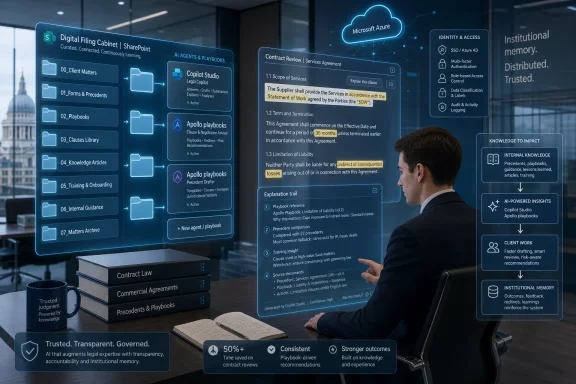
The most revealing detail in Microsoft’s account is not the prize car, though it makes for a tidy anecdote. It is the SharePoint repository.
Joanne Bevan, who joined Shoosmiths nearly three decades ago as a secretary in the real estate team and is now a senior innovation advisor, built a no-code Copilot agent for a long-standing retail client with hundreds of leased properties. The client work depended on highly specific procedures, documents, and contract-handling conventions. When staff changed, newer lawyers spent too much time looking for the right guidance.
That is exactly the kind of problem enterprise AI vendors love to describe as “knowledge work transformation,” but it is also exactly the kind of problem that collapses if the underlying knowledge is messy. Bevan’s agent worked because the firm first helped create a structured SharePoint repository. The AI layer was not replacing the knowledge base; it was making the knowledge base conversational.
This is the part many organizations still get backward. They buy a chatbot and then discover that the bot’s answers are only as coherent as the permissions, document hygiene, naming conventions, and process discipline beneath it. Shoosmiths’ example is smaller and more practical than most AI launch rhetoric, but it is more persuasive for that reason. A retrieval agent that helps a junior lawyer find the correct procedure for a specific client matter may not sound futuristic. In a real firm, it may be the difference between scalable service and institutional drift.
The lesson for WindowsForum readers is familiar from decades of SharePoint, Exchange, Active Directory, and Microsoft 365 administration: the platform never eliminates governance. It exposes whether governance exists.
No-code agent building changes who gets to automate a workflow. Instead of waiting for a developer team, an innovation advisor or business expert can wire together a useful assistant around a specific knowledge set. That can be enormously valuable in a law firm, where the people closest to the work understand the client’s quirks, the procedural landmines, and the reasons a clause or process exists.
But no-code does not mean no control. In fact, it increases the need for control, because the population of potential tool builders expands from a small technical group to a much wider class of business users. The governance burden shifts from “Who is allowed to code?” to “Who is allowed to publish an agent, connect it to what data, and put it in front of which users?”
Shoosmiths’ story suggests that its most successful AI work is not casual experimentation but domain-scoped automation. Bevan’s agent served a defined client process. Apollo, the firm’s contract review system, applies Shoosmiths’ own legal playbooks to draft contracts. These are not general-purpose bots asked to “do law.” They are bounded systems pointed at specific legal work.
That boundedness is the difference between a useful enterprise AI agent and a liability generator with a friendly interface. The smaller the domain, the easier it is to test outputs, constrain risk, and explain why the system produced a recommendation. The broader the ambition, the more likely the organization is to rediscover why professional judgment cannot simply be stuffed into a prompt box.
That history matters because it punctures the illusion that legal AI began when large language models became fashionable. Law firms have been trying to automate review, due diligence, document assembly, and knowledge retrieval for years. What changed with large language models was not the desire to systematize legal work; it was the cost and flexibility of the interface.
Apollo’s design choice is telling. Shoosmiths did not merely ask an external model to behave like a lawyer. It codified its own expertise into playbooks, which Randle describes as aggregating the experience of many lawyers into a “gold standard.” The AI then compares draft contracts against those rules.
In other words, the competitive asset is not the model by itself. Microsoft Azure provides the infrastructure, and AI models provide the reading and matching capability, but Shoosmiths’ differentiated value sits in the playbooks. Those playbooks contain the firm’s preferred positions, explanations, drafting fixes, and accumulated judgment.
This is where the legal sector’s AI adoption becomes more interesting than the usual productivity pitch. If every firm uses the same generic model to summarize the same generic contract, the advantage is thin. If a firm can encode its own best practice and deliver it consistently through an AI-assisted workflow, the advantage becomes more durable.
That is also why the build-versus-buy decision becomes complicated. Shoosmiths reportedly reviewed around 15 suppliers and decided it could not find an off-the-shelf product that met its standards. That does not mean every firm should build its own Apollo. It does mean the buyer’s question has changed. The old question was whether software could review contracts. The new question is whether software can embody your review standard rather than somebody else’s.
That is not a nice-to-have in legal work. It is the entire basis on which a lawyer can decide whether to trust, reject, or modify the system’s suggestion. A contract review tool that says “this clause is risky” is less useful than one that says, in effect, “this clause departs from our standard position for these reasons, and here is the drafting route we usually take.”
The distinction is especially important for junior lawyers. Sarah Hartley, a trainee solicitor at Shoosmiths, said Apollo helped identify issues she might not otherwise have spotted, suggested practical drafting solutions, and explained why provisions were flagged for change. That turns the tool into more than a productivity layer. It becomes a training surface.
This is one of the least appreciated implications of enterprise AI. The same system that accelerates work can also flatten learning if it hides the reasoning process. If junior lawyers merely accept AI-generated markups, they may process more documents while understanding less law. If the system forces the underlying playbook into view, it can make tacit expertise more legible.
Shoosmiths is therefore making an argument that will resonate beyond law: AI should not merely produce outputs; it should reveal the organization’s standard of care. That is harder to build than a chatbot, but it is much more valuable.
That stack is increasingly coherent. A business user can build a retrieval agent over curated content. A technical team can build a deeper system on Azure. Both can, in theory, sit within the broader Microsoft identity, compliance, and productivity environment that enterprises already manage.
For Microsoft, this is the strongest version of the Copilot story. The weakest version says Copilot helps workers write emails faster. The stronger version says Copilot and its agent ecosystem let organizations operationalize their own knowledge. Shoosmiths gives Microsoft a tidy example of the latter: a firm captures expertise, wraps it in controlled tools, and pushes it into daily work.
That is also why this story lands differently from consumer AI demos. Legal work is full of repeatable patterns, but it is also full of risk. A system that saves three to five hours on a document review, as Shoosmiths says earlier AI work could do, becomes meaningful when multiplied across thousands of documents. But the savings only count if the outputs remain defensible.
The Microsoft ecosystem gives Shoosmiths a familiar administrative foundation, but it does not remove the burden of legal accountability. Lawyers still need to supervise. Partners still need to own standards. IT still needs to manage access, retention, auditability, and data boundaries. The platform can help, but the risk does not disappear into the cloud.
The broader strategic point is that AI gains are most credible when attached to work that is high-volume, document-heavy, and rule-mediated. Contract review fits that profile. So do lease reviews, due diligence exercises, compliance checks, policy triage, client-specific process lookups, and internal knowledge retrieval.
This does not mean the work is simple. It means the work contains enough recurring structure for software to help. The playbook model is powerful because it accepts that structure without pretending the entire job is mechanical.
Shoosmiths’ reported M&A workload also helps explain the appeal. During busy transaction cycles, professional-services firms face a familiar constraint: the work arrives in bursts, but expertise is unevenly distributed. AI that diffuses expertise does not just save time; it changes how the firm absorbs demand without diluting quality.
That is the real operational advantage. Not “AI does the law,” but “AI helps more people apply the firm’s standard more consistently, especially when the work spikes.”
She had deep institutional context, understood the client problem, and used accessible tools to solve a specific bottleneck. That is precisely the kind of person many organizations overlook when they centralize AI strategy in a boardroom or a data science team. The best use cases often live with the people who have spent years watching processes fail in the same places.
There is a reason her agent was “simple” and still powerful. Many expensive enterprise problems are not technically exotic. They are coordination problems, memory problems, and consistency problems. The legal team knows the answer exists somewhere, but not where. The process was documented once, but not where the new joiner is looking. The client expects continuity, but the people on the matter have changed.
A retrieval agent over properly organized material is a modest intervention with outsized impact. It does not require artificial general intelligence. It requires a clean corpus, sensible permissions, user trust, and a workflow where asking the system is easier than interrupting a colleague or rummaging through folders.
This is why the Shoosmiths example is more convincing than grand claims about autonomous lawyering. It shows AI meeting the firm where the firm actually works.
But the deeper risk is not simply that AI replaces junior lawyers. It is that AI changes what junior lawyers get to practice.
Professional formation depends on exposure to messy first drafts, awkward clauses, contradictory client instructions, and the slow process of learning why a senior lawyer cares about one phrase and not another. If AI handles the first pass invisibly, junior staff may lose some of that apprenticeship. If AI explains the playbook, surfaces exceptions, and invites review, it can become part of the apprenticeship.
Shoosmiths appears to understand this distinction. Apollo is described as transparent, explanatory, and tied to the firm’s own reasoning. That gives it a better chance of strengthening judgment rather than bypassing it.
Still, the balance will require active management. A tool that begins as a learning aid can become a crutch if targets, billing pressure, or client expectations push users toward blind acceptance. The governance issue is therefore cultural as much as technical. The firm must decide not only what the system can do, but what kind of lawyers it wants the system to produce.
That is especially important for long-running client relationships. A retail client with hundreds of leased properties does not want every matter to feel like a fresh expedition through a filing cabinet. It wants continuity. It wants the firm to remember how things are done. It wants new lawyers to behave as if they inherited the full context of the relationship.
AI agents can help deliver that continuity, but only if the client trusts the machinery around them. That includes the content source, the review process, the escalation path, and the security model. In legal services, confidence is not created by automation alone. It is created by demonstrable control.
This is where law firms may find a competitive line to draw. The market will not reward every firm equally for saying it uses AI. Clients will ask sharper questions: What data does the system use? Who validated the playbook? Can lawyers explain the output? How are errors caught? Is the tool improving service or merely reducing cost?
Shoosmiths’ emphasis on transparency and internal expertise gives it a better answer than the firms that treat AI as a procurement badge.
What they cannot instantly replicate is Shoosmiths’ accumulated legal judgment, client-specific procedure, and willingness to turn that judgment into reusable systems. That is the actual moat, if one exists.
This is a useful corrective to the way AI is often discussed in professional services. Firms tend to talk about tools because tools are easy to name. But the long-term advantage is likely to sit in the combination of proprietary process, trusted data, expert review, and organizational adoption.
Shoosmiths’ internal poll, with 63 percent of responding partners reportedly wanting to be early adopters, hints at another important factor: partner buy-in. In a law firm, technology rarely succeeds by executive decree alone. It needs practice leaders who believe the tool will improve client work rather than embarrass them.
That adoption curve may be more decisive than the model choice. A mediocre tool with strong governance and committed practice groups can improve. A technically impressive tool that lawyers do not trust will become shelfware.
Shoosmiths gives Microsoft a better proof point because it is specific. It is not “employees save time.” It is a legal firm using agents to retrieve client-specific process knowledge and using Azure-backed AI to compare contracts against internal playbooks. That is the kind of case study CIOs can map onto their own backlog.
The catch is that case studies often show the polished end state, not the organizational plumbing. For every successful AI agent, someone had to decide which documents were authoritative, which permissions applied, how to handle stale content, what the agent should refuse to answer, and how users should report problems. None of that is glamorous, but it is where projects live or die.
This is why Microsoft’s enterprise AI future depends as much on administrators and process owners as on model performance. The company can keep improving Copilot Studio orchestration, agent lifecycle controls, and Microsoft 365 integration. But customers still have to do the hard work of making their own knowledge usable.
For WindowsForum’s IT audience, that means the AI mandate will increasingly look like familiar Microsoft estate management with higher stakes. Identity, access, retention, labeling, auditing, endpoint security, and user training are not side issues. They are the substrate of trustworthy AI.
Shoosmiths is using AI in three layers. At the everyday productivity layer, Microsoft 365 Copilot helps with tasks like transcripts and drafting. At the departmental layer, Copilot Studio agents help people query curated repositories and client procedures. At the deeper product layer, Apollo applies codified legal playbooks to contract review using Azure-based AI.
That layered model is likely to become common in serious enterprise AI programs. Not every problem needs a custom application. Not every problem should be solved by a general-purpose assistant. Mature organizations will route work to the right level of tool, from lightweight retrieval agents to heavily governed domain systems.
The important question is whether the organization can keep the layers connected without letting them blur. A quick internal agent should not become an unsupervised legal product. A contract review system should not be treated as authoritative beyond the playbooks and document types it has been designed to handle. A productivity assistant should not be mistaken for institutional expertise.
Shoosmiths’ apparent strength is that it understands AI as a way to diffuse knowledge, not conjure it. That is the right starting point.
 Shoosmiths Is Betting That Legal AI Starts With the Filing Cabinet
The most revealing detail in Microsoft’s account is not the prize car, though it makes for a tidy anecdote. It is the SharePoint repository.Joanne Bevan, who joined Shoosmiths nearly three decades ago as a secretary in the real estate team and is now a senior innovation advisor, built a no-code Copilot agent for a long-standing retail client with hundreds of leased properties. The client work depended on highly specific procedures, documents, and contract-handling conventions. When staff changed, newer lawyers spent too much time looking for the right guidance.
That is exactly the kind of problem enterprise AI vendors love to describe as “knowledge work transformation,” but it is also exactly the kind of problem that collapses if the underlying knowledge is messy. Bevan’s agent worked because the firm first helped create a structured SharePoint repository. The AI layer was not replacing the knowledge base; it was making the knowledge base conversational.
This is the part many organizations still get backward. They buy a chatbot and then discover that the bot’s answers are only as coherent as the permissions, document hygiene, naming conventions, and process discipline beneath it. Shoosmiths’ example is smaller and more practical than most AI launch rhetoric, but it is more persuasive for that reason. A retrieval agent that helps a junior lawyer find the correct procedure for a specific client matter may not sound futuristic. In a real firm, it may be the difference between scalable service and institutional drift.
The lesson for WindowsForum readers is familiar from decades of SharePoint, Exchange, Active Directory, and Microsoft 365 administration: the platform never eliminates governance. It exposes whether governance exists.
The No-Code Story Is Really a Power Story
Microsoft’s customer story frames Bevan’s work as proof that “anyone in a business” can build useful AI tools. That is true, but it should not be mistaken for a fairy tale about democratization without trade-offs.No-code agent building changes who gets to automate a workflow. Instead of waiting for a developer team, an innovation advisor or business expert can wire together a useful assistant around a specific knowledge set. That can be enormously valuable in a law firm, where the people closest to the work understand the client’s quirks, the procedural landmines, and the reasons a clause or process exists.
But no-code does not mean no control. In fact, it increases the need for control, because the population of potential tool builders expands from a small technical group to a much wider class of business users. The governance burden shifts from “Who is allowed to code?” to “Who is allowed to publish an agent, connect it to what data, and put it in front of which users?”
Shoosmiths’ story suggests that its most successful AI work is not casual experimentation but domain-scoped automation. Bevan’s agent served a defined client process. Apollo, the firm’s contract review system, applies Shoosmiths’ own legal playbooks to draft contracts. These are not general-purpose bots asked to “do law.” They are bounded systems pointed at specific legal work.
That boundedness is the difference between a useful enterprise AI agent and a liability generator with a friendly interface. The smaller the domain, the easier it is to test outputs, constrain risk, and explain why the system produced a recommendation. The broader the ambition, the more likely the organization is to rediscover why professional judgment cannot simply be stuffed into a prompt box.
Apollo Shows Why the Best AI Projects Begin Before the Model
The firm’s Apollo system is the more strategically important project. According to Microsoft’s account, Shoosmiths had already built a natural language processing system for commercial supply agreements before the current generative AI wave. Tony Randle, the firm’s director of client technology and service improvement, said that earlier system took two years to train on a single contract type.That history matters because it punctures the illusion that legal AI began when large language models became fashionable. Law firms have been trying to automate review, due diligence, document assembly, and knowledge retrieval for years. What changed with large language models was not the desire to systematize legal work; it was the cost and flexibility of the interface.
Apollo’s design choice is telling. Shoosmiths did not merely ask an external model to behave like a lawyer. It codified its own expertise into playbooks, which Randle describes as aggregating the experience of many lawyers into a “gold standard.” The AI then compares draft contracts against those rules.
In other words, the competitive asset is not the model by itself. Microsoft Azure provides the infrastructure, and AI models provide the reading and matching capability, but Shoosmiths’ differentiated value sits in the playbooks. Those playbooks contain the firm’s preferred positions, explanations, drafting fixes, and accumulated judgment.
This is where the legal sector’s AI adoption becomes more interesting than the usual productivity pitch. If every firm uses the same generic model to summarize the same generic contract, the advantage is thin. If a firm can encode its own best practice and deliver it consistently through an AI-assisted workflow, the advantage becomes more durable.
That is also why the build-versus-buy decision becomes complicated. Shoosmiths reportedly reviewed around 15 suppliers and decided it could not find an off-the-shelf product that met its standards. That does not mean every firm should build its own Apollo. It does mean the buyer’s question has changed. The old question was whether software could review contracts. The new question is whether software can embody your review standard rather than somebody else’s.
Transparency Is the Feature Lawyers Cannot Treat as Optional
Apollo’s most important feature may be that it shows its work. Microsoft’s account says the system does not operate as a black box; it explains why it flagged an issue and identifies the relevant part of Shoosmiths’ own playbook.That is not a nice-to-have in legal work. It is the entire basis on which a lawyer can decide whether to trust, reject, or modify the system’s suggestion. A contract review tool that says “this clause is risky” is less useful than one that says, in effect, “this clause departs from our standard position for these reasons, and here is the drafting route we usually take.”
The distinction is especially important for junior lawyers. Sarah Hartley, a trainee solicitor at Shoosmiths, said Apollo helped identify issues she might not otherwise have spotted, suggested practical drafting solutions, and explained why provisions were flagged for change. That turns the tool into more than a productivity layer. It becomes a training surface.
This is one of the least appreciated implications of enterprise AI. The same system that accelerates work can also flatten learning if it hides the reasoning process. If junior lawyers merely accept AI-generated markups, they may process more documents while understanding less law. If the system forces the underlying playbook into view, it can make tacit expertise more legible.
Shoosmiths is therefore making an argument that will resonate beyond law: AI should not merely produce outputs; it should reveal the organization’s standard of care. That is harder to build than a chatbot, but it is much more valuable.
Microsoft’s Real Enterprise Pitch Is Becoming Institutional Memory as a Service
Microsoft’s role in the Shoosmiths story is predictable but significant. The company wants Copilot to be the front door for workplace AI, Copilot Studio to be the tool for custom agents, Microsoft 365 to be the permissions and content fabric, and Azure to be the platform for heavier custom systems.That stack is increasingly coherent. A business user can build a retrieval agent over curated content. A technical team can build a deeper system on Azure. Both can, in theory, sit within the broader Microsoft identity, compliance, and productivity environment that enterprises already manage.
For Microsoft, this is the strongest version of the Copilot story. The weakest version says Copilot helps workers write emails faster. The stronger version says Copilot and its agent ecosystem let organizations operationalize their own knowledge. Shoosmiths gives Microsoft a tidy example of the latter: a firm captures expertise, wraps it in controlled tools, and pushes it into daily work.
That is also why this story lands differently from consumer AI demos. Legal work is full of repeatable patterns, but it is also full of risk. A system that saves three to five hours on a document review, as Shoosmiths says earlier AI work could do, becomes meaningful when multiplied across thousands of documents. But the savings only count if the outputs remain defensible.
The Microsoft ecosystem gives Shoosmiths a familiar administrative foundation, but it does not remove the burden of legal accountability. Lawyers still need to supervise. Partners still need to own standards. IT still needs to manage access, retention, auditability, and data boundaries. The platform can help, but the risk does not disappear into the cloud.
The Efficiency Numbers Are Compelling Because the Work Is Repetitive
The efficiency case is straightforward. Randle says the kind of review Shoosmiths is pursuing can save three to five hours on a single legal document, and the piloting team handles about 3,000 documents a year. Even allowing for uneven applicability, that is not a rounding error.The broader strategic point is that AI gains are most credible when attached to work that is high-volume, document-heavy, and rule-mediated. Contract review fits that profile. So do lease reviews, due diligence exercises, compliance checks, policy triage, client-specific process lookups, and internal knowledge retrieval.
This does not mean the work is simple. It means the work contains enough recurring structure for software to help. The playbook model is powerful because it accepts that structure without pretending the entire job is mechanical.
Shoosmiths’ reported M&A workload also helps explain the appeal. During busy transaction cycles, professional-services firms face a familiar constraint: the work arrives in bursts, but expertise is unevenly distributed. AI that diffuses expertise does not just save time; it changes how the firm absorbs demand without diluting quality.
That is the real operational advantage. Not “AI does the law,” but “AI helps more people apply the firm’s standard more consistently, especially when the work spikes.”
The Human Story Is Useful Because It Avoids the Usual AI Theater
Bevan’s story could easily become corporate AI theater: non-coder builds bot, wins car, everyone claps. But beneath the gloss is a more serious pattern.She had deep institutional context, understood the client problem, and used accessible tools to solve a specific bottleneck. That is precisely the kind of person many organizations overlook when they centralize AI strategy in a boardroom or a data science team. The best use cases often live with the people who have spent years watching processes fail in the same places.
There is a reason her agent was “simple” and still powerful. Many expensive enterprise problems are not technically exotic. They are coordination problems, memory problems, and consistency problems. The legal team knows the answer exists somewhere, but not where. The process was documented once, but not where the new joiner is looking. The client expects continuity, but the people on the matter have changed.
A retrieval agent over properly organized material is a modest intervention with outsized impact. It does not require artificial general intelligence. It requires a clean corpus, sensible permissions, user trust, and a workflow where asking the system is easier than interrupting a colleague or rummaging through folders.
This is why the Shoosmiths example is more convincing than grand claims about autonomous lawyering. It shows AI meeting the firm where the firm actually works.
The Risk Is Not Job Loss So Much as Judgment Loss
Shoosmiths CEO David Jackson says the firm is not building these tools to cut jobs, but to empower people, help them learn, and offer clients something distinctive. That is the right message, and probably the necessary one. Legal employers cannot credibly introduce AI into junior workflows without addressing the fear that training pathways will be hollowed out.But the deeper risk is not simply that AI replaces junior lawyers. It is that AI changes what junior lawyers get to practice.
Professional formation depends on exposure to messy first drafts, awkward clauses, contradictory client instructions, and the slow process of learning why a senior lawyer cares about one phrase and not another. If AI handles the first pass invisibly, junior staff may lose some of that apprenticeship. If AI explains the playbook, surfaces exceptions, and invites review, it can become part of the apprenticeship.
Shoosmiths appears to understand this distinction. Apollo is described as transparent, explanatory, and tied to the firm’s own reasoning. That gives it a better chance of strengthening judgment rather than bypassing it.
Still, the balance will require active management. A tool that begins as a learning aid can become a crutch if targets, billing pressure, or client expectations push users toward blind acceptance. The governance issue is therefore cultural as much as technical. The firm must decide not only what the system can do, but what kind of lawyers it wants the system to produce.
Clients Will Care Less About the AI Than the Assurance Around It
For clients, the appeal of Shoosmiths’ approach is not that Microsoft technology is involved. It is that the firm can plausibly promise faster, more consistent application of agreed standards.That is especially important for long-running client relationships. A retail client with hundreds of leased properties does not want every matter to feel like a fresh expedition through a filing cabinet. It wants continuity. It wants the firm to remember how things are done. It wants new lawyers to behave as if they inherited the full context of the relationship.
AI agents can help deliver that continuity, but only if the client trusts the machinery around them. That includes the content source, the review process, the escalation path, and the security model. In legal services, confidence is not created by automation alone. It is created by demonstrable control.
This is where law firms may find a competitive line to draw. The market will not reward every firm equally for saying it uses AI. Clients will ask sharper questions: What data does the system use? Who validated the playbook? Can lawyers explain the output? How are errors caught? Is the tool improving service or merely reducing cost?
Shoosmiths’ emphasis on transparency and internal expertise gives it a better answer than the firms that treat AI as a procurement badge.
The Shoosmiths Playbook Is the Part Rivals Cannot Simply Download
The most defensible asset in this story is not Copilot Studio, Azure, or the large language model. Competitors can buy access to the same platform. They can hire consultants. They can announce pilots.What they cannot instantly replicate is Shoosmiths’ accumulated legal judgment, client-specific procedure, and willingness to turn that judgment into reusable systems. That is the actual moat, if one exists.
This is a useful corrective to the way AI is often discussed in professional services. Firms tend to talk about tools because tools are easy to name. But the long-term advantage is likely to sit in the combination of proprietary process, trusted data, expert review, and organizational adoption.
Shoosmiths’ internal poll, with 63 percent of responding partners reportedly wanting to be early adopters, hints at another important factor: partner buy-in. In a law firm, technology rarely succeeds by executive decree alone. It needs practice leaders who believe the tool will improve client work rather than embarrass them.
That adoption curve may be more decisive than the model choice. A mediocre tool with strong governance and committed practice groups can improve. A technically impressive tool that lawyers do not trust will become shelfware.
Microsoft Also Needs Stories Like This to Prove Copilot Is More Than a License Line
Microsoft has spent the last several years pushing Copilot into almost every corner of its software estate. That ubiquity creates opportunity, but also skepticism. Many IT pros have seen vendors turn “AI” into a pricing strategy before users have seen a durable workflow improvement.Shoosmiths gives Microsoft a better proof point because it is specific. It is not “employees save time.” It is a legal firm using agents to retrieve client-specific process knowledge and using Azure-backed AI to compare contracts against internal playbooks. That is the kind of case study CIOs can map onto their own backlog.
The catch is that case studies often show the polished end state, not the organizational plumbing. For every successful AI agent, someone had to decide which documents were authoritative, which permissions applied, how to handle stale content, what the agent should refuse to answer, and how users should report problems. None of that is glamorous, but it is where projects live or die.
This is why Microsoft’s enterprise AI future depends as much on administrators and process owners as on model performance. The company can keep improving Copilot Studio orchestration, agent lifecycle controls, and Microsoft 365 integration. But customers still have to do the hard work of making their own knowledge usable.
For WindowsForum’s IT audience, that means the AI mandate will increasingly look like familiar Microsoft estate management with higher stakes. Identity, access, retention, labeling, auditing, endpoint security, and user training are not side issues. They are the substrate of trustworthy AI.
The Car Prize Is Cute; the Operating Model Is the Story
The details that make the Shoosmiths case memorable are human: a former secretary turned innovation advisor, a no-code agent, a client service competition, a new car. But the durable lesson is operational.Shoosmiths is using AI in three layers. At the everyday productivity layer, Microsoft 365 Copilot helps with tasks like transcripts and drafting. At the departmental layer, Copilot Studio agents help people query curated repositories and client procedures. At the deeper product layer, Apollo applies codified legal playbooks to contract review using Azure-based AI.
That layered model is likely to become common in serious enterprise AI programs. Not every problem needs a custom application. Not every problem should be solved by a general-purpose assistant. Mature organizations will route work to the right level of tool, from lightweight retrieval agents to heavily governed domain systems.
The important question is whether the organization can keep the layers connected without letting them blur. A quick internal agent should not become an unsupervised legal product. A contract review system should not be treated as authoritative beyond the playbooks and document types it has been designed to handle. A productivity assistant should not be mistaken for institutional expertise.
Shoosmiths’ apparent strength is that it understands AI as a way to diffuse knowledge, not conjure it. That is the right starting point.
What Shoosmiths Has Actually Proved About Legal AI
Shoosmiths’ work is still partly in pilot mode, and the legal industry should resist declaring victory on the basis of a vendor-published customer story. But the example is concrete enough to draw some practical conclusions for firms, IT teams, and Microsoft 365 administrators watching the agent wave arrive in their own tenants.- Shoosmiths’ most credible AI wins come from narrow, well-understood workflows rather than broad claims about autonomous legal work.
- The firm’s use of SharePoint-backed retrieval shows that information architecture remains a prerequisite for useful enterprise agents.
- Apollo’s playbook-driven approach suggests that a firm’s real advantage lies in codified expertise, not merely access to the same large language models as everyone else.
- The system’s transparency matters because lawyers need to understand, challenge, and learn from AI-generated recommendations.
- No-code agent building expands innovation beyond developers, but it also increases the need for publishing controls, permissions discipline, and lifecycle governance.
- The client value proposition is strongest when AI improves consistency and assurance, not when it is sold merely as a faster way to produce text.
References
- Primary source: Microsoft UK Stories
Published: Wed, 24 Jun 2026 06:59:24 GMT
How Shoosmiths is turning legal expertise into AI-powered advantage
One of the UK’s oldest law firms is helping its people turn know-how into AI-powered tools that save time, improve consistency, and help junior lawyers learn.ukstories.microsoft.com - Related coverage: techcrunch.com
Microsoft launches Scout, an OpenClaw-inspired personal assistant | TechCrunch
Launched at Build, Microsoft Scout is a new AI assistant meant to bring the power and flexibility of OpenClaw into the Microsoft 365 system.techcrunch.com - Official source: microsoft.com
What’s new in Copilot Studio: May 2026 updates and features | Microsoft Copilot Blog
Explore what's new in Copilot Studio, May 2026: computer-using agents are now available, plus redesigned workflows and Work IQ extensibility.www.microsoft.com - Official source: blogs.microsoft.com
Achieving success with AI - The Official Microsoft Blog
The two most important elements in any AI solution are Intelligence + Trust. I first made this statement in November at our Ignite conference and my conviction is strengthened by every conversation I have with customers. Through my travels, three consistent topics are being raised when...blogs.microsoft.com - Official source: enablement.microsoft.com
Automated contract review agent – Microsoft Adoption
Detect risks, deviations, and compliance issues and recommend changes for faster legal review. enablement.microsoft.com
- Related coverage: simplywall.st
Microsoft NHS Copilot Deal Highlights Push Into Sector Focused Enterprise AI - Simply Wall St News
Microsoft (NasdaqGS:MSFT) has agreed to roll out Microsoft 365 Copilot and Copilot Studio to 505,000 NHS England clinicians and support staff, described as the largest generative AI deployment in healthcare globally. The company is expanding sector specific Copilot and AI model collaborations...simplywall.st
- Related coverage: financialit.net
LSEG and Microsoft Transform Access to AI-Ready Financial Data in Customer Workflow
LSEG and Microsoft today announced the next step in their multi-year, strategic partnership: transforming access to LSEG licensed financial data and powering the deployment of agentic AI with data that is secure and accessible through an LSEG managed MCP server. Through this collaboration... financialit.net
- Related coverage: shoosmiths.com
- Related coverage: computerworld.com
Microsoft now has more than 20M paying Copilot users – Computerworld
According to CEO Satya Nadella, the AI assistant is used just as much as Outlook. www.computerworld.com
- Official source: cdn-dynmedia-1.microsoft.com
Microsoft-logo_rgb_c-wht
Smart city development concept.Modern big data connection technology is the future.Telecommunication and communication network on city.cdn-dynmedia-1.microsoft.com
- Related coverage: newsroom.ibm.com
IBM Introduces New Microsoft Copilot Capabilities to Fuel AI-Powered Business Transformation
PDF documentnewsroom.ibm.com
- Official source: news.microsoft.com
