Shoosmiths Is Selling Judgment, Not Just Speed
The most interesting part of Project Apollo is not that it reviews contracts. Legal tech vendors have been promising faster contract review for years, first with rules engines and natural language processing, then with large language models, and now with more fashionable talk of agents. The interesting part is Shoosmiths’ insistence that the tool should explain why it recommends a change.
That sounds like a product feature, but in a law firm it is closer to a governance model. Contract review is not merely a hunt for missing clauses or risky wording. It is a training ground where junior lawyers learn what matters, what can be conceded, what must be escalated, and how commercial risk gets translated into drafting.
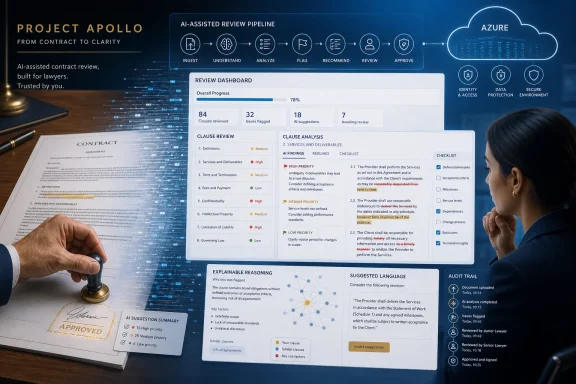
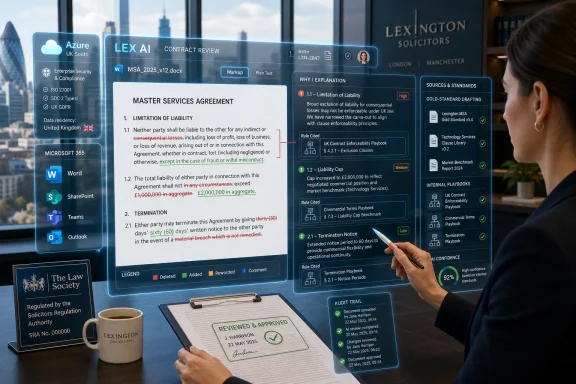
Shoosmiths says Apollo marks up contracts against playbooks and “gold-standard” drafting derived from the firm’s own dealmakers. That is a crucial distinction. The firm is not presenting Apollo as a general-purpose legal chatbot reading a contract in isolation, but as a way to apply Shoosmiths’ internal view of what good looks like.
The promise, then, is not simply fewer hours spent on first-pass review. It is consistency at scale. If the system can apply the same playbook repeatedly, and if its explanations are grounded in internal know-how rather than free-floating model confidence, Shoosmiths can argue that Apollo is a way of exporting senior judgment across teams without pretending that the machine has become a partner.
The Playbook Becomes the Product
Law firms have always been knowledge businesses, but much of that knowledge is awkwardly stored. It lives in precedent banks, old deal files, partner memory, annotated documents, private notes, and the oral tradition of “that clause is fine unless the customer is in sector X.” Generative AI does not solve that problem by magic. It only becomes useful when the underlying knowledge is structured enough to retrieve and apply.
Apollo appears to be built around that premise. Microsoft’s own account of the project describes Shoosmiths’ playbooks as containing hundreds of rules, setting out what contracts should contain, why provisions matter, and how defects should be fixed with tested drafting. That is the quiet engineering work behind the headline: before the model can explain itself, the firm must have made its own reasoning explicit enough to be used.
This is where many AI pilots in professional services stall. It is easy to let staff ask a model to summarize a document. It is harder to encode what the organization actually believes. A model can produce fluent prose, but a firm still has to define risk appetite, preferred positions, fallback drafting, escalation routes, and jurisdiction-specific nuance.
Shoosmiths’ earlier experience with natural language processing is instructive. According to Microsoft’s write-up, the firm had previously built an NLP system for commercial supply agreements that took two years to train on a single contract type. Large language models changed the economics of that work, but they did not remove the need for playbooks. They made the playbook more valuable.
That is why the most commercially significant asset here may not be the model layer at all. It may be Shoosmiths’ curated corpus of legal know-how and the workflows around it. In a world where many firms can access similar foundation models, competitive advantage shifts toward domain content, process design, governance, and trust.
Microsoft Gets Another Vertical AI Showcase
For Microsoft, Apollo fits a pattern that has become increasingly visible across regulated and document-heavy industries. The company does not need every AI customer to buy an off-the-shelf Microsoft-branded legal product. It needs firms to build serious workloads on Azure, use Microsoft 365 Copilot and Copilot Studio where appropriate, and treat Microsoft’s cloud as the safe place to operationalize AI.
Shoosmiths is a useful case study because law is both conservative and text-saturated. Contracts, correspondence, due diligence materials, client instructions, and legal memos are exactly the kind of material large language models appear well suited to process. They are also exactly the kind of material where errors, confidentiality failures, and uncontrolled model behavior can be professionally catastrophic.
That makes Azure’s role more than infrastructure marketing. A law firm needs identity management, access controls, auditability, data residency considerations, and integration with existing Microsoft productivity environments. The model may attract the headlines, but enterprise adoption depends on the boring plumbing.
Microsoft UK and Ireland chief executive Darren Hardman framed Apollo as a way to make Shoosmiths’ most experienced lawyers’ knowledge available across the firm. That is also Microsoft’s larger enterprise AI pitch: the value of AI is not a chatbot bolted to the side of work, but knowledge embedded into the flow of work. In legal services, that means Word documents, SharePoint repositories, email, matter workflows, and contract review playbooks.
The strategy is familiar to WindowsForum readers because it echoes Microsoft’s broader platform instincts. Microsoft wins when the new layer becomes dependent on its old layers. If AI contract review sits on Azure, draws from Microsoft-hosted repositories, is accessed through Microsoft productivity tools, and is governed through Microsoft enterprise controls, the AI revolution looks less like disruption and more like another phase of platform consolidation.
The Junior Lawyer Is the Real Test Case
Shoosmiths has placed unusual emphasis on Apollo as a learning tool for developing lawyers. The tool is designed, the firm says, to mirror how a senior associate would justify changes to a partner. Every step of the contract review process is supposed to be accompanied by an explanation of the reasoning behind the recommendation.
That framing is both persuasive and risky. It is persuasive because good explanations can accelerate learning. A junior lawyer who sees not only a redline but the rationale behind it may understand the commercial and legal logic more quickly than someone copying precedent language without context.
But it is risky because professional judgment is developed partly through friction. Young lawyers learn by struggling with ambiguity, making tentative calls, being corrected, and gradually developing an instinct for proportionality. If AI removes too much of that struggle, firms may save hours today while weakening the apprenticeship model that produces senior lawyers tomorrow.
Shoosmiths’ answer is that Apollo is meant to teach, not replace. The firm says transparency is central to the design, and external reporting says senior lawyers will still review and sign off outputs. That guardrail matters because the technology should not become an invisible authority. A junior lawyer should be able to challenge Apollo’s reasoning, not merely accept it as a senior voice in software form.
The danger is not that Apollo will be obviously wrong. Obvious errors are easier to catch. The danger is that it will be plausible, fluent, and usually right, encouraging reviewers to become less alert over time. In legal work, a system that is correct most of the time can be more dangerous than one that is clearly unreliable, because confidence has a way of becoming contagious.
Black-Box AI Was Never Going to Survive Legal Review
Shoosmiths’ rejection of “opaque” black-box models is not just branding. It reflects the central problem facing legal AI adoption: lawyers cannot delegate responsibility to a system they cannot interrogate. A redline without a rationale is a productivity feature; a redline with grounded reasoning is at least a candidate for professional review.
The word grounded does a lot of work here. In AI product marketing, it usually means the model’s output is anchored in retrieved documents or approved sources rather than generated from general statistical memory. In Apollo’s case, the grounding appears to be Shoosmiths’ playbooks, guidance notes, and gold-standard drafting.
That does not make the system infallible. Retrieval can pull the wrong source. A model can misread a clause. A playbook can be incomplete or out of date. A contract can contain commercial context not visible in the document. But grounding changes the review posture: the lawyer can ask whether the cited rule applies, whether the recommendation follows, and whether the underlying playbook needs updating.
This is where legal AI diverges from consumer AI. A consumer chatbot can answer a trivia question and move on. A law-firm tool must preserve a chain of reasoning that can be reviewed, challenged, and improved. The closer Apollo gets to that model, the more credible it becomes.
The same principle matters for IT administrators and security teams. Explainability is not only a user-experience issue. It supports audit, incident review, risk management, and accountability. If an AI system changes the way contracts are reviewed, the firm needs to know what it recommended, what source material it relied on, who accepted the change, and who signed off.
Building Beats Buying When the Knowledge Is the Moat
Shoosmiths reportedly reviewed around 15 suppliers before deciding to build its own system with Microsoft’s support. That is one of the more revealing details in the story. The legal AI market is crowded, but Shoosmiths evidently concluded that off-the-shelf tools could not meet its standards or reflect its internal knowledge closely enough.
This is the classic build-versus-buy question reframed for generative AI. Buying is faster and may be cheaper upfront. Building is slower, more expensive, and harder to maintain. But if the firm’s differentiator is its own legal judgment, handing the core workflow to a generic vendor may feel like outsourcing the very thing clients are paying for.
The right answer will vary by firm. Smaller practices may sensibly use commercial tools because they lack the resources to build and govern their own platforms. Large firms with strong knowledge management teams may increasingly see proprietary AI systems as an extension of their brand. The more a firm can encode its own playbooks, the more it can claim that its AI output is not generic legal automation but firm-specific expertise.
There is also a data-control argument. Legal work involves confidential client information, privileged communications, sensitive transaction data, and regulatory obligations. Building within a controlled Azure environment may give Shoosmiths more confidence over where data sits, how access is managed, and how outputs are monitored than a less integrated external product would.
Still, building carries its own burdens. The firm becomes responsible for model selection, prompt and retrieval design, evaluation, security testing, document handling, user training, and continuous maintenance of playbooks. A proprietary AI system is not a one-year project that ends at launch. It is a new operational capability that must be staffed, governed, and improved.
The Productivity Claim Will Be Measured in Exceptions
The obvious commercial pitch for Apollo is time saved. Microsoft’s account says similar review work can save three to five hours on a single legal document, and that the relevant Shoosmiths team handles thousands of documents a year. Those numbers explain why law firms are moving quickly: even modest reductions in review time can add up to significant capacity.
But legal productivity is complicated because not all hours are equal. A first-pass review hour may be easier to compress than a negotiation strategy hour. A routine clause issue may be easy to flag, while a bespoke indemnity position tied to a client’s commercial leverage may require human judgment.
The real test is not whether Apollo can handle standard cases. It is whether the system helps lawyers identify exceptions without burying them in false confidence or noise. Contract review tools often fail when they flag too much, miss the subtle issue, or produce recommendations that are technically correct but commercially tone-deaf.
Shoosmiths’ playbook approach should help by narrowing the problem. A tool reviewing against a known standard is on firmer ground than a general chatbot asked whether a contract is “good.” But the firm will need rigorous feedback loops. Each accepted, rejected, or modified recommendation should teach the organization something about the tool, the playbook, or the training need.
This is where the operational discipline of IT becomes inseparable from legal innovation. Apollo will need version control for playbooks, permissioning for sensitive content, audit logs for outputs, monitoring for model drift, and clear procedures for escalation. The contract review tool is also a software system in production, and production systems need owners.
AI Governance Moves From Policy Binder to Workflow
Many organizations have written AI policies that tell employees not to upload confidential data into public tools, not to rely blindly on model outputs, and not to use AI for prohibited purposes. Those policies matter, but they are weak if the sanctioned tools are worse than the unsanctioned ones. Users route around friction.
Apollo is a more mature response. Instead of merely warning lawyers against unsafe AI use, Shoosmiths is giving them a purpose-built environment for a high-value workflow. If the tool is useful enough, it can channel behavior into a governed system rather than leaving junior staff to experiment with whatever chatbot is at hand.
That is the lesson for enterprise IT. AI governance cannot live only in PowerPoint decks, training modules, and acceptable-use memos. It has to be embedded in the tools people actually use. The safest AI platform is often the one that becomes the path of least resistance.
The design also suggests a shift from generic AI literacy to role-specific AI fluency. A lawyer reviewing a contract does not need an abstract lecture on transformers. They need to know what Apollo is good at, where it fails, how its explanations are sourced, when to escalate, and how to document their own judgment.
For Microsoft, this is convenient. The more enterprises translate AI policy into workflow-specific tools on Azure, the more Microsoft becomes the governance layer as well as the compute provider. For customers, the benefit is control. The risk is dependency.
Legal AI’s Credibility Problem Is Now a Training Problem
The legal profession has already seen enough AI embarrassment to understand the stakes. Courts have criticized lawyers for filings or communications containing AI-generated inaccuracies. Firms have had to clarify when AI may be used, who must check it, and how outputs should be verified. The problem is not hypothetical anymore.
Shoosmiths is entering that environment with a tool designed to reduce uncertainty by grounding recommendations in internal knowledge. That is sensible, but it does not eliminate the cultural challenge. A system can be well designed and still be misused by people under deadline pressure.
The firm’s emphasis on upskilling by design is therefore more than a human-resources flourish. If Apollo becomes part of junior lawyers’ daily work, it will shape how they learn. The explanations, examples, and guidance notes it surfaces will become a curriculum of sorts. That curriculum must be kept current and must leave room for human challenge.
There is a subtle danger in presenting AI as the distilled wisdom of the firm. If junior lawyers experience Apollo as the voice of institutional authority, they may hesitate to disagree. Healthy professional development requires the opposite: the tool should provoke reasoning, not end it.
The best version of Apollo would become a sparring partner. It would identify a clause, explain the preferred position, show the relevant playbook rule, suggest drafting, and invite the lawyer to decide whether the context warrants a different approach. The worst version would become a compliance machine that teaches users to click through.
Clients Will Like the Efficiency, but They Will Ask About Liability
Clients are likely to welcome faster turnaround and more consistent review, especially in high-volume contract environments. In-house legal teams are under pressure to do more with less, and external counsel that can reduce repetitive effort without reducing quality has a strong story to tell. Apollo gives Shoosmiths a way to say that AI is not replacing legal judgment but making that judgment more repeatable.
Yet sophisticated clients will also ask harder questions. Was their data used to train anything beyond the matter? Can they opt out of AI-assisted review? How are outputs checked? What records are retained? Who is liable if an AI-generated recommendation is wrong and a human reviewer misses it?
Those questions are not anti-AI. They are normal procurement and risk questions. Legal departments have spent years asking technology vendors about security, privacy, data processing, and audit rights. They will ask law firms similar questions as those firms become builders of AI tools.
Shoosmiths’ Azure environment should help answer some of those concerns, especially where Microsoft’s enterprise controls are already familiar to corporate clients. But cloud branding is not a complete answer. Clients will want policy detail, technical assurance, and contractual clarity.
The firms that win trust will be the ones that can explain both the technology and the supervision model in plain language. “Built with Microsoft” opens the door. “Reviewed and signed off by a qualified lawyer according to a documented process” keeps it open.
The WindowsForum Angle Is the Enterprise Pattern
At first glance, a UK law firm’s contract review tool might seem distant from the usual WindowsForum diet of Windows, Microsoft 365, Azure, endpoint security, and admin headaches. It is not. Apollo is a clear example of the direction enterprise Microsoft environments are moving.
The center of gravity is shifting from generic productivity apps to domain-specific AI systems built on top of the Microsoft stack. SharePoint becomes a knowledge repository. Azure becomes the execution environment. Microsoft 365 Copilot and Copilot Studio become entry points for users and no-code builders. Identity, compliance, and audit controls become part of the sales pitch.
For sysadmins, that means AI adoption will often arrive through business units with plausible productivity cases rather than through a single centralized “AI project.” A legal team builds a contract tool. A finance team builds a close-assistant. HR builds a policy agent. Operations builds a maintenance knowledge bot. Each one touches permissions, data classification, logging, retention, and support.
The old question was whether users had access to the right application. The new question is whether an AI system has access to the right data, the right tools, the right boundaries, and the right reviewers. That is a more complex administrative problem.
Apollo is also a reminder that the most valuable AI systems may not look dramatic from the outside. They may not be autonomous agents roaming across the enterprise. They may be narrow systems that review a document against a playbook and explain their recommendations. That is less glamorous than artificial general intelligence, but far more deployable.
The Real Apollo Story Is Discipline Masquerading as Innovation
Shoosmiths has wrapped Apollo in the language of innovation, but the underlying story is discipline. The firm had to identify a repeatable workflow, codify expert knowledge, choose a controlled technical environment, build or integrate the model layer, pilot the system, gather feedback, and prepare deployment. That is not a moonshot. It is enterprise software done seriously.
This is where the hype cycle starts to mature. Early generative AI adoption was dominated by demos: summarize this, draft that, answer this question about a PDF. The next phase is about embedding AI into workflows where correctness, accountability, and organizational knowledge matter.
Apollo’s focus on explanations is a sign of that maturity. Users do not simply need an answer. They need provenance, rationale, and a path for review. The more consequential the workflow, the more the AI output must be treated as a draft opinion, not a finished fact.
The firm’s rhetoric about helping junior lawyers “learn more, faster” should be tested over time. If Apollo reduces drudgery while increasing exposure to good reasoning, it may strengthen legal training. If it turns early-career lawyers into supervisors of machine output before they have developed independent judgment, the efficiency gain may come with a hidden professional cost.
That is the tension every knowledge business now faces. AI can distribute expertise, but expertise is created through practice. The firms that benefit most will be those that use AI to expose reasoning, not conceal it.
Apollo’s Contract With the Future Is Written in Guardrails
Shoosmiths’ announcement gives enterprise AI a concrete shape, and that is what makes it worth watching. The story is not a robot lawyer replacing associates. It is a firm trying to industrialize its own standards while keeping human review in the loop.
- Shoosmiths launched Project Apollo on June 24, 2026, after a year-long build and pilot supported by Microsoft.
- Apollo runs in Microsoft Azure and reviews contracts against Shoosmiths’ own playbooks, guidance notes, and gold-standard drafting.
- The tool’s central claim is transparency, with recommendations accompanied by explanations grounded in the firm’s internal know-how.
- The strongest business case is consistency and time savings in high-volume review, but the strongest governance case is auditable reasoning.
- The biggest unresolved risk is not whether AI can mark up routine contracts, but whether junior lawyers will learn better judgment or become over-reliant on machine-generated rationales.
- For IT leaders, Apollo is another sign that enterprise AI will arrive as many domain-specific systems built on cloud, identity, permissions, and knowledge-management foundations.
Project Apollo is best understood as a prototype for the next phase of professional AI: not a general chatbot with a legal costume, but a controlled system that turns a firm’s own knowledge into repeatable workflow. If Shoosmiths can keep the explanations honest, the playbooks current, and the human sign-off meaningful, it will have built more than a contract review accelerator. It will have built a model for how Microsoft-backed AI can move from novelty to infrastructure in the places where mistakes still have consequences.