

Reply’s renewed recognition as a Microsoft Azure Expert Managed Services Provider (Azure Expert MSP) for the sixth consecutive year is a clear market signal: it reaffirms the group’s operational maturity on Azure while resurfacing important procurement and governance questions for enterprise buyers evaluating managed‑service partners.
Microsoft’s Azure Expert MSP program is a gated, top‑tier partner track designed to identify and validate partners that can deliver end‑to‑end, repeatable managed services on Azure at enterprise scale. The program combines three pillars: aligned Solutions Partner designations (for example, Data & AI, Digital & App Innovation, and Infrastructure), measurable customer success evidence, and a mandatory independent audit that inspects people, processes and tooling. Renewal is not automatic; it requires ongoing adherence to program gates, documented SLAs and a formal audit cadence that includes pre‑audit and on‑site assessments.
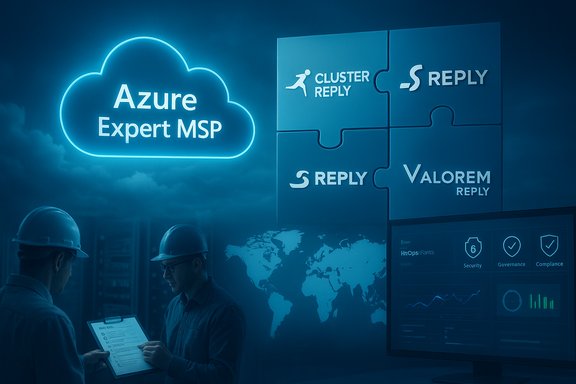
Reply announced its latest renewal via a Business Wire release, attributing the recognition to the combined delivery capabilities of its specialized companies — Cluster Reply, Solidsoft Reply and Valorem Reply — and noting that the renewal was secured through the contribution of certified Azure specialists and successful passage of a third‑party audit. The announcement highlights concrete customer examples: Solidsoft’s Azure‑based traceability and managed services across 30+ countries in regulated healthcare and pharma; Cluster’s Generative AI adoption model for Danieli built entirely on Azure; and Valorem’s Microsoft‑first integration modernization for the University of Portsmouth.
However, there are several important caveats and risk areas procurement teams should not overlook:
At the same time, the recognition should be treated as a starting point for procurement and technical validation rather than a terminal approval. The audit is a snapshot, multi‑entity delivery adds governance complexity, and Azure‑native build patterns introduce portability and cost trade‑offs that must be managed contractually. Insist on Partner Center proof, an audit attestation, named references, and a pilot with clear operational and FinOps acceptance criteria. When those guardrails are in place, Reply’s combination of audited managed‑service discipline and verticalized accelerators can deliver measurable, low‑friction outcomes for Windows‑centric organisations moving strategic workloads and AI initiatives to Azure.
Reply’s statements quoted Filippo Rizzante, CTO at Reply, on the company’s commitment to cloud innovation, and included Microsoft’s Julie Sanford noting the importance of partners with deep cloud expertise to guide customers to the public cloud — quotes that frame the announcement as both a commercial milestone and a field‑level reassurance to customers. Buyers should accept those sentiments as context, but verify the technical and contractual artifacts described above before entrusting mission‑critical Azure estates and AI production workloads to any partner, including those carrying the Azure Expert MSP badge.
Source: Business Wire https://www.businesswire.com/news/h...ices-Provider-for-the-Sixth-Consecutive-Year/
 Background
Microsoft’s Azure Expert MSP program is a gated, top‑tier partner track designed to identify and validate partners that can deliver end‑to‑end, repeatable managed services on Azure at enterprise scale. The program combines three pillars: aligned Solutions Partner designations (for example, Data & AI, Digital & App Innovation, and Infrastructure), measurable customer success evidence, and a mandatory independent audit that inspects people, processes and tooling. Renewal is not automatic; it requires ongoing adherence to program gates, documented SLAs and a formal audit cadence that includes pre‑audit and on‑site assessments.Reply announced its latest renewal via a Business Wire release, attributing the recognition to the combined delivery capabilities of its specialized companies — Cluster Reply, Solidsoft Reply and Valorem Reply — and noting that the renewal was secured through the contribution of certified Azure specialists and successful passage of a third‑party audit. The announcement highlights concrete customer examples: Solidsoft’s Azure‑based traceability and managed services across 30+ countries in regulated healthcare and pharma; Cluster’s Generative AI adoption model for Danieli built entirely on Azure; and Valorem’s Microsoft‑first integration modernization for the University of Portsmouth.
What the Azure Expert MSP badge actually certifies
The audit and operational baseline
Earning (and renewing) the Azure Expert MSP badge requires demonstrable operational discipline. Auditors typically inspect:- Runbooks, incident response procedures and SRE practices.
- 24×7 monitoring and automation for alerting, change control and remediation.
- Security and governance controls, including identity, key management and logging.
- FinOps processes: cost monitoring, tagging and budget controls.
- Documented customer success with named references and measurable outcomes.
Solutions Partner alignment
Candidates must hold aligned Solutions Partner designations in relevant domains. Those designations evaluate performance, skilling and customer success across discrete solution areas; combined with the MSP audit they create a layered credibility model that many procurement teams rely on to shorten vendor shortlists. Reply’s announcement explicitly calls out alignment across Data & AI, Digital & App Innovation and Infrastructure—credentials that map to the types of projects it cites.Why the renewal matters (strengths and practical advantages)
Reply’s renewal as an Azure Expert MSP is not merely marketing; it confers several practical advantages for enterprise customers:- Auditable operational maturity. The third‑party audit gives procurement teams an independent artifact to reduce risk during shortlisting. For regulated industries this is a meaningful procurement lever.
- Verticalized IP plus platform engineering. The group model — specialist companies delivering domain IP on top of Azure platform engineering — shortens time‑to‑value for industry use cases such as pharmaceutical traceability, industrial AI, and education integration modernization.
- Microsoft alignment and co‑sell pathways. Top‑tier partners often gain commercial advantages via Partner Center discoverability and field‑level collaboration that can accelerate procurement and delivery. That visibility helps large projects secure the necessary vendor and platform support.
- Repeatable accelerators. Examples cited in the announcement — a GenAI adoption model, traceability platforms, and integration modernization accelerators — indicate reusable templates that compress early phases of pilots and minimum viable production projects.
The case examples — what they tell buyers
Solidsoft Reply: regulated traceability at scale
Solidsoft Reply’s work focuses on global traceability platforms and managed services across many countries, a combination that raises both opportunity and compliance demands. For regulated pharmaceutical and healthcare workloads, auditors and buyers commonly look for mapped data flows, encryption controls, key management and multi‑jurisdictional data residency handling. Solidsoft’s engagement profile aligns with what Microsoft’s Azure Expert MSP audit intends to validate — repeatable, governed operations for regulated workloads — but buyers should still require concrete attestations, runbooks and technical architectures as part of procurement due diligence.Cluster Reply: Generative AI at industrial scale
Cluster Reply’s case study for Danieli — described as a GenAI Hub built on Azure — highlights how industrial adopters are moving from point experiments to governed, multi‑tenant generative AI platforms. Key elements of that pattern include tenant‑scoped governance, observability, model provenance, and developer template libraries. For enterprises seeking to operationalize LLMs, the value is not just model accuracy but the controls that keep inference, data handling and auditing auditable. The example demonstrates the kind of operational artifacts auditors expect an Azure Expert MSP to maintain.Valorem Reply: Microsoft‑first integration modernization
Valorem’s University of Portsmouth engagement is a classic modernization story: replacement of legacy integration platforms with Azure Integration Services, API management and automation to improve throughput and governance. Integration modernization projects are high‑value because they unblock downstream application modernization and provide a foundation for cloud‑native telemetry and FinOps. The case shows repeatable migration patterns and organisational change processes that map to what the Azure Expert MSP audit reviews.Critical analysis — strengths, limitations, and open questions
Reply’s sixth consecutive renewal signals sustained investment in Azure operations and the ability to replicate core managed‑service capabilities across subsidiaries. That continuity has clear value for buyers who want a single partner able to operate at scale while bringing vertical‑specific IP.However, there are several important caveats and risk areas procurement teams should not overlook:
- Badge ≠ perpetual performance. The audit is a snapshot. Long‑running SLAs, continuous improvement metrics and independent performance reports should be contractually required. The badge lowers discovery friction, but it does not eliminate the need for operational KPIs.
- Multi‑entity delivery complexity. When delivery is split across Cluster, Solidsoft and Valorem, clarity is essential: define a single accountable integrator, escalation pathways and a consolidated governance model to avoid fragmentation of responsibility.
- Vendor concentration and lock‑in risk. Heavy investment in Azure‑native primitives reduces migration friction but increases portability risk for critical artifacts (data, IaC, model artifacts). Contracts should include escape clauses, data export guarantees and model portability commitments.
- Commercial complexity and FinOps risk. Large Azure programs frequently surface unexpected cost drivers — inference costs, data egress and storage — that need explicit FinOps acceptance criteria, tagging strategies and cost visibility built into the SOW.
- Regulatory and residency concerns. For regulated industries, the badge is helpful but insufficient; buyers must request detailed architecture diagrams, encryption and key management proofs, and mapped regulatory controls.
Practical checklist for buyers (convert the badge into contract confidence)
The following checklist converts partner signals into enforceable contract items. Each item should be included in procurement and technical due diligence.- Ask for Partner Center proof of current Azure Expert MSP status with effective and expiry dates.
- Request the audit attestation or summary that lists audited domains and any remediation items.
- Obtain named customer references for projects comparable in scale, regulatory profile and geography.
- Require documented runbooks, SRE rosters, on‑call schedules and escalation matrices.
- Insist on a FinOps plan with tagging standards, budget alerts, and SLOs for cost variance.
- Include explicit portability and exit provisions for data, IaC, APIs and model artifacts.
- Define measurable acceptance criteria for AI artifacts (e.g., latency, accuracy, security tests, explainability metrics).
- Require evidence of applied Cloud Adoption Framework practices and continuous compliance monitoring.
- Validate status and dates first (Partner Center export).
- Validate the scope of the audit and any open remediation items.
- Run a scoped pilot with clear acceptance and rollback criteria.
Technical implications for Windows‑centric enterprises
Windows‑focused organisations considering Azure workloads should pay attention to several technical implications raised by Reply’s renewal:- Identity and hybrid connectivity. Enterprises with large on‑prem Windows estates will value mature Azure SRE practices around Azure AD integration, ExpressRoute/VPN connectivity, and conditional access. Ensure the MSP demonstrates secure hybrid architectures and identity lifecycles.
- Application modernization pathways. Integration modernization work (as described by Valorem) typically reduces delivery friction for Windows applications migrating from middleware stacks (BizTalk, on‑prem ESBs) to Azure Integration Services and API Management. Ask for migration maps that show cutover, fallbacks and rollback planes.
- Endpoint and device telemetry. For organisations running Windows clients against Azure workloads, telemetry pipelines and APM/observability configurations matter. Confirm monitoring coverage for both cloud‑side services and client telemetry aggregation.
- Security posture and Windows platform controls. Ensure the MSP’s audited controls include patching, vulnerability management, device compliance (Intune/Endpoint Manager) and logging that integrates with Azure Sentinel or SIEM for enterprise threat operations.
- AI governance and data protection. When generative AI is in scope (Cluster’s GenAI Hub example), validate data usage policies, prompt logging, redaction, and retention policies — all of which must comply with enterprise data protection and privacy regimes.
How to run a meaningful pilot (recommended sequence)
- Define a narrowly scoped pilot workload that mirrors the critical data flows of production. Describe success criteria in business and operational terms (latency, cost per transaction, RTO/RPO).
- Request an architecture design review and threat model from the MSP, with documented mitigations for identified risks.
- Instrument FinOps and observability from day one: tagging, cost alerts, telemetry dashboards and synthetic tests.
- Run a security and compliance scan (pen test, data flow verification, privacy impact) and evaluate results against acceptance criteria.
- Execute a controlled failover or rollback exercise to validate exit plans and data exports.
What remains unverifiable and what to demand
Reply’s press materials include several load‑bearing claims (sixth consecutive year; specific audited domains; case study outcomes). While the corporate release and subsidiary case studies provide public corroboration, the definitive proof of current program status and the exact audit scope remains the Microsoft Partner Center and the official audit attestation. Buyers should treat the press announcement as a strong signal but request:- A Partner Center export or screenshot showing the effective dates of the Azure Expert MSP recognition.
- A redacted audit summary or attestation indicating which domains were audited and whether there were any remediation findings.
Final assessment
Reply’s renewed Azure Expert MSP badge for a reported sixth consecutive year reflects genuine sustained investment in Azure operational disciplines and a deliberate strategy to combine verticalized IP with platform engineering. That combination is attractive for enterprises seeking partners that can both deliver regulated workloads and help operationalize AI at scale.At the same time, the recognition should be treated as a starting point for procurement and technical validation rather than a terminal approval. The audit is a snapshot, multi‑entity delivery adds governance complexity, and Azure‑native build patterns introduce portability and cost trade‑offs that must be managed contractually. Insist on Partner Center proof, an audit attestation, named references, and a pilot with clear operational and FinOps acceptance criteria. When those guardrails are in place, Reply’s combination of audited managed‑service discipline and verticalized accelerators can deliver measurable, low‑friction outcomes for Windows‑centric organisations moving strategic workloads and AI initiatives to Azure.
Reply’s statements quoted Filippo Rizzante, CTO at Reply, on the company’s commitment to cloud innovation, and included Microsoft’s Julie Sanford noting the importance of partners with deep cloud expertise to guide customers to the public cloud — quotes that frame the announcement as both a commercial milestone and a field‑level reassurance to customers. Buyers should accept those sentiments as context, but verify the technical and contractual artifacts described above before entrusting mission‑critical Azure estates and AI production workloads to any partner, including those carrying the Azure Expert MSP badge.
Source: Business Wire https://www.businesswire.com/news/h...ices-Provider-for-the-Sixth-Consecutive-Year/
