

Rigetti Computing made its 108-qubit Cepheus-1-108Q superconducting quantum computer generally available in April 2026 through its own cloud service and major quantum platforms including Amazon Braket, with broader availability cited across Azure Quantum and qBraid. The announcement is not just another qubit-count press release. It is Rigetti’s attempt to prove that modular superconducting quantum hardware can be scaled like an engineering platform rather than a laboratory stunt. For WindowsForum readers, the interesting part is not whether quantum computers replace classical machines next year; it is whether the cloud, developer, and enterprise tooling around them is beginning to look real enough for IT organizations to track seriously.
Rigetti’s Cepheus-1-108Q arrives at a moment when quantum computing companies are under pressure to turn increasingly exotic physics into increasingly ordinary infrastructure. The company’s pitch is simple: if a quantum processor can be assembled from repeatable chiplets, then scaling becomes a manufacturing and interconnect problem rather than a one-off act of physics heroism.
That matters because superconducting quantum computers have often looked promising at small scale and punishing at larger scale. Qubits are fragile, calibration is relentless, and error rates can erase theoretical gains before a program produces anything useful. Rigetti’s answer is not to pretend those problems are gone, but to argue that its modular architecture gives it a cleaner path toward machines with hundreds and then thousands of qubits.
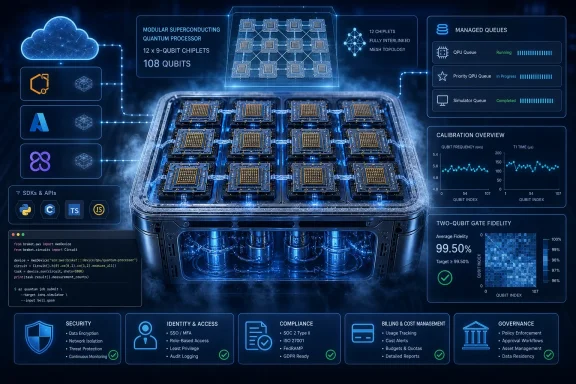
Cepheus-1-108Q is built from twelve interconnected 9-qubit chiplets arranged as a larger system. That may sound like a packaging detail, but it is the core of the strategy. A monolithic chip has to get bigger and better at the same time; a chiplet-based system tries to separate the problem into smaller modules that can be fabricated, tested, improved, and linked.
The company is also leaning on availability as a form of credibility. A quantum processor hidden inside a lab can be impressive and irrelevant at the same time. A system exposed through cloud services, developer SDKs, and production-adjacent workflows becomes something researchers and early commercial teams can actually test, benchmark, and complain about.
That is exactly how frontier computing tends to enter the enterprise. GPUs did not become strategically important because every company bought a supercomputer on day one. They became important because cloud providers, software frameworks, and developer ecosystems made specialized hardware consumable by people who did not design the chips.
Quantum is nowhere near that level of maturity, but the shape is familiar. Developers write jobs using frameworks. Researchers compare backends. Enterprises run small experiments without owning cryogenic systems or hiring a building full of physicists. The hardware remains exotic, but the access model is becoming almost mundane.
For Microsoft watchers, Azure Quantum’s role is part of a broader platform contest. Microsoft, Amazon, Google, IBM, and a rotating cast of specialist vendors all want to be the interface through which future quantum workloads are discovered, priced, scheduled, and integrated. Even if quantum advantage remains elusive, the platform layer is being built now.
That creates a practical question for IT leaders: when does a speculative technology become something worth governance? Not deployment, necessarily. Governance. Cloud access to quantum processors means credentials, billing, data movement, export controls, intellectual property concerns, vendor lock-in, and developer experimentation all arrive before a single production workload exists.
Rigetti is aware of that problem, which is why management is emphasizing two-qubit gate fidelity and future error mitigation alongside system size. Two-qubit gates are especially important because they allow entangling operations, the basis for many quantum algorithms. They are also among the places where errors become most damaging.
The company has reportedly discussed a target of roughly 99.5% median two-qubit gate fidelity later in 2026 and a longer-range target of 99.9% as part of a path toward quantum advantage. Those numbers sound close together, but in quantum hardware the difference between 99.1%, 99.5%, and 99.9% can be enormous. Every fraction of a percent matters when an algorithm requires many operations in sequence.
This is why quantum advantage remains a moving target rather than a finish line with a ribbon. A machine can outperform classical systems on a narrow benchmark and still be commercially uninteresting. Conversely, a system that is not yet “advantageous” in the strict sense can still be valuable for algorithm development, materials simulation research, error mitigation, and workforce training.
Rigetti’s challenge is to convert roadmap credibility into demonstrated workload credibility. Investors may reward the suggestion of a three-year path to advantage, but researchers and enterprise buyers will want evidence that the machine can run deeper circuits, produce repeatable results, and improve in ways that survive independent scrutiny.
But quantum chiplets are not server CPUs. Linking superconducting quantum modules is not the same as wiring together classical silicon dies inside a package. Quantum states are fragile, and interconnects can introduce loss, noise, calibration complexity, and architectural constraints that do not show up in a simple block diagram.
The promise is still meaningful. Smaller repeatable modules could improve manufacturing yield and create a more systematic path to scale. If each chiplet can be improved over time, a modular architecture gives Rigetti a way to upgrade the ingredients without rethinking the whole system from scratch.
The risk is that modularity moves the bottleneck rather than eliminating it. A 12-chiplet system validates that the company can assemble a larger machine, but the next questions are harsher: how well does performance scale as modules are added, how stable is the system under real workloads, and how costly is calibration as complexity rises?
This is where the comparison with classical computing both helps and misleads. In CPUs and GPUs, modular scaling eventually became a business process. In quantum computing, it remains an experimental discipline wrapped in a business plan.
Still, the revenue base remains tiny by public-market standards. Quantum companies often live in a strange financial zone: valued on the possibility of a computing revolution, while reporting revenue that looks more like a specialized scientific equipment supplier. That mismatch is not automatically fatal, but it demands discipline from anyone reading the stock story.
On-premises deployments to universities, research institutions, and national laboratories are particularly important because they create more than revenue. They create users, test cases, publications, integration lessons, and technical feedback. A quantum system in a lab can become a proving ground for the next generation of control electronics, compilers, and error mitigation methods.
Commercial interest from materials science, logistics, and financial services is plausible and unsurprising. These are the sectors that have long been associated with quantum use cases. Chemistry and materials simulation map naturally to quantum systems, optimization problems haunt logistics, and finance has both complex models and a high tolerance for speculative computing experiments.
But interest is not the same as deployment, and deployment is not the same as advantage. Enterprises have spent the last decade running quantum pilots whose main output was learning. That is not a criticism. Learning is the rational thing to buy when the technology is not yet ready to solve production problems reliably.
The phrase itself is slippery. Quantum advantage usually means a quantum computer can perform a task better than a classical computer by some meaningful measure. But “better” can mean faster, cheaper, more accurate, more energy efficient, or simply feasible where classical methods are not. A narrow scientific demonstration is not the same as a broadly useful commercial breakthrough.
That distinction matters because the public quantum market has become crowded with companies selling different versions of the future. Rigetti pushes superconducting chiplets. IonQ pushes trapped ions and increasingly sophisticated system engineering. D-Wave has long emphasized quantum annealing while also discussing gate-model ambitions. IBM, Google, Microsoft, and others sit behind or beside them with deeper balance sheets and broader platform strategies.
Rigetti’s reported cash position of roughly $569 million and no debt gives it room to operate aggressively. That is a serious asset in a field where hardware development is expensive and timelines are uncertain. It does not guarantee success, but it reduces the immediate risk that the company has to choose between roadmap investment and survival.
For investors, however, cash can become a sedative. A strong balance sheet buys time; it does not buy physics. The market will eventually ask whether each dollar is turning into better fidelities, more reliable systems, more customers, and a clearer path to workloads that matter.
That diversity is healthy, but it makes the market harder to read. In classical computing, architectural competition can be intense, but users usually understand the categories: CPU, GPU, FPGA, ASIC, memory, storage, networking. In quantum computing, even the underlying physical qubit technologies can differ profoundly.
Trapped ions typically advertise long coherence times and high fidelity, but can face challenges around speed and scaling. Superconducting systems often emphasize faster gates and semiconductor-adjacent fabrication, but they must fight noise and cryogenic complexity. Annealing machines target a different computational model, which may prove useful for certain optimization problems even if it does not map neatly onto the gate-model race.
For enterprise IT, this means the safest assumption is pluralism. There may not be one quantum architecture to rule them all. Different workloads may favor different systems, and the winning platform may be the one that hides that complexity behind orchestration, compilers, benchmarking, and pricing.
This is why the hyperscalers matter so much. Amazon Braket, Azure Quantum, and similar services can abstract over competing hardware backends. If they succeed, customers may not need to bet directly on Rigetti versus IonQ versus D-Wave in the early stages. They may instead bet on a platform that lets them experiment across several machines.
That changes the market. Public funding can accelerate facilities, stabilize suppliers, and push domestic capability in areas that might otherwise depend on fragile global supply chains. It can also distort incentives, allowing companies to chase grant-aligned milestones rather than customer-validated ones.
The U.S. government’s reported equity interest in such arrangements adds another wrinkle. It suggests Washington is not merely subsidizing research from a distance; it is exploring ways to participate financially in companies tied to critical technologies. That is a very different posture from the old assumption that frontier computing would be left mostly to private capital until it became useful.
Rigetti could benefit from the same strategic logic even when the specific funding headline belongs to a peer. A domestic quantum hardware company with a working cloud-accessible system, a modular manufacturing story, and a U.S. customer base is exactly the kind of asset policymakers are likely to view through a national competitiveness lens.
The lesson for WindowsForum’s IT pro audience is that quantum may arrive in enterprise planning through government, compliance, and security channels before it arrives as an application accelerator. Procurement rules, research partnerships, export restrictions, and post-quantum cryptography mandates may touch organizations sooner than practical quantum compute workloads do.
That still matters for the Microsoft ecosystem. Azure Quantum positions Microsoft as a broker between developers and multiple quantum hardware approaches, while Microsoft’s broader developer stack gives it a path to fold quantum experiments into familiar enterprise workflows. The company’s quantum ambitions also sit alongside its work in post-quantum cryptography, cloud security, and high-performance computing.
For Windows developers, the practical entry point remains simulation, education, and cloud job submission. Most organizations will not need quantum specialists on staff today, but they may need people who understand enough to evaluate vendor claims, manage pilots, and avoid being dazzled by qubit counts alone.
Sysadmins and security teams should watch a different clock. The most urgent quantum-related enterprise issue is not quantum computing as a service; it is the long migration toward cryptographic systems resistant to future quantum attacks. Even if useful quantum computers remain years away, encrypted data stolen today could be vulnerable later if adversaries store it long enough and sufficiently capable machines arrive.
That makes quantum a two-track story for IT. One track is speculative compute advantage. The other is defensive modernization. Rigetti’s machine belongs mostly to the first track, but the attention around it will inevitably feed the second.
A price-to-book ratio, a value score, and an earnings estimate tell investors something about market expectations. They do not tell users whether a 108-qubit superconducting processor can solve a problem better than a classical cluster. They also do not tell procurement teams whether a pilot should be funded.
Rigetti’s year-to-date share movement and industry comparisons are snapshots, not verdicts. Quantum stocks have been volatile because their narratives are unusually sensitive to announcements, grants, partnerships, and broad appetite for speculative technology. A single hardware milestone can move sentiment without changing the hard technical road ahead.
That does not make the company uninteresting. Quite the opposite. It means Rigetti is now in the difficult middle stage where it has enough hardware to be judged but not enough commercial proof to end the argument. Early-stage quantum companies no longer get credit merely for existing; they must show that each new system reduces uncertainty.
For investors, the honest view is uncomfortable: Rigetti may be both technically serious and financially risky. Those statements can coexist. In frontier markets, they usually do.
That means benchmarking will matter, but so will ergonomics. Developers need documentation, queues that behave predictably, calibration data they can understand, SDK compatibility, reproducible examples, and pricing that does not turn every experiment into a budget meeting. Hardware excellence can be smothered by poor platform experience.
Amazon Braket’s support is important here because AWS has already trained enterprises to think in terms of managed access to specialized compute. If quantum is going to be consumed experimentally, a familiar cloud procurement and development path lowers friction. The same logic applies to Azure Quantum and other aggregators.
Rigetti also needs to navigate the expectations gap between physicists and enterprise customers. Researchers may tolerate rough edges if the hardware is scientifically interesting. Commercial teams will tolerate uncertainty only if the vendor can define what a pilot is supposed to prove.
The killer application for near-term quantum may not be a single industry problem. It may be a disciplined experimental workflow that lets organizations learn quickly, cheaply, and without pretending the future has already arrived.
It also makes the company easier to challenge. Once hardware is generally available, claims can be tested outside the company’s preferred framing. Users can examine calibration behavior, run workloads, compare backends, and decide whether Rigetti’s speed and modular architecture translate into practical advantages.
That is the price of seriousness. The quantum industry has had years of carefully staged demos and ambiguous claims. The next phase will be less forgiving because more systems will be exposed to more users through more standardized cloud interfaces. Marketing will not disappear, but it will have to coexist with user experience.
Rigetti’s roadmap toward roughly 1,000 qubits, 99.9% two-qubit gate fidelity, and integrated error mitigation is ambitious. It is also the right kind of ambition: specific enough to be evaluated. The company has given the market a set of markers to watch, and now it has to hit them.
If it does, Cepheus may be remembered as more than a 108-qubit announcement. It could be the point at which Rigetti’s modular thesis moved from slide deck to platform. If it does not, the same announcement may become evidence that scaling quantum systems is easier to describe than to sustain.
 Rigetti Is Selling a Roadmap, Not Just a 108-Qubit Machine
Rigetti’s Cepheus-1-108Q arrives at a moment when quantum computing companies are under pressure to turn increasingly exotic physics into increasingly ordinary infrastructure. The company’s pitch is simple: if a quantum processor can be assembled from repeatable chiplets, then scaling becomes a manufacturing and interconnect problem rather than a one-off act of physics heroism.That matters because superconducting quantum computers have often looked promising at small scale and punishing at larger scale. Qubits are fragile, calibration is relentless, and error rates can erase theoretical gains before a program produces anything useful. Rigetti’s answer is not to pretend those problems are gone, but to argue that its modular architecture gives it a cleaner path toward machines with hundreds and then thousands of qubits.
Cepheus-1-108Q is built from twelve interconnected 9-qubit chiplets arranged as a larger system. That may sound like a packaging detail, but it is the core of the strategy. A monolithic chip has to get bigger and better at the same time; a chiplet-based system tries to separate the problem into smaller modules that can be fabricated, tested, improved, and linked.
The company is also leaning on availability as a form of credibility. A quantum processor hidden inside a lab can be impressive and irrelevant at the same time. A system exposed through cloud services, developer SDKs, and production-adjacent workflows becomes something researchers and early commercial teams can actually test, benchmark, and complain about.
The Cloud Is Where Quantum Hardware Becomes an IT Problem
The most significant part of Rigetti’s announcement may not be the 108-qubit figure. It is the distribution channel. By putting Cepheus-1-108Q onto services such as Amazon Braket and Rigetti Quantum Cloud Services, and by pointing to access through other quantum platforms, the company is positioning quantum hardware as another cloud resource — strange, expensive, limited, but addressable.That is exactly how frontier computing tends to enter the enterprise. GPUs did not become strategically important because every company bought a supercomputer on day one. They became important because cloud providers, software frameworks, and developer ecosystems made specialized hardware consumable by people who did not design the chips.
Quantum is nowhere near that level of maturity, but the shape is familiar. Developers write jobs using frameworks. Researchers compare backends. Enterprises run small experiments without owning cryogenic systems or hiring a building full of physicists. The hardware remains exotic, but the access model is becoming almost mundane.
For Microsoft watchers, Azure Quantum’s role is part of a broader platform contest. Microsoft, Amazon, Google, IBM, and a rotating cast of specialist vendors all want to be the interface through which future quantum workloads are discovered, priced, scheduled, and integrated. Even if quantum advantage remains elusive, the platform layer is being built now.
That creates a practical question for IT leaders: when does a speculative technology become something worth governance? Not deployment, necessarily. Governance. Cloud access to quantum processors means credentials, billing, data movement, export controls, intellectual property concerns, vendor lock-in, and developer experimentation all arrive before a single production workload exists.
A Bigger Qubit Count Still Does Not Mean a Better Computer
The phrase “108 qubits” is useful marketing, but it should not be mistaken for a complete performance metric. In quantum computing, a higher qubit count without sufficient fidelity, connectivity, coherence, and software support can produce little more than a larger error machine. The industry has spent years learning that raw qubits are the easiest number to headline and one of the hardest numbers to interpret.Rigetti is aware of that problem, which is why management is emphasizing two-qubit gate fidelity and future error mitigation alongside system size. Two-qubit gates are especially important because they allow entangling operations, the basis for many quantum algorithms. They are also among the places where errors become most damaging.
The company has reportedly discussed a target of roughly 99.5% median two-qubit gate fidelity later in 2026 and a longer-range target of 99.9% as part of a path toward quantum advantage. Those numbers sound close together, but in quantum hardware the difference between 99.1%, 99.5%, and 99.9% can be enormous. Every fraction of a percent matters when an algorithm requires many operations in sequence.
This is why quantum advantage remains a moving target rather than a finish line with a ribbon. A machine can outperform classical systems on a narrow benchmark and still be commercially uninteresting. Conversely, a system that is not yet “advantageous” in the strict sense can still be valuable for algorithm development, materials simulation research, error mitigation, and workforce training.
Rigetti’s challenge is to convert roadmap credibility into demonstrated workload credibility. Investors may reward the suggestion of a three-year path to advantage, but researchers and enterprise buyers will want evidence that the machine can run deeper circuits, produce repeatable results, and improve in ways that survive independent scrutiny.
Chiplets Are the Right Bet, but They Do Not Remove the Hard Parts
Rigetti’s chiplet strategy has obvious appeal to anyone who has watched classical semiconductors evolve. Chiplets are one of the ways the conventional computing industry has worked around the cost and yield problems of ever-larger monolithic dies. The idea that quantum computing might borrow that architectural lesson is attractive.But quantum chiplets are not server CPUs. Linking superconducting quantum modules is not the same as wiring together classical silicon dies inside a package. Quantum states are fragile, and interconnects can introduce loss, noise, calibration complexity, and architectural constraints that do not show up in a simple block diagram.
The promise is still meaningful. Smaller repeatable modules could improve manufacturing yield and create a more systematic path to scale. If each chiplet can be improved over time, a modular architecture gives Rigetti a way to upgrade the ingredients without rethinking the whole system from scratch.
The risk is that modularity moves the bottleneck rather than eliminating it. A 12-chiplet system validates that the company can assemble a larger machine, but the next questions are harsher: how well does performance scale as modules are added, how stable is the system under real workloads, and how costly is calibration as complexity rises?
This is where the comparison with classical computing both helps and misleads. In CPUs and GPUs, modular scaling eventually became a business process. In quantum computing, it remains an experimental discipline wrapped in a business plan.
The Revenue Jump Is Real, but the Business Is Still Lumpy
Rigetti’s first-quarter 2026 revenue reportedly rose to $4.4 million, nearly tripling from the year-earlier period, driven largely by Novera quantum processing unit deliveries and related contracts. For a small quantum hardware company, that is meaningful progress. It shows customers are willing to pay for systems, services, and access rather than merely applaud conference demos.Still, the revenue base remains tiny by public-market standards. Quantum companies often live in a strange financial zone: valued on the possibility of a computing revolution, while reporting revenue that looks more like a specialized scientific equipment supplier. That mismatch is not automatically fatal, but it demands discipline from anyone reading the stock story.
On-premises deployments to universities, research institutions, and national laboratories are particularly important because they create more than revenue. They create users, test cases, publications, integration lessons, and technical feedback. A quantum system in a lab can become a proving ground for the next generation of control electronics, compilers, and error mitigation methods.
Commercial interest from materials science, logistics, and financial services is plausible and unsurprising. These are the sectors that have long been associated with quantum use cases. Chemistry and materials simulation map naturally to quantum systems, optimization problems haunt logistics, and finance has both complex models and a high tolerance for speculative computing experiments.
But interest is not the same as deployment, and deployment is not the same as advantage. Enterprises have spent the last decade running quantum pilots whose main output was learning. That is not a criticism. Learning is the rational thing to buy when the technology is not yet ready to solve production problems reliably.
Quantum Advantage Is Becoming a Capital Markets Narrative
Rigetti management’s claim that quantum advantage could be achievable within roughly three years is the kind of statement that drives both excitement and skepticism. It gives investors a time horizon. It gives customers a reason to stay close. It gives competitors a benchmark to attack.The phrase itself is slippery. Quantum advantage usually means a quantum computer can perform a task better than a classical computer by some meaningful measure. But “better” can mean faster, cheaper, more accurate, more energy efficient, or simply feasible where classical methods are not. A narrow scientific demonstration is not the same as a broadly useful commercial breakthrough.
That distinction matters because the public quantum market has become crowded with companies selling different versions of the future. Rigetti pushes superconducting chiplets. IonQ pushes trapped ions and increasingly sophisticated system engineering. D-Wave has long emphasized quantum annealing while also discussing gate-model ambitions. IBM, Google, Microsoft, and others sit behind or beside them with deeper balance sheets and broader platform strategies.
Rigetti’s reported cash position of roughly $569 million and no debt gives it room to operate aggressively. That is a serious asset in a field where hardware development is expensive and timelines are uncertain. It does not guarantee success, but it reduces the immediate risk that the company has to choose between roadmap investment and survival.
For investors, however, cash can become a sedative. A strong balance sheet buys time; it does not buy physics. The market will eventually ask whether each dollar is turning into better fidelities, more reliable systems, more customers, and a clearer path to workloads that matter.
IonQ and D-Wave Show the Race Is Splintering, Not Consolidating
The peer updates around IonQ and D-Wave underline a larger point: the quantum industry is not converging on one obvious design. IonQ’s new Boulder facility is focused on quantum R&D and semiconductor ion-trap chip testing, supporting its trapped-ion approach. D-Wave’s proposed CHIPS Act-related funding arrangement points toward a different blend of annealing systems, gate-model ambitions, domestic manufacturing, and government-backed strategic technology policy.That diversity is healthy, but it makes the market harder to read. In classical computing, architectural competition can be intense, but users usually understand the categories: CPU, GPU, FPGA, ASIC, memory, storage, networking. In quantum computing, even the underlying physical qubit technologies can differ profoundly.
Trapped ions typically advertise long coherence times and high fidelity, but can face challenges around speed and scaling. Superconducting systems often emphasize faster gates and semiconductor-adjacent fabrication, but they must fight noise and cryogenic complexity. Annealing machines target a different computational model, which may prove useful for certain optimization problems even if it does not map neatly onto the gate-model race.
For enterprise IT, this means the safest assumption is pluralism. There may not be one quantum architecture to rule them all. Different workloads may favor different systems, and the winning platform may be the one that hides that complexity behind orchestration, compilers, benchmarking, and pricing.
This is why the hyperscalers matter so much. Amazon Braket, Azure Quantum, and similar services can abstract over competing hardware backends. If they succeed, customers may not need to bet directly on Rigetti versus IonQ versus D-Wave in the early stages. They may instead bet on a platform that lets them experiment across several machines.
Government Money Is Turning Quantum Into Strategic Infrastructure
D-Wave’s reported letter of intent with the U.S. Department of Commerce for up to $100 million in proposed CHIPS and Science Act funding is a reminder that quantum is no longer just a venture-backed science project. Governments increasingly see quantum computing, quantum networking, sensing, and cryptography as strategic infrastructure.That changes the market. Public funding can accelerate facilities, stabilize suppliers, and push domestic capability in areas that might otherwise depend on fragile global supply chains. It can also distort incentives, allowing companies to chase grant-aligned milestones rather than customer-validated ones.
The U.S. government’s reported equity interest in such arrangements adds another wrinkle. It suggests Washington is not merely subsidizing research from a distance; it is exploring ways to participate financially in companies tied to critical technologies. That is a very different posture from the old assumption that frontier computing would be left mostly to private capital until it became useful.
Rigetti could benefit from the same strategic logic even when the specific funding headline belongs to a peer. A domestic quantum hardware company with a working cloud-accessible system, a modular manufacturing story, and a U.S. customer base is exactly the kind of asset policymakers are likely to view through a national competitiveness lens.
The lesson for WindowsForum’s IT pro audience is that quantum may arrive in enterprise planning through government, compliance, and security channels before it arrives as an application accelerator. Procurement rules, research partnerships, export restrictions, and post-quantum cryptography mandates may touch organizations sooner than practical quantum compute workloads do.
The Windows Angle Is Not a Quantum PC on Your Desk
Nobody should read Rigetti’s Cepheus announcement and expect a quantum coprocessor in a Windows workstation. The near-term Windows connection is cloud access, developer tooling, identity, security, and hybrid workflows. Quantum hardware will live in specialized facilities; users will reach it through APIs, notebooks, SDKs, and cloud consoles.That still matters for the Microsoft ecosystem. Azure Quantum positions Microsoft as a broker between developers and multiple quantum hardware approaches, while Microsoft’s broader developer stack gives it a path to fold quantum experiments into familiar enterprise workflows. The company’s quantum ambitions also sit alongside its work in post-quantum cryptography, cloud security, and high-performance computing.
For Windows developers, the practical entry point remains simulation, education, and cloud job submission. Most organizations will not need quantum specialists on staff today, but they may need people who understand enough to evaluate vendor claims, manage pilots, and avoid being dazzled by qubit counts alone.
Sysadmins and security teams should watch a different clock. The most urgent quantum-related enterprise issue is not quantum computing as a service; it is the long migration toward cryptographic systems resistant to future quantum attacks. Even if useful quantum computers remain years away, encrypted data stolen today could be vulnerable later if adversaries store it long enough and sufficiently capable machines arrive.
That makes quantum a two-track story for IT. One track is speculative compute advantage. The other is defensive modernization. Rigetti’s machine belongs mostly to the first track, but the attention around it will inevitably feed the second.
The Stock Story Is Racing Ahead of the Deployment Story
The Zacks-syndicated market framing around Rigetti highlights share performance, valuation, earnings estimates, and rank. That is expected; quantum companies are now financial instruments as much as research organizations. But the language of stock screens can flatten the technological uncertainty into a misleading sense of precision.A price-to-book ratio, a value score, and an earnings estimate tell investors something about market expectations. They do not tell users whether a 108-qubit superconducting processor can solve a problem better than a classical cluster. They also do not tell procurement teams whether a pilot should be funded.
Rigetti’s year-to-date share movement and industry comparisons are snapshots, not verdicts. Quantum stocks have been volatile because their narratives are unusually sensitive to announcements, grants, partnerships, and broad appetite for speculative technology. A single hardware milestone can move sentiment without changing the hard technical road ahead.
That does not make the company uninteresting. Quite the opposite. It means Rigetti is now in the difficult middle stage where it has enough hardware to be judged but not enough commercial proof to end the argument. Early-stage quantum companies no longer get credit merely for existing; they must show that each new system reduces uncertainty.
For investors, the honest view is uncomfortable: Rigetti may be both technically serious and financially risky. Those statements can coexist. In frontier markets, they usually do.
The Real Test Is Whether Developers Come Back Twice
A cloud-accessible quantum processor wins its first users through novelty. It wins its second wave through usefulness. The most important signal over the next year will not be how many people try Cepheus once, but how many researchers, developers, and customers return because the system gives them a capability they cannot get elsewhere.That means benchmarking will matter, but so will ergonomics. Developers need documentation, queues that behave predictably, calibration data they can understand, SDK compatibility, reproducible examples, and pricing that does not turn every experiment into a budget meeting. Hardware excellence can be smothered by poor platform experience.
Amazon Braket’s support is important here because AWS has already trained enterprises to think in terms of managed access to specialized compute. If quantum is going to be consumed experimentally, a familiar cloud procurement and development path lowers friction. The same logic applies to Azure Quantum and other aggregators.
Rigetti also needs to navigate the expectations gap between physicists and enterprise customers. Researchers may tolerate rough edges if the hardware is scientifically interesting. Commercial teams will tolerate uncertainty only if the vendor can define what a pilot is supposed to prove.
The killer application for near-term quantum may not be a single industry problem. It may be a disciplined experimental workflow that lets organizations learn quickly, cheaply, and without pretending the future has already arrived.
Cepheus Makes Rigetti Harder to Ignore and Easier to Challenge
Cepheus-1-108Q gives Rigetti a stronger claim to relevance in the crowded quantum field. A 108-qubit modular superconducting system available through cloud channels is a concrete milestone. It gives the company a story that is technical enough for researchers and accessible enough for investors.It also makes the company easier to challenge. Once hardware is generally available, claims can be tested outside the company’s preferred framing. Users can examine calibration behavior, run workloads, compare backends, and decide whether Rigetti’s speed and modular architecture translate into practical advantages.
That is the price of seriousness. The quantum industry has had years of carefully staged demos and ambiguous claims. The next phase will be less forgiving because more systems will be exposed to more users through more standardized cloud interfaces. Marketing will not disappear, but it will have to coexist with user experience.
Rigetti’s roadmap toward roughly 1,000 qubits, 99.9% two-qubit gate fidelity, and integrated error mitigation is ambitious. It is also the right kind of ambition: specific enough to be evaluated. The company has given the market a set of markers to watch, and now it has to hit them.
If it does, Cepheus may be remembered as more than a 108-qubit announcement. It could be the point at which Rigetti’s modular thesis moved from slide deck to platform. If it does not, the same announcement may become evidence that scaling quantum systems is easier to describe than to sustain.
The Signals Worth Watching After the Cepheus Launch
Rigetti’s latest push is important because it shifts the conversation from isolated hardware milestones toward whether a modular quantum platform can become a repeatable business. The next evidence will come less from slogans about supremacy and more from fidelity gains, customer reuse, platform availability, and credible demonstrations of workloads that matter.- Rigetti’s 108-qubit Cepheus-1-108Q is best understood as a test of modular superconducting scaling, not as proof that quantum advantage has arrived.
- Cloud availability through platforms such as Amazon Braket makes the system more relevant to developers and IT planners because it turns specialized hardware into an accessible service.
- Two-qubit gate fidelity, error mitigation, and repeatable workload performance matter more than raw qubit count.
- Rigetti’s stronger cash position gives it time to pursue its roadmap, but the company still has to convert technical milestones into durable customer demand.
- IonQ and D-Wave show that the quantum race remains architecturally fragmented, which makes cloud abstraction and benchmarking increasingly important.
- Enterprise IT should track quantum computing experiments, but post-quantum cryptography and governance of cloud-based pilots are more immediate operational concerns.
References
- Primary source: TradingView
Published: 2026-06-09T16:30:11.757007
Rigetti Advances Toward Quantum Advantage With Cepheus Push — TradingView News
Rigetti Computing RGTI is strengthening its position in the quantum computing race through a combination of technological advancements and expanding customer adoption. During the first quarter of 2026, the company made its 108-qubit Cepheus-1-108Q system generally available through Rigetti Quantum…www.tradingview.com
- Related coverage: aws.amazon.com
Amazon Braket adds support for Rigetti's 108-qubit Cepheus QPU - AWS
Discover more about what's new at AWS with Amazon Braket adds support for Rigetti's 108-qubit Cepheus QPUaws.amazon.com
- Related coverage: ionq.com
IonQ |
 www.ionq.com
- Related coverage: aws-news.com
Amazon Braket launches Rigetti Cepheus™-1-108Q superconducting device | The AWS News Feed
Amazon Braket now offers Rigetti's Cepheus-1-108Q, a 108-qubit superconducting quantum processor featuring improved CZ gate fidelity and modular…aws-news.com - Related coverage: stocktitan.net
A 108-qubit quantum computer is now open to customers via AWS
Built from 12 interconnected 9-qubit chiplets, Cepheus-1-108Q is Rigetti's largest modular system and targets 99.5% two-qubit fidelity later in 2026.www.stocktitan.net - Related coverage: foreignpolicyjournal.com
Rigetti Computing's (RGTI) 108-Qubit Cepheus-1 System Targets Quantum Advantage Within Three Years
RIGETTI Computing (NASDAQ: RGTI) is advancing its position in the quantum computing market through the general availability of its 108-qubit Cepheus-1 system www.foreignpolicyjournal.com
- Related coverage: hpcwire.com
Rigetti Announces General Availability of 108-Qubit System - HPCwire
Cepheus-1-108Q validates Rigetti’s proprietary chiplet-based scaling architecture and is now generally available to Rigetti’s customers and partners via the Rigetti Quantum Cloud Services platform and through Amazon Braket. BERKELEY, Calif., April 7, 2026 — Rigetti Computing, Inc., a pioneer in... www.hpcwire.com
- Related coverage: news.fundsforngos.org
U.S. Commerce Department and D-Wave Quantum Sign $100 Million CHIPS Act Funding Agreement to Advance Quantum Computing - fundsforNGOs News
D-Wave Quantum Inc. has signed a Letter of Intent with the U.S. Department of Commerce for up to $100 million in funding under the CHIPS and Science Act, aimed at accelerating the development of advanced quantum computing technologies and strengthening U.S. leadership in the sector. Under the... news.fundsforngos.org
- Related coverage: morningoverview.com
- Official source: nist.gov
- Related coverage: investors.rigetti.com

