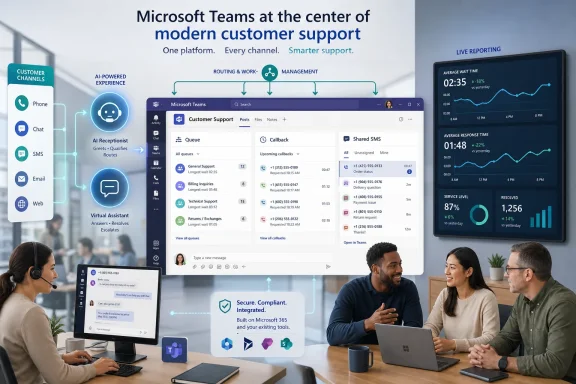
RingCentral made its Customer Engagement Bundle generally available inside Microsoft Teams in May 2026, bringing call queues, shared SMS inboxes, intelligent routing, live reporting, and AI-assisted customer interactions into Microsoft’s collaboration workspace. The move is less about turning every Teams user into a contact center agent than about redefining what counts as a contact center in the first place. For businesses stranded between basic cloud calling and heavyweight CCaaS deployments, RingCentral is pitching a middle layer: customer engagement that lives where employees already work. The gamble is that “informal contact center” will sound less like a compromise and more like the product category many mid-market organizations were waiting for.
The most important word in RingCentral’s pitch is not AI, Teams, or even contact center. It is informal. That adjective gives the company permission to blur a boundary that enterprise software vendors have spent years defending: the line between unified communications and customer experience infrastructure.
Traditional contact centers are built for scale, discipline, and control. They assume agent pools, queues, skills-based routing, workforce management, quality monitoring, compliance needs, and supervisory layers. Microsoft Teams, by contrast, is where office work happens: meetings, chats, calls, documents, quick escalations, and all the ambient coordination that keeps a modern business running.
RingCentral’s Customer Engagement Bundle sits between those worlds. It does not pretend that a regional dental group, a law firm, a property manager, or a manufacturer with a busy sales desk needs the same machinery as an airline reservations center. Instead, it argues that plenty of customer-facing work already happens in Teams-like environments, just without the tooling to prevent missed calls, dropped texts, blind handoffs, and invisible service bottlenecks.
That is the commercial opportunity. The market has been crowded with full-stack CCaaS platforms at one end and UCaaS phone systems at the other. The messy middle has often been handled with shared voicemail boxes, hunt groups, spreadsheets, and heroic office managers. RingCentral is now packaging that middle as a product.
For years, the Teams voice conversation has tended to revolve around replacement. Should an organization use Microsoft Phone System? Should it bring its own carrier through Operator Connect or Direct Routing? Should it keep a UCaaS provider and simply surface calling inside Teams? Those questions matter, but they increasingly miss the bigger shift. The collaboration client has become the user interface of enterprise communications, even when Microsoft is not the underlying communications provider.
RingCentral understands that distinction. Its Teams strategy is not merely “we can place calls from Teams.” It is “we can make Teams the front end for a broader customer engagement workflow while RingCentral remains the communications and intelligence layer underneath.” That is a subtler and more durable position than competing with Teams head-on.
This is also why the CEB integration matters more than a normal feature announcement. A vendor can add another app, another tab, another bot, or another sidebar to Teams and call it an integration. RingCentral is trying to attach a customer-facing operational workflow to Teams without asking users to adopt a separate contact center desktop. If it works, the collaboration platform becomes the place where customer intent is received, routed, answered, analyzed, and escalated.
The risk is obvious. Teams is already crowded, and IT departments are allergic to integrations that promise simplicity but create another layer of administration. RingCentral has to prove that embedding customer engagement into Teams reduces workflow friction rather than relocating it.
But for many organizations, those capabilities represent a major operational upgrade. The difference between “calls ring a group of people” and “calls enter a visible queue with basic management and reporting” is the difference between hoping someone answers and knowing whether the business is actually reachable. The same is true for SMS. A text message to a business number can be a sales lead, a patient question, a delivery issue, or a complaint. If it lands in one person’s inbox, the company has created a single point of failure.
RingCentral’s packaging is aimed directly at that gap. CEB brings voice and SMS into a shared operational view, then layers AI on top through products such as AI Receptionist, AI Virtual Assistant, and AI Conversation Expert. The company says the bundle is designed to reduce missed messages, lower call abandonment, and give managers real-time visibility without requiring a full contact center deployment.
The phrase “without requiring a full contact center deployment” is doing a lot of work. It speaks to cost, but also to psychology. Many businesses resist buying CCaaS not because they dislike better customer service, but because the category implies a level of process maturity they do not have and may not want. They hear “contact center” and imagine agents, scripts, monitoring, implementation projects, and consultants.
CEB reframes the purchase. It lets a business say: we are not building a contact center; we are making Teams better at handling customers. That distinction may be the product’s sharpest weapon.
That matters because AI in communications has often been sold as a layer of magic dust sprinkled over transcripts and summaries. RingCentral’s CEB strategy is more grounded. If calls and texts flow through managed queues inside Teams, there is something for AI to do. It can answer overflow calls, route inquiries, respond to routine SMS messages, summarize interactions, identify sentiment, and surface coaching patterns.
The economics are also important. UCaaS has become a mature market, and basic calling is a difficult place to grow aggressively. Contact center software still has more room for expansion, but full CCaaS purchases are heavier lifts. AI gives RingCentral a way to increase revenue per customer without forcing every customer into a full RingCX deployment immediately.
That is why the attach rate is worth watching. If CEB customers see AI as an optional novelty, the bundle risks becoming a low-margin feature pack. If they see AI as the reason the bundle works at all, RingCentral has a more compelling story. The company can claim not just that Teams can receive customer interactions, but that RingCentral can help automate and improve those interactions in ways Microsoft Teams alone does not.
There is an uncomfortable tension here, too. The more AI handles front-door customer interactions, the more businesses must care about accuracy, disclosure, escalation, and auditability. A virtual receptionist that routes calls and books appointments is useful. A virtual receptionist that misunderstands a customer in a regulated industry can create real risk. Informal does not mean consequence-free.
The company’s full contact center product, RingCX, has reportedly grown to more than 1,700 customers, up more than 70 percent year over year, with more than half using AI. That gives RingCentral a two-step motion. CEB captures organizations that are not ready for full CCaaS. RingCX waits for the customers whose needs become more complex.
This is a classic land-and-expand strategy, but the Teams angle makes it more dangerous for competitors. If a department starts using CEB inside Teams to handle customer calls and texts, RingCentral becomes part of the daily workflow before a formal contact center procurement ever begins. By the time the organization realizes it needs more advanced routing, analytics, compliance, integrations, or agent management, RingCentral can argue that the upgrade path is already there.
Standalone CCaaS vendors will not ignore this. Many already integrate with Teams in some form, and the strongest players can still claim deeper capabilities for complex environments. But they may face a distribution problem. If the first customer engagement tool a mid-market business adopts is embedded in Teams and bundled with its communications provider, a later CCaaS challenger has to displace not just software, but habit.
That is the moat RingCentral is trying to build. It is not a moat made purely of features. It is a moat made of workflow gravity.
But the more interesting story is that Teams’ dominance creates room for non-Microsoft infrastructure providers to survive and even thrive. Many organizations want the Teams interface without relying on Microsoft for every communications function. They may prefer RingCentral’s telephony capabilities, global reach, administrative model, reliability commitments, SMS handling, analytics, or contact-center roadmap. They may also already have RingCentral deployed and want Teams to be the user experience rather than the replacement platform.
That gives RingCentral a pragmatic message for IT: keep Teams as the workspace, but do not assume Teams must be the whole communications stack. In a Microsoft-first enterprise, that is often the only viable way to sell adjacent software. Vendors no longer win by asking users to leave Teams. They win by making Teams do something it could not do well enough on its own.
This is also where Microsoft’s ecosystem strategy becomes complicated. Microsoft benefits when Teams becomes the place where work happens, even if partners provide the underlying functionality. But every successful partner integration also reminds customers that Teams is not always sufficient by itself. The platform wins attention; the partner wins specialization.
For WindowsForum readers, this is familiar terrain. Microsoft often owns the default experience, while third parties compete on the parts of the job where the default becomes limiting. The question is not whether Teams can be extended. The question is whether the extension feels native enough that users stop noticing the seam.
For straightforward customer engagement, the case is strong. A small team that needs call queues, shared SMS, basic reporting, callbacks, AI-assisted routing, and post-call insights may not need a full CCaaS suite. If those features appear inside Teams, adoption could be easier than training staff on a dedicated agent desktop.
But “good enough” is a moving target. A business that starts with simple queues may later want skills-based routing, complex IVR flows, CRM-driven screen pops, omnichannel orchestration, outbound campaign management, quality assurance workflows, workforce engagement management, compliance recording, retention policies, granular permissions, and deep reporting. At that point, the informal contact center starts to look like a staging area, not the final architecture.
RingCentral knows this, which is why RingCX exists as the upward path. The challenge is making the transition feel natural rather than punitive. If customers hit the ceiling too quickly, CEB will be remembered as a teaser. If the ceiling is high enough for most mid-market use cases, CEB could become a durable category in its own right.
The harshest evaluations will come from administrators, not executives. Admins will ask how licensing works, how identity and permissions map across Teams and RingCentral, how reporting is accessed, how SMS compliance is handled, how AI actions are logged, how support boundaries are drawn, and what happens when Teams presence and RingCentral presence disagree. These details rarely dominate launch messaging, but they determine whether a deployment becomes trusted infrastructure or another integration users quietly work around.
This is especially true in healthcare, financial services, legal services, real estate, and field services — exactly the kinds of industries RingCentral often points to as natural fits for the bundle. These organizations may not run traditional contact centers, but they do handle high-value and sometimes sensitive communications. They need visibility, retention, consent management, and escalation discipline.
CEB may help by replacing ad hoc behavior with managed queues and shared inboxes. That is a governance improvement over personal mobile numbers, unmanaged voicemail, or private text threads. But it also concentrates more customer engagement inside a collaboration environment that may not have been designed, governed, or audited as a customer service platform.
This is where IT leaders need to resist the seduction of the word “simple.” Simple deployment is good. Simple workflows are good. Simple assumptions about compliance are not. If Teams becomes the place where customer interactions happen, then Teams governance, RingCentral administration, data retention, AI configuration, and user training all become part of the same operational fabric.
RingCentral’s opportunity is to make that fabric coherent. Its risk is that customers discover they have not eliminated complexity so much as hidden it behind a familiar interface.
Most software markets are shaped by the moment a buyer realizes they have a problem. If that moment happens inside Teams — a missed call, an overloaded queue, a customer text no one saw, a manager asking for visibility — then the solution embedded in Teams has an enormous advantage. It is present at the point of pain.
That is different from winning a procurement bake-off. A CCaaS-native vendor might have better workforce optimization, richer omnichannel routing, more mature analytics, and a larger integration library. But if the buyer’s initial need is modest, those strengths can sound like overhead. RingCentral’s pitch is that the business can start with the lighter tool and grow later.
Cisco, Zoom, Microsoft partners, and CCaaS specialists will all have their own answers. Some will emphasize enterprise depth. Some will stress native Teams compatibility. Some will argue that customer engagement should not be treated as a sidecar to UCaaS. Those are credible arguments, especially for larger or more regulated organizations.
Still, RingCentral’s wedge is well chosen. In the mid-market, the winning product is often not the most complete product. It is the one that fits the buyer’s current operating model with the least disruption. Teams gives RingCentral that context. CEB gives it the offer.
That is the customer RingCentral wants more of. A company already using RingEX and AI Conversation Expert can add CEB as an incremental improvement rather than a platform replacement. The value proposition is not transformation in the overused enterprise-software sense. It is fewer missed inquiries, better queue handling, and more visibility from the tools the business already has.
This is also why analyst recognition matters, but only up to a point. RingCentral’s leadership placements in 2026 customer engagement platform evaluations support the claim that the company is taken seriously in this market. They do not prove that CEB inside Teams will work for a given organization, or that the product can satisfy more demanding use cases over time.
The proof will come from expansion behavior. Do CEB customers add AI? Do they increase usage? Do they move into RingCX when appropriate? Do they standardize on RingCentral for Teams-based customer workflows? Or do they treat CEB as a stopgap before buying a more specialized platform?
The answers will tell us whether RingCentral has created a new on-ramp or merely a more convenient bundle.
The buyer’s problem is not a shortage of AI claims. It is determining which claims are operationally meaningful. If RingCentral controls the AI layer, it can argue for tighter integration, faster iteration, and clearer accountability. If something fails, the customer should not have to navigate a maze of subcontracted intelligence and half-owned workflows.
That said, “built in-house” is not the same as “better.” The quality of AI features will depend on accuracy, latency, language support, configurability, guardrails, reporting, and the ease with which human users can correct or override the system. It will also depend on whether AI outputs become part of a useful management process or merely another dashboard.
CEB gives RingCentral a practical proving ground. AI Receptionist can be judged by whether it handles routine interactions and escalates cleanly. AI Virtual Assistant can be judged by whether it helps users during live interactions without becoming a distraction. AI Conversation Expert can be judged by whether managers actually use its insights to improve service.
That is healthier than AI theater. The closer AI is to a concrete operational workflow, the easier it is to measure. The danger for RingCentral is that the same clarity cuts both ways. If the AI is not good enough, customers will notice quickly.
A Teams-native CEB deployment is not just a toggle. Someone must decide which groups receive queues, which numbers support SMS, which users can access shared inboxes, how callbacks are configured, when AI Receptionist answers, what it is allowed to say, where reports are reviewed, and when a customer interaction should escalate to a live person or a more formal support process. Those are business design decisions disguised as communications settings.
This is where mid-market organizations often struggle. They adopt tools to compensate for process gaps, then discover that the tool exposes those gaps. A call queue will show that no one is available at lunch. A shared SMS inbox will reveal that three people answered the same customer differently. Sentiment analysis may reveal recurring frustration that was previously anecdotal. Live reports can make a manager accountable for service levels the business never formally defined.
That exposure is not a bad thing. In fact, it is one of the strongest arguments for CEB. Visibility is the beginning of operational maturity. But buyers should understand that the bundle does not eliminate the need to design customer engagement; it makes the lack of design harder to ignore.
RingCentral can help itself here by keeping configuration approachable without oversimplifying the controls that matter. The product must feel light enough for informal teams but serious enough for IT. That balance is hard to maintain, and it will become harder as customers ask for more advanced behavior.
The answer will depend on how the organization already uses Teams. If Teams is the default workspace and RingCentral is already the calling provider, CEB could be a logical extension. Users remain in Teams, customer calls and texts become more manageable, and managers get visibility they previously lacked. In that scenario, the integration reduces context switching and may improve adoption.
If the organization is already standardizing on Microsoft-native voice or another contact center platform, the calculus is different. RingCentral’s value must justify another vendor relationship, another licensing layer, and another administrative surface. That justification may exist, but it should be tested against real workflows rather than assumed from the phrase “native integration.”
There is also a support boundary issue. Teams problems are sometimes Microsoft problems, sometimes network problems, sometimes identity problems, sometimes endpoint problems, and sometimes third-party integration problems. Add customer-facing voice, SMS, and AI to the mix, and the importance of clear ownership rises. When a customer cannot get through, no one wants vendors debating whose layer is at fault.
This is why pilots matter. A small deployment with real queues, real users, real customer messages, and real reporting will reveal more than a feature checklist. It will show whether the integration behaves like part of the workday or like a clever demo.
That mundane demand is enormous. It includes organizations that would never issue an RFP for CCaaS, never employ a contact center architect, and never build a formal agent hierarchy. They still have customers. They still have service expectations. They still lose money when communication breaks down.
RingCentral’s CEB strategy is compelling because it respects that reality. It does not ask a mid-market business to pretend it is a large contact center. It offers a way to professionalize the customer front door without adopting the full machinery of contact center operations.
The danger is that the category becomes a dumping ground for “not quite contact center” features. If informal contact center becomes synonymous with limited, underpowered, or poorly governed, the label will hurt more than help. RingCentral needs CEB to feel intentionally lighter, not merely smaller.
That distinction will determine whether the product becomes a bridge or a cul-de-sac.
 RingCentral Is Selling the Contact Center Before the Contact Center
The most important word in RingCentral’s pitch is not AI, Teams, or even contact center. It is informal. That adjective gives the company permission to blur a boundary that enterprise software vendors have spent years defending: the line between unified communications and customer experience infrastructure.Traditional contact centers are built for scale, discipline, and control. They assume agent pools, queues, skills-based routing, workforce management, quality monitoring, compliance needs, and supervisory layers. Microsoft Teams, by contrast, is where office work happens: meetings, chats, calls, documents, quick escalations, and all the ambient coordination that keeps a modern business running.
RingCentral’s Customer Engagement Bundle sits between those worlds. It does not pretend that a regional dental group, a law firm, a property manager, or a manufacturer with a busy sales desk needs the same machinery as an airline reservations center. Instead, it argues that plenty of customer-facing work already happens in Teams-like environments, just without the tooling to prevent missed calls, dropped texts, blind handoffs, and invisible service bottlenecks.
That is the commercial opportunity. The market has been crowded with full-stack CCaaS platforms at one end and UCaaS phone systems at the other. The messy middle has often been handled with shared voicemail boxes, hunt groups, spreadsheets, and heroic office managers. RingCentral is now packaging that middle as a product.
Teams Has Become the Place Vendors Must Enter
Microsoft Teams is no longer just a collaboration app that vendors integrate with for convenience. It is an operating surface for office work. That makes it both a threat and an opportunity for communications providers.For years, the Teams voice conversation has tended to revolve around replacement. Should an organization use Microsoft Phone System? Should it bring its own carrier through Operator Connect or Direct Routing? Should it keep a UCaaS provider and simply surface calling inside Teams? Those questions matter, but they increasingly miss the bigger shift. The collaboration client has become the user interface of enterprise communications, even when Microsoft is not the underlying communications provider.
RingCentral understands that distinction. Its Teams strategy is not merely “we can place calls from Teams.” It is “we can make Teams the front end for a broader customer engagement workflow while RingCentral remains the communications and intelligence layer underneath.” That is a subtler and more durable position than competing with Teams head-on.
This is also why the CEB integration matters more than a normal feature announcement. A vendor can add another app, another tab, another bot, or another sidebar to Teams and call it an integration. RingCentral is trying to attach a customer-facing operational workflow to Teams without asking users to adopt a separate contact center desktop. If it works, the collaboration platform becomes the place where customer intent is received, routed, answered, analyzed, and escalated.
The risk is obvious. Teams is already crowded, and IT departments are allergic to integrations that promise simplicity but create another layer of administration. RingCentral has to prove that embedding customer engagement into Teams reduces workflow friction rather than relocating it.
The Bundle Is Built for the Businesses That Outgrew the Phone Tree
The Customer Engagement Bundle includes the kinds of features that sound ordinary until a business lacks them. Call queues with wait-time announcements and callbacks are not glamorous. Shared SMS inboxes are not science fiction. Live reports on queue activity and response performance will not impress a CIO who has spent years around mature contact center platforms.But for many organizations, those capabilities represent a major operational upgrade. The difference between “calls ring a group of people” and “calls enter a visible queue with basic management and reporting” is the difference between hoping someone answers and knowing whether the business is actually reachable. The same is true for SMS. A text message to a business number can be a sales lead, a patient question, a delivery issue, or a complaint. If it lands in one person’s inbox, the company has created a single point of failure.
RingCentral’s packaging is aimed directly at that gap. CEB brings voice and SMS into a shared operational view, then layers AI on top through products such as AI Receptionist, AI Virtual Assistant, and AI Conversation Expert. The company says the bundle is designed to reduce missed messages, lower call abandonment, and give managers real-time visibility without requiring a full contact center deployment.
The phrase “without requiring a full contact center deployment” is doing a lot of work. It speaks to cost, but also to psychology. Many businesses resist buying CCaaS not because they dislike better customer service, but because the category implies a level of process maturity they do not have and may not want. They hear “contact center” and imagine agents, scripts, monitoring, implementation projects, and consultants.
CEB reframes the purchase. It lets a business say: we are not building a contact center; we are making Teams better at handling customers. That distinction may be the product’s sharpest weapon.
AI Is the Upsell, Not the Ornament
RingCentral says more than 5,000 customers have adopted CEB since launch, and nearly 40 percent have attached at least one paid AI product. Those numbers are early, vendor-reported, and not a final verdict on market fit. Still, they suggest RingCentral has found a useful wedge: bundle the workflow, then monetize the intelligence around it.That matters because AI in communications has often been sold as a layer of magic dust sprinkled over transcripts and summaries. RingCentral’s CEB strategy is more grounded. If calls and texts flow through managed queues inside Teams, there is something for AI to do. It can answer overflow calls, route inquiries, respond to routine SMS messages, summarize interactions, identify sentiment, and surface coaching patterns.
The economics are also important. UCaaS has become a mature market, and basic calling is a difficult place to grow aggressively. Contact center software still has more room for expansion, but full CCaaS purchases are heavier lifts. AI gives RingCentral a way to increase revenue per customer without forcing every customer into a full RingCX deployment immediately.
That is why the attach rate is worth watching. If CEB customers see AI as an optional novelty, the bundle risks becoming a low-margin feature pack. If they see AI as the reason the bundle works at all, RingCentral has a more compelling story. The company can claim not just that Teams can receive customer interactions, but that RingCentral can help automate and improve those interactions in ways Microsoft Teams alone does not.
There is an uncomfortable tension here, too. The more AI handles front-door customer interactions, the more businesses must care about accuracy, disclosure, escalation, and auditability. A virtual receptionist that routes calls and books appointments is useful. A virtual receptionist that misunderstands a customer in a regulated industry can create real risk. Informal does not mean consequence-free.
RingCX Is the Destination RingCentral Wants Customers to Notice Later
RingCentral is careful not to position CEB as a full replacement for enterprise-grade CCaaS. That restraint is strategically useful. It lets the company avoid a direct feature-by-feature comparison with mature contact center platforms while still entering the buying conversation earlier.The company’s full contact center product, RingCX, has reportedly grown to more than 1,700 customers, up more than 70 percent year over year, with more than half using AI. That gives RingCentral a two-step motion. CEB captures organizations that are not ready for full CCaaS. RingCX waits for the customers whose needs become more complex.
This is a classic land-and-expand strategy, but the Teams angle makes it more dangerous for competitors. If a department starts using CEB inside Teams to handle customer calls and texts, RingCentral becomes part of the daily workflow before a formal contact center procurement ever begins. By the time the organization realizes it needs more advanced routing, analytics, compliance, integrations, or agent management, RingCentral can argue that the upgrade path is already there.
Standalone CCaaS vendors will not ignore this. Many already integrate with Teams in some form, and the strongest players can still claim deeper capabilities for complex environments. But they may face a distribution problem. If the first customer engagement tool a mid-market business adopts is embedded in Teams and bundled with its communications provider, a later CCaaS challenger has to displace not just software, but habit.
That is the moat RingCentral is trying to build. It is not a moat made purely of features. It is a moat made of workflow gravity.
Microsoft Is the Platform, but Not Necessarily the Winner
It would be tempting to read this as another example of Microsoft swallowing the enterprise stack. In one sense, it is. Teams becomes more central when vendors keep building into it. Every integration reinforces Microsoft’s role as the front door to work.But the more interesting story is that Teams’ dominance creates room for non-Microsoft infrastructure providers to survive and even thrive. Many organizations want the Teams interface without relying on Microsoft for every communications function. They may prefer RingCentral’s telephony capabilities, global reach, administrative model, reliability commitments, SMS handling, analytics, or contact-center roadmap. They may also already have RingCentral deployed and want Teams to be the user experience rather than the replacement platform.
That gives RingCentral a pragmatic message for IT: keep Teams as the workspace, but do not assume Teams must be the whole communications stack. In a Microsoft-first enterprise, that is often the only viable way to sell adjacent software. Vendors no longer win by asking users to leave Teams. They win by making Teams do something it could not do well enough on its own.
This is also where Microsoft’s ecosystem strategy becomes complicated. Microsoft benefits when Teams becomes the place where work happens, even if partners provide the underlying functionality. But every successful partner integration also reminds customers that Teams is not always sufficient by itself. The platform wins attention; the partner wins specialization.
For WindowsForum readers, this is familiar terrain. Microsoft often owns the default experience, while third parties compete on the parts of the job where the default becomes limiting. The question is not whether Teams can be extended. The question is whether the extension feels native enough that users stop noticing the seam.
The “Good Enough” Test Will Be Brutal
RingCentral’s CEB pitch depends on a phrase that enterprise buyers rarely say out loud but often act on: good enough. Not best. Not most complete. Good enough to solve the business problem without creating a larger one.For straightforward customer engagement, the case is strong. A small team that needs call queues, shared SMS, basic reporting, callbacks, AI-assisted routing, and post-call insights may not need a full CCaaS suite. If those features appear inside Teams, adoption could be easier than training staff on a dedicated agent desktop.
But “good enough” is a moving target. A business that starts with simple queues may later want skills-based routing, complex IVR flows, CRM-driven screen pops, omnichannel orchestration, outbound campaign management, quality assurance workflows, workforce engagement management, compliance recording, retention policies, granular permissions, and deep reporting. At that point, the informal contact center starts to look like a staging area, not the final architecture.
RingCentral knows this, which is why RingCX exists as the upward path. The challenge is making the transition feel natural rather than punitive. If customers hit the ceiling too quickly, CEB will be remembered as a teaser. If the ceiling is high enough for most mid-market use cases, CEB could become a durable category in its own right.
The harshest evaluations will come from administrators, not executives. Admins will ask how licensing works, how identity and permissions map across Teams and RingCentral, how reporting is accessed, how SMS compliance is handled, how AI actions are logged, how support boundaries are drawn, and what happens when Teams presence and RingCentral presence disagree. These details rarely dominate launch messaging, but they determine whether a deployment becomes trusted infrastructure or another integration users quietly work around.
Informal Contact Centers Still Need Formal Governance
The term “informal contact center” is clever, but it can also be misleading. Customer communication does not become low-risk because the team handling it is small or because the interface is familiar. A missed call can lose revenue. A mishandled message can expose sensitive data. A poorly routed inquiry can frustrate a customer who does not care whether the company owns a CCaaS license.This is especially true in healthcare, financial services, legal services, real estate, and field services — exactly the kinds of industries RingCentral often points to as natural fits for the bundle. These organizations may not run traditional contact centers, but they do handle high-value and sometimes sensitive communications. They need visibility, retention, consent management, and escalation discipline.
CEB may help by replacing ad hoc behavior with managed queues and shared inboxes. That is a governance improvement over personal mobile numbers, unmanaged voicemail, or private text threads. But it also concentrates more customer engagement inside a collaboration environment that may not have been designed, governed, or audited as a customer service platform.
This is where IT leaders need to resist the seduction of the word “simple.” Simple deployment is good. Simple workflows are good. Simple assumptions about compliance are not. If Teams becomes the place where customer interactions happen, then Teams governance, RingCentral administration, data retention, AI configuration, and user training all become part of the same operational fabric.
RingCentral’s opportunity is to make that fabric coherent. Its risk is that customers discover they have not eliminated complexity so much as hidden it behind a familiar interface.
The Competitive Threat Is Distribution, Not Feature Parity
The obvious competitive question is whether CEB threatens standalone CCaaS vendors. The honest answer is yes, but not because CEB will beat mature platforms on depth. It threatens them because it can intercept demand before it becomes a formal CCaaS evaluation.Most software markets are shaped by the moment a buyer realizes they have a problem. If that moment happens inside Teams — a missed call, an overloaded queue, a customer text no one saw, a manager asking for visibility — then the solution embedded in Teams has an enormous advantage. It is present at the point of pain.
That is different from winning a procurement bake-off. A CCaaS-native vendor might have better workforce optimization, richer omnichannel routing, more mature analytics, and a larger integration library. But if the buyer’s initial need is modest, those strengths can sound like overhead. RingCentral’s pitch is that the business can start with the lighter tool and grow later.
Cisco, Zoom, Microsoft partners, and CCaaS specialists will all have their own answers. Some will emphasize enterprise depth. Some will stress native Teams compatibility. Some will argue that customer engagement should not be treated as a sidecar to UCaaS. Those are credible arguments, especially for larger or more regulated organizations.
Still, RingCentral’s wedge is well chosen. In the mid-market, the winning product is often not the most complete product. It is the one that fits the buyer’s current operating model with the least disruption. Teams gives RingCentral that context. CEB gives it the offer.
The Customer Example Shows the Target More Clearly Than the Marketing
RingCentral has pointed to Worldwide Steel Buildings, a Missouri-based manufacturer, as an early adopter. The example is useful because it is not a stereotypical contact center story. This is not a massive agent operation optimizing handle time across thousands of seats. It is a business trying to make sure customer inquiries are answered, queues are managed, and interactions are visible without adding unnecessary operational machinery.That is the customer RingCentral wants more of. A company already using RingEX and AI Conversation Expert can add CEB as an incremental improvement rather than a platform replacement. The value proposition is not transformation in the overused enterprise-software sense. It is fewer missed inquiries, better queue handling, and more visibility from the tools the business already has.
This is also why analyst recognition matters, but only up to a point. RingCentral’s leadership placements in 2026 customer engagement platform evaluations support the claim that the company is taken seriously in this market. They do not prove that CEB inside Teams will work for a given organization, or that the product can satisfy more demanding use cases over time.
The proof will come from expansion behavior. Do CEB customers add AI? Do they increase usage? Do they move into RingCX when appropriate? Do they standardize on RingCentral for Teams-based customer workflows? Or do they treat CEB as a stopgap before buying a more specialized platform?
The answers will tell us whether RingCentral has created a new on-ramp or merely a more convenient bundle.
AI Ownership Is a Message to Buyers Tired of Wrapperware
RingCentral has emphasized that its RCAI products are built in-house rather than simply resold under the company’s brand. That claim matters in a market crowded with AI features that are difficult to distinguish from one another. Every communications vendor now has summaries, sentiment, transcription, coaching, virtual agents, or some combination of those features.The buyer’s problem is not a shortage of AI claims. It is determining which claims are operationally meaningful. If RingCentral controls the AI layer, it can argue for tighter integration, faster iteration, and clearer accountability. If something fails, the customer should not have to navigate a maze of subcontracted intelligence and half-owned workflows.
That said, “built in-house” is not the same as “better.” The quality of AI features will depend on accuracy, latency, language support, configurability, guardrails, reporting, and the ease with which human users can correct or override the system. It will also depend on whether AI outputs become part of a useful management process or merely another dashboard.
CEB gives RingCentral a practical proving ground. AI Receptionist can be judged by whether it handles routine interactions and escalates cleanly. AI Virtual Assistant can be judged by whether it helps users during live interactions without becoming a distraction. AI Conversation Expert can be judged by whether managers actually use its insights to improve service.
That is healthier than AI theater. The closer AI is to a concrete operational workflow, the easier it is to measure. The danger for RingCentral is that the same clarity cuts both ways. If the AI is not good enough, customers will notice quickly.
The Admin Burden Moves From Deployment to Design
The great promise of embedded customer engagement is that users do not have to change where they work. The hidden cost is that administrators must think harder about how work should flow.A Teams-native CEB deployment is not just a toggle. Someone must decide which groups receive queues, which numbers support SMS, which users can access shared inboxes, how callbacks are configured, when AI Receptionist answers, what it is allowed to say, where reports are reviewed, and when a customer interaction should escalate to a live person or a more formal support process. Those are business design decisions disguised as communications settings.
This is where mid-market organizations often struggle. They adopt tools to compensate for process gaps, then discover that the tool exposes those gaps. A call queue will show that no one is available at lunch. A shared SMS inbox will reveal that three people answered the same customer differently. Sentiment analysis may reveal recurring frustration that was previously anecdotal. Live reports can make a manager accountable for service levels the business never formally defined.
That exposure is not a bad thing. In fact, it is one of the strongest arguments for CEB. Visibility is the beginning of operational maturity. But buyers should understand that the bundle does not eliminate the need to design customer engagement; it makes the lack of design harder to ignore.
RingCentral can help itself here by keeping configuration approachable without oversimplifying the controls that matter. The product must feel light enough for informal teams but serious enough for IT. That balance is hard to maintain, and it will become harder as customers ask for more advanced behavior.
The Windows and Microsoft 365 Angle Is Practical, Not Philosophical
For many WindowsForum readers, the practical question is simple: does this make life easier in a Microsoft 365 environment, or does it add another dependency to troubleshoot?The answer will depend on how the organization already uses Teams. If Teams is the default workspace and RingCentral is already the calling provider, CEB could be a logical extension. Users remain in Teams, customer calls and texts become more manageable, and managers get visibility they previously lacked. In that scenario, the integration reduces context switching and may improve adoption.
If the organization is already standardizing on Microsoft-native voice or another contact center platform, the calculus is different. RingCentral’s value must justify another vendor relationship, another licensing layer, and another administrative surface. That justification may exist, but it should be tested against real workflows rather than assumed from the phrase “native integration.”
There is also a support boundary issue. Teams problems are sometimes Microsoft problems, sometimes network problems, sometimes identity problems, sometimes endpoint problems, and sometimes third-party integration problems. Add customer-facing voice, SMS, and AI to the mix, and the importance of clear ownership rises. When a customer cannot get through, no one wants vendors debating whose layer is at fault.
This is why pilots matter. A small deployment with real queues, real users, real customer messages, and real reporting will reveal more than a feature checklist. It will show whether the integration behaves like part of the workday or like a clever demo.
RingCentral’s Bet Is That the Market Is Bigger Below the Enterprise Line
The contact center market often talks as if every organization is marching toward sophisticated omnichannel orchestration. That is not how the world works. Many businesses simply want to stop losing calls, respond to texts faster, route customers to the right person, and understand what happened afterward.That mundane demand is enormous. It includes organizations that would never issue an RFP for CCaaS, never employ a contact center architect, and never build a formal agent hierarchy. They still have customers. They still have service expectations. They still lose money when communication breaks down.
RingCentral’s CEB strategy is compelling because it respects that reality. It does not ask a mid-market business to pretend it is a large contact center. It offers a way to professionalize the customer front door without adopting the full machinery of contact center operations.
The danger is that the category becomes a dumping ground for “not quite contact center” features. If informal contact center becomes synonymous with limited, underpowered, or poorly governed, the label will hurt more than help. RingCentral needs CEB to feel intentionally lighter, not merely smaller.
That distinction will determine whether the product becomes a bridge or a cul-de-sac.
The Teams Bundle Gives IT a New Kind of Buying Decision
The immediate lesson is not that every business should run customer engagement inside Teams. It is that Teams has become too central for communications vendors to treat it as just another integration target. RingCentral’s CEB move turns that reality into a buying decision that IT leaders will increasingly face.- Organizations that already use Teams as their daily workspace should evaluate whether customer-facing calls and messages are being handled through managed workflows or informal habits.
- CEB is best suited to teams that need queues, shared SMS, callbacks, reporting, and AI assistance but do not yet need a full enterprise contact center.
- Businesses with complex routing, strict compliance needs, high agent volume, or mature workforce management requirements should treat CEB as an entry point rather than a replacement for full CCaaS.
- RingCentral’s real competitive advantage is not feature parity with dedicated contact center platforms, but early placement inside the Teams workflow where customer engagement problems first become visible.
- The AI layer will matter only if it improves measurable outcomes such as missed-call reduction, faster responses, cleaner routing, and better coaching, rather than simply adding summaries and dashboards.
- Administrators should pilot the integration with real customer traffic, because identity, permissions, reporting, SMS governance, AI behavior, and support ownership will decide whether the deployment succeeds.
References
- Primary source: CX Today
Published: Thu, 04 Jun 2026 10:41:56 GMT

RingCentral Turns Microsoft Teams into a Contact Center
Can RingCentral close the UCaaS-CCaaS gap inside Teams? We break down what CEB delivers for enterprise CX teams. www.cxtoday.com
- Related coverage: ringcentral.com

Make customer engagement work inside Microsoft Teams
Microsoft Teams became widely adopted at a moment when organizations needed a collaboration tool immediately. It was implemented quickly, adopted easily,www.ringcentral.com
- Related coverage: ir.ringcentral.com
RingCentral Announces New Customer Engagement Bundle for RingEX
New Customer Engagement Bundle introduces advanced queue management and SMS shared inbox capabilities to power lightweight contact centers RingCentral, Inc. (NYSE: RNG), a global leader in AI-powered business communications, today announced new offerings that capture growing customer engagement...ir.ringcentral.com
- Related coverage: support.ringcentral.com
- Related coverage: fool.com

RingCentral (RNG) Q1 2026 Earnings Transcript | The Motley Fool
RingCentral (RNG) Q1 2026 Earnings Transcriptwww.fool.com
- Related coverage: briefglance.com

RingCentral Bolsters Customer Engagement with AI, RCS, an... — RingCentral, Inc. | BriefGlance
RingCentral introduced new features including Rich Communication Services (RCS) with Branded Messaging, Enterprise Branded Calling, and expanded internationa...briefglance.com
- Related coverage: assets.ringcentral.com