

Microsoft is developing Roadmap ID 567000, a Microsoft 365 Copilot web feature for Worldwide standard multi-tenant customers that uses Sales Agent to enrich inbound leads with business-specific summaries. It is for sales teams that need to triage inbound leads faster, with preview availability listed as June 2025 and general availability planned for September 2026. For admins and sales-operations leaders, the next step is not broad deployment planning around undocumented connectors or speculative integrations; it is to track the roadmap item, identify which sales teams would be appropriate for a controlled pilot when the feature is available, and review whether existing lead data and access rules are reliable enough to support AI-generated summaries.
The roadmap item is described in direct productivity terms: sellers have too many inbound leads, too many systems to check, and too little time to decide which prospects deserve attention. Sales Agent, according to the roadmap description, reviews every lead in a seller’s queue, gathers information from available data sources, creates a comprehensive summary, and surfaces insights specific to the seller’s business. The intended user experience is simple: look at the lead, understand why it may matter, and decide whether to engage.
That is why the feature matters. The sales workflow Microsoft is targeting is not the glamorous part of selling. It is the first-pass decision that sits between demand generation and human follow-up: Is this lead real? Is it relevant? Is it urgent? Does it deserve a seller’s time now, later, or not at all?
Microsoft is positioning Sales Agent-enriched leads as a way to shorten that research step. The roadmap wording says the agent gathers information from available data sources and synthesizes it into a summary that can help sellers make faster decisions and personalize outreach. That is a narrower and safer reading than assuming a full CRM, web, or third-party data architecture. Roadmap ID 567000 supports the claim that Microsoft wants Sales Agent to review leads and produce business-specific summaries; it does not, by itself, prove every possible source, connector, product surface, or admin behavior that may surround the broader Sales Agent ecosystem.
The claim is still meaningful. Lead enrichment has existed for years, and revenue-operations teams already know the difference between a useful signal and a decorative one. What Microsoft is trying to change is where the synthesis happens. Instead of asking sellers to manually collect context before deciding whether a lead deserves a response, Microsoft wants Copilot to prepare the lead brief first.
That moves Copilot from a general-purpose assistant toward a more operational role. A meeting summary helps a worker remember what happened. A document draft helps someone start writing. A lead summary influences which prospect gets attention. That is a different level of workflow importance, because the output may shape pipeline behavior rather than merely save a few minutes of writing.
The safest way to read this feature is as an inbound lead triage aid, not as an autonomous sales brain. The roadmap does not say Sales Agent replaces lead scoring, routing rules, sales management judgment, or the seller’s responsibility to verify context before outreach. It says the feature enriches inbound leads with summaries so sellers can more quickly decide whether to engage. That is the answer-first takeaway for IT: prepare for an AI-assisted sales workflow, but do not treat the roadmap entry as permission to assume a complete end-to-end sales automation system.
Those are the verified roadmap dates. Anything beyond that is interpretation.
It is reasonable to infer that this roadmap item is part of a staged Copilot rollout in which capabilities, previews, and roadmap records do not always appear in a neat public sequence. However, the roadmap entry alone should not be used to claim that a broader product preview began on a particular day, that specific admin controls already exist, or that related sales experiences are available to every customer. The practical reading is simpler: this specific lead-enrichment capability is listed as in development, preview is listed in the past, and GA is planned for September 2026 for Worldwide standard multi-tenant customers on the web platform.
The two-ring structure matters because this is not a cosmetic UI change. A feature that summarizes inbound leads has to be judged on accuracy, source clarity, access boundaries, and workflow impact. A preview can be useful for learning whether summaries are helpful. A generally available workflow becomes more consequential if sellers begin relying on those summaries to prioritize real prospects.
Microsoft’s roadmap also makes clear that this is a Microsoft 365 Copilot feature on the web platform, not a standalone CRM replacement. That puts the work in a familiar adoption lane: understand the audience, confirm availability, assign business ownership, evaluate data quality, train users on verification, and measure whether the workflow actually improves lead handling.
2026-07-08 — Microsoft’s roadmap entry for ID 567000 is created and last updated.
2026-09 — General availability is planned for Worldwide standard multi-tenant customers on the web platform.
The important distinction is that these dates describe the roadmap entry’s stated availability milestones. They do not prove what every tenant can access today, what every admin center will show, or how every related sales workflow will behave. Admins should treat the roadmap as an availability signal, not as a substitute for tenant-specific validation.
Roadmap ID 567000 is aimed at that moment. The feature description says sellers can receive enriched summaries for inbound leads and quickly decide whether to engage. That means Microsoft is not merely promising a nicer view of lead data; it is targeting the decision point before outreach.
That is a meaningful shift because administrative research has always been one of sales software’s contradictions. Systems capture information to help sellers, but retrieving and interpreting that information can become its own tax. A seller looking at a new inbound lead does not need a novel. They need to know whether the lead looks legitimate, whether the company or person fits the seller’s business, and what context might make a first response relevant.
If Sales Agent can do that reliably, it becomes more than a convenience. It becomes an embedded qualification aid between lead capture and human selling. That is why the wording around reviewing leads in a seller’s queue is important. Microsoft is describing a workflow that prepares context for the seller rather than waiting for the seller to manually begin every investigation from scratch.
The risk is that lead triage is not just an information problem. It is a judgment problem. The best prospects are not always the ones with the most complete records or the most obvious buying signals. A thin lead from a strategic account may be more valuable than a richly described lead from a poor-fit organization. A student, competitor, consultant, partner, existing customer, or automated form submission may also look more important than it is if the summary lacks enough context.
That is where sellers and managers remain central. The healthy deployment pattern is not “Copilot decides.” It is “Copilot prepares, seller decides, manager reviews.” The roadmap language supports that framing because it emphasizes helping sellers decide whether to engage. It does not say the agent should automatically accept, reject, route, or score every lead without human oversight.
This is where organizations should resist the temptation to over-focus on the AI layer. A poor lead record summarized elegantly is still a poor lead record. If account ownership is unclear, lead sources are inconsistent, required fields are unreliable, or sales stages mean different things across teams, an AI summary may simply make that disorder easier to read.
The important administrative questions are practical:
There is also a user-trust issue. Sellers will quickly learn whether summaries help them save time or send them in the wrong direction. If the first few experiences are wrong, too generic, or difficult to verify, adoption will suffer. If the summaries are useful but no one explains their limits, sellers may over-rely on them. The pilot has to measure both failure modes.
A useful summary should make uncertainty visible. It should help the seller distinguish strong evidence from weak context. It should not turn a messy record into a confident-sounding paragraph that hides gaps. Even without knowing the final interface details, admins can prepare for this evaluation by defining what “good enough” means before the feature is broadly used.
That distinction matters because “AI for sales” can easily become a catch-all phrase. A seller may expect perfect lead ranking. A manager may expect cleaner pipeline. An executive may expect faster conversion. The roadmap item supports a narrower promise: Sales Agent provides enriched summaries that help sellers decide whether to engage inbound leads.
That narrower promise is still valuable. Sales teams spend real time sorting leads, gathering context, and deciding how to personalize outreach. If a summary can reduce the first-pass research burden, sellers can spend more time on judgment and communication. But the customer still owns the business rules.
For example, an organization may care about company size, region, industry, product interest, existing account status, partner involvement, renewal timing, or strategic account tier. Those signals may not have equal weight. Some may disqualify a lead. Others may increase urgency. Some may matter only in certain territories or product lines. A generic summary cannot solve that policy question.
That is why sales operations should own the qualification model, while IT owns enablement and governance. Sales leadership should define what a useful lead brief must answer. Revenue operations should identify which fields and processes are reliable. IT should confirm access, availability, and support boundaries. Security and compliance teams should review whether sensitive information could be exposed in a way that changes risk.
If those roles are not assigned, the feature can fall into a familiar enterprise software gap. Sales assumes IT configured it. IT assumes sales knows how to use it. Managers assume sellers are verifying the output. Sellers assume the summary is authoritative. The result is an AI-assisted workflow with no clear owner.
That is avoidable. Treat the feature as a governed sales-operations project, not merely a Copilot toggle. The roadmap entry may be small, but the workflow it touches is consequential.
That raises four issues.
First, there is provenance. Sellers need to understand why a summary says a lead is promising, weak, urgent, or relevant. A lead brief that cannot be checked is risky because it can turn unknowns into apparent certainty. Even if the final product experience does not expose every detail, organizations should train sellers to verify important claims before using them in outreach.
Second, there is freshness. Lead context changes quickly. A person may change roles. A company may shift priorities. A campaign response may be old. A previously relevant note may no longer apply. AI-generated text can feel current because it is newly written, even when the underlying information is dated.
Third, there is sensitivity. Sales records can include pricing context, objections, relationship notes, procurement details, competitor references, and other information that may not be appropriate for every user. Any feature that summarizes business-specific lead context should be evaluated against existing access expectations. The issue is not simply whether users can open a record; it is whether summaries make sensitive context more visible or easier to consume.
Fourth, there is accountability. If a seller ignores a good prospect because a summary made it look weak, who reviews that outcome? If a seller sends a poor message based on an unverified summary, is that a training problem, a data problem, or an AI-output problem? The answer may vary, but the organization should decide in advance how feedback will be captured.
The practical answer is to make summaries reviewable and contestable during any pilot. Sellers should be able to report inaccurate, incomplete, or misleading summaries. Managers should compare summary quality against actual outcomes. Revenue operations should look for patterns: Are certain lead sources producing weak summaries? Are certain fields missing too often? Are strategic-account leads being under-prioritized? Are low-fit leads being made to look attractive because they have more available context?
That review loop matters more than abstract AI enthusiasm. A lead summary is only valuable if it improves decisions. If it merely accelerates bad assumptions, it adds risk at machine speed.
However, the admin guidance should stay within what the roadmap supports. Roadmap ID 567000 identifies the product, platform, cloud instance, status, and availability milestones. It does not provide a complete configuration procedure. It does not justify detailed claims about specific admin center settings, connectors, application surfaces, or toggles. Until Microsoft publishes or confirms those details for this specific feature, admins should avoid building a checklist around unsupported assumptions.
The better recommendation is shorter and more verifiable: prepare the environment and the pilot criteria, but do not pretend the deployment mechanics are known from the roadmap alone.
What admins can do now is set the operating model. The core question is not “Where is the toggle?” The core question is “Who will decide whether this lead summary is accurate enough to influence sales behavior?” That question can and should be answered before general availability.
That is the strategic point. A generic productivity feature saves time across many roles. A sales workflow can be judged against business outcomes. If lead summaries help sellers respond faster, personalize better, and focus on stronger prospects, the value case becomes easier for sales leaders to understand. If the summaries are generic, stale, or hard to trust, sellers will route around them.
This is also where expectations need discipline. It is fair to infer that Microsoft will continue exploring more role-specific Copilot workflows, because this roadmap item itself is a role-specific sales workflow. It is not fair to claim, based only on Roadmap ID 567000, that Microsoft will next automate routing, outreach, CRM updates, or lead scoring in a particular way. Those may be plausible future directions for the market, but they are not established by the roadmap item.
The more grounded point is this: Microsoft is testing Copilot’s value closer to the moment of business decision. A lead summary is not just a text artifact. It sits beside a choice: engage or pass. That makes accuracy, reviewability, and ownership more important than they are for lower-stakes productivity tasks.
Sales is a natural proving ground because outcomes can be measured. Response times, conversion rates, accepted leads, meeting bookings, opportunity creation, and pipeline quality can all be tracked by the business. That measurability is an opportunity for Microsoft and a warning for customers. The feature should not be evaluated only by whether sellers like the demo. It should be evaluated by whether it improves the sales motion without creating new governance or quality problems.
Inbound leads are especially messy. Some prospects provide careful information. Others use personal email addresses, vague company names, incomplete forms, or minimal context. Some leads are students, competitors, partners, existing customers, consultants, or automated noise. Any lead-enrichment system has to separate signal from noise without hiding uncertainty.
The roadmap description says the seller can quickly decide whether to engage. That phrasing matters because it preserves human judgment. The feature should reduce the cost of research, not remove accountability from the seller or manager.
A strong pilot should therefore include deliberate error review. Sales teams should not simply ask, “Did the summary sound good?” They should ask:
The failure model should also include escalation. If sellers repeatedly flag summaries as wrong, someone must own the fix. That may involve lead-source cleanup, field standardization, access review, user training, or waiting for Microsoft to improve the feature. Without that feedback loop, bad summaries become background noise. With it, the pilot can reveal whether the organization is ready for AI-assisted lead triage.
Admins should start with ownership. Sales operations or revenue operations should define the business rules for lead triage. IT should own tenant readiness, access review, support planning, and user enablement. Sales managers should own adoption and outcome measurement. Sellers should remain responsible for verifying summaries before acting on them.
The pilot should be small but meaningful. It should include people who handle enough inbound volume to expose patterns, not only enthusiastic early adopters. It should include at least one manager who is willing to challenge the summaries against real conversion outcomes. It should also include a process for collecting errors, not just praise.
The measurement plan should be agreed before rollout. If the organization cannot say what success looks like, it will not know whether the feature helped. Useful measures include time to first response, lead acceptance rate, meeting conversion, seller-reported usefulness, manager confidence, and examples of false positives or false negatives. The goal is not to prove that AI is impressive. The goal is to prove that lead decisions improved.
The training message should be equally clear: Sales Agent prepares context; sellers decide. A summary can speed up research, but it should not replace judgment. Sellers should verify important claims, especially before using them in customer-facing outreach. Managers should review whether the tool changes behavior in ways that help the pipeline rather than merely making the workflow feel faster.
That is the explicit takeaway. Roadmap ID 567000 is a small roadmap entry with a large operational implication: Microsoft wants Copilot to help sellers triage inbound leads, not just write about them. The opportunity is faster, more focused follow-up. The risk is confident summarization of imperfect data. The organizations that benefit most will be the ones that treat the feature as governed decision support, with clear owners, measured outcomes, and a disciplined pilot before broad adoption.
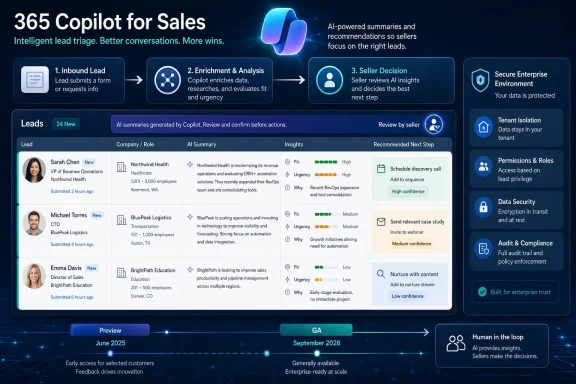 Microsoft Moves Copilot From Assistant to Pipeline Gatekeeper
The roadmap item is described in direct productivity terms: sellers have too many inbound leads, too many systems to check, and too little time to decide which prospects deserve attention. Sales Agent, according to the roadmap description, reviews every lead in a seller’s queue, gathers information from available data sources, creates a comprehensive summary, and surfaces insights specific to the seller’s business. The intended user experience is simple: look at the lead, understand why it may matter, and decide whether to engage.That is why the feature matters. The sales workflow Microsoft is targeting is not the glamorous part of selling. It is the first-pass decision that sits between demand generation and human follow-up: Is this lead real? Is it relevant? Is it urgent? Does it deserve a seller’s time now, later, or not at all?
Microsoft is positioning Sales Agent-enriched leads as a way to shorten that research step. The roadmap wording says the agent gathers information from available data sources and synthesizes it into a summary that can help sellers make faster decisions and personalize outreach. That is a narrower and safer reading than assuming a full CRM, web, or third-party data architecture. Roadmap ID 567000 supports the claim that Microsoft wants Sales Agent to review leads and produce business-specific summaries; it does not, by itself, prove every possible source, connector, product surface, or admin behavior that may surround the broader Sales Agent ecosystem.
The claim is still meaningful. Lead enrichment has existed for years, and revenue-operations teams already know the difference between a useful signal and a decorative one. What Microsoft is trying to change is where the synthesis happens. Instead of asking sellers to manually collect context before deciding whether a lead deserves a response, Microsoft wants Copilot to prepare the lead brief first.
That moves Copilot from a general-purpose assistant toward a more operational role. A meeting summary helps a worker remember what happened. A document draft helps someone start writing. A lead summary influences which prospect gets attention. That is a different level of workflow importance, because the output may shape pipeline behavior rather than merely save a few minutes of writing.
The safest way to read this feature is as an inbound lead triage aid, not as an autonomous sales brain. The roadmap does not say Sales Agent replaces lead scoring, routing rules, sales management judgment, or the seller’s responsibility to verify context before outreach. It says the feature enriches inbound leads with summaries so sellers can more quickly decide whether to engage. That is the answer-first takeaway for IT: prepare for an AI-assisted sales workflow, but do not treat the roadmap entry as permission to assume a complete end-to-end sales automation system.
The Roadmap Date Tells Its Own Story
The timing needs to be stated carefully. Microsoft lists preview availability as June 2025. The roadmap entry for ID 567000 was created and last updated on July 8, 2026. General availability is listed for September 2026. The status is “In development.”Those are the verified roadmap dates. Anything beyond that is interpretation.
It is reasonable to infer that this roadmap item is part of a staged Copilot rollout in which capabilities, previews, and roadmap records do not always appear in a neat public sequence. However, the roadmap entry alone should not be used to claim that a broader product preview began on a particular day, that specific admin controls already exist, or that related sales experiences are available to every customer. The practical reading is simpler: this specific lead-enrichment capability is listed as in development, preview is listed in the past, and GA is planned for September 2026 for Worldwide standard multi-tenant customers on the web platform.
| Release ring | Availability listed | Status | Platform | Cloud instance | Practical read |
|---|---|---|---|---|---|
| Preview | 2025-06 | In development | Web | Worldwide standard multi-tenant | Roadmap-listed preview timing; use only as a signal to monitor availability and evaluate fit |
| General Availability | 2026-09 | In development | Web | Worldwide standard multi-tenant | Roadmap-listed target; production plans should remain conditional until Microsoft confirms availability |
Microsoft’s roadmap also makes clear that this is a Microsoft 365 Copilot feature on the web platform, not a standalone CRM replacement. That puts the work in a familiar adoption lane: understand the audience, confirm availability, assign business ownership, evaluate data quality, train users on verification, and measure whether the workflow actually improves lead handling.
Timeline
2025-06 — Preview availability is listed for the Sales Agent-enriched leads capability.2026-07-08 — Microsoft’s roadmap entry for ID 567000 is created and last updated.
2026-09 — General availability is planned for Worldwide standard multi-tenant customers on the web platform.
The important distinction is that these dates describe the roadmap entry’s stated availability milestones. They do not prove what every tenant can access today, what every admin center will show, or how every related sales workflow will behave. Admins should treat the roadmap as an availability signal, not as a substitute for tenant-specific validation.
This Is Really a Fight Against Lead Triage Delay
Sales leaders often describe pipeline generation as a volume problem: more leads, more campaigns, more top-of-funnel activity. In practice, the bottleneck is often triage. A seller or sales-development rep must decide whether a new lead is credible, relevant, timely, and worth a personalized response. If that decision requires too much manual research, response quality drops or follow-up slows.Roadmap ID 567000 is aimed at that moment. The feature description says sellers can receive enriched summaries for inbound leads and quickly decide whether to engage. That means Microsoft is not merely promising a nicer view of lead data; it is targeting the decision point before outreach.
That is a meaningful shift because administrative research has always been one of sales software’s contradictions. Systems capture information to help sellers, but retrieving and interpreting that information can become its own tax. A seller looking at a new inbound lead does not need a novel. They need to know whether the lead looks legitimate, whether the company or person fits the seller’s business, and what context might make a first response relevant.
If Sales Agent can do that reliably, it becomes more than a convenience. It becomes an embedded qualification aid between lead capture and human selling. That is why the wording around reviewing leads in a seller’s queue is important. Microsoft is describing a workflow that prepares context for the seller rather than waiting for the seller to manually begin every investigation from scratch.
The risk is that lead triage is not just an information problem. It is a judgment problem. The best prospects are not always the ones with the most complete records or the most obvious buying signals. A thin lead from a strategic account may be more valuable than a richly described lead from a poor-fit organization. A student, competitor, consultant, partner, existing customer, or automated form submission may also look more important than it is if the summary lacks enough context.
That is where sellers and managers remain central. The healthy deployment pattern is not “Copilot decides.” It is “Copilot prepares, seller decides, manager reviews.” The roadmap language supports that framing because it emphasizes helping sellers decide whether to engage. It does not say the agent should automatically accept, reject, route, or score every lead without human oversight.
The Data Question Comes Before the AI Question
The lead summary will only be as useful as the information behind it. That is the core operational issue for admins and revenue-operations teams. The roadmap says the feature creates summaries based on available data sources and business-specific context. It does not remove the need to ask whether the underlying lead records are complete, current, and governed.This is where organizations should resist the temptation to over-focus on the AI layer. A poor lead record summarized elegantly is still a poor lead record. If account ownership is unclear, lead sources are inconsistent, required fields are unreliable, or sales stages mean different things across teams, an AI summary may simply make that disorder easier to read.
The important administrative questions are practical:
- Which sales teams actually handle inbound leads at enough volume to benefit from summarization?
- Which lead fields are trusted enough to influence seller prioritization?
- Which fields are routinely stale, optional, or inconsistently used?
- Which users should be allowed to see the information that may appear in a summary?
- Who owns the process when a seller says the summary is wrong?
There is also a user-trust issue. Sellers will quickly learn whether summaries help them save time or send them in the wrong direction. If the first few experiences are wrong, too generic, or difficult to verify, adoption will suffer. If the summaries are useful but no one explains their limits, sellers may over-rely on them. The pilot has to measure both failure modes.
A useful summary should make uncertainty visible. It should help the seller distinguish strong evidence from weak context. It should not turn a messy record into a confident-sounding paragraph that hides gaps. Even without knowing the final interface details, admins can prepare for this evaluation by defining what “good enough” means before the feature is broadly used.
Sales Agent Is Not a Standalone Sales Brain
The most important boundary for buyers is that Roadmap ID 567000 describes a Copilot feature for enriching inbound leads. It does not describe a complete prospecting database, a replacement for CRM governance, or an autonomous sales representative.That distinction matters because “AI for sales” can easily become a catch-all phrase. A seller may expect perfect lead ranking. A manager may expect cleaner pipeline. An executive may expect faster conversion. The roadmap item supports a narrower promise: Sales Agent provides enriched summaries that help sellers decide whether to engage inbound leads.
That narrower promise is still valuable. Sales teams spend real time sorting leads, gathering context, and deciding how to personalize outreach. If a summary can reduce the first-pass research burden, sellers can spend more time on judgment and communication. But the customer still owns the business rules.
For example, an organization may care about company size, region, industry, product interest, existing account status, partner involvement, renewal timing, or strategic account tier. Those signals may not have equal weight. Some may disqualify a lead. Others may increase urgency. Some may matter only in certain territories or product lines. A generic summary cannot solve that policy question.
That is why sales operations should own the qualification model, while IT owns enablement and governance. Sales leadership should define what a useful lead brief must answer. Revenue operations should identify which fields and processes are reliable. IT should confirm access, availability, and support boundaries. Security and compliance teams should review whether sensitive information could be exposed in a way that changes risk.
If those roles are not assigned, the feature can fall into a familiar enterprise software gap. Sales assumes IT configured it. IT assumes sales knows how to use it. Managers assume sellers are verifying the output. Sellers assume the summary is authoritative. The result is an AI-assisted workflow with no clear owner.
That is avoidable. Treat the feature as a governed sales-operations project, not merely a Copilot toggle. The roadmap entry may be small, but the workflow it touches is consequential.
The Lead Summary Becomes a Business Artifact
Once an AI-generated summary influences whether a seller contacts a prospect, the summary becomes more than a convenience. It becomes a business artifact. It may affect prioritization, outreach tone, manager coaching, and pipeline interpretation.That raises four issues.
First, there is provenance. Sellers need to understand why a summary says a lead is promising, weak, urgent, or relevant. A lead brief that cannot be checked is risky because it can turn unknowns into apparent certainty. Even if the final product experience does not expose every detail, organizations should train sellers to verify important claims before using them in outreach.
Second, there is freshness. Lead context changes quickly. A person may change roles. A company may shift priorities. A campaign response may be old. A previously relevant note may no longer apply. AI-generated text can feel current because it is newly written, even when the underlying information is dated.
Third, there is sensitivity. Sales records can include pricing context, objections, relationship notes, procurement details, competitor references, and other information that may not be appropriate for every user. Any feature that summarizes business-specific lead context should be evaluated against existing access expectations. The issue is not simply whether users can open a record; it is whether summaries make sensitive context more visible or easier to consume.
Fourth, there is accountability. If a seller ignores a good prospect because a summary made it look weak, who reviews that outcome? If a seller sends a poor message based on an unverified summary, is that a training problem, a data problem, or an AI-output problem? The answer may vary, but the organization should decide in advance how feedback will be captured.
The practical answer is to make summaries reviewable and contestable during any pilot. Sellers should be able to report inaccurate, incomplete, or misleading summaries. Managers should compare summary quality against actual outcomes. Revenue operations should look for patterns: Are certain lead sources producing weak summaries? Are certain fields missing too often? Are strategic-account leads being under-prioritized? Are low-fit leads being made to look attractive because they have more available context?
That review loop matters more than abstract AI enthusiasm. A lead summary is only valuable if it improves decisions. If it merely accelerates bad assumptions, it adds risk at machine speed.
Windows and Microsoft 365 Admins Still Have a Role
For WindowsForum readers, the immediate temptation is to treat this as a sales-department feature. That would be too narrow. Microsoft 365 Copilot features land in an administrative environment: users, licenses, policies, support processes, training, and change management. Sales owns the business outcome, but IT will almost certainly be asked to help make the experience available, understandable, and supportable.However, the admin guidance should stay within what the roadmap supports. Roadmap ID 567000 identifies the product, platform, cloud instance, status, and availability milestones. It does not provide a complete configuration procedure. It does not justify detailed claims about specific admin center settings, connectors, application surfaces, or toggles. Until Microsoft publishes or confirms those details for this specific feature, admins should avoid building a checklist around unsupported assumptions.
The better recommendation is shorter and more verifiable: prepare the environment and the pilot criteria, but do not pretend the deployment mechanics are known from the roadmap alone.
Practical preparation for admins and sales operations
- Assign a business owner for inbound lead triage before the feature is piloted. This should usually be sales operations or revenue operations, not IT alone.
- Identify the pilot audience by role and workflow. Choose users who handle meaningful inbound lead volume and whose outcomes can be measured.
- Define what a useful lead summary must answer, such as fit, urgency, existing relationship context, and recommended next step.
- Review lead-data hygiene before rollout. Focus on fields that sellers already use to decide whether to engage.
- Decide how sellers will report inaccurate or misleading summaries during a pilot.
- Measure outcomes that matter: response time, accepted leads, rejected leads, meeting conversion, seller adoption, and manager confidence.
- Train sellers that summaries are decision support, not final authority.
What admins can do now is set the operating model. The core question is not “Where is the toggle?” The core question is “Who will decide whether this lead summary is accurate enough to influence sales behavior?” That question can and should be answered before general availability.
Microsoft’s Copilot Strategy Gets More Vertical
Roadmap ID 567000 fits Microsoft’s broader shift from general productivity assistance toward role-specific workflows. The first wave of Copilot adoption was easy to explain: summarize, draft, rewrite, search, and prepare. Those are horizontal productivity patterns. Sales Agent-enriched leads are narrower, but potentially more valuable because they attach Copilot to a revenue process.That is the strategic point. A generic productivity feature saves time across many roles. A sales workflow can be judged against business outcomes. If lead summaries help sellers respond faster, personalize better, and focus on stronger prospects, the value case becomes easier for sales leaders to understand. If the summaries are generic, stale, or hard to trust, sellers will route around them.
This is also where expectations need discipline. It is fair to infer that Microsoft will continue exploring more role-specific Copilot workflows, because this roadmap item itself is a role-specific sales workflow. It is not fair to claim, based only on Roadmap ID 567000, that Microsoft will next automate routing, outreach, CRM updates, or lead scoring in a particular way. Those may be plausible future directions for the market, but they are not established by the roadmap item.
The more grounded point is this: Microsoft is testing Copilot’s value closer to the moment of business decision. A lead summary is not just a text artifact. It sits beside a choice: engage or pass. That makes accuracy, reviewability, and ownership more important than they are for lower-stakes productivity tasks.
Sales is a natural proving ground because outcomes can be measured. Response times, conversion rates, accepted leads, meeting bookings, opportunity creation, and pipeline quality can all be tracked by the business. That measurability is an opportunity for Microsoft and a warning for customers. The feature should not be evaluated only by whether sellers like the demo. It should be evaluated by whether it improves the sales motion without creating new governance or quality problems.
The Hard Part Is Deciding When the Agent Is Wrong
Every AI-assisted sales workflow needs a failure model. What happens when a summary is incomplete? What happens when a weak lead is made to look strong? What happens when an important strategic lead appears ordinary because the available data is thin? What happens when a seller trusts a summary without checking the underlying record?Inbound leads are especially messy. Some prospects provide careful information. Others use personal email addresses, vague company names, incomplete forms, or minimal context. Some leads are students, competitors, partners, existing customers, consultants, or automated noise. Any lead-enrichment system has to separate signal from noise without hiding uncertainty.
The roadmap description says the seller can quickly decide whether to engage. That phrasing matters because it preserves human judgment. The feature should reduce the cost of research, not remove accountability from the seller or manager.
A strong pilot should therefore include deliberate error review. Sales teams should not simply ask, “Did the summary sound good?” They should ask:
- Was the summary accurate?
- Was any important context missing?
- Did the summary make the lead look stronger or weaker than it really was?
- Could the seller verify the key points quickly?
- Did the summary help produce a better next action?
- Did it change which leads were pursued?
- Did managers agree with those changes after reviewing outcomes?
The failure model should also include escalation. If sellers repeatedly flag summaries as wrong, someone must own the fix. That may involve lead-source cleanup, field standardization, access review, user training, or waiting for Microsoft to improve the feature. Without that feedback loop, bad summaries become background noise. With it, the pilot can reveal whether the organization is ready for AI-assisted lead triage.
What To Do Now
The top-line action is straightforward: do not overbuild around assumptions, but do prepare. Roadmap ID 567000 says Microsoft is developing Sales Agent-enriched inbound lead summaries for Microsoft 365 Copilot on the web, with preview listed for June 2025 and GA planned for September 2026. That is enough to justify planning, but not enough to justify unsupported claims about specific connectors, admin center behavior, app surfaces, or configuration steps.Admins should start with ownership. Sales operations or revenue operations should define the business rules for lead triage. IT should own tenant readiness, access review, support planning, and user enablement. Sales managers should own adoption and outcome measurement. Sellers should remain responsible for verifying summaries before acting on them.
The pilot should be small but meaningful. It should include people who handle enough inbound volume to expose patterns, not only enthusiastic early adopters. It should include at least one manager who is willing to challenge the summaries against real conversion outcomes. It should also include a process for collecting errors, not just praise.
The measurement plan should be agreed before rollout. If the organization cannot say what success looks like, it will not know whether the feature helped. Useful measures include time to first response, lead acceptance rate, meeting conversion, seller-reported usefulness, manager confidence, and examples of false positives or false negatives. The goal is not to prove that AI is impressive. The goal is to prove that lead decisions improved.
The training message should be equally clear: Sales Agent prepares context; sellers decide. A summary can speed up research, but it should not replace judgment. Sellers should verify important claims, especially before using them in customer-facing outreach. Managers should review whether the tool changes behavior in ways that help the pipeline rather than merely making the workflow feel faster.
That is the explicit takeaway. Roadmap ID 567000 is a small roadmap entry with a large operational implication: Microsoft wants Copilot to help sellers triage inbound leads, not just write about them. The opportunity is faster, more focused follow-up. The risk is confident summarization of imperfect data. The organizations that benefit most will be the ones that treat the feature as governed decision support, with clear owners, measured outcomes, and a disciplined pilot before broad adoption.
References
- Primary source: Microsoft 365 Roadmap
Published: 2026-07-08T23:10:57.8991775Z
Loading…
www.microsoft.com - Official source: learn.microsoft.com
Loading…
learn.microsoft.com - Official source: techcommunity.microsoft.com
Loading…
techcommunity.microsoft.com - Official source: adoption.microsoft.com
Microsoft 365 Copilot for Sales – Microsoft Adoption
Microsoft 365 Copilot for Sales is experienced within Microsoft 365 and connects directly to Dynamics and Salesforce CRMs for real-time data and updates.adoption.microsoft.com - Related coverage: randgroup.com
Loading…
www.randgroup.com - Related coverage: techradar.com
Microsoft Dynamics 365 CRM review 2026: Fully tested | TechRadar
What makes Microsoft Dynamics 365 such a strong enterprise pick? Read our 4.5-star review for insights into its AI functionality, customization, and more.www.techradar.com
