

AMD’s ROCDXG library for Windows Subsystem for Linux has expanded ROCm support to more Ryzen hardware in 2026, giving Windows 11 users with supported Ryzen APUs a more official path for running Linux GPU-compute and AI workloads without leaving Windows. The change is not just another compatibility footnote in AMD’s long-running ROCm saga. It is a sign that the company finally understands where many developers actually live: in Windows, inside WSL, trying to make Linux-first AI tooling behave like part of a normal workstation. For AMD, the stakes are bigger than a few more laptop SKUs; this is about whether Radeon and Ryzen can become credible local AI development hardware rather than perpetually interesting alternatives to NVIDIA’s default stack.
For years, ROCm has had the shape of a serious compute platform and the reputation of a platform that made ordinary users work too hard. On Linux, it has matured into an important part of AMD’s data-center and HPC pitch. On Windows, especially on consumer hardware, it has often felt like a door that was technically open but practically hard to walk through.
That is why the ROCDXG work matters. The library, better known in package and repository form as
The latest expansion, highlighted by Phoronix, pushes that bridge across more Ryzen hardware. Earlier ROCDXG work had already made AMD’s WSL story more credible for Radeon GPUs and newer Ryzen AI parts. Extending that support further into Ryzen systems is the sort of incremental move that looks small in a changelog and large in the real world, because APUs are everywhere: in laptops, mini PCs, developer boxes, and compact workstations that were never bought as “AI machines” but increasingly get asked to run AI workloads anyway.
This is also a Windows story as much as it is an AMD story. WSL has become Microsoft’s quiet answer to the fact that a huge amount of developer infrastructure assumes Linux. AMD’s move says that if Windows is going to be the shell around Linux workflows, GPU compute cannot remain trapped on one vendor’s hardware.
That uncertainty punished enthusiasts first. A Windows user with a Radeon GPU could read about ROCm, see promising framework support, and still end up in a maze of compatibility matrices, version pins, community scripts, and forum posts that aged badly. For sysadmins and IT pros, that is not merely annoying; it is disqualifying. A compute stack that cannot be deployed with confidence is not a platform, it is a hobby.
WSL made the problem more visible. Microsoft gave Windows users a convenient Linux environment, but GPU compute through that environment depends on careful cooperation between the guest Linux stack, Windows kernel plumbing, the display driver, and the vendor runtime. NVIDIA made CUDA in WSL feel like an extension of an already dominant developer ecosystem. AMD had to fight on two fronts: first to make ROCm strong enough, and then to make it feel ordinary inside Windows.
ROCDXG is AMD’s attempt to reduce the number of moving parts that users must personally reconcile. By using the WSL GPU exposure path through Microsoft’s DXCore and
The distinction matters because developer trust is cumulative. Nobody expects first-generation WSL compute support to be perfect. But they do expect the architecture to look like something the vendor intends to maintain.
The design also loosens a knot that has long frustrated ROCm users: tight coupling between releases. AMD’s documentation frames ROCDXG as a library that can evolve independently from both ROCm releases and Windows display driver versions. In plain English, that means AMD is trying to avoid a world where updating Adrenalin breaks WSL compute, or updating ROCm forces users to hunt down a matching Windows-side package.
That decoupling is especially valuable for WindowsForum’s core audience. Enthusiasts update drivers because games demand it. Developers update frameworks because PyTorch, ONNX Runtime, TensorFlow, and Triton move quickly. IT departments update Windows because security policy demands it. A GPU compute path that survives those rhythms is much more useful than one that assumes a frozen lab image.
There is still complexity here. Users need Windows 11, WSL2, a supported Ubuntu release, compatible AMD drivers, ROCm packages, and the correct environment variable to enable DXG detection. Containers need WSL-specific flags and library mounts. Monitoring and profiling are not equivalent to native Linux. But this is the kind of complexity that can be documented, scripted, and eventually wrapped by tooling.
That is why the move feels more important than the version number attached to it. AMD is not merely adding another supported device ID. It is building the scaffolding that lets ROCm behave like a Windows-adjacent developer platform rather than a Linux-only stack awkwardly peering through the glass.
That is the pressure behind the Ryzen expansion. AMD has put serious GPU and NPU silicon into modern mobile and desktop processors, especially in the Ryzen AI generation. The company cannot simultaneously promote local AI PCs and leave the most popular AI development workflows feeling like they belong to somebody else’s ecosystem. If ROCm is only comfortable on a curated set of discrete GPUs, AMD’s AI PC pitch loses developer oxygen.
WSL is the natural bridge because the AI software world remains heavily Linux-shaped. Many tutorials assume Ubuntu. Many wheels, containers, scripts, and training recipes are written for Linux first. Windows-native AI support exists, and Microsoft has invested heavily in DirectML, ONNX Runtime, and Windows AI APIs, but the frontier of community experimentation still often begins in a Linux shell.
For Ryzen APUs, that means WSL support is not a bonus feature. It is the difference between telling users to buy different hardware and telling them to open a terminal. AMD badly needs the latter message.
The expansion also helps AMD in a market where “AI PC” risks becoming a branding exercise detached from developer reality. NPUs are useful, especially for power-efficient inference and OS-integrated features, but a great deal of practical AI tinkering still leans on GPU software stacks. If a Ryzen laptop can run more ROCm-backed workloads inside WSL, it becomes a more credible machine for students, indie developers, researchers, and IT labs experimenting with local models.
AMD cannot defeat that by announcing support in one more matrix. It has to make the alternative boringly functional. That means broad hardware coverage, stable WSL behavior, timely framework support, good documentation, and enough performance that users do not feel punished for choosing Radeon or Ryzen.
The ROCDXG approach is a practical response to that reality. Instead of pretending Windows users will abandon Windows to enter AMD’s preferred compute environment, AMD is meeting them where the tooling already works. Instead of forcing every user to understand driver internals, it is narrowing the path to a supported bridge. Instead of leaving WSL support as an afterthought, it is treating WSL as a first-class deployment target.
Still, AMD remains behind in ecosystem confidence. A developer who buys an NVIDIA GPU today can assume a vast amount of software will behave. A developer who buys AMD hardware is more likely to check the exact GPU architecture, ROCm version, framework release, and operating system notes before committing. That gap is psychological as much as technical, and it will take repeated uneventful releases to close.
This is where Ryzen support becomes symbolically useful. The broader ROCm runs across normal AMD client hardware, the less it feels like a specialist stack for people willing to memorize code names. Users should not need to know whether their GPU is
Today, a plausible developer workstation is a Windows 11 laptop running VS Code, Docker, WSL Ubuntu, Python environments, local inference tools, and a browser full of documentation. The user may never think of themselves as “running Linux,” even though their workflow depends on it. In that world, GPU compute support inside WSL is not a niche feature. It is table stakes.
Microsoft benefits from this arrangement because it keeps developers on Windows without forcing Windows-native ports of every Linux tool. NVIDIA benefits because CUDA already occupies the mental default. AMD has often been the odd participant: strong CPU presence in Windows machines, competitive GPUs in many segments, but a compute software story that did not always follow users into their actual workflow.
ROCDXG is AMD’s bid to stop surrendering that neutral ground. By translating ROCm calls through the WSL GPU interface and Windows driver stack, AMD can make a Windows machine feel more like a Linux GPU box from the perspective of AI frameworks. That is exactly the illusion WSL is supposed to provide.
There is a strategic elegance here. AMD does not need to make Windows the primary ROCm development environment overnight. It needs to make Windows stop being a reason developers avoid AMD hardware. WSL gives the company a way to do that without rewriting the Linux-first AI ecosystem around native Windows assumptions.
Some monitoring and management capabilities remain constrained under WSL. Users may need to rely on Windows-native tools such as Task Manager or AMD Software for certain GPU telemetry rather than expecting the full native Linux ROCm management experience. Debugging and profiling support is also not yet equivalent to a native Linux setup. For serious performance engineering, those gaps matter.
Framework support is another area where the headline can outrun the lived experience. PyTorch, ONNX Runtime, TensorFlow, and Triton support matrices are improving, but AI software moves quickly and breaks casually. A working ROCm stack does not guarantee that every community model, extension, quantization path, or custom kernel will run smoothly. Anyone who has tried to make modern AI packages agree on Python versions, wheel builds, and GPU backends knows that “supported” is the start of the conversation, not the end.
There is also the practical issue of memory. APUs share system memory and may have different allocation behavior than discrete GPUs with large VRAM pools. AMD’s recent ROCDXG work around APU memory allocation is encouraging precisely because it acknowledges that Ryzen support is not just a matter of recognizing a device. The runtime must handle the realities of integrated graphics, shared memory, and laptop-class thermal budgets.
None of these caveats invalidate the expansion. They simply define the stage AMD is in. ROCm on WSL is becoming usable enough to matter, but not invisible enough to forget.
If a data scientist, automation engineer, or internal tools developer can prototype ROCm-backed workflows on a Windows laptop, AMD gains mindshare before hardware procurement enters the room. If those workflows remain CUDA-only because that is what every developer machine supports, AMD loses long before the accelerator comparison sheet is written. Local development matters because it shapes defaults.
For IT departments, WSL support also fits existing Windows management realities. Many organizations are standardized on Windows endpoints but increasingly need Linux development environments. WSL has become a compromise that security teams can understand and developers can tolerate. GPU compute inside that compromise layer makes AMD hardware more viable in fleets that were never going to run native Linux on every machine.
There is also a cost argument lurking beneath the software story. Not every AI workload needs a cloud instance or a workstation-class discrete GPU. Small-model inference, experimentation, teaching, data preprocessing, and framework validation can benefit from local acceleration even when the hardware is modest. If AMD can make that experience reliable on Ryzen systems already in the fleet, it gives IT a better answer than “buy everyone a CUDA laptop.”
The catch is supportability. Enterprises do not merely ask whether something works; they ask who owns the failure. AMD’s move toward production support is therefore essential. Community patches and clever scripts are useful for enthusiasts, but procurement departments need vendor-backed paths, documented limitations, and a release cadence that does not feel improvised.
The best version of AMD’s strategy is not “choose us because you can inspect the code.” It is “choose us because the code is inspectable, the stack works, and the community can help close gaps faster.” ROCDXG gives AMD a chance to make that argument with more credibility because the bridge itself is public, modular, and tied to a widely used Windows subsystem.
That could matter for edge cases. Enthusiasts and downstream developers are often the first to find unsupported-but-nearly-working hardware combinations. In a closed stack, that energy turns into frustration. In an open one, it can become bug reports, pull requests, compatibility experiments, and eventually official support. AMD should not rely on the community to do its product work, but it should absolutely harness the community’s ability to identify where the product should go next.
The danger is that open source becomes a pressure valve rather than a promise. If users discover that support for their hardware depends on unofficial forks or fragile patches, the message becomes muddy. AMD needs to make the official path expand steadily enough that community work feels like acceleration, not rescue.
ROCDXG’s latest Ryzen expansion suggests AMD is moving in that direction. The important question is whether the company can keep the cadence going.
That shift helps AMD because not every local AI workload requires top-end hardware. Many users are not trying to train frontier models. They are trying to run a model privately, test a pipeline, accelerate a notebook, or learn how inference frameworks behave. For that audience, the difference between “CPU only” and “some working GPU acceleration” can be substantial.
Ryzen APUs are especially interesting in this context because they sit in machines people already own. A laptop with integrated Radeon graphics will not behave like a high-end discrete card, but it may still turn an unusable experiment into a tolerable one. More importantly, it lets users learn ROCm workflows without buying into a separate GPU ecosystem first.
That learning loop is valuable. Developers tend to carry their early platform experiences into later hardware decisions. If a student or sysadmin learns AI tooling on CUDA because that is the only path that works on their machine, CUDA becomes the default. If ROCm works on the Ryzen system in front of them, AMD gets a chance to become normal.
This is why seemingly modest compatibility expansions matter. Platform wars are not won only by flagship benchmarks. They are won when ordinary users stop asking whether the platform exists.
ROCDXG does not solve that entire problem, but it attacks one of its most visible symptoms. A Windows user should not have to choose between keeping their normal desktop environment and using the Linux-first tools that dominate AI development. If the hardware is capable and supported, WSL should be a practical route to acceleration.
The real test will be how fast AMD turns this from “expanded support” into “expected support.” The company needs clean installers, better diagnostics, richer telemetry, container recipes that survive copy-and-paste use, and framework support that tracks upstream releases without long awkward gaps. It also needs to communicate supported hardware in language normal users understand, not only in GPU architecture identifiers and matrix rows.
There is an opportunity here for OEMs as well. Ryzen AI laptops, small-form-factor desktops, and workstation-class notebooks could ship with clearer local AI stories if ROCm on WSL becomes dependable. Microsoft’s Windows AI push, AMD’s Ryzen AI branding, and WSL’s developer footprint all point in the same direction. The missing piece has been a GPU compute path that feels maintained.
ROCDXG is not glamorous, but platform plumbing rarely is. The pipes matter because everything else depends on them.
Source: Phoronix AMD Expands ROCm Support On Windows WSL To More Ryzen Hardware - Phoronix
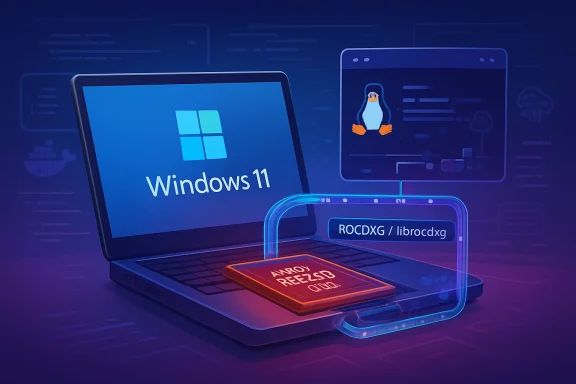 AMD Moves ROCm Closer to the Windows Developer’s Desk
For years, ROCm has had the shape of a serious compute platform and the reputation of a platform that made ordinary users work too hard. On Linux, it has matured into an important part of AMD’s data-center and HPC pitch. On Windows, especially on consumer hardware, it has often felt like a door that was technically open but practically hard to walk through.That is why the ROCDXG work matters. The library, better known in package and repository form as
librocdxg, acts as the user-mode bridge between ROCm inside WSL and the Windows GPU stack. Instead of asking developers to treat Windows as a second-class host or to dual-boot into Linux for serious GPU compute, AMD is leaning into WSL as the compromise layer where modern Windows development already happens.The latest expansion, highlighted by Phoronix, pushes that bridge across more Ryzen hardware. Earlier ROCDXG work had already made AMD’s WSL story more credible for Radeon GPUs and newer Ryzen AI parts. Extending that support further into Ryzen systems is the sort of incremental move that looks small in a changelog and large in the real world, because APUs are everywhere: in laptops, mini PCs, developer boxes, and compact workstations that were never bought as “AI machines” but increasingly get asked to run AI workloads anyway.
This is also a Windows story as much as it is an AMD story. WSL has become Microsoft’s quiet answer to the fact that a huge amount of developer infrastructure assumes Linux. AMD’s move says that if Windows is going to be the shell around Linux workflows, GPU compute cannot remain trapped on one vendor’s hardware.
The Old ROCm Problem Was Never Just Missing Drivers
The easy version of the ROCm complaint is that AMD supported fewer GPUs than users wanted. That is true, but incomplete. The harder problem has always been predictability: knowing whether a given card, driver, framework, kernel, distro, and workload would line up without turning a weekend project into a forensic exercise.That uncertainty punished enthusiasts first. A Windows user with a Radeon GPU could read about ROCm, see promising framework support, and still end up in a maze of compatibility matrices, version pins, community scripts, and forum posts that aged badly. For sysadmins and IT pros, that is not merely annoying; it is disqualifying. A compute stack that cannot be deployed with confidence is not a platform, it is a hobby.
WSL made the problem more visible. Microsoft gave Windows users a convenient Linux environment, but GPU compute through that environment depends on careful cooperation between the guest Linux stack, Windows kernel plumbing, the display driver, and the vendor runtime. NVIDIA made CUDA in WSL feel like an extension of an already dominant developer ecosystem. AMD had to fight on two fronts: first to make ROCm strong enough, and then to make it feel ordinary inside Windows.
ROCDXG is AMD’s attempt to reduce the number of moving parts that users must personally reconcile. By using the WSL GPU exposure path through Microsoft’s DXCore and
/dev/dxg, the library aligns AMD’s compute story with the mechanism Windows already provides for GPU virtualization into WSL. That does not magically make every workload supported, but it changes the center of gravity from “hack around the stack” to “install the supported bridge.”The distinction matters because developer trust is cumulative. Nobody expects first-generation WSL compute support to be perfect. But they do expect the architecture to look like something the vendor intends to maintain.
ROCDXG Turns WSL from Workaround into Strategy
The most important part of ROCDXG is not that it exists, but that AMD describes it as production-supported and open source. That combination is deliberate. Production support tells cautious users that this is no longer a science project. Open source tells ROCm’s traditional audience that the bridge is inspectable, debuggable, and not just another opaque Windows shim.The design also loosens a knot that has long frustrated ROCm users: tight coupling between releases. AMD’s documentation frames ROCDXG as a library that can evolve independently from both ROCm releases and Windows display driver versions. In plain English, that means AMD is trying to avoid a world where updating Adrenalin breaks WSL compute, or updating ROCm forces users to hunt down a matching Windows-side package.
That decoupling is especially valuable for WindowsForum’s core audience. Enthusiasts update drivers because games demand it. Developers update frameworks because PyTorch, ONNX Runtime, TensorFlow, and Triton move quickly. IT departments update Windows because security policy demands it. A GPU compute path that survives those rhythms is much more useful than one that assumes a frozen lab image.
There is still complexity here. Users need Windows 11, WSL2, a supported Ubuntu release, compatible AMD drivers, ROCm packages, and the correct environment variable to enable DXG detection. Containers need WSL-specific flags and library mounts. Monitoring and profiling are not equivalent to native Linux. But this is the kind of complexity that can be documented, scripted, and eventually wrapped by tooling.
That is why the move feels more important than the version number attached to it. AMD is not merely adding another supported device ID. It is building the scaffolding that lets ROCm behave like a Windows-adjacent developer platform rather than a Linux-only stack awkwardly peering through the glass.
Ryzen Support Changes the Shape of the Audience
Discrete Radeon support is important, but Ryzen APU support changes who can plausibly care. A user with a high-end Radeon RX 7900-class card is already the sort of person who may tolerate rough edges to get local GPU compute working. A user with a Ryzen AI laptop is more likely to ask a simpler question: why shouldn’t the hardware already in my machine run the tools everyone is talking about?That is the pressure behind the Ryzen expansion. AMD has put serious GPU and NPU silicon into modern mobile and desktop processors, especially in the Ryzen AI generation. The company cannot simultaneously promote local AI PCs and leave the most popular AI development workflows feeling like they belong to somebody else’s ecosystem. If ROCm is only comfortable on a curated set of discrete GPUs, AMD’s AI PC pitch loses developer oxygen.
WSL is the natural bridge because the AI software world remains heavily Linux-shaped. Many tutorials assume Ubuntu. Many wheels, containers, scripts, and training recipes are written for Linux first. Windows-native AI support exists, and Microsoft has invested heavily in DirectML, ONNX Runtime, and Windows AI APIs, but the frontier of community experimentation still often begins in a Linux shell.
For Ryzen APUs, that means WSL support is not a bonus feature. It is the difference between telling users to buy different hardware and telling them to open a terminal. AMD badly needs the latter message.
The expansion also helps AMD in a market where “AI PC” risks becoming a branding exercise detached from developer reality. NPUs are useful, especially for power-efficient inference and OS-integrated features, but a great deal of practical AI tinkering still leans on GPU software stacks. If a Ryzen laptop can run more ROCm-backed workloads inside WSL, it becomes a more credible machine for students, indie developers, researchers, and IT labs experimenting with local models.
The NVIDIA Shadow Still Defines the Room
Every ROCm development arrives under the long shadow of CUDA. NVIDIA’s advantage is not merely hardware performance or market share; it is the accumulated habit of developers assuming CUDA will be there. Framework authors test CUDA first. Tutorials default to CUDA. Container images are often CUDA-first. When a user asks whether a model will run locally, the community answer frequently begins with which NVIDIA GPU to buy.AMD cannot defeat that by announcing support in one more matrix. It has to make the alternative boringly functional. That means broad hardware coverage, stable WSL behavior, timely framework support, good documentation, and enough performance that users do not feel punished for choosing Radeon or Ryzen.
The ROCDXG approach is a practical response to that reality. Instead of pretending Windows users will abandon Windows to enter AMD’s preferred compute environment, AMD is meeting them where the tooling already works. Instead of forcing every user to understand driver internals, it is narrowing the path to a supported bridge. Instead of leaving WSL support as an afterthought, it is treating WSL as a first-class deployment target.
Still, AMD remains behind in ecosystem confidence. A developer who buys an NVIDIA GPU today can assume a vast amount of software will behave. A developer who buys AMD hardware is more likely to check the exact GPU architecture, ROCm version, framework release, and operating system notes before committing. That gap is psychological as much as technical, and it will take repeated uneventful releases to close.
This is where Ryzen support becomes symbolically useful. The broader ROCm runs across normal AMD client hardware, the less it feels like a specialist stack for people willing to memorize code names. Users should not need to know whether their GPU is
gfx1100, gfx1103, or something else before deciding whether to try a Python notebook.Windows Becomes the Neutral Ground in the AI Workstation Fight
The old mental model separated Linux workstations from Windows PCs. Linux was where serious compute happened; Windows was where Office, games, and vendor control panels lived. WSL has spent the last several years eroding that distinction, and AI development has accelerated the collapse.Today, a plausible developer workstation is a Windows 11 laptop running VS Code, Docker, WSL Ubuntu, Python environments, local inference tools, and a browser full of documentation. The user may never think of themselves as “running Linux,” even though their workflow depends on it. In that world, GPU compute support inside WSL is not a niche feature. It is table stakes.
Microsoft benefits from this arrangement because it keeps developers on Windows without forcing Windows-native ports of every Linux tool. NVIDIA benefits because CUDA already occupies the mental default. AMD has often been the odd participant: strong CPU presence in Windows machines, competitive GPUs in many segments, but a compute software story that did not always follow users into their actual workflow.
ROCDXG is AMD’s bid to stop surrendering that neutral ground. By translating ROCm calls through the WSL GPU interface and Windows driver stack, AMD can make a Windows machine feel more like a Linux GPU box from the perspective of AI frameworks. That is exactly the illusion WSL is supposed to provide.
There is a strategic elegance here. AMD does not need to make Windows the primary ROCm development environment overnight. It needs to make Windows stop being a reason developers avoid AMD hardware. WSL gives the company a way to do that without rewriting the Linux-first AI ecosystem around native Windows assumptions.
The Limitations Are Still the Tell
A good platform announcement tells you what works. A better one tells you what still does not. ROCDXG’s limitations are therefore worth reading closely, because they show where AMD’s WSL support remains a bridge rather than a full native destination.Some monitoring and management capabilities remain constrained under WSL. Users may need to rely on Windows-native tools such as Task Manager or AMD Software for certain GPU telemetry rather than expecting the full native Linux ROCm management experience. Debugging and profiling support is also not yet equivalent to a native Linux setup. For serious performance engineering, those gaps matter.
Framework support is another area where the headline can outrun the lived experience. PyTorch, ONNX Runtime, TensorFlow, and Triton support matrices are improving, but AI software moves quickly and breaks casually. A working ROCm stack does not guarantee that every community model, extension, quantization path, or custom kernel will run smoothly. Anyone who has tried to make modern AI packages agree on Python versions, wheel builds, and GPU backends knows that “supported” is the start of the conversation, not the end.
There is also the practical issue of memory. APUs share system memory and may have different allocation behavior than discrete GPUs with large VRAM pools. AMD’s recent ROCDXG work around APU memory allocation is encouraging precisely because it acknowledges that Ryzen support is not just a matter of recognizing a device. The runtime must handle the realities of integrated graphics, shared memory, and laptop-class thermal budgets.
None of these caveats invalidate the expansion. They simply define the stage AMD is in. ROCm on WSL is becoming usable enough to matter, but not invisible enough to forget.
The Enterprise Angle Is Smaller Today and Bigger Tomorrow
At first glance, Ryzen APU support for ROCm under WSL sounds like an enthusiast and developer story, not an enterprise one. Large organizations doing serious AI training are not about to replace data-center accelerators with laptop integrated graphics. But that misses how enterprise adoption often begins: not with production deployment, but with developer availability.If a data scientist, automation engineer, or internal tools developer can prototype ROCm-backed workflows on a Windows laptop, AMD gains mindshare before hardware procurement enters the room. If those workflows remain CUDA-only because that is what every developer machine supports, AMD loses long before the accelerator comparison sheet is written. Local development matters because it shapes defaults.
For IT departments, WSL support also fits existing Windows management realities. Many organizations are standardized on Windows endpoints but increasingly need Linux development environments. WSL has become a compromise that security teams can understand and developers can tolerate. GPU compute inside that compromise layer makes AMD hardware more viable in fleets that were never going to run native Linux on every machine.
There is also a cost argument lurking beneath the software story. Not every AI workload needs a cloud instance or a workstation-class discrete GPU. Small-model inference, experimentation, teaching, data preprocessing, and framework validation can benefit from local acceleration even when the hardware is modest. If AMD can make that experience reliable on Ryzen systems already in the fleet, it gives IT a better answer than “buy everyone a CUDA laptop.”
The catch is supportability. Enterprises do not merely ask whether something works; they ask who owns the failure. AMD’s move toward production support is therefore essential. Community patches and clever scripts are useful for enthusiasts, but procurement departments need vendor-backed paths, documented limitations, and a release cadence that does not feel improvised.
Open Source Is AMD’s Advantage Only If It Reduces Friction
AMD often contrasts its open software posture with NVIDIA’s proprietary dominance. That is fair as far as it goes, and ROCDXG being open source fits the broader ROCm philosophy. But openness alone does not win developers if the open path is harder.The best version of AMD’s strategy is not “choose us because you can inspect the code.” It is “choose us because the code is inspectable, the stack works, and the community can help close gaps faster.” ROCDXG gives AMD a chance to make that argument with more credibility because the bridge itself is public, modular, and tied to a widely used Windows subsystem.
That could matter for edge cases. Enthusiasts and downstream developers are often the first to find unsupported-but-nearly-working hardware combinations. In a closed stack, that energy turns into frustration. In an open one, it can become bug reports, pull requests, compatibility experiments, and eventually official support. AMD should not rely on the community to do its product work, but it should absolutely harness the community’s ability to identify where the product should go next.
The danger is that open source becomes a pressure valve rather than a promise. If users discover that support for their hardware depends on unofficial forks or fragile patches, the message becomes muddy. AMD needs to make the official path expand steadily enough that community work feels like acceleration, not rescue.
ROCDXG’s latest Ryzen expansion suggests AMD is moving in that direction. The important question is whether the company can keep the cadence going.
Local AI Makes “Good Enough” GPU Compute Valuable Again
The AI boom has changed what users expect from their PCs. A few years ago, GPU compute on a consumer Windows machine mostly meant gaming-adjacent creation workflows, video processing, or specialized development. Today, local LLMs, image generation, speech tools, coding assistants, retrieval experiments, and small training jobs have made GPU acceleration feel relevant to a much wider group.That shift helps AMD because not every local AI workload requires top-end hardware. Many users are not trying to train frontier models. They are trying to run a model privately, test a pipeline, accelerate a notebook, or learn how inference frameworks behave. For that audience, the difference between “CPU only” and “some working GPU acceleration” can be substantial.
Ryzen APUs are especially interesting in this context because they sit in machines people already own. A laptop with integrated Radeon graphics will not behave like a high-end discrete card, but it may still turn an unusable experiment into a tolerable one. More importantly, it lets users learn ROCm workflows without buying into a separate GPU ecosystem first.
That learning loop is valuable. Developers tend to carry their early platform experiences into later hardware decisions. If a student or sysadmin learns AI tooling on CUDA because that is the only path that works on their machine, CUDA becomes the default. If ROCm works on the Ryzen system in front of them, AMD gets a chance to become normal.
This is why seemingly modest compatibility expansions matter. Platform wars are not won only by flagship benchmarks. They are won when ordinary users stop asking whether the platform exists.
AMD’s Software Story Finally Starts Matching Its Hardware Story
AMD’s client hardware has been on a strong run for years. Ryzen reshaped desktop and laptop expectations, and Radeon remains competitive across meaningful parts of the graphics market. But the software story around compute has often lagged the silicon story, creating a strange disconnect: AMD systems could be excellent general-purpose PCs while still feeling risky for AI developers.ROCDXG does not solve that entire problem, but it attacks one of its most visible symptoms. A Windows user should not have to choose between keeping their normal desktop environment and using the Linux-first tools that dominate AI development. If the hardware is capable and supported, WSL should be a practical route to acceleration.
The real test will be how fast AMD turns this from “expanded support” into “expected support.” The company needs clean installers, better diagnostics, richer telemetry, container recipes that survive copy-and-paste use, and framework support that tracks upstream releases without long awkward gaps. It also needs to communicate supported hardware in language normal users understand, not only in GPU architecture identifiers and matrix rows.
There is an opportunity here for OEMs as well. Ryzen AI laptops, small-form-factor desktops, and workstation-class notebooks could ship with clearer local AI stories if ROCm on WSL becomes dependable. Microsoft’s Windows AI push, AMD’s Ryzen AI branding, and WSL’s developer footprint all point in the same direction. The missing piece has been a GPU compute path that feels maintained.
ROCDXG is not glamorous, but platform plumbing rarely is. The pipes matter because everything else depends on them.
The Fine Print Behind AMD’s Ryzen WSL Win
AMD’s latest ROCDXG move is best understood as a platform credibility update rather than a single-driver triumph. The concrete implications are straightforward, but they point to a larger shift in how AMD wants Windows developers to see ROCm.- AMD is expanding ROCm-on-WSL support to more Ryzen hardware, which makes integrated and mobile AMD systems more relevant for Linux-first AI and compute workflows on Windows.
- ROCDXG matters because it uses WSL’s GPU virtualization path instead of forcing users through older, more tightly coupled ROCm-on-WSL packaging models.
- Windows 11 developers benefit most when the stack is boring: supported Ubuntu releases, compatible Adrenalin drivers, current ROCm packages, and documented framework versions.
- Ryzen APU support does not turn thin laptops into data-center accelerators, but it can make local inference, experimentation, and education more practical on machines users already own.
- AMD still has to close gaps in monitoring, profiling, framework smoothness, and hardware clarity before ROCm feels as automatic as CUDA does to many developers.
- The strategic win is that AMD is treating WSL as a first-class developer surface, not a workaround for people unwilling to install Linux.
Source: Phoronix AMD Expands ROCm Support On Windows WSL To More Ryzen Hardware - Phoronix
