

Rubrik’s latest partner play with Microsoft pushes data protection into the fast-moving center of enterprise AI operations, promising discovery, runtime governance, and surgical recovery for the new class of software called AI agents — but it also raises practical questions about scale, trust, and how recovery-first architectures will perform in real-world Copilot Studio deployments.
Rubrik announced in November 2025 a pair of Microsoft-focused capabilities that extend its data-protection and cyber-resilience portfolio into agentic AI operations and into deeper Microsoft 365 and DevOps recovery workflows. The two headline items are:
This is an explicitly resilience-first approach to agentic AI adoption: instead of only detecting and alerting on agent errors or malicious activity, Rubrik aims to make agent actions auditable and reversible while tying remediation to immutable backups and identity-aware telemetry.
That capability creates enormous productivity upside but also introduces a new operational surface area:
Practical caveat: the depth of visibility depends on telemetry fidelity (what Microsoft surfaces via logs and APIs) and on how completely Rubrik can correlate tool calls, model reasoning steps, and downstream effects across heterogeneous connectors.
Practical caveats:
What to watch for (realism check):
Key capabilities described:
Operational considerations:
Rubrik’s DevOps Protection promises:
Why this is useful: code and pipeline state are mission-critical assets — losing them or trusting noisy native version history is insufficient for high-stakes environments.
Implementation notes:
However, the headline capabilities will be meaningful only if they prove robust in real tenant scenarios. That requires:
For administrators and security leaders, the sensible path is incremental: pilot the Agent Cloud integration for low-risk agent classes, exercise MVB recoveries until they become reliable, harden agent identities and policies, and validate DevOps protection with staged restores. If selective rollback lives up to its promise under scale and across Microsoft 365 and DevOps artifacts, it will change how organizations prepare for and recover from agent-induced incidents — but until then, rigorous validation and careful operational planning will be the difference between controlled resilience and unexpected chaos.
Source: Channel Insider Rubrik Debuts New Capabilities With Microsoft
 Background / Overview
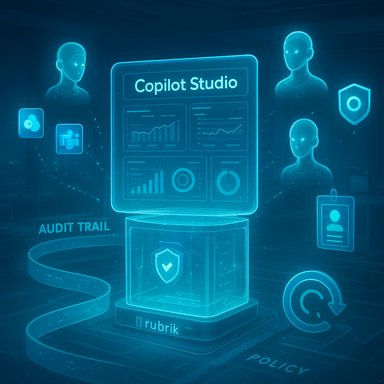
Rubrik announced in November 2025 a pair of Microsoft-focused capabilities that extend its data-protection and cyber-resilience portfolio into agentic AI operations and into deeper Microsoft 365 and DevOps recovery workflows. The two headline items are:- Rubrik Agent Cloud integrated with Microsoft Copilot Studio — a single-pane control plane to discover, monitor, govern, and remediate AI agents that operate across Microsoft 365, Azure, and related services.
- Rubrik Intelligent Business Recovery for Microsoft 365 and Rubrik DevOps Protection for Azure DevOps and GitHub — coordinated recovery orchestration aimed at restoring business-critical users, workflows, and development assets fast after cyber incidents or major outages.
This is an explicitly resilience-first approach to agentic AI adoption: instead of only detecting and alerting on agent errors or malicious activity, Rubrik aims to make agent actions auditable and reversible while tying remediation to immutable backups and identity-aware telemetry.
Why this matters now
AI agents — automated software that can plan, call tools, and write back into enterprise systems — are moving rapidly from isolated pilots into business workflows. Microsoft’s Copilot Studio gives organizations a low-code/full-code environment to build and publish agents that can read tenant data and perform write operations across Microsoft 365, Dataverse, SharePoint, OneDrive, Teams and downstream connectors.That capability creates enormous productivity upside but also introduces a new operational surface area:
- Agents can perform high-impact actions at machine speed.
- Agents are being issued directory-grade identities, which makes discovery possible but also turns identity compromise into system compromise.
- Traditional observability and backup tools were not designed for reversible, time-bounded rollbacks of automated agent actions.
Rubrik Agent Cloud: what it claims to deliver
Rubrik groups the Copilot Studio integration around three operational pillars — Agent Monitor, Agent Govern, and Agent Remediate — with each pillar targeting a specific gap in current AgentOps maturity.Agent Monitor — automated discovery and audit
Agent Monitor promises to:- Auto-discover agents authored in Microsoft Copilot Studio, as well as agents running in Azure and other clouds.
- Map agent identities and inventory them in a centralized registry so IT and security teams see who owns what.
- Continuously monitor agent activity by ingesting Azure-native logs and other telemetry, and maintain immutable audit trails that tie prompts, plan steps, tool calls, and data access to identity and application context.
Practical caveat: the depth of visibility depends on telemetry fidelity (what Microsoft surfaces via logs and APIs) and on how completely Rubrik can correlate tool calls, model reasoning steps, and downstream effects across heterogeneous connectors.
Agent Govern — runtime guardrails and behavior policies
Agent Govern bills itself as the real-time policy layer:- Track usage and evaluate behavior against expected prompt outcomes or SLAs.
- Enforce action & access policies in real-time — block or throttle destructive or out-of-bounds actions.
- Integrate with enterprise identity systems to apply lifecycle and least-privilege controls to agent identities.
Practical caveats:
- Real-time enforcement relies on Microsoft’s integration points and the latency of those hooks — some action types or connectors may not support immediate blocking.
- False positives and overly broad blocking rules can degrade agent utility; policy tuning will be essential.
Agent Remediate — selective rollback (Agent Rewind)
Agent Remediate is the headline differentiator: the ability to undo agent-driven changes selectively and rapidly.- Agent Rewind (announced earlier in 2025) ties into Rubrik’s immutable backups and aims to perform time- and blast-radius-limited rollbacks for files, records, configs, and other artifacts affected by an agent.
- Rubrik positions this as surgical recovery: revert only the undesired changes while preserving legitimate updates and keeping systems online.
What to watch for (realism check):
- Selective rollback across connected systems (e.g., SharePoint site edits, Teams messages, Dataverse records, and downstream integrations) is complex. Ensuring referential integrity, consistency, and application-level correctness after partial rewinds is non-trivial.
- Performance and scale limits — how quickly can rollbacks execute across large tenant datasets? — will be a key determinant of operational utility.
- Vendor claims about being the “only” solution are positioning; independent validation of scale, edge cases, and cross-system consistency will be necessary before trusting automated rewinds in production.
Intelligent Business Recovery for Microsoft 365 — a business-first recovery model
Rubrik’s Intelligent Business Recovery aims to make recovery decisions business-aware rather than purely technical.Key capabilities described:
- Identify key users — admins can define critical roles (C-suite, department heads) whose access and data have recovery priority.
- Analyze critical workflows — automated scanning of protected M365 assets (recent emails, files, SharePoint sites, Teams chats, OneDrive) to surface the most critical data required by key users to operate.
- Automate Minimal Viable Business (MVB) recovery — restore a minimal dataset and user subset that constitutes a “viable company” so essential functions resume fast while full recovery continues.
Operational considerations:
- The accuracy of the scan and how Rubrik defines the MVB set are critical. Erroneous omission of key artifacts will hamper operations; overly broad MVB sets reintroduce long restore times.
- Organizations must predefine critical user lists and workflows and exercise MVB recovery in regular tabletop and live tests to make it reliable.
Rubrik DevOps Protection — closing the software/IP recovery gap
DevOps environments are an increasingly attractive target — not only for theft but for destructive attacks or flawed AI-driven commits that can corrupt CI/CD pipelines.Rubrik’s DevOps Protection promises:
- Automated, unified protection for Azure DevOps and GitHub repositories and pipelines, governed by policy-driven SLAs.
- Air-gapped, immutable backups of repos/pipelines in a logically separate, natively immutable format to make backups invisible and indelible to attackers.
- Rapid, granular recovery for flexible restores of individual repositories or commits to recover from ransomware or flawed agent commits.
- Enterprise-grade security features such as Retention Lock, Quorum Authorization, and Role-Based Access Control.
Why this is useful: code and pipeline state are mission-critical assets — losing them or trusting noisy native version history is insufficient for high-stakes environments.
Implementation notes:
- Immutable, air-gapped snapshots are a solid resilience pattern — but integration with code review, CI/CD signing, and pipeline integrity checks will be needed for end-to-end assurance.
- Restore granularity matters: developers demand the ability to mount or check out specific branch states or commits quickly without breaking pipeline metadata and build caches.
Strengths — what Rubrik brings to the table
- Recovery-first pedigree: Rubrik’s core competency in immutable backups and recovery gives credibility to claims about surgical rollback and fast restores.
- Identity-aware correlation: Tying agent actions to Entra Agent IDs and tenant telemetry makes auditability feasible in ways prior toolchains couldn’t match.
- Unified control plane for AgentOps: Centralized discovery, policy enforcement, and recovery reduce the operational friction of managing agent fleets across builders and clouds.
- Business-aware recovery workflows: The MVB concept directly addresses the need to keep critical business functions alive during extended recoveries.
- Extending protection to DevOps: Protecting code, pipelines, and repos addresses a blind spot in many backup/DR plans.
Risks, caveats, and open questions
- Vendor positioning vs. independent validation: Phrases claiming market uniqueness or “industry-first” advantages are marketing language until proven in independent tests and large-scale customer pilots.
- Telemetry completeness & enforcement latency: The ability to discover, monitor, and block agent actions depends on what Microsoft exposes (logs, hooks, APIs) and their latency/coverage — some actions may not be immediately interceptable.
- Rollback complexity across interdependent systems: Selectively reverting changes while preserving cross-system consistency (e.g., file edits referenced by database records or pipeline artifacts) will be challenging and will require careful testing.
- Operational overhead & policy tuning: Guardrails can generate false positives; security and product teams will need to tune rules and maintain exception workflows.
- Legal & compliance implications of rewinds: For regulated industries, reversible operations may affect audit trails and records retention; organizations must define preservation vs. revert rules per compliance requirements.
- Cost and storage implications: Immutable, air-gapped backups and frequent snapshots increase storage and retention costs — budgeting and SLA planning are essential.
Practical guidance for Windows, M365, and security teams
To operationalize Rubrik’s offerings safely and get realistic value, teams should treat these capabilities as part of a broader AgentOps and resilience program:- Establish an AgentOps playbook
- Define ownership, approval gates, and lifecycle controls for agents before wide rollout.
- Catalog agent types, risk levels, and business impact.
- Start with limited pilots and staged rollouts
- Use non-production tenants and simulated incidents to validate discovery, governance, and rewind behavior.
- Measure detection-to-remediation latency and the time required to perform selective rollbacks.
- Define and test Minimal Viable Business (MVB) plans
- Predefine the “viable company” user sets and critical datasets.
- Run scheduled MVB recovery drills and validate business continuity.
- Harden identity and access management
- Apply strict least-privilege and conditional access to agent identities (Entra Agent IDs).
- Implement lifecycle rules: periodic access reviews, automated revocation for retired agents.
- Integrate with incident response and change control
- Plug Agent Monitor logs and immutable audit trails into the SIEM and IR playbooks.
- Ensure rollback operations require appropriate approvals and are audited.
- Validate cross-system consistency post-rollback
- Test that reverting agent changes does not create data corruption or orphaned references.
- Incorporate automated post-rollback verification checks.
- Protect development pipelines as part of disaster planning
- Configure DevOps Protection to snapshot repo states and pipeline metadata frequently.
- Train developers and platform engineers to use restore workflows and to validate integrity before redeploys.
- Review retention and legal holds
- Ensure retention lock and retention policies meet compliance requirements.
- Coordinate retention rules with legal and compliance teams before enabling automated rewinds.
Technical caveats administrators must verify during evaluation
- Confirm which Microsoft telemetry sources are ingested (Copilot Studio logs, Azure Activity Logs, Graph change logs) and whether there are gaps for specific connector types.
- Measure latency between an agent action and its appearance in Rubrik’s immutable audit trail — this affects forensic timelines and the feasibility of near-immediate rollback.
- Verify the scope of rollback for each artifact type (files, SharePoint lists, Dataverse tables, Teams messages, repo commits) and test for consistency.
- Understand the dependency graph Rubrik uses to determine blast radius — how it models relationships across artifacts and connectors.
- Determine the retention and storage model for air-gapped/immutable backups and evaluate long-term cost impact.
Vendor claims that should be treated cautiously
- Any statement that a product is the “industry’s only” solution for a capability should be treated as marketing until validated by independent testing and broad customer evidence.
- Performance claims (e.g., speed of selective rewind at scale) must be validated with benchmarks and real tenant recovery tests, especially for large Microsoft 365 tenants with heavy collaboration artifacts.
- Assurances about “no downtime” during rewinds require careful operational proof — for some systems, partial rewinds may still necessitate short locks or degraded functionality.
What this means for WindowsForum readers and IT decision makers
Rubrik’s integration with Microsoft Copilot Studio is an important step toward operationalizing AgentOps at enterprise scale. For organizations that plan to use AI agents in production, the combination of automated discovery, runtime guardrails, and contextual, immutable recovery addresses gaps that many security and operations teams have been warning about since agent deployments began to proliferate.However, the headline capabilities will be meaningful only if they prove robust in real tenant scenarios. That requires:
- careful pilot programs,
- rigorous testing of rewind operations,
- tight identity and policy controls,
- and harmonization of recovery plans with compliance and legal requirements.
Conclusion — a resilience-first posture for an agent-driven world
The shift from observability-only tools to recovery-first AgentOps reflects a maturing market reality: automated agents can do as much harm as they can good, and response strategies must move beyond detection to fast, precise recovery. Rubrik’s announcements place recovery and immutable protection at the center of agent governance and broaden the company’s protection scope into developer ecosystems as well.For administrators and security leaders, the sensible path is incremental: pilot the Agent Cloud integration for low-risk agent classes, exercise MVB recoveries until they become reliable, harden agent identities and policies, and validate DevOps protection with staged restores. If selective rollback lives up to its promise under scale and across Microsoft 365 and DevOps artifacts, it will change how organizations prepare for and recover from agent-induced incidents — but until then, rigorous validation and careful operational planning will be the difference between controlled resilience and unexpected chaos.
Source: Channel Insider Rubrik Debuts New Capabilities With Microsoft
