

Nonprofit health providers in Appalachia and artificial intelligence developers in Silicon Valley are pursuing sharply different responses in 2026 to a rural mental health crisis marked by severe clinician shortages, expanding telehealth demand, and growing public reliance on general-purpose chatbots for emotional support. The collision is not really between “human care” and “technology.” It is between systems built around accountability and platforms built around scale. Rural America needs more reach, but reach without responsibility is not care.
The numbers are stark because they describe absence more than demand. Rural communities have far fewer mental health providers per resident than urban ones, and Kentucky offers a grimly useful case study: millions of residents live in areas officially short of mental health professionals. That shortage is not a temporary scheduling problem; it is the operating condition of care.
In practical terms, the crisis arrives as a waiting list, a long drive, a missed appointment because the car broke down, or a child whose anxiety becomes a school crisis before a counselor can see them. Rural mental health is often discussed as if the main challenge is stigma, and stigma remains real. But stigma is easier to overcome than geography, workforce economics, broadband gaps, and the simple fact that a provider cannot see a patient from a county away if there is no appointment slot to offer.
That is why organizations such as the Christian Appalachian Project matter. CAP’s model is not glamorous, and it does not promise disruption. It provides counseling in person and through telehealth while connecting behavioral health to the material conditions that often intensify it: housing instability, hunger, disaster recovery, family stress, and poverty.
This is the part the technology industry tends to flatten. Mental health support is not just the transfer of soothing language from one party to another. It is triage, relationship, local knowledge, legal duty, escalation, documentation, and a web of services that can make therapy possible in the first place.
The organization’s broader approach is important. Families seeking counseling may also need food assistance, home repairs, help after flooding, or support navigating basic services. A model that separates mental health from these pressures risks treating symptoms while ignoring the machinery that keeps producing them.
This is not sentimentalism. It is operational realism. A parent facing eviction may not benefit from a mindfulness exercise if the next crisis is a utility shutoff. A child recovering from disaster trauma may need counseling, but the family may also need transportation, school coordination, and material stabilization.
Telehealth helps, but it does not magically erase rural scarcity. A video session still requires a clinician, privacy, bandwidth, trust, and time. For people living in crowded homes or unstable housing, “just go online” can be a shallow prescription. CAP’s hybrid model understands that digital access is a tool, not a substitute for a care system.
That convenience is powerful. It is also dangerous to mistake convenience for competence. General-purpose AI systems are optimized to generate plausible, context-sensitive responses, not to carry clinical responsibility for a vulnerable person. Their fluency can create the feeling of being understood even when the underlying system has no durable understanding of the user, no duty of care in the clinical sense, and no local capacity to intervene.
This is where Microsoft’s role becomes relevant to WindowsForum readers. Copilot is no longer a side experiment bolted onto Bing or Office; it is part of the Windows and Microsoft 365 experience for many users and organizations. As AI assistants become ambient, the boundary between productivity tool, search interface, personal adviser, and quasi-counselor becomes harder for ordinary users to see.
For IT administrators, this is not merely a cultural issue. It is a governance issue. If employees, students, patients, or public-sector staff use enterprise AI tools for sensitive mental health conversations, organizations need policies that address privacy, retention, escalation, and acceptable use. The chatbot may look like a friendly box on a screen, but the data and duty questions behind it are institutional.
AI-assisted coding has already changed software development. Models can generate, review, and refactor code at a scale that would have seemed fanciful a few years ago. That does not mean the machines are autonomous engineers in the science-fiction sense, but it does mean the feedback loop is tightening: AI helps build better AI systems, which then help build more software, faster.
For mental health use cases, speed is not an unalloyed virtue. A model that becomes more persuasive, more agentic, and more deeply integrated into everyday computing may be more useful in ordinary moments and more hazardous in edge cases. The industry’s favorite metric is capability. Health care’s necessary metric is safety under stress.
This is the mismatch. Rural mental health systems move slowly because they are constrained by people, funding, licensure, geography, and trust. AI platforms move quickly because scale rewards speed. The former can fail by not reaching enough people; the latter can fail by reaching everyone without being prepared for what they bring.
Used carefully, AI could make scarce providers more effective. It could help a small rural clinic manage intake forms, summarize patient histories, identify appointment gaps, or maintain follow-up reminders. It could help patients understand what services exist before they meet a clinician. It could help community organizations triage nonurgent needs without drowning staff in paperwork.
But those uses are different from outsourcing emotional crisis response to a general-purpose model. The difference is accountability. In a clinical or nonprofit setting, there is a responsible organization, a defined workflow, and a human escalation path. In consumer AI, the user is often alone with a system whose limitations are disclosed somewhere in policy language but obscured by the intimacy of conversation.
The market will blur that distinction because users already have. People do not wait for a vendor to certify a product as therapeutic before using it therapeutically. They type what hurts into whatever text box is open. That is the reality platform companies must design for, not the narrower reality their disclaimers prefer.
Rural health care has seen versions of this story before. Telehealth was supposed to dissolve distance, and in many cases it helped. But telehealth did not create clinicians out of thin air, did not fix broadband inequity, did not resolve reimbursement headaches, and did not make every home a safe place for a confidential session. It extended care where the rest of the system could support it.
AI will follow the same pattern. Where there are trained professionals, governance, community partnerships, and funding, AI may become a useful amplifier. Where those are absent, it risks becoming a pressure valve that lets policymakers and companies avoid the harder work of building capacity.
That harder work is not mysterious. Rural communities need recruitment pipelines, loan repayment programs, reimbursement models that sustain behavioral health, integrated primary care, school-based services, addiction treatment access, crisis response capacity, and broadband that actually works. Technology can support these aims, but it cannot substitute for them.
That creates a challenge for schools, hospitals, nonprofits, local governments, and businesses in rural regions. These organizations may adopt AI to improve productivity while discovering that employees or clients use it for sensitive emotional support. Blocking every use may be unrealistic. Ignoring the behavior is worse.
Administrators should treat AI assistants as part of the organization’s risk surface. That means understanding what data is logged, which tenant controls exist, how prompts are handled, whether sensitive categories are restricted, and what guidance employees receive. It also means deciding what the organization will do when users disclose crisis content in systems not designed as clinical channels.
The worst policy is silence. If a county agency, school district, or health nonprofit deploys AI tools without explaining boundaries, users will infer them from the product’s tone. A warm assistant can feel like a safe confidant. IT policy has to make clear when it is not.
AI companies face a difficult incentive problem. The more human their systems feel, the more users will rely on them emotionally. The more those companies warn users that the systems are not human and not clinicians, the more they puncture the experience that makes the products sticky. This is not a minor product-design tension; it is the heart of the business model.
For rural users, the danger is sharper. A person who can access a therapist tomorrow may treat a chatbot as a stopgap. A person who cannot access a therapist for months may treat it as the system. The same product can have very different risk profiles depending on the availability of human care around it.
That is why rural mental health should be a test of AI humility. If the industry is serious about helping, it should prioritize partnerships with accountable providers, transparent safety evaluation, crisis routing, privacy protections, and tools that reduce clinician burden. It should resist the fantasy that scale alone is the same thing as access.
This does not mean rural communities should reject technology. On the contrary, they often need better technology more urgently than affluent urban systems do. But the technology has to enter through local workflows rather than floating above them. The best rural mental health tools will look less like replacement therapists and more like connective tissue.
A useful system might help a counselor coordinate with a food pantry, remind a family about an appointment, summarize a session for a supervised clinician, or identify when a client also needs housing support. A harmful system might keep a distressed person engaged in an endless private conversation while no one nearby knows help is needed. The difference is not whether AI is involved. The difference is whether the AI is embedded in a care network.
This is where nonprofit providers have an advantage the tech firms cannot easily buy. They have trust. Trust is slow, local, and relational. It does not scale like software, but in mental health it may be the most important infrastructure of all.
The AI industry risks recreating the same diffusion of responsibility at platform scale. A model responds, a user feels heard, a company points to disclaimers, a policymaker points to innovation, and the local provider still does not exist. That may be a profitable arrangement, but it is not a care system.
The more constructive path is narrower and more demanding. AI should be evaluated not by how convincingly it can simulate empathy, but by how reliably it supports accountable care. It should be deployed where it strengthens human networks, not where it allows society to tolerate their absence.
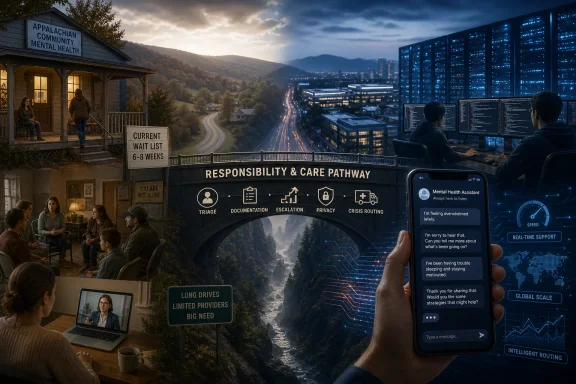 The Rural Mental Health Gap Is a Systems Failure, Not a Discovery Problem
The numbers are stark because they describe absence more than demand. Rural communities have far fewer mental health providers per resident than urban ones, and Kentucky offers a grimly useful case study: millions of residents live in areas officially short of mental health professionals. That shortage is not a temporary scheduling problem; it is the operating condition of care.In practical terms, the crisis arrives as a waiting list, a long drive, a missed appointment because the car broke down, or a child whose anxiety becomes a school crisis before a counselor can see them. Rural mental health is often discussed as if the main challenge is stigma, and stigma remains real. But stigma is easier to overcome than geography, workforce economics, broadband gaps, and the simple fact that a provider cannot see a patient from a county away if there is no appointment slot to offer.
That is why organizations such as the Christian Appalachian Project matter. CAP’s model is not glamorous, and it does not promise disruption. It provides counseling in person and through telehealth while connecting behavioral health to the material conditions that often intensify it: housing instability, hunger, disaster recovery, family stress, and poverty.
This is the part the technology industry tends to flatten. Mental health support is not just the transfer of soothing language from one party to another. It is triage, relationship, local knowledge, legal duty, escalation, documentation, and a web of services that can make therapy possible in the first place.
CAP’s Quiet Advantage Is That It Treats Distress as Lived Reality
CAP’s reported 3,306 counseling services last year are modest when measured against the scale of Kentucky’s shortage. They are also exactly the kind of metric that matters because each session represents real service delivery rather than speculative capacity. In a rural county, a few thousand counseling contacts can mean the difference between an abstract “access problem” and a functioning care pathway.The organization’s broader approach is important. Families seeking counseling may also need food assistance, home repairs, help after flooding, or support navigating basic services. A model that separates mental health from these pressures risks treating symptoms while ignoring the machinery that keeps producing them.
This is not sentimentalism. It is operational realism. A parent facing eviction may not benefit from a mindfulness exercise if the next crisis is a utility shutoff. A child recovering from disaster trauma may need counseling, but the family may also need transportation, school coordination, and material stabilization.
Telehealth helps, but it does not magically erase rural scarcity. A video session still requires a clinician, privacy, bandwidth, trust, and time. For people living in crowded homes or unstable housing, “just go online” can be a shallow prescription. CAP’s hybrid model understands that digital access is a tool, not a substitute for a care system.
AI Arrives Because the System Leaves a Vacuum
The rise of ChatGPT, Gemini, Copilot, Claude, and other AI assistants as informal mental health companions should surprise no one. When a professional is unavailable, expensive, distant, or intimidating, a chatbot that responds instantly at midnight becomes attractive. The machine does not have a waiting room, does not judge a user’s accent, and does not require insurance paperwork before answering.That convenience is powerful. It is also dangerous to mistake convenience for competence. General-purpose AI systems are optimized to generate plausible, context-sensitive responses, not to carry clinical responsibility for a vulnerable person. Their fluency can create the feeling of being understood even when the underlying system has no durable understanding of the user, no duty of care in the clinical sense, and no local capacity to intervene.
This is where Microsoft’s role becomes relevant to WindowsForum readers. Copilot is no longer a side experiment bolted onto Bing or Office; it is part of the Windows and Microsoft 365 experience for many users and organizations. As AI assistants become ambient, the boundary between productivity tool, search interface, personal adviser, and quasi-counselor becomes harder for ordinary users to see.
For IT administrators, this is not merely a cultural issue. It is a governance issue. If employees, students, patients, or public-sector staff use enterprise AI tools for sensitive mental health conversations, organizations need policies that address privacy, retention, escalation, and acceptable use. The chatbot may look like a friendly box on a screen, but the data and duty questions behind it are institutional.
“AI-Builds-AI” Raises the Stakes at the Worst Possible Time
The most jarring contrast in the current moment is that nonprofit providers are trying to stretch scarce human services while frontier AI companies are racing toward systems that can help build their successors. Anthropic’s warnings about recursive self-improvement and AI-assisted development are not directly about rural mental health. But they expose the industry’s central contradiction: the companies building tools people may use in moments of despair are themselves unsure how quickly those tools are becoming more capable and harder to govern.AI-assisted coding has already changed software development. Models can generate, review, and refactor code at a scale that would have seemed fanciful a few years ago. That does not mean the machines are autonomous engineers in the science-fiction sense, but it does mean the feedback loop is tightening: AI helps build better AI systems, which then help build more software, faster.
For mental health use cases, speed is not an unalloyed virtue. A model that becomes more persuasive, more agentic, and more deeply integrated into everyday computing may be more useful in ordinary moments and more hazardous in edge cases. The industry’s favorite metric is capability. Health care’s necessary metric is safety under stress.
This is the mismatch. Rural mental health systems move slowly because they are constrained by people, funding, licensure, geography, and trust. AI platforms move quickly because scale rewards speed. The former can fail by not reaching enough people; the latter can fail by reaching everyone without being prepared for what they bring.
Chatbots Can Support Care, But They Cannot Replace the Chain of Responsibility
There is a reasonable version of AI in rural mental health. It is not a chatbot pretending to be a therapist for millions of isolated users. It is software that reduces administrative burden, helps route patients to services, supports clinicians with documentation, flags risks under strict oversight, translates information into plain language, and improves access to evidence-based resources.Used carefully, AI could make scarce providers more effective. It could help a small rural clinic manage intake forms, summarize patient histories, identify appointment gaps, or maintain follow-up reminders. It could help patients understand what services exist before they meet a clinician. It could help community organizations triage nonurgent needs without drowning staff in paperwork.
But those uses are different from outsourcing emotional crisis response to a general-purpose model. The difference is accountability. In a clinical or nonprofit setting, there is a responsible organization, a defined workflow, and a human escalation path. In consumer AI, the user is often alone with a system whose limitations are disclosed somewhere in policy language but obscured by the intimacy of conversation.
The market will blur that distinction because users already have. People do not wait for a vendor to certify a product as therapeutic before using it therapeutically. They type what hurts into whatever text box is open. That is the reality platform companies must design for, not the narrower reality their disclaimers prefer.
Rural America Does Not Need a Digital Savior
The temptation to frame AI as the answer to rural mental health shortages is strong because the shortage is so severe. If there are not enough providers, and AI can talk to everyone, the spreadsheet seems to solve itself. That logic is clean, scalable, and wrong.Rural health care has seen versions of this story before. Telehealth was supposed to dissolve distance, and in many cases it helped. But telehealth did not create clinicians out of thin air, did not fix broadband inequity, did not resolve reimbursement headaches, and did not make every home a safe place for a confidential session. It extended care where the rest of the system could support it.
AI will follow the same pattern. Where there are trained professionals, governance, community partnerships, and funding, AI may become a useful amplifier. Where those are absent, it risks becoming a pressure valve that lets policymakers and companies avoid the harder work of building capacity.
That harder work is not mysterious. Rural communities need recruitment pipelines, loan repayment programs, reimbursement models that sustain behavioral health, integrated primary care, school-based services, addiction treatment access, crisis response capacity, and broadband that actually works. Technology can support these aims, but it cannot substitute for them.
The Windows and Enterprise Angle Is Governance Before Deployment
For Windows users, the mental health chatbot debate may feel distant until Copilot appears in the workflow. The operating system is becoming a front door to AI-mediated action: summarizing documents, drafting messages, searching files, querying organizational knowledge, and increasingly acting across applications. Once a tool is embedded in the workday, users will bring human problems to it.That creates a challenge for schools, hospitals, nonprofits, local governments, and businesses in rural regions. These organizations may adopt AI to improve productivity while discovering that employees or clients use it for sensitive emotional support. Blocking every use may be unrealistic. Ignoring the behavior is worse.
Administrators should treat AI assistants as part of the organization’s risk surface. That means understanding what data is logged, which tenant controls exist, how prompts are handled, whether sensitive categories are restricted, and what guidance employees receive. It also means deciding what the organization will do when users disclose crisis content in systems not designed as clinical channels.
The worst policy is silence. If a county agency, school district, or health nonprofit deploys AI tools without explaining boundaries, users will infer them from the product’s tone. A warm assistant can feel like a safe confidant. IT policy has to make clear when it is not.
The Market Wants Scale, But Care Requires Friction
Silicon Valley often treats friction as the enemy. Health care is full of friction, some of it maddening and wasteful, some of it protective. Licensure is friction. Documentation is friction. Mandatory reporting is friction. Clinical supervision is friction. In mental health, not every delay is defensible, but not every guardrail is bureaucracy.AI companies face a difficult incentive problem. The more human their systems feel, the more users will rely on them emotionally. The more those companies warn users that the systems are not human and not clinicians, the more they puncture the experience that makes the products sticky. This is not a minor product-design tension; it is the heart of the business model.
For rural users, the danger is sharper. A person who can access a therapist tomorrow may treat a chatbot as a stopgap. A person who cannot access a therapist for months may treat it as the system. The same product can have very different risk profiles depending on the availability of human care around it.
That is why rural mental health should be a test of AI humility. If the industry is serious about helping, it should prioritize partnerships with accountable providers, transparent safety evaluation, crisis routing, privacy protections, and tools that reduce clinician burden. It should resist the fantasy that scale alone is the same thing as access.
The Appalachian Lesson Is That Context Is Infrastructure
CAP’s work points to a broader truth: context is not a soft add-on to care. It is infrastructure. A counselor who understands local poverty, disaster recovery, church networks, schools, roads, and family systems has information no general chatbot can infer reliably from a prompt.This does not mean rural communities should reject technology. On the contrary, they often need better technology more urgently than affluent urban systems do. But the technology has to enter through local workflows rather than floating above them. The best rural mental health tools will look less like replacement therapists and more like connective tissue.
A useful system might help a counselor coordinate with a food pantry, remind a family about an appointment, summarize a session for a supervised clinician, or identify when a client also needs housing support. A harmful system might keep a distressed person engaged in an endless private conversation while no one nearby knows help is needed. The difference is not whether AI is involved. The difference is whether the AI is embedded in a care network.
This is where nonprofit providers have an advantage the tech firms cannot easily buy. They have trust. Trust is slow, local, and relational. It does not scale like software, but in mental health it may be the most important infrastructure of all.
The Hard Lesson From the Rural Crisis Belongs in Every AI Roadmap
The concrete lesson from this collision is not that AI is bad or that nonprofits are enough. It is that mental health access fails when responsibility is diffused. Rural America has lived with that failure for years: too few providers, too little funding, too much distance, and too many people left to improvise.The AI industry risks recreating the same diffusion of responsibility at platform scale. A model responds, a user feels heard, a company points to disclaimers, a policymaker points to innovation, and the local provider still does not exist. That may be a profitable arrangement, but it is not a care system.
The more constructive path is narrower and more demanding. AI should be evaluated not by how convincingly it can simulate empathy, but by how reliably it supports accountable care. It should be deployed where it strengthens human networks, not where it allows society to tolerate their absence.
The Real Test Is Whether the Tools Reach the People Without Replacing the People
The rural mental health crisis does not leave room for purism. Communities need more clinicians, more telehealth, better funding, smarter software, and more flexible service models. The question is whether each new tool deepens the care system or merely decorates the hole where the care system should be.- Rural mental health shortages are primarily capacity and infrastructure problems, not simply awareness problems.
- Nonprofit models such as CAP’s show why counseling often has to be paired with housing, food, disaster recovery, and family support.
- General-purpose AI assistants are already being used for emotional support because they are immediate, cheap, and always available.
- AI can help rural care when it reduces administrative burden, improves routing, and supports clinicians inside accountable workflows.
- AI becomes risky when users treat it as a substitute for professional help in communities where professional help is already scarce.
- Windows, Copilot, and enterprise AI deployments make mental-health-adjacent use an IT governance issue, not just a consumer technology story.
References
- Primary source: harianbasis.co
Published: 2026-06-13T10:50:18.879309
Providers and AI Developers Battle Growing Rural Mental Health Crisis
Appalachian communities face severe mental health provider shortages while technology companies build advanced artificial intelligence systems for therapy.www.harianbasis.co - Related coverage: ruralhealth.us
About Rural Health Care | National Rural Health Association - NRHA - NRHA
The National Rural Health Association recognizes that the obstacles faced by health care providers and patients in rural areas are vastly different than those in urban areas. Economic factors, cultural and social differences, educational shortcomings, lack of recognition by legislators and the...www.ruralhealth.us - Related coverage: namiky.org
New Report Shows Remarkable Lack Of Access To Mental Health Care - NAMI Kentucky
From nami.orgnamiky.org - Related coverage: ruralhealthinfo.org
Rural Mental Health Overview - Rural Health Information Hub
Information, resources and frequently asked questions on rural mental health services and issues. Details the state of mental health, suicide prevention, and access to mental health services in rural areas.www.ruralhealthinfo.org
- Related coverage: aha.org
Rural Behavioral Health | AHA
The AHA supports its members as they strive to provide high quality, accessible behavioral health services in America’s rural communities.www.aha.org - Related coverage: mhstats.org
Rural Mental Health Statistics 2026 | Mental Health Stats
Comprehensive mental health statistics for rural in 2026. Find prevalence rates, treatment data, and condition breakdowns. mhstats.org
- Related coverage: mhanational.org
Rural Mental Health Crisis | Mental Health America
 mhanational.org
- Related coverage: christianapp.org

Family Life Counseling Program meets… | Christian Appalachian Project
CAP builds hope, transforms lives, and shares Christ's love through service in the 13 Appalachian states and two Ozark states, Arkansas and Missouri.
www.christianapp.org
- Related coverage: nga.org
Governors’ Policy Actions on Behavioral Health Access - National Governors Association
(Download) Behavioral health workforce shortages remain a significant barrier to accessing care in rural areas across the United States. According to the Health Resources and Services Administration’s (HRSA) State of the Behavioral Health Workforce, (2025) substantial shortages are projected for... www.nga.org
- Related coverage: pafp.com
- Related coverage: indianaruralhealth.org
- Official source: openai.com
An update on our mental health-related work | OpenAI
OpenAI shares updates on its mental health safety work, including parental controls, trusted contacts, improved distress detection, and recent litigation developments.openai.com - Related coverage: windowscentral.com
OpenAI's staggering mental health crisis revealed — Millions use ChatGPT like a therapist, but that's about to change | Windows Central
GPT-5's tendency to give bad advice to those going through a mental health crisis has (hopefully) been reduced.www.windowscentral.com
