

Samsung’s 2026 The Frame lineup, announced April 2, gives both The Frame and The Frame Pro upgraded Glare Free panels and up to seven years of One UI Tizen OS updates, while reserving Micro HDMI eARC and the sharper Pro value argument for buyers with serious audio or PC-gaming plans. If you want the art-TV look, better reflection control, and longer software runway, the standard The Frame is the money-saving default. If your wall-mounted TV is also a gaming display or a soundbar-centered entertainment hub, The Frame Pro is where Samsung is asking you to pay the premium.
The easiest mistake with Samsung’s 2026 The Frame refresh is to treat The Frame Pro as the automatically “correct” model because it has the stronger name. That is how TV lineups are marketed, but not always how they should be bought. This year, the most important upgrades are not locked exclusively behind the Pro badge.
Both The Frame and The Frame Pro get Samsung’s upgraded Glare Free technology for 2026. Both sit on the One UI Tizen OS track that Samsung says supports up to seven years of OS updates. Both are being sold as part of the same art-TV proposition: a screen meant to disappear into a room rather than dominate it like a black rectangle.
That makes the buying decision unusually concrete. The standard 55-inch The Frame starts at $1,199.99, while the 55-inch The Frame Pro starts at $1,499.99. At that size, the Pro premium is $300, and the question is not whether Pro sounds better on a spec sheet. The question is whether you will actually use what Pro uniquely adds.
For most buyers, the answer may be no. For a very specific group — PC gamers chasing the highest supported frame-rate mode, wall-mount obsessives building around external audio, and buyers who want the Pro’s connection strategy — the answer may be yes. Samsung has built a lineup where the cheapest model is not necessarily the compromised one.
Anti-glare technology is not glamorous in the way refresh rates are glamorous. It does not produce a clean marketing number that makes a forum thread explode. But for a TV pretending to be framed art, glare is the enemy. Reflections break the illusion faster than almost anything else.
That is why Samsung’s decision to bring upgraded Glare Free technology to both models is the pivot point of the 2026 lineup. It means the standard Frame is not merely a cheaper entry point into an older aesthetic. It gets the core visual improvement that makes the product make sense in the first place.
The standard model also gets a practical installation change: built-in connections and back stoppers for easier cable management. That matters because The Frame is often purchased by people who care about the wall as much as the screen. A TV that requires constant awkward cable gymnastics undercuts the whole “picture frame” premise.
For renters, apartment dwellers, and buyers who do not want to turn a TV installation into a weekend renovation project, the standard Frame’s simpler connection story may be more appealing than it first appears. Samsung is not positioning this as the flashiest upgrade, but it is exactly the kind of thing that can determine whether a product remains delightful after the unboxing glow fades.
For the buyer who streams shows from built-in apps, watches sports, and occasionally plugs in a console, eARC may not justify the Pro premium by itself. Many living rooms never expose the limits of their audio chain because the TV is not being used as the hub of a carefully matched system. In those rooms, the money may be better spent on a better soundbar, installation, or simply kept in the bank.
For the buyer who does care, eARC is not decorative. It affects how cleanly the TV can participate in a modern audio chain. If The Frame is going on the wall and the soundbar is the real speaker system, the Pro model’s eARC support becomes less about bragging rights and more about avoiding friction.
This is where the Pro model makes sense as a system purchase rather than a screen purchase. You are not just buying a nicer Frame. You are buying the version that is more likely to fit a higher-end living-room stack without forcing compromises around audio routing.
WindowsForum readers will recognize the pattern from PCs: the right port can matter more than the prettier chassis. A laptop without the port you need is not “almost as good” if it forces dongles, adapters, and workarounds every day. A wall-mounted TV can create the same kind of annoyance, only with more drywall involved.
That makes it a gaming feature, but not a universal gaming feature. If your gaming life is mostly a console under the TV, the 240Hz language should not drive the purchase. The feature is aimed at people who intend to connect a capable PC and care enough about frame rate to accept trade-offs.
This is where the spec-sheet race becomes a little misleading. A number like 240Hz sounds like an across-the-board upgrade, but Samsung’s own framing narrows the audience. It is not simply “The Frame is now a 240Hz TV” in the way a casual shopper might interpret it. It is a PC-focused mode with requirements and compromises.
That does not make it unimportant. For a certain enthusiast, it is exactly the sort of feature that makes The Frame more plausible as a hybrid display. A wall-mounted art TV that can also serve a high-refresh PC setup is more interesting than previous lifestyle-TV stereotypes allowed.
But it should not be confused with the main reason to buy The Frame. If you are buying this product because it looks good in a living room, the upgraded Glare Free treatment and long software support are the universal upgrades. DLG 240Hz is a specialized bonus, and specialized bonuses should not be allowed to hijack a budget.
A longer OS update runway does not guarantee that every app will remain perfect for seven years, nor does it mean the TV will feel new forever. But it does make the purchase feel less disposable. In an era when televisions are increasingly software products with panels attached, update policy belongs in the buying conversation.
This is especially relevant for WindowsForum’s audience because the TV is no longer isolated from the rest of the home network. Smart TVs run accounts, apps, voice features, content recommendations, gaming portals, and sometimes AI services. A longer update commitment is not just a nicety; it is part of the risk profile of owning a connected device.
The critical detail is that Samsung is not making the seven-year OS update point a Pro-only feature in the supplied announcement. Both The Frame and The Frame Pro are on that 2026 One UI Tizen OS footing. That again strengthens the standard model’s value case.
For families, offices, waiting rooms, and mixed-use spaces, this may be more important than peak refresh-rate claims. A TV that remains supported longer is easier to justify as an infrastructure purchase. The more a screen functions like a household endpoint, the more its update policy matters.
The Pro argument is strongest when the buyer can name the reason before walking into the store. “I need eARC for my soundbar setup” is a reason. “I plan to connect a compatible PC and actually use the high-frame-rate mode” is a reason. “I want the Pro because it is Pro” is marketing doing its job a little too well.
That distinction is not anti-Pro. It is pro-buyer. Samsung has created a meaningful split, but not the old-fashioned kind where the cheaper model is denied the upgrades that ordinary people most want. The standard Frame gets the anti-glare improvement and the software runway. Those are not crumbs.
The pricing also matters because The Frame is often not bought alone. The aesthetic ecosystem can include bezels, wall mounting, audio, and art services. A buyer focused only on the panel price may undercount the true cost of making the room look like the advertisement.
That is why the standard model may be the smarter total-package purchase for many homes. If the saved money helps complete the installation cleanly, the cheaper TV may produce the better end result. A beautiful screen with sloppy cabling is not a better design choice than a slightly less expensive screen installed properly.
That changes how buyers should think about connections. Ports are not just ports when the screen is flush-mounted. Every future device, audio upgrade, or cable swap becomes more annoying if the installation is tight, clean, and difficult to access.
Samsung’s standard Frame update — built-in connections plus back stoppers to make cable access easier without removing the TV from the wall — speaks directly to that problem. It is an unromantic improvement, but it may be one of the most practical changes in the lineup. A TV that looks like art still has to behave like hardware.
The Pro’s Micro HDMI eARC support, meanwhile, is about a different kind of installation discipline. If you know the TV will sit at the center of a soundbar-based setup, that audio path can be worth paying for up front. The mistake is discovering the need after the TV is mounted, the cables are hidden, and the return window is already a memory.
This is where enthusiasts and IT pros should approach The Frame like they would a conference-room display or a home-lab rack: map the connections before buying. What sources will feed the TV? Where will audio live? Will a PC ever be connected? Will the room’s layout make cable access painful? The right answer depends less on the model name than on the wiring plan.
That shift should make buyers more demanding, not less. When a TV becomes a software endpoint, it inherits software expectations. Updates, account requirements, app availability, and network behavior become part of ownership.
For Windows enthusiasts, that means the living-room TV deserves the same skepticism as any other connected device. A seven-year OS update promise is welcome, but it does not remove the need to think about privacy settings, account dependencies, app longevity, and whether the TV’s smart features are actually preferable to an external streaming box.
The Frame’s art-TV identity makes this even more interesting. Many buyers will leave it connected and active in ways they might not with a conventional screen. A display that rotates artwork, streams content, supports apps, and participates in a smart-home ecosystem is not passive décor.
That does not make the product suspicious. It makes it modern. But the more modern a TV becomes, the less useful it is to judge it only by brightness, refresh rate, and port count. Samsung’s seven-year update language belongs near the top of the decision tree because it acknowledges that software has become part of the product’s lifespan.
The upgraded Glare Free technology is the most obvious everyday reason to consider the 2026 lineup. If your current Frame sits opposite windows or bright fixtures and often fails at the “art” illusion, that is a real complaint. A feature that improves how the TV behaves in its actual room can matter more than a dozen abstract spec bumps.
The software support story is the slower-burn reason. If you tend to keep TVs for many years, the seven-year OS update commitment may influence when you buy. It is less exciting than unboxing a new panel, but it addresses one of the quiet frustrations of smart-TV ownership.
The Pro-specific reasons remain narrower. If you have been waiting for eARC in the Pro connection path, that is a concrete trigger. If you are a PC gamer building a living-room setup and understand the DLG 240Hz caveats, that may also move the needle.
Everyone else can wait for price movement, reviews, and real-world impressions. Samsung’s announcement gives enough information to sort buyer types, but not enough to answer every picture-quality, latency, or installation nuance. The smart move is to match the model to the pain point rather than chase the newest badge.
That is why The Frame Pro’s 240Hz and eARC story should not be isolated from Samsung’s broader premium-TV posture. The company is trying to make lifestyle TVs credible to people who previously dismissed them as décor-first compromises. A Frame that can talk to serious audio gear and accept a high-frame-rate PC signal is a different proposition than a pretty screen for ambient art.
But the standard Frame’s strength is just as important. If the non-Pro model gets the upgraded Glare Free treatment and the same stated OS update runway, Samsung is also acknowledging that not every premium buyer is an enthusiast gamer. Some people simply want the TV to look less like a TV and age less badly as a smart platform.
That split is strategically useful. Samsung can court PC-connected performance buyers with Pro language while keeping the mainstream art-TV promise intact at a lower starting price. The risk is confusion: shoppers may hear “240Hz,” “eARC,” “Glare Free,” and “seven years” as a pile of equivalent upgrades, when only some apply equally to the way they will use the TV.
The sharper read is that Samsung has made The Frame easier to recommend but harder to buy lazily. The standard model is better than a stripped-down lifestyle TV should be. The Pro model is more interesting than its design-first category suggests. The right choice is no longer obvious from the name.
In a home theater-lite room built around a soundbar, The Frame Pro becomes more plausible. Micro HDMI eARC support is the kind of feature that matters most when the TV is not just a screen, but the routing point for audio. If clean wall mounting and better sound are both priorities, the Pro’s price gap may be easier to defend.
In a PC-gaming room masquerading as a living room, both models’ gaming claims deserve close reading. Samsung’s DLG 240Hz language is tied to compatible PC use and comes with a resolution trade-off. That means the feature is potentially valuable, but only for buyers who know they will connect the right PC hardware and accept the compromise.
The office and conference-room angle is more subtle. The Frame’s design can make sense in spaces where a display must be present without looking like a command center. In those settings, the seven-year OS update promise and cable-access improvements may matter more than gaming features.
The retail and hospitality angle follows the same logic. A display that doubles as décor benefits from glare reduction, long support, and manageable installation. Pro-level audio and PC-focused refresh modes may be irrelevant unless the deployment specifically needs them.
Real-world reviews still matter. Glare Free technology can be described in a press release, but its value depends on the room, viewing angle, lighting, and whether the anti-reflection treatment affects perceived contrast or texture in ways users notice. Buyers who are sensitive to image processing and panel behavior should wait for hands-on testing.
The same is true for gaming. Samsung’s language around DLG 240Hz is careful, and the resolution reduction should prevent anyone from treating it as a free performance upgrade. Input behavior, visual quality, and title-by-title usefulness are the kinds of things that need testing, not assumption.
Audio setups also need practical confirmation. eARC support is important, but compatibility chains can still involve soundbar behavior, cable choices, device settings, and firmware. The Pro model has the right headline for higher-end audio, but buyers should still verify how their specific soundbar and sources will connect.
This is not a knock on Samsung. It is a reminder that lifestyle TVs are still TVs. The prettier the product, the easier it is to under-interrogate the hardware.
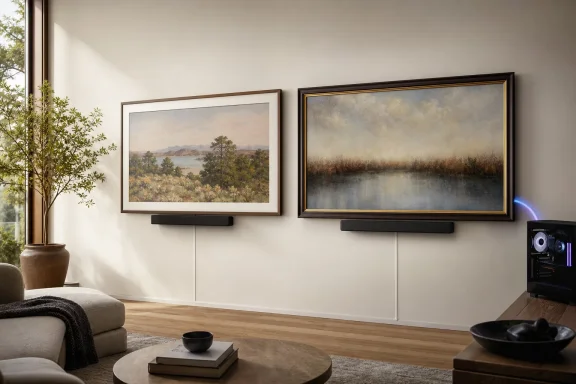 Samsung’s 2026 Frame Choice Is Really About Use Case, Not Prestige
The easiest mistake with Samsung’s 2026 The Frame refresh is to treat The Frame Pro as the automatically “correct” model because it has the stronger name. That is how TV lineups are marketed, but not always how they should be bought. This year, the most important upgrades are not locked exclusively behind the Pro badge.Both The Frame and The Frame Pro get Samsung’s upgraded Glare Free technology for 2026. Both sit on the One UI Tizen OS track that Samsung says supports up to seven years of OS updates. Both are being sold as part of the same art-TV proposition: a screen meant to disappear into a room rather than dominate it like a black rectangle.
That makes the buying decision unusually concrete. The standard 55-inch The Frame starts at $1,199.99, while the 55-inch The Frame Pro starts at $1,499.99. At that size, the Pro premium is $300, and the question is not whether Pro sounds better on a spec sheet. The question is whether you will actually use what Pro uniquely adds.
For most buyers, the answer may be no. For a very specific group — PC gamers chasing the highest supported frame-rate mode, wall-mount obsessives building around external audio, and buyers who want the Pro’s connection strategy — the answer may be yes. Samsung has built a lineup where the cheapest model is not necessarily the compromised one.
The Standard Frame Is the Sensible Buy for the Art-TV Majority
The standard 2026 The Frame is the model most people should evaluate first, not last. It receives the headline living-room upgrade that matters to the art-TV pitch: the upgraded Glare Free panel treatment. If the purpose of buying The Frame is to make digital artwork look more believable in a bright room, that is the feature that changes daily experience.Anti-glare technology is not glamorous in the way refresh rates are glamorous. It does not produce a clean marketing number that makes a forum thread explode. But for a TV pretending to be framed art, glare is the enemy. Reflections break the illusion faster than almost anything else.
That is why Samsung’s decision to bring upgraded Glare Free technology to both models is the pivot point of the 2026 lineup. It means the standard Frame is not merely a cheaper entry point into an older aesthetic. It gets the core visual improvement that makes the product make sense in the first place.
The standard model also gets a practical installation change: built-in connections and back stoppers for easier cable management. That matters because The Frame is often purchased by people who care about the wall as much as the screen. A TV that requires constant awkward cable gymnastics undercuts the whole “picture frame” premise.
For renters, apartment dwellers, and buyers who do not want to turn a TV installation into a weekend renovation project, the standard Frame’s simpler connection story may be more appealing than it first appears. Samsung is not positioning this as the flashiest upgrade, but it is exactly the kind of thing that can determine whether a product remains delightful after the unboxing glow fades.
The Frame Pro Earns Its Name Only When Audio and PC Gaming Matter
The Frame Pro’s most concrete differentiator in Samsung’s announcement is Micro HDMI eARC support. That is not a casual-TV feature. It matters when the TV is part of a more deliberate audio setup, especially one built around a soundbar and higher-quality audio return from the display.For the buyer who streams shows from built-in apps, watches sports, and occasionally plugs in a console, eARC may not justify the Pro premium by itself. Many living rooms never expose the limits of their audio chain because the TV is not being used as the hub of a carefully matched system. In those rooms, the money may be better spent on a better soundbar, installation, or simply kept in the bank.
For the buyer who does care, eARC is not decorative. It affects how cleanly the TV can participate in a modern audio chain. If The Frame is going on the wall and the soundbar is the real speaker system, the Pro model’s eARC support becomes less about bragging rights and more about avoiding friction.
This is where the Pro model makes sense as a system purchase rather than a screen purchase. You are not just buying a nicer Frame. You are buying the version that is more likely to fit a higher-end living-room stack without forcing compromises around audio routing.
WindowsForum readers will recognize the pattern from PCs: the right port can matter more than the prettier chassis. A laptop without the port you need is not “almost as good” if it forces dongles, adapters, and workarounds every day. A wall-mounted TV can create the same kind of annoyance, only with more drywall involved.
The 240Hz Headline Belongs to PC Gamers, Not Everyone With a Console
The other feature that deserves careful translation is Samsung’s DLG 240Hz support. Samsung says both 2026 Frame models support Motion Xcelerator 144Hz and that the new DLG 240Hz mode can reach higher frame rates when connected to a compatible PC. The fine print matters: this is a PC-connected feature, and Samsung says DLG 240Hz reduces image resolution, with results varying by title and system configuration.That makes it a gaming feature, but not a universal gaming feature. If your gaming life is mostly a console under the TV, the 240Hz language should not drive the purchase. The feature is aimed at people who intend to connect a capable PC and care enough about frame rate to accept trade-offs.
This is where the spec-sheet race becomes a little misleading. A number like 240Hz sounds like an across-the-board upgrade, but Samsung’s own framing narrows the audience. It is not simply “The Frame is now a 240Hz TV” in the way a casual shopper might interpret it. It is a PC-focused mode with requirements and compromises.
That does not make it unimportant. For a certain enthusiast, it is exactly the sort of feature that makes The Frame more plausible as a hybrid display. A wall-mounted art TV that can also serve a high-refresh PC setup is more interesting than previous lifestyle-TV stereotypes allowed.
But it should not be confused with the main reason to buy The Frame. If you are buying this product because it looks good in a living room, the upgraded Glare Free treatment and long software support are the universal upgrades. DLG 240Hz is a specialized bonus, and specialized bonuses should not be allowed to hijack a budget.
Seven Years of OS Updates Changes the Ownership Math
Samsung’s promise that One UI Tizen OS on the 2026 Frame models supports up to seven years of OS updates is one of the most important parts of the announcement, even though it is less photogenic than a new panel coating. Smart TVs age strangely. The display can remain perfectly usable while apps, services, interfaces, and platform support become the weak link.A longer OS update runway does not guarantee that every app will remain perfect for seven years, nor does it mean the TV will feel new forever. But it does make the purchase feel less disposable. In an era when televisions are increasingly software products with panels attached, update policy belongs in the buying conversation.
This is especially relevant for WindowsForum’s audience because the TV is no longer isolated from the rest of the home network. Smart TVs run accounts, apps, voice features, content recommendations, gaming portals, and sometimes AI services. A longer update commitment is not just a nicety; it is part of the risk profile of owning a connected device.
The critical detail is that Samsung is not making the seven-year OS update point a Pro-only feature in the supplied announcement. Both The Frame and The Frame Pro are on that 2026 One UI Tizen OS footing. That again strengthens the standard model’s value case.
For families, offices, waiting rooms, and mixed-use spaces, this may be more important than peak refresh-rate claims. A TV that remains supported longer is easier to justify as an infrastructure purchase. The more a screen functions like a household endpoint, the more its update policy matters.
The $300 Gap at 55 Inches Is Small Enough to Tempt, Large Enough to Question
At 55 inches, Samsung’s published starting prices put The Frame at $1,199.99 and The Frame Pro at $1,499.99. That $300 difference is not enormous in premium-TV terms, but it is large enough to deserve a real decision. It can buy part of a soundbar, contribute to installation, cover a bezel option, or simply keep the standard model closer to the point of the product: design without overbuying.The Pro argument is strongest when the buyer can name the reason before walking into the store. “I need eARC for my soundbar setup” is a reason. “I plan to connect a compatible PC and actually use the high-frame-rate mode” is a reason. “I want the Pro because it is Pro” is marketing doing its job a little too well.
That distinction is not anti-Pro. It is pro-buyer. Samsung has created a meaningful split, but not the old-fashioned kind where the cheaper model is denied the upgrades that ordinary people most want. The standard Frame gets the anti-glare improvement and the software runway. Those are not crumbs.
The pricing also matters because The Frame is often not bought alone. The aesthetic ecosystem can include bezels, wall mounting, audio, and art services. A buyer focused only on the panel price may undercount the true cost of making the room look like the advertisement.
That is why the standard model may be the smarter total-package purchase for many homes. If the saved money helps complete the installation cleanly, the cheaper TV may produce the better end result. A beautiful screen with sloppy cabling is not a better design choice than a slightly less expensive screen installed properly.
Wall-Mounted TVs Turn Ports Into Long-Term Decisions
The Frame lineup is not a normal TV purchase because installation is part of the product identity. A conventional TV can sit on a stand, expose its ports, and tolerate a little cable clutter. The Frame is asking to be judged as an object on a wall.That changes how buyers should think about connections. Ports are not just ports when the screen is flush-mounted. Every future device, audio upgrade, or cable swap becomes more annoying if the installation is tight, clean, and difficult to access.
Samsung’s standard Frame update — built-in connections plus back stoppers to make cable access easier without removing the TV from the wall — speaks directly to that problem. It is an unromantic improvement, but it may be one of the most practical changes in the lineup. A TV that looks like art still has to behave like hardware.
The Pro’s Micro HDMI eARC support, meanwhile, is about a different kind of installation discipline. If you know the TV will sit at the center of a soundbar-based setup, that audio path can be worth paying for up front. The mistake is discovering the need after the TV is mounted, the cables are hidden, and the return window is already a memory.
This is where enthusiasts and IT pros should approach The Frame like they would a conference-room display or a home-lab rack: map the connections before buying. What sources will feed the TV? Where will audio live? Will a PC ever be connected? Will the room’s layout make cable access painful? The right answer depends less on the model name than on the wiring plan.
Samsung’s Lifestyle TV Is Becoming a Software Endpoint
The 2026 Frame refresh also shows how much the TV category has changed. Samsung is not just selling a panel and a frame. It is selling a platform: art services, smart apps, gaming features, AI-branded functions, and a long-term OS commitment.That shift should make buyers more demanding, not less. When a TV becomes a software endpoint, it inherits software expectations. Updates, account requirements, app availability, and network behavior become part of ownership.
For Windows enthusiasts, that means the living-room TV deserves the same skepticism as any other connected device. A seven-year OS update promise is welcome, but it does not remove the need to think about privacy settings, account dependencies, app longevity, and whether the TV’s smart features are actually preferable to an external streaming box.
The Frame’s art-TV identity makes this even more interesting. Many buyers will leave it connected and active in ways they might not with a conventional screen. A display that rotates artwork, streams content, supports apps, and participates in a smart-home ecosystem is not passive décor.
That does not make the product suspicious. It makes it modern. But the more modern a TV becomes, the less useful it is to judge it only by brightness, refresh rate, and port count. Samsung’s seven-year update language belongs near the top of the decision tree because it acknowledges that software has become part of the product’s lifespan.
Existing Frame Owners Should Upgrade Only for Specific Pain Points
Owners of older Frame models should be careful not to mistake a clean 2026 announcement for an automatic upgrade mandate. The clearest reasons to move are practical: glare bothers you, your installation needs a cleaner cable-management approach, you want the longer OS update runway, or your audio and PC-gaming plans line up with the new Pro features.The upgraded Glare Free technology is the most obvious everyday reason to consider the 2026 lineup. If your current Frame sits opposite windows or bright fixtures and often fails at the “art” illusion, that is a real complaint. A feature that improves how the TV behaves in its actual room can matter more than a dozen abstract spec bumps.
The software support story is the slower-burn reason. If you tend to keep TVs for many years, the seven-year OS update commitment may influence when you buy. It is less exciting than unboxing a new panel, but it addresses one of the quiet frustrations of smart-TV ownership.
The Pro-specific reasons remain narrower. If you have been waiting for eARC in the Pro connection path, that is a concrete trigger. If you are a PC gamer building a living-room setup and understand the DLG 240Hz caveats, that may also move the needle.
Everyone else can wait for price movement, reviews, and real-world impressions. Samsung’s announcement gives enough information to sort buyer types, but not enough to answer every picture-quality, latency, or installation nuance. The smart move is to match the model to the pain point rather than chase the newest badge.
The WindowsForum Read on Samsung’s 2026 TV Strategy
WindowsForum users are already discussing Samsung’s 2026 TV push as more than a routine refresh, and The Frame sits neatly inside that larger story. Samsung is pushing design-first TVs, gaming features, AI-branded software, and longer update commitments into the same conversation. The company is making televisions behave more like durable computing platforms, even when they are dressed as wall art.That is why The Frame Pro’s 240Hz and eARC story should not be isolated from Samsung’s broader premium-TV posture. The company is trying to make lifestyle TVs credible to people who previously dismissed them as décor-first compromises. A Frame that can talk to serious audio gear and accept a high-frame-rate PC signal is a different proposition than a pretty screen for ambient art.
But the standard Frame’s strength is just as important. If the non-Pro model gets the upgraded Glare Free treatment and the same stated OS update runway, Samsung is also acknowledging that not every premium buyer is an enthusiast gamer. Some people simply want the TV to look less like a TV and age less badly as a smart platform.
That split is strategically useful. Samsung can court PC-connected performance buyers with Pro language while keeping the mainstream art-TV promise intact at a lower starting price. The risk is confusion: shoppers may hear “240Hz,” “eARC,” “Glare Free,” and “seven years” as a pile of equivalent upgrades, when only some apply equally to the way they will use the TV.
The sharper read is that Samsung has made The Frame easier to recommend but harder to buy lazily. The standard model is better than a stripped-down lifestyle TV should be. The Pro model is more interesting than its design-first category suggests. The right choice is no longer obvious from the name.
The Buying Call Comes Down to Three Rooms
Think about the room before thinking about the spec sheet. In a design-first living room where the TV spends much of its life displaying art or streaming ordinary content, the standard 2026 The Frame is the default recommendation. It gets the upgraded glare handling and the long OS update promise without forcing the Pro premium.In a home theater-lite room built around a soundbar, The Frame Pro becomes more plausible. Micro HDMI eARC support is the kind of feature that matters most when the TV is not just a screen, but the routing point for audio. If clean wall mounting and better sound are both priorities, the Pro’s price gap may be easier to defend.
In a PC-gaming room masquerading as a living room, both models’ gaming claims deserve close reading. Samsung’s DLG 240Hz language is tied to compatible PC use and comes with a resolution trade-off. That means the feature is potentially valuable, but only for buyers who know they will connect the right PC hardware and accept the compromise.
The office and conference-room angle is more subtle. The Frame’s design can make sense in spaces where a display must be present without looking like a command center. In those settings, the seven-year OS update promise and cable-access improvements may matter more than gaming features.
The retail and hospitality angle follows the same logic. A display that doubles as décor benefits from glare reduction, long support, and manageable installation. Pro-level audio and PC-focused refresh modes may be irrelevant unless the deployment specifically needs them.
The Specs Samsung Did Not Emphasize Are the Ones Buyers Should Ask About Later
The verified announcement provides the spine of the decision, but it does not answer every reasonable buying question. Samsung’s own details establish pricing, rollout timing, Glare Free availability, Micro HDMI eARC support on Pro, built-in connections and back stoppers on the standard Frame, DLG 240Hz caveats, and up to seven years of OS updates. That is enough to separate likely buyers, but not enough to settle every enthusiast debate.Real-world reviews still matter. Glare Free technology can be described in a press release, but its value depends on the room, viewing angle, lighting, and whether the anti-reflection treatment affects perceived contrast or texture in ways users notice. Buyers who are sensitive to image processing and panel behavior should wait for hands-on testing.
The same is true for gaming. Samsung’s language around DLG 240Hz is careful, and the resolution reduction should prevent anyone from treating it as a free performance upgrade. Input behavior, visual quality, and title-by-title usefulness are the kinds of things that need testing, not assumption.
Audio setups also need practical confirmation. eARC support is important, but compatibility chains can still involve soundbar behavior, cable choices, device settings, and firmware. The Pro model has the right headline for higher-end audio, but buyers should still verify how their specific soundbar and sources will connect.
This is not a knock on Samsung. It is a reminder that lifestyle TVs are still TVs. The prettier the product, the easier it is to under-interrogate the hardware.
The Sensible 2026 Frame Purchase Is the One That Refuses to Overbuy
The 2026 Frame lineup is best understood as a set of buyer paths, not a ladder where everyone should climb as high as possible. The standard model carries more of the important upgrade load than the Pro branding might suggest, while the Pro model justifies itself only when its specific strengths line up with the room.- Buy the standard 2026 The Frame if you mainly want the art-TV design, upgraded Glare Free technology, and the stated seven-year One UI Tizen OS update runway at the lowest 55-inch starting price.
- Buy The Frame Pro if Micro HDMI eARC support matters to your soundbar or audio setup and you want to design the room around that cleaner connection path.
- Treat DLG 240Hz as a PC-gaming feature with caveats, not as a universal reason for every console or streaming buyer to pay more.
- Do not ignore installation, because The Frame’s wall-mounted identity makes cable access, port planning, and audio routing part of the purchase.
- Existing Frame owners should upgrade for a clear pain point such as glare, software longevity, cable management, eARC, or PC-focused high-refresh gaming rather than for the 2026 label alone.
References
- Primary source: news.samsung.com
Samsung Elevates 2026 The Frame Lineup with Broader Customization and Advanced Glare Free Technology
The Frame simplifies set-up with built-in connections and easy port access; Glare Free technology enhances realism, minimizes distractionnews.samsung.com - Independent coverage: samsung.com
2026 The Frame Pro (189cm) | KQ75LSH03WFXKR | Samsung 대한민국
2026 The Frame Pro (189cm) 제품의 특장점을 확인해 보세요. 모던 프레임 디자인, 아트 모드, 눈부심 걱정 없는 Neo QLED를 경험해보세요.www.samsung.com
- Independent coverage: image-us.samsung.com
- Primary source: WindowsForum
Samsung 2026 The Frame Upgrade: 240Hz, Glare Free, eARC, 7 Years
Samsung’s 2026 refresh of The Frame and The Frame Pro is a sharper move than it first appears. On paper, the headline additions are easy to summarize: DLG 240Hz support, an upgraded anti-glare coating, a new 55-inch Frame Pro, and seven years of OS updates for both models. In practice, those... windowsforum.com
