

Samsung’s 2026 TV strategy is no longer just about sharper panels or brighter backlights. It is about turning the television into an AI companion that can answer questions, guide discovery, and adapt audio and picture settings in real time, across everything from flagship Micro RGB models to more affordable mini LED sets. That shift matters because Samsung is not treating AI as a premium add-on; it is trying to make Vision AI Companion the common software layer across its entire lineup, effectively redefining what a TV is supposed to do. The move also raises the stakes for competitors, because the battle is now as much about interface, services and ecosystem control as it is about panel technology.
For years, the television industry has been stuck in a familiar loop. Every new cycle brings better contrast, higher brightness, more local dimming zones and another acronym to explain incremental gains, but the basic experience has remained stubbornly unchanged. Consumers still navigate channels and apps through menus built for a remote-control era, even as streaming, gaming and connected home use have made the TV one of the most important screens in the house.
Samsung has been pushing against that stagnation for some time. The company first introduced its broader Vision AI concept at CES 2025, positioning AI as a layer that could improve picture quality, audio processing, content discovery and device connectivity. By IFA 2025, that idea had matured into Vision AI Companion, which Samsung described as a more natural, conversational experience that unifies its most advanced AI features and adds support from third-party AI services such as Microsoft Copilot and Perplexity. Samsung also tied the platform to a seven-year software support promise through One UI Tizen, signaling that its TV strategy is increasingly a software lifecycle story rather than a one-time hardware sale.
The 2026 rollout is important because it extends that strategy into a much wider product range. Samsung is no longer talking only about premium showcase TVs in giant living rooms. It is applying the same AI identity across Neo QLED, OLED, mini LED, UHD, lifestyle models like The Frame, and even portable or audio products. That is a crucial distinction. A platform becomes meaningful only when it reaches beyond the halo product and starts shaping the mainstream.
Samsung’s hardware roadmap reinforces the same message. The company launched Micro RGB in 2025 as a new ultra-premium category and then expanded the lineup to 2026 sizes from 55 inches to 115 inches, while also unveiling a 130-inch class model at CES 2026. The company is clearly using size, design and AI together as a single value proposition. In other words, Samsung wants buyers to think less about whether they are buying a TV and more about which screen personality best fits their home.
What makes this particularly notable is that Samsung is borrowing a lesson from smartphones. The smartphone industry stopped being only about displays and radios years ago; it became about ecosystems, assistants, app stores and services. Samsung appears to be aiming for the same transition on the largest screen in the home. That is ambitious, and it is also risky, because televisions are slower to replace, harder to upsell, and far more likely to be used by multiple family members with different expectations. But if any company can try to rewrite TV behavior at scale, it is Samsung, which has spent two decades near the top of the global TV market and continues to use that position as leverage for platform change.
The more important shift is that Samsung wants this interaction to happen without forcing the user into a single AI stack. The company has emphasized support for Bixby, Perplexity and Microsoft Copilot in the same ecosystem, which suggests a deliberate strategy of optionality rather than lock-in. In practical terms, that gives Samsung a way to meet users where they already are, whether they prefer device-native voice control or a more generative AI assistant style.
That may sound small, but in consumer electronics, fewer steps often means higher engagement. If viewers can ask about a soundtrack, an actor, a sports stat or a location without leaving the couch or reaching for a phone, the TV becomes the center of attention again. That is exactly the kind of “sticky” behavior platform companies want, because it increases time spent inside their ecosystem and makes competitor apps less relevant.
Samsung’s language around “AI everyday companion” is also telling. The company is not framing the TV as a productivity device in the same way a laptop or tablet would be. Instead, it is positioning the set as a social and entertainment-aware assistant that lives in the background of daily life. That framing is smart because it aligns with how most households actually use a TV: not as a tool, but as a shared room experience.
That is why the company’s 2026 lineup emphasizes a shared AI experience across price points. The move is especially important in the midrange and entry-level segments, because those are the products that determine market share at scale. If Samsung can make AI feel consistent across a wide range of sets, it reduces the traditional gap between premium innovation and mass adoption.
That analogy also helps explain Samsung’s screen segmentation strategy. Just as phones come in different sizes and designs for different lifestyles, Samsung is diversifying TVs into more specialized shapes and uses. It is less a single-product business than a catalog of different screen identities. The consequence is that the TV starts to behave like a personal computing category, only shared by the family. That is a subtle but profound shift.
Samsung’s platform ambition is also defensive. As streaming interfaces, smart home devices and search assistants all become more capable, the TV risks being reduced to a dumb endpoint. By owning the AI layer, Samsung ensures that the home screen remains relevant and that the company maintains leverage over services, content, and user behavior. That is the real prize.
That matters because Samsung is no longer presenting giant TVs as novelty items for the wealthy. It is building a tiered ladder of premium sizes and placing AI functionality on top of all of them. In market terms, that is smart. Size creates aspiration, while AI creates everyday usefulness. Together, they create a stronger reason to upgrade than either one alone.
But the broader strategic value lies in trickle-down effect. Features like AI picture processing, real-time scene analysis and improved color management can be marketed at the top of the lineup before migrating downward into more affordable sets. That gives Samsung a way to amortize its AI investment across the product stack while still preserving prestige at the high end.
The risk, of course, is that premium TV innovation can become disconnected from real-world household needs. At 115 or 130 inches, you are not solving the average living room problem. You are building a brand beacon. Samsung seems comfortable with that distinction, because a beacon can still move the rest of the portfolio.
That new interaction model could improve content discovery in a major way. Viewers routinely lose interest when the next step requires too much effort. AI search shortens the path from curiosity to action. It also gives Samsung a chance to influence which apps, services and recommendations get surfaced first, which has obvious implications for the company’s content and platform partners.
This is where the TV starts to resemble a search engine front end. Samsung is not trying to win with brute-force app count alone. It is trying to become the layer that translates vague intent into useful results. That is an old Silicon Valley strategy, but it is relatively new in the TV market. And it could be powerful if the execution is clean.
The complication is trust. Contextual AI has to be accurate enough to feel magical but not so eager that it becomes annoying or incorrect. A TV that guesses badly about a scene, a song or a location will not feel intelligent for long. Samsung will have to prove that the feature is genuinely helpful, not just a demo-friendly gimmick.
In sports viewing, AI can detect motion and adjust color and clarity to keep fast action legible. For audio, Samsung says its sound system can separate dialogue, music and effects in real time, making it easier to raise commentary or suppress crowd noise. Those are practical use cases, not marketing fluff. They solve real pain points for people who watch live sports, older content or noisy action programming.
This also gives Samsung a way to broaden the appeal of AI beyond the novelty crowd. A user may not care about generative prompts or assistant apps, but they do care if the football game is clearer or if dialogue is easier to hear. In that sense, AI processing is the bridge between technical sophistication and everyday usefulness.
There is still a challenge, though. Automated processing can overcorrect. Too much sharpening, too much color boost or over-aggressive audio separation can make content feel artificial. Samsung will need to balance automation with user control, because the most satisfying smart TV is still one that lets people override the machine when necessary.
The move is especially interesting in homes where the TV is not permanently centered in one dedicated media room. Portable and repositionable screens appeal to users who want flexibility, while ultra-slim wall-mounted designs appeal to those who care about aesthetics as much as image quality. Samsung seems determined to make the TV less of an appliance and more of an object that participates in interior design.
That is a subtle but effective branding strategy. Samsung is not only saying the TV can do more; it is saying the TV can belong more naturally in the home. That emotional fit matters, especially in premium segments where design is part of the purchase decision. In 2026, the TV is not just larger or smarter. It is trying to be more domestic.
That ecosystem ambition is important because TV hardware margins are notoriously under pressure. Services, content discovery and audio accessories offer more ways to increase lifetime value per customer. Samsung’s logic is simple: if the TV becomes the hub, then adjacent products and services become easier to sell.
This ecosystem approach is strategically sound because it lowers dependence on outside platform gatekeepers. If a user spends more time inside Samsung-owned content surfaces, the company captures more data, more engagement and more opportunities to upsell. It also increases the likelihood that software updates remain relevant to the consumer after purchase, which is one reason long-term support has become such a valuable differentiator.
For enterprises and commercial display customers, the implications are more indirect but still meaningful. Samsung’s AI TV strategy helps strengthen the company’s broader display narrative: that screens are becoming intelligent surfaces capable of adapting to context. Even if the consumer product line is the headline, the same design language can influence signage, hospitality displays and other connected screen categories over time.
This could accelerate a broader industry move toward AI assistants embedded directly in TVs. That is good for consumers in the short term, because it creates more innovation and more choice. But it also raises the possibility of fragmentation, with each brand building its own AI vocabulary, app partnerships and service logic. The result could be more intelligent TVs — and more confusing ones.
Samsung’s advantage is scale. Its install base gives it a head start in software iteration and data-driven optimization. Its challenge is consistency. If the experience is not intuitive across regions, price tiers and model years, the platform story loses credibility.
It will also be important to watch how Samsung balances openness and control. Supporting multiple AI services is strategically clever, but it can also create complexity in the user experience. The best version of Vision AI Companion will likely be the one that feels flexible without feeling fragmented, powerful without feeling intrusive, and smart without demanding too much from the household.
Source: 디지털투데이 Samsung to reshape TV viewing with Vision AI Companion platform
 Background
For years, the television industry has been stuck in a familiar loop. Every new cycle brings better contrast, higher brightness, more local dimming zones and another acronym to explain incremental gains, but the basic experience has remained stubbornly unchanged. Consumers still navigate channels and apps through menus built for a remote-control era, even as streaming, gaming and connected home use have made the TV one of the most important screens in the house.Samsung has been pushing against that stagnation for some time. The company first introduced its broader Vision AI concept at CES 2025, positioning AI as a layer that could improve picture quality, audio processing, content discovery and device connectivity. By IFA 2025, that idea had matured into Vision AI Companion, which Samsung described as a more natural, conversational experience that unifies its most advanced AI features and adds support from third-party AI services such as Microsoft Copilot and Perplexity. Samsung also tied the platform to a seven-year software support promise through One UI Tizen, signaling that its TV strategy is increasingly a software lifecycle story rather than a one-time hardware sale.
The 2026 rollout is important because it extends that strategy into a much wider product range. Samsung is no longer talking only about premium showcase TVs in giant living rooms. It is applying the same AI identity across Neo QLED, OLED, mini LED, UHD, lifestyle models like The Frame, and even portable or audio products. That is a crucial distinction. A platform becomes meaningful only when it reaches beyond the halo product and starts shaping the mainstream.
Samsung’s hardware roadmap reinforces the same message. The company launched Micro RGB in 2025 as a new ultra-premium category and then expanded the lineup to 2026 sizes from 55 inches to 115 inches, while also unveiling a 130-inch class model at CES 2026. The company is clearly using size, design and AI together as a single value proposition. In other words, Samsung wants buyers to think less about whether they are buying a TV and more about which screen personality best fits their home.
What makes this particularly notable is that Samsung is borrowing a lesson from smartphones. The smartphone industry stopped being only about displays and radios years ago; it became about ecosystems, assistants, app stores and services. Samsung appears to be aiming for the same transition on the largest screen in the home. That is ambitious, and it is also risky, because televisions are slower to replace, harder to upsell, and far more likely to be used by multiple family members with different expectations. But if any company can try to rewrite TV behavior at scale, it is Samsung, which has spent two decades near the top of the global TV market and continues to use that position as leverage for platform change.
The Vision AI Companion Strategy
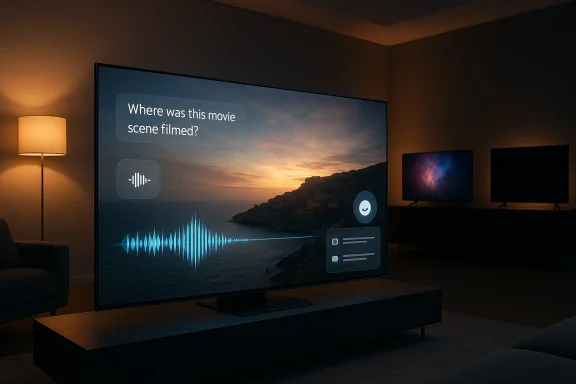
At the center of Samsung’s 2026 pitch is Vision AI Companion, a platform that tries to make the TV feel more like a conversational device than a passive panel. The example Samsung highlights is simple but revealing: ask where a movie scene was filmed, and the TV analyzes what is on screen and returns context immediately. That is a meaningful change from the old model, where the user had to leave the TV experience, open a search box somewhere else, and manually type a query.The more important shift is that Samsung wants this interaction to happen without forcing the user into a single AI stack. The company has emphasized support for Bixby, Perplexity and Microsoft Copilot in the same ecosystem, which suggests a deliberate strategy of optionality rather than lock-in. In practical terms, that gives Samsung a way to meet users where they already are, whether they prefer device-native voice control or a more generative AI assistant style.
Why this matters for TV UX
The core problem Samsung is trying to solve is not just search. It is friction. Television interfaces have historically been optimized for browsing, not for intent. AI search turns the TV into something closer to a helper that can interpret context, surface metadata and reduce the number of steps between curiosity and answer.That may sound small, but in consumer electronics, fewer steps often means higher engagement. If viewers can ask about a soundtrack, an actor, a sports stat or a location without leaving the couch or reaching for a phone, the TV becomes the center of attention again. That is exactly the kind of “sticky” behavior platform companies want, because it increases time spent inside their ecosystem and makes competitor apps less relevant.
Samsung’s language around “AI everyday companion” is also telling. The company is not framing the TV as a productivity device in the same way a laptop or tablet would be. Instead, it is positioning the set as a social and entertainment-aware assistant that lives in the background of daily life. That framing is smart because it aligns with how most households actually use a TV: not as a tool, but as a shared room experience.
- It reduces dependence on mobile search for contextual questions.
- It makes TV discovery feel more natural and voice-first.
- It supports multiple AI preferences instead of one assistant.
- It creates room for Samsung to monetize services over time.
- It strengthens the TV’s role as a household hub rather than a display.
From Hardware Race to Platform Race
Samsung’s TV strategy now looks like a two-layered competition. One layer is still hardware, where Micro RGB, Neo QLED, OLED and mini LED all fight for attention through brightness, contrast and form factor. The other layer is software, where Vision AI Companion becomes the differentiator that can work across those product tiers. Samsung appears to believe the second layer will increasingly define purchasing decisions, even for buyers who cannot afford the most expensive models.That is why the company’s 2026 lineup emphasizes a shared AI experience across price points. The move is especially important in the midrange and entry-level segments, because those are the products that determine market share at scale. If Samsung can make AI feel consistent across a wide range of sets, it reduces the traditional gap between premium innovation and mass adoption.
The smartphone analogy
Samsung’s comparison to smartphones is not accidental. In the phone market, the experience users value is increasingly shaped by services and software behavior rather than raw specifications alone. Samsung is trying to bring that same logic to TV ownership, where the “best” model may no longer be only the one with the most zones or the largest panel, but the one that best understands the household.That analogy also helps explain Samsung’s screen segmentation strategy. Just as phones come in different sizes and designs for different lifestyles, Samsung is diversifying TVs into more specialized shapes and uses. It is less a single-product business than a catalog of different screen identities. The consequence is that the TV starts to behave like a personal computing category, only shared by the family. That is a subtle but profound shift.
Samsung’s platform ambition is also defensive. As streaming interfaces, smart home devices and search assistants all become more capable, the TV risks being reduced to a dumb endpoint. By owning the AI layer, Samsung ensures that the home screen remains relevant and that the company maintains leverage over services, content, and user behavior. That is the real prize.
- Hardware differentiation alone is becoming harder to sustain.
- AI software can extend value across multiple price tiers.
- Platform control helps Samsung defend against OS and app rivals.
- Unified experiences can make the lineup easier to market.
- Shared AI features can create upgrade paths between models.
Micro RGB and the Premium Signal
Samsung’s Micro RGB lineup is the clearest example of how the company blends hardware prestige with AI messaging. The technology uses individually controlled red, green and blue micro LEDs behind a large-format panel, and Samsung has described it as a new benchmark for color accuracy and contrast. By 2026, the company says the lineup spans 55-inch through 115-inch class models, with a 130-inch class version also unveiled in January.That matters because Samsung is no longer presenting giant TVs as novelty items for the wealthy. It is building a tiered ladder of premium sizes and placing AI functionality on top of all of them. In market terms, that is smart. Size creates aspiration, while AI creates everyday usefulness. Together, they create a stronger reason to upgrade than either one alone.
Why premium still drives the narrative
Premium TVs matter disproportionately because they shape public perception. Even if the majority of units sold are not in the ultra-premium range, flagship models establish what the brand represents. Samsung is clearly using Micro RGB as its design statement: ultra-large, ultra-precise and visibly expensive.But the broader strategic value lies in trickle-down effect. Features like AI picture processing, real-time scene analysis and improved color management can be marketed at the top of the lineup before migrating downward into more affordable sets. That gives Samsung a way to amortize its AI investment across the product stack while still preserving prestige at the high end.
The risk, of course, is that premium TV innovation can become disconnected from real-world household needs. At 115 or 130 inches, you are not solving the average living room problem. You are building a brand beacon. Samsung seems comfortable with that distinction, because a beacon can still move the rest of the portfolio.
- Micro RGB reinforces Samsung’s premium leadership story.
- Large-screen innovation gives the company a headline product.
- AI features help justify expensive hardware.
- High-end sets act as technology ambassadors for the rest of the lineup.
- Bigger screens support Samsung’s living-room ecosystem vision.
Voice Search, Context and Discovery
One of the most consequential changes in Samsung’s 2026 TV narrative is the emphasis on voice-based and context-aware search. This is not just about convenience. It is about changing what counts as a TV interaction in the first place. If a user can ask what is happening in a scene, what an object is, or where a location appears, then television becomes a form of interactive media rather than a fixed broadcast surface.That new interaction model could improve content discovery in a major way. Viewers routinely lose interest when the next step requires too much effort. AI search shortens the path from curiosity to action. It also gives Samsung a chance to influence which apps, services and recommendations get surfaced first, which has obvious implications for the company’s content and platform partners.
Discovery as a retention tool
The deeper strategic value of contextual search is that it keeps the user in Samsung’s ecosystem. A household that uses the TV to ask questions is more likely to stay within the Samsung interface rather than migrate to a phone, tablet or smart speaker. That creates more opportunities for the company to promote other services, from entertainment recommendations to smart-home interactions.This is where the TV starts to resemble a search engine front end. Samsung is not trying to win with brute-force app count alone. It is trying to become the layer that translates vague intent into useful results. That is an old Silicon Valley strategy, but it is relatively new in the TV market. And it could be powerful if the execution is clean.
The complication is trust. Contextual AI has to be accurate enough to feel magical but not so eager that it becomes annoying or incorrect. A TV that guesses badly about a scene, a song or a location will not feel intelligent for long. Samsung will have to prove that the feature is genuinely helpful, not just a demo-friendly gimmick.
- Voice search lowers the friction of content discovery.
- Contextual answers increase perceived intelligence.
- Better discovery can improve engagement and retention.
- Search behavior may shift from apps to the OS layer.
- Accuracy and latency will determine whether users keep using it.
AI Picture and Sound Processing
Samsung is also leaning heavily on automatic optimization features such as AI Soccer Mode Pro, AI Sound Control Pro and AI Upscaling Pro. These features go after a more immediate problem than search: they make the TV look and sound better without requiring users to know anything about settings. That is a valuable proposition, especially for households that want better performance but do not want to spend time calibrating anything.In sports viewing, AI can detect motion and adjust color and clarity to keep fast action legible. For audio, Samsung says its sound system can separate dialogue, music and effects in real time, making it easier to raise commentary or suppress crowd noise. Those are practical use cases, not marketing fluff. They solve real pain points for people who watch live sports, older content or noisy action programming.
The appeal of invisible AI
The best consumer AI often disappears into the background. It improves the experience without making the user think about the technology. Samsung’s picture and sound tools fit that pattern well because they act before the viewer has to intervene. That is especially important on TVs, where users are often reluctant to dive into menus or manually tweak settings.This also gives Samsung a way to broaden the appeal of AI beyond the novelty crowd. A user may not care about generative prompts or assistant apps, but they do care if the football game is clearer or if dialogue is easier to hear. In that sense, AI processing is the bridge between technical sophistication and everyday usefulness.
There is still a challenge, though. Automated processing can overcorrect. Too much sharpening, too much color boost or over-aggressive audio separation can make content feel artificial. Samsung will need to balance automation with user control, because the most satisfying smart TV is still one that lets people override the machine when necessary.
- AI upscaling helps older content remain watchable.
- Sound separation improves dialogue clarity.
- Sports mode targets a high-engagement use case.
- Automatic tuning reduces setup friction.
- User override remains important to avoid over-processing.
Form Factors and Living Spaces
Samsung’s 2026 lineup is also an argument that TVs should fit the room, not force the room to adapt around them. The company is expanding design options across wall-mounted sets, frame-style displays and portable screens, with products like The Frame, Moving Style and the redesigned OLED models showing how aggressively Samsung is pushing beyond the traditional black rectangle. That diversification is crucial because the television increasingly competes with décor, lifestyle expectations and multipurpose room layouts.The move is especially interesting in homes where the TV is not permanently centered in one dedicated media room. Portable and repositionable screens appeal to users who want flexibility, while ultra-slim wall-mounted designs appeal to those who care about aesthetics as much as image quality. Samsung seems determined to make the TV less of an appliance and more of an object that participates in interior design.
Design as part of AI strategy
At first glance, form factor may seem unrelated to AI. In practice, it is part of the same story. If the TV is a companion, it has to fit the lifestyle of the person using it. A screen that can move between spaces, blend into a wall, or hang like art is easier to see as part of daily life rather than a single-purpose machine.That is a subtle but effective branding strategy. Samsung is not only saying the TV can do more; it is saying the TV can belong more naturally in the home. That emotional fit matters, especially in premium segments where design is part of the purchase decision. In 2026, the TV is not just larger or smarter. It is trying to be more domestic.
- Wall-mount integration supports minimalist interiors.
- Frame-style sets blend display and décor.
- Portable large screens widen use cases across rooms.
- Design diversity supports different household lifestyles.
- Form factor becomes part of the premium value story.
Sound, Content and the Ecosystem Play
Samsung is not stopping at the panel. It is extending the experience into soundbars, Wi-Fi speakers and content services, which is exactly what a platform company should do. The Music Studio speaker and Q Series soundbar help Samsung reduce the need for third-party audio gear, while the company’s content ecosystem, including Samsung TV Plus and support for next-generation audio formats, makes the screen more valuable even without a separate subscription stack.That ecosystem ambition is important because TV hardware margins are notoriously under pressure. Services, content discovery and audio accessories offer more ways to increase lifetime value per customer. Samsung’s logic is simple: if the TV becomes the hub, then adjacent products and services become easier to sell.
The role of TV Plus and audio formats
Samsung TV Plus already gives the company a distribution channel it owns, and the service’s growth gives Samsung leverage over what users watch and how they find it. The company has also pointed to broader content expansion and new audio capabilities such as ECLIPSA AUDIO, which it says will support next-generation 3D audio experiences. That helps Samsung frame its TVs as not just screens, but media gateways.This ecosystem approach is strategically sound because it lowers dependence on outside platform gatekeepers. If a user spends more time inside Samsung-owned content surfaces, the company captures more data, more engagement and more opportunities to upsell. It also increases the likelihood that software updates remain relevant to the consumer after purchase, which is one reason long-term support has become such a valuable differentiator.
- Samsung TV Plus expands the company’s content footprint.
- Soundbars and speakers increase accessory attach rates.
- New audio standards can make Samsung hardware more distinctive.
- Owned services reduce dependence on rival ecosystems.
- More services can improve post-sale engagement and retention.
Enterprise, Consumer and Competitive Implications
For consumers, the biggest immediate impact is convenience. Samsung’s AI TV pitch promises faster discovery, better sound, clearer dialogue and more flexible design choices. For families, the most noticeable benefit may be less frustration: fewer settings to hunt through, fewer remotes to fumble, and fewer moments of “what was that actor’s name again?” interrupted by a phone search. The whole proposition is aimed at reducing friction in everyday viewing.For enterprises and commercial display customers, the implications are more indirect but still meaningful. Samsung’s AI TV strategy helps strengthen the company’s broader display narrative: that screens are becoming intelligent surfaces capable of adapting to context. Even if the consumer product line is the headline, the same design language can influence signage, hospitality displays and other connected screen categories over time.
Competitive pressure on rivals
Samsung’s biggest competitive message is aimed at LG, TCL, Hisense and the broader smart TV ecosystem. The company is trying to shift the fight away from pure panel metrics into integrated experience leadership. That means rivals must answer not only with better display specs but with equally compelling AI layers, content ecosystems and software longevity promises.This could accelerate a broader industry move toward AI assistants embedded directly in TVs. That is good for consumers in the short term, because it creates more innovation and more choice. But it also raises the possibility of fragmentation, with each brand building its own AI vocabulary, app partnerships and service logic. The result could be more intelligent TVs — and more confusing ones.
Samsung’s advantage is scale. Its install base gives it a head start in software iteration and data-driven optimization. Its challenge is consistency. If the experience is not intuitive across regions, price tiers and model years, the platform story loses credibility.
- Consumers gain convenience and better automatic optimization.
- Enterprise narrative benefits from Samsung’s intelligent screen positioning.
- Competitors are pushed into software-led differentiation.
- Ecosystem fragmentation may become a new industry problem.
- Samsung’s scale helps, but consistency will determine trust.
Strengths and Opportunities
Samsung’s 2026 TV roadmap is compelling because it combines product breadth, AI functionality and platform ambition in a way few rivals can match. The company is not just launching features; it is building a coherent story about how the television should behave in the AI era. That coherence is a strength in a market that often feels fragmented and overly dependent on spec-sheet marketing.- Unified AI identity across premium and entry-level models.
- Broader consumer appeal through voice search and automatic optimization.
- Stronger content discovery that keeps users inside Samsung’s ecosystem.
- Premium halo effect from Micro RGB and ultra-large displays.
- Design diversification that supports different homes and lifestyles.
- Software longevity through Tizen-based support and updates.
- Accessory and service upsell potential through audio and content integration.
Risks and Concerns
Samsung’s vision is ambitious, but ambition alone does not guarantee adoption. The biggest risk is that the company may be asking consumers to care about AI features they do not yet trust, understand or need. TV buyers can be conservative, and many still prioritize picture quality, price and reliability over conversational interfaces.- Feature overload could confuse mainstream buyers.
- AI accuracy issues may hurt trust if contextual answers miss the mark.
- Privacy concerns may grow as more screen interaction becomes data-driven.
- Over-processing could make picture and sound feel unnatural.
- Platform fragmentation may occur if assistant choices become inconsistent by region or model.
- Premium halo dependence may fail if flagship innovations do not translate into mass-market relevance.
- Long support expectations create pressure to deliver consistent updates over time.
Looking Ahead
Samsung’s next challenge is execution. The company has already established the narrative: AI across the lineup, voice-driven search, contextual help, automatic audio and picture tuning, and a more lifestyle-friendly design approach. What remains is proving that these features are stable, fast and useful enough to change buying behavior, not just impress during a launch event.It will also be important to watch how Samsung balances openness and control. Supporting multiple AI services is strategically clever, but it can also create complexity in the user experience. The best version of Vision AI Companion will likely be the one that feels flexible without feeling fragmented, powerful without feeling intrusive, and smart without demanding too much from the household.
- Watch for regional rollout differences in AI features and services.
- Monitor whether assistant choice becomes a genuine advantage or just a menu item.
- Track how quickly AI features migrate from flagship to midrange sets.
- Observe whether TV Plus and audio services grow alongside hardware sales.
- Pay attention to consumer trust, especially around voice, privacy and accuracy.
Source: 디지털투데이 Samsung to reshape TV viewing with Vision AI Companion platform
Last edited:
