

The phrase that jumps out in Samsung’s latest TV push is not just “AI” but the company’s attempt to make AI feel useful, immediate, and native to the television experience. At “The First Look Seoul 2026,” Samsung unveiled a broad 2026 lineup that stretches from premium Micro RGB, OLED, and Neo QLED sets down into Mini LED and UHD models, while adding a Vision AI Companion layer and third-party assistants such as Bixby, Perplexity AI, and Microsoft Copilot. That matters because Samsung is no longer pitching smart TV features as a side benefit; it is treating the TV as an ambient AI interface for the living room, the same way smartphones became the first mass-market personal computing screen. The move also signals a deeper competitive battle over who controls the home’s default assistant experience.
Samsung’s 2026 television strategy is best understood as the convergence of three trends: AI becoming a consumer expectation, premium TVs becoming platform products, and the living room turning into a shared screen for search, entertainment, and household control. The company’s pitch is that a TV should do more than display content; it should help interpret it, enrich it, and respond to it in context. Samsung’s own event framing called this “Your Companion to AI Living,” and the product roadmap reflects that ambition across multiple tiers.
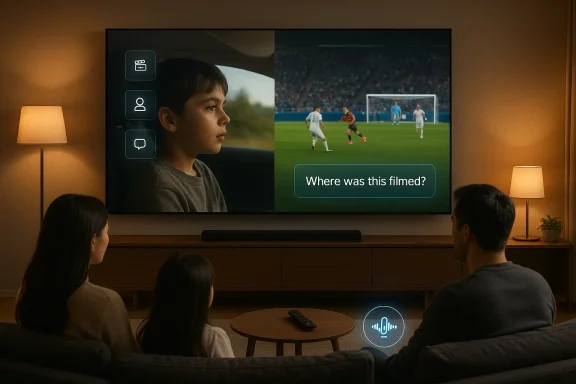
The headline feature is Vision AI Companion, Samsung’s integrated AI interface for TVs. In practical terms, it is meant to let viewers ask questions about what they are watching, receive contextual answers, and move between entertainment and information without leaving the screen. Samsung says that if someone asks, “Where was this movie filmed?” or asks for a sports record while watching, the system can answer in context. That is not a trivial UX tweak; it is an attempt to replace the old “search on your phone later” behavior with an always-available conversational layer built into the display itself.
The company is also using the launch to deepen its hardware segmentation. The 2026 lineup spans Micro RGB, OLED, Neo QLED, Mini LED, and UHD ranges, plus lifestyle products such as The Frame Pro, The Frame, and The Movingstyle. Samsung is clearly trying to make AI a common software thread while preserving distinct hardware identities for cinephiles, gamers, décor-minded buyers, and buyers who simply want a large screen with modern intelligence. That is a more mature strategy than treating AI as a one-model marketing gimmick.
The broader significance is that Samsung is competing not just on panel quality, but on ownership of the interface. The television has long been the most centralized device in the home, yet most smart TV platforms still feel passive. Samsung’s new pitch is more ambitious: the TV should become an active companion, a recommendation layer, and a natural-language gateway to both content and services. In a market where AI features are multiplying quickly, the companies that can make those features feel ordinary may end up with the strongest long-term advantage.
The 2026 launch continues that arc by making AI a cross-category feature. Samsung is not limiting conversational intelligence to a flagship panel or a single region. Instead, it is extending AI capabilities across existing high-end lines and into more mainstream products such as Mini LED and UHD TVs. That is strategically important because it normalizes AI as part of the base TV purchase rather than an upsell reserved for the most expensive models.
Another reason the launch stands out is that TVs are one of the few consumer devices still used collectively rather than individually. Phones are private, laptops are personal, but televisions are usually shared by a household. That makes the TV a particularly interesting proving ground for ambient AI, because the assistant has to work in a messy, social environment with multiple viewers, different intent levels, and frequent interruptions. If Samsung can make AI useful there, it can probably make it useful almost anywhere. That is the real prize.
The event also showed Samsung’s willingness to stretch the meaning of “TV” beyond a rectangle on the wall. Alongside the core lineup, it introduced or expanded products such as The Frame Pro, The Movingstyle, and new audio gear including Music Studio speakers and Q-series soundbars. That broader ecosystem is important because AI works better when it spans multiple devices, and Samsung is clearly trying to turn the television into the center of a connected home stack rather than an isolated screen.
This is also where Samsung’s choice of the word companion matters. The company is not framing the feature as a search bar with voice support. It is framing it as a helper that sits close to the user and adapts to routines. That positioning is much closer to how mobile AI is being sold today, and it reflects a broader industry move toward relational language rather than purely technical descriptors. The branding is intentional.
The likely appeal is strongest for casual viewers who want quick answers, sports fans who want live context, and households that already use voice assistants for basic control. The challenge is whether those use cases are frequent enough to become habit-forming. A feature can be impressive in a demo and still fade if it does not materially save time or reduce friction in everyday viewing. That is the hardest test Samsung now faces.
There is also a strategic hedge at work. AI platforms are changing quickly, and partnerships can shift as user preferences and commercial terms evolve. By keeping the TV open to multiple assistants, Samsung avoids overcommitting to one vendor and gives itself room to adapt if usage patterns change. In other words, the company is building a portfolio strategy around AI rather than a one-bet strategy.
Still, there is a tradeoff. Too many assistants can create confusion about which one to use, what each one is best at, and how data flows between them. Consumers may appreciate choice in theory but default to whichever option is easiest to activate. The success of this strategy will depend on whether Samsung hides complexity well enough that the user experiences choice without friction. That is easier said than done.
Samsung also introduced a 115-inch Micro RGB TV at the event, underscoring its desire to keep the premium narrative alive at the very top of the range. Large-format TVs are not just about size; they are about signaling technological leadership, especially when paired with AI messaging and luxury pricing. The bigger the screen, the easier it is to sell the idea that the TV is the centerpiece of a smart home.
At the same time, the company is carefully extending AI and display innovation into products with broader reach. The new Mini LED lineup, for example, gives Samsung a middle-ground option for consumers who want premium features without jumping all the way to OLED or Micro RGB pricing. That tiering is critical because it lets Samsung cast a wider net while preserving the exclusivity of its flagship models. Tiered premium is still premium.
The Movingstyle expansion is equally interesting. Portable and flexible screens appeal to households that do not want a fixed living-room topology. By stretching The Movingstyle up to 85 inches, Samsung is blurring the boundary between portability and home theater scale. That is a bold move, even if the actual use cases will remain relatively specialized.
These lifestyle products also help Samsung compete on taste rather than just specs. Rivals can match brightness, panel technology, and even AI features over time, but aesthetic identity is harder to clone. Samsung knows that a TV can be a décor decision as much as a technology decision, and The Frame family remains one of the clearest expressions of that insight.
Sound control is similarly important because many households experience TV frustration through audio more than picture. Dialogue is too quiet, crowd noise is too loud, or the room acoustics are not ideal. If Samsung can make sound tuning feel automatic and intelligible, it can remove one of the biggest hidden pain points in television ownership. That is a very consumer-friendly use of AI.
The broader implication is that Samsung is trying to sell a whole viewing experience rather than a pile of features. That matters in a market where technical specifications increasingly look similar on paper. The brands that win will be the ones that can turn those specs into a simpler daily experience for actual households. Samsung clearly wants that role.
For consumers, the upside is choice. Buyers can choose between an art-first screen, a giant premium display, or a more mainstream Mini LED model without leaving the Samsung ecosystem. For enterprise and design-conscious buyers, products like The Frame and The Movingstyle could also have commercial appeal in hospitality, luxury apartments, showrooms, and premium offices. That said, this remains a consumer-led launch, not an enterprise-first hardware strategy.
The risk, of course, is that AI becomes just another premium justification rather than a decisive reason to buy. If consumers do not feel a meaningful improvement in daily use, the feature may not support the pricing narrative for long. Samsung is betting that an AI companion plus elite panel quality plus design-first products is a stronger bundle than any single category competitor can offer. That is a reasonable bet, but it is still a bet.
This also makes Samsung’s TV strategy look more like its broader device ecosystem strategy. The company has been expanding AI partnerships across mobile and other device categories, which suggests a shared platform logic underneath the product launches. The more Samsung can unify AI behavior across phones, TVs, and home devices, the harder it becomes for rivals to offer a similarly connected experience without matching the whole stack.
The largest unanswered question is whether consumers actually want their TV to become a multi-assistant AI hub. Many will want a better picture, cleaner sound, and easier setup more than they want a chatty screen. If Samsung gets the balance right, it could define the next phase of TV evolution. If it gets it wrong, the company risks loading the product with features that look impressive but rarely get used.
It will also be worth tracking how widely the AI features roll across the lineup and whether Samsung keeps them coherent across regions, price points, and hardware families. If the company can maintain consistency across premium and mainstream models, that would be a strong sign that AI is truly becoming a platform layer rather than a flagship novelty. The television market has seen many “smart” promises over the years; the difference this time is that Samsung is trying to make smart feel conversational, contextual, and permanent.
What to watch next:
Source: 매일경제 "Where Was This Movie Filmed?" Samsung Electronics Packs Record Number of AI Platforms Into New TVs - MK
 Overview
Samsung’s 2026 television strategy is best understood as the convergence of three trends: AI becoming a consumer expectation, premium TVs becoming platform products, and the living room turning into a shared screen for search, entertainment, and household control. The company’s pitch is that a TV should do more than display content; it should help interpret it, enrich it, and respond to it in context. Samsung’s own event framing called this “Your Companion to AI Living,” and the product roadmap reflects that ambition across multiple tiers.The headline feature is Vision AI Companion, Samsung’s integrated AI interface for TVs. In practical terms, it is meant to let viewers ask questions about what they are watching, receive contextual answers, and move between entertainment and information without leaving the screen. Samsung says that if someone asks, “Where was this movie filmed?” or asks for a sports record while watching, the system can answer in context. That is not a trivial UX tweak; it is an attempt to replace the old “search on your phone later” behavior with an always-available conversational layer built into the display itself.
The company is also using the launch to deepen its hardware segmentation. The 2026 lineup spans Micro RGB, OLED, Neo QLED, Mini LED, and UHD ranges, plus lifestyle products such as The Frame Pro, The Frame, and The Movingstyle. Samsung is clearly trying to make AI a common software thread while preserving distinct hardware identities for cinephiles, gamers, décor-minded buyers, and buyers who simply want a large screen with modern intelligence. That is a more mature strategy than treating AI as a one-model marketing gimmick.
The broader significance is that Samsung is competing not just on panel quality, but on ownership of the interface. The television has long been the most centralized device in the home, yet most smart TV platforms still feel passive. Samsung’s new pitch is more ambitious: the TV should become an active companion, a recommendation layer, and a natural-language gateway to both content and services. In a market where AI features are multiplying quickly, the companies that can make those features feel ordinary may end up with the strongest long-term advantage.
Background
Samsung has spent years turning TVs into more than just display panels. The company’s strategy has increasingly centered on software, ecosystems, and differentiated form factors, especially in premium segments where raw image quality alone is no longer enough to guarantee premium pricing. That shift accelerated as competitors improved their own panels and as buyers became more willing to compare TVs as platforms rather than appliances.The 2026 launch continues that arc by making AI a cross-category feature. Samsung is not limiting conversational intelligence to a flagship panel or a single region. Instead, it is extending AI capabilities across existing high-end lines and into more mainstream products such as Mini LED and UHD TVs. That is strategically important because it normalizes AI as part of the base TV purchase rather than an upsell reserved for the most expensive models.
Why this matters now
The timing is also notable. AI assistants have been moving from novelty to utility across phones, PCs, and search products, and Samsung is now trying to carry that momentum into TV. On the mobile side, Samsung has already signaled a multi-agent future with Bixby, Perplexity, and other AI partners, so the TV rollout looks like part of a broader company-wide platform alignment rather than a standalone experiment. That consistency matters because users increasingly expect the same assistant logic across devices.Another reason the launch stands out is that TVs are one of the few consumer devices still used collectively rather than individually. Phones are private, laptops are personal, but televisions are usually shared by a household. That makes the TV a particularly interesting proving ground for ambient AI, because the assistant has to work in a messy, social environment with multiple viewers, different intent levels, and frequent interruptions. If Samsung can make AI useful there, it can probably make it useful almost anywhere. That is the real prize.
The event also showed Samsung’s willingness to stretch the meaning of “TV” beyond a rectangle on the wall. Alongside the core lineup, it introduced or expanded products such as The Frame Pro, The Movingstyle, and new audio gear including Music Studio speakers and Q-series soundbars. That broader ecosystem is important because AI works better when it spans multiple devices, and Samsung is clearly trying to turn the television into the center of a connected home stack rather than an isolated screen.
Vision AI Companion
Samsung’s Vision AI Companion is the most important software message in the entire launch. It is the company’s attempt to create a TV-specific AI layer that understands what is on screen, what the viewer is asking, and how to keep the interaction grounded in the moment. That contextual focus is the difference between a gimmick and a genuine interface shift.A TV assistant with context
The examples Samsung uses are telling. A viewer can ask where a film was shot, or ask about a team record while a sports match is on, and the TV should answer without forcing the user to leave the content. That kind of interaction is powerful because it preserves attention. Instead of interrupting the experience, the assistant becomes a layer on top of it. Samsung is effectively saying that the TV should understand the topic of the room in real time.This is also where Samsung’s choice of the word companion matters. The company is not framing the feature as a search bar with voice support. It is framing it as a helper that sits close to the user and adapts to routines. That positioning is much closer to how mobile AI is being sold today, and it reflects a broader industry move toward relational language rather than purely technical descriptors. The branding is intentional.
The likely appeal is strongest for casual viewers who want quick answers, sports fans who want live context, and households that already use voice assistants for basic control. The challenge is whether those use cases are frequent enough to become habit-forming. A feature can be impressive in a demo and still fade if it does not materially save time or reduce friction in everyday viewing. That is the hardest test Samsung now faces.
- It lowers the barrier between watching and searching.
- It keeps the user on the same screen.
- It makes the TV feel interactive, not passive.
- It depends on fast, accurate contextual understanding.
- It will be judged on daily usefulness, not launch-day novelty.
Multi-AI Platform Strategy
Samsung says its 2026 TVs offer the industry’s largest selection of AI service platforms, including Bixby, Perplexity AI, and Microsoft Copilot. That is a significant statement because it moves the company away from the one-assistant model and toward a choice-based ecosystem. Instead of forcing a single AI personality onto every task, Samsung is presenting the TV as a gateway to multiple AI strengths.Why multiple assistants could matter
A multi-assistant model has obvious advantages. A user might want Bixby for device control, Copilot for general productivity-style queries, and Perplexity for answer-oriented search. In theory, this gives the television a more flexible intelligence layer and reduces the odds that one assistant’s weaknesses define the whole experience. That is a smart move in a market where no single assistant is clearly best at everything.There is also a strategic hedge at work. AI platforms are changing quickly, and partnerships can shift as user preferences and commercial terms evolve. By keeping the TV open to multiple assistants, Samsung avoids overcommitting to one vendor and gives itself room to adapt if usage patterns change. In other words, the company is building a portfolio strategy around AI rather than a one-bet strategy.
Still, there is a tradeoff. Too many assistants can create confusion about which one to use, what each one is best at, and how data flows between them. Consumers may appreciate choice in theory but default to whichever option is easiest to activate. The success of this strategy will depend on whether Samsung hides complexity well enough that the user experiences choice without friction. That is easier said than done.
- Bixby likely remains the control layer.
- Perplexity may appeal to conversational search.
- Copilot may widen the productivity and discovery angle.
- Multiple AI options create flexibility but also complexity.
- Samsung will need strong interface design to prevent assistant fatigue.
Hardware Expansion Across the Lineup
Samsung is pairing its software pitch with a broad hardware refresh. The company’s 2026 range includes premium TV families such as Micro RGB, OLED, and Neo QLED, while also bringing AI capabilities into new Mini LED and UHD models. That is important because it means AI is no longer being framed as a premium-only badge; it is becoming a baseline expectation across the portfolio.Premium and mid-range are converging
This kind of convergence matters for market perception. When a brand gives even its mid-range models meaningful AI features, it raises the floor for what consumers consider “smart” enough. Competitors then have to decide whether to match Samsung feature-for-feature or differentiate on panel quality, software polish, or price. That competitive pressure is exactly how platform features become industry standards.Samsung also introduced a 115-inch Micro RGB TV at the event, underscoring its desire to keep the premium narrative alive at the very top of the range. Large-format TVs are not just about size; they are about signaling technological leadership, especially when paired with AI messaging and luxury pricing. The bigger the screen, the easier it is to sell the idea that the TV is the centerpiece of a smart home.
At the same time, the company is carefully extending AI and display innovation into products with broader reach. The new Mini LED lineup, for example, gives Samsung a middle-ground option for consumers who want premium features without jumping all the way to OLED or Micro RGB pricing. That tiering is critical because it lets Samsung cast a wider net while preserving the exclusivity of its flagship models. Tiered premium is still premium.
The Frame, The Movingstyle, and Lifestyle TV
Samsung’s lifestyle TV category remains one of its best differentiators, and the 2026 changes reinforce that position. The company added a 98-inch model to The Frame art TV lineup and expanded The Movingstyle range, which now goes up to 85 inches from its previous 27-to-55-inch span. That expansion is more than a spec update; it is a statement that design-first screens are no longer limited to small or medium rooms.Art, décor, and display
The Frame continues to occupy a unique position in the market because it sells itself partly as a decorative object. Samsung understands that for many buyers, the emotional value of a TV is tied to how it looks when it is not in use. Adding a larger 98-inch model broadens The Frame’s reach into more ambitious home installations, and it makes the product feel less like a niche curiosity and more like a mature category.The Movingstyle expansion is equally interesting. Portable and flexible screens appeal to households that do not want a fixed living-room topology. By stretching The Movingstyle up to 85 inches, Samsung is blurring the boundary between portability and home theater scale. That is a bold move, even if the actual use cases will remain relatively specialized.
These lifestyle products also help Samsung compete on taste rather than just specs. Rivals can match brightness, panel technology, and even AI features over time, but aesthetic identity is harder to clone. Samsung knows that a TV can be a décor decision as much as a technology decision, and The Frame family remains one of the clearest expressions of that insight.
- The Frame is as much about interior design as display performance.
- The 98-inch model pushes lifestyle TV into larger spaces.
- The Movingstyle’s growth suggests more flexible home-screen use.
- Samsung is using design to defend premium pricing.
- Lifestyle screens help broaden the brand beyond cinephiles and gamers.
Entertainment Features and Living-Room Utility
Samsung is not relying on AI alone to sell the 2026 lineup. The company also highlighted entertainment-oriented features such as AI Soccer Mode Pro and AI Sound Control Pro, signaling that the AI layer is meant to improve playback, not just answer questions. That distinction matters because many TV buyers will judge the product by image and audio enhancements before they ever test a conversational feature.Making the picture smarter
AI-enhanced sports modes are a logical place for Samsung to invest because sports viewing is time-sensitive, emotionally charged, and highly sensitive to motion, brightness, and sound balancing. If the AI can make soccer look more dynamic and more legible in real rooms, the feature can earn genuine everyday loyalty. This is where AI can feel less abstract and more like a practical improvement.Sound control is similarly important because many households experience TV frustration through audio more than picture. Dialogue is too quiet, crowd noise is too loud, or the room acoustics are not ideal. If Samsung can make sound tuning feel automatic and intelligible, it can remove one of the biggest hidden pain points in television ownership. That is a very consumer-friendly use of AI.
The broader implication is that Samsung is trying to sell a whole viewing experience rather than a pile of features. That matters in a market where technical specifications increasingly look similar on paper. The brands that win will be the ones that can turn those specs into a simpler daily experience for actual households. Samsung clearly wants that role.
Pricing and Market Positioning
Samsung’s pricing strategy shows that it is staying firmly in the premium lane. The company listed an 85-inch RH95 Micro RGB model at 9.29 million won, while the 85-inch MH80 Mini LED model was listed at 3.39 million won. Those figures tell a story of deliberate segmentation: Samsung is using AI to justify a premium experience, but it is still maintaining distinct price ladders for different levels of ambition.Premium without collapsing the ladder
This approach is smart because it protects Samsung from internal cannibalization. A sharply tiered lineup gives the company room to address different buyer budgets without making the flagship feel redundant. It also helps Samsung keep the top end aspirational, which is essential when the TV market depends as much on status as on technology.For consumers, the upside is choice. Buyers can choose between an art-first screen, a giant premium display, or a more mainstream Mini LED model without leaving the Samsung ecosystem. For enterprise and design-conscious buyers, products like The Frame and The Movingstyle could also have commercial appeal in hospitality, luxury apartments, showrooms, and premium offices. That said, this remains a consumer-led launch, not an enterprise-first hardware strategy.
The risk, of course, is that AI becomes just another premium justification rather than a decisive reason to buy. If consumers do not feel a meaningful improvement in daily use, the feature may not support the pricing narrative for long. Samsung is betting that an AI companion plus elite panel quality plus design-first products is a stronger bundle than any single category competitor can offer. That is a reasonable bet, but it is still a bet.
- Premium pricing keeps the lineup aspirational.
- Tiering helps Samsung avoid cannibalizing its own models.
- AI is being used as part of a broader value bundle.
- The Frame and Movingstyle target lifestyle buyers.
- Mid-range AI features help normalize the category.
Competitive Implications
Samsung’s move puts pressure on every major TV rival, but especially on brands that have treated AI as a thin layer rather than a core product principle. If Samsung can make conversational viewing and contextual search work well, competitors will need to answer with either stronger AI, simpler interfaces, or sharper value pricing. In a mature category, small shifts in software usefulness can create outsized marketing leverage.The race is no longer only about panels
For years, TV competition was mostly about contrast ratios, refresh rates, HDR formats, and bezel design. Those still matter, but Samsung is broadening the battlefield to include assistants, ecosystem integration, and content-related convenience. That is especially disruptive because software-based differentiation can be updated faster than hardware. It changes the cadence of competition.This also makes Samsung’s TV strategy look more like its broader device ecosystem strategy. The company has been expanding AI partnerships across mobile and other device categories, which suggests a shared platform logic underneath the product launches. The more Samsung can unify AI behavior across phones, TVs, and home devices, the harder it becomes for rivals to offer a similarly connected experience without matching the whole stack.
The largest unanswered question is whether consumers actually want their TV to become a multi-assistant AI hub. Many will want a better picture, cleaner sound, and easier setup more than they want a chatty screen. If Samsung gets the balance right, it could define the next phase of TV evolution. If it gets it wrong, the company risks loading the product with features that look impressive but rarely get used.
Strengths and Opportunities
Samsung’s 2026 TV push has real strategic strength because it connects hardware, software, and lifestyle identity into one narrative. It is not simply adding AI for the sake of a press release; it is trying to make AI feel like the organizing principle of the TV experience. That gives the company multiple ways to win different customers, from cinephiles to sports viewers to design-first buyers.- Vision AI Companion gives Samsung a TV-specific AI story.
- Bixby, Perplexity AI, and Microsoft Copilot broaden user choice.
- The lineup spans premium and mid-range categories.
- The Frame and The Movingstyle extend Samsung’s design leadership.
- AI sports and sound features add everyday utility.
- The premium tier remains aspirational and well segmented.
- The ecosystem approach strengthens long-term platform loyalty.
Risks and Concerns
Samsung’s biggest challenge is execution. AI in a television has to be fast, accurate, and easy enough that people actually use it while watching something else. If the assistant is slow, confusing, or inconsistent, the feature could end up as a marketing line rather than a daily habit. There is also a real risk that Samsung is stacking too many initiatives onto one product category.- Too many AI options could create interface clutter.
- Some buyers may see AI as optional rather than essential.
- Premium pricing may narrow adoption outside affluent households.
- Feature overload could dilute the product message.
- Lifestyle products may be admired more than widely purchased.
- Voice interactions in shared living rooms can be awkward.
- Competitors could copy the language faster than the experience.
Looking Ahead
The next thing to watch is whether Samsung can make Vision AI Companion feel indispensable rather than merely clever. If the company succeeds, TV search could become more conversational, sports viewing more responsive, and streaming navigation much less fragmented. That would be a meaningful step toward making the television the home’s most intelligent shared screen.It will also be worth tracking how widely the AI features roll across the lineup and whether Samsung keeps them coherent across regions, price points, and hardware families. If the company can maintain consistency across premium and mainstream models, that would be a strong sign that AI is truly becoming a platform layer rather than a flagship novelty. The television market has seen many “smart” promises over the years; the difference this time is that Samsung is trying to make smart feel conversational, contextual, and permanent.
What to watch next:
- Whether Vision AI Companion becomes a default habit in households.
- How well Samsung balances Bixby, Perplexity AI, and Copilot.
- Whether AI features spread cleanly across Mini LED and UHD sets.
- How rivals respond with their own TV assistant strategies.
- Whether The Frame and The Movingstyle expand beyond niche lifestyle demand.
Source: 매일경제 "Where Was This Movie Filmed?" Samsung Electronics Packs Record Number of AI Platforms Into New TVs - MK
Last edited:
