

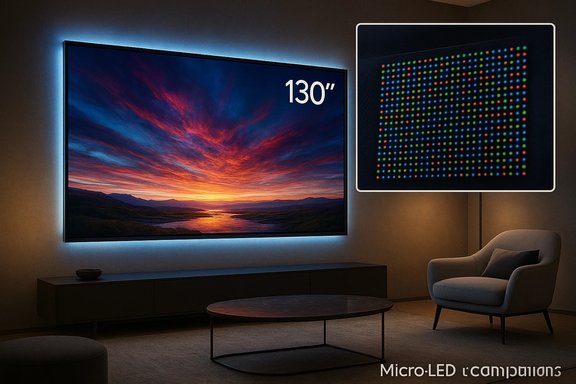
Samsung’s CES 2026 reveal is a statement: a 130‑inch Micro RGB flagship, a seriously upgraded OLED family with gaming‑first features, a new generation of QD‑OLED panels hitting unprecedented peak brightness, and an Odyssey monitor lineup that pushes refresh rates into territory previously reserved for research labs and esports arenas.
Background / Overview
Samsung used its “First Look” and CES showroom to present a multi‑pronged strategy for 2026: push display technology forward at the extremes of size and brightness, fold AI deeper into the TV experience, and give gamers and creators practical, high‑refresh hardware. The announcements fall into three clear streams:- Micro RGB — a new premium LCD-derived family that uses sub‑100µm RGB light sources to achieve wider gamut, finer dimming and much higher peak luminance than traditional LED TVs.
- OLED/QD‑OLED — refreshed QD‑OLED and QD‑OLED‑adjacent models with higher brightness, anti‑glare coatings, and gaming‑oriented refresh‑rate options.
- Odyssey gaming monitors — experimental, high‑refresh panels (including glasses‑free 3D and multi‑hundred‑Hz modes) designed to reclaim the bleeding edge for PC esports and pro gamers.
The 130‑inch Micro RGB R95H: what Samsung showed, and what it means
Samsung’s headline for CES 2026 is the R95H — the company’s first 130‑inch Micro RGB TV. It’s a deliberately theatrical product: huge, framed with Samsung’s “Timeless Frame” design language, and intended as a one‑box statement that marries ambitious picture specs with a gallery‑style aesthetic.Key hardware and image claims
- Micro RGB Precision Color 100 — Samsung positions the R95H as capable of delivering 100% of the BT.2020 wide color gamut, enabled by sub‑100µm red, green and blue LEDs and extremely fine dimming control.
- VDE certification — Samsung says the Micro RGB Precision Color 100 implementation is verified by the Verband der Elektrotechnik (VDE), a widely‑recognized European test lab.
- Micro RGB AI Engine Pro, Color Booster Pro, HDR Pro — an on‑device AI pipeline for per‑frame tuning: lift shadow detail, control highlights, and optimize contrast dynamically.
- Glare Free coating — an anti‑reflection surface intended to preserve perceived contrast on such a scale.
- HDR10+ Advanced and Eclipsa Audio — Samsung’s new HDR iteration and a spatial audio system are both called out for the R95H.
- Vision AI Companion — the expanded on‑TV AI assistant that offers conversational search, generative wallpapers, live translate, and integrations with services like Microsoft Copilot and Perplexity (availability varies by region).
Why the 130‑inch experiment matters
A 130‑inch TV changes the rules in two ways. First, scale: at that size viewers sit closer, meaning pixel density and color fidelity are tested much more severely than with conventional living‑room sets. Achieving clean highlights, accurate skin tones and consistent shadow detail across that canvas is harder than for smaller TVs. Samsung’s Micro RGB approach — independent RGB LEDs with micro‑dimming — is explicitly targeted at that problem.Second, design: the Timeless Frame and integrated audio inside the panel’s frame are an attempt to reposition extreme displays as architectural pieces rather than appliances. This plays to an affluent, design‑first buyer who wants a “feature wall” that behaves like a window to content.
Practical realities and caveats
- Installation: a 130‑inch screen is a structural and logistical challenge. Wall and mount specifications, room sightlines, and acoustic treatment matter far more than they do for a 55‑ or 65‑inch set.
- Content and scaling: nearly all native broadcast and streaming content is produced for much smaller screens. Upscaling and motion handling will be crucial, but even the best processing can’t create new native detail where none exists.
- Price and availability: Samsung has not published MSRP or broad availability details. Historically, Samsung’s largest, most advanced display models command price and distribution constraints that put them in a premium, limited‑run category.
- Power and heat: high peak luminance often increases power draw and thermal load. Buyers should expect more demanding installation requirements and possibly higher electricity use compared with smaller OLEDs or mid‑range QLEDs.
OLED and QD‑OLED for 2026: S95H, S90H, and the peak‑brightness leap
Samsung’s OLED lineup for 2026 gets a design refresh and clearer differentiation between the S‑series tiers. The flagship S95H joins the family with modest design updates; more importantly, Samsung Display’s new QD‑OLED panels promise much higher peak brightness than prior generations.S95H and family: what Samsung describes
- S95H — the top QD‑OLED model with updated metal framing, zero‑gap wall mount options, and a wireless Zero Connect box option (wireless connections for external boxes). Samsung says S95H models will include HDR10+ Advanced support and Eclipsa Audio.
- S90H — the midrange OLED gains the OLED Glare Free anti‑reflection tech previously limited to flagship models. Samsung and reviewers cite support for 4K 165Hz and adaptive sync (G‑Sync/FreeSync) in certain S‑series models.
- S85H — the entry series expands into a 48‑inch SKU this year, bringing Samsung into a size segment popular with PC gamers and small‑room owners.
The QD‑OLED brightness story (up to 4,500 nits)
Samsung Display has showcased a new fourth‑generation QD‑OLED TV panel capable of extremely high peak luminance — claims as high as 4,000 to 4,500 nits have been publicized for select prototype panels. That’s a meaningful technical milestone: self‑emissive panels historically struggled to match mini‑LED and LCD peak luminance, but QD‑OLED’s RGB sub‑pixel architecture combined with new organic materials and panel driving methods appears to push maximum short‑term peaks substantially higher.Important nuance: Samsung Display’s panel peak figures are laboratory peak luminance numbers. In real TV products, panel brightness is influenced by TV electronics, thermal limits, power management and frame‑averaging rules. Expect commercial sets to quote more conservative sustained or APL‑weighted brightness numbers. High peak nits are excellent for spec‑sheet comparisons and HDR highlights, but sustained HDR performance and tone mapping behavior determine real‑world HDR experience.
Gaming: the 165Hz battleground
Samsung’s newer OLED and high‑end QD‑OLED models are being positioned for gaming at higher than 120Hz, with several mid and flagship models calling out support for 4K 165Hz and hardware compatibility with AMD/NVIDIA adaptive sync technologies.How that works in practice:
- 165Hz at 4K is primarily a PC feature today; current consoles (PlayStation, Xbox) typically cap at 4K/120Hz for native HDR gaming. PC GPUs with HDMI/DisplayPort and the right cables can drive higher refresh rates.
- HDMI bandwidth and Display Stream Compression (DSC) matter. Running 4K at 165Hz with full 10‑bit color and 4:4:4 chroma often needs DSC or relaxed color/chroma settings. Implementation differences between TVs can affect whether you get full HDR color at those frequencies.
- For console gamers, the 165Hz spec is less immediately useful — it’s an important future‑proofing feature and a big win for high‑end PC gamers.
HDR10+ Advanced and the platform wars
Samsung’s software strategy for 2026 is more than cosmetics. The company is doubling down on an evolved HDR format — HDR10+ Advanced — positioned as a counterweight to Dolby Vision 2. HDR10+ Advanced is explicitly designed to handle the new high‑peak brightness panels and adds multiple capabilities:- brightness‑aware tone mapping up to 4,000–5,000 nits,
- genre‑based picture profiles,
- motion handling improvements,
- cloud gaming optimizations,
- and finer local tone‑mapping controls.
- Content availability will drive perceived benefit. HDR10+ Advanced needs content providers and game developers to produce compatible metadata layers; initial partners are likely but broad adoption will take time.
- Consumers who prioritize Dolby Vision native support (widely used in many streaming titles) will need to be aware of Samsung’s stance and cross‑platform HDR behaviors.
Vision AI Companion, Tizen / One UI and the 7‑year update promise
Samsung is folding a collection of AI features under a Vision AI Companion umbrella that combines natural language, generative features and LLM integrations. The platform enables:- conversational search and recommendations,
- live translate and on‑screen translation aids,
- generative wallpapers and dynamic UI elements,
- dedicated AI modes for sports (AI Football Mode Pro) and audio (AI Sound Controller Pro).
- integrations with Microsoft Copilot and Perplexity (availability varies by region and model).
- Seven years of upgrades — Samsung commits to multi‑year software updates for many 2026 TVs, extending the “longer support” trend that already exists on Samsung phones and appliances. That’s a meaningful shift for TV longevity and security.
- Privacy and unknowns — deeper LLM and cloud features raise reasonable questions about data collection, voice processing, and model validation. Samsung advertises internal review and red‑team checks for models, but buyers should review regional privacy settings and opt‑outs once final firmware and privacy policies land.
Odyssey monitors and the extreme refresh race
If the 130‑inch TV is Samsung making a design statement, the Odyssey monitor family is the company making a technical flex. The 2026 Odyssey lineup contains several radical displays:- a 32‑inch 6K glasses‑free 3D monitor with real‑time eye tracking (Dual Mode: 6K/165Hz and 3K/330Hz),
- a 27‑inch model that supports dual‑mode 1440p @ 500Hz / 1080p @ 1000Hz in some vendor implementations,
- a G6 that claims a dual‑mode approach up to 1,040Hz in specific reduced‑resolution configurations,
- QD‑OLED and high‑refresh 4K OLED variants hitting 240Hz and beyond.
- Competitive edge: esports and pro gamers who prioritize motion clarity and low input lag will be thrilled by native ultra‑high refresh hardware.
- New workflows: creators who game and work on the same machine benefit from multi‑mode monitors that balance resolution and refresh as needed.
- Bandwidth and cabling: delivering these refresh rates requires modern ports (DisplayPort 2.x, HDMI FRL + DSC), certified cables, and GPUs that support the target modes.
Strengths: where Samsung genuinely pushed the envelope
- Color gamut and precision — claiming VDE‑verified BT.2020 coverage in Micro RGB is a strong signal aimed at color‑critical workflows and cinema‑grade reproduction.
- Peak brightness advancement — Samsung Display’s QD‑OLED panels hitting multiple thousands of nits change HDR possibilities for self‑emissive displays.
- AI processing for practical gaps — Micro RGB AI Engine Pro and HDR10+ Advanced signal that Samsung is aware of the limits of raw hardware and is investing in software layers to maximize image fidelity.
- Longer software support — seven‑year update promises plus an expanded One UI/Tizen experience make these TVs more future‑proof from a software perspective.
- Breadth of product choices — from a 48‑inch OLED gamer’s TV to a 130‑inch living‑room canvas and ultraspecialized monitors, Samsung’s portfolio addresses multiple buyer personas.
Risks, unresolved questions and buyer cautions
- Spec inflation vs real‑world results — laboratory peak nits and 100% gamut claims are compelling, but real viewing experiences depend on sustained brightness, tone mapping, power limits and factory calibration.
- Price, distribution and service — ultra‑large sets and advanced QD‑OLEDs will carry high MSRPs and possibly limited initial availability. Installation, calibration and warranty logistics matter a lot at the top end.
- HDR format fragmentation — Samsung is doubling down on HDR10+ Advanced while bypassing Dolby Vision. That may produce uneven HDR experiences across streaming services and movie titles in the near term.
- Gaming ecosystem mismatch — 165Hz at 4K is an appealing spec for PC gamers, but the HDMI/DSC and GPU ecosystem complexity means many buyers will need to research cables, drivers and possible color compromises.
- Burn‑in concerns for OLED — although QD‑OLED and Samsung’s engineering mitigate some retention risks, self‑emissive tech still requires user care and firmware safeguards for prolonged static UI elements.
- AI trust and privacy — Vision AI Companion and LLM integrations open the door to convenience and functionality, but also to data‑handling and hallucination risks. Clear, audited privacy policies and on‑device processing options would reduce concern.
Buyer guidance: who should care and what to check before buying
If you’re considering any of Samsung’s 2026 TVs or Odyssey monitors, here are practical steps to take:- Confirm the exact model number and specs at retail, not just headlines — refresh rates, port counts, and HDR format support vary by SKU.
- If you plan to use 4K@165Hz, verify cable type, GPU support, and whether the TV requires DSC or sacrifices color depth/chroma to reach that mode.
- For ultra‑large Micro RGB installations, consult an AV installer and confirm wall/mounting specs and electrical/ventilation requirements.
- If HDR fidelity matters, plan on professional calibration or wait for trusted lab reviews that measure sustained HDR performance and tone mapping.
- For AI features, research privacy settings and whether voice and cloud features have on‑device fallbacks or user controls.
The competitive landscape and market implications
Samsung’s 2026 line is a direct challenge to multiple rivals:- LG and Hisense are moving into RGB / Micro RGB segments with competing micro‑LED / RGB mini‑LED products; the space is becoming a two‑horse (or more) race focused on brightness and gamut rather than pure OLED black levels.
- Sony and other premium brands will argue for color fidelity and creative intent with Dolby Vision workflows, so the HDR format split is not only technical but also commercial.
- Monitor brands and PC‑centric panel makers (BenQ, ASUS, Acer) will respond to the Odyssey play with their own dual‑mode and high‑Hz products; competition will quickly determine which refresh‑rate war items become useful and which remain niche curiosities.
Conclusion
Samsung’s CES 2026 slate is bold and unapologetically ambitious. The 130‑inch Micro RGB R95H is less a mass‑market product than a showcase of what Samsung hopes mainstream products will inherit: extreme color coverage, meticulous dimming, high peak brightness capacity and AI‑assisted image fidelity. The S‑series OLED refresh and the 4,000–4,500 nit QD‑OLED panels point to a genuine shift in self‑emissive panel capability, and the Odyssey monitors push the frontier for competitive gaming.That said, buyers should temper excitement with scrutiny. Laboratory peak numbers and marketing names don’t automatically equate to superior day‑to‑day viewing. The ecosystem complexity — HDR formats, HDMI/DSC trade‑offs, software features and privacy behaviors — means the real test will come when units land in reviewers’ labs and real homes. For those with deep pockets and a desire for the “best now,” Samsung’s top tier will likely deliver headline‑making visuals. For mainstream buyers, the practical advice remains timeless: confirm the exact model’s measured performance, understand connectivity requirements for your primary use (console vs PC), and factor in installation and long‑term support before committing.
Samsung has staked a clear claim: displays are entering a new cycle where brightness, color volume, AI and refresh flexibility define the conversation. The 2026 lineup makes that future visible — and, in many ways, harder to ignore.
Source: Wccftech Samsung Unveils Massive 130-Inch Micro RGB TV, New Gaming QLEDs, OLEDs Including 48" S95H With 165Hz Refresh Rate
